The Lost Girls interview, war, and its relationship to sex

In the Lost Girls interview I linked to recently, one thing that Alan Moore says stands out as resolutely wrong:

War, I still believe, is a complete and utter failure of the imagination. It’s when everything else has been abandoned or hasn’t worked. It’s what destroys the imagination. It set back the progress of the human imagination.

It’s true that war “set[s] back the progress of the human imagination,” but war is actually about resource control, with “resources” defined broadly. Resources may be primarily geographic (one thinks of the recent U.S. invasions of Iraq and Afghanistan) or they may be about commodities (one thinks of Japan capturing oil fields in World War II) or they may be people themselves (one thinks of innumerable pre-modern religious wars). They are also often sexual, or have a sexual tinge, which Moore and Gebbie do get right in Lost Girls and foreground, since sexual behaviors and motives tend to be glossed or ignored in most histories.

There are exceptions, however; consider, for example, this passage from Savage Continent: Europe in the Aftermath of World War II:

The number of sexual relationships that took place between European women and Germans during the war is quite staggering. In Norway as many as 10 per cent of women aged between fifteen and thirty had German boyfriends during the war. If the statistics on the number of children born to German soldiers are anything to go by, this was by no means unusual: the numbers of women who slept with German men across western Europe can easily be numbered in the hundreds of thousands.

Resistance movements in occupied countries came up with all kinds of excuses for the behaviour of their women and girls. They characterized women who slept with Germans as ignorant, poor, even mentally defective. They claimed that women were raped, or that they slept with Germans out of economic necessity. While this was undoubtedly the case for some, recent surveys show that women who slept with German soldiers came from all classes and all walks of life. On the whole European women slept with Germans not because they were forced to, or because their own men were absent, or because they needed money or food – but simply because they found the strong, ‘knightly’ image of German soldiers intensely attractive, especially compared to the weakened impression they had of their own menfolk. In Denmark, for example, wartime pollsters were shocked to discover that 51 per cent of Danish women openly admitted to finding German men more attractive than their own compatriots. (164–166)

That wartime behavior became a topic of community discussion and cathartic release and punishment after the war. Still, this passage and other, similar ones from Savage Continent demonstrate that a lot of men treat women like resources in the context of war. Saying that war “is a complete and utter failure of the imagination” implies a level of goodwill that often doesn’t exist. To continue with the World War II example, it’s evident that Hitler had a phenomenal imagination, to the point that most of his adversaries and victims couldn’t believe the staggering, cruel audacity of what he was attempting. In a more recent example, in the first Gulf War it was apparent that Saddam Hussein imagined himself taking over Kuwait and perhaps Saudi Arabia, although he didn’t presumably imagine that he’d provoke a world-wide counter-reaction.

Nonetheless, the rest of the Moore and Gebbie interview is excellent and unexpectedly moving, and Lost Girls itself is, from what I know, still a singular, highly unusual, and highly recommended book.

The sex plot: a discussion for novelists and readers

I wrote to a friend:

I wonder about the extent to which novels in general are continuing to have trouble with sexual liberalization; so many major novels in the canon deal with that topic, but it’s much harder to use those tropes in a permissive age.

He replied: “This intrigues me, but I’m not sure what you mean. Can you elaborate?”

Yes!

The novel as a genre has tended to thrive on sexual repression, and has used steadily increasing sexual liberation as fuel for plots. Leslie Fiedler wrote about this in Love and Death in the American Novel, and Tony Tanner wrote about it in Adultery and the Novel. In taking courses about the novel as a genre, I was struck by how many times I heard or read phrases like, “X pushed the limits of the sexual mores of his / her day,” where X is any number of writers ranging from Richardson to Flaubert to Dreiser to Roth and Updike. (Weirdly, however, the Marquis de Sade has always been lurking beneath the history of the novel as a genre, mostly unacknowledged and often hidden from the reading public).

But working against sexual repression as such doesn’t really work so well as a plot device anymore because the barriers are mostly down. If you’re over age 18 today, you can more or less do whoever you want as long as they’re not under 18. This may be why professor-student plots are somewhat popular: it’s one of the few forbidden-but-plausible-and-not-gross relationships left.

There are only so many sexual lines one can cross, and too many books like 100 Strokes of the Brush Before Bed, to make the mere crossing of the few lines left all that interesting. When an entire society is set up to repress, re-channel, and control sexuality, a novel like Lady Chatterley’s Lover is shocking. In our society, it’s not. Today, if you want it, go get it—just don’t make promises you can’t keep. It’s not hard to live a life of constant sexual novelty and most parts of society won’t really censure you, provided that you don’t marry someone else, and even then lots of people divorce.

It’s much harder to get wring major consequences from affairs and what not. Don’t want to cheat? Don’t get married. It’s not impossible to use sex and romance plots—my to-be-self-published novel, Asking Anna, is a comedy about such subjects—to get material from these fields, but it’s a greater challenge than it used to be, and hard if not impossible to shock. A novel with the sexual politics of Stranger in a Strange Land wouldn’t have the same shock-value today then it did when it was published, though actually now that I think about it I still think it would raise a few eyebrows.

Some genres, like science fiction, don’t rely on sex plots as much, but even in SF sex plots are still often present. The growth of murder mysteries and thrillers may also represent some veering from sex plots, since premature death is still a big deal and is likely to remain so for the foreseeable future.

On a separate but related note, it also seems that many “literary” writers borrow SF-ish ideas. Think of Ian McEwan’s Solar. Not a great novel, but I liked a lot of what McEwan was doing by meshing discovery, politics, social ideas, environmentalism, science, and a not-very-nice character into one bunch. It’s McEwan, so the writing is good on a sentence-by-sentence level. The technical descriptions are also interesting and too uncommon in novels. I like the idea of writing about intellectual, social, technical, or business discovery as a motive. It’s underutilized as a driver of plot.

One section of Paul Graham’s essay “The Word ‘Hacker’” addresses this point and continues to have a profound impact on me:

Hacking predates computers. When he was working on the Manhattan Project, Richard Feynman used to amuse himself by breaking into safes containing secret documents. This tradition continues today. When we were in grad school, a hacker friend of mine who spent too much time around MIT had his own lock picking kit. (He now runs a hedge fund, a not unrelated enterprise.)

It is sometimes hard to explain to authorities why one would want to do such things. Another friend of mine once got in trouble with the government for breaking into computers. This had only recently been declared a crime, and the FBI found that their usual investigative technique didn’t work. Police investigation apparently begins with a motive. The usual motives are few: drugs, money, sex, revenge. Intellectual curiosity was not one of the motives on the FBI’s list. Indeed, the whole concept seemed foreign to them.

Most novels focus on money, sex, revenge. Why don’t they focus more on intellectual curiosity: perhaps how intellectual curiosity relates to money, sex, revenge, and similar topics? That seems like a fruitful avenue, especially because we might be moving towards a world where many people’s material needs are met, making money less immediately important; though of course many people are still driven by keeping up with the Joneses, in large swaths of the industrialized world we have plenty of money and plenty of stuff.

(A relevant side note about money: Among people interested in “game” and picking up women, it has become a common observation that additional money above the amount needed to buy drinks, dress reasonably well, and live independently doesn’t do much help most guys. A guy making $50,000 a year and a guy making $200,000 a year are mostly on a level playing field, and if the guy making $200,000 has to work 60+ hours a week, he’s at a disadvantage. Personalities and tenacity count far more than incomes, all else being equal. This could be seen as a variant on one of Geoffrey Miller’s points in Spent: Sex, Evolution, and Consumer Behavior.)

I don’t see money, sex, or revenge—and motives for revenge usually reduce to money and sex—becoming unimportant as long as humans remain humans and not brains in vats or on chips, but intellectual curiosity and a sense of wonder and discovery should be more emphasized in narrative. I think the tedium of Jonathan Franzen’s novels can in part be explained by the tedium of his characters: if those characters had a greater sense of discovery and possibility, they wouldn’t be so annoying. The other day I was listening to a friend describing single electron chain reactions in photosynthesis and how she misses research and life in the lab. It’s very interesting stuff, and the sort of thing that is rarely really discussed in novels.

But it should be!

Plus, the progression of science, technology, economics, and the attitudes that go along with them have ameliorated a lot of the money-revenge resource-distribution fights that used to define every aspect of human existence, instead of most aspects of human existence. To the extent major societal problems in the future are going to be solved—most obviously involving energy, but certainly involving other topics too—the solutions are going to come from intellectual curiosity and the intellectually curious. Maybe we, collectively, should be thinking about art that cultivates and glorifies those traits, instead of art that cultivates or glorifies simple status domination, or the ability to be cooler than the other guy or girl.

Another Paul Graham quote, from “How To Make Wealth:”

Making wealth is not the only way to get rich. For most of human history it has not even been the most common. Until a few centuries ago, the main sources of wealth were mines, slaves and serfs, land, and cattle, and the only ways to acquire these rapidly were by inheritance, marriage, conquest, or confiscation. Naturally wealth had a bad reputation.

Two things changed. The first was the rule of law. For most of the world’s history, if you did somehow accumulate a fortune, the ruler or his henchmen would find a way to steal it. But in medieval Europe something new happened. A new class of merchants and manufacturers began to collect in towns. Together they were able to withstand the local feudal lord. So for the first time in our history, the bullies stopped stealing the nerds’ lunch money. This was naturally a great incentive, and possibly indeed the main cause of the second big change, industrialization.

A great deal has been written about the causes of the Industrial Revolution. But surely a necessary, if not sufficient, condition was that people who made fortunes be able to enjoy them in peace. One piece of evidence is what happened to countries that tried to return to the old model, like the Soviet Union, and to a lesser extent Britain under the labor governments of the 1960s and early 1970s. Take away the incentive of wealth, and technical innovation grinds to a halt.

People still steal to get rich, and even more people make many movies and write many books about stealing, along with efforts to thwart thieves. Making stuff people want is, again, an under-explored avenue. It’s also harder to represent dramatically. The movie The Social Network does this successfully, albeit at the expense of accuracy; most of the important parts of Facebook actually happened in the heads of Zuckerberg and other programmers, not in interpersonal drama.

Still, The Social Network works as a movie, and it does something very different than yet another version of Fast & Furious, which is about sex, power, tribal loyalty, and blowing shit up—like most movies (sample from the link: “Like any reasonable person, I watch the Fast and the Furious film franchise primarily for its insights into moral philosophy and political economy. At a fundamental level, the franchise is about what Harvard philosopher Christine Korsgaard identifies in The Sources of Normativity as the ‘intractable conflicts” that arise from our conflicting practical identities'”). I like Solar despite its flaws in part because the protagonist, Michael, makes his money and gains status by discovering something that may turn out to be essential in solar panels.

Solar and The Social Network don’t deploy straightforward sex / family plots, and that’s refreshing. They’re part of an answer to the question of what happens in a world where you can, if you have sufficient skill or are sufficiently desirable, sleep with anyone who’ll have you? Because that’s the world most people above the age of 18 or 19 find themselves in. Marriage rates are dropping. Arguably the most interesting parts about marriage and children right now are economic: what’s happening with alimony and child support, and how those issues affect behavior and emotions.

Moreover, for the highly sexually experienced—people who’ve had their share of three-ways, sex work, group sex, etc.—the sex plot is going to be dull. Juvenile. If you’ve slept with five people in a week, agonizing over who you’re going to sleep with for the rest of your life isn’t going to seem that important. It’s going to be more important that you find someone who loves you but who also has an sufficient level of adventure compatibility. Arguably a more interesting question is what it takes to be a highly desirable person, which a lot of romance novels appear to be exploring (strangely enough) and how to become that desirable person if you aren’t already. Becoming the sort of person who can get the man / woman / men / women of your dreams is often more interesting than the immediate process of getting him / her / them.

Sex plots need a sense of the sacred attached to sex, along with the dangers of pregnancy that can be ameliorated by IUDs and other forms of birth control. Danger used to generate sacredness. Most people today still don’t want their significant others to sleep with random people, even though many obviously do anyway, but taking away or reducing the risk of pregnancy also reduces the fear and risk of affairs or multiple partners. One reason Vow: A Memoir of Marriage (and Other Affairs) got written is not just because of the affairs Plump and her husband have, but because he knocks up the other woman, or the other woman deliberately gets knocked up by him. Women tend to fear that their man will impregnate another woman and thus split his resources / time / affection, and men tend to fear that their woman will be impregnated by another man and thus stick them with the costs of raising another man’s child. While these fears can obviously be alleviated by the judicious use of birth control, not everyone is diligent about birth control and deeply seated fears aren’t always allayed by modern technologies laid over atavistic drives.

The highly adventurous and experienced probably don’t represent a hugely overwhelming portion of the general population, but they probably represent a portion that is either growing or coming out of the closet. Through divorce and other means, many people are already leading a serially monogamous and/or hypocritically adventurous life, though perhaps because they are bad at anticipating what temptation and desire feel like in the moment and good at rationalizing. The only thing missing is intellectual honesty, which may itself be rarer than fidelity.

There will probably always be challenges in admitting to fantasies or taboo desires, and it will probably always be difficult to find another person with roughly similar tastes, predilections, and preferences, but I’m not sure how easy it is to build a novel around those ideas. That question might be best answered in novel form.

Once you get away from the sex plot, where do novels go? Martha McPhee’s Dear Money is one successful recent example. Cryptonomicon is another. Solar, which I mentioned before, is a third. Ann Patchett’s State of Wonder is a fourth. More writers need to get this memo, and more readers need to use their attention to direct writers towards topics that matter instead of those that have been exhausted by the tradition.

Further discussion:

* Sexting and society: How do writers respond? Sample:

Questions like “What happens when people do things sexually that they’re not supposed to? How does the community respond? How do they respond?” are the stuff novelists feed on. They motivate innumerable plots, ranging from the beginnings of the English novel at Pamela and Clarissa all the way to the present.

Pamela and Clarissa are interesting as historical documents, but it’s not easy to project the modern mind backward into the dilemmas of someone with a very different set of social and intellectual concerns.

Rereading Nick Hornby’s High Fidelity

I still laughed aloud many times at High Fidelity, although the jokes are almost all context-dependent and so can’t be quoted without causing a quizzical look that says, “You really think that’s funny?” Flipping through it doesn’t yield anything obvious, but I kept smiling at many moments. This is the closest I can get:

There were some nights with Laura when I’d kind of nestle into her back in bed when she was asleep, and I’d be filled with this enormous, nameless terror, except now I have a name for it: Brian. Ha, ha. OK, not really a name, but I can see where it came from, and why I wanted to sleep with Rosie the pain-in-the-arse simultaneous orgasm woman, and if that sounds feeble and self-serving at the same time—oh, right! He sleeps with other women because he has a fear of death!—well, I’m sorry, but that’s the way things are.

Rob’s voice and attitude carry the book, as does the writing, which is largely about nothing yet still moves rapidly from incident to incident, creating plot, which is easily overlooked in novels like this, such as Wilson’s Flatscreen. The continuous happening in the plot contrasts with the non-happening in many of the characters’ lives.

There are moments of astute observation too, as when Laura says “sometimes you need someone to lob into the middle of a bad relationship like a hand grenade and blow it all apart.” Which is true, even if the hand grenade is often made out to be the bad guy (or girl) in the relationship. Often the grenade is the bad guy. But sometimes he (or she) is the catalyst for doing what should have been done long before. When big, life-changing transitions stop happening on a regular basis, (from high school to college, college to grad school and/or work), it becomes distressingly easy to slip into a single path and lose the willingness necessary to make radical changes, whether in work, the mind, or love.

Rob basically knows as much:

None of us is young anymore, but what has just taken place could have happened when I was sixteen, or twenty, or twenty-five. We got to adolescence and just stopped dead; we drew up the map then and left the boundaries exactly as they were.

Life changes even if you don’t. This should be obvious. It takes Laura to tell him what he should already know; when Rob asks “So what should I be doing?”, she replies:

I don’t know. Something. Working. Seeing people. Running a scout troop, or running a club even. Something more than waiting for life to change and keeping your options open. You’d keep your options open for the rest of your life, if you could. You’d be lying on your deathbed, dying of some smoking-related disease, and you’ll be thinking, ‘Well, at least I’ve kept my options open.’

She’s right. Whatever else you’re doing, you should be doing something. But Rob doesn’t, mostly, and as a result his problems are largely self-imposed. He says:

It’s only beginning to occur to me that it’s important to have something going on somewhere, at work or at home, otherwise you’re just clinging on. [. . .] You need as much ballast as possible to stop you from floating away; you need people around you, things going on, otherwise life is like some film where the money ran out, and it’s just one bloke on his own staring into the camera with nothing to do and nobody to speak to, and who’d believe in this character then?

Rob lacks that intellectual ballast. He only listens to music and doesn’t play; at his level of obsession, connoisseurship and taste should pale compared to making (Rob hooks up with an American singer named Marie and says of her place, “thrillingly, there are two guitars leaning against the wall.” He could have two guitars leaning against his wall, although I think one would suffice). Still, I am struck by the extent to which many YouTube videos can be reduced to “one block on his own staring into the camera with nothing to do,” except talk to an audience that isn’t present. Jenna Marbles is a useful approximation of this idea.

There are moments of poignance and useful articulations of the obvious, as when Rob says:

You run the risk of losing anyone who is worth spending time with, unless you are so paranoid about loss that you choose someone unlosable, somebody who could not possibly appeal to anyone else at all.

Being overly fearful of loss increases the likelihood of loss, and Rob is disproportionately anxious. As a college student dating Charlie Rob is “fretful about my abilities as a lover,” and fifteen or so years later he is still fretful about his abilities as a lover. Eventually shouldn’t he just let the anxiety go and figure out what he’s doing? Though he apparently hasn’t in his economic life so perhaps his love and economic lives reflect each other. Rob is a sort of what-not-to-do when it comes to women. He even says, “There are still enough of the old-style, big-mouthed, self-opinionated egomaniacs around to make someone like me appear refreshingly different.” That might work for him, but the big-mouthed egomaniacs are the way they are because what they do tends to work (link is text but potentially NSFW).

For a guy who thinks a lot about his love life, and pop songs that are almost entirely about love, sex, and romance, Rob appears to know very little about actual women. Most pop culture, however, appears to be highly misleading on this score, which may explain why a pop-culture junkie like Rob is or has been highly misled. People who don’t make a concerted effort to learn about actual women. But this is true of much narrative art, especially American narrative art.

In my reading over the last few days, I’m struck by how much more pathetic Rob seems: as I said before, his problems are largely self-imposed, or imposed by his personality, and the solutions also must come from within. Rob fears the women he’s attracted to, like a fifteen-year-old; he goes to a small gig where Marie plays and afterwords she sells CDs: “We all buy one from her, and to our horror she speaks to us.” Most guys are happy to be talking to the people they’re attracted to, and the same obviously applies to women.

In addition, High Fidelity feels like a period piece: Rob owns a record store in an era when CDs and records are mainstream, and people who want to hear a particular song must track down a physical copy of it. Though I was born into that era it feels very long ago and foreign. So does the difficulty of getting ahold of people through the phone. The default state of more people as “alone” then. Computers are almost totally absent. It also feels highly PC, as when Rob recounts “a terribly unsound joke” that is only mildly funny and not really offensive. Why qualify it by saying that it’s “terribly unsound” when it’s not and when interesting humor by its nature is “unsound,” using Rob’s definition?

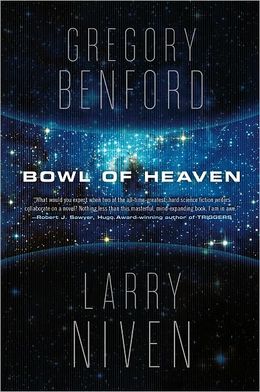
Bowl of Heaven — Larry Niven and Gregory Benford

Bowl_of_heavenIt’s almost always a mistake to represent alien consciousness in science fiction. Aliens, if we ever encounter them, are likely to be so alien that we can’t or won’t understand them—not at first, and conceivably not ever. The bigger problem with representing alien consciousness in science fiction comes from the language that is doing the representing.

Language, as pretty much everyone who has ever learned a foreign one knows, shapes what and how you think, as does the culture that carried by that language. Languages, though translatable, have different flavors. And the aliens in Bowl of Heaven sound like the humans, who sound like each other, and all of whom sound like Americans. They can’t do much better than call the human-built spacecraft “boldly simple.” These are aliens who, even more than most aliens in fiction, feel like humans dressed in exotic garb and wielding exotic technology.

Arthur C. Clarke wisely avoided this problem in Rendezvous with Rama, which is one reason the first one is so good and the latter ones less so.

It’s very hard to create fully differentiated human characters, each with a style all their own. Few accomplish this, which is why most writers choose a single first-person narrator, or a limited third-person narrator. One accomplishment in a novel like Anita Shreve’s Testimony is that the characters don’t sound alike, as they do in, say, Tom Perrotta’s Election, or many of Elmore Leonard’s novels. Hell, the style of, say, Remains of the Day, Jonathan Strange & Mr Norrell, and Atonement are as different as they are because each of their authors is trying to achieve (and achieving) a very specific effect and way of thinking. Niven and Benford aren’t.

I got into Bowl of Heaven because Peter Watts blurbed it and wrote about it in Circling the Bowl. I should’ve paid more heed to the way he described it: “Bowl of Heaven resonates with me, not so much as a work of fiction but as an artefact of the publishing industry.” I can see why it wouldn’t resonate with him “much as a work of fiction,” because by that standard it doesn’t succeed well. I should’ve read his post more carefully and noticed that sentence, though he also notes that “Bowl of Heaven seems to have done just fine with the advance reviewers.”

_MG_9690-1Watts looked at Amazon reviews for the book and noticed that “27% of the reviews complain about sloppy editing and continuity errors.” I’m going to complain about sloppy editing too: a lot of my pages looked like the one on the right, in which extraneous words and sentences are crossed out. This is the sort of thing nearly all authors do on their own (many pages of my own work are filled with cross-outs), and that line and copy editors do too. Generally I ignore extraneous sentences in novels, because everyone commits a couple. But when page after page looks like the one depicted to the right, I get annoyed.

Anyway, Watts’s recommendation kept me reading despite editing problems, but I quit reading when the English-speaking aliens appeared, with all of their Capitalized Proper Nouns (“For Memor was not amid the fevered straits of the Change;” there are also mentions of “the Dancing,” “the Watchers,” and capital-A “Astronomers”). There’s better work out there: before Bowl of Heaven, make sure you’ve read Blindsight and Starfish first: those are Watts novels, and I don’t remember where I first learned about them, and both are hard to read at their beginnings but dazzling by their ends as pieces click into place.

To return to the language issue, novels like Bowl of Heaven tend to give SF a bad rep among lit-fic types, who are obsessively attentive to language and how people use language in very particular way. As I noted above, these authors aren’t attentive to those issues, and they also seem to have a confused point of view—and not one that’s intentionally confused for artistic effect, like Virginia Woolf. The effect feels like a mess: it seems like the novel is following Cliff from a first-person limited view, but then it slips into a paragraph or two with only things that Redwing, or other characters, could know. It’s the sort of thing that undergrads learn about in creative writing classes.

Maybe there’s an artistic purpose here, but if so I’m not seeing it. If not, it’s just a mistake, and seeing novels with many simple mistakes praised by many eminent science fiction writers will tend to subtly and unfairly devalue the genre as a whole.

A.S. Byatt and Tracy K. Smith speaking in New York

A.S. Byatt and poet Tracy K. Smith spoke in New York last night, and my favorite moment may have been Byatt’s comment on influence: she said, “I learn from dead people. I read books.” Which is accurate, simple, and too seldom mentioned. She also said, “If there is one thing I shall never do it is write a memoir.” But Byatt does watch viral YouTube videos, though I won’t offer the context. No word on whether she’s seen “Gangnam Style.” I wanted to listen to her indefinitely; she seemed low bullshit and subtly, Britishly funny in a way not conveyed by these quotes and perhaps not conveyed by any quotes. I would take her seminar despite the danger of being assigned Henry James and Melville.

IMG_2029Byatt also said that at some point “I got sick of realism. . . and I realized realism is only one way of putting prose together.” That remark—”putting prose together” was deliberate. English’s promiscuous borrowing also delights her (as it does pretty much anyone who really writes), and to that I would add that English has a sophisticated technical vocabulary offering a rich lode of metaphors not always available, or easily available, in other languages, unless they’ve borrowed from English (often in turn borrowing from other languages).

One senses that literature for her is urgent, as it is for Roland Mitchell in Possession (in one of my favorite moments in the novel, Roland Mitchell explains that he stole letters from the British Library “Because they were alive. They seemed urgent,” implying that much of what happens in the British Library and academia is so not urgent that one must wonder if and why it should happen at all) and many characters in The Children’s Book. She makes me want to be a better writer.

Smith said, in the context of mentorship, that having someone ask different kinds of questions of your work can be useful. She’s right, though I’d never conceptualized the issue in those terms, and it’s difficult to find people who will ask questions different but still useful than those you ask yourself.

Does she like Billy Collins?

A discussion of a weird grammar quirk: tense and Mark McGurl’s The Program Era

In Mark McGurl’s excellent The Program Era: Postwar Fiction and the Rise of Creative Writing, he writes this about Vladimir Nabokov:

In fact, one of his best-known quirks was a scientific passion for a certain family of butterflies, the Blues.

The word “was” is interesting, because Nabokov’s quirks are still well-known, in the present. But Nabokov’s quirks happened in the past—he’s obviously dead. So there’s a moment of verb tense weirdness in this sentence, which might otherwise read something like, “In fact, one of his best-known quirks is the scientific passion Nabokov had for a certain family of butterflies, the Blues.”

There’s no particular point to this post other than a writer’s duty to notice language, and the opportunity to observe a specific example of language’s sometimes bizarre ambiguity.

(Those of you who are reading the last sentence and thinking about its own weirdness, be aware: that is intentional.)

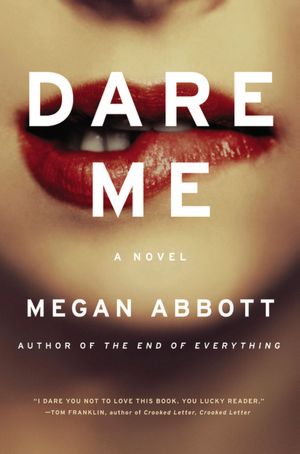
Dare Me — Megan Abbott

There’s something compelling about Dare Me that shouldn’t be compelling: stripped of its narrative voice, Dare Me is about teenage cheerleaders and their coach, who may as well be a teenager, competing to be the neighborhood’s queen bee. It’s unfair to summarize a novel like this—Lord of the Ring could be reduced to, “Midget chucks ring into mountain; local vagrant crowned king”—but it’s also useful, because interesting novels usually have characters who are trying to learn something about the world and who have larger ambitions to do things that will have more than just local effects.

Addy narrates the novel in an insistent present-tense voice that offers a sense of immediacy. Her primary aspiration, however, is to maintain her status on the cheer squad, chiefly as the “lieutenant” of the captain, Beth, who is the chief bad girl and doer of drugs, men, and deeds that Addy might want to do but can’t bring herself to. Beth, however, is stripped of her captaincy by the new Coach, who demands more from the girls than their previous coach:

Back then, we could hardly care, our moves so sloppy and weak. We’d just streak ourselves with glitter and straddle jump and shake our asses to Kanye. Everybody loved us. They knew we were sexy beyotches. It was enough.

But part of life is the “it” not being enough: skills count, more than merely being admired. Plus, contrary to what Addy thinks, it’s unlikely that “Everybody loved us.” The cheerleaders in Dare Me love themselves much more than any outsiders could possibly love them. And the cheerleaders never quite ask if they should want to be anything more than “sexy beyotches.” They certainly have a strong sense of sexuality, although sexuality in the novel is primarily used to express dominance among the various girls (and their Coach), rather than as an end in itself. The novel’s prime source of antagonism is between Beth and the new Coach, whom Beth describes this way: “Colette French [. . . ] Sounds like a porn star, a classy one who won’t do anal.” Beth tells us more about herself than she does about Coach: that she thinks about porn stars, that she has a dirty yet moralistic streak at the same time.

Most of the girls do. They want what most of us want, but that doesn’t stop them from castigating others. None of them recognize their own hypocrisy, and they probably wouldn’t care if someone did point that hypocrisy out to them. At one moment, Addy says, “Beth and I made loud comments across the gym about how Brinnie’s slutty sister got caught making out with the assistant custodian until Brinnie ran off to the far showers to cry.”

Women really do slut-shame each other much more vigorously than men slut-shame women. Addy doesn’t notice that, however. She only notices how she can use what she perceives to be raw power: the “loud comments” and the derogatory adjective, “slutty,” forming without much thought about what’s underneath her ideas. Despite what the two say about Brinnie’s sister, Addy also reports that “In eighth grade, no, summer after, at a beer party, Beth put her scornful little-girl mouth on Ben Trammel, you know where. I remember the sight.” Why is Beth’s mouth scornful? We don’t find out. But she says a moment later that “We don’t judge,” when the page prior Beth and Addy were judging Brinnie’s sister.

Dare Me, however, isn’t about consistency. It’s about inconsistency, expressed through power and dominance. Beth versus Coach, but sexuality is the weapon—not fists. The girls use it against each other, although I won’t describe how here. The only character who apparently isn’t competing is Addy. She doesn’t really get much in the novel, and she gives a weak excuse about why: “There’s not a lot to interest me at Sutton Grove High.” That’s another way of saying that being alone and being the cheer squad’s resident observer is more valuable to her than the experience of a “real” relationship. About Jordy, a boy at the school, the best Addy can summon is that “He looks like he’s thinking things [. . .] Like maybe he actually thinks about things.” Does that mean Addy and her friends don’t? And, if so, perhaps we again shouldn’t be reading about them. She does get with him, after a fashion, and his giving in disappoints Addy: “His wanting, so easily won—well, it bores me.” Everything does. The boredom she feels at his being “so easily won” is how guys end up affecting cruel uninterest in order to win women. But that’s another thing Addy doesn’t know. Her lack of sophistication is realistic but grating; there are answers to the questions she doesn’t know to ask.

She does know, however, that a military recruiter is aloof and thus desirable. He has a nickname that denotes his position: “Sarge, though, is above all this. All the girls are hurling themselves at him, but he never blinks, not once. He smiles, but his smile doesn’t really seem like a smile but the kind of thing you do with your mouth when you know everyone is watching.” He’s smiling that way because he has to, and he knows that the penalties for indulging in “the girls” who “are hurling themselves at him” is probably worse than the pleasure that he might gain from indulging them. There’s also a link between the two: by apparently standing above the girls making offers, he’s making himself more alluring. He contrasts with the “easily won” Jordy. The harder the prize, the sweeter the accomplishment, at least in Addy’s eyes, and hence the challenge of being a better cheerleader is the challenge of doing harder stunts, of doing more than “shak[ing] our asses to Kanye.”

The physicality of motion counts for a lot, and so does the wanting eyes Addy imagines her body inspiring. Addy thinks, “This is my body, and I can make it do things. I can make it spin, flip, fly.” She can also make it the object of male adoration, which, regardless of what else cheerleading might do, does that first. Addy also doesn’t perceive the way the boredom of her own life is partially of her own making, as when she says

Ages fourteen to eighteen, a girl needs something to kill all that time, that endless itchy waiting, every hour, every day for something—anything—to begin.
‘There’s something dangerous about the boredom of teenage girls.’

This is given like a law of the universe, an ahistorical fact that must be true of all times and places, like respiration. It isn’t. For all I know, in many hunter-gatherer tribes fourteen year olds were often mothers, or members of adult societies: their life had already begun. Addy is really commenting on contemporary Western society, even if she doesn’t have the language to realize it.

Has she read Paul Graham? Boredom is endemic to the high school experience. But boredom itself is dangerous to the mind, because it’s a waste of the planet’s most valuable resource: minds. I don’t need to rely on vague assertions like “There’s something dangerous;” I know what’s dangerous, in part because I was reading enough at the time to eventually learn how to use words to express complex ideas. Addy hasn’t gotten there yet.

That should make her an uncompelling narrator, but she isn’t. She’s naive in some ways, which shouldn’t be a surprise given her age, but she also observes the bad-girl behavior around her, and that bad-girl behavior is underappreciated in much of the larger society. Addy can also see what boys see, at times, as when she describes her teammate: “Emily whose balloony breasts and hip-cascades are the joy of all the boys, their ga-ga throats stretched to follow her gait, to stretch around corridor corners just to see that cheer skirt dance.” Addy’s awareness is a form of power, but it’s a limited form of power, and it’s counteracted by the limits that she accepts. The “endless itchy waiting” is imposed in part because we, collectively, don’t want to believe in the bad girl and want to see fourteen to eighteen year olds of both sexes as children, even when they’re clearly not. So we, collectively, take their autonomy away and are surprised when they’re unhappy. To return to Graham, in “Why Nerds Are Unpopular:”

What bothers me is not that the kids are kept in prisons, but that (a) they aren’t told about it, and (b) the prisons are run mostly by the inmates. Kids are sent off to spend six years memorizing meaningless facts in a world ruled by a caste of giants who run after an oblong brown ball, as if this were the most natural thing in the world. And if they balk at this surreal cocktail, they’re called misfits.

Addy doesn’t even bother with the “memorizing meaningless facts,” but she does accept high school as “the most natural thing in the world.” In her own way, she’s a misfit by believing in “this surreal cocktail,” and believing that the world of cheer is the only one that counts.

The only real hope of the society is that the “teenage girls” who Addy represents don’t realize the power of their bodies over men. Addy realizes it. Beth does too. They find cheer to be ridiculously helpful: Addy says that “It made things matter. It put a spine into my spineless life and that spine spread, into backbone, ribs, collarbone, neck held high.” If cheer is enough to make things matter, she must have a dull life—but she’s already established that she does.

She says that “Coach gave it all to us.” Meaning, in other words. And that “She was the one who showed me all the dark wonders of life, the real life, the life I’d only seen flickering from the corner of my eye.” But whose fault is it that Addy hasn’t seen “real life” before? And what is this “real life” that Addy keeps mentioning? It sounds like something she herself has constructed.

The questioning of what is “real,” however, reappears again and again in the novel. Addy says, “Could [Coach] see past all of that to something else, something quivering and real, something poised to be transformed, turned out, made?” Addy’s repeated use of “real” makes her seem convinced of her own unreality (“By Saturday practice [. . .] we’re already—some of us—starting to look forward to that pain, which feels like something real”). If it takes pain to be “real,” something in your life might be amiss. When the girls learn to do a pyramid, Addy says that “the momentum makes you realize that you are part of something. Something real.” Was she not part of something before? Does she have any theory or coherence beyond her theory of reality? She doesn’t, not really, and it takes death and rivalry to make something real.

Addy could say no to cheer and yes to Python, or sculpture, or the guitar, buts he doesn’t. She isn’t really interested in being real, in doing the things that other people might value. The only real value she, and Beth, offer to the world is sexuality, but they don’t even ask, really ask, what their sexuality means. At one point Beth says that “I’m not even interested in our lives.” This, however, raises an important point: Why should readers be? Addy as a narrator is one answer. The fact that she constructs a story out of something other than who gets to take the most popular boy to Prom is another. Her moments of inchoate realization is a third:

We’re all the same under our skin, aren’t we? We’re all wanting things we don’t understand. Things we can’t even name. The yearning so deep, like pinions over our hearts.

She should learn the names, and the things that most people most desire are obvious, money, sex, and social status, in some tangled, interdependent triangle. For a smaller but still significant number of people, intellectual curiosity is as or more important as those first three. Those things can be understood, especially by people who want to understand them. Addy doesn’t, or doesn’t have the intellectual context she needs to understand them. As someone very happy to be out of high school, I see a lot of the things that Addy doesn’t, though she should: she’s narrating the story from an unnamed future point, even as she drops into the present tense.

One problem with Addy or her narration is that we don’t know what any of these characters are like, other than mean and, in a petty, squabbling fashion, stupid. But Addy’s voice carries the novel, along with her fascination with Beth, which in Addy’s view is like staring at a serpent: fascinating, even as you hope it doesn’t bite. What do Addy and Beth do when they’re not cheerleading? What is Beth’s favorite color? If she had to answer the question, “What do you want to do when you grow up,” what might she say? Is the prospect of college or a technical school anything more than a distant glimmer in their eyes, along with a source of older boys?

To the extent Beth and Addy have character beyond their sexuality and social status, we don’t see it. If the slice of character we see is their primary character, then they’re not very nice people, and, perhaps worse, they’re not very interesting people. Beth is willing to violate taboo by sleeping with older men, which speaks well of her low opinion of convention, but is she willing to extend taboo violation to, say, playing the corporate game as hard as the cheer game, or cutting across gender stereotype to build web apps for bad girls? The interesting thing is not just her as a bad girl, but what she can do with being a bad girl.

Perhaps that kind of question is for the sequel. Dare Me deals in a surprisingly plausible murder plot, with Addy and the reader the last to know what all the other characters seem to. The frustrations of Addy and Beth as characters doesn’t prevent the book from being compelling, in part because the girls’ blindness to anything important seems characteristic of their age, time, and generation. That should be scary.

Coach’s husband, Matt French

There are men in the novel: the aforementioned Sarge, is one. The other major male character, Matt French, is Coach’s husband. He misallocates resources. Coach says, “Oh, you know him, he’s working. He never, ever stops.” On the next page: “He is always on his cell phone and he always looks tired.” Addy says, “He works very hard, and he’s not interesting at all.” This misallocation of time and energy leads his wife to seek sexual solace elsewhere, as it so often does, and Matt apparently doesn’t realize that she, like most women, need tending. If he won’t keep the garden, someone else will.

Predictably, someone else does. When the girls catch Coach in the act with another man, she explains that “what [. . .] I have is a real thing [. . .] A true thing.” By that standard, what she has with Matt must not be a true thing. It must not count. She excuses herself by saying, “I never thought I’d feel like this,” as if the invocation of feelings trumps any and every other consideration. The girls don’t challenge her. They probably believe the same thing.

But the affair is a commentary on Matt’s folly. He should cut work and increase sex. We never learn why he doesn’t, or anything about his job. He’s a pathetic ghost of a man who enables the fake world of high school, which his wife joins. Addy and Beth show little interest in him, while they show a lot of interest in Will. The only exception comes at a moment when Addy tries to imagine what Matt is like:

Poor Matt [French], in some airport or office tower in Georgia, some conference room someplace where men like Matt French go to do whatever it is they do, which is not interesting to any of us, but maybe it would be if we knew. Though I doubt it.

Except sometimes I think of him, and the soulful clutter in his eyes, which is not like Will’s eyes because Will’s eyes always seemed about Will. And Matt French’s seem only about Coach.

That he is only about Coach, and not about anything else, makes him seem weak and replaceable to her; still, Addy’s analysis appears to be wrong because Matt is really about work, at least as measured by time spent doing an activity. We don’t get enough information about Matt French’s thought process to understand why he ignores his wife in favor of constant work that appears to weaken, not strengthen, his relationship, and leave his wife bored and frustrated. It should be obvious to anyone who has observed the people around them or been in serious relationships that bored, sexually frustrated people will find ways to get their needs met.

To return to the point I raised in the first paragraph, the problem with realistic but limited perspective Beth, Addy, and Coach have is with the scope of their vision and concerns. Adam Gopnik’s essay “The Unreal Thing” encapsulates some of their problems:

In a long article on the first “Matrix” film, the Princeton philosopher James Pryor posed the question “What’s so bad about living in the Matrix?,” and, after sorting through some possible answers, he concluded that the real problem probably has to do with freedom, or the lack of it. “If your ambitions in the Matrix are relatively small-scale, like opening a restaurant or becoming a famous actor, then you may very well be able to achieve them,” Pryor says. “But if your ambitions are larger—e.g., introducing some long-term social change—then whatever progress you make toward that goal will be wiped out when the simulation gets reset. . . . One thing we place a lot of value on is being in charge of our own lives, not being someone else’s slave or plaything. We want to be politically free.”

For Beth, Addy, and Coach, political freedom isn’t important. Competing with each other is the only important thing. Their ambitions are so “small-scale” that they don’t matter. Their achievements will be “wiped out” when they leave high school, which is its own Matrix-like simulation, and the smarter, more aware residents know it. So do adults who remember what high school was like: Paul Graham says in “Lies We Tell Kids:”

By 15 I was convinced the world was corrupt from end to end. That’s why movies like The Matrix have such resonance. Every kid grows up in a fake world. In a way it would be easier if the forces behind it were as clearly differentiated as a bunch of evil machines, and one could make a clean break just by taking a pill.

I don’t think it’s a coincidence that he uses The Matrix as an analogue for high school. Both high school and The Matrix put a natural cap on ambition, which the better high school students will challenge. Beth, Addy, and Coach don’t challenge that system; Addy even thinks that it’s the only thing that matters: “God it must be terrible not to be on cheer. How would you know what to do?” You wouldn’t know what to do, but pretty much anything you do in lieu of cheer, aside from watching T.V., vegging out, or playing on Facebook is likely to be more substantive than cheer. But Addy is so firmly plugged in that she doesn’t recognize her “fake world,” to use Graham’s term, and maybe she can’t. Maybe, if she were a different sort of person, someone would point it out to her, like the teacher in The Perks of Being a Wallflower implicitly does. Cheer for Addy is a kind of Matrix-within-a-Matrix, a way of further shrinking her social and competitive world. Addy wants to give up the kind of political freedom Gopnik and Pryor are describing. Abrogating freedom makes her seem like a fool, or a slave to the conformity imposed most obviously by Beth; perhaps this is why Addy wants to be Beth’s lieutenant, and why she doesn’t aspire to be the top girl.

Not wanting to be the top girl makes sense. But wanting to be in a social milieu where all that matters is being the top girl makes less sense; it’s like aspiring to slavery, or perpetually wearing glasses with a red tint, such that you can’t experience the full richness of the world. Addy doesn’t realize that she’s wearing those glasses, and that, finally, makes her seem sad. She’s missing so much, and she doesn’t even realize it.
Summary Judgement: Sweet Tooth — Ian McEwan

For a novel about a spy, Sweet Tooth is surprisingly slack. Maybe it’s slack in defense of realism. The cause eludes me, since the writing is as customarily crisp as the story isn’t. Excellent quotes are easy, from the first page, with this description of Serena’s father, an Anglican Bishop: his “belief in God was muted and reasonable, did not intrude much on our lives and was just sufficient to raise him smoothly through the Church hierarchy and install us in a comfortable Queen Anne House.” The parents are distant to the point of barely believable indifference: much later in the novel, Serena thinks, “Would the Bishop even notice I’d been away?” She’s free of parents, like an orphan in a 19th Century novel or a teenager in a contemporary TV show.

That doesn’t detract from the aforementioned beauty, like this, to go back to the second page: “We liked to think of ourselves as bad girls, but actually we were rather good.” Serena, on learning about the difficulties of writing, “went for important walks,” the silliness and accuracy of the phrase “important walks” working so well to conceptualize her state of mind and what many people with intellectual dispositions end up doing.

But the beauty of sentences eventually feels like backdrop when a second or third act fails to develop. The novel ends with a great, revisionary secret, the sort of secret that powers PhD dissertations more often than it does readerly love. We’ve seen these surprise techniques before—most notably in Atonement, but also, after a fashion, On Chesil Beach.

Like many writers, including this one, McEwan, through Serena, is at least interested in and perhaps obsessed by what reading and books do to people. Serena works in books as much as she’s a spy and sleeps with authors (which is the sort of practice I’d like to encourage). She notes what she reads and how she reads it. The book becomes about a love of books, but it does so to the point that the occupant of this book becomes dull. What does the book talk add up to? I’m a person sympathetic to books and book talk, but in Sweet Tooth the answer is “not much.” It becomes easy to lose focus midway through. Sure, for Serena, reading is how she both constructs and understands her world, but then you have to, you know, go do something. That’s not to say that she isn’t artful or funny. Consider this problem, about Jeremy, Serena’s first lover who turns out, predictably, to prefer men:

I wanted him to have a secret and shameful desire that only I could satisfy. I wanted to make this lofty, courteous man all mind. Did he want to smack my backside, or have me smack his? Was he wanting to try on my underwear? This mystery obsessed me when I was away from him, and made it all the harder to stop thinking about him when I was supposed to be concentrating on the maths. Colette was my escape.

Colette was her escape, but into what and from what? From mysteries? From something she can’t quite articulate, perhaps. And Serena, as a narrator, is also willing to ostentatiously tell us that she’s older and wiser now: “What I took to be the norm—taut, smooth, supple—was the transient special case of youth. To me, the old were a separate species, like sparrows or foxes. And now, what I would give to be fifty-four again!” This intrusion of the future self reminds us that we’re reading something from the future of events, with two pairs of eyes: the eyes of the undergraduate Serena and the eyes of the much older Serena, imagining her younger self from a position of greater articulacy and knowledge. Done too often, though, it becomes tedious. The notes in my copy trail off as the novel advances, and as I hope for Serena to become more than an acted-upon reporter of events. Her own life feels like it happened to someone else. Later in the novel, much later, the reason for this is revealed. But the view at the end of a long trail doesn’t always redeem the journey. The reason is clever, cerebral, not expected and not forced, and doesn’t make me want to read Sweet Tooth again, unless the next reading is part of some academic project about the usual sorts of academic things.

Serena says this of her reading habit:

All thanks to my mother, I didn’t stop reading. I’d never read much poetry or any plays at school, but I think I had more pleasure out of novels than my university friends, who were obliged to sweat over weekly essays on Middlemarch or Vanity Fair. I raced through the same books, chatted about them perhaps, if there was someone around who could tolerate my base level of discourse, then I moved on. Reading was my way of not thinking about maths. More than that (or do I mean less?), it was my way of not thinking.

Reading can be a powerful way of not thinking. I know from experience, even if most people think of reading as a highbrow, intensely intellectual activity these days. It isn’t, necessarily. And the assigned essay can be a chore instead of a pleasure. Serena wants it to be a pleasure:

My needs were simple. I didn’t bother much with themes or felicitous phrases and skipped fine descriptions of weather, landscapes, and interiors. I wanted characters I could believe in, and I wanted to be made curious about what was to happen to them. Generally, I preferred people to be falling in and out of love, but I didn’t mind so much if they tried their hand at something else. It was vulgar to want it, but I liked someone to say ‘Marry me’ by the end. Novels without female characters were a lifeless desert. Conrad was beyond my consideration, as were most stories by Kipling and Hemingway. Nor was I impressed by reputations. I read anything I saw lying around. Pulp fiction, great literature and everything in between—I gave them all the same rough treatment.

Simple intellectual and erotic needs might be easier to fulfill than complex ones, in one sense, but also harder, in the way that a simple task executed perfectly may be harder than a complex task executed with a margin for error. Still, Serena should have known that it isn’t vulgar to want love and marriage and plot. It’s vulgar that professors and highbrow critics might make her think it is vulgar to want those things, to want fiction that might be, to use that overused term, “relatable.” That one might be able to follow effectively. Serena isn’t a close reader, or someone practicing towards being a professional.

But she is someone who learns how to be through books, which makes her different from someone who learns how to be from in other ways, or someone who never learns how to be. She says, “I caused amusement among my Newnham friends studying English when I told them that Valley of the Dolls was as good as anything Jane Austen ever wrote. They laughed, they teased me for months. And they hadn’t read a line of Susann’s work.” Her friends are snobby and dismissive. Given the choice between snobby and unrefined but passionate, I’ll take the latter. The difference between those becomes a running issue, as when Serena begins to write a little column, and, like bloggers, something unfortunate happens: “I had written half a dozen jaunty pieces when something went wrong. Like many writers who come by a little success, I began to take myself too seriously.”

It’s a narrow act, the stance that straddles too serious and not serious enough. When I’m waffling between them, I try for “not serious enough:” after all, we’re talking about fiction here, not life and death. But for Serena the two become bound together because of her work. That’s an interesting theme; if only the plot were drilled more vigorously through the loam of Serena’s mind and story.

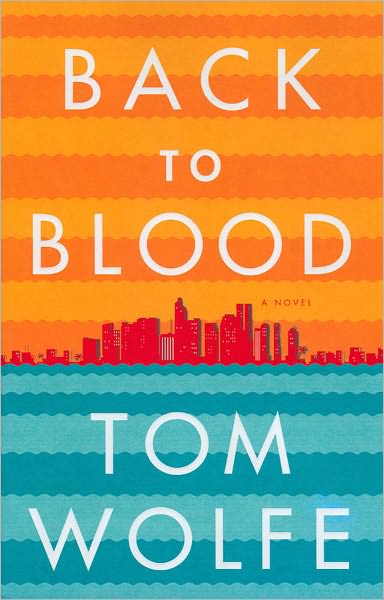
Back to Blood — Tom Wolfe

The real problem with Back to Blood is that you’ve already read it, most notably in The Bonfire of the Vanities and A Man in Full—and if you haven’t read those, you should start with them. Back to Blood has the same assortment of obsessions and interests: there is the child with an unusual name and an elite pedigree: “Last week he totally forgot to call the dean, the one with the rehabilitated harelip, at their son Fiver’s boarding school, Hotchkiss [. . .]” But does anyone still care about elite boarding schools? Does anyone still care about the Miami Herald other than the people who work there? The father of Fiver is the editor, and he thinks it is “one of the half-dozen-or-so most important newspapers in the United States” in an era when the era of newspapers has passed.

The Miami nightclub is named “Balzac’s,” after another Wolfe preoccupations. There is a prurient mention of girls who “were wearing denim shorts with the belt lines down perilously close to the mons veneris and the pants legs cut off up to. . . here . . .” Has anyone in the U.S. ever used the term mons veneris, outside of Tom Wolfe and medical schools? I think it appeared in I am Charlotte Simmons a couple of times too, and there it was even more improbable. And the word loins! In this case, “juicy little loins and perfect little cupcake bottoms.” I’ve heard loins described as loins before, but only by Tom Wolfe and the writers of the Bible. Someone born more recently than 1931 would use “pussy” if they wanted to be crude, “va jay jay” if they wanted to be hipster, or “vagina” if they wanted clinical directness. But not loins. No one but Tom Wolfe would use loins, and use it again and again.

Sometimes writers working out variations on ideas that iterate subtly book by book can work—Elmore Leonard is a good example. Others just feel like they’re repeating themselves. When I am Charlotte Simmons came out, I was in college and skipped class to read it, only to feel an increasing sense of disappointment with the wrongness of many scenes—like Charlotte feeling nervous about the cost of long distance calls. That was an anachronism. Most college students had free long distance by 2004. I would’ve let anyone who asked use my phone to call home. Or, for another example of reportorial wrongness, Charlotte gets a salvaged, pieced-together computer, like a salvaged car. By 2004, however, older but working computers were $25 on Craigslist, or outright given away by schools. These two examples are salient, but there were others, just as I am Charlotte Simmons repeated words, phrases, and ideas from Wolfe’s earlier books. It, and Back to Blood, repeatedly describe moments of cowardly prurience, with men likes wolves and women who didn’t want it or didn’t want to want it and submitted to it only reluctantly, like a female character from the 19th century and not at all like many of the contemporary women I know.

The period details in Back to Blood are wrong. Today, anyone cool would be driving a Tesla Roadster, or Fisker Karma, not a Ferrari 403; Ferraris might’ve been cool twenty years ago, but technology and culture have moved on. Then there’s the simply and wildly improbable: a French professor named Lantier thinks of his daughter that she wasn’t ready for “snobbery” because “She was at the age, twenty-one, when a girl’s heart is filled to the brim with charity and love for the little people.” Someone exposed to live students every semester is unlikely to think of their hearts as “filled to the brim with charity and love” for much of anything, except perhaps alcohol, condoms, iPhones, verbing nouns, and obsessive Facebooking. Not that there’s anything wrong with those things, but familiarity is a great slayer of illusions like Lantier’s belief about the hearts of most 21-year-old girls.

Back to Blood isn’t a bad book, but it has the same but lesser strengths of the earlier novels, with the same but exaggerated weaknesses of them. We’re told, not shown, that “Mac was an exemplar of the genus WASP in a moral and cultural sense,” without knowing why, if at all, that’s important. We’re told a lot of things, most of them not especially new if we’re familiar with the Wolfe oeuvre.

There are clever moments, as when Magdalena, in a fight with her Spanish-speaking mother (or, in Wolfe-land, Mother), resorts “to the E-bomb: English.” It’s a moment of geriatric cruelty, since “Her mother had no idea what colloquially meant. Magdalena didn’t, either, until not all that many nights ago when Norman used it and explained it to her. Her mother might know hang and possibly even slang, but the hang of slang no doubt baffled her, and the expression clueless was guaranteed to make her look the way she did right now, which is to say, clueless.” It’s clever, and the kind of cleverness that makes the scene fresh and unusual. It’s also the kind of cleverness missing in repeated references to the mons verneris, or to loins, or to high-end private schools.

Wolfe also gets and has gotten for decades the weirdness and power of modern media; its spotlight is restless yet powerful, and it plays a tremendous role in Bonfire. In Back to Blood, Nestor Camacho, a Miami cop, rescues a refugee from the mast of a ship and is recorded doing it; consequently, he becomes momentarily famous, such that: “Even now, at the midnight hour, the sun shone ’round about him.” The analogizing of fame to light seems obvious, even necessary, and although I don’t want to probe its deeper properties here I like how Wolfe avoids the spotlight metaphor, much as I didn’t a few sentences ago. Wolfe uses metaphor in an almost 19th Century fashion, usually effectively.

He gets the way civic booster types think of the arts not as a thing in and of themselves, but as a checkbox; an editor at the Miami Herald thinks that “Urban planners all over the country were abuzz with this fuzzy idea that that every ‘world-class’ city—world class was another au courant term—must have a world class cultural destination. Cultural referred to the arts. . . in the form of a world-class art museum” {Wolfe “Blood”@111}. He’s right, of course, but right in a generic way, like people are right about love being like a rose. If you’ve read anything about urban planning, or cities (and I have), you won’t be surprised at the editor’s knowledge, which he probably picked up in the same places I did, and which says very little about him as a character, exception that he, like so many Wolfe characters, is an information and status receptacle more than he is a person with his own needs and desires.

The complaint expressed throughout this post is similar to but a bit different than James Woods’, which concerns how Wolfe’s characters tend to speak in similar or identical registers, despite coming from wildly different backgrounds. That isn’t necessarily a weakness, but the verisimilitude of the characters must be maintained in novels that portray such startlingly different people in a similar register; that’s what Bonfire of the Vanities does and what Back to Blood doesn’t, quite. The earlier novel also doesn’t feel reported even if it was reported; the latter does, in the same way I am Charlotte Simmons misses the college milieu in a thousand subtle ways. If you swing, it doesn’t matter whether you miss the ball by a millimeter or a meter. The scrim of realism is pierced and the novel doesn’t quite work.

Wood also says that “Wolfe isn’t interested in ordinary life. Ordinary life is complex, contradictory, prismatic. Wolfe’s characters are never contradictory, because they have only one big emotion, and it is lust—for sex, money, power, status.” But this isn’t quite true: Wolfe is interested in ordinary life when it’s touched by big events, or ordinary life when its inhabitants have a powerful yearning for something other than ordinary life. That yearning, that drive, can be fascinating. Plus, there’s nothing wrong with writing about extraordinary life, which can be as fascinating, “complex, contradictory, prismatic.” Wood obviously isn’t making this argument, and I doubt he would make it in the kind of caricature I’m making it here, but it’s easy to draw this kind of false lesson from the Back to Blood review. Almost every Wood review is a momentary master class in the novel as a genre, which is why so many writers and would-be writers attend so carefully to them, and why it’s worth appending this brief commentary to a review that in some ways is more useful and interesting than the impressively hyped novel being discussed.

Back to Blood is drawing on capital built up from Wolfe’s earlier novels, and overall it leaves a sense of “Fool me once, shame on you; fool me twice, shame on me.” If another Wolfe novel appears, I don’t think I’m likely to be fooled again. There are better novels about the state of America—Gillian Flynn’s Gone Girl is one—even if they don’t announce themselves as tomes about the state of America. Given how the voices of Back to Blood don’t quite work and the book-report function doesn’t quite work, there are probably better uses of one’s reading time.

Alif the Unseen — G. Willow Wilson

Alif the Unseen almost works, but it persistently mischaracterizes technology in a distracting, false-sounding way that its eponymous hacker protagonist wouldn’t. On the first page of Alif’s narration, we find this about his phone: “Another hack had set this one up for him, bypassing the encryption installed by whatever telecom giant monopolized its patent.” But encryption algorithms are math, and math can’t be patented. Furthermore, a patent is by definition a limited monopoly right. As a result, the last part of the sentence seems incoherent. And what is being encrypted? The phone’s operating system? Its user data?

A few pages later, Alif is “watching as a readout began to scroll up the screen, tracking the IP address and usage statistics of whoever was attempting to break through his encryption software.” But reading “usage statistics” makes no sense here: Alif isn’t, say, providing blogging software or an e-commerce platform (a few pages later, he installs a keystroke logger and other software on the computer of his love interest, and says that he does so “to track her usage statistics.” This makes more sense). Someone wouldn’t “break through his encryption software;” he or she would attempt to penetrate Alif’s firewall. The same would-be intruder leaves after “executing Pony Express, a trojan Alif had hidden in what looked like an encryption glitch.” I don’t know what “an encryption glitch” means here, and I don’t think the author does either.

Alif notes that, in the Arab Spring, “the digital stratosphere became a war zone. The bloggers who used free software platforms were most vulnerable.” If anything, open-source software should be less vulnerable, because well-known open-source software systems won’t have obvious backdoors (because they’d be found) and they have the advantage of many eyes on their source code. There’s an equally jarring moment when Alif says that he’s written a piece of software in “C++. But the type system is soft of—new. I’ve made a lot of modifications.” But he probably is referring to whether it’s dynamically or statically typed—that is, checking whether a program’s internal variables and other values are computable and safe when the program is run or when it’s compiled. It isn’t clear why Alif would change C++’s type system. At another moment, Alif worries that a malevolent, governmental entity is watching him: “The Hand would see Alif using his e-mail and cloud computing accounts, but until he could crack his algorithm, Alif would appear to be working from Portugal, Hawaii, Tibet.” The phrase “crack his algorithm” is meaningless here. “Cloud computing” is the kind of term marketers use; programmers or hackers would probably say “servers.”

These kinds of persistent, distracting errors detract from the story and the novel’s realism. It might seem strange to discuss realism in a book that features Djinn, vampires, and other supernatural elements, but any writer still has a duty to get the language of the “real” or mundane world right. Wilson doesn’t, and that makes the whole novel feel fake when it shouldn’t. In The Name of the Rose, religious language and medieval thought infuse every line, even when contemporary philosophical ideas are being expressed through the language of the time. Eco knows the period like Wilson doesn’t know the language of hackers, programmers, and computer science. I’m not an expert, but I’ve read enough in the field to understand what she misses.

Still, there’s a sense of hidden knowledge that runs throughout Alif the Unseen, and a melding of old ideas with new technology. That’s an appealing idea, and so is the idea of an Arab Golden Compass. It’s got some religious elements that could come from The Name of the Rose. Much of the writing is skillful if not particularly memorable. Funny moments appear: Vikram the Vampire, on hearing one of Alif’s schemes, says, “I don’t want foreigners involved in my business. Jinn are one thing but I draw the line at Americans.” Such moments are just not common enough to merit reading this book over something better, like The Golden Compass or Gillian Flynn’s Gone Girl or Carlos Ruiz Zafon’s recent novels, all of which do language better.