Links: Why your city has no money, Thiel’s weak defense, novels, movements, and more!

* The Real Reason Your City Has No Money.

* “Peter Thiel, Trump’s Tech Pal, Explains Himself,” wildly unconvincing and specious; it’s bizarre to read Thiel’s criticisms of others that apply primarily to himself. He wrote Zero to One.

* Thinking about the process of being an artist and a writer: Lessons from David Galenson’s Old Masters and Young Geniuses.

* There’s “No proof music lessons make children any smarter.”

* “The Novel as Math Problem: As a formal exercise, Paul Auster’s 4321 is impeccable. As a story, it’s curiously cold.” I’ll pass.

* Why Most Economists Are So Worried About Trump.

* An excellent, important point: “Every movement…has a smart version and a stupid version, I try to (almost) always consider the smart version. The stupid version is always wrong for just about anything.” I have sometimes been guilty of attacking the stupid version.

* “Housing supply is [finally, almost] catching up to demand.”

* “Elena’s career exemplifies two cultures in women’s writing that are not supposed to mix: the unimpeachably high, where abstract desires are worked out in texts accessible only to educated elites, and the thrillingly low—writing that, driven by big, vulgar passions, grips the popular imagination but is not to be taken seriously.”

Links: Writers and cash, hate, friendship, laptops, book making and mending

* “Make America Mate Again,” very much an underrated issue that has not made it much into the general culture.

* “The Friendship That Created Behavioral Economics,” on Michael Lewis’s The Undoing Project.

* “Anatomy of a Hoax: How the physicist Alan Sokal hoodwinked a group of humanists and why, 20 years later, it still matters.” I’m not sure it does still matter, but it is entertaining!

* “U.S. Says Putin Ordered Broad Campaign of Influence to Help Trump Win Election.” In short, Americans fell for it.

* “How Japan has almost eradicated gun crime.” The secret is unsurprising.

* Rake’s Progress: A Look at the Well-Traveled Casanova.

* “Donald Trump isn’t Hitler, Mussolini, or even Putin. He’s Trump; but that, in itself, presents a real danger.”

* “Dell’s latest XPS 13 DE still delivers Linux in a svelte package.”

* “He Fixes the Spines of Books, Without an Understudy: Donald Vass has been mending books in the Seattle area for 26 years, but his craft is a fading one.”

* “The Soviet Union Is Gone, But It’s Still Collapsing: And 5 other unlearned lessons from leading experts about modern Russia and the death of an empire.” Better than the title makes it sound.

* “Buffalo Becomes First City to Bid Minimum Parking Goodbye,” good news.

* “Why is it so hard for writers to talk about how much money they make?” Probably because for most the answer is “not much.”

Briefly noted: Underground Airlines — Ben H. Winters

You may have seen the good reviews, but I gave up after 50 pages, many of which look like this:

Underground Airlines

The premise is clever—the Civil War is averted and slavery persists in four states up to the present day—but the writing is not. One wishes to read instead Elmore Leonard, who is a master of the kind of style attempted here. Almost every page is overwritten. Many of the pieces in Martin Amis’s The War Against Cliche apply here too.

Good books I read in 2016

A reader pointed out that I didn’t write a “best of 2016” post, which is correct, but “best of” strikes me wrong, so I’m going to write about good books that I happened to read in 2016 and that you should read too.

* The Undoing Project: A Friendship That Changed Our Minds by Michael Lewis, probably the best book I read all year, except maybe for Blindsight, but that is so different that the two aren’t really comparable.

* Perfect Rigor: A Genius and the Mathematical Breakthrough of the Century by Masha Gessen, another narrative nonfiction book, though this one emerged and escaped my notice in 2009.

* The Map and the Territory by Houellebecq, still weird and likely always weird; Houellebecq has his misses, especially The Possibility of an Island, but his hits are strong, weird, and different—with “different” too often meaning “bad,” but not in his case.

* Cryptonomicon by Neal Stephenson, one of those amazing books worth re-reading whenever you can’t find a new book to read.

* The Song Machine: Inside the Hit Factory by John Seabrook, which is novelistic in detail and beautifully reported. I didn’t fully know where the music everyone listens to comes from and now I do.

I’ve been having trouble finding really good novels, though my tastes are idiosyncratic and I don’t have rules for what makes a good novel besides the tautological, “Be really good.” If you have suggestions drop me a line.

The most-visited post I wrote last year is “The race to the bottom of victimhood and ‘social justice’ culture.”

Life: Be joyfully weird edition

“He is, or has been, in many ways a great man. But for this very reason he is odd. It is only petty men who seem normal.”

—Umberto Eco, The Name of the Rose

Links: Software, divorce from the practitioner’s perspective, problem cops, Vienna, and more!

* “Writing software is hard,” an important point often not understood by those outside the industry.

* Divorce lawyers explain that divorces are much more similar than different, and yes, they all know that “your ex is an asshole,” just like everyone else’s ex.

* Why some problem cops don’t lose their badges.

* How Vienna produced ideas that shaped the West.

* The Twin Prime Hero: Rags, riches, and fame in mathematics.

* Robin Hanson’s idea trade engagement. I feel bad that I can’t think of good ideas he should blog!

* How Watership Down was written.

* “When city retirement pays better than the job: One in four El Monte residents lives in poverty. Yet taxpayers pay a steep price to fund bonus pensions and other perks for city workers.” I try not to post outrage reads, yet sometimes I can’t resist.

* The red Solo cup is a marvel of modern engineering.

* Women Who Count: 3 Smart STEM Romances.

* On The Fever by Megan Abbott.

The Trespasser — Tana French

I don’t remember where I first learned about French, but “Women Are Writing the Best Crime Novels” inspired me to read The Trespasser. The novel is not bad and if you like the genre you might dig it—it’s not offensively written—but halfway through one feels like nothing much has happened, the dead girl, Aislinn, remains a cipher, and maybe a bunch of stuff will add up to something but maybe it won’t. Comparisons to Gone Girl are not quite apt because in that novel something changes virtually every chapter, and around halfway through the big reveal occurs.

trespasserIn The Trespasser things meander to no particular end. From a marketing perspective the endless comparisons to Gone Girl makes sense, but from a narrative perspective they rarely do. Gone Girl does seem to break the narrative pattern in a way that’s difficult to repeat, and that may help explain why it is so read and still so good.

Still, reading a competently executed book is refreshing, and there are crisp descriptions like, “Breslin likes thinking he’s Mr. Indispensable; he’ll show up just as fast for a shitty domestic as he would for a skin-stripping serial killer, because he knows the poor victim is bollixed until he gets there to save the day.” Arguably the part of the sentence before the semicolon could be omitted, with the reader left to infer it, but one gets a sense of someone whose virtue is motivated by self-love more than caring for mankind. We also get a lot of standard detective-fiction patter, like “I didn’t use to be like this. I’ve always had a temper on me, but I’ve always kept it under control, no matter how hard I had to bite down.” Why are tempers always under control and not over control? What does control of a temper mean, versus a temper having control? The kinds of standardized language one finds in the novel never gets to those questions. It’s actually hard to find really characteristic quotes because The Trespasser doesn’t stray far enough from its genre:

The point is, this isn’t the telly, where cops are all blood brothers and anyone who gets on the wrong side of a cop ends up dead in a ditch while the rest of us lose the evidence. I don’t have any squad loyalty.

The writing is often good but not quite good enough to justify the plot. I still await “the next Gone Girl.”

A surprisingly large amount of the novel describes the bureaucracy of police departments (which is a surprisingly large amount of many contemporary detective novels and maybe novels set more generally in offices). Bureaucracy may be the characteristic fact of life. See also “Bartlebys All.”

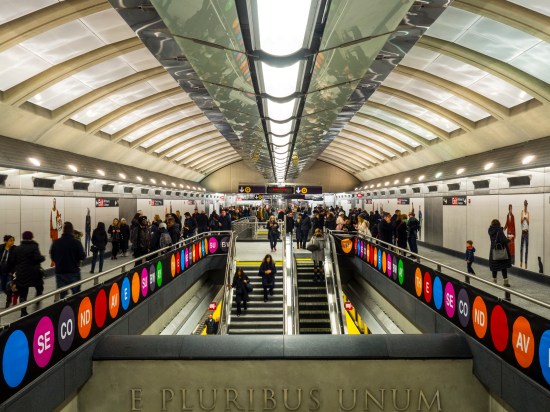
The Second Avenue Subway, opening day

We have entirely too few epic engineering projects; to finally get to ride one is fun! Today the Second Avenue Subway, a century in the making, opened:

second avenue subway

The subway stops don’t feel like typical subway stops because they lack the grime that usually marks them in the same way cold marks the winter solstice.

second avenue subway 2

The active part of this round of subway construction began in 2007; while the subway should’ve opened years ago, it is nice to see it open at all. One gets a sense of the sublime from epic engineering works, and, as Zero to One argues, we’ve collectively lost faith in our ability to build big things and tackle serious problems. The new subway is evidence to the contrary.

Still, one hopes the next phase of the line goes better. Matt Yglesias explains some of this phase’s problems in “NYC’s brand new subway is the most expensive in the world — that’s a problem: The tragedy of the Second Avenue Subway.” On a per-mile basis the Second Avenue Subway is the by far the most expensive subway in the world, and it’s by far more expensive than similar projects in crowded first-world cities like London, Paris, and Tokyo. We’re not getting much bang-for-the-buck and that needs to change.

New York has so far been “Slow to Embrace Approach That Streamlines Building Projects.” Management and labor have been eagerly lining each other’s pockets. That’s particularly unfortunate because the infrastructure is desperately needed and has been desperately needed for decades if not longer.

Second Avenue Subway 3

To be sure, the stations are much more functional than most others, and their mezzanine levels impress. One wishes, however, for fewer mezzanines and more total stations.

Second Avenue Subway selfie art

As you can see above, someone thought through the selfie-friendly art that lines the stations.

Today is still a historic occasion and one does not so often get the chance to participate directly and obviously in history. It may be churlish to note this, but my train spent five to ten minutes waiting due to “train traffic ahead of us” between 63rd Street and 72nd Street. Some things may be new but others are too familiar.

Links: Food, odd campus culture, ebikes, quality literary feuds, and more!

* “Quinoa is the new Big Mac: Can Eatsa succeed in delicious and inexpensive plant-based fast food?”

* The inventor of the red Solo cup has died. Real tragedy.

* “Student Accused of Rape By ‘Mattress Girl’ Sues Columbia U., Publishes Dozens of Damning Texts.” See a related discussion in this post.

* “The personal is political” (note: the personal is not necessarily political and if someone tells you it is, tell them to get stuffed).

* Low Definition in Higher Education: When college students are told what to think and what not to say, who suffers in the end?

* Ebikes: I Sing the Ride Electric.

* “When did Literary Feuds Become So Boring? Duels between writers were once epic. Now they’re just petty.”

* “The long political history of sneakers;” the article sounds dumb but is actually good.

* Trump’s Narcissistic Personality Disorder (NPD).

* “Why People Vote for Counterproductive Policies.” And: “‘What the Russians Did Was Utterly Unprecedented.’” Voter irrationality has always been an interesting topic but it’s become more interesting and salient since 2010, with a special rise this year.

* Open societies are facing major crises. I don’t think Soros’s answer is the right one or that most people even know who or what they might mean by “elites,” but the problems are clear and not going away.

Links: The widowhood effect, Mac desktops, nuclear power, campus identity politics, and more!

* “The widowhood effect: What it’s like to lose a spouse in your 30s.” Brutal, moving, and you may cry. Consider yourself warned.

* Tim Cook alleges that great desktop Macs are in the works. I’ll believe it when I see them.

* To Slow Global Warming, We Need Nuclear Power.

* “How Silicon Valley Nails Silicon Valley,” unexpectedly hilarious.

* Campus Identity Politics Is Dooming Liberal Causes, according to Mark Lilla, who you may remember from The Shipwrecked Mind.

* “How Amazon’s problems with cheap knockoffs got real.” I’ve become much more sensitized to this issue and less likely to buy non-books from Amazon for precisely this reason.

* “World War III, by mistake.” See also “Trump fears and the nuclear apocalypse.”

* “If anyone is alive in 100 years to write a history of the 2016 U.S. election they will not believe how dumb it was.”

* “Automakers Prepare for an America That’s Over the Whole Car Thing.” The bizarre thing to me is that Americans ever loved cars in the first place. See also “Cars and generational shift” and “Owning vs sharing: Don’t get caught in the ugly middle.”