Sexting and society: How do writers respond?

In a post on the relative quality of fiction and nonfiction, I mentioned that fiction should be affected by how society and social life changes. That doesn’t mean writers should read the news de jour and immediately copy plot points, but it does mean paying attention to what’s different in contemporary attitudes and expression. I got to thinking about “sexting,” an unfortunate but useful portmanteau, because it’s an example of a widespread, relatively fast cultural change enabled by technology. (Over a somewhat longer term, “From shame to game in one hundred years: An economic model of the rise in premarital sex and its de-stigmatisation” describes “a revolution in sexual behaviour,” which may explain why a lot of contemporary students find a lot of nineteenth century literature dealing with sexual mores to be tedious.)

Laws that cover sexting haven’t really caught up with what’s happening on the ground. Penelope Trunk wrote a an article called The Joys of Adult Sexting, in which she does it and thinks:

And what will his friends think of me? Probably nothing. Because they have women sending nude photos of themselves. It’s not that big a deal. You know how I know? Because the state of Vermont, (and other states as well) is trying to pass a law that decriminalizes sending nude photos of oneself if you are underage. That’s right: For years, even though kids were sending nude photos of themselves to someone they wanted to show it to, the act was illegal—an act of trafficking in child pornography.

But sending nude photos is so common today that lawmakers are forced to treat it as a mainstream courting ritual and legalize it for all ages.

Sending a naked photo of yourself is an emotionally intimate act because of the implied trust you have in the recipient. When you act in a trusting way—like trusting the recipient of the photo to handle it with care and respect—you benefit because being a generally trusting person is an emotionally sound thing to do; people who are trusting are better judges of character.

Trunk’s last paragraph explains why, despite all the PSAs and education and whatever in the world, people are going to keep doing it: because it shows trust, and we want significant others to prove their trust and we want to show significant others we trust them. You can already imagine the dialogue in a novel: “Why won’t you send me one? Don’t you trust me?” If the answer is yes, send them; if the answer is no, then why bother continuing to date? The test isn’t fair, of course, but since when are any tests in love and lust fair?

Over time, as enough kids of legislators and so forth get caught up in sexting scandals and as people who’ve lived with cell phone cameras grow up, I think we’ll see larger change. For now, the gap between laws / customs and reality make a fruitful space for novels, even those that don’t exploit present circumstances well, like Helen Shulman’s This Beautiful Life. Incorporating these kinds of social changes in literature is a challenge and will probably remain so; as I said above, that doesn’t mean novelists should automatically say, “Ah ha! Here’s today’s headlines; I’m going to write a novel based on the latest sex scandal/shark attack/celebrity bullshit,” but novelists need to be aware of what’s going on. I wrote a novel called Asking Alice that got lots of bites from agents but no representation, and the query letter started like this:

Maybe marriage would be like a tumor: something that grows on you with time. At least that’s what Steven Deutsch thinks as he fingers the ring in his pocket, trying to decide whether he should ask Alice Sherman to marry him. Steven is almost thirty, going on twenty, and the future still feels like something that happens to other people. Still, he knows Alice won’t simply agree to be his long-term girlfriend forever.

When Steven flies to Seattle for what should be a routine medical follow up, he brings Alice and hits on a plan: he’ll introduce her to his friends from home and poll them about whether, based on their immediate judgment, he should ask Alice. But the plan goes awry when old lovers resurface, along with the cancer Steven thought he’d beaten, and the simple scheme he hoped would solve his problem does everything but.

Asking Alice is asking questions about changes in dating and marriage; if you write a novel today about the agonies of deciding who to marry with the metaphysical angst such a choice engendered in the nineteenth century, most people would find that absurd and untrue: if you get married to a Casaubon, you divorce him and end up in about the same circumstance as you were six months before you started. But a lot of people still get married or want to get married, and the question is still important even if it can’t drive the plot of a novel very well. It can, however, provide a lot of humor, and that’s what Asking Alice does.

A lot of literature, like a lot of laws, is also based on the premise that women don’t like sex as much as men, don’t or won’t seek it out, and are automatically harmed by it or wanting it. This is a much more tenuous assertion than it used to be, especially as women write directly about sex. A novel liked Anita Shreve’s Testimony, discussed extensively by Caitlin Flanagan here and by me here, engages that idea and finds it somewhat wanting. So does the work of Belle de Jour (now revealed as Dr. Brooke Magnanti), who basically says, “I worked as a hooker for a long time, didn’t mind it, and made a shit ton of money because I made a rational economic decision.” A lot of academic fiction premised on professors having sex with students examines the idea that female students can want/use sex just as much as men; this is how Francine Prose’s Blue Angel works, and Prose is a canny observer of what’s going on and how it connects to the past.

Note that women wrote all these examples, which I don’t think is an accident, since they’re probably less likely to put other women on pedestals than men are. I’ve been reading a lot of sex memoirs / novels written by women (Never the Face; Nine and a Half Weeks; two of Mary Karr’s memoirs, which are good but overrated; Abby Lee (British sex blogger); Elisabeth Eaves’ Bare) in part because I want to write better female characters. After reading a lot of this stuff, I’m even less convinced than I was that there are stereotypically “male” or “female” ways of thinking or writing about the world, but knowledge itself never hurts and I don’t regret the time spent. On a similar note, Janice Radway’s Reading the Romance is totally fascinating, even when Radway tries to explain away retrograde features of romances or how women are often attracted to high-powered, high-status men.

She write in a time before sexting, but I wonder if she’s thought about doing a Young Adult version using similar methodology today. For writers and others, sexting shows that teenagers can make their own decisions as people too, even if those are arguably bad decisions. To me, this is another generational gap issue, and one that will probably close naturally over time. One older agent said on the phone that maybe I needed a younger agent, because her assistant loved Asking Alice but she didn’t want to rep it.

Damn.

I’m old enough to have lived through a couple medium-scale social changes: when I was in high school, people still mostly talked to each other on the phone. In college, people called using cell phones and often communicated via IM. After college, I kept using phones primarily for voice, especially to arrange drinks / quasi-dates, until I realized that most girls have no ability to talk on the phone anymore (as also described Philip Zimbardo and the ever-changing dynamics of sexual politics). As I result, I’d now use text messages if I were arranging drinks and so forth. Around the time I was 23, I realized that even if I did call, women would text back. That doesn’t mean one should race out and change every phone conversation in a novel that features a contemporary 19-year-old to a text conversation (which would be tedious in and of itself; in fiction I write, I tend not to quote texts very often), but it’s the kind of change that I register. Things changed between the time I was 16 and 23.

I’m in the McLuhan, “the medium changes what can be said,” which means that the text is probably changing things in ways not immediately obvious or evident. Sexting is one such way; it lowers the cost of transmission of nude pictures to the extent that you can now do so almost instantly. Laws are predicated on the idea that balding, cigar-chomping, lecherous 40-year-old men will try and coerce 16-year-old girls outside cheer practice, not ubiquitous cell phone cameras. Most parents will instinctively hate the cigar-chomping 40-year-old. They will not hate their own 14-year-old. So you get for all sorts of amusement where laws, putative morals, conventional wisdom, technology, and desire meet. Still, when pragmatics meet parents, expect parental anger / protectiveness to win for the moment but not for all time. Nineteenth and twentieth century American culture is not the only kind out there. As Melvin Konner wrote in The Evolution of Childhood:

Contrary to some claims of cultural historians, anthropologists find that liberal premarital sex mores are not new for a large proportion of the cultures of the ethnological record and that liberal sexual mores and even active sexual lives among adolescents do not necessarily produce pregnancies. In fact, a great many cultures permit or at least tolerate sex play in childhood (Frayser 1994). Children in these cultures do not play ‘doctor’ to satisfy their anatomical curiosity—they play ‘sex.’ They do play ‘house’ as Western children do, but the game often includes pretend-sex, including simulated intercourse. Most children in non-industrial cultures have opportunities to see and hear adult sex, and they mimic and often mock it.

Perhaps our modern aversion to sex among adolescents is in part because of the likelihood of pregnancy, economic factors, and others. Given the slow but real outcry from places like the Economist and elsewhere, this might eventually change. That’s pretty optimistic, however. A lot of social and legal structures merely work “good enough,” and the justice system is certainly one of those: we’ve all heard by now about cases where DNA evidence resulted in exoneration of people accused of murder or rape. So maybe we’re now heading towards a world in which laws about sexting are unfair, especially given current practice, but the laws remain anyway because the law doesn’t have to be optimal: it has to be good enough, and most people over 18 probably don’t care much about it unless it happens to be their son or daughter who gets enmeshed in a legal nightmare for behavior that doesn’t result in tangible harm.

Something like a quarter to a third of American adults have smoked pot, but we still have anti-pot laws. America can easily afford moral hypocrisy, at least for now, and maybe sexting will be something like weed: widely indulged in, a rite of passage, and something not likely to result in arrest unless you happen to be unlucky or in the wrong situation at the wrong time. The force generation the prohibition—that is, parents engaging in daughter-guarding—might be much stronger than the force of individual rights, utilitarianism, or pragmatic observations about the enforcement of laws against victimless crimes that do not result in physical harm.

There’s more of the legal challenges around this in Ars Technica’s article “14-year old child pornographers? Sexting lawsuits get serious,” which should replace “serious” with “ridiculous.” In the case, a 14-year-old girl sent a 14-year-old boy a video of herself masturbating, and then her family sued his. But how does a 14-year-old be guilty of the sexual exploitation of children,” as is claimed by the girl’s family—if a 14 year old can’t consent to consent to this kind of activity, then a 14-year old also can’t have the state of mind necessary to exploit another one. Paradoxes pile up, of the sort described in Regulating Sex: The Politics of Intimacy and Identity, where the writers show how the age of consent has been rising as the age of being tried as an adult has been falling. Somewhere inside that fact, or pair of facts, there’s a novel waiting to be written.

Questions like “What happens when people do things sexually that they’re not supposed to? How does the community respond? How do they respond?” are the stuff novelists feed on. They motivate innumerable plots, ranging from the beginnings of the English novel at Pamela and Clarissa all the way to the present. When Rose and Pinkie are first talking to each other in Brighton Rock, Rose lies about her age: ” ‘I’m seventeen,’ she said defiantly; there was a law which said a man couldn’t go with you before you were seventeen.” Brighton Rock was published in 1938. People have probably been evading age-of-consent laws for as long as there have been such laws, and they will probably continue to do so—whether those laws affect sex or depictions of the body.

Adults have probably been reinforcing prohibitions for as long as they’ve existed. Consider this quote, from the Caitlin Flanagan article about Testimony linked above:

Written by a bona fide grown-up (the author turned 63 last fall), Testimony gives us not just the lurid description of what a teen sex party looks like, but also an exploration of the ways that extremely casual sex can shape and even define an adolescent’s emotional life. One-night stands may be perfectly enjoyable exercises for two consenting adults, but teenagers aren’t adults; in many respects, they are closer to their childhoods than to the adult lives they will eventually lead. Their understanding of affection and friendship, and most of all their innocent belief, so carefully nurtured by parents and teachers, that the world rewards kindness and fairness, that there is always someone in authority to appeal to if you are being treated cruelly or not included in something—all of these forces are very much at play in their minds as they begin their sexual lives.

In Testimony, the sex party occurs at the fictional Avery Academy; Shreve imagines Siena, the girl at the center of the event, as a grifter, eager to exploit her new status as victim so that she can write a killer college essay about it, or perhaps even appear on Oprah. For the most part, the boys are callous and self-serving.

Flanagan has no evidence whatsoever that “teenagers aren’t adults” other than bald assertion. That “they are closer to their childhoods than to the adult lives they will eventually lead” has more to do with culture than with biology, as Robert Epstein argues in The Case Against Adolescence: Rediscovering the Adult in Every Teen and Alice Schlegel and Herbert Barry argue in Adolescence: An Anthropological Inquiry, and even then, it depends on when a particular person hits puberty, how they react, and how old they are; nineteen-year olds are probably closer to their adults selves than thirteen-year olds. Saying that teenagers believe, according to an ethos created by teachers, that “the world rewards kindness and fairness,” indicates that Flanagan must have had a very different school experience than I did or a lot of other people did (for more, see “Why Nerds are Unpopular.”) As I recall, school was capricious, arbitrary, and often stupid; the real world rewards fulfilling the desires of others, whether artistically, financially, sexually, or otherwise, while the school world rewards jumping through hopes and mindless conformity. If I don’t like the college I go to, I can transfer; if I don’t like my job, I can quit; if I don’t like some other milieu, I leave it. In contrast, school clumps everyone together based on an accident of geography.

In Testimony, Shreve misses or chooses not to emphasize that Sienna enjoys the attention, and she’s not actually got much beyond that. She says that “I”m going to start a new life. I can be, like, Sienna. I can whoever I want” {Shreve “Testimony”@27}. In Rob’s voice, Sienna is described this way:

I remember that Sienna started moving to the beat, a beer in her hand, as if she were in a world of her own, just slowly turning this way and that, and moving her hips to the music, and little by little the raucous laughter started to die down, and we were all just watching her. She was the music, she was the beat. Her whole little body had become this pure animal thing. She might have been dancing alone in her room. She didn’t look at any of us, even as she seemed to be looking at all of us. There was no smile on her face. If it was a performance, it was an incredible one. I don’t think anyone in the room had ever seen anything like it. She was in this light-blue halter top with these tight jeans. The heels and her little jacket were gone already. You just knew. Looking at her, you just knew.

She took off her own clothes, and “We watched as she untied her halter top at the neck. The blue cloth fell to reveal her breasts. They were beautiful and firm and rounded like her face. You knew at that moment you were in for good [. . .]” Later, he says “It was group seduction of the most powerful kind.” Given how Mike, the headmaster, describes the video in the first section, it’s hard to see Sienna as lacking agency, or someone who’s coerced into her actions. That, in the end, is what I think makes the Caitlin Flanagans of the world so unhappy: if the Siennas will perform their dances and give it up freely and happily, does that mean other girls will have to chase the market leader? Will they have to acknowledge that a reasonably large minority of girls like the action, like the hooking up, like the exploring? If so, a lot of Western narratives about femininity go away, if they haven’t already. If you’re a novelist, you have to look at the diversity of people out there and the diversity of their desires. Shreve does this quite well. So does Francine Prose in Blue Angel. If you’re writing essays / polemics, though, you can questionable claim that teenagers are closer to their childhood selves all you want.

I like Flanagan’s writing because she’s good at interrogating what’s going on out there, but I’m not the first to notice her problems with politics; William Deresiewicz is more concise than I am when he writes Two Girls, True and False, but the point is similar. Flanagan wants to imply that all people, or all girls, are the same. They aren’t. The ones unhappy with the hookup culture are certainly out there, and they might be the majority. But the Siennas are too. To deny them agency because they’re 14 is foolish. Matthew, J. Dot’s father, says that “The irony was that if a few kids had done something similar at the college, they’d be calling it an art film.” He’s right. Things don’t magically change at 18. Our culture and legal system are designed around the fiction that everything changes at 18, when it actually does much earlier. The gap between puberty and 18, however, is a fertile ground for novelists looking for cultural contradictions.


Links: Why Software Is Eating The World, reading for the plot, Brooklyn, the writer as hustler, Moleskine lies, and more

* Why Software Is Eating The World by Marc Andreessen—one of the most impressive essays I’ve read recently.

* Has plot driven out other kinds of story? The market’s stress on keeping stories moving means we’re in danger of losing some truer fictions. If anything, it seems like the opposite to me, but that might be an artifact of the books assigned in graduate school.

* How sad: “It’s a Pattern: London Rioters Are Leaving Bookstores Untouched.” Rather sad, this. When I’m in restaurants or out and about, I make sure to take expensive electronic devices with me if I have to leave for a short period, but I leave books on tables; they’re always untouched.

* File this under, “Really?”:

[Brooklyn] may own only a small sliver of America’s attention, but as Mr. Hughes writes, “more people live in Brooklyn than in San Francisco; Washington, D.C.; Boston; and Miami put together.”

As I wrote in an e-mail to a friend from the borough, “Maybe one day I will be there, with a $4 latte, a fixie, literary pretensions, and a jaunty hat.” Also, the linked essay, “I Write in Brooklyn. Get Over It, is fucking hilarious, as my students say.

* What happens to doctors who think outside the box? Answer: nothing good.

* Goodbye, cruel Word.

But: I’m not sure programs like Scrivener will be useful to most people, for reasons tangentially related to this post on Scrivener and Joyce.

A lot of people, based on the amateur writing I’ve seen, don’t need a fancier way of arranging words so much as they need to improve 1) the quality of their sentences and 2) how one event drives another in their plots. I worry especially regarding point 2) that Scrivener lets people work in parallel when they should be working in serial, with one event driving another organically. Too much amateur writing I see is, for lack of a better term, plotless: meandering around feelings, or random encounters, or designed to show how *deep* the author is—instead of telling a story.

Scrivener will help with some things, as I’ve written elsewhere, but I’m not sure it’s really enough for the vast majority of what writers and would-be writers are working on.

* On English as a language:

[. . .] there’s no subject, however technical or complex, that can’t be made clear to any reader in good English—if it’s used right. Unfortunately, there are many ways of using it wrong

This reminds me of the Grant Writing Confidential post How to Write About Something You Know Nothing About: It’s Easy, Just Imagine a Can Opener.

* Do Sex Offender Registries Reduce Crime? Answer: Probably not, or at best modestly, in part because such registries are too broad. As Tabarrok says:

Bear in mind that teenagers having sex with other teenagers, hiring or trying to hire a prostitute and even streaking can make a person fall under the sex offender statutes. Moreover, contrary to popular belief, sex offenders have low recidivism rates, much lower than for most other crimes.

* I Wrote It, Must I Also Hustle It? Apparently so.

* Does a Moleskine notebook tell the truth? Answer: probably not. I’ve been trying various notebooks over the last couple months and have probably settled on the Rhodia Webbie, an unfortunately named but quite nice notebook that appears much more durable than its competitors. More to follow.

Looking them in the eye and Peter Shankman's story

There’s a back-and-forth going on at Hacker News over Peter Shankman’s post, “The Greatest Customer Service Story Ever Told, Starring Morton’s Steakhouse.” First, read Shankman’s post, because what Morton’s did is, in fact, amazing, and I say this in an age where most of what people call “amazing” is, in fact, not. And I don’t want to spoil the surprise, beyond noting that he sent this Tweet as a joke: “Hey @Mortons – can you meet me at newark airport with a porterhouse when I land in two hours? K, thanks. :)”

The top Hacker News commenter said, “With modern communication systems, flying in airplanes to lunch meetings and flying back that night is such an absurd waste of resources it qualifies as obscene.” Someone else disagreed: “The difference of quality between meeting face to face and through a webcam is so high that it’s sometimes worth taking a plane just for one lunch.”

The second person is right: sometimes the quality of a face-to-face meeting is worth a plane trip. As Paul Graham said in “Cities and Ambition:” “The physical world is very high bandwidth, and some of the ways cities send you messages are quite subtle.” You don’t reproduce the same effect meeting someone in person when you “meet” them online. This doesn’t just apply to romantic partners, either, although that’s an obvious example of the effect described: how many people want to see their lovers solely on the Internet?

The high-bandwidth physical world argues for meetings, and I suspect Shankman wasn’t just going to New Jersey for the meeting—he was going to communicate how important the meeting was. You don’t just spend hours on a plane for something frivolous; he was sending a signal and reaping face-to-face rewards. If someone flew to Tucson solely to meet with me, I’d be impressed. Very few people fly on a whim.

A brief story, although it‘s not on the same scale as Shankman’s: I’m a grad student in English Lit at the University of Arizona, which means I teach freshman composition. Students e-mail me all the time. Constantly. Unless there’s some compelling reason to reply, I usually answer their emails in class; if they want or need a longish explanation, I tell them to come to office hours (note: if they can’t make office hours, I also do office hours by appointment, so I’m not doing this to stiff them).

This strategy has a three-fold benefit: it cuts down on the amount of e-mail I receive over the course of the semester because students realize I won’t answer frivolous e-mails twelve hours after they’re sent. If I have follow-up questions, or the student does, those questions are easier to ask face-to-face. Misunderstandings caused by not not being face-to-face are evaded; it’s hard to ascertain context from e-mail. I think everyone has had misunderstandings and hurt feelings caused by dashed off e-mails that aren’t carefully considered. Finally, if students want me to read their papers or other work and show up to office hours, I know they really want me to edit their work, and their desire to get feedback isn’t just a passing fancy as ephemeral as a Facebook status update. The back-and-forth that can come from reading work and immediately responding to it can’t be easily duplicated—especially among non-professionals—over e-mail or other asynchronous communications.

I meant to list three things, I really did. But the reasons kept popping into my head, and I think they’re all valid.

Taken together, these issues point to why I doubt face-to-face meetings will disappear any time soon. If anything, their value might rise as they become less common. When I can, I interview writers, and I only do such interviews face-to-face because I think they’re more valuable. I’ve signaled to the writer that their time is valuable enough for me to come to them, and the conversations that result are, on average, deeper than I think they would be otherwise. There’s something about a person sitting across from you that you don’t get over the phone or Internet.

EDIT: Regarding students and e-mail, this story by Wired’s Chris Anderson also gets it right: “Why is e-mail volume getting ever worse? I believe it’s because of a simple fact: E-mail is easier to create than to respond to. This seems counterintuitive — after all, it’s quicker to read than to write. But reading a message is just the start. It may contain a hard-to-answer question, such as ‘What are your thoughts on this?'” The solution is to reduce e-mail wherever possible by making it equally expensive for emailers as e-mail receivers. Office hours help do this, and showing up at them signals that the student isn’t merely wasting time.

This principle affects other scales, too. Big tech companies still have central offices, usually in very high-rent areas, where they make sure everyone in the company gets together on a regular basis. The willingness of companies to pay for offices indicates they still get a lot of utility from having large numbers of people hanging out in a concentrated area—perhaps because of knowledge-spillover effects, which is Edward Glaeser’s explanation in The Triumph of the City.

If there weren’t such spillover effects, companies would disburse to avoid paying for office space, people would move to rural areas with fast internet and low real estate costs, education wouldn’t consist of a group getting together in a classroom, and the world would look much different than it does. Even in an age of social media, a lot of people want to live in Manhattan—a city not exactly renown for its wonderful weather. Commenters have been predicting the death of distance and the death of place and so on since the dawn of the Internet, if not earlier, and so far they’ve proven wrong. As long as humans remain basically as we are today—in the absence, in other words, of some singularity-type event—I don’t think people are going to want to stop seeing each across a table, or standing next to each other in a room. Social media has not turned our world in Snow Crash, at least not yet. Shankman knows this. Digital technologies complement, rather than substitute for, real world experience. He uses Twitter and flies for face-to-face meetings. That’s the essence of one aspect of modernity: being able to handle multiple registers of communication fluently and realizing that most of them have their place for most people.

Looking them in the eye and Peter Shankman’s story

There’s a back-and-forth going on at Hacker News over Peter Shankman’s post, “The Greatest Customer Service Story Ever Told, Starring Morton’s Steakhouse.” First, read Shankman’s post, because what Morton’s did is, in fact, amazing, and I say this in an age where most of what people call “amazing” is, in fact, not. And I don’t want to spoil the surprise, beyond noting that he sent this Tweet as a joke: “Hey @Mortons – can you meet me at newark airport with a porterhouse when I land in two hours? K, thanks. :)”

The top Hacker News commenter said, “With modern communication systems, flying in airplanes to lunch meetings and flying back that night is such an absurd waste of resources it qualifies as obscene.” Someone else disagreed: “The difference of quality between meeting face to face and through a webcam is so high that it’s sometimes worth taking a plane just for one lunch.”

The second person is right: sometimes the quality of a face-to-face meeting is worth a plane trip. As Paul Graham said in “Cities and Ambition:” “The physical world is very high bandwidth, and some of the ways cities send you messages are quite subtle.” You don’t reproduce the same effect meeting someone in person when you “meet” them online. This doesn’t just apply to romantic partners, either, although that’s an obvious example of the effect described: how many people want to see their lovers solely on the Internet?

The high-bandwidth physical world argues for meetings, and I suspect Shankman wasn’t just going to New Jersey for the meeting—he was going to communicate how important the meeting was. You don’t just spend hours on a plane for something frivolous; he was sending a signal and reaping face-to-face rewards. If someone flew to Tucson solely to meet with me, I’d be impressed. Very few people fly on a whim.

A brief story, although it‘s not on the same scale as Shankman’s: I’m a grad student in English Lit at the University of Arizona, which means I teach freshman composition. Students e-mail me all the time. Constantly. Unless there’s some compelling reason to reply, I usually answer their emails in class; if they want or need a longish explanation, I tell them to come to office hours (note: if they can’t make office hours, I also do office hours by appointment, so I’m not doing this to stiff them).

This strategy has a three-fold benefit: it cuts down on the amount of e-mail I receive over the course of the semester because students realize I won’t answer frivolous e-mails twelve hours after they’re sent. If I have follow-up questions, or the student does, those questions are easier to ask face-to-face. Misunderstandings caused by not not being face-to-face are evaded; it’s hard to ascertain context from e-mail. I think everyone has had misunderstandings and hurt feelings caused by dashed off e-mails that aren’t carefully considered. Finally, if students want me to read their papers or other work and show up to office hours, I know they really want me to edit their work, and their desire to get feedback isn’t just a passing fancy as ephemeral as a Facebook status update. The back-and-forth that can come from reading work and immediately responding to it can’t be easily duplicated—especially among non-professionals—over e-mail or other asynchronous communications.

I meant to list three things, I really did. But the reasons kept popping into my head, and I think they’re all valid.

Taken together, these issues point to why I doubt face-to-face meetings will disappear any time soon. If anything, their value might rise as they become less common. When I can, I interview writers, and I only do such interviews face-to-face because I think they’re more valuable. I’ve signaled to the writer that their time is valuable enough for me to come to them, and the conversations that result are, on average, deeper than I think they would be otherwise. There’s something about a person sitting across from you that you don’t get over the phone or Internet.

EDIT: Regarding students and e-mail, this story by Wired’s Chris Anderson also gets it right: “Why is e-mail volume getting ever worse? I believe it’s because of a simple fact: E-mail is easier to create than to respond to. This seems counterintuitive — after all, it’s quicker to read than to write. But reading a message is just the start. It may contain a hard-to-answer question, such as ‘What are your thoughts on this?'” The solution is to reduce e-mail wherever possible by making it equally expensive for emailers as e-mail receivers. Office hours help do this, and showing up at them signals that the student isn’t merely wasting time.

This principle affects other scales, too. Big tech companies still have central offices, usually in very high-rent areas, where they make sure everyone in the company gets together on a regular basis. The willingness of companies to pay for offices indicates they still get a lot of utility from having large numbers of people hanging out in a concentrated area—perhaps because of knowledge-spillover effects, which is Edward Glaeser’s explanation in The Triumph of the City.

If there weren’t such spillover effects, companies would disburse to avoid paying for office space, people would move to rural areas with fast internet and low real estate costs, education wouldn’t consist of a group getting together in a classroom, and the world would look much different than it does. Even in an age of social media, a lot of people want to live in Manhattan—a city not exactly renown for its wonderful weather. Commenters have been predicting the death of distance and the death of place and so on since the dawn of the Internet, if not earlier, and so far they’ve proven wrong. As long as humans remain basically as we are today—in the absence, in other words, of some singularity-type event—I don’t think people are going to want to stop seeing each across a table, or standing next to each other in a room. Social media has not turned our world in Snow Crash, at least not yet. Shankman knows this. Digital technologies complement, rather than substitute for, real world experience. He uses Twitter and flies for face-to-face meetings. That’s the essence of one aspect of modernity: being able to handle multiple registers of communication fluently and realizing that most of them have their place for most people.

Philip Zimbardo and the ever-changing dynamics of sexual politics

A friend sent me a link to Philip Zimbardo’s talk, “The demise of guys?“, which recapitulates and shortens Hanna Rosen’s long Atlantic article, “The End of Men.” Based on the video and reading lots of material on similar subjects recently (like: Baumeister, Is There Anything Good About Men?, although I do not find all of it compelling), I replied to my (female) friend:

1) There is still a very strong preference for males in much of the developing world, including India and China.

2) Barring unpredictable improvements in reproductive technology that bring us closer to Brave New World, I do not see substantial numbers of women wanting to live without men. There are some, have always been some, and will always be some, but they’re in the minority and probably will be for a long time.

3) I wouldn’t be surprised if what’s actually happening is that we’re seeing an increasing bifurcation in male behavior, as we’re seeing in many aspects of society, where the winners win more and the losers lose more than they once did. I suspect you can see more guys getting a larger number of women—a la Strauss in The Game, guys in frats, and guys who want to play the field in major cities—but also more guys who substitute video games and porn for real women, or who are incarcerated, or otherwise unable to enter / compete in mating markets. This makes women unhappy because they have to compete for a smaller number of “eligible” guys, the word “eligible” being one women love to use without wanting to define it. Women on average aren’t punishing men as much as one might expect for playing the field—see, e.g., this Slate article. Notice how Baumeister is cited there too.

4) Guys are more likely to drop out of high school, but they’re also more likely to be in the top 1% of the income distribution. They’re overrepresented in software, engineering, novel writing, and lots of other high-octane fields. They’re also overrepresented in prisons, special ed classes, and so forth. If you concentrate on the far reaches of either end of the bell curve, you’ll find guys disproportionately represented. Feminists like to focus on the right side, Zimbardo is focusing on the left. Both might be right, and we’re just seeing or noticing more extreme variation than we used to.

5) I’m not convinced the conclusions drawn by Zimbardo follow from the research, although it’s hard to tell without citations.

6) If guys are playing 10,000 hours of video games before age 21, no wonder they’re not great at attracting women and women are on average less attracted to them. This may reinforce the dynamic in number 3, in which those guys who are “eligible” can more easily find available women.

7) Most women under the age of 30 will not answer phone calls any more and will only communicate with men via text. If I were on the market, I would find this profoundly annoying, but it’s true. Many women, at least in college, make themselves chiefly available for sex after drinking heavily at parties; this contributes to perceived problems noted by Zimbardo, instead of alleviating them. If women will mostly sleep with guys after drinking and at parties, that’s what guys will do, and guys who follow alternate strategies will not succeed as well. Despite this behavior, many women also say they want more than just a “hookup,” but their stated and revealed preferences diverge (in many instances, but not all). In other words, I’m not sure males are uniquely more anti-social, at least from my perspective. When stated and revealed preferences diverge, I tend to accept evidence of revealed preferences.

EDIT: At the gym, I was telling a friend about this post, and our conversation reminded me of a student who was a sorority girl. The student and I were talking and she mentioned how her sorority was holding an early morning event with a frat, but a lot of the girls didn’t want to go if there wasn’t going to be alcohol because they didn’t know how to talk to boys without it. Point is, atrophied social skills are not limited to one sex.

8) For more on number 7, see Bogle, Hooking Up: Sex, Dating, and Relationships on Campus; I read the interviews and thought, “A lot of these people, especially the women, must experience extreme cognitive dissonance.” But people on average do not appear to care much about consistency and hypocrisy, at least in themselves.

9) In “Marry Him!“, Lori Gottlieb argues that women are too picky about long-term partners and can drive themselves out of the reproductive market altogether by waiting too long. This conflicts somewhat with Zimbardo’s claims; maybe we’re all too picky and not picky enough at the same time? She’s also mostly addressing women in their 30s and 40s, while Zimbardo appears to be dealing with people in their teens and 20s.

10) If Zimbardo wrote an entire book the subject, I would read it, although very skeptically.

Keeping Romance Alive in the Age of Questionable Journalism

Keeping Romance Alive in the Age of Female Empowerment is a somewhat dumb article about women who earn more than their partners, or who earn enough to apparently “scare off” guys with inferiority complexes or generalized fear; I started laughing when I read this bit: “Ms. Domscheit-Berg, who is also active in the European Women’s Management Development International Network, has three bits of advice for well-paid women: [. . .] And go after men who draw their confidence from sources other than money, like academics and artists.”

I sent this to a couple friends, one of whom replied, “Perhaps men are simply afraid of someone named Ms. Domscheit-Berg. I bet she yells Achtung! in bed….. just saying.”

Besides, who really cares if one’s partner earns more, as long as you yourself are doing real work (that might, of course, just be the artist in me). The quality of one’s life is seldom measured in dollars, or dollars alone.

Bernard Prieur, a psychoanalyst and author of “Money in Couples,” says men who earn less than their partners struggle with two insecurities: “They feel socially and personally vulnerable. Socially, they go against millennia of beliefs and stereotypes that see them as the breadwinner. And the success of their partner also often gives them a feeling of personal failure,” Mr. Prieur said in the November issue of the French magazine Marie-Claire.

I suspect a couple of things: 1) that, to the extent this is a real problem and not another bogus trend story in the New York Times (well-documented at the link), the women involved aren’t unhappy about money, per se, but that they feel like they’re dating a guy who’s too much of a beta for them. 2) The guys involved are not actually worried about money, per se, but about something else, and are using money as an excuse for something else.

The “bogus trend story” issue, however, is a real one, because the most conspicuous absence in this article is data. Katrin Bennhold writes, “There is a growing army of successful women in their 30s who have trouble finding a mate [. . .]” but cites no evidence that this is true. So romance might be alive, but journalism, on the other hand. . .

Links: Books, Text Slang for Adults, public goods and bads, Qwests's weak Internet access offerings, Picplum, unlikely secrets, and more

* Literary agent Jane Dystel: “All of this makes me think that my colleagues on the publishing side have lost sight of the fact that in these new wild, wild west days in publishing, this is the time for them to take more, not fewer, risks. Taking risks has always been what the business of publishing is all about. There are no sure winners, guys, and the more fearful and cautious you get, the more authors will want to publish on their own—and won’t need you anymore.”

* Reminder: in the age of the death of the book, “Publishers sold 2.57 billion books in all formats in 2010, a 4.1 percent increase since 2008. (See also: Umberto Eco and Jean Claude Carriere, This is Not the End of the Book, which is actually about a wide array of topics ancillary to the death, life, or zombiehood of books.)

* Text Slang for Adults. Sample: “NSR = Need some roughage”; “T4W = Time for whiskey.”

* Lev Grossman on writing The Magician King: “when you’re in a certain phase of novel-making, you’re like a magpie: when something gleams at you funny, you swoop down and grab it and take it back to your nest, because you know, you just know, you’re going to need it later.”

* This may be the most impressive blog comment I’ve ever read (it’s from Cory Doctorow):

Education is a public good. It is best supplied and paid for by the group as a whole, because no individual or small collective can produce the overall social benefit that the nation can provision collectively.

Education doesn’t respond well to market forces because many of the social goods that arise from education — socialization, a grounding in civics, historical context, rational and systematic reasoning — are not goods or services demanded by a market, but rather they are the underlying substrate that allows people to intelligently conduct transactions in a marketplace as well as establishing and maintaining good governance.

There is a long and wide body of evidence that people with wide, solid educational foundations that transcend mere vocational skills produce societies that are more prosperous, more transparent, healthier, more democratic — that attain, in short, all the things we hope markets will attain for us.

* If you can get FiOS, you should. Tucson’s Internet access choices are so bad that I effectively have a choice between Comcast, which offers ~12mb / sec down and ~2mb / sec up, and nothing. I saw “nothing” because Qwest offers “DSL” at 1.5mb / sec down, which would’ve been great in, say, 1999, but is terrible now. I actually sent an e-mail to Qwest Arizona president Jim Campbell asking if Qwest was actually going to roll out real competition in my area. To Qwest’s credit, his administrative assistant, Deborah Statt, replied and said there wouldn’t be any improvement in 2010. Also to Qwest’s credit, she’s followed-up consistently. Alas, however, responsiveness doesn’t mean improvement, and I’m still stuck with Comcast.

* Michael Chabon’s The Yiddish Policemen’s Union comes to life, at least in terms of villains.

* PicPlum calls itself “the easiest way to send photos.” I ordered some; we’ll see how it goes.

* We’ll Show You Ours if You Show Us Yours; “we thought it would be fun to round up the favorite dirty books of some of our most illustrious literary critics at The Times. Below, their spicy replies.”

* Someone found Grant Writing Confidential by searching for “secrets to writing like dan brown.” I would start by being incoherent on the level of the sentence.

Links: Books, Text Slang for Adults, public goods and bads, Qwests’s weak Internet access offerings, Picplum, unlikely secrets, and more

* Literary agent Jane Dystel: “All of this makes me think that my colleagues on the publishing side have lost sight of the fact that in these new wild, wild west days in publishing, this is the time for them to take more, not fewer, risks. Taking risks has always been what the business of publishing is all about. There are no sure winners, guys, and the more fearful and cautious you get, the more authors will want to publish on their own—and won’t need you anymore.”

* Reminder: in the age of the death of the book, “Publishers sold 2.57 billion books in all formats in 2010, a 4.1 percent increase since 2008. (See also: Umberto Eco and Jean Claude Carriere, This is Not the End of the Book, which is actually about a wide array of topics ancillary to the death, life, or zombiehood of books.)

* Text Slang for Adults. Sample: “NSR = Need some roughage”; “T4W = Time for whiskey.”

* Lev Grossman on writing The Magician King: “when you’re in a certain phase of novel-making, you’re like a magpie: when something gleams at you funny, you swoop down and grab it and take it back to your nest, because you know, you just know, you’re going to need it later.”

* This may be the most impressive blog comment I’ve ever read (it’s from Cory Doctorow):

Education is a public good. It is best supplied and paid for by the group as a whole, because no individual or small collective can produce the overall social benefit that the nation can provision collectively.

Education doesn’t respond well to market forces because many of the social goods that arise from education — socialization, a grounding in civics, historical context, rational and systematic reasoning — are not goods or services demanded by a market, but rather they are the underlying substrate that allows people to intelligently conduct transactions in a marketplace as well as establishing and maintaining good governance.

There is a long and wide body of evidence that people with wide, solid educational foundations that transcend mere vocational skills produce societies that are more prosperous, more transparent, healthier, more democratic — that attain, in short, all the things we hope markets will attain for us.

* If you can get FiOS, you should. Tucson’s Internet access choices are so bad that I effectively have a choice between Comcast, which offers ~12mb / sec down and ~2mb / sec up, and nothing. I saw “nothing” because Qwest offers “DSL” at 1.5mb / sec down, which would’ve been great in, say, 1999, but is terrible now. I actually sent an e-mail to Qwest Arizona president Jim Campbell asking if Qwest was actually going to roll out real competition in my area. To Qwest’s credit, his administrative assistant, Deborah Statt, replied and said there wouldn’t be any improvement in 2010. Also to Qwest’s credit, she’s followed-up consistently. Alas, however, responsiveness doesn’t mean improvement, and I’m still stuck with Comcast.

* Michael Chabon’s The Yiddish Policemen’s Union comes to life, at least in terms of villains.

* PicPlum calls itself “the easiest way to send photos.” I ordered some; we’ll see how it goes.

* We’ll Show You Ours if You Show Us Yours; “we thought it would be fun to round up the favorite dirty books of some of our most illustrious literary critics at The Times. Below, their spicy replies.”

* Someone found Grant Writing Confidential by searching for “secrets to writing like dan brown.” I would start by being incoherent on the level of the sentence.

How to be a faster writer: Don't

There’s a Slate article making the rounds on “How to be a faster writer,” which has lots of good advice, including some that a lot of people don’t seem to appreciate (like: you don’t become a good writer over night; you grow into it, like any other cognitively challenging skill.) It’s also got some not-so-good advice:

The research verifies that taking notes makes writing easier­—as long as you don’t look at them while you are writing the draft! Doing so causes a writer to jump into reviewing/evaluating mode instead of getting on with the business of getting words on the screen.

If research, outline, and so forth are actually part of the writing process, I think they can be smoothly integrated with the art of writing itself (as I write this, the Slate article I’m responding to is on the right and the Textmate window on the left, letting me look back and forth).

When I was writing completely unpublishable novels, I didn’t use outlines, and I ended up with piles of words that utterly lacked narrative tension and the many good qualities that stem from narrative tension. Such piles of words didn’t have much point, which more astute readers observed. One told me to think about writing a novel in which something happens.

So I went through a three-novel phase during which I’d heavily outline, and I’d usually have the outline on one screen (or one side of the screen) and a main document on the other. This prevented me from getting “stuck” or from writing off into nowhereville without the structure of a scene. A lot of amateur writers have trouble with plot: they think their novels should resemble famous ones they’ve read in school, in which characters spend a lot of time talking about their feelings in a very deep way, or the sense of being lost, or the ennui imparted by the modern world. There’s nothing precisely wrong with this sort of writing, if done well, but most people seem to like reading (and writing) novels where something happens in a series scenes that build to a climax better. Sure, a lot of novels you’ve read in school don’t really do that for various reasons, some very good, but if you imitate them, you’ll often be doing yourself and your reader a disservice. If you’re unconsciously imitating the boring novels you’ve read in school, that’s even worse, because you don’t have enough command over your craft to know what you’re doing.

These days, I still make a bit of an outline, but I can do a lot of the outlining in my head—the last novel I finished, One Step Into the Labyrinth, really needed an outline because the plot was complex; about half a dozen literary agents have the full manuscript or a piece of it, so you may yet see it in bookstores near you. The novel I’m working on now isn’t as complex, and although I’m not using an outline, I’m still writing in scenes that build up to something. In essence, I’ve learned how to write in scenes without necessarily needing an external structure to guide those scenes and make sure they work towards a whole. I suspect this to be a sign of growth, and, I hope, not a malignant sign, like cancer.

My Dad doesn’t write proposals using outlines. He’s internalized virtually everything he needs to know about delivering human services. When I gave technical writing students a proposal writing assignment for the Department of Education’s Educational Opportunity Centers (EOC) Program, however, I knew I couldn’t expect them to write like my Dad did, because what’s appropriate for experts isn’t appropriate for amateurs. I couldn’t just give them an RFP and let ’em rip—I had to get them to think about how services should actually be delivered and real-world constraints; many had a charmingly strong vision of the power and competence of volunteers. Others wanted to hire 30 staff people on an RFP that offered a $230,000 / year grant. Virtually all had to be taught to read between the lines. My Dad—and these days, I—will do that automatically.

Slate says that, during writing

the writer’s brain is juggling three things: the actual text, what you plan to say next, and—most crucially—theories of how your imagined readership will interpret what’s being written. A highly skilled writer can simultaneously be a writer, editor, and audience.

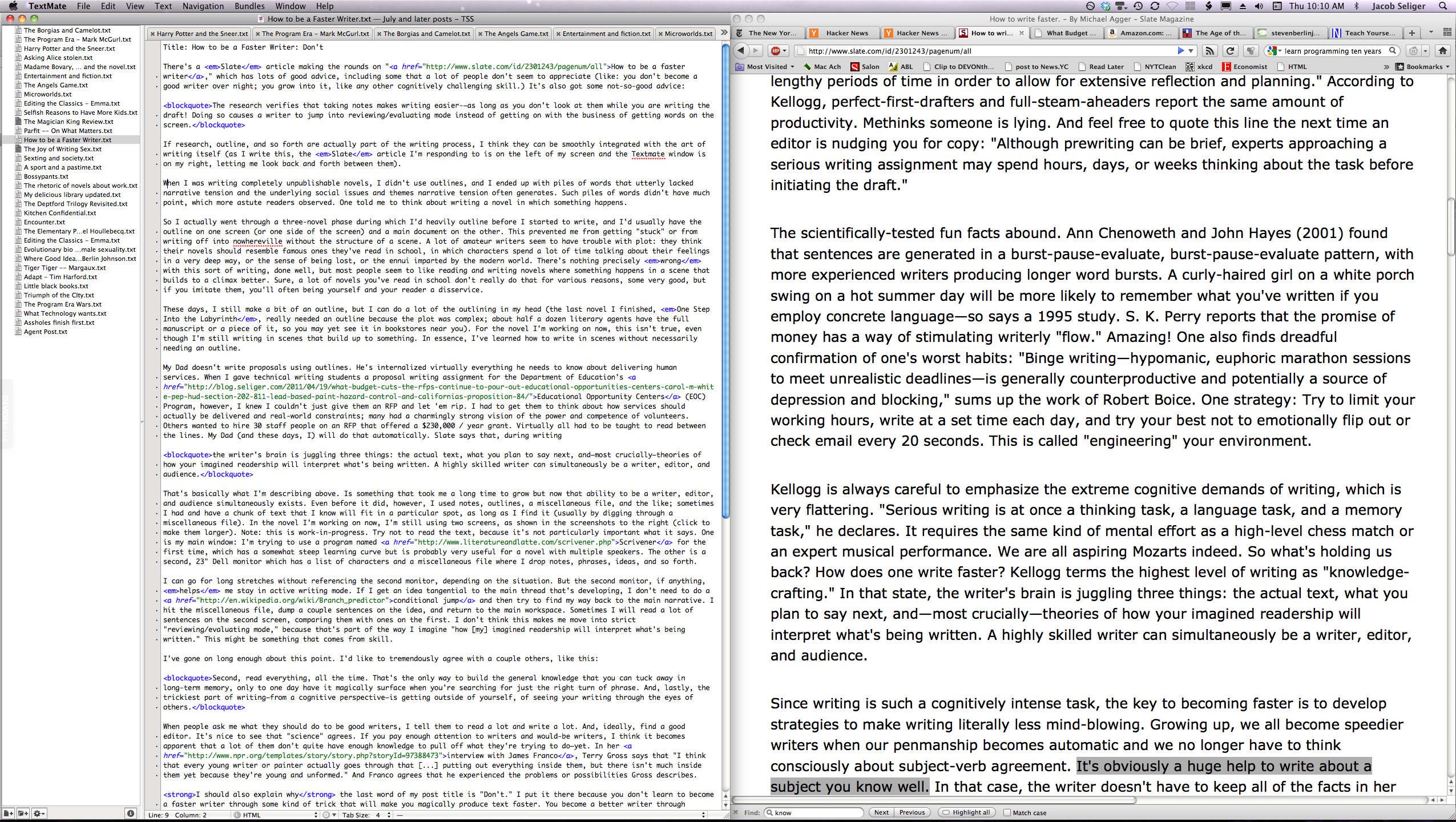
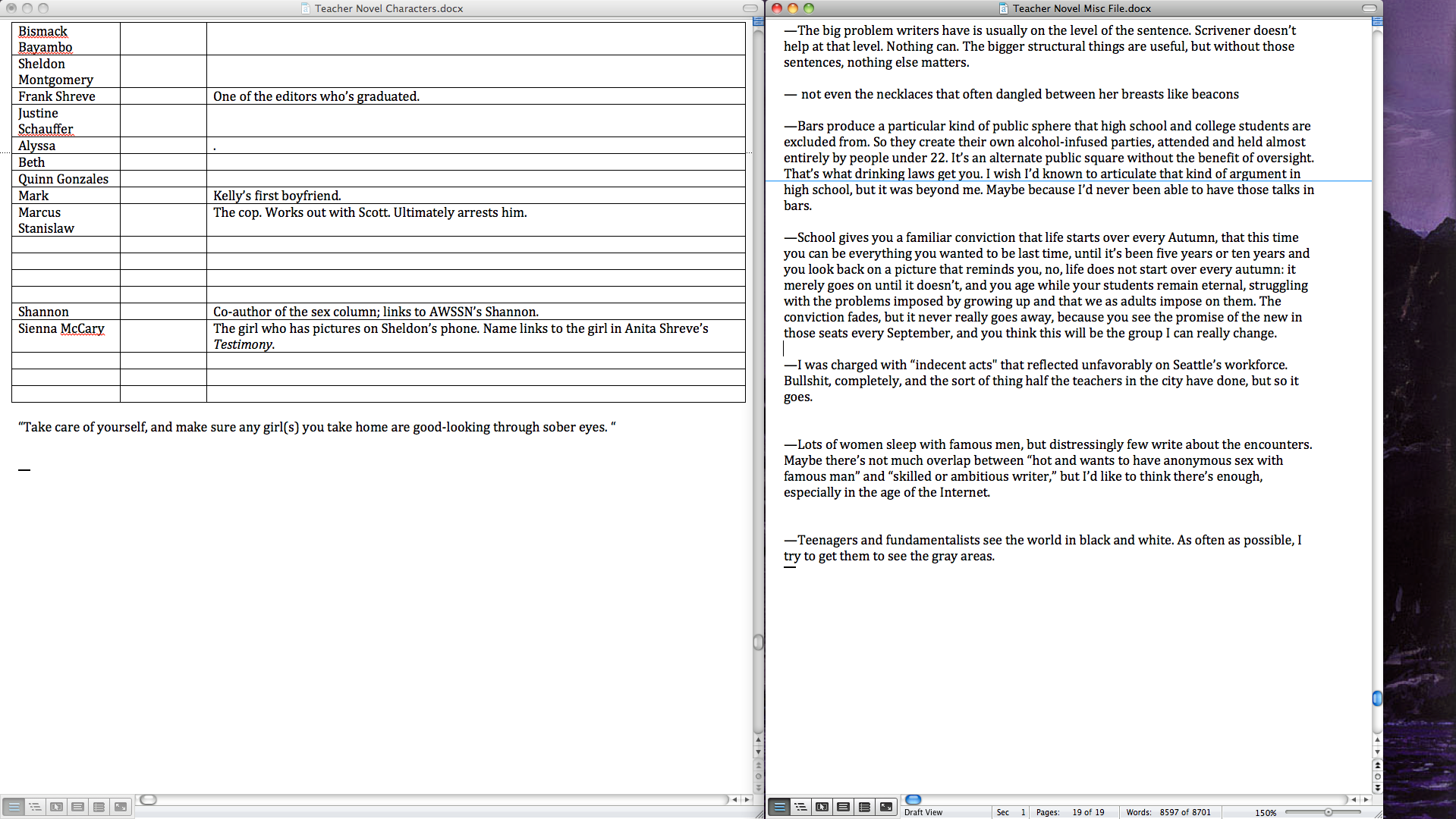
That’s basically what I’m describing above. Is something that took me a long time to grow but now that ability to be a writer, editor, and audience simultaneously exists. Even before it did, however, I used notes, outlines, a miscellaneous file, doodled; sometimes I had, and have, a chunk of text that I know will fit in a particular spot, as long as I find it, usually by digging through a miscellaneous file. In the novel I’m working on now, I’m still using two screens, as shown in the screenshots to the right (click to make them larger). Note: because this is work-in-progress, try not to read the text, because it’s not particularly important what it says and the conversation I was working on last night doesn’t make sense or have the same resonance out of context.

Anyway, as you can see, one screenshot shows my main window: I’m trying to use a program named Scrivener for the first time, which has a somewhat steep learning curve but is probably very useful for a novel with multiple speakers. The other is a second, 23″ Dell monitor which has a list of characters and a miscellaneous file where I drop notes, phrases, ideas, and so forth. I’m using Word at the moment, but I’ve used Mellel and all manner of other writing programs for this purpose. Nothing even remotely sophisticated is happening on those screens, so the word processor doesn’t matter much.

I can go for long stretches without referencing the second monitor, depending on the situation. But the second monitor, if anything, helps me stay in active writing mode. If I get an idea tangential to the main thread that’s developing, I don’t need to do a conditional jump and then try to find my way back to the main narrative. I hit the miscellaneous file, dump a couple sentences on the idea, and return to the main workspace. Sometimes I will read a lot of sentences on the second screen, comparing them with ones on the first. I don’t think this makes me move into strict “reviewing/evaluating mode,” because that’s part of the way I imagine “how [my] imagined readership will interpret what’s being written.” This might be something that comes from skill.

I’ve gone on long enough about a minor point of contention. I’d like to tremendously agree with some of the other points made in Slate, like this:

Second, read everything, all the time. That’s the only way to build the general knowledge that you can tuck away in long-term memory, only to one day have it magically surface when you’re searching for just the right turn of phrase. And, lastly, the trickiest part of writing—from a cognitive perspective—is getting outside of yourself, of seeing your writing through the eyes of others.

When people ask me what they should do to be good writers, I tell them to read a lot and write a lot. And, ideally, find a good editor. It’s nice to see that “science” agrees. If you pay enough attention to writers and would-be writers, I think it becomes apparent that a lot of them don’t quite have enough knowledge to pull off what they’re trying to do—yet. In her interview with James Franco, Terry Gross says that “I think that every young writer or painter actually goes through that […] putting out everything inside them, but there isn’t much inside them yet because they’re young and unformed.” And Franco agrees that he experienced the problems or possibilities Gross describes.

I should also explain why the last word of my post title is “Don’t.” I put it there because you don’t learn to become a faster writer through some kind of trick that will make you magically produce text faster. You become a better writer through experience and through reading. Those aren’t things you can do in a day or a week or a month. They’re things you do over years. The only way to start if you haven’t already is to start now, especially since the greatest value in writing isn’t always in writing for other people. I’ve been rereading Mihaly Csikszentmihalyi’s book Flow: The Psychology of Optimal Experience, which was even better the second time around than the first (probably because now I have the background knowledge to really grok it). He says:

[I]t is never a waste to write for intrinsic reasons. First of all, writing gives the mind a disciplined means of expression. It allows one to record events and experiences so that they can be easily recalled, and relived in the future. It is a way to analyze and understand experiences, a self-communication that brings order to them.

“A disciplined means of expression” is available to anyone, even someone with no readers. Csikszentmihalyi gets that writing isn’t just about writing: “If the only point to writing were to transmit information, then it would deserve to become obsolete. But the point of writing is to create information, not simply to pass it along. [. . .] It is the slow, organically growing process of thought involved in writing that lets the ideas emerge in the first place.” It’s about generating ideas that emerge through an attempt to express those ideas (Paul Graham says something similar in The Age of the Essay). Given that writing is about itself, we shouldn’t be as worried about how fast we’re writing; as demonstrated in Flow, when we’re really writing well we often won’t have a sense of time, because we’ll be in a moment-to-moment existence in which our task demands complete concentration and little else matters. Doesn’t that sound better than merely getting words on the page? It sure does to me.

By the way, you shouldn’t valorize writers and writing too much, because writing can have strange effects on the mind. In Michael Chabon’s Wonder Boys, Grady Tripp describes “the midnight disease” that writers suffer from,

[…] which started out as a simple feeling of disconnection from other people, an inability to ‘fit in’ by no means unique to writers, a sense of envy and of unbridgeable distance like that felt by someone tossing a restless pillow in a world full of sleepers. Very quickly, though, what happened with the midnight disease was that you began actually to crave this feeling of apartness, to cultivate and even flourish within it. You pushed yourself farther and farther and farther apart until one black day you woke to discover that you yourself had become the chief object of your hostile gaze.

And I don’t think this unique to writer: programmers, hackers, engineers, scientists, and others probably feel too: all the people who, like Gollum in The Lord of the Rings, still desire to walk free under the sun even as they are compelled to return to darkness and solitude. The solitude is what it takes to do the work: but for writers, they’re writing about people, which is odd that one needs to get away from people to describe people, but it’s nonetheless true for many of us.

By the way, most of those delicious quotes come from DevonThink Pro, but they’re still evidence that I’ve done a certain amount of reading and thinking about writing that enabled me to write this post over an hour or so (back to Slate: “It’s obviously a huge help to write about a subject you know well”). If I was 19 and writing this post, I simply wouldn’t have been able to write it. Not like this, anyway. If you look at the blog archives—I discourage you, but if you must, you must—and compare early posts to the posts I write these days, there simply is no comparison. That’s because I’ve learned how to write blog posts effectively, or somewhat effectively, anyway. I’m capable of doing things now that I simply couldn’t do then. Want to really write faster? You can teach yourself how in ten years.

La Seduction: How the French Play the Game of Life — Elaine Sciolino

La Seduction: How the French Play the Game of Life started life as a New York Times article that’s definitely worth reading and retains some of the humor of the book (sample: “The Customer Is Always Wrong”). And the way to read La Seduction is as a comedy. It’s not very deep, but there’s something hilarious about Sciolino’s ceaseless focus on the myriad forms of French seduction, which take a primarily erotic term and extend it as a metaphor throughout French life, or at least a certain segment of French life. There’s a sense of bemusement throughout the book, as when Sciolino indulges a fascination with French sexual practices:

Unlike Americans, who are forced to take up the mantle of purity just when assuming high office might give them an advantage in the sexual game, French politicians are allowed to enjoy their enhance opportunities. This reality flows from centuries of precedent. The kings took sexual seduction to new heights. There was a hierarchy to the women in their lives: wives, significant others (known as ‘favorites’), and women passing through through the court who provided fleeting adventures. To make sure no one forgets France’s royal history today, the kings’ escapades are routinely retold in cover stories in mainstream weekly news magazines.

Notice the Americanisms creeping in her prose: they’re “allowed to enjoy,” rather just “enjoy” or some other verb. They’ve been granted implicit permission to be naughty, and the words that point out that implication sound American. Sciolino takes the role of tut-tutting American even when she doesn’t mean to; whether this is ingrained in her upbringing or part of her schtick is hard to say. France comes off as wildly appealing in this book, which is perhaps as it should be. Sciolino makes it sound delightfully cultured a lot of the time; she doesn’t focus much on what it’s like not to have a lot of money in France, but I bet that would be pretty different. The threads of appeal and privilege come together at moments, like this one:

Growing up in france, my two daughters were allowed to drink legally as teenagers. Champagne was served at their senior prom. They developed a healthy respect for moderation. Perhaps the biggest cultural shock they faced in college in the United States was binge drinking.

The integration of wine into daily life starts early.

If you normalize drinking, it won’t be as much of a problem and can simply be a pleasure. I wonder too if part of the issue is development patterns in the United States: everyone, almost everywhere, has to drive everywhere. So drinking naturally becomes more of a problem, since it’s intertwined with driving. And because it’s forbidden whole institutions, like college fraternities, and cultures, like the high school kegger, grow up to enable drinking. Sciolino doesn’t go in this direction, but she could: she’s bent on staying observational. It’s amusing to watch an anthropologist at work, especially one who’s divided between admiration and distaste. We get this in Sciolino’s discussion of sexual politics, which frankly sound like a lot more fun in France:

The game of the sexes also extends deep into the workplace. In the United States, the mildest playfulness during business hours and in a business setting is forbidden; in France, it is encouraged. In American corporations, men are told routinely that they cross the line when they compliment a female employee on the color of her dress or the style of her hair. In France, flirtation is part of the job.

This also applies to universities: one has the presumed right to be free from unwanted advances, which also has the effect of frequently being free from wanted advances, since it’s hard to tell one from the other until the advance has been made. Much of Sciolino’s chapter deals with this French attitude, where so much is, in one woman’s words, “based on humor, irony, complicity, and what is left unsaid.” Sciolino continues by asking a small, unrepresentative survey of women “whether they are outraged by the perpetual game of seduction in their professional lives. I found that if American women engage in a perpetual battle of the sexes, French women are more likely to collaborate with the opposite sex.” The battle is a game: notice the difference in metaphors. She goes on to say that “The most exasperating thing I heard was that there are no fixed rules. You just have to intuit them, as if you are feeling your way up a vertical rock formation.” Dealing with ambiguity is hard, but, to some people, fun. Yet social rules are notoriously hard to encode; if they weren’t, there wouldn’t be innumerable advice columns advising people on social issues. When you encode a rule like “don’t comment on someone’s shirt,” you get a presumed benefit—someone who doesn’t wish to be complimented on his shirt doesn’t have to be—and a presumed drawback—someone who wishes people would notice her shirt finds that they don’t. One could say that American sexual politics are more rule-based and business less so, while the French do the opposite.

One hundred and fifty pages later, we’re still talking about the sex thing:

[Carla Bruni] didn’t seem to care what others thought of her. She reportedly told Michelle Obama that she and Sarkozy had been late to meet a foreign head of state because they were having sex, a story recounted by journalist Jonathan Alter in his book The Promise. ‘Bruni wanted to know if, like the Sarkozys, Michelle and the president had ever kept anyone waiting that way,’ Alter wrote. ‘Michelle laughed nervously and said no.’ “

It’s hard not to laugh at this paragraph, not just for the reason, but for the question that implies a shared intimacy that evidently has not quite developed, based on the adverb “nervously;” indeed, the whole book makes France sound intensely comic in a way I’d never considered before. If you want to have the stereotype that French people are busily drinking wine, having sex, and discoursing about philosophy, this is not the book for you: although Sciolino takes time to cite statistics about the fall in wine consumption (50% of earlier highs) and the prevalence of fast food (more than 1,000 McDonald’s are open for service in France), the overall feel of the anecdotes is toward whispering about sex and outrageous dalliances, even if said things are more whispered about than done.