Links: Nicholson Baker, college students drink, college students wear short skirts (a feminist perspective), risk-taking, the “left,” publishing, and more

* I’ll Have What He’s Having: Breaking bread with Nicholson Baker, America’s foremost writer of literary sex novels, by Katie Roiphe, whose book The Morning After: Sex, Fear, and Feminism I admire.

* News flash: college students like drinking because it alleviates social anxiety and enables hooking up. I’m tempted to post the video someone took from a couple weeks ago when my team lost at flip cup.

* Leading off the link from above, Smart Girls Wear Short Skirts, Too: Stop Complaining About College Students.

* Reaping the Rewards 0f Risk-Taking, which includes this bit about how many nations lack “a social environment that encourages diversity, experimentation, risk-taking, and combining skills from many fields into products that he calls “recombinant mash-ups [. . .]” ” This is the kind of stuff I want to do and promote in both the fiction I write and classes I teach.

* College football as seen by a (British?) person acting as an anthropologist.

* Born, and Evolved, to Run.

* Articles like Why won’t America embrace the left? annoy me because they’re dumb. Michael Kazin wrote a book about the left, leading to his interview, in which he says things like, “Americans want capitalism to work well for everybody, which is somewhat of a contradiction in terms since capitalism is about people competing with each other to get ahead, and everyone’s not going to be able to do well at the same time.” That’s not really true: capitalism is about a) finding something you do that you want to do and b) producing goods and services other people want enough to pay or barter for. If you don’t make something users want, you have to make something else. Maybe users should want different things, but that’s a separate argument. He also says things like, “The ideas are that if you work hard you can get ahead and that it’s better to be self-employed than employed by the people.” But think of how many Americans have immigrant parents or grandparents for whom that is exceptionally true. Mine fall into that category. Kazin mostly sounds like someone who’s never actually run a business.

If the left believes people like Kazin, we shouldn’t be surprised that America won’t embrace it. But there are smart people on the left, like Tony Judt, and maybe they aren’t getting enough airtime.

* There’s a fabulous interview with Mark McGurl in which he discusses The Program Era, I book I would’ve liked to write in detail about but got so involved with that the writing in this space went away. But you should still read the book! Especially if you’re a writer or would-be writer.

* By the Time A Self-Published Author Hits it Big, Do They Really Need a Publisher? Answer: probably not. Yet. Keep an eye on this space: you may yet see me wade into the self-publishing pool. And:

For publishers, here’s the nightmare publishing path for authors of the future: Author signs with traditional publisher for first book, author hits it big, author says thankyouverymuch I got this now and self-publishes from then on out.

* Speaking of publishers, “Amazon.com is so well positioned to sell digital files that one glance at their list of Contemporary Fantasy bestsellers shows one unsurprising fact: It’s not dominated by books put out by New York publishers.” That’s from “The rising ebook wave,” which I might be joining in the next six months to one year.

* When To Ignore Criticism (and How to Get People to Take Your Critique Seriously).

* The “overlearning the game” problem.

* The Tyranny of Silly Expense Control Rules; notice the comment from yours truly.

* The Freelance Surge Is the Industrial Revolution of Our Time. A lot of academics in the humanities appear to be completely missing this.

Links: Nicholson Baker, college students drink, college students wear short skirts (a feminist perspective), risk-taking, the "left," publishing, and more

* I’ll Have What He’s Having: Breaking bread with Nicholson Baker, America’s foremost writer of literary sex novels, by Katie Roiphe, whose book The Morning After: Sex, Fear, and Feminism I admire.

* News flash: college students like drinking because it alleviates social anxiety and enables hooking up. I’m tempted to post the video someone took from a couple weeks ago when my team lost at flip cup.

* Leading off the link from above, Smart Girls Wear Short Skirts, Too: Stop Complaining About College Students.

* Reaping the Rewards 0f Risk-Taking, which includes this bit about how many nations lack “a social environment that encourages diversity, experimentation, risk-taking, and combining skills from many fields into products that he calls “recombinant mash-ups [. . .]” ” This is the kind of stuff I want to do and promote in both the fiction I write and classes I teach.

* College football as seen by a (British?) person acting as an anthropologist.

* Born, and Evolved, to Run.

* Articles like Why won’t America embrace the left? annoy me because they’re dumb. Michael Kazin wrote a book about the left, leading to his interview, in which he says things like, “Americans want capitalism to work well for everybody, which is somewhat of a contradiction in terms since capitalism is about people competing with each other to get ahead, and everyone’s not going to be able to do well at the same time.” That’s not really true: capitalism is about a) finding something you do that you want to do and b) producing goods and services other people want enough to pay or barter for. If you don’t make something users want, you have to make something else. Maybe users should want different things, but that’s a separate argument. He also says things like, “The ideas are that if you work hard you can get ahead and that it’s better to be self-employed than employed by the people.” But think of how many Americans have immigrant parents or grandparents for whom that is exceptionally true. Mine fall into that category. Kazin mostly sounds like someone who’s never actually run a business.

If the left believes people like Kazin, we shouldn’t be surprised that America won’t embrace it. But there are smart people on the left, like Tony Judt, and maybe they aren’t getting enough airtime.

* There’s a fabulous interview with Mark McGurl in which he discusses The Program Era, I book I would’ve liked to write in detail about but got so involved with that the writing in this space went away. But you should still read the book! Especially if you’re a writer or would-be writer.

* By the Time A Self-Published Author Hits it Big, Do They Really Need a Publisher? Answer: probably not. Yet. Keep an eye on this space: you may yet see me wade into the self-publishing pool. And:

For publishers, here’s the nightmare publishing path for authors of the future: Author signs with traditional publisher for first book, author hits it big, author says thankyouverymuch I got this now and self-publishes from then on out.

* Speaking of publishers, “Amazon.com is so well positioned to sell digital files that one glance at their list of Contemporary Fantasy bestsellers shows one unsurprising fact: It’s not dominated by books put out by New York publishers.” That’s from “The rising ebook wave,” which I might be joining in the next six months to one year.

* When To Ignore Criticism (and How to Get People to Take Your Critique Seriously).

* The “overlearning the game” problem.

* The Tyranny of Silly Expense Control Rules; notice the comment from yours truly.

* The Freelance Surge Is the Industrial Revolution of Our Time. A lot of academics in the humanities appear to be completely missing this.

Lovers, writers, and scheduling

A friend who I’ll call “Heather” was describing a common problem among artistic types in their teens and 20s: she wants time to write, but she also wants time for sex, and sometimes the time that might be spent on the former gets slotted into the aftermath of the latter.

“Gets slotted into the aftermath of the latter” is a strange phrase I should explain further: Heather said that she’d invite a guy over after she gets home from work and they’d make dinner, and hang out, and watch a movie, and chat, and get down to it; all these activities necessarily took all night, while I got the impression she was most interested in one of them. Heather also said she’d feel bad about giving a guy the boot on a Saturday morning after he’d stayed over on a Friday, instead of spending most of the day with him. But she also wants to be a writer—would-be writers tend to clump—and she said she’d also feel bad if an entire week had gone by without her managing to accomplish anything because she’s busy running from work to guy to sleep back to work, leaving no time for any substantial projects of her own.

The solution seemed obvious to me, but I have a fair amount of experience in this department, and, as with many matters romantic, the honest and simple solution is often best. Instead of inviting someone over as soon as you get home from work, say, “I’ve got an hour between eight and nine. Bring a bottle of wine.” Or, if you’re more direct, just say, “I’ve got an hour between eight and nine. Come over.” As New York Magazine’s sex diaries series makes clear, this is not unusual or unreasonable behavior. On a weekend, you do your morning thing—like E does in that one episode of Entourage*—and say something like, “I’m going to start writing. You need anything?” If the answer is no, start writing. If the answer is yes, and if it’s concrete, do something about it. Ignore the pouting that may result (more on that below).

Heather and I chatted some more and it came out that the problem is not really the simple stuff—it’s what Heather worried that her actions said about her and/or the guy she’s dating. To me, saying, “Hey, I’m going to start writing this morning” doesn’t say anything other than, “I want to get some writing done.” To her, however, it says a host of other things bound up with femininity: that she can’t be a person who might be perceived as an “easy lay,” whatever that means; that she has to want to develop a deep relationship quickly; that a “deep relationship” means spending nearly every waking moment outside of work with someone; that two people can’t see each other for an hour and still care about each other. She kept saying things like, “I can’t do this to someone!”, until I said, “Your language is all wrong. You’re not doing to someone. And the guy might be happier anyway.”

It turns out she’s internalized social norms into some voice in her head. We talked about that some, and she said—by this point I realized there was a solid blog post in our conversation—”I know what I want. I want it now. Then I’ll create a block: ‘No, you can’t.’ ” The answer, of course, is that she can. And it’s not even really Heather doing it to Heather: it’s what she imagines other saying about her: “You know what gets me into trouble? Other girls. We are a factory of bullshit.” My observation: she just needs to stop caring what she imagines other girls think and how some vast cultural narrative of how relationships works. Because real relationships seldom fully work like they’re supposed to (which is why Dan Savage coined the term “monogamish,” which I just taught Textmate how to spell). Heather said that she feels like if a relationship or hookup isn’t serious, if a girl isn’t being treated in a certain way (whatever “a certain way” means)—it’s automatically bad. But why? There isn’t a great answer.

Philosophy is good at digging underneath assumptions, and so are teachers; while we were talking, I was basically digging at assumptions. After Heather figured out what was going on, she wanted to know: “How do I avoid this shit?” I didn’t have a perfect answer, because it would be something like, “Internalize some of the feminist arguments about cultural conditioning,” which isn’t an easy or short-term process. A more practical, immediate approach is to be conscious of it. Tell yourself: you can make boundaries. The whole argument about, “Am I getting taken advantage of?” go away. Heather feared what others would think of her. That’s a status question, and once you become cognizant of the status games people play you can, I hope, become like Neo when sees through the Matrix and learns to manipulate the fabric of perceived reality itself. You can’t be taken advantage of if you’re getting what you want and giving someone else what they want.

Besides, I told Heather something important: “You are not like other girls: you want to be an artist.” Other girls can be perfectly happy wasting an infinite amount of time sitting in their boyfriends’ or fuck buddies’ apartments (which I know, having been on the receiving end of the sitting treatment before I knew better) not doing anything. If you want to be an artist, you can’t do that, or you can’t do it all the time.

Note that this isn’t an argument for not spending time with another person, or for avoiding intimacy, or for any number of misreadings I can already imagine. It’s an argument for recognizing priorities and for realizing that work, sex/love, sleep, and being an artist can coexist, if you want them to. The trick, of course, is sticking to your offers. When nine rolls around, say, “I’ve got to go to work in the morning.” If the guy (or girl) doesn’t take the hint, say, “I’ve got to got to work in the morning—you should take off.” Very few people will refuse, for obvious reasons, especially if you remain firm.

Heather observed that she was worried she’d get attached to a guy who wasn’t attached to her. It’s not an illegitimate fear, but my response to it was simple: so what? The sex in the meantime is probably better than none. Being the kind of person she is, Heather observed that, if she gets attached and the guy doesn’t, she still gets a net Pareto improvement, demonstrating that, as Dan Ariely and Tim Harford have shown, economics does apply to love. And she’s right. There’s been a spate of dumb movies about what happens when people in their teens or twenties who start out mostly just having sex develop feelings; No Strings Attached and Friends with Benefits are the most recent I’m aware of, although there are doubtlessly others. People who’re just doing it often develop feelings. And if they don’t, that’s okay too.

Look: you don’t need to have a stopwatch next to your bed, couch, chair, or kitchen table, and no one wants to feel like they’ve been scheduled into a slot. Or they don’t want to in the heat of the moment. But it’s also reasonable, if you’re an artist or want to be an artist, to make time for your work. You can find a million posts and essays and so forth like “Find the Time or Don’t” (which is John Scalzi’s version) that all say what his title says: people who find writing (or other art) valuable will find time to do it. Those who don’t, won’t. But you shouldn’t have to compromise on your love life. And you don’t, which I pointed out to Heather. You can be reasonable about time: you don’t need to fit someone in a “slot” every day, and it’s reasonable to spend an hour hanging out when you wake up on a Saturday. If you’re a writer, you can also involve your “friend” by asking him or her to read your work, since almost everyone knows how to read even if many people are effectively aliterate. If you’re reading this, you’re highly unlikely to be aliterate, but there’s a decent chance you’ve also slept with someone who has been. While their comments might not be as helpful as an editorial assistant for a literary agent, who I’ve been told are good to sleep with for multiple reasons, reading tens of thousands of words also takes at least a couple of hours, during which you, the writer, can produce some more words.

Even if you can’t get that person to read, after an hour or so you can get up, make breakfast (if you need to), and say, “I’m going to start writing. Do you need anything?” If the person says yes, and it’s a small task (“I need potato chips”), give it to them, and if they say no, start writing. If the person interrupts you with questions like, “What did you think of The Social Network?” Turn and stare at them for a good three to five seconds. Say, “I don’t know” or “I don’t care” and go back to writing. They’ll stop interrupting you. Print a copy of “A Nerd in a Cave” if the need arises. If they’re bored and don’t have anything to do, suggest they go home; meet up with them later in the evening, perhaps with new pages for them to read.

The danger is lounging in bed for two hours, then going for a leisurely brunch, then coming back to “hang out” (assuming “hang out” is not a euphemism for something more fun), then going to Bed Bath & Beyond (which is like death itself condensed into one shiny, plasticized place), then you find it’s 5:00, which means you’re going to meet some friends for a drink, or you promised your family you’d have dinner with them, or the person who you found in your bed that morning wants you to have dinner with their family, and so on. The occasional day like that is obviously okay. Having every weekend day like that while you work a weekday job means that you’re not going to get any real writing done, and any kind of writing can only be done one keystroke, one word at a time. So if you don’t guard your time to some extent, you’re going to let it through your hands until you wake up and realize that you haven’t accomplished whatever you wanted to accomplish, and the fault is your own.

The other extreme—simply saying, “no sex while I do this”—sounds even more unpalatable than having someone slurp your entire weekend into nothingness, and I suggested to Heather that one can have both. If, of course, you’re willing to set boundaries. In her case, that meant understanding the social conditioning she’s had, which implies that a) she always has to be on the hunt for a “serious” relationship, b) that she needs to play games to gauge a guy’s commitment, c) that feelings might be hurt by her having other interests, and d) that the person you’re sleeping with has to be at the entire center of your being. None of those have to be true, but when they’ve been ingrained since, if not birth, then your advent into American culture,

None of this is especially true: feminists have been saying stuff like this for years. Virginia Woolf wrote A Room of One’s Own. But the conditioning remains, and if you’re not willing to dig underneath the assumptions that are preventing you from doing what you need to do, you might also simply not have the tools to be a writer. Heather does, from what I can tell, and if she has those tools, she should also be able to apply them to the conditioning she’s undergone as a member of our society. She once said, “I can’t help it. I’m a girl. Our foreplay starts 12 hours before the actual sex.” That might be true, but she can help it, or re-channel her energy, or take other steps to make sure she’s not wholly bound by other people’s desires. I’m merely pointing out to her that it’s possible for her to do so.

If it’s possible for her to do so, it should be possible for you to too.


* Found it: Season 2, Episode 2, “My Maserati Does 185.” Worth watching for, uh, educational purposes.

Sugar in my Bowl: Real Women Write About Real Sex — Edited by Erica Jong

Sugar in my BowlI can’t really generalize about the pieces in Sugar in my Bowl other than to say that most have a quality of the forbidden about them. Michel Foucault famously argues in The History of Sexuality that we’ve always talked about sex and that the “regressive hypothesis,” which holds sex can’t be discussed, is wrong. But I think he’s wrong, or at least wrong regarding the United States: it’s still difficult for many people, especially women to speak and write of sex, which is why Erica Jong—the editor of Sugar in my Bowl—can cite what amounts to a version of the regressive hypothesis in her introduction. Maybe we’re now collectively allowed to express all kinds of sexual signs, but moving from physical expression of signs like the ones seen in movies and porn to intellectual analysis is or feels forbidden. What happens in the mind is so intimate relative to what you’ve got under your clothes. Anyone can shuck their clothes, and Victoria’s Secret has built a massive business on the promise that most of us will, but relatively few people have the ability to really express what’s happening in their minds. Susan Cheever writes that “A one-night stand is the erotic manifestation of carpe diem—only we are seizing the night instead of the day,” but one has to wonder: how many people have felt precisely that and never found the words to express it?
Without the words to express it, one can’t create the writing that will allow others to feel empathy. I don’t buy the school of thought that holds men and women can’t fundamentally understand each other, or that either sex is incapable of writing characters from the other effectively in fiction. People who want to learn what other people are thinking will find a way to do so, and, if they’re good, they’ll be able to reproduce what other people are thinking. There’s a cultural meme, for example, that women automatically “give up” sex to men who “take” it from women. While that no doubt describes many encounters, especially first encounters, it doesn’t describe all of them. Consider Anne Roiphe describing her first, or what I assume to be her first, time, after playing doctor with a boy as a child:

Years later when Jimmy and I were thirteen we were kissing in the dark at a party. We were sitting on a table in my classmates’ living room. Couples were curled up together in every corner of the floor, despite the fact that the carpet was rough and scratchy. Louis Armstrong was playing softly in the background. Abandoned in a corner was the Coke bottle that had begun it all. It was a game of spin the bottle that had brought Jimmy and I to the moment. ‘Do you remember,’ I said, ‘when we played doctor.’ ‘Yes,’ he said. ‘Do you have hair there now?’ he asked. ‘Yes,’ I said. ‘I really need to see it,’ he said. We found a closet. I showed him. He showed me his penis, larger, straight penis, full of some mysterious fluid.

This isn’t merely a my-first-time description (although it is that too), which litter memoirs and the Internet like discarded water bottles after a concert. It’s her way of delving into what’s nominally about the development of sex but really feels like the growth of an artist:

The thing about sex is that each act while different from the other even with the same person, even with the same person for forty years, is not a single act. It builds on the sex the night before, the year before, the decade before. Sex is a matter that unfolds like an accordion in the brain, the past is connected to the near past to the present and the future stands there waiting to be attached. So the feeling in the body, the feelings for someone else, the excitement of the new or the welcome of the familiar rises and falls, depends on memory, gains its depth from what happened at the beginning, a while ago, in the imagination, in reality.

You get older, you try things, you realize that, say, writing “is not a single act,” that it “builds on the [writing] the night before, the year before, the decade before.” Experience makes you good, and, although, there’s a sense that experience contrasts with innocence and is somehow bad, Roiphe doesn’t buy it. Neither do many of the writers in Sugar in my Bowl. They’re too heavily thinkers to buy the bullshit, and when thinkers break down their lives, they realize how much more valuable experience is than ignorance. It’s ignorance, and the celebration of it, that they’re really fighting, collectively, through writing, which is a powerful and impressive thing if you take the time to think about it. Maybe even more powerful than sex, which is their putative subject and the one that branches into so many other subjects; as so often happens, writers inevitably write about other things while they nominally write about one. Those “other” things can’t help being present to those who care to look. Susan Cheever writes, for example, “Sex feels like a series of shared secrets, a passage through a maze leading to the most wonderful feelings available to human beings.” But it’s so often hidden, and hidden deliberately, that one might ask why something wonderful must be “a passage through a maze,” unless seeking is part of the finding. Others want it to be religious, like Fay Weldon when she says:

I have been convinced not just of the significance and marvel of sex, but also of its sanctity, and its healing power, and the importance it plays in our lives, and how it is wrong to deny this. And if for a time thereafter, as I fled from bed to bed in search of love, I became a positive priestess of Aphrodite, it was not for long. I had a baby, as I was bound to, and steadied up. The psychoanalyst told me I suffered from low self-esteem, but my version is I was just born to like sex, and inherited the tendency from my father.

Notice the “sanctity,” the way she becomes a “priestess,” and the way she might not be in full control of her sexuality—she’s is “just born to like sex.” So if she did it, she did it, and so what?

There’s a wide and funny drift of self-knowing hypocrisy in these essays, many of which feel like the writer is talking to their younger selves, as when Ariel Levy says: “I smoked pot when I was twelve. I dropped acid when I was thirteen. Losing my virginity was the next logical step. It’s not like these things were necessarily fun. Well, the pot, actually, was great—unless you are reading this and you are twelve, in which case it was awful.” This reminds me of the first weekend I smoked pot, in high school (it wasn’t great: I don’t much care for the feeling, although I understand that many others do). The next week, a friend said she was going to the elementary school a block from my house to talk about D.A.R.E., which is a dumb and ineffective program. She invited me to go with her. Most importantly, this got me out of a couple classes. I went, spouted platitudes, felt like the world’s most terrible hypocrite. When we left, I told my friend about my experience with pot. She said, “I got wasted this weekend.”

So far as I know, we both turned out reasonably okay. So why not admit, unabashedly, “the pot, actually was great,” and leave the qualification out? I can imagine reasons, like the ones Megan McArdle pointed out:

In my experience, the big dividing line [between favoring drug legalization and not favoring it] is having kids. Read this interview with P.J. O’Rourke and discover some shocking things coming out of his mouth about how he doesn’t want his kids to do drugs. Having kids makes you realize how narrowly you escaped killing yourself–and remember all the friends who overdosed, or got arrested on a DUI, or spent their twenties working at a job that would let them smoke up three times a day, only to realize at age 35 that they had pushed themselves into a dead end. [. . ..]

in my experience, as the kids approach the teenage years, a lot of parents do suddenly realize they aren’t that interested in legal marijuana any more, and also, that totally unjust 21-year-old drinking age is probably a very good idea.

That’s not a good intellectual argument, but it is a very persuasive one that explains why we are where we are. (Does Levy have children, I wonder?) Still, Ariel’s line is funny precisely because of the discomfort she experiences at imagining a twelve year old wanting to follow in these particular footsteps.

I like Sugar in my Bowl more than it probably deserves, which may say more about my present preoccupations and less than its absolute merit. But, as I said above, while the anthology has the drawback of anthologies it also has the virtue: any piece that doesn’t resonate is only a few pages from being done and is easily skipped. And if you don’t care for reading a collection primarily about sex, you can also read it for what it says about history, relationships, politics, and writing. Jong thinks it’s also important because it equalizes an unlevel playing field some; she writes about

the fear some potential contributors had that they would not be taken seriously if they wrote for my anthology.

Anaïs Nin had made exactly the same argument in 1971 when I asked her why she allowed her diaries to be bowdlerized for publication: ‘Women who write about sex are never taken seriously as writers,’ she said.

‘But that’s why we must do it, Miss Nin,’ I countered.

And that is why we must do it. We must brave the literary double standard.

I can’t tell if she’s right, though she sounds the same note in the “Acknowledgments” section, where she writes that “Women who write about sex still get no respect—but we don’t give a damn!” Really? I don’t think I’d take someone less serious for writing about sex or not writing about it; Jong sounds certain that it’s true, however, and I wonder: who is giving the respect needed here? And, if someone is giving this respect, is it actually worth having? Isn’t an assumed position on the outside of some presumed literary establishment a necessary precondition for eventually getting in the literary establishment? The questions presume the answers, and, by creating this anthology, Jong does imply that 1) she can probably get more respect with it than without and 2) writing about sex is probably more literarily respectable now than it ever has been.

Keeping Romance Alive in the Age of Questionable Journalism

Keeping Romance Alive in the Age of Female Empowerment is a somewhat dumb article about women who earn more than their partners, or who earn enough to apparently “scare off” guys with inferiority complexes or generalized fear; I started laughing when I read this bit: “Ms. Domscheit-Berg, who is also active in the European Women’s Management Development International Network, has three bits of advice for well-paid women: [. . .] And go after men who draw their confidence from sources other than money, like academics and artists.”

I sent this to a couple friends, one of whom replied, “Perhaps men are simply afraid of someone named Ms. Domscheit-Berg. I bet she yells Achtung! in bed….. just saying.”

Besides, who really cares if one’s partner earns more, as long as you yourself are doing real work (that might, of course, just be the artist in me). The quality of one’s life is seldom measured in dollars, or dollars alone.

Bernard Prieur, a psychoanalyst and author of “Money in Couples,” says men who earn less than their partners struggle with two insecurities: “They feel socially and personally vulnerable. Socially, they go against millennia of beliefs and stereotypes that see them as the breadwinner. And the success of their partner also often gives them a feeling of personal failure,” Mr. Prieur said in the November issue of the French magazine Marie-Claire.

I suspect a couple of things: 1) that, to the extent this is a real problem and not another bogus trend story in the New York Times (well-documented at the link), the women involved aren’t unhappy about money, per se, but that they feel like they’re dating a guy who’s too much of a beta for them. 2) The guys involved are not actually worried about money, per se, but about something else, and are using money as an excuse for something else.

The “bogus trend story” issue, however, is a real one, because the most conspicuous absence in this article is data. Katrin Bennhold writes, “There is a growing army of successful women in their 30s who have trouble finding a mate [. . .]” but cites no evidence that this is true. So romance might be alive, but journalism, on the other hand. . .

“You can do other things between the fun bits, you know”

A friend and I have an arrangement to exchange whatever substantial work we’ve written each Friday. It’s like an MFA program, without the pretension. She missed a week, saying:

Nice weather and boys, extension required.

Having some knowledge of such situations (as long as you replace “boys” with “girls”), I replied:

In my experience, you can only spend so much time in the sun before you burn and so much time in bed before, well, you need to do something else in the interim. If that latter bit weren’t true, we probably wouldn’t have iPhones, civilization, and all the other things that make the modern world wonderful or horrible or both.

Yeah, Freud got there first, but so what?

"You can do other things between the fun bits, you know"

A friend and I have an arrangement to exchange whatever substantial work we’ve written each Friday. It’s like an MFA program, without the pretension. She missed a week, saying:

Nice weather and boys, extension required.

Having some knowledge of such situations (as long as you replace “boys” with “girls”), I replied:

In my experience, you can only spend so much time in the sun before you burn and so much time in bed before, well, you need to do something else in the interim. If that latter bit weren’t true, we probably wouldn’t have iPhones, civilization, and all the other things that make the modern world wonderful or horrible or both.

Yeah, Freud got there first, but so what?

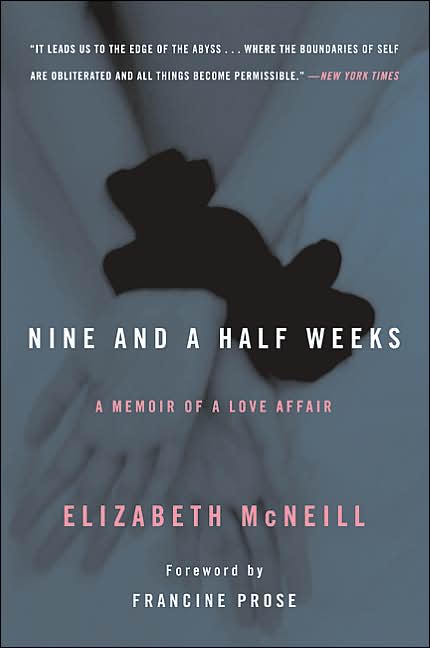
Nine and a Half Weeks: A Memoir of a Love Affair — Elizabeth Mcneill

Most novels (and memoirs) leave you with a sense of distance, a sense of being at a comfortable remove. Nine and a Half Weeks doesn’t: it’s too graphic, too immediate, too flat. One sees this effect in the first sentences, without any preamble as to who these people are and how they came to be: “The first time we were in bed together he held my hands pinned down above my head. I liked it. I liked him. He was moody in a way that struck me as romantic; he was funny, bright, interesting to talk to; and he gave me pleasure.” One senses quickening thoughts and pulses in those short sentences, and even in the long one, where semicolons could be periods, and the last descriptor—”he gave me pleasure”—is the really important one. You don’t get the very ironic tone of a book like Alain de Botton’s On Love, letting us see that love is irrational but really understandably so. Alain, the narrator of On Love is basically a needy, endearing, neurotic weakling; his self-consciousness contrasts so much with the man in Nine and a Half Weeks that they’re practically different species.

There are clever phrases in the memoir, as when the narrator says of her lover, “His face turns attractive when he talks;” I like the strange word choice, as if the head is physically turning, or as if he has two, or multiple, faces. A few moments are archaic—the man describes a friend or rival coming over as “This dope” (emphasis in original), which hasn’t been currently slang in decades and stands out in a book that otherwise stands out for not being part of any particular time. The prose holds up, and the narrator has an eye for tedious rituals, as when she tells of a “statistical tale,” where the contrast of statistics and narrative stands out:

In the middle of the statistical tale he’s requested from me—brothers and sisters and parents and grandparents, hometown, schools, jobs—I stop and close my eyes . . . please, I think, inarticulate even in my own mind, unable to turn to him and make the first move, please . . .

There’s a pervasive fear of dullness running through the memoir. The narrator notes that she and her lover looked like “An attractive, well-educated couple in New York City, average, middle-class, civilized.” That contrasts with what came before and will come after. Or does it? The memoir teases us by making us wonder if the the narrator isn’t so unusual as public discourse would make her out to be. I think the story’s flatness, the unwillingness to engage in direct commentary on what’s happening, points us in this direction, as when the narrator says, “I am standing, nearly on tiptoes, across the room from him, my arms raised above my head. My hands are tied to the hook on the wall on which his one large painting hangs during the day.” She’s hung like a painting and enjoys it. There is no further morality or analysis. Sixty Minutes plays in the background, a reminder of the middle America the narrator feels like she’s leaving behind even when she imagines it as a foil to her own actions.

Images repeat through the memoir. Scarves reappear. The words “like” and “love” are reconfigured like body parts. One senses Nabokovian echoes in the prose that one distantly hears on the first read but can’t make out. The narrator also feels her internal sense of self discombobulating, like a washing machine that shakes itself apart from within. She knows this is happening and imagines the reactions of otherwise course, until she writes of her experience.

We don’t know what the narrator wants beyond the obvious: sexual satisfaction. That she might only want the obvious might be the most frightening thing of all. What if everything else she has—a job, presumed communal respect, literary and political opinions—don’t matter very much? What if your real self isn’t those frontal cortex developments, but something deeper, more primal? I find posing the questions unsettling. The answers implied by Nine and a Half Weeks are more so. The patina of everyday experience conceals so much, especially in the realm of inchoate desire that social life is designed to channel. What happens when the channeling breaks? What happens when we want it to break? I’m reminded of Donna Tartt’s The Secret History, which also features the discarding of the mind in pursuit of a mental state or feeling very unlike the one most of us presumably inhabit most of the time—the mental state worried about how much money we have, what other people think about us, whether we’ll get the job / life partner / degree / accommodates of our dreams.

The narrator likes the man’s dominance above all other traits, which derive from that dominance. He says of a friend or rival, “he’s got no guts whatsoever.” Note what she likes in the contrast he offers by comparison. He shows mastery by reading Gide in French and Kafka in German, both implying continental expertise and sexuality. Some moments are obvious, as when the narrator reads with “his thick pen solid and comfortable in my hand.” One doesn’t need to be Freud to imagine that the pen is not just a pen. In the same scene, the narrator says, “I write the letter (‘. . . met this man a few days ago, nice start, very different from Gerry, who’s more than happy with Harriett these day, you remember her . . .’)” (sic). The dig at her ex-boyfriend is subtle but present: he isn’t dominant, won’t tie her up, and presumably has settled with a lesser woman.

He demonstrates great knowledge too: “[. . .] whatever else he may do [in] it, this man clearly does read his original-language books in bed; why would anyone want to miss out on one of the most satisfying pleasures available? All he’d need is a better bulb, a few more pillows, and a reading lamp. . . .” The room sounds sad and denuded, but it doesn’t matter much, even if the narrator is right about beds, which are good for more than just sleeping and that other thing. He offers commands, as when the narrator says:

He guides my hands between my legs and says, ‘I’d like to watch you make yourself come.’

He is sitting idly, comfortably, one leg crossed over the other, the creases sharp in the freshly cleaned suit. I do not try to move my hands. He waits. ‘You don’t understand.’ My voice cracks. ‘I never . . .’ He is silent. ‘I’ve never done that in front of anybody. It embarrasses me.’ “

She does, of course. That it embarrasses her is part of the point. What embarrasses her in the moment becomes the fodder for memoir, even under a pseudonym, long after. She likes giving power to him, which she does by letting him watch her masturbate. She also does by repeating how much she loves him, but I don’t think he ever says it back. It’s like he doesn’t need to, and by withholding the confirmation of his love he creates a neurotic fear in her. Only at one moment does he crack, when “All at once he is a decade my junior, a very young man asking me to have a drink with him, expecting to be refused.” But that doesn’t last long. Little does in this memoir, including their relationship, whose duration is given away by the title. But the narrator learns a lot in a short period. She says, “If you’ve never screamed, out of control, you can’t imagine how it feels. Now I know how it feels, it’s like coming.” She never goes the Biblical or mythological root and thinks there are things we shouldn’t know. For her, all knowledge is knowledge.

You can see that McNeill’s memoir doesn’t sit well with current ideals of equality and mutual respect in all fields. As Laura Kipnis says in “Off Limits: Should students be allowed to hook up with professors?” for Slate.com, “Feminism has taught us to recognize the power dynamics in these kinds of relationships, and this has evolved into a dominant paradigm, the new propriety.” Feminism has taught us to recognize power dynamics, but it should also teach us to recognize points of view. The narrator gets this; she thinks the man’s room is “too plain to be called plain. It’s austere, if you want to be charitable, or chic, if you want to be snide, or boring, if you want to be honest. It is not, in any event, a room you’d call cozy” {McNeill “Love”@9}. So the narrator is aware of angles, points of view, possibilities. I’ve been told I use “or” a lot in my own writing. It’s a useful word for people who perceive many ways of describing things, and here it betrays an openness to experience that the memoir exploits. She has a strong theory of mind that weakens as she awakens to herself.

I should point out that I call the narrator “the narrator” as opposed to “McNeill” or something more conventional because she feels like a fictional person more than a real person (which is strange, given how many fictional characters seem real, but that’s a topic for another time). Elizabeth McNeill is itself a pseudonym. We don’t know who the real author is. The man is never given a name—he’s only given traits, like his penchant for Brooks Brothers and sadomasochism (sometimes, especially when it comes to belts, simultaneously). So I don’t entirely know what to call them, or what to call their madness, if it is indeed madness. Can we find pleasure in madness? The narrator’s point is that many of these normally distinct categories eventually blur. I think that’s one of Tartt’s points in The Secret History too. There is more to be written about the book—its strange tenses, leaping from past to present to future, to what extent we should indulge in or avoid attempting to apply universal lessons—but this gives flavor of it and why its merits still show.

A Billion Wicked Thoughts: What The World’s Largest Experiment Reveals About Human Desire — Ogi Ogas and Sai Gaddam

A Billion Wicked Thoughts is good but not great; it covers a lot of much-discussed studies from an angle that, although novel, isn’t quite novel enough. The book is like Why Women Have Sex: both are written by pairs of popularizing intellectuals who probably want to earn more money and affect the social conversation more than they could through writing purely academic work. Anyone really interested in issues around sexuality and evolution is better served by The Evolutionary Biology of Human Female Sexuality, which is insanely detailed and concomitantly worth reading.

In A Billion Wicked Thoughts, the forward by Catherine Salmon notes, “There is a lot of truth to the belief that if you can imagine it, you can find it as Internet porn.” If you can imagine it and can’t find it, you probably have a good business model. Or you can make the porn yourself. But the ubiquity of online porn, combined with its breadth, makes it a trove of information about behavior that, as Ogas and Gaddam point out, most people are reluctant to share. If they do share, what they share and how they shade information can render that information nearly useless. In contrast, the Internet feels anonymous enough to let your search engine rip. So Ogas and Gaddam decided to study search queries, sort them (apparently using Amazon’s Mechanical Turk), classify them, and analyze them. We also get lots of specific sample search queries, like “family nude beach” (167), “anal sex benefits” (168), and “nude construction workers” (168). These illustrate important points, I’m sure, and I’m not including them in this post purely to ensnare unwary search engine users.

Using Internet search queries reduces some forms of bias while presumably introducing others—like what we know about people who don’t use the Internet. What can see about all those searchers who aren’t looking for porn? What can we say about sample bias?
The authors are aware of this and say, for example:

The male desire for older women is also reflected in the popularity of ‘mom’ searches on PornHub (since teen content is highly visible and easily accessible on PornHub, users may be more likely to manually type in searches for content they don’t immediately seen.

But how do we know about the proportions of searchers to non-searchers? This may be an example of the old joke about the “Streetlight Effect:

A policeman sees a drunk man searching for something under a streetlight and asks what the drunk has lost. He says he lost his keys and they both look under the streetlight together. After a few minutes the policeman asks if he is sure he lost them here, and the drunk replies, no, that he lost them in the park. The policeman asks why he is searching here, and the drunk replies, “this is where the light is.

Internet searches are where the light is right now.

Still, the project is interesting, and, in the absence of other data, it makes some sense to use what’s available. Ogas and Gaddam structure the book as a series of chapters that use Internet porn search classifications as headers, note some of those searches, and explain what those searches might mean using research that draws from evolutionary biology, evolutionary psychology, sexology, and similar fields. It’s a readable introduction, but it’s also part of a torrent of pop sex books over the last decade, which you can find through Amazon’s “if you bought this, you’ll also like this. . .” feature. If you’ve read enough of those books, you probably don’t need this one. Read this Salon Q&A instead.

The prose in A Billion Wicked Thoughts is competent—and, unlike Sex at Dawn‘s whacky metaphors and comparisons that strive for style and instead hit silliness, it rarely strays into the ludicrous. Although the purpose of nonfiction is to convey information, the best nonfiction goes beyond that stage to become art (Umberto Eco makes this as a subsidiary point in Confessions of a Young Novelist). A few jokes might even be intentional—I particularly like “On the web, group sex porn has exploded into a variety of sub-genres” (emphasis added)—but A Billion Wicked Thoughts doesn’t quite get there, although there’s nothing wrong with it.

Having little wrong isn’t enough to be right, and they still use coinages like “The Miss Marple Detective Agency” to describe a large body of research demonstrating that women’s physical reactions to sexual stimuli often differ markedly from their psychological reactions to sexual stimuli. You can get a lot of the material in this chapter from the New York Times article “Women Who Want to Want,” starring psychologist Lori Brotto instead of psychologist Meredith Chivers instead of psychologist Lori Brotto.

The upshot shot of the chapter is that many women appear to physically respond to sexual stimuli even when their conscious minds aren’t responsive or even find it disturbing—and those same women are frequently unaware of the phenomenon. Ogas and Gaddamn analogize the situation to the mind-body problem in philosophy (which also happens to be the name of an excellent novel by Rebecca Goldstein). The upshot: “women need to be psychologically aroused.” This appears to be true, but although the research points in that direction, it isn’t perfect; we have effects, but the causes remain uncertain.

There’s still evidence in that direction, and Ogas and Gaddam discuss much of it, including the female penchant for romance novels (which, although sexual, also focus much more on narrative and emotional connection than porn) and the male penchant for porn featuring anonymous sex focused in particular on body parts. They’re also aware of their own biases, as when they note “We all have our favorite theories that fit our experiences and prejudices.” That’s true, and it’s hard to shake ideology out of sex research. It’s also hard to shake one’s own training, and mine in literature makes me think some of their literary analysis is suspect, but they’re good at a naive version of Franco Moretti’s distant reading, as when they note how rare it is for heroes in romance novels to be truly, consistently poor:

In modern romances, the heroine often has a high-powered, high-paying job of her own. Romances feature women who are corporate executives, politicians, and financiers. Since such heroines no longer require a man to provide for their needs, has this cultural transformation led to more romance heroes with limited resources?

Not at all. If a heroine is rich, then the hero is even more rich.

They cite Janice Radway’s Reading the Romance, which studies the genre from a politically inflected but still fascinating perspective. They cite a lot in general, and their notes / bibliography is close to 100 pages. I always admire a book with a very, very big bibliography. In this respect, A Billion Wicked Thoughts satisfies.

Week 33 links: The secret sex lives of teachers, B. R. Myers and A Reader's Manifesto, digital cameras, a book in the home, science fiction writers' picks, adultery and politics

* The secret sex lives of teachers, which notes, “there is clearly something irresistible about teachers with decidedly adult extracurricular activities.”

* The Soul-Sucking Suckiness of B.R. Myers, which I don’t buy. I read A Reader’s Manifesto and loved it. Hallberg says, “It was hard to say which was more irritating: Myers’ scorched-earth certainties; his method, a kind of myopic travesty of New Criticism; or his own prose, a donnish pastiche of high-minded affectation and dreary cliché.” I suppose one man’s weak “method” is the opening of another’s eyes to something he’d long suspected but never quite articulated.

I remember trying to read DeLillo and Pynchon as a teenager, thinking they were incoherent, boring, or both, and putting them back down again—an opinion I haven’t managed to revised.

* Why we’ve reached the end of the camera megapixel race.

* A Book in Every Home, and Then Some.

* The Stockholm Syndrome Theory of Long Novels.

* The stars of modern SF pick the best science fiction. A lot of the choices don’t look very appealing to me; I wonder if this is an example of the values of writers and reading diverging.

* Normally I think the day-to-day of politics is stupid and cruel, but some meta political commentary can be amusing, along the observation of hypocrisy. Like in this New York Times column: “What is it with Republicans lately? Is there something about being a leader of the family-values party that makes you want to go out and commit adultery?”

* The Magician King is done.

* The annoyances of eBooks, and why they will probably win anyway.