Anything You Want — Derek Sivers

Anything You Want is hard not to love: it’s a collection of lessons bound up in stories that hit the place where life, business, dreams, and meaning intersect, in a way that transcends my unfortunate description (Sivers on Sivers: “This is most of what I learned in ten years, compacted into something you can read in an hour”). I learned more from this hour than from 20 hours spent on numerous dense, tedious books. Anything You Want inspires me to use abstract ideas like “life” in my description because that’s what the book is about, but the reading experience itself feels so concrete. A woman I know, for example, was busy castigating all the guys she met through online dating, and I sent her this:

My friend Valerie was doing online dating.

She was half-hearted about it. She wanted a magic perfect man to sweep her off her feet through divine serendipity.

We were at her computer, when I asked her how it’s going. She logged into her account and showed me her inbox. Eight new messages from men, each one well-written, saying what they liked about her profile, how they have a mutual interest in hiking, or also speak German, asking her if she’s also been to Berlin, or have hiked in New Zealand.

I felt for those guys. Each one pouring out his heart, projecting his hopes onto Valerie, hoping she’ll reply with equal enthusiasm, hoping she might be the one that will finally see and appreciate him.

She said, “Ugh. Losers. I get like ten of these a day,” and clicked [delete] on all of them, without replying.

Valerie fails to have empathy. Sivers understands empathy, which is part of what made and, I assume, makes him effective in business. He goes on, “It’s too overwhelming to remember that at the end of every computer is a real person, a lot like you, whose birthday was last week, who has three best friends but nobody to spoon at night, and is personally affected by what you say” even when he doesn’t use the word. It is “too overwhelming,” but it shouldn’t be. Someone is on the other end of everything we do online and over the phone, but why don’t we remember? Because we’re not seeing things from their perspective. Sivers is.

If he didn’t, he probably couldn’t’ve run CD Baby, or run it the way he did, which was something closer to an art form than to an MBA stereotype. I wonder: did he read The Management Myth when The Atlantic published it? If so, did he feel a shock of recognition? If not, he should’ve. Anything You Want is better philosophy than 99% of the material published by academic philosophers. In this philosophy bite, Alain de Botton observes how few philosophers have real style, despite being writers, and how many of them mistakenly think bad writing necessary to the practice of philosophy because of a number of historical accidents involving good philosophy encased in bad writing (here, I’m thinking specifically of Hegel and the popularization industry that’s grown up around him to translate him into something comprehensible). Sivers gets that. He gets so much. Sometimes I wonder if the study of philosophy should really be studying how people get one another (or don’t) to believe. Isn’t that so much of what the world is about? Isn’t that what so many people are trying, on some level, even without direction, to do? Why then do so many of us, myself included, fail?

Maybe getting one another is just “overwhelming.”

There’s so much to admire, like this:

Most people don’t know why they’re doing what they’re doing. They imitate others, go with the flow, and follow paths without making their own. [. . .] Don’t be on your deathbed someday, having squandered your one chance at life, full of regret because you pursued little distractions instead of big dreams.

That size contrast between “little distractions”—the stuff that everyday life consists of—and “big dreams” is so stark, so simple, so beautiful, like the warning against death that acts as a way of propelling life. Those little distractions proliferate like kipple. I’m in the midst of one right now in the form of grad school exams, and its frustrations drown me, and reading Anything You Want makes me feel better because it’s not really about anything you want: it’s about anything you choose to do and make in the world for others: a far more powerful goal than merely doing things for yourself.

Still, the sentiment about imitating others and squandering “your one chance at life” is somewhat expected: we’ve heard the carpe diem idea group before. Sivers can be weirder, in the best way, and more distinctive: “But ‘revolution’ is a term that people use only when you’re successful. Before that, you’re just a quirky person who does things differently.” He gets distinctions: what he did and why he did it didn’t change much, but perceptions of him change. There are aphorisms too: “If you set up your business like you don’t need the money, people are happier to pay you.” In other words: don’t exude desperation, especially when you are desperate.

It’s impossible to cite a negative, but one thing I find fascinating about Anything You Want—like Paul Graham’s essays and Tyler Cowen’s The Great Stagnation—is the absence of superfluous material. I call it the “word-to-value” or “word-to-idea” ratio. One sometimes finds great slops of books that run to hundreds of pages based around a very limited idea or set of ideas. Even if the core idea within said book is valuable, it’s hard to recommend the whole thing; a book like Rapt falls in this category.

Note that I’m not ranting against long books in either fiction or nonfiction: Cryptonomicon enthralls, and Joel Mokyr’s The Enlightened Economy manages to be illuminating and various over 500 dense pages. Neither his work nor Sivers’ is “right,” per se, since both are well-written, idea-rich, and engaging, but it’s nice to see someone like Sivers, whose experience informs every section and who cuts like I don’t. I’m more loquacious in a way that I like to think is valuable, but that doesn’t mean I don’t appreciate someone whose directness should be a model.

You can, by the way, in effect get Anything You Want as a collection of blog posts; I’m not sure Sivers has added to the book form. But I like the book form better. Sometimes one needs a great drink of water instead of dribbles. Sivers’ essays—”essay” is a bit too substantial, but “post” doesn’t do him justice, either—have those “pops” at the end, when the lesson meshes with the story. He even explains how he learned to write terse: when you’ve got tens or hundreds of thousand of people receiving an e-mail blast, small ambiguities can regenerate hundreds or thousands of e-mails in response. So you better be clear and you better be succinct, because few people are going to read through a 1,000-word missive and confused people will slam you with replies.

I’ve re-read Anything You Want a couple times, and each time reveals new facets. Few books do.

Distrust That Particular Flavor — William Gibson

As with most essay collections, the ones in Distrust That Particular Flavor are uneven: a few feel like period pieces that’ve outlived their period, but most maintain their vitality (Gibson admits as much in the introduction). Gibson knows about the expiration date of predictions and commentary, and having this feature built into his essays makes them endure better. It’s a useful form of admitting a potential weakness and thus nullifying it. In the place of dubious predictions, Gibson makes predictions about not being able to predict and how we should respond:

I found the material of the actual twenty-first century richer, stranger, more multiplex, than any imaginary twenty-first century could ever have been. And it it could be unpacked with the toolkit of science fiction. I don’t really see how it can be unpacked otherwise, as so much of it is so utterly akin to science fiction, complete with a workaday level of cognitive dissonance we now take utterly for granted.

I’d like to know what that last sentence means: what’s a “workaday level of cognitive dissonance,” as opposed to a high or low level? How do we take it for granted now, in a way w didn’t before? I’d like clarification, but I have some idea of what he means: that things are going to look very different in a couple years, in a way that we can’t predict now. His own novels offer an example of this: in Pattern Recognition, published in 2003, Cayce Pollard is part of a loose collaborative of “footage” fetishists, who hunt down a series of mysterious videos and debate what, if anything, they mean (as so many people do on so many Internet forums: the chatter too often means nothing, as I’ve discovered since starting to read about photography). By 2005, YouTube comes along as the de facto repository of all non-pornographic things video. The “material of the actual twenty-first century” changes from 2003 to 2012. What remains is the weirdness.

In writing and in ideas, though Gibson is less weird and easier to follow here than in his recent fiction. There are transitions, titles, short descriptions in italicized blue at the back of each essay, where the contemporary-ish, 2011 Gibson comments on his earlier work. He gets to grade himself on what he’s gotten right and what he hasn’t. He’s self-aware, about both his faults and his mode of work:

A book exists at the intersection of the author’s subconscious and the reader’s response. An author’s career exists in the same way. A writer worries away at a jumble of thoughts, building them into a device that communicates, but the writer doesn’t know what’s been communicated until it’s possible to see it communicated.

After thirty years, a writer looks back and sees a career of a certain shape, entirely unanticipated.

It’s a mysterious business, the writing of fiction, and I thank you all for making it possible.

Comments like this, on the nature of the book and of writing, are peppered in Distrust That Particular Flavor. Technology changes but writing remains, though we again get the idea of fundamental unpredictability (“the writer doesn’t know what’s being communicated”), which is the hallmark of our time and perhaps the hallmark of life since the Industrial Revolution. It’s the kind of life that science fiction prepares us for, even when the science fiction is wrong about the particulars. It still gets the temperament right. Hence science fiction as a toolkit for the present and future—and, to some extent, as a toolkit for the past. One could view the past as a series of social disruptions abetted and enabled by technology that creates winners and losers in the struggle or cooperation for resources, sex, power:

Much of history has been, often to an unrecognized degree, technologically driven. From the extinction of North America’s mega-fauna to the current geopolitical significance of the Middle East, technology has driven change. [. . .] Very seldom do nations legislate the emergence of new technology.

The Internet, an unprecedented driver of change, was a complete accident, and that seems more often the way of things. The Internet is the result of the unlikely marriage of a DARPA project and the nascent industry of desktop computing. Had nations better understood the potential of the Internet, I suspect they might well have strangled it in its cradle. Emergent technology is, by its very nature, out of control, and leads to unpredictable outcomes.

The first step is recognition, which is part of the work Gibson is doing. Nations also might not “legislate the emergence of new technology,” but they do create more or less favorable conditions to the emergence of technology. Economic historians, general historians, and others have been trying to figure out why the Industrial Revolution emerged from England when it did, as opposed to emerging somewhere else or sometime else. I find the Roman example most tantalizing: they appear to have missed the printing press and gunpowder as two major pre-conditions, since the printing press allows the rapid dissemination of ideas and gunpowder, if used correctly, lowers of the cost of defense against barbarians.

I find the idea of history being “technologically driven” intriguing: technology has enabled progressively large agglomerations of humans, whether in what we now call “countries” or “corporations,” to act in concert. The endgame isn’t obvious and probably never will be, unless we manage to destroy ourselves. We can only watch, participate in, or ignore the show. Most people do the latter, to the extent they can.

I use a fountain pen and notebook and so identify with this:

Mechanical watches are so brilliantly unnecessary.
Any Swatch or Casio keeps better time, and high-end contemporary Swiss watches are priced like small cars. But mechanical watches partake of what my friend John Clute calls the Tamagotchi Gesture. They’re pointless in a peculiarly needful way; they’re comforting precisely because they require tending.

Much of life, especially cultural life, beyond food, shelter, and sex might be categorized as “brilliantly unnecessary;” it’s awfully hard to delineate where the necessary ends and superfluous begins—as the Soviet Union discovered. To me, haute couture is stupidly unnecessary, but a lot of fashion designers would call fountain pens the same. Necessity changes. Pleasure varies by person. Being able to keep “better time” isn’t the sole purpose of a watch, which itself is increasingly an affectation, given the ubiquity of computers with clocks embedded (we sometimes call these computers “cell phones”). We want to tend. Maybe we need to. Maybe tending is part of what makes us who we are, part of what makes us different from the people who like hanging out with their friends, watching TV, and shopping. Gibson also mentions that his relationship or lack thereof to TV also relates to him as a writer:

I suspect I have spent just about exactly as much time actually writing as the average person my age has spent watching television, and that, as much as anything, may be the real secret here.

Notice that word, “may,” weakening his comment, but not fatally. TV is the mostly invisible vampire of time, and it’s only when people like Gibson, or Clay Shirky, point to it as such that we think about it. Doing almost anything other than watching TV with the time most people spend watching it means you’re going to learn a lot more, if you’re doing something even marginally active (this is Shirky’s point about the coming “cognitive surplus” enabled by the Internet). Gibson did something different than most people his generation, which is why we now know who he is, and why his thoughts go deeper. Like this, variations of which I’ve read before but that still resonate:

Conspiracy theories and the occult comfort us because they present models of the world that more easily make sense than the world itself, and, regardless of how dark or threatening, are inherently less frightening.

They’re less frightening because they have intentionality instead of randomness, and random is really scary to many people, who prefer to see causality where none or little exists. Instead, we have all these large systems with numerous nodes and inherently unpredictability in the changes and interactions between the nodes; one can see this from a very small to a very large scale.

This is easier to perceive in the abstract, as stated here, than in the concrete, as seen in life. So we get stories, often in “nonfiction” form, about good and evil and malevolent consciousnesses, often wrapped up in political narratives, that don’t really capture reality. The weirdness of reality, to return to term I used above. Reality is hard to capture, and perhaps that science fiction toolkit gives us a method of doing so better than many others. Certainly better than a lot of the newspaper story toolkits, or literary theory toolkits, to name two I’m familiar with (and probably better than religious toolkits, too).

I’m keeping the book; given that I’ve become progressively less inclined to keep books I can’t imagine re-reading, this is a serious endorsement of Distrust That Particular Flavor. I wish Gibson wrote more nonfiction—at least, I wish he did if he could maintain the impressive quality he does here.

Adapt — Tim Harford

Adapt is deep—much deeper than most pop economics books, and deeper than Harford’s last book, The Logic of Life. I can’t really define precisely how—”deeper” is not the sort of thing that lets me compare quotes from one section versus another section. But there’s a sense of inevitability about this book.

Harford describes how Thomas Thwaites, “a post-graduate design student at the Royal College of Art in London,” attempted to make a toaster from scratch. He failed, and not subtly, either. This leads to Harford’s larger observation: “The modern world is mind-bogglingly complicated. Far simpler objects than a toaster involve global supply chains and the coordinated efforts of many individuals, scattered across the world. Many do not even know the final destination of their efforts.” It’s easy to find this alienating, especially if you’re a random paper pusher who manages information and never sees anything tangible that you’ve created. Hence the derogatory term—”paper pusher”—that presumably sets up some kind of binary, with the paper pusher contrasted to, say, a lumberjack, or something. I don’t even know what, other than that the phrase is common.

Yet we exist as paper-pushers and bureaucratic cogs because people will pay for cogs and because if we didn’t, we also wouldn’t have the modern economy. We don’t think about this much, however; as Harford says, “The complexity we have created for ourselves envelops us so completely that, instead of being dizzied, we take it for granted.” Maybe we need to. But we also need an unusual set of skills in such a vast landscape: ones that will let us try new ideas, let them fail or succeed, and then try something else. That’s a top-level view of Harford’s point.

In a blog post, Harford writes:

[. . .] the message of Adapt isn’t really “practice makes perfect,” or even “learn from your mistakes,” at least not as a straightforward self-help cliché. It’s about building systems – whether markets, businesses, governments or armies – that solve complex problems. And it turns out that complex problem-solving usually means experimenting, quickly discovering what works and what doesn’t, and somehow letting what’s working replace what isn’t.

Unfortunately, we often don’t realize how complex problems should be solved, and individual egos often get in the way of those problems. That was the basic issue with Rumsfeld as Defense Secretary: he didn’t accept the need to improvise, which appears to be getting more important over time, not less. This also sounds similar to the subject of Nassim Taleb’s next book, Antifragility: How to Live in a World We Don’t Understand.

Or consider this passage from Adapt, which should make us humbler about the large political problems we face and how we can solve them:

We badly need to believe in the potency of leaders. Our instinctive response, when faced with a complicated challenge, is to look for a leader who will solve it. It wasn’t just Obama: every president is elected after promising to change the way politics works; and almost every president then slumps in the pools as reality starts to bite. This isn’t because we keep electing the wrong leaders. It is because we have an inflated sense of what leadership can achieve in the modern world.

Perhaps we have this instinct because we evolved to operate in small hunter-gatherer groups, solving small hunter-gatherer problems. The societies in which our modern brains developed weren’t modern: they contained a few hundred separate products, rather than ten billion. The challenges such societies faced, however formidable, were simple enough to have been solved by an intelligent, wise, brave leader. They would have been vastly simpler than the challenges facing a newly elected US president.

Notice the key word in the first sentence: “need.” Is it really a need we have to believe in our leaders? At first I wanted to say no, but thinking about all the symbolic capital we invest in our leaders (and actors, and others, especially if those “others” are credentialed) makes me think otherwise. Those needs should make us somewhat uncomfortable, since leaders might not be able to fix as much as they might imagine. This is also an aspect of the “New Jesus” complex, which James Fallows described in the context of David Petraeus becoming the commander of American troops in Iraq. As Fallows says:

Everyone who has ever worked in an office will recognize the idea. The New Jesus is the guy the boss has just brought in to solve the problems that the slackers and idiots already on the staff cannot handle. Of course sooner or later the New Jesus himself turns into a slacker or idiot, and the search for the next Jesus begins.*

We want some Messianic figure to sweep away all our problems. In the real world, that just doesn’t happen, or it very seldom happens. Petraeus was certainly important, but he was also implementing ideas that had percolated around the military for some time—as Harford discusses in his chapter on “Conflict or: How Organisations Learn.” The military is an obvious environment for exploring adaptation, since the consequences of failing to adapt are severe: people die. Blockbuster went under because it couldn’t or wouldn’t compete with Netflix (see here for more), but the consequences mostly happened in terms of shares lost. On the battlefield or in the emergency room, it happens in terms of lives lost. We want a leader to somehow “clean house” or “cut through red tape” to solve problems, but that often doesn’t happen, especially outside secular hagiography. Instead, we need to learn as individuals and organizations how to adapt to circumstances and how to make circumstances adapt to us. Few would disagree with this banal assertion. Many would disagree in a particular circumstance that requires adaptation.

The word “potency” hearkens to the Middle Ages, when the fecundity of the King was linked to the fecundity of the realm, as so many fairy tales hold. Yet we’re still using the same kinds of words to describe leaders today, even when leaders get in trouble for being overly, uh, potent (see, for example, Bill Clinton, or whoever is involved in the scandal du jour).

There’s a recurrent thread of very old ideas and needs running up against modern complexity in this book, although Harford doesn’t discuss such issues directly. But they’re present, if you’re watching for adjectives like “potency” to describe leaders. Or word like “instinct” that contrast with the cool, cerebral mastery we’d like to associate with modern technical accomplishment. Underlying contemporary achievements sit older ideas. When we deny those ideas, we get into trouble. Harford is trying to get us back out.


* For the origins of the New Jesus complex, see this post, also from Fallows.

Kitchen Confidential: Adventures in the Culinary Underbelly — Anthony Bourdain

Kitchen Confidential: Adventures in the Culinary Underbelly is as good as a lot of people say it is, which is pretty uncommon. It moves quickly and cleverly: as a young man, Bourdain observes an older cook’s hands, which “looked like the claws of some monstrous science-fiction crustacean, knobby and calloused under wounds old and new.” Notice that word, “crustacean,” and how well it fits, especially since the kitchen is making seafood. The memoir is filled with evocative and expressive moments like that. I’m tempted to start listing them. But that would spoil the surprising pleasure they offer on the page.

There’s a moment when Bourdain points out one of the problems with writing about something as sensual as food, since you can never taste the food through words:

. . . the events described are somehow diminished in the telling. A perfect bowl of bouillabaisse, that first, all-important oyster, plucked from the Bassin d’Arcachon, both are made cheaper, less distinct in my memory, once I’ve written about them.

But the problem of something becoming “somehow diminishing in the telling” or “cheaper, less distinct in my memory” are perils not only of the food writer, although he might be particularly sensitive to them, but to the writer of almost any genre. Tactile sensations like food, sex, water, and the like might be especially susceptible, but even our descriptions of our thoughts are probably different once we’ve “written about them.” But writing about them is the only effective way we have of communicating them to others. And Bourdain is very, very good at that communication. I never thought I cared about what it was like to work in a kitchen, or about the tribulations of the chef. I didn’t realize just how dramatic being a chief could be. Now I understand, and am slightly closer to understanding the fascination with cooking TV shows. I say “closer,” however because I’d still rather be in the kitchen with knife and spatula at hand than watching someone else in the kitchen, much as I’d rather be on the field with a soccer ball at my feet than playing the FIFA soccer video game.

I come out of Kitchen Confidential with a sense that I’ve read a religious story, in which the wayward one day finds God. Except most of us moderns don’t really find God, but we find something abstract to serve, and that something is greater than ourselves. For Bourdain it’s food, despite the many problems that come with it. For others it might be art, science, math, business, the ideal of the family. The things you can choose to admire proliferate. But most of us only choose one or maybe two things. Or the thing chooses us.

You have to love the thing, as Bourdain does cooking, but you can’t love it only for itself. I’ve read the unfortunate prose of plenty of people who say they love “writing” but don’t love it enough to learn basic grammar, expand their vocabularies, or think about the reader more than themselves (Bourdain holds chefs who cook attractive dishes that don’t taste very good in low regard, which is approximately how I feel about people who publish essays in novel format). Love might be necessary if you’re going to go to the distance, but a lot of people have this silly, romantic idea that love is all about the moment, dying for each other, crashing emotional waves, love-at-first-sight, tussles-in-the-bedroom.

And it is about that—we learn about Bourdain’s apprenticeship—but the part is relatively small: a lot of love is about persevering during the tedious, boring parts of life, learning one’s craft, and learning how to get along with others. People who cook because they think they love to cook, without having considered that cooking professionally might mean doing it six to seven days a week for years on end, haven’t realized that no, maybe love isn’t enough. Here’s Michael Idov in “Bitter Brew: I opened a charming neighborhood coffee shop. Then it destroyed my life,” which every aspiring coffee artist should read:

Looking back, we (incredibly) should have heeded the advice of bad-boy chef Anthony Bourdain, who wrote our epitaph in Kitchen Confidential: “The most dangerous species of owner … is the one who gets into the business for love.”

Advice like this by its nature goes unheeded because most people probably can’t project themselves imaginatively into the mind of the advice giver. The advice is “diminished in the telling,” since we don’t have the sensory information and deep background that went into the person giving the advice. We’re bad at thinking about what doing something over and over for months or years at a time is like. We’ll probably never be good at it, but that’s not going to stop us from giving and taking it.

I like to cook and cook for myself and friends with what I imagine to be reasonable skill. If, for some unknown reason, Bourdain showed up at my apartment for dinner, I think I could make something he’d find passable, especially because he likes food you can eat better than food that’s designed to show off the chef’s smarts. But I probably don’t love cooking enough to do it as a pro. I don’t like it enough to put forth my best effort when I’m not in the mood. Maybe I once thought I liked cooking enough, because who hasn’t imagined themselves as a chef somewhere as they grease their pan with olive oil, knowing that an hour later perfect penne a la vodka and tender green beans with garlic will be served? We’ve all probably briefly imagined ourselves giving Nobel and Oscar acceptance speeches too.

But the gap between current skills and the social admiration can only be bridged by the long honing of skill that requires incredibly internal and psychological fortitude (or, possibly, dumb luck and not having anywhere else to go). Even if we do keep trying, the plaudits may never come. I know of Bourdain not because of his work as a chef, but because he’s so skilled a writer that I’ve seen him mentioned often enough to read his book. Which I will now recommend that you do too, because it’s fabulous. He probably could’ve amped up the sex part, though he does say that he doesn’t want the reader “to think that everything up to this point was about fornication, free booze, and ready access to drugs.” But for Bourdain it is, more than anything else, about the food. I think it would be extraordinarily difficult to fake his level of enthusiasm for food. And when you have an enthusiasm that you probably can’t fake, you’ve probably also got a shot at being the best.


I also wrote about Bourdain in “So you wanna be a writer: What Anthony Bourdain can tell you even when he’s not talking about writing.” I like that he views cooking as a craft. “Craft” sounds intellectually honest, as opposed to an art that can fall prey to pretension, and even though all arts require some level of craftsmanship. He raises cooking to an art form without overdramatizing it.

This Beautiful Life — Helen Schulman

I heard about This Beautiful Life in a New York Times review and immediately worried: the novel sounded similar to the novel I’m working on that doesn’t have a title (I’m referring to it as “The Teacher Novel”). But reading This Beautiful Life makes me happy because the Teacher Novel is definitely not worse and almost certainly better. This Beautiful Life is too frequently boring; it’s disconnected from itself (the very short first and last chapters are effective and engaging, however). Anita Shreve’s Testimony and Tom Perrotta’s Election cover similar territory far, far better.

Other comparisons work too. Reading the first long section of This Beautiful Life, which belongs to Liz, the mother, made me reread the first three chapters of The Great Gatsby, because Gatsby isn’t just better, it’s on a whole different plane, even though it’s also covering the banal problems of rich New Yorkers. Gatsby retains its ability to amaze, especially at how deftly Fitzgerald transitions from scene to scene. He’s so damn technically good that 1) I wonder / doubt if I’ll ever do anything as good and 2) Schulman looks unfortunate in comparison (funnily enough, Jake, the 15-year-old boy, reads Gatsby towards the end; I wonder if he learns anything).

Schulman avoids transitions by not writing much in scenes. There are some good sentences (one example: Liz, Jake’s mother, notes his height and says that “It was as if, suddenly, three extra vertebrae had been added to the staircase of his spine”) and amusing bits, but most of the novel isn’t composed of scenes, and the writing isn’t quite enough to make up for that. I feel like I’m reading weekend New York Times articles on overly yoga-ified Upper East Siders. The novel lacks the fiery pop at the end of Election‘s chapters, as it does tension. The father, Richard, has the strongest section, mostly because he actually does something, instead of sitting around being acted on.

Like Testimony, This Beautiful Life has the problem of having a single, main event, without any other plot points or subsidiary issues, but Testimony has more voice. It has more knowledge of itself. This Beautiful Life also got a moral problem: a 13-year-old girl named Daisy sends a 15-year-old guy named Jake a sex tape, and he forwards it to one person. Who cares? She did it willingly, and although she’s young it’s apparent she has sufficient knowledge and agency of what she’s doing to make the question of her agency unimportant. The novel is set in 2003, which is essential: if it were set closer to the present, the idea of a sex tape becoming a social conflagration beyond the confines of high school would be wildly improbable.

I feel like the New York Times reviewer, Maria Russo, read an entirely different book than I did, or hasn’t read This Beautiful Life’s predecessors. Schulman teaches in New York, and I wonder if getting the cover of the book review was a sweetheart deal with Russo, her agent, and/or the book review editor (if so, I’d love such a deal). Not everything that makes the NYT Book Review cover is aesthetically or intellectually interesting (here I’m thinking of Angelology, an utterly forgettable book). Russo assume that social and cultural mores are permanent (“What can the future hold for unformed, vulnerable kids who bumble their way into the lowliest realm of the permanent record that is the Internet? (Or, in Daisy’s case, reach it by simulating sex with a toy baseball bat.) Should their parents be held responsible, or are they equally victimized by the seductions and traps of digital life?”) instead of fluid. Russo gets to the idea that cultural mores, but not until the last paragraph. I would’ve liked a stronger historical sense. These criticisms may be due to the brevity of the venue: the NYT only allows so many words, and I think her review is in the neighborhood of 1,200.

I suspect that, if it hasn’t happened already, sexting will be pretty normal and not enough to drive plots in the near future. For guidance on changing mores, look to the past. In 1900 – ~1965, you could drive plots using the question of whether teenagers have sex, given how much of society was set up against that. Today, if you did the same, you’d have to use religious prohibition or something similar to drive the plot, which isn’t very satisfying because the solution (“stop being a religious wacko; your parents are unreasonable”) is obvious. Caitlin Flanagan get some, but not all of this—I’ve seen her work in The Atlantic. We’re seeing the phenomenon of “shocking” behavior becoming normal much faster than we used to, which makes me worried about the Teacher Novel, because it might not age well if behavior considered daring or inappropriate today becomes obvious tomorrow. Fortunately, I think the central questions avoid sex tape plots, but still: looking at changes throughout history make me wonder what’ll happen next.

For example, one grad seminar assigned Dreiser’s famous novel Sister Carrie, which was apparently shocking for its day (IIRC, it was published in 1900, though it might be a little later—1910?). Reading it now is banal. Who cares if a woman divorces one guy and marries another? I wonder if these narratives about teenage sex tapes will have the same effect in the nearish future, once people who’ve grown up with sending naked pictures of yourself as a standard practice; Penelope Trunk gets this, but she’s uncommonly opened minded, and I sense a generation gap (am I on the wrong side, I wonder?).

The first and last pages of This Beautiful Life are very good and describe Daisy. The sex acts that begin this novel (and Testimony) are effective attention-getters because most people don’t believe or want to believe that 12- and 14-year-old girls can be sexual (raising the question: have most people forgotten what it’s like to be 12 – 14?). The second paragraph is a single sentence: “Still think I’m too young?” It’s a provocation, but the description isn’t sexy: she has “a hunky ponytail” and “A little roll of ivory fat nestled above the waistband” of her skirt. The suggestion is powerful anyway, and the pages to follow are largely the lead-up and comedown from the two that begin the novel. This has the unfortunate side effect of draining narrative tension; Election avoids this problem through a shadow story about how the party happens, which isn’t revealed until the very end of the novel. This, along with the sheer diversity of voices, makes it a better novel.

Still, This Beautiful Life is a reminder that the novel as a genre is still going places movies and TV can’t or won’t. If a director portrayed a video of a girl who in this scene: “The breasts inside were small, and at first she covered them with her palms, fingers splayed like scallop shells. Then she unhooked the bra in front and they popped out as if on springs”, she’d be arrested for depicting someone under 18 in a sexualized circumstance with nudity. The director could hint and imply but couldn’t show what the novel describes.
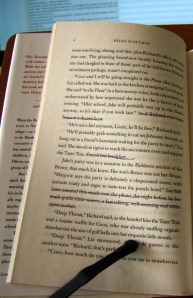
I have to read the first paragraph of the second section ironically: “As with so many things of consequence, it all began with a party.” It seems highly unlikely that many “things of consequence” started with a party; an idea, a conversation, a scribble in a notepad, maybe, but a party? Seems improbable. Pages 10 and 11 of the hardcover have a lot of superfluous stuff. I took a picture of a page with my edits, where I remove sentences the book doesn’t need. In rereading of Gatsby, part of what’s so amazing is how essential most of it feels. So mysterious. We don’t even meet Gatsby until chapter three, and then by accident. One of the novel’s letdowns is in Chapter 6, where Nick suddenly regurgitates a bunch of stuff about Gatsby’s supposed background (this is similar to what Mark Sarvas mentioned in 2007: that it’s important not to become overawed by the great). Too much of the novel should be tightened like the face of the mothers Liz lives among. On page 100, “Richard felt the skin on his face tighten.” You could remove that sentence and lose nothing. There’s also a strange mistake: Schulman writes URLs as “feigenbaum/blogspot.com,” when Blogspot URLS are always in the form feigenbaum.blogspot.com. It’s minor, but it galls.

So do aspects of the characters. Take this early scene from Liz:

It’s your butt or your face—you can’t have both, Liz thought. Some movie star had said this; she’d read it or heard something like it somewhere, and had stored a smudged replica of the quote in the hash of celebrity trivia her brain had accumulated without effort, along with all the other stuff and nonsense that passed for knowledge these days from print magazines and whatever: TV, the Net, idle chitchat, the air . . . But it was true, about your butt or your face.

The “hash of celebrity trivia” is what’s so odd to me about Liz: she used to be an art historian. She got a PhD in art history. Yet little to no knowledge of art, art theory, aesthetics, or related subjects trickles into her thought. By now I’ve met lots and lots of academics, and the ones who stick it out to the PhD don’t do so for the money, which is practically nonexistent; they do do so for the love of their subject. It’s bizarre that Liz imparts so little of this in her thinking; she says that “her dissertation had distinguished itself because she’d focused on the synthesis of art, design, and dance in a new and radical way” {Schulman “Beautiful”@38}. But what way is that? How does it differ? Liz “couldn’t remember the subtitle” of that dissertation, which is understandable: titles are easy to forget. But much of the content appears to have gone the way of that subtitle. If art plays a real role in her present life, it’s well-hidden.

People’s professions cast shadows over their conversation, but Liz’s appears to be a veneer that lies no deeper than the letters after her name. What happened to all the knowledge she must have acquired? Why doesn’t she ever think in ideas? Characters content to surf on the world of everyday minutia are boring; one thing that sets science fiction apart from other kinds, at least in the view of Neal Stephenson, is its focus on ideas. He elaborates in this Salon interview, where he defines science fiction’s big tent as

Fiction that’s not considered good unless it has interesting ideas in it. You can write a minimalist short story that’s set in a trailer park or a Connecticut suburb that might be considered a literary masterpiece or well-regarded by literary types, but science fiction people wouldn’t find it very interesting unless it had somewhere in it a cool idea that would make them say, “That’s interesting. I never thought of that before.” If it’s got that, then science fiction people will embrace it and bring it into the big-tent view of science fiction. That’s really the role that science fiction has come to play in literature right now. In arty lit, it’s become uncool to try to come to grips with ideas per se.

Knowing something of celebrity gossip doesn’t automatically preclude one from having ideas, thinking about ideas, or thinking about what might go beyond the tiny halo of an individual life. Thinking about ideas also isn’t incompatible with worry about the body, sexual attractiveness, how others respond to the body, and so forth. But this moment is emblematic of why Liz, as a character, tends to be boring: she doesn’t have access to those ideas. The writing isn’t as crisp and mysterious as Fitzgerald’s (but then again, whose is?). The structure isn’t as sharp as Shreve’s or Perrotta’s.

If Liz had really been the house intellectual, the person who understands the deeper cultural structures underlying what her family is going through, she could’ve been a fascinating character. Instead she seems to have hung up her mind when she became a former. I suspect not all women do. The noun she uses in the passage above—”trivia”—is the problem: her life appears to have become trivia. This isn’t a fact that dooms her altogether, but if you can’t rise beyond trivia, then why bother? And I’m not asking that she cite Foucault or tedious theoretical windbags; I’m just asking for more awareness of her own situation. Give me some cool ideas about what things are about. Literature that endures has ideas; Jane Austen, whatever her faults, is constantly questioning how families and social relationships should work. Her characters are attuned to the minutest questions of status. I’d like to see the same here.

Liz has some faint idea of her problem, since she notes the “nonsense that passed for knowledge.” But it doesn’t pass for knowledge “from print magazine and whatever:” it passes for knowledge because she consumes it. Anytime she wants, she can skip US Weekly and pick up The Atlantic. But she doesn’t.

This passage isn’t bad on its own; if it were embedded in a story with more power, I’d take from it what I think Schulman was shooting for: Liz’s struggle with the wealthy but stultifying environment she’s in and can’t easily leave without harming her family and her husband’s work. It’s a worthy struggle, but a frustrating one because Liz should have the intellectual and financial tools to understand it. But she chooses not to use them, and a character who seems pointlessly helpless is a tedious character too. And Liz does have some real thoughts. In this scene of self-criticism, she’s looking at her ex-flings writing and says:

He was smart, funny, but still immature. He hadn’t seemed to have developed distance from his own dilemmas or learned how to structure a narrative. At what point did potential, budding and nascent, turn into stagnancy? At what point did stagnancy equal tragedy? Is that what made midlife unendurable for so many? Is that what made each and every day feel so damaging?

All this is plausible, and notice how she moves from the guy’s writing to her own life: she stats off talking with him, and by the second sentence you still think she’s talking about him. By the third—”At what point did stagnancy equal tragedy?”—you get the idea that she’s not talking about someone else. She’s talking about herself, as critics so often are when they write criticism. So she gets some self-analysis by the end of the story.

So does her son. Jake is uncommonly knowledgeable, like so many adolescents in fiction; he notes how teenagers mostly “walked around, calling out to one another, ‘S’up. S’up.’ It was rhetorical, not ever a question. Nothing was up, usually, unless something was. They were kids; they were terminally looking for something to do.” They don’t find it. At the very least, this passage feels dangerous, knowing what we know about the novel from the dust jacket and the first two pages. There’s a sense of a transgression. But you’ve read these scenes before, especially if you’re a regular young adult reader, but Jake’s crush on a girl of Chinese descent is endearing; he notices what she wears and “thought Audrey’s haircut made her look French, although he had no idea really what that meant.” Who does, really? Maybe someone who’s read La Seduction. That he wants Audrey drives him forward and toward Daisy, who wants him and sets about luring him via video. Lesson: people do strange things for love. Perhaps it’s a lesson we already know, but so it goes.

He understands Daisy slightly better than his mother does: Liz says of Daisy, “That poor, wretched, stupid girl. Marjorie says the mother’s always away somewhere, that even when she was little she was always picked up by a nanny.” As if someone who wasn’t picked up by a nanny would automatically never make a sex tape. Plus, Daisy presumably wouldn’t have made the tape if she didn’t think it was a good idea; perhaps she has a high discount rate, and adults, with lower discount rates, are thus unhappy because they’re judging someone they don’t understand. Her husband does the same thing, but intentionally, to a reporter. He says that of the video “It looked like a junior league Debbie Does Dallas. I don’t know where the girl learned this stuff.” The answer is obvious: the Internet. Of course, lots of people “learn” stuff of this nature from the Internet and turn out to be perfectly okay, as Daisy does.

But Richard understands something that he doesn’t want to define; he watches the video (all the adults do, and one gets a prurient swirl of surveillance). When he does, he uses standard moralistic language, but he also notes, basically, that it’s also hot, a way similar to some of the comments in Testimony, when either Mike or Rob is describing the tape of Sienna. If someone is being intellectually honest, they have to acknowledge that erotic power isn’t flipped on like a switch when one turns 16 or 18. In some people it develops early. When Richard sees the video, he also says:

And for all the video’s dismal raunch, its tawdriness, for all its sexual immaturity and unknowingness, there is something about the way this girl has revealed herself, the way that she has offered herself, truly stripped herself bare, that is brave and powerful and potent and ridiculous and self-immolating and completely nuts.

He’s right; the nuttiness, the sense of going beyond the bounds, gives the video its power (does this language sound familiar? It’s similar to how I described Ariel Sands’ Never the Face). In the end, there can be something about such a video. Richard doesn’t understand everything; he says that “It looked like a junior league Debbie Does Dallas. I don’t know where the girl learned this stuff.” The answer is obvious: the Internet. Of course, lots of people “learn” stuff of this nature from the Internet and turn out to be perfectly okay, as Daisy does. The novel needs to be set in 2003, because if it were set in 2011, a viral sex tape wouldn’t be so shocking, and I’m somewhat confident that high school students have developed antibodies for the event (from what students tell me, that’s true).

What’s normal today may not be normal tomorrow, and, thus, the worries about the tape might eventually be as strange to us as Seventeenth Century European schisms and wars. Manufactured drama around sex can make the amorality of Gossip Girl attractive by comparison. What would Blair say to Jake and Daisy?

Virtually everyone in this novel is reacting to things. Jake reacts to Daisy. Liz reacts to circumstances. Richard reacts to Jake. The only person who really acts on their own volition in the novel is Daisy; if anyone’s the hero, she is. That the hero gets to say so little is unfortunate. Notice how The Great Gatsby is driven by several great wants: Gatsby’s for Daisy; Daisy for excitement or some way out of her stultifying life with Tom (he who cites The Rise of the Coloured Empires), Nick’s for figuring out who Gatsby really is. Without all that want, like the voice of “I want, I want” in Henderson the Rain King, you wouldn’t have a story in The Great Gatsby. You’d have a series of still lifes. This Beautiful Life is more animated than a still life but less than The Great Gatsby. It shows so much promise, and The Great Gatsby keeps creeping up in it.


She’s gotten a lot of good press. The NYT review is above; the Paris Review blog interviewed her. The Washington Post has a banal review not worth linking to. Reading such reviews reminds me of why I like James Wood so much, even when I disagree with his assessments.

Effi Briest — Theodore Fontane, with a side of James Wood and Samuel Delany’s Paris Review interview

Despite what I wrote in this post, I got a copy of Effi Briest. And you know what? I couldn’t finish it. There were some great lines—my favorite is Effi’s father saying, “There’s nothing so good for one as a wedding, provided of course it isn’t one’s own”—but I couldn’t take the rest, even though I stopped reading the very nice introduction by Helen Chambers after realizing it was prejudicing me against the book:

The sexual dimensions of the age gap [between Effi and her husband] remain beneath the surface of this discreet and allusive novel. They are suggested, as is much that is vital in the inner action, by the symbolic texture of the narrative. Effi’s sexual inexperience at the beginning of the novel is beyond question, and the premature loss of her virginity is prefigured by the twins calling her back to the garden through a window framed by Virginia Creeper

This explains why little seems to happen, since “remain beneath the surface” feels like another phrase for “buried so deeply that you need an even dirtier mind than mine to excavate it. In a Paris Review interview, Robertson Davies says:

I do not respond quite so immediately and warmly to writers in the United States, because their concerns are different from mine and their approach to them is different from mine. They seem to be infinitely concerned with very subtle details of feeling and life. I find this exemplified, for instance, in many stories in The New Yorker where whether the family will have pumpkin pie or something else on Thanksgiving Day is a decision with infinite psychological and sexual repercussions. I take this quite seriously. I admire their subtlety—but I get so sick of it. I wish they would deal with larger themes.

With enough subtlety, substance disappears, and I love his characterization of American Thanksgivings as portrayed in stories. Anyway, Chambers also says of Effi’s husband, “It seems that after years of self-discipline and mortification of the flesh Innstetten has regulated his natural urges into a state of atrophy.” In the margin I wrote, “Yawn,” a judgment that still seems reasonable a week later. Practically the entire text of Ian McEwan’s On Chesil Beach could fit between the end of the wedding scene on page 26 and the next paragraph, which begins, “The day after the wedding was a bright October day,” as if one of the presumably major events of Effi’s life hadn’t just happened. And I’m not talking about the wedding.

I was thinking about Effi Briest when I read Samuel Delany’s Paris Review interview in the Summer 2011 issue. He talks about two characters in his work Nova who almost have an incestuous relationship. The interviewer begins this exchange:

Did you intentionally want to make something the reader could only speculate about, rather than be certain of?

Delany: Certainly as far as the incest goes. Suggestion is a literary strategy. But when, in 1968, works like Henry Miller’s Tropic of Cancer and Black Spring and Lawrence’s Lady Chatterley’s Lover were legal to publish and sell in this country, the age of innuendo and the coyly placed line of white space, as the hero envelops the heroine in his arms, ended. Fifteen years later, AIDS rendered them permanently obsolete.

Today, I watch seminar rooms full of graduate students misread both [Alfred] Bester and [Joseph] Conrad, because they no longer have to wonder about the possibility of such illegal elements occurring in the story and the compensating possibility of suggestion as a writerly strategy for representing sex and violence.

I am one of those graduate students, and I evidently don’t have the exquisitely tuned sex detector that pre-’68 readers might have developed. This became especially clear in a seminar on Henry James’ The Golden Bowl, when one of my professors at the University of Arizona began to point out the many euphemisms and double entendres left by James, beginning with the name “Assingham” and proceeding from there. I mostly wondered what the big fuss was about, given the modesty of the phrases in questions, but I didn’t realize how generational my readings were until I discovered the Delany interview an hour ago.

Delany is right—I don’t have a lot of tolerance of “innuendo and the coyly placed line of white space.” That doesn’t mean I want every novel to be wildly explicit, or that I want pornography to merge with literary fiction, but it does mean that a lot of older books seem coy. Like Effi Briest. Today, when McEwan’s aforementioned novel takes those white spaces and turns them into entire works of their own, it’s hard to accept the white space, or an extraordinarily “discreet and allusive novel” where Virginia Creepers (or pumpkin pie) have “infinite psychological and sexual repercussions”

I didn’t expect to have my malady so accurately and suddenly diagnosed, however, and it wasn’t until I read Delany that I was able to write this post. He makes me want to be a more careful and considerate reader. Or maybe novels do have a sense of technological progression, or something like progress, or even progress itself. James Wood speculates on the subject in his review of Chang-Rae Lee’s The Surrendered:

Does literature progress, like medicine or engineering? Nabokov seems to have thought so, and pointed out that Tolstoy, unlike Homer, was able to describe childbirth in convincing detail. Yet you could argue the opposite view; after all, no novelist strikes the modern reader as more Homeric than Tolstoy. [. . .] Perhaps it is as absurd to talk about progress in literature as it is to talk about progress in electricity—both are natural resources awaiting different forms of activation. The novel is peculiar in this respect, because while anyone painting today exactly like Courbet, or composing music exactly like Brahms, would be accounted a fraud or a forger, much contemporary fiction borrows the codes and conventions—the basic narrative grammar—of Flaubert or Balzac without essential alteration.

If literature progresses technologically, it still doesn’t do so in quite the same way as technology: no one would use a camera from 1925 unless they were a masochist, had a historical fetish, or were trying to achieve some very peculiar artistic effect. The rest of us use digital cameras manufactured in the last five years, or phones, given the obvious advantages of convenience. But many writers from 1925 still feel quite modern—Fitzgerald, most obviously, but many others too. Yet I don’t find that much 19th Century fiction really moves me (exceptions: Moby-Dick, The Scarlet Letter). Contemporary writers have a greater and perhaps infinite rein to express what they need to express, and by contrast older writers do seem coy, even if this is an unfair judgment on my part—or the kind of judgment that might be tempered by age. The more I think about the idea, the more I see how others have considered it. For example, this review of William Deresiewicz’s A Jane Austen Education is bizarre because it’s like reading about myself, right down to the love for Madame Bovary:

In 1990, William Deresiewicz was on his way to gaining a Ph.D. in English literature at Columbia University. Describing that time in the opening pages of his sharp, endearingly self-effacing new book, “A Jane Austen Education,” Deresiewicz explains that he faced one crucial obstacle. He loathed not just Jane Austen but the entire gang of 19th-century British novelists: Hardy, Dickens, Eliot . . . the lot.

At 26, Deresiewicz wasn’t experiencing the hatred born of surfeit that Mark Twain described when he told a friend, “Every time I read ‘Pride and Prejudice’ I want to dig her up and hit her over the skull with her own shinbone.” What Deresiewicz (who has considerable fun at the expense of his pompous younger self) was going through was the rebel phase in which Dostoyevsky rules Planet Gloom, that stage during which the best available image of marriage is a prison gate.

Sardonic students do not, as Deresiewicz points out, make suitable shrine-­tenders for a female novelist whose books, while short on wedding scenes, never skimp on proposals. Emma Bovary fulfilled all the young scholar’s expectations of literary culture at its finest; Emma Woodhouse left him cold. “Her life,” he lamented, “was impossibly narrow.” Her story, such as it was, “seemed to consist of nothing more than a lot of chitchat among a bunch of commonplace characters in a country village.” Hypochondriacal Mr. Woodhouse, garrulous Miss Bates — weren’t these just the sort of bores Deresiewicz had spent his college years struggling to avoid? Maybe, he describes himself conceding, the sole redeeming feature of smug Miss Woodhouse was that she seemed to share his distaste for the dull society of Highbury.

I’m 27. Maybe I’ll have considerable fun at the expense of my pompous younger self one day.

I bought A Jane Austen Education, which shouldn’t be surprising given my feelings about Deresiewicz. Maybe he will teach me to read Austen more kindly, more attentively (Wood has succeeded at least somewhat in that respect: his discussion of free indirect speech in How Fiction Works finally gave me the tools to figure out why people like Austen). I’m still not sure that it will bring Effi Briest to life, and even if it does, it might be more like reanimating a corpse (which, as genre fiction teaches us, is replete with dangers) than interacting with a live person.

Effi Briest — Theodore Fontane, with a side of James Wood and Samuel Delany's Paris Review interview

Despite what I wrote in this post, I got a copy of Effi Briest. And you know what? I couldn’t finish it. There were some great lines—my favorite is Effi’s father saying, “There’s nothing so good for one as a wedding, provided of course it isn’t one’s own”—but I couldn’t take the rest, even though I stopped reading the very nice introduction by Helen Chambers after realizing it was prejudicing me against the book:

The sexual dimensions of the age gap [between Effi and her husband] remain beneath the surface of this discreet and allusive novel. They are suggested, as is much that is vital in the inner action, by the symbolic texture of the narrative. Effi’s sexual inexperience at the beginning of the novel is beyond question, and the premature loss of her virginity is prefigured by the twins calling her back to the garden through a window framed by Virginia Creeper

This explains why little seems to happen, since “remain beneath the surface” feels like another phrase for “buried so deeply that you need an even dirtier mind than mine to excavate it. In a Paris Review interview, Robertson Davies says:

I do not respond quite so immediately and warmly to writers in the United States, because their concerns are different from mine and their approach to them is different from mine. They seem to be infinitely concerned with very subtle details of feeling and life. I find this exemplified, for instance, in many stories in The New Yorker where whether the family will have pumpkin pie or something else on Thanksgiving Day is a decision with infinite psychological and sexual repercussions. I take this quite seriously. I admire their subtlety—but I get so sick of it. I wish they would deal with larger themes.

With enough subtlety, substance disappears, and I love his characterization of American Thanksgivings as portrayed in stories. Anyway, Chambers also says of Effi’s husband, “It seems that after years of self-discipline and mortification of the flesh Innstetten has regulated his natural urges into a state of atrophy.” In the margin I wrote, “Yawn,” a judgment that still seems reasonable a week later. Practically the entire text of Ian McEwan’s On Chesil Beach could fit between the end of the wedding scene on page 26 and the next paragraph, which begins, “The day after the wedding was a bright October day,” as if one of the presumably major events of Effi’s life hadn’t just happened. And I’m not talking about the wedding.

I was thinking about Effi Briest when I read Samuel Delany’s Paris Review interview in the Summer 2011 issue. He talks about two characters in his work Nova who almost have an incestuous relationship. The interviewer begins this exchange:

Did you intentionally want to make something the reader could only speculate about, rather than be certain of?

Delany: Certainly as far as the incest goes. Suggestion is a literary strategy. But when, in 1968, works like Henry Miller’s Tropic of Cancer and Black Spring and Lawrence’s Lady Chatterley’s Lover were legal to publish and sell in this country, the age of innuendo and the coyly placed line of white space, as the hero envelops the heroine in his arms, ended. Fifteen years later, AIDS rendered them permanently obsolete.

Today, I watch seminar rooms full of graduate students misread both [Alfred] Bester and [Joseph] Conrad, because they no longer have to wonder about the possibility of such illegal elements occurring in the story and the compensating possibility of suggestion as a writerly strategy for representing sex and violence.

I am one of those graduate students, and I evidently don’t have the exquisitely tuned sex detector that pre-’68 readers might have developed. This became especially clear in a seminar on Henry James’ The Golden Bowl, when one of my professors at the University of Arizona began to point out the many euphemisms and double entendres left by James, beginning with the name “Assingham” and proceeding from there. I mostly wondered what the big fuss was about, given the modesty of the phrases in questions, but I didn’t realize how generational my readings were until I discovered the Delany interview an hour ago.

Delany is right—I don’t have a lot of tolerance of “innuendo and the coyly placed line of white space.” That doesn’t mean I want every novel to be wildly explicit, or that I want pornography to merge with literary fiction, but it does mean that a lot of older books seem coy. Like Effi Briest. Today, when McEwan’s aforementioned novel takes those white spaces and turns them into entire works of their own, it’s hard to accept the white space, or an extraordinarily “discreet and allusive novel” where Virginia Creepers (or pumpkin pie) have “infinite psychological and sexual repercussions”

I didn’t expect to have my malady so accurately and suddenly diagnosed, however, and it wasn’t until I read Delany that I was able to write this post. He makes me want to be a more careful and considerate reader. Or maybe novels do have a sense of technological progression, or something like progress, or even progress itself. James Wood speculates on the subject in his review of Chang-Rae Lee’s The Surrendered:

Does literature progress, like medicine or engineering? Nabokov seems to have thought so, and pointed out that Tolstoy, unlike Homer, was able to describe childbirth in convincing detail. Yet you could argue the opposite view; after all, no novelist strikes the modern reader as more Homeric than Tolstoy. [. . .] Perhaps it is as absurd to talk about progress in literature as it is to talk about progress in electricity—both are natural resources awaiting different forms of activation. The novel is peculiar in this respect, because while anyone painting today exactly like Courbet, or composing music exactly like Brahms, would be accounted a fraud or a forger, much contemporary fiction borrows the codes and conventions—the basic narrative grammar—of Flaubert or Balzac without essential alteration.

If literature progresses technologically, it still doesn’t do so in quite the same way as technology: no one would use a camera from 1925 unless they were a masochist, had a historical fetish, or were trying to achieve some very peculiar artistic effect. The rest of us use digital cameras manufactured in the last five years, or phones, given the obvious advantages of convenience. But many writers from 1925 still feel quite modern—Fitzgerald, most obviously, but many others too. Yet I don’t find that much 19th Century fiction really moves me (exceptions: Moby-Dick, The Scarlet Letter). Contemporary writers have a greater and perhaps infinite rein to express what they need to express, and by contrast older writers do seem coy, even if this is an unfair judgment on my part—or the kind of judgment that might be tempered by age. The more I think about the idea, the more I see how others have considered it. For example, this review of William Deresiewicz’s A Jane Austen Education is bizarre because it’s like reading about myself, right down to the love for Madame Bovary:

In 1990, William Deresiewicz was on his way to gaining a Ph.D. in English literature at Columbia University. Describing that time in the opening pages of his sharp, endearingly self-effacing new book, “A Jane Austen Education,” Deresiewicz explains that he faced one crucial obstacle. He loathed not just Jane Austen but the entire gang of 19th-century British novelists: Hardy, Dickens, Eliot . . . the lot.

At 26, Deresiewicz wasn’t experiencing the hatred born of surfeit that Mark Twain described when he told a friend, “Every time I read ‘Pride and Prejudice’ I want to dig her up and hit her over the skull with her own shinbone.” What Deresiewicz (who has considerable fun at the expense of his pompous younger self) was going through was the rebel phase in which Dostoyevsky rules Planet Gloom, that stage during which the best available image of marriage is a prison gate.

Sardonic students do not, as Deresiewicz points out, make suitable shrine-­tenders for a female novelist whose books, while short on wedding scenes, never skimp on proposals. Emma Bovary fulfilled all the young scholar’s expectations of literary culture at its finest; Emma Woodhouse left him cold. “Her life,” he lamented, “was impossibly narrow.” Her story, such as it was, “seemed to consist of nothing more than a lot of chitchat among a bunch of commonplace characters in a country village.” Hypochondriacal Mr. Woodhouse, garrulous Miss Bates — weren’t these just the sort of bores Deresiewicz had spent his college years struggling to avoid? Maybe, he describes himself conceding, the sole redeeming feature of smug Miss Woodhouse was that she seemed to share his distaste for the dull society of Highbury.

I’m 27. Maybe I’ll have considerable fun at the expense of my pompous younger self one day.

I bought A Jane Austen Education, which shouldn’t be surprising given my feelings about Deresiewicz. Maybe he will teach me to read Austen more kindly, more attentively (Wood has succeeded at least somewhat in that respect: his discussion of free indirect speech in How Fiction Works finally gave me the tools to figure out why people like Austen). I’m still not sure that it will bring Effi Briest to life, and even if it does, it might be more like reanimating a corpse (which, as genre fiction teaches us, is replete with dangers) than interacting with a live person.

Sex at Dawn — Christopher Ryan and Cacilda Jethá

EDIT: This review, from the journal Evolutionary Psychology, is the one I would’ve written if I’d been better read in the field and had more time to read extensively in it. Read the linked review if you really want to understand the problems with Sex at Dawn.

Furthermore, “The Myth of Promiscuity: A review of Lynn Saxon, Sex at Dusk: Lifting the Shiny Wrapping from Sex at Dawn” discusses the (many) problems with Sex at Dawn in a more complete fashion than I did. So if you’re looking for a deeper discussion than the one I can offer, consider Sex at Dusk.


My bottom-line assessment of Sex at Dawn: The Prehistoric Origins of Modern Sexuality is that the book would never get past peer review because so many of its descriptions of existing research and ideas are wrong or skewed. The book argues that humans are not “naturally” monogamous. That might be true. But Sex at Dawn doesn’t prove it. The data are ambiguous.

The biggest problem with the book starts on page 46, with the chapter “A Closer Look at the Standard Narrative of Human Sexual Revolution.” But there is no standard narrative of human sexual revolution: there are a wide array of people who have made inferences about the evolutionary basis of sexuality, but their narratives aren’t consistent and new papers and ideas constantly jostle or replace old ones. Ryan and Jethá don’t cite anyone else who claims a “standard” narrative, because to my knowledge no one has, and the standard narrative they cobble together is just that: cobbled together from a variety of sources with a variety of views.

I mentioned the lack of citations as a problem that occurs in their chapter on the standard narrative. It continues throughout the book. On page 293, Ryan and Jethá say that “To avoid the genetic stagnation that would have dragged our ancestors into extinction long ago, males evolved a strong appetite for sexual novelty and a robust aversion to the overly familiar.” But they don’t have any evidence for that. Similarly, they accuse scientists and others of claiming that monogamy is “natural” or inborn and cite, the anthropologist Owen Lovejoy as saying, “The nuclear family and human behavior may have their ultimate origin long before the dawn of the Pleistocene” (34). And he’s right: such behaviors may have their origins there. Or they may not have. Good scientists tend to be more tentative than polemicists because scientists recognize the fragility of so much human knowledge.

In Melvin Konner’s The Evolution of Childhood, he writes:

A double standard of sexual restriction is common across cultures; still, most human marriages have been mainly monogamous, owing either to environmental constraint or cultural principle. Modern cultures are monogamous in principle, but both adultery and serial monogamy are common. In at least thirty-seven countries, men express preference for women several years younger than themselves and place more emphasis on appearance, while women prefer men several years older and emphasize status and wealth (41).

The “environmental constraint” is important because it takes a lot of resources to support multiple spouses; this means that most men in most places and most conditions cannot afford to support multiple women. One woman might be able to support or be supported by multiple men, but polyandry is far less common than polygyny, as Konner points out. This is probably as close to accurate as one is likely to get regarding the historical or anthropological record on the subject of polygamy. It also has the advantage of coming from someone who spent his entire career on the subject of childhood development and who is deeply familiar with the vast literature surrounding evolution, anthropology, and childhood.

Ryan and Jethá also have many sections where they ask rhetorical questions or pit themselves against imaginary foes of great power; the page after the Lovejoy quote, they say, “This is what we’re up against. It’s a song that is powerful, concise, self-reinforcing, and playing on the radio all day and all night . . . but still wrong, baby, oh so wrong” (35). Enough with the polemics: if you’re right, show us that you’re right and leave the judgment up tot he reader.

Dan Savage called Sex at Dawn “the single most important book about human sexuality since Alfred Kinsey unleashed Sexual Behavior in the Human Male on the American public in 1948.” The statement is hyperbolic and unlikely but nonetheless demonstrates the power of the book, especially when America’s most famous sex columnist is pimping it, so to speak.

In addition, Kinsey was at least doing original research by taking and compiling sexual histories. Ryan and Jethá aren’t: they’re rehashing a variety of other people’s research, and in doing so regularly misrepresenting that research. Furthermore, Kinsey was reacting to a much, much different culture than ours today; Sexual Behavior in the Human Male had essentially no real forerunners, while Sex at Dawn is a weak entry to a crowded field of evolutionary biologists and psychologists like Geoffrey Miller (The Mating Mind), Sarah Blaffer Hrdy (The Woman Who Never Evolved, and David Buss). All three get cited, but out of context, and their deeper arguments are never really engaged. I don’t think it a coincidence that all three are academics.

For another example of imprecision in Sex at Dawn, Ryan and Jethá point out that men are only 10% – 20% larger than women (in polygynous species, the larger the size difference between sexes, the greater the number of sex partners). But that raw size or height difference way underestimates how that size translates to muscle. Consider David Potts’ work:

When fat-free mass is considered, men are 40% heavier (Lassek & Gaulin, 2009; Mayhew & Salm, 1990) and have 60% more total lean muscle mass than women. Men have 80% greater arm muscle mass and 50% more lower body muscle mass (Abe, Kearns, & Fukunaga, 2003). Lassek and Gaulin (2009) note that the sex difference in upper-body muscle mass in humans is similar to the sex difference in fat-free mass in gorillas (Zihlman & MacFarland, 2000), the most sexually dimorphic of all living primates.

These differences in muscularity translate into large differences in strength and speed. Men have about 90% greater upper-body strength, a difference of approximately three standard deviations (Abe et al., 2003; Lassek & Gaulin, 2009). The average man is stronger than 99.9% of women (Lassek & Gaulin, 2009). Men also have about 65% greater lower body strength (Lassek & Gaulin, 2009; Mayhew & Salm, 1990), over 45% higher vertical leap, and over 22% faster sprint times (Mayhew & Salm, 1990).

(That’s from Puts, David, A. “Beauty and the Beast: Mechanisms of Sexual Selection in Humans.” Evolution & Human Behavior 31.3 (2010): 157-75.)

The weird thing is that this information supports their assertion that humans are polygynous but hurts their assertion that early societies were mostly kind and peaceful, which they probably weren’t, per Lawrence Keeley’s War Before Civilization. Both the Potts paper and the Keeley book are the kinds of things that peer reviewers should be apt to point out.

Even when they aren’t simplifying the research others have done or selectively quoting writers without fully engaging in their arguments, Ryan and Jethá are merely poor writers. Take this: “For better or worse, the human female’s naughty bits don’t swell up to five times their normal size and turn bright red just to signal her sexual availability,” which is true in many species of apes. But note how bad this writing is: the sentence starts with a cliche, moves on to a childish description of women more appropriate to 14-year-olds than a real book and that also reinforces the very cultural forces the authors are trying to counteract, and then proceeds to something that has already been stated earlier in the chapter. The writing in much of the book is equally bad, the reasoning sloppy, and the thought underdeveloped. Which isn’t to say the book doesn’t have interesting or useful elements—it does—but those tend to get subsumed by its flaws.

The more I read about humanity, history, and the rhetoric of authenticity, naturalness, human instinct, and the like, the more I think there aren’t such things and the claims about what is “natural” reflect more about the person making the claim than anything about humanity itself. I would say that it’s natural for people to make claims about what is natural, but relatively little else is; circumstances affect so much that it’s hard to perceive many higher order behaviors as anything other than reflecting the bizarre combinations of self and environment.

People simply vary widely in their preferences, and most appear to view whatever society and subculture they grew up in as normal and natural. I posit that it’s not normal or abnormal to be polygamous or monogamous: in some circumstances one might make more sense, and in others the other strategy would. And people are too variable to say one mode is completely correct for all people under all circumstances.

I had actually begun this post before I read Paul Graham’s latest essay, “The Top Idea in Your Mind.” This part especially resonated:

I’ve found there are two types of thoughts especially worth avoiding—thoughts like the Nile Perch in the way they push out more interesting ideas. One I’ve already mentioned: thoughts about money. Getting money is almost by definition an attention sink. The other is disputes. These too are engaging in the wrong way: they have the same velcro-like shape as genuinely interesting ideas, but without the substance. So avoid disputes if you want to get real work done. [3]

To really catalog everything that’s wrong with Sex at Dawn, I’d have to go back through at least five or six books (and probably more) and at least a dozen papers. It would take me all day. Why spend that much time on a book that’s not very good? A while ago I promised myself that I wasn’t going to write many more posts on books that are bad in a generic way that doesn’t do anything special because I’m usually not spending my time in an optimal way. And reading Sex at Dawn is unlikely to be an optimal use of your time.