Briefly Noted: “The Fever” — Megan Abbott

I’ve already reviewed The Fever—it’s just under the title Dare Me, with its similar subject matter (high-school girls, transformation, darkness in women, sexuality) and style (half-knowing, unwilling to admit, chopped up narrative). This is not a criticism, Dare Me readers who want more of the same will find The Fever delivers. Like Dare Me the principle concern is female rivalry over high-status guys and female judgment of each other’s sexuality. I won’t say it’s a critique of those topics, though it could be read that way. It could also be seen as a commentary on the eternal conflict between children and parents.

Similarity is not always a bad thing—Elmore Leonard’s many caper novels consistently delivered similar characters, styles, and plots, and again that could be read as weakness or strength as he played with variations around a central concern or set of concerns (which I read as coolness and silence—subjects for an academic paper yet to be written).

the_feverThere is a Paglian tinge to Abbott’s last two novels (sample: “In the school’s hallways, Tom could see it: Gabby carried the glamour of experience, like a dark queen with a bloody train trailing behind.” Unlikely, but poetic, and it tells us about Tom’s overwrought perspective). They may be of less interest to those far from high school or offspring in high school. Abbot is willing to probe darkness in a way rarely seen in TV or movies, which tend to lag books by decades in terms of their willingness to portray what lurks within. Even the better TV stations like HBO and Showtime need to appeal to “Heads of Households,” which explains why the teen series tend to be on network TV or basic cable.

There are comparisons to be made with Caitlin Flanagan, and Abbott wins them; Flanagan’s book Girl Land was published in only 2012 and already the hardcover is justifiably available for $.01 from Amazon. I think I read a library copy. Both the Flanagan essays and the Abbott novels show how little we tend to know about things when we’re young and have no context or framework for understanding them. One could argue that the knowledge for understanding the world is out there, and most teenagers choose not to access it. This leads to confusion. That confusion is reproduced to good effect in the narrative voice and structure of The Fever:

I’m next, Deenie thinks, a few minutes and it’ll be me.
If only she’d gotten it over with a year ago. But she’d heard about how much it hurt and no one else had done it yet, at least not anyone she knew.
Now she’s one of the last one.

The tense moves from present to past back to present, with the “it” deliberately ambiguous in that it sounds like sexuality but may actually be the fever of the title. Naturally hypocrisy appears too, with slightly incestuous overtones, when Eli thinks that “Since then, he could only ever think about his sister, one wall away. And how he hoped Deenie never did things like this. With guys like him.” To be thinking about his sister in this context seems like a mistake of focus. About some things there is little to say; people are people and want what they want, as teenagers are probably taught not to know or admit. The characters are also mostly ignorant: Deenie thinks, “Why did everything have to be about sex, she wondered. Didn’t it make a lot more sense that it was something else?” She hasn’t read or probably even heard of evolutionary biology or Darwin’s The Descent of Man and Selection in Relation to Sex. I hadn’t either in high school, and I don’t remember my first introduction, but I do know that a couple books on the subject made a lot of previously puzzling behavior fall into place. It’s true that not everything is about sex but so much is about it because we’ve evolved to pay close attention to matters relating to survival and reproduction.

Simple principles give rise to dizzyingly complex behaviors and patterns. Deenie doesn’t know that and in some ways her society conspires with her towards ignorance. One reading of Abbott’s last two novels could be as a move from utter ignorance to slightly greater knowledge. Jealousy is a perpetual companion because there are so few real status ladders to climb in high school (“Everything was so easy for Skye, with her older boyfriends, the way her aunt bought her cool old-time lingerie from vintage shops, the strip of birth control pills she once unfurled for them like candy.”) Skye, however, probably doesn’t think things are easy for Skye, but few high schoolers have the ability to get out of their own heads and into the heads of their companions. The last two paragraphs may be unfair, like saying that Faulkner is merely writing about the machinations of slack-jawed southern yokels who need education and functioning political infrastructure, but there is also some accuracy to them.

The question of whether the fever has supernatural, psychological, microbiological, or other origins does get resolved, but its mechanics are dubious.
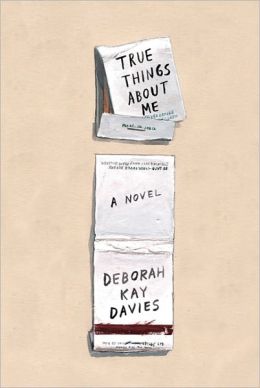
True Things About Me — Deborah Kay Davies

True Things About Me is disturbing and compelling, especially because it doesn’t want to explain. Its unnamed protagonist doesn’t want to explain. She just wants to act and in acting without explanation she may in some ways be truer to life, in which we so often act and then come up with rationalizations about why we acted after the fact. The disturbing implication of the novel may be that our reasons for doing things are opaque even to us and always will be. Like markets, we just can’t predict our own behavior.

True_things_about_meIn the novel the unnamed narrator has unplanned, unexpected sex with a man just out of prison who is registering for benefits. It is unexpected, a disjunction, a call to action in a mythic sense, and beyond the initial bang, so to speak, True Things About Me is at most loosely plotted. The scary thing about the story is not that it may be sick but that it may be normal, or at least more common than is commonly supposed, despite the evidence in fiction and art that few of us, Paglia aside, want to face. Much of the online commentary mentions “mental illness,” which is a comforting but wrong misreading. Desire can be neither legislated nor medicalized away. It will reemerge in different forms, and its verbal component is weak or nonexistent. When Alison, the narrator’s boring foil friend, wants to know what’s happening with the narrator, the narrator says “Somehow I couldn’t be bothered to explain it all.” “Somehow:” why bother analyzing what can’t be fully analyzed?

Her parents are either delusional or right; when the narrator invents a boyfriend for her parents’ benefit her mother says, “I just hope he’s a nice boy.” The irony is obvious. Her mother describes Alison as “so sensible,” which may read here as a synonym for boring. There may be no greater modern relationship sin than being boring or needy.* When madness intrudes in normal life we don’t know how to react, unless perhaps we live a continually mad life, like a different Alison, the protagonist in Story of My Life. For the narrator of True Things About Me everything is permitted and nothing matters, which may be the nature of modern adulthood for many nulliparous people.

For the narrator internal changes inspire external changes. After her encounter she thinks that “It seemed to me that I hadn’t looked at clothes properly before.” The clothes she buys says things other than what her old clothes presumably said: “a pair of low-slung cream linen trouser, and a scarlet and cream striped bustier” are new to her, and make one see fashion as part of the story. Silence is power, which is strange in a book composed of words; at one point she says that “He didn’t say much.” What and how he does counts.

Alison and her coworkers are twits. At one moment “They were talking about a television programme. Everyone was really into it. Alison was the most knowledgable.” There is nothing wrong with being into a TV show but in this context the TV show is a stand-in for a life the coworkers are too scared to live. The narrator becomes an outsider by dint of secret knowledge. She drifts away or is separated from from Alison’s world and that is arguably an improvement. Halfway through the novel she considers getting “back into the real world,” raising the usual question of what constitutes reality beyond knowing it when you see it.

In Nine and a Half Weeks one gets many sentences like “His face is blank. The gray pupils on which mine are focused reflect two miniature faces.” There are many descriptions of movement (same page: “I walk slowly across the carpet”) but few of feeling or context. Here is one extended, reasonably representative passage from True Things About Me, and it’s representative in both style and in raising questions about whether one should trust this narrator:

I began to see how it was, how it had always been. Alison was one of those types who loved to sit on the sidelines of someone else’s fascinating life and shout advice at them. She fed off me, and I let her. It made people like that feel even more smug about themselves when they could observe another human being struggling. Unravelling, if they were lucky. . . . She sounded like a second-rate actress in a daytime soap.

Who does the narrator sound like?

True Things About Me may be obliquely related to Susan Minot’s Rapture. Both could be construed as arguments that things don’t matter—people and experiences do. True Things About Me is also a commentary on soulless bureaucratic jobs and their deadening effects on the human condition.

At one point an old woman says, “That girl is on the game [. . .] living off immoral earnings. It’s disgusting. Someone ought to come round and investigate.” The contemporary term “hater” describes her well. The old woman hates the player because she is “living like she doesn’t have a care in the world. It shouldn’t be allowed.” Why not? The narrator doesn’t ask and the old woman doesn’t volunteer. The narrator is about to live without a seeming care in the world either. She leaves her work as an anonymous, Houellebecq-esque bureaucrat processing welfare claims forms to meet a dissolute but presumably sexy man. She blows off her friend, Alison, who is the voice of boredom, restraint, wisdom, and creation, to go “underground.”

There are numerous references to going underground, with connotations that go back to Persephone if not earlier. While there her mind “had stretched and blanked, like a washed sheet on a clothes line.” Is that how the best sexual encounters always happen? Maybe. But the metaphor can be extended through the novel, in which her mind is never really not “blank.”

True Things About Me is probably too uncomfortable to be of interest to most people; in this respect it resembles Never the Face, an underrated and under-known book. I imagine True Things About Me doing better in Europe than here, based solely on stereotype. The truth is out there, the book implies, and you will not like it.

See also Rebecca Barry’s NYT review, although she doesn’t get the novel and wants to throw around the word “abuse,” as if the novel is a cautionary, modern liberal, story about leading a sanitized life purged of dark impulses. Camille Paglia would be the ideal reviewer: she might not like the book—in some ways it may stick too close to the tradition—but she would get it.


* Reminder: Linking does not imply endorsement.

Arts & Entertainments — Christopher Beha

Arts & Entertainments is among other things very good, very New York, a comedy complement to Gillian Flynn’s Gone Girl (mid book: “I don’t like living this way. I’ve barely been outside in a week. I want to come home”), a defense of privacy and explanation of its importance (see also “Solitude and Leadership“), a surprise critique of the NSA, a reminder to trust liars, and a reminder that attention is the scarcest commodity of all and becoming scarcer.

Arts and entertainmentsI want to write that the plot is absurd. But is it? The vast celebrity-industrial complex is so large and amorphous that it is difficult to judge the plausibility of the plot, or of Eddie’s fatal sex-tape miscalculation. Does he not read the news? Every week some teacher or other gets fired not for being a stripper but for becoming known as one. Digital life is rife with such stories. People as a whole (and the culture we create) are hypocritical, as the novel is aware; though this is taken out of context it reinforces the point:

People don’t want to go overboard with the sad stuff. Mostly, they want to be able to judge people, and they can’t judge a girl in a coma. If she was older and had some kids, they could judge her for being selfish and irresponsible. But she’s too young for that. Maybe they can judge her father for a little while, but that’s his daughter in the coma, so that will only last so long. They can judge, like, the culture at large, but that means judging themselves, so that gets tiresome too. And there’s another episode of Desperately Expecting Susan to watch on Tuesday. Everyone will want an excuse to return their attention to the usual entertainment. We give them a nice opportunity.

The judgment reflex and public morality lag behind reality and rarely moreso than in putative education. The joy of altruistic punishment is real and rarely more powerful than in sexual mattes, with financial matters probably coming in second.

Arts & Entertainments picks up a millennia-old conversation about the self and how much, if at all, we can really know another person. In “In its second season premiere, Masters of Sex takes on the hardest questions of love,” Todd VanDerWerff writes:

One reason so many have tried to repress their sexual desires or legislate them away throughout human history is because when it comes to sex, we’re reduced to our most basic selves. There’s a moment where we are uncontrolled, and our true face appears, even if only for a second. To “fix” this, we try to introduce a rigidity, a script to stick to. We try to set up carefully delineated divisions between that true self and the version of ourselves we present to the world. Yet the fear is always there that in a moment of weakness, that face will appear, and we’ll finally be seen for who we truly are, even if no one would blink for a second.

This may be one reason people like porn, especially of celebrities or other people they know: they imagine that they are getting a moment of the “true” self, and that one gets to see through the personality. But Masters of Sex undercuts that: think of the scene in which Masters is told by Jane Martin, a prostitute in the show, that virtually all women can fake it and have faked it. Masters is astonished, and his astonishment comes from a massive revision about human nature. Most people, I suspect, go through such revisions over and over again, their views on nature changing until they come to a realization like this paraphrase of Terence, by way of Montaigne: “Nothing human is foreign to me.”

Art is filled with moments that remind us of the liars we are. Can we accept an answer of “no,” we do not know and cannot really know another person? Take a moment at the end of Generation War, a fantastic German miniseries that follows five German friends through World War II, in which a Jewish survivor returns to Germany after the war only to discover that a highly-placed Nazi shifted allegiances after the war and continued to be part of the German government. The Nazi’s allegiance was to power itself, and the implication is that we don’t know what a person will do when the circumstances in which they live change.

That we may not be able to know another is not a new idea, but the jones for “reality” TV and celebrity gossip fuels it. There is also an old idea that only God can see our true selves, but the true self may be an outgrown idea, like that other somewhat outgrown idea. In “Scientists discover that atheists might not exist, and that’s not a joke,” Nury Vittachi writes that “a metaphysical outlook may be so deeply ingrained in human thought processes that it cannot be expunged.” I’m unconvinced but I do think most if not all people need an attachment to an idea greater than and outside themselves. Celebrity, Arts & Entertainments suggests, could be that idea, but it is ultimately a hollow one. The cameras lie as effectively as we lie to each other and ourselves. Eddie’s weakness as an actor and a character is his inability to lie effectively. Poor deception skills make him ironically unable to exist on reality TV. The book is filled with subtle ironies like this, and that’s one reason why I think it catches the attention of critics who might be otherwise inclined to write it off as basic, lightweight satire. It isn’t just that. It’s a book of pleasures and of depth.

People who truly live and die an ideology or belief are the real exceptions. Standing for something is the uncommon thing, which may be why it’s so valorized in proportion to the number of people who actually do it. It may also be one of the many reasons religion keeps sneaking into this book. Eddie went to a Catholic school at which he teaches, and he appears to want on some level to do the time without doing the crime, so to speak, but this comment will appear inscrutable without having read the book, but I don’t want to give it more context for fear of spoiling the surprisingly twisty plot. Nothing feels like it’s happening as everything does.

One character, a reality TV producer named Moody, describes how he spent time in “a retreat house in Minnesota, run by the Order of St. Clement” while studying to become a priest; but he left after contact with a film crew that had arrived to make a video that showed what happened. As he says

The crew had their own problems. The things that were really going on in that place couldn’t be captured on film, because they were meant for God, not for the audience. They happened inside people. I watched all this, and somehow I knew what the audience would want to see.

If what you’re doing, or thinking, or feeling can’t be seen, does it matter? Does it “exist?” Is the audience God? Moody also highlights a challenge in any sort of narrative fiction, which can’t effectively depict what happens during the having of an idea, or when someone is doing an intellectual activity. Intellectual effort is mostly invisible, though it may be represented by books or typing or the like. Biographies of many artists are boring because the artists don’t necessarily do that much with their lives. Unless they’re unusually social or unusually sexual, they draw, they pain, they write—none of which lend themselves to narrative. One can write about influences and encounters and so on, but many people have interesting influences and encounters but never go on to do important work, as the artist does.

Movies have an especially hard time with boring writers and thinkers. The Social Network needs a lot of tarted-up, amped up drama to make it compelling; in real life Mark Zuckerberg appears to have spent most of his life at a keyboard and to have been in a monogamous relationship since he was 19 or 20. A Beautiful Mind also dramatizes the discovery moments in math, but the bulk of the movie focuses on dramatizing schizophrenia instead. Novels have similar problems. Few works of narrative art have plots that are motivated by ideas or intellectual curiosity—instead they focus on the interwoven meanings of sex, money, social status, and death. All are fine topics but one wonders if there is more out there.

TV and film, even more than the novel, are about dramatizing the exterior. Anything inside that can’t be represented outside doesn’t exist, but it’s so often what’s inside that counts most. If the soul does not live outside the body, it must not exist at all. The camera reminds us that we do exist, and we live for the adulation of others. That is so hard to resist that we barely know the people who do resist it; for one thing, they aren’t on TV, are rarely in any media, and as such they are the dark matter of contemporary society, everywhere and nowhere simultaneously. Yet they may be the real-ist people of all. If there once was such a thing as natural existence, TV has taken that away, and those who actively cultivate the TV-social-media-Internet-gossip mindset may not have it all. They are faux people, pod people, and that scares because they cannot be relied on to produce a consistent set of behaviors over time, which we usually call personality. One purpose of religion is to enforce a set of behavior codes that allow reasonable forward planning and projection. Arts & Entertainments encourages us to think that maybe there are parts of religion that we think more seriously about, and that fame as a secular religion has its perils that are often not seen until after it has been achieved.

“Some Hope” and “Bad News” — Edward St. Aubyn

Both Some Hope (the better or at least less gross novel, since it lacks the precise drug descriptions) and Bad News are novels about nothing, or self-destructiveness, or family, or themselves, or critiques of a lack of financial need that leads to a lack of financial discipline that leads to both snobbish and waste. But it is redeemed by humor, on almost every page, though of a nasty sort. There are clever descriptions everywhere:

‘It’s too bad your not being able to come,’ said David Windfall to his wife, slipping a couple of condoms into the inside pocket of his dinner jacket, just in case.

Is “come” a double entendre here, whether intentional or not? Maybe. Or consider this this, when a girl begs her father to read a story to her, and he eventually caves:

‘Of course I will. I’d be delighted,’ said Sonny with a little bow, as if he’d been asked to address an agricultural fair.

“An agricultural fair:” he is pompous, distant, and yet slightly pleased to oblige an inferior at the same time. As a father he will inspire therapy, an inability to form close relationship, cloying clinginess, or all three paradoxically at once. One can only hope that he will spend enough of “his” money—the scare quotes are warranted—to not perpetuate the next generation of vaguely aristocratic and worthless assholes of the sort that make one see why Europeans were more susceptible to the otherwise idiotic temptations of Marxism than Americans. The U.S. has plenty of rich, pointless heirs and heiresses, but few have been enshrined in ten or more generations of land-holding assholes.

Every work of fiction creates its own moral universe. That universe may be obscured and debatable, but it’s there. In Some Hope, the good guys recognize their own snobbishness, ridiculous beliefs, nastiness, pettiness, forbidden desire, awkward desire, and cruelty (petty or mortal). If they don’t recognize those aspects of themselves, they at least recognize the search for them. Patrick and Johnny may be the only good guys in the novel. The bad guys don’t recognize their own snobbishness, ridiculous beliefs, nastiness, pettiness, forbidden desire, awkward desire, and cruelty (petty or mortal). By this definition almost everyone in the novel is bad. Like Seinfeld, there is no hugging and no learning.

No one builds or makes anything except jokes (“[Bridget] ought to get on with the arrangements, which, in her case, meant worrying, since all the work had been delegated to somebody else”). There are only parties, art, aesthetics, and jockeying for status for its own sake, rather than based on some external measure of achievement. Social form without content is meaningless and spiritually deadening, a fun place to visit—which is why the Patrick Melrose novels work—but not a great place to live. The Patrick Melrose novels can be read as an argument against large hereditary transfers of wealth and against a basic or guaranteed annual income.

There are no social obligations aside from being witty and beautiful. “Witty” usually also means “self-aware,” as only Patrick and Johnny might be.

Their lives are works of art paid for by the industriousness of their ancestors, or by others in their society. Do most people who are doing or making interesting things have time to think, “The meaning of life was whatever meaning one could thrust down its reluctant throat”? That may be true; on the same page Patrick is thinking about Measure for Measure “while he bared his teeth to rip open a sachet of bath gel.” Is this a brilliant example of the profound and banal mixing, as they do in real life, or an example of the flight of ideas and intellectual incoherence?

At one point another rich dilettante named Kitty says:

So, you see, I know what I’m talking about. Children give off the most enormous sexual feeling; they set out to seduce their parents. It’s all in Freud, I’m told, although I haven’t read his books myself.

Some Hope is filled with people who have strong opinions despite or because of not having read the books themselves. Most haven’t cooked for themselves, cleaned for themselves, or other activities that might connect them with reality, and they don’t realize how much of life’s fabric they’re missing. Their regular complete missing the point—any point—makes them funny. Kitty in context is comedic, though out of it she may not show it. Almost everyone can, in the right context, be shown to be ridiculous, but the characters in the Patrick Melrose novels need even less removal than most.

Here is The New Yorker on Aubyn. Here is Tyler Cowen, and note his genre description (“Derelict” fiction?). Most reviews and interviews focus on his life’s relationship to his fiction, which I find an uninteresting and unedifying set of concerns, yet I appear to be almost alone in that regard.

Briefly Noted: The Truth About the Harry Quebert Affair, and the meaning of the thriller

Francophone Hit, American Letdown” inspired me to read The Truth About the Harry Quebert Affair, but “Francophone Hit” describes the book’s sentence-by-sentence weaknesses well:

The dialogue barely surpasses lorem ipsum in its specificity: “Do you have any change?” “No.” “Keep it, then.” “Thank you, writer.” “I’m not a writer anymore.” And life advice from an alleged literary genius takes the form of shampoo-bottle nonsense: “Rain never hurt anyone. If you’re not brave enough to run in the rain, you’ll certainly never be brave enough to write a book.”

Let me add to that list: towards the beginning of the book, Marcus’s first novel is an incredible sales success; he says that “Even the harshest critics on the East Coast all agreed: young Marcus Goldman was destined to become one of our great writers.” I don’t think I’ve read any critic, ever, who announces that a writer is “destined” to become great, because no one is destined to do anything. The vagueness of “East Coast” critics—who are these people, exactly?—is symptomatic of a vagueness infecting the entire novel, as if the narrator has learned to speak through advertising platitudes and brand names: “New Writer! More Popular and Absorbent Than the Competition!” There are occasional bursts of cleverness (“I bought a new laptop, in the hope that it would come pre-loaded with good ideas”), but they are rare. More often we find that “I treated myself to a five-star hotel in Miami.” Which hotel? What makes a “five-star” hotel? Little of the novel rings true to life, and it also doesn’t ring true to an alternate reality constructed from artifice in the fashion of someone like Carlos Ruiz Zafón. For writers, both Marcus and Harry Quebert seem incredibly uninterested in the work of other writers.

There are shades of Gillian Flynn but the comparison does not flatter Dicker; anyone tempted to read Harry Quebert should start with Gone Girl and work backwards through Flynn first.

What made Harry Quebert popular in Europe? I don’t know, though the mystery of why some works become popular and others don’t continues to fascinate me. It isn’t the literary quality of a book: bestseller lists are filled, seemingly indiscriminately, with a mixture of books so horribly written that they’re unreadable to me, along with some books so good that I recommend them to everyone. Being poorly written, or at least not well written, isn’t a barrier.

The real answer to “Who killed Lola Kellergan?” is “Who cares?” Most thrillers are not thrilling and most mysteries are not mysterious; they’re simply boringly written, as if the authors have not read thousands of other books before and lack the will, interest, or ability to try something new and/or beautiful. Literary fiction, whatever its characteristic generic flaws, generally tries to do something linguistically different, and few readers or critics of lit fic consider a specific example successful unless it does something fresh with the language.

The books that do something different—like Zafón’s The Shadow of the Wind and The Angel’s Game. I’m not a person who sniffs at fiction because of the tags marketers choose. Every book is begun with the greatest hope. Few fulfill it. Dicker shows promise and may eventually write something great, but it will probably come at the expense of an obsession with greatness as a concept.

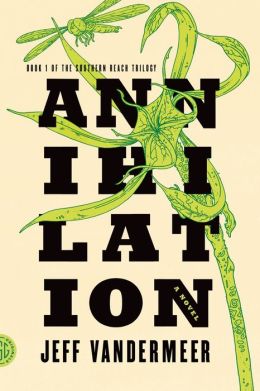
Annihilation — Jeff Vandermeer

Annihilation works and lives up to its hype but may not live up to predecessors like Solaris or Peter Watt’s brilliant, bizarre novel Blindsight. I say “may not” because Annihilation is a simpler book, which I say descriptively rather than derogatorily, written in an easy-to-understand style that isn’t as demanding as Blindsight. Because the protagonist of Annihilation knows very little, she doesn’t have the knowledge or vocabulary to explain what is happening to her. Most of the characters in Blindsight speak in sentences like this: “The geometry—it’s not so symmetrical. Looks almost like the Phaistos Disk.” The what disk? And the chapters skip confusingly around.

Annihilation_coverBlindsight is much harder SF, but the last third, like the novel as a whole, is as good as any fiction I’ve read, ever. It is a book that needs to be started again from the beginning to be understood, which is both a strength and weakness. One could say that Ulysses is the greatest novel ever written—I don’t think so, despite the commonness of the view—but it is also not for everyone or even most people.

Annihilation and Blindsight should be compared because they share an important theme: what happens when we can’t trust our own senses. Annihilation is scary not just because it’s about exploring the unknown but because the protagonist can’t trust memory, which can be directly manipulated in the novel. In a world without reliable memory it becomes impossible to know what you know or don’t. There is no real way to make sense of human life or to receive meaningful feedback from the environment.

This isn’t a totally new fear—Lovecraft’s stories often involve cosmic horror overcoming the senses of humans and causing madness in them, such that they can no longer rationally evaluate what they see and process with their senses. Descartes asked how we know what we know and how we can trust it in 1641’s First Meditation. The difference between then and the near future is the possibility of being able to systematically alter memories. Contemporary science fiction (and, increasingly, science), however, points out that we’re getting much closer to the point at which direct brain or sensory manipulation could be used to make it impossible to trust one’s senses. That sort of thing existing as a fantastical horror scenario is very different from knowing that it could be done to you and, almost as bad, you might not even know.

The narrator’s epistemological gaps are wide. She says: “We had also been assured that it was safe to live off the land if necessary.” Who had done the assuring? When? Why? The party reaches “the camp” and “set about replacing obsolete or damaged equipment.” What equipment is gone and what remains? The narrator doesn’t say. She hears “a lot, powerful moaning at dusk,” but no one tries to figure out what it is. Blindsight is a voyage of discovery; Annihilation is a voyage of strange passivity.

The part of the brain that deals with curiosity seems to have disappeared, and a few pages later the narrator says as much: that “Curiosity could be a powerful distraction.” For someone exploring the unknown, however, curiosity is a motivator, not a distraction. The term “unreliable narrator” is common, but it doesn’t describe Annihilation’s narrator, who better be termed “wildly delusional.” She seems not to search for explanations when the explanation might save her life and its lack might kill her. At times she is anti-rationalist:

I found the psychologist’s faith in measurements and her rationalization for the tower’s absence from maps oddly. . . endearing? Perhaps she meant only to reassure us, but I would like to believe she was trying to reassure herself. Her position, to lead and possibly to know more than us, must have been difficult and lonely.

Almost no one could know less than the narrator. She knows nothing at the beginning of the novel: of one of her party, she says “I think we all believed she came from some kind of management background.” I’d want to know more about someone I hired to edit proposals, let alone someone I’m accompanying into an unknown area long cut off from the rest of the world and human society. She realizes that “we might now be living in a kind of nightmare,” and that sense never goes away. Neither do questions about the narrator’s reliability; towards the end of the novel, she says:

It may be clear by now that I am not always good at telling people things they feel they have a right to know, and in this account thus far I have neglected to mention some details about the brightness. My reason for this is, again, the hope that any reader’s initial opinion in judging my objectivity might not be influenced by these details.

Worries about “objectivity” are standard fare in novels. The quality of the writing in Annihilation, on a sentence-by-sentence basis, is average, but the novel remains fun, even if the narrator’s ineptness is not to my taste. That the ineptness may be an artifact of whoever sent her is scarier than the things she sees, or think she sees, in Area X.

How to Sell — Clancy Martin

How to Sell works, or at least the first half does while the second descends to melodrama. It’s a novel of surfaces and not an easily quotable book. The narrator notices but doesn’t do up the descriptions:

I should have known that as soon as the pitch started Jim believed the lines he was throwing me. It’s like being an actor or prime minister, you get all worked up with the audience and you think can can say nothing false or unbelievable.

How to sellOne could say many professions involve lying as a central component of the work; one could say that science does the opposite and is one of the only fields in which lying, while possible, is at least also discoverable. In How to Sell the narrator and his brother, Jim, work the jewelry business in a pre-Internet age, though I’m not sure how much the Internet has changed that business.

How to Sell starts with an Elmore Leonard-esque word slide: “Our father told it that Jim was caught dressing up in my grandmother’s black Mikimotos when he was scarcely two years old.” He “told it?” To who, when, how? It doesn’t matter since we don’t find it, but it and that weird “scarcely” tell us that the narrator isn’t quite level and maybe the story won’t be either.

It isn’t, not really, and much of the discussion revolves around who is lying (everyone) and who isn’t (no one, not really, including the narrator). Yet a lot of people want to be lied to and put themselves in a position to be lied to and then others do the lying and justify it, as Jim explains:

Look, Bobby, the appraisal is not a lab report. [. . .] We are not calculators, we are people and so are our customers.

W’re people and we want to be lied to. The people who want the truth take the time to learn how jewelry works and the rest take the bullshit the salesman tells them. But information has a cost and so in some circumstances it’s easier to just do it without paying attention to the niggling gaps between details; a lot of romantic relationships function on the same principles as selling jewelry, as the novel makes clear since it is about how the one activity is a metaphor for another. Jewelry is a potent metaphor here because it’s also unnecessary: no one dies because they can’t wear it. As a pure luxury item it is sold as glamor, and one element of glamor is a lie plausible or well-presented enough to be believed.

No one in this book should be married or in a monogamous relationship, yet many characters are and their dilemmas would go away if they could undergo that simple change. But they can’t, or won’t.

Characters are constantly giving bad advice. One, a man named Kizakov, says “In this business, always trust your eyes.” Except that eyes can be deceived, which is why humans build so many tools to augment what we can see. Our senses should be verified rather than trusted; in this way do they also resemble lovers? In that domain broken promises may not be the norm but the evolutionary and other pressures are so strong that everyone at least knows stories about crumbling and breakage and base metals.

Jim gives brotherly advice: “Sometimes it’s better to stay on the surface with somebody.” People who say that often mean, “Stay on the surface with me.” Jim is a man of surfaces more than most people, and when he stays “on the surface” he means that he’ll do what he wants, when he wants it, and you’re only “in” with him to the extent you can do something for him. For men that means selling and for women that not surprisingly means something else.

The owner of the store, Mr. Popper, has a post-modernist view of the truth, as when he says that “It don’t really matter [what’s real and what’s fake], so long as she’s done right.” The similarities to love are again obvious; the bad outcome for Mr. Popper is also not surprising.

A few other points: Clancy knows enough about the jewelry business to describe it or learned enough about the jewelry business to fake it. There is substance amid the love lines and too many novels forget that. The second half of the novel is less about the technical facets of the jewelry business and that’s part of why it is weaker.

* There is more in common with selling jewelry and religion than is commonly supposed.

* To some extent no one knows anyone and that fact continues to drive fiction.

Tampa — Alissa Nutting

Tampa starts with a bang, so to speak—the first line says, “I spent the night before my first day of teaching in an excited loop of hushed masturbation”—and also explains the narrator’s curious, never-resolved marital predicament: “I find it hilarious that people think Ford and I are the perfect couple based solely on our looks.” I find it curious that the narrator, who is obsessed with teenage boys, wanted to marry Ford or stay married to him. Her marriage exists for no reason outside of the needs of plot mechanics; there are occasional references to Ford’s money, but based on the novel Celeste has a single overriding focus on sex.

That focus doesn’t take a lot of money to maintain, and indeed it would be greatly enhanced by her divorcing Ford, or never marrying him. The closest we get to some kind of rationale, emotional or otherwise, is that “I hoped his wealth might provide me with a distraction, but this backfired—it left me with no unfulfilled urges but the sexual.” In 1900, it might have been very hard to “fulfill” sexual urges, but today that is not the case, and someone so single-mindedly focused on sex doesn’t need to be and shouldn’t be married. The “wealth” doesn’t seem to matter to her: other than name-checking one or two luxury items, money doesn’t seem to matter for Celeste. Explaining her husband to her teenage lover, she “didn’t have to feign indifference” and tells him “He’s just a husband.” Why bother? When Humbert Humbert married, he at least had a reason.

To be sure people are rarely fully rational and most of us are riven by conflicting desires, by Celeste’s desire to marry or stay marry makes little sense at the beginning of the novel and less as it goes on. Ford’s presence offers useful plot mechanic friction.

A novel like Dare Me works more effectively than Tampa because its protagonists are supposed to be vacuous twits. A twenty-six-year old with a classics degree, even a very horny one, should have more going on between her ears than Celeste does, and what’s between her ears shouldn’t harm what’s going on between her legs. She says, for example, that “At university I began throwing myself into classics studies, finding brief solace from my sexual frustrations in texts depicting ancient battles of fervent bloodshed.” But for someone interested in classics, she references them very rarely; her studies seem to have left no mark in her mind. Contrast that with a novel like Donna Tartt’s The Secret History, where Greek appears and an obsession with the past fuels the characters’ actions in the present. Those are characters whose thought is fully colored by classics. Here, classics get mentioned as empty window dressing, like material objects.

Toni Bentley deals with the money issue in The Surrender, her memoir of anal sex, where she says:

You let a man into your bowels—your deepest space, the space that all your life you are taught to ignore, hide, keep quiet about—and consciousness is born. Who needs diamonds, pearls, and furs? Those who’ve never been where I have been. The promised land, the Kingdom.

In asking “Who needs diamonds, pearls, and furs?”, she could be speaking for Celeste, who is also indifferent-seeming to possessions because she has her own “promised land,” albeit of a different though even more forbidden sort than Bentley’s (I say “even more forbidden” because while Bentley’s favorite act used to be illegal, it now mostly isn’t; while Celeste’s used to be not prosecuted, these days it is, thanks to feminists seeking equality in an instance where many teenage boys would probably be happy without it).

There are bizarrely hilarious moments in Tampa, as when Celeste narrates:

Sex struck me as a seafood with the shortest imaginable shelf life, needing to be peeled and eaten the moment the urge ripened. Even by sixteen, seventeen, it seemed that people became too comfortable with their desires to have any objectivity over their vulgar moments. They closed their eyes to avoid awkward orgasm faces, slipped lingerie made for models and mannequins onto wholly imperfect bodies.

Actually, sex is not at all like sea food in the sense Celeste describes, but we do see how Celeste totally misconceptualizes the world and thus a lot about her own, non-universal, proclivities. She also asks rhetorically, “Why did anyone pretend human relationships had value?”, when the better question is why she pretends they do, since most of us who aren’t sociopaths have obvious, readily available answers. Yet the metaphor is compelling, like enough of the writing in Tampa to make the book writing about. There are interesting questions about the extent to which desire clouds judgment, but that assumes the characters have any kinds of judgment in the first place, and the ones in Tampa mostly don’t.

Like Humbert Humbert, her obvious antecedent and another character with desire problems, Celeste is obsessed with guys on the cusp of manhood, and her chosen crush gets described in ways similar to Humbert’s nymphets: “I loved the lanky-limbed smoothness, the plasticity of his limbs, the way his frame shunned both fat and muscle.” The alliteration is there, but that kind of poetic style isn’t sustained. There is room in literature for a female Humbert, but she is not Celeste, and Jack is not Dolly. It is a novel with no animating soul beyond the purely carnal. I can appreciate the purely carnal but Celeste doesn’t even both arranging her life in ways that make sense (which may be why carnality is so often depicted in adolescents, who are still faced with strictures of schools and parents).

It is painful reading a book in which there is an obvious solution to an obvious problem that the protagonist doesn’t notice; Celeste’s situation in Tampa doesn’t rise to the TV trope “Too Dumb to Live,” but there should be a lesser term for characters who fail to perceive simple ways of dramatically improving their lots. In addition, Ford appears happy not having sex with—or having bad sex with—his wife. Marrying someone hot but sexually uninteresting doesn’t seem like a great deal, but we see little of him either.

I wanted Tampa to be a better novel; it wasn’t bad yet it feels wrong. I’m writing at length about the book because it’s not badly written and has a lot of promise. Tampa is not bad but should be better than it is. Books like that often generate the most response in me, because truly bad books aren’t worth bothering about and one runs out of empty superlatives with the good ones. There is so much promise, but Tampa isn’t quite executed in a way that makes sense. The supposed shock of what Celeste wants is a good premise that doesn’t go anywhere useful.

Daily Rituals: How Artists Work — Mason Currey

Daily Rituals is charming, and almost every entry feels like the right length; if anything, I would have liked each to be slightly longer, perhaps because the quirks and weirdnesses of the famous artists described provide justification for the quirks and weirdnesses of non-famous artists.

daily_ritualsThe answer to the title is “divergently,” but with some patterns. Many like walks, routines, and stimulants. Exasperation with TV is common, and even the non-writer artists tend to read. Many artists also exasperated lovers and spouses through their compulsions and tics. Given the low remunerative value of art and the low probability of success through recognition, being an artist is a compulsion for many of those described within—Currey even uses the word in his description of Patricia Highsmith: “Writing was less a source of pleasure for her than a compulsion, without which she was miserable.” Daily Rituals may be best read by anyone romantically entangled with or biologically related to artists, as well as any artists who want to justify their own weird predilections. I love it when people explain myself to me.

Currey wants to answer questions like, “are comfort and creativity incompatible, or is the opposite true: Is finding a basic level of daily comfort a prerequisite for sustained creative work?” But they don’t have answers, because artists work in all sorts of places in all sorts of ways. It’s like asking about alcoholics: people who really want to drink will drink in elegant bars like Pouring Ribbons or chug Natty Lites in a dark Chinatown alley. Most might prefer the former to the latter but will settle for the latter when necessary. Currey also writes:

“The book’s title is Daily Rituals, but my focus in writing it was really people’s routines. The word connotes ordinariness and even a lack of thought; to follow a routine is to be on autopilot. But one’s daily routine is also a choice, or a whole series of choices.

Most of the artists in here establish routines whenever they can, much like the writers in Writers on Writing. The number of people who need routine, who need defaults, speaks to its utility, among artists or anyone trying to accomplish a task with an artist’s dedication (like entrepreneurs, who might be the artists of the modern age). Distraction might also be handier than ever, giving rise to essays like “Disconnection Distraction:

Some days I’d wake up, get a cup of tea and check the news, then check email, then check the news again, then answer a few emails, then suddenly notice it was almost lunchtime and I hadn’t gotten any real work done. And this started to happen more and more often.

If you get into that habit, you’ll be well-informed on unimportant news and less likely to make the thing that becomes the news. One question you might ask is: “Are you reading or making the news?” Aim for the latter. The former isn’t wrong, exactly, and it’s worth reading a lot, but as a secondary, not a primary, activity. Reading the news on the Internet or checking e-mail are especially dangerous in this regard because they can feel like working though they’re not.

I mentioned the compulsive aspect of art. That reappears again and again. Currey writes of Simone de Beauvoir that “when she took her annual two- or three-month vacations, she found herself growing bored and uncomfortable after a few weeks away from her work.” Long, pointless idleness is is boring, like binging on TV, but that’s because most artists seem to like what they do, or like it like an addict likes. Voltaire’s secretary “estimated that, all told, they worked eighteen to twenty hours a day. for Voltaire, it was a perfect arrangement. ‘I love the cell,’ he wrote.”

Such stories may be why, in Currey’s words, “Looking at the achievements of past greats is alternately inspiring and utterly discouraging.” The line made me laugh because of the juxtaposition of opposites, but also because he’s expressing a fundamental truth: if you look at the work as work, it can be “discouraging,” since so many artists do so much of it, but if you look at it as an extended form of play, it should be “encouraging.” It should also be “encouraging” because you can do it too—if you want to. Which means the limiting factor between you and art is you—which oscillates back to discouragement.

Still, Daily Rituals is at its heart a manual for dealing with and/or understanding someone with an artistic disposition, which might be described as imagination and execution. A surprisingly large number of people seem to imagine that being an artist is all about the “imagination” part and not much at all about the execution part; wandering around coffeeshops, bars, and parties, doffing a funny hat, and making enigmatic pronouncements is not the majority of what being an artist, broadly defined, is about. It’s about results, and Daily Rituals is about getting them and enabling the conditions necessary to get them. “Necessary” is the key word: a condition may be necessary but not sufficient, and it’s possible to treat a daily ritual as an empty ritual with no real output.

There are also a fairly wide range of ways to succeed. Some artists do spend a lot of time drunk or at parties. At least one prefers to work hungover, which would make me crazy. The artists appear approximately split between those who like noise and those who prefer quiet. I’m among the latter and can barely believe that anyone really gets anything done in noisy coffeeshops, tapping on laptops, but enough successful writers have testified to the contrary that I’m forced to believe them. The fundamental idea remains, however, that artists are artists because of their output. That’s it.

Some passages in Daily Rituals are funny; you wouldn’t expect this book to be a comedy and yet I laughed frequently. Two examples:

[John Cheever] had what appears to have been an unusually robust sex drive (the actress Hope Lange, who had a brief affair with Cheever, said that he was ‘the horniest man [she] ever met’) combined with frequent bouts of impotence, probably brought on by his alcoholism but no doubt made worse by his sexual guilt and a frequently rocky marriage. All of this was distracting from his work, especially since Cheever placed a high value on the salutary effects of erotic release. He thought that his constitution required at least ‘two or three orgasms a week’ and he believed that sexual stimulation improved his concentration and even his eyesight: ‘With a stiff prick I can read the small print in prayer books but with a limp prick I can barely read newspaper headlines.’

or:

The German poet, historian, philosopher, and playwright [Friedrich Schiller] kept a drawer full of rotting apples in his workroom; he said that he needed their decaying smell in order to feel the urge to write.

Rereading Nick Hornby’s High Fidelity

I still laughed aloud many times at High Fidelity, although the jokes are almost all context-dependent and so can’t be quoted without causing a quizzical look that says, “You really think that’s funny?” Flipping through it doesn’t yield anything obvious, but I kept smiling at many moments. This is the closest I can get:

There were some nights with Laura when I’d kind of nestle into her back in bed when she was asleep, and I’d be filled with this enormous, nameless terror, except now I have a name for it: Brian. Ha, ha. OK, not really a name, but I can see where it came from, and why I wanted to sleep with Rosie the pain-in-the-arse simultaneous orgasm woman, and if that sounds feeble and self-serving at the same time—oh, right! He sleeps with other women because he has a fear of death!—well, I’m sorry, but that’s the way things are.

Rob’s voice and attitude carry the book, as does the writing, which is largely about nothing yet still moves rapidly from incident to incident, creating plot, which is easily overlooked in novels like this, such as Wilson’s Flatscreen. The continuous happening in the plot contrasts with the non-happening in many of the characters’ lives.

There are moments of astute observation too, as when Laura says “sometimes you need someone to lob into the middle of a bad relationship like a hand grenade and blow it all apart.” Which is true, even if the hand grenade is often made out to be the bad guy (or girl) in the relationship. Often the grenade is the bad guy. But sometimes he (or she) is the catalyst for doing what should have been done long before. When big, life-changing transitions stop happening on a regular basis, (from high school to college, college to grad school and/or work), it becomes distressingly easy to slip into a single path and lose the willingness necessary to make radical changes, whether in work, the mind, or love.

Rob basically knows as much:

None of us is young anymore, but what has just taken place could have happened when I was sixteen, or twenty, or twenty-five. We got to adolescence and just stopped dead; we drew up the map then and left the boundaries exactly as they were.

Life changes even if you don’t. This should be obvious. It takes Laura to tell him what he should already know; when Rob asks “So what should I be doing?”, she replies:

I don’t know. Something. Working. Seeing people. Running a scout troop, or running a club even. Something more than waiting for life to change and keeping your options open. You’d keep your options open for the rest of your life, if you could. You’d be lying on your deathbed, dying of some smoking-related disease, and you’ll be thinking, ‘Well, at least I’ve kept my options open.’

She’s right. Whatever else you’re doing, you should be doing something. But Rob doesn’t, mostly, and as a result his problems are largely self-imposed. He says:

It’s only beginning to occur to me that it’s important to have something going on somewhere, at work or at home, otherwise you’re just clinging on. [. . .] You need as much ballast as possible to stop you from floating away; you need people around you, things going on, otherwise life is like some film where the money ran out, and it’s just one bloke on his own staring into the camera with nothing to do and nobody to speak to, and who’d believe in this character then?

Rob lacks that intellectual ballast. He only listens to music and doesn’t play; at his level of obsession, connoisseurship and taste should pale compared to making (Rob hooks up with an American singer named Marie and says of her place, “thrillingly, there are two guitars leaning against the wall.” He could have two guitars leaning against his wall, although I think one would suffice). Still, I am struck by the extent to which many YouTube videos can be reduced to “one block on his own staring into the camera with nothing to do,” except talk to an audience that isn’t present. Jenna Marbles is a useful approximation of this idea.

There are moments of poignance and useful articulations of the obvious, as when Rob says:

You run the risk of losing anyone who is worth spending time with, unless you are so paranoid about loss that you choose someone unlosable, somebody who could not possibly appeal to anyone else at all.

Being overly fearful of loss increases the likelihood of loss, and Rob is disproportionately anxious. As a college student dating Charlie Rob is “fretful about my abilities as a lover,” and fifteen or so years later he is still fretful about his abilities as a lover. Eventually shouldn’t he just let the anxiety go and figure out what he’s doing? Though he apparently hasn’t in his economic life so perhaps his love and economic lives reflect each other. Rob is a sort of what-not-to-do when it comes to women. He even says, “There are still enough of the old-style, big-mouthed, self-opinionated egomaniacs around to make someone like me appear refreshingly different.” That might work for him, but the big-mouthed egomaniacs are the way they are because what they do tends to work (link is text but potentially NSFW).

For a guy who thinks a lot about his love life, and pop songs that are almost entirely about love, sex, and romance, Rob appears to know very little about actual women. Most pop culture, however, appears to be highly misleading on this score, which may explain why a pop-culture junkie like Rob is or has been highly misled. People who don’t make a concerted effort to learn about actual women. But this is true of much narrative art, especially American narrative art.

In my reading over the last few days, I’m struck by how much more pathetic Rob seems: as I said before, his problems are largely self-imposed, or imposed by his personality, and the solutions also must come from within. Rob fears the women he’s attracted to, like a fifteen-year-old; he goes to a small gig where Marie plays and afterwords she sells CDs: “We all buy one from her, and to our horror she speaks to us.” Most guys are happy to be talking to the people they’re attracted to, and the same obviously applies to women.

In addition, High Fidelity feels like a period piece: Rob owns a record store in an era when CDs and records are mainstream, and people who want to hear a particular song must track down a physical copy of it. Though I was born into that era it feels very long ago and foreign. So does the difficulty of getting ahold of people through the phone. The default state of more people as “alone” then. Computers are almost totally absent. It also feels highly PC, as when Rob recounts “a terribly unsound joke” that is only mildly funny and not really offensive. Why qualify it by saying that it’s “terribly unsound” when it’s not and when interesting humor by its nature is “unsound,” using Rob’s definition?