On what makes people happy, from Daniel Kahneman:

Our poor intuitions about the pursuit of happiness are a genuine paradox. Daniel Kahneman summarizes decades of happiness research this way: “It is only a slight exaggeration to say that happiness is the experience of spending time with people you love and who love you.”

(Emphasis in original.)

[. . .] it’s not just survey data that confirms the horror of rush hour. A few years ago, the Swiss economists Bruno Frey and Alois Stutzer outlined a human bias they called “the commuting paradox.” They found that, when people are choosing where to live, they consistently underestimated the pain of a long commute. As a result, they mistakenly believed that the McMansion in the suburbs, with its extra bedroom and sprawling lawn, will make them happier, even though it might force them to drive an additional forty-five minutes to work. It turns out, though, that traffic is torture, and the big house isn’t worth it.

Both quotes come from “Does Money Make You Unhappy?” (hat tip Penelope Trunk). Strangely, Jonah Lehrer doesn’t mention Daniel Gilbert, author of Stumbling on Happiness, until the very end. Since reading Stumbling on Happiness, I’ve been pointing out these points from it to various people in various contexts:

  • making more than about $40,000 / year does little to improve happiness (this should probably be greater in, say, New York, but the main point about the diminishing returns of additional income for most people remains)
  • most people value friends, family, and social connections more than additional money above around $40K/year
  • your sex life probably matters more than your job, and many people mis-optimize in this area
  • making your work meaningful is important, although this means different things to different people

I consciously think about this book when making my own life choices, and this is also the kind of valuable insight that seemingly never gets taught in schools.

I have some theories about why so many people screw this up, but they aren’t well-developed enough to write about. Yet.

How being in Huntington Beach is affecting my thinking

John Scalzi on San Diego:

I say to myself, hey, I wonder what’s going on in the rest of the world.

Then I look around me and go, why the fuck should I care what’s going on in the rest of the world?

This is how I feel about Huntington Beach, where I’ve been for the last week. The temperature is a steady 75. The shore is maybe 800 meters from the door. Girls don’t wear much clothing. Drinks aren’t too expensive, considering. I feel like I should learn how to play the guitar. One great advantage over Tucson and Phoenix: virtually no driving.

It might be for the best that I didn’t get into graduate school at UC Santa Barbara. I could imagine the temptation: go to the beach or work on the dissertation? Beach, or dissertation? Beach, or. . . what? I can’t hear myself over the sound of the waves.

Boredom in books according to Alain de Botton

There are, so Montaigne implied, no legitimate reasons why books in the humanities should be difficult or boring; wisdom does not require a specialized vocabulary or syntax, nor does an audience benefit from being wearied. Carefully used, boredom can be a valuable indicator of the merit of books. Though it can never be a sufficient judge (and in its more degenerate forms, slips into wilful [sic] indifference and impatience), taking our levels of boredom into account can temper an otherwise excessive tolerance for balderdash. THose who do not listen to their boredom when reading, like those who pay no attention to pain, may be increasing their suffering unnecessarily. Whatever the dangers of being wrongly bored, there are as many pitfalls in never allowing ourselves to lose patience with our reading matter.

—Alain de Botton, The Consolations of Philosophy

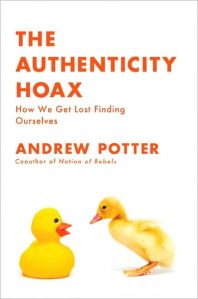
The Authenticity Hoax: How We Get Lost Finding Ourselves — Andrew Potter

A lot of us are searching for something “real” and “authentic” in the same way that Jake Barnes is searching, fruitlessly, in The Sun Also Rises:

We ate dinner at Madame Lecomte’s restaurant on the far side of the island. It was crowded with Americans and we had to stand up and wait for a place. Some one had put it on the American Women’s Club list as a quaint restaurant on the Paris quais as yet untouched by Americans, so we had to wait forty-five minutes for a table.

As soon as Americans arrive, the place is spoiled, but, more importantly, a paradox emerges: when something is identified as “untouched,” it immediately becomes the focus of attention and is touched. The same phenomenon occurs with bullfighting: a nominally pure activity becomes contaminated by Americans seeking authenticity. Notice, however, that no one is directly responsible for putting Madame Lecomte’s on the list: it just happens. “Someone” does it, with no effort to identify that someone: the action is as natural as the dawn and perhaps as inevitable. There is no sense in fighting. It just is, which is part of the small joke, and a rare one in The Sun Also Rises. The meal ends: “After the coffee and a fine we got the bill, chalked up the same as ever on a slate, that was doubtless one of the ‘quaint’ features, paid it [. . .]” The supposed authenticity is inauthentic, and made so by people who are seeking the authentic. This leads us into a paradox that we can’t really get out of.

Unless we acknowledge that authenticity itself is a pernicious desire. That’s Andrew Potter’s main point in The Authenticity Hoax: How We Get Lost Finding Ourselves, which is as authentic a book I’ve read because it doesn’t strive to be authentic. He says:

In the end, authenticity is a positional good, which is valuable precisely because not everyone can have it. The upshot is that, like the earlier privilege given to the upper classes, or the later distinction gained from being cool, the search for the authentic is a form of status competition. Indeed, in recent years authenticity has established itself as the most rarified form of status competition in our society, attracting only the most discerning, well-heeled, and frankly competitive players to the game.
Any status hierarchy is socially pernicious when it is used to allocate scarce goods and resources on the basis of arbitrary or unearned qualities. It is good to be the kind, and almost as good to be a prince, or a duke, or a count, and on down the aristocratic chain. But not all forms of status are illegitimate: higher education is a status hierarchy that helps allocate wealth and privileges, yet for many people, the fact that the education system is for the most part a meritocracy makes it a fair, just, and even democratic form of status competition.

Once it becomes positional, it becomes fake. Still, I would argue that not everyone can have authenticity in the same way, but everyone can probably have it some way. Even the seemingly inauthentic can become authentic if pursued with sufficient vigor: think of the pop culture bubbles Paris Hilton or The Jersey Shore, in which crass commercialism becomes something like authentic. Las Vegas exists by being inauthentic and appropriating the styles of other places—and the pastiche has become a style of its own. Once aware, you can never become unaware:

Authenticity is like authority or charisma: if you have to tell people you have it, then you probably don’t. […] authenticity has an uneasy relationship with the market economy. This is because authenticity is supposed to be something that is spontaneous, nature, innocent, and ‘unspun,’ and for most people, the cash nexus is none of these. Markets are the very definition of that which is planned, fake, calculating, and marketed. That is, selling authenticity is another way of making it self-conscious, which is again, self-defeating.

The best you can do is fight back by not using the language of authenticity, because once one uses it, the thing itself becomes its opposite. Potter is pointing to something like The Gift, which deals with how people tend to have two modes: a commercial mode and a gift mode. Authenticity is supposed to correspond mostly to the gift mode, in opposition to the commercial one, except that this often doesn’t work out.

In The Sun Also Rises, there are long passages about “aficion” that can’t be stated exactly but can be seen. Once seen, it is not spoken of as such; it is only felt, as in this scene with Jake Barnes describing his friend Montoya introducing Jake to other aficionados:

Somehow it was taken for granted that an American could not have aficion. He might simulate it or confuse it with excitement, but he could not really have it. When they saw that I had aficion, and there was no password, no set questions that could bring it out, rather it was a sort of oral spiritual examination with the questions always a little on the defensive and never apparent, there was this same embarrassed putting the hand on the shoulder, or a ‘Beun hombre.’ But nearly always there was the actual touching. It seemed as though they wanted to touch you to make it certain.

In a world where the language of authenticity has been stolen by advertisers and whoever else happens along to appropriate it, we’re stuck striving for “conspicuous authenticity,” a play on Thorstein Veblen term, “conspicuous consumption.” Instead of merely consuming goods, we’re consuming status, which might come in the form of goods, but might also come in the form of experiences, behaviors, acts, postures, and the like. Potter gets this, and he hopes that once we get that the authenticity game—and it is a game—is a phony one, we’ll stop falling for it. And if we do, maybe we’ll also stop falling for some of the other major tropes of our time, in which everyone is striving to be unlike everyone else—and in the process is just like everyone else:

The idea that authority is repressive, that status-seeking is humiliating, that work is alienating, that conformity is a form of death. . . none of this is remotely original. We have heard every variation of the tune, from nineteenth-century bohemians to twentieth-century counterculturalists to twenty-first century antiglobalists, and we know every part by heart.

It is not the sheer persistence but rather the amazing popularity of the stance that ought to give us reason to pause and maybe reconsider our attitude toward modernity. Look around. Is there anyone out there who does not consider him or herself to be an ‘antihero of authenticity’? Anyone who embraces authority, delights in status-seeking, loves work, and strives for conformity?

My guess would be yes: people in the military or law enforcement embrace authority. A lot of celebrities or others of very high status seem to delight in status seeking. People who love work are common enough that we have a phrase for them: workaholics. And high school students either strive for conformity or for the anti-conformity of wearing all black as a group. But the overall point stands—like the point that

One reason I might find novels a more real or satisfying experience than cinema is because they feel further from the cash economy: although novels are obviously protected by copyright and charged for by their authors, many feel less crassly commercial. This is the problem with articles like “The Cobra: Inside a movie marketer’s playbook,” which detail exactly how calculating the movie industry is. Taken with Edward Jay Epstein’s The Hollywood Economist, and it’s hard not to feel bamboozled most of the time when you go to a big Hollywood movie.

Elif Batuman might agree with much of The Authenticity Hoax, especially after she spends a summer in Uzbekistan, which she describes this way in The Possessed: Adventures with Russian Books and the People Who Read Them:

I have never been so hungry in my life as I was that summer [in Uzbekistan]. I remember lying across the bed with Eric, fantasizing about buying anything we wanted from the twenty-four hour Safeway across from our apartment in Mountain View.
[…]
When we first moved to Mountain View, I used to think it was depressing to look out the window and see a gigantic Safeway parking lot, but that was before I spent any time in the ‘Fourth Paradise.’

If the authentic is starvation, give me McDonald’s. If the authentic is local vegetables, give me the avocados and bananas shipped halfway around the world so I can have salads and smoothies in December. In the case of Batuman, Safeway is banal and boring and symptomatic of soul-deadening consumer capitalism, right up to the point where you just want to buy some french fries and maybe one of those takeaway meals that aren’t very good, unless you’ve been subsisting on tea and rancid borscht in a third-world former Soviet republic. Modern life probably also looks sterile and boring up to the point when you’re kidnapped by pirates and die in the ensuring firefight. Some experiences are better left to the movies, unless you have to undergo them.

For example, one thing that makes The Lord of the Rings so effective is the reluctance of the hobbits to leave the Shire; they don’t really want to go on an adventure, or if they do they only half do, and would tarry a long time unless forced. Sam wants to go see Elves on an adventure chiefly because he doesn’t really conceive of what’s ahead. But if they must go, they will.

Their longing for home, rather than for power or for the misery that traveling entailed in a world before planes, trains, and automobiles, is what makes their experience so real. The Authenticity Hoax is partially about what happens if you try to take fantasy experiences and make them into messy realities without the many amenities that many people in developed countries now effectively assume will be there, invisibly woven into the fabric of our lives—like Safeway, and which so many generations have toiled so long in order to give us the standard of living we now enjoy (despite the anxiety still generated around status issues).

The book is worth reading, but skim sections. Some of the later chapters in The Authenticity Hoax are weak: there’s a gross misinterpretation of Harold Bloom’s The Anxiety of Influence at one point. The chapter “Vote for Me, I’m Authentic” is funny but overly focused on contemporary issues, like the 2008 election. At one point Potter says that “[…] it is dangerous for anyone, no matter what their partisan alliance, to have so much contempt for voters. Democracy is based on the premise that reasonable people can disagree over issues of fundamental importance, from abortion and gay rights to the proper balance between freedom and security.” The problem isn’t that voters disagree—the problem is how little voters know. If you read Bryan Caplan’s The Myth of the Rational Voter, it’s hard not to have contempt for voters: their ideology is incoherent, they don’t understand how economics or politics work, they know their individual votes are unlikely to affect the outcome and thus can vote irrationally or against their best interests without consequences, and they don’t know how the government they’re voting on is structured. As Caplan points out, the politicians who are elected are often substantially more knowledgeable than the people who elect them.

Later, Potter says that “[…] a great share of the blame [for politicians who massage the truth] lies with the media and its obsession with controversy and scandal at the expense of more difficult question of policy (sic) and other serious issues.” But the real issue is, once again, within us: a lot more people subscribe to People magazine than Foreign Affairs or The Atlantic, and a lot more voters (“consumers” might be a better word here) watch brain-dead network news shows than good-for-you special reports on the situation in Lebanon, or South Ossetia, or wherever. The problem isn’t the media or politicians—the problem is us. It always has been, and it probably always will be. You can gloss authenticity problems over political ones, but the political ones really point elsewhere.

Skip the last third of the book and pay great attention to the first half. If you read The Authenticity Hoax, maybe you’ll come out with a better conception of your self as an authentic person—which is to say, an inauthentic person. You’ll come out caring less. And when your friend comes back from an “exotic” location you’ll roll your eyes—as you should.

Notes on Christopher Nolan's Inception

I saw Christopher Nolan’s Inception last week and noticed a couple of strange or notable tendencies:

* The almost complete lack of computers: I think one or two peep out, but otherwise this movie could’ve been made in 1980. Or 1970.

* The equally anachronistic portrayal of what a “chemist” (really an anesthesiologist) works like. His shop could be an alchemist’s lair circa 1500.

* The movie, like DiCaprio’s earlier Shutter Island, recalls Descartes’ first meditation, in which the philosopher questions how we can trust our senses and how we know what we know. The answer: on some level we can’t. But Shutter Island and Inception both posit a world where we have enough evidence to engage the first meditation because there is some evidence we can’t trust our senses.

Obviously, Inception isn’t the first movie or book to ask these kinds of questions; The Matrix came out more than a decade ago, and Adam Gopnik treats it subtly in the linked New Yorker article.

* The almost complete absence of sexuality. The criminal team is composed almost entirely of hypercompetent men devoted solely to their job; the one attractive young woman gets virtually no sexual attention. Neither does anyone else. Their technocratic devotion is nearly perfect—perhaps a fantasy of our own competence and ability to discard what we might otherwise call distraction.

Notes on Christopher Nolan’s Inception

I saw Christopher Nolan’s Inception last week and noticed a couple of strange or notable tendencies:

* The almost complete lack of computers: I think one or two peep out, but otherwise this movie could’ve been made in 1980. Or 1970.

* The equally anachronistic portrayal of what a “chemist” (really an anesthesiologist) works like. His shop could be an alchemist’s lair circa 1500.

* The movie, like DiCaprio’s earlier Shutter Island, recalls Descartes’ first meditation, in which the philosopher questions how we can trust our senses and how we know what we know. The answer: on some level we can’t. But Shutter Island and Inception both posit a world where we have enough evidence to engage the first meditation because there is some evidence we can’t trust our senses.

Obviously, Inception isn’t the first movie or book to ask these kinds of questions; The Matrix came out more than a decade ago, and Adam Gopnik treats it subtly in the linked New Yorker article.

* The almost complete absence of sexuality. The criminal team is composed almost entirely of hypercompetent men devoted solely to their job; the one attractive young woman gets virtually no sexual attention. Neither does anyone else. Their technocratic devotion is nearly perfect—perhaps a fantasy of our own competence and ability to discard what we might otherwise call distraction.

Tyler Cowen's political (and general) wisdom

“[…] we are accustomed to judging the truth of a claim by the moral status of the group making the claim.”

That’s Tyler Cowen speaking of “Climategate” in his post “The limits of good vs. evil thinking.” Normally I would put something like this in a links post, but “The limits of good vs. evil thinking” is so good that I’m emphasizing it with an independent post.

The major problem is that sometimes people we perceive as morally palatable can make untruthful or not optimally useful claims, while the opposite—people we perceive as morally unpalatable can make truthful or optimally useful claims—can also occur. Notice that I’m intentionally not providing examples of either phenomenon. As Paul Graham says in the notes to “What You Can’t Say:”

The most extreme of the things you can’t say would be very shocking to most readers. If you doubt that, imagine what people in 1830 would think of our default educated east coast beliefs about, say, premarital sex, homosexuality, or the literal truth of the Bible. We would seem depraved to them. So we should expect that someone who similarly violated our taboos would seem depraved to us.

If I said this kind of thing, it would be like someone doing a cannonball into a swimming pool. Immediately, the essay would be about that, and not about the more general and ultimately more important point.

The more important point is about avoiding ad hominem attacks and being able to consider claims independently of the person making the claims in some circumstances. As Cowen says, this is really hard.

The pleasures of Bellow and the unexpected moment in Herzog

One of the pleasures of reading and rereading Bellow comes from the unexpected moments that ceaseless arise. I’ve read most of Bellow’s novels two or three times, but this bit regarding Herzog’s mind stands out: “It was too full of his grant projects to think anything clearly.” The contradiction of a full mind, which we usually consider orderly, brilliant, professorial, and the failure to think “clearly,” which is normally a problem of the undereducated or the thoughtless, seems perfectly right for someone who is being put back together by falling apart (or vice-versa; with Bellow, you never know). Here’s the larger context for that passage:

But it would never happen to her daughter, not if she could help it. And Madeleine was just as determined that it should not. And this was where Moses came in, on the bench of Verdi Square. His face was shaven, his shirt was clean, his nails clean, his legs, somewhat heavy in the thighs, were crossed, and he listened to Tennie very thoughtfully—for a man whose mind had stopped working. It was too full of his grant projects to think anything clearly.

So who is Moses, the man whose mind isn’t working clearly but who is also presented as a good and thoughtful bourgeois provider, at least here, with his cleanliness and full/empty mind? That I don’t have a good answer, two or three or however many times through, reminds me of Bellow’s subtlety, his habit of slipping in that idea that’s endlessly forgotten and rediscovered, and which makes him unexpected even when I superficially know what’s going to happen.

Moses Herzog and Bellow also know what’s going to happen, of course, which is why images of death are so pervasive in Herzog and many of Bellow’s other novels. The question is how we deal with that fact and how it animates our social and intellectual lives. The (partial) answer to that question is the complete works of Saul Bellow; I say “partial” because I suspect the larger point is that there is no answer, only more questions. No wonder so many people exist in such a neurotic world.

Late December links: Holiday guide edition

* From James Fallows, excellent holiday shopping advice for you to ignore. I’ve followed it, but like a person of religious persuasion who pats himself on the back from not fornicating, I can’t help but think that I’m not much going to change the composition of the cultural ocean around me. Still, giving books for me is only half about the book itself: the other half is gauging the book someone else would want.

In large part, I’m not just giving the physical manifestation, but the fruit of whatever meager knowledge I have about book and recipient. Sometimes this works better and sometimes not, but I think it worth trying, since the gift of expertise is perhaps the best one of all.

Fallows has a second post on the subject here. And Random House’s Modern Library imprint gets in on the action here. And Mark Sarvas does here. And I do in the post you’re reading.

* Although not directly related to the above, this is pretty interesting:

There is a Catalan custom of men giving women and girls red roses on St. George’s Day (April 23), while women traditionally give men and boys a book on that day.

My guide mentioned that the books are always sold to the (female) buyer at a 10 percent discount below the regular price […]

But why the book discount?

Answer: no one knows.

* As if to reinforce some of the points I made in my post on Beer and Circus, the Financial Times reports:

But students at Manchester University, where he is paid £3,000 an hour as professor of creative writing, barely recognise him.

A survey by Student Direct, the company that offers undergraduate loans and banking services, asked students to put names to faces of the university’s prominent figures. Only 12 per cent knew who Mr Amis was.

Then again, maybe 12% is pretty good for an author.

(Hap tip TEV.)

* According to a Wall Street Journal analysis

Your parents might have worried when you chose Philosophy or International Relations as a major. But a year-long survey of 1.2 million people with only a bachelor’s degree by PayScale Inc. shows that graduates in these subjects earned 103.5% and 97.8% more, respectively, about 10 years post-commencement.

After 10 years, Philosophy majors earn more than Business Management majors, but still less than Math and many engineering majors. Consider this in light of the second bullet point in this earlier post from me. Consider too “The Management Myth” in The Atlantic, which argues that

Most of management theory is inane, writes our correspondent, the founder of a consulting firm. If you want to succeed in business, don’t get an M.B.A. Study philosophy instead.

As so often happens with such arguments, I don’t know whether I like it because it’s true or if I like it because it flatters the values I hold.

(But maybe the smartest people of all discard philosophy, as Paul Graham argues at the link.)

More on How Fiction Works and someone else’s review doesn’t

In The Australian, a nominal review of James Wood’s How Fiction Works is really a discussion of Wood’s work more generally. It also shows why I shirked writing a deep review of How Fiction Works, as I I have more than a few quibbles:

If Wood doesn’t “get” the overall trick of an author’s writing he tends to dismiss it. This was most evident in his notorious Guardian review (reworked in The Irresponsible Self) of “hysterical realism”, a term Wood has coined to sum up the work of a whole slew of contemporary novelists that includes Don DeLillo, Zadie Smith, David Foster Wallace, Salman Rushdie and Thomas Pynchon.

Is this an issue of not “getting” the works, or of getting them too well and not liking or caring for what they represent? To me, DeLillo and Pynchon in particular have long been overrated. I remember trying to read them in late school and early college and thinking, “why are these awful writers so highly praised?” At the time I didn’t realize that they were a reaction against earlier literary trends and that they were trying to be stylistically unusual merely for the sake of being stylistically unusual, or for obscure philosophical points without writing actual philosophy. Paul Graham seems to have had a similar experience with actual philosophy. Wood gets this, and probably better than I do, and I’m not the only one who’s noticed the overpraised and under-talented; one thing I very much appreciate about A Reader’s Manifesto is its willingness to engage with writing, rather than politics surrounding writing, or whatever propelled DeLillo to fame.

To return to the review:

While another critic might see the impulse towards jam-packed, baroquely hyperreal novels as a legitimate and thoughtful, albeit varyingly skilful, response to our postmodern world (a mimetic reflection of the different status of information in an age of instant and indiscriminate communication, say, or an attempt to “wake up” a form whose traditional gestures are now the cliched staples of Hollywood cinema) […]

The problem is that these techniques aren’t mimetic: in trying to mimic the supposed techniques that they implicitly criticize, they don’t reflect information, but chaos; they aren’t hyperreal, but fake. And I’m not convinced modern life is so different in terms of “the different status of information in an age of instant and indiscriminate communication.” Information isn’t indiscriminate: I still choose what to read and what to watch most of the time; if I’m exposed to ads, it’s because I choose to be. In some essays, Umberto Eco discusses how he sees ideas and battles from the Middle Ages underlying much of everyday life, and the more I read, the more I tend to trace the lineage of intellectual and personal ideas backwards through time. Although our technological and physical world has changed enormously in the last two hundred years, I’m not sure the purposes to which we put technology and power (conquest, sex, etc.) has much. That isn’t to say literary style hasn’t evolved, as it obviously has, and my preference tends toward novels written after 1900. Ideas have shifted and evolved too. Still, techniques used by modern authors like the hyperrealists just because they can be used doesn’t make them an improvement. Furthermore, not all of Wood’s loves are mine—I just finished Henry James’ The Portrait of a Lady and wouldn’t have if I didn’t need to. But I have seldom read a stronger argument for the capital-N Novel than I have in How Fiction Works, and even when I sometimes don’t find Wood persuasive, the power of his argument and depth of his reading always compels me to think more clearly and deeply about my own positions and thoughts.