Kitchen Confidential: Adventures in the Culinary Underbelly — Anthony Bourdain

Kitchen Confidential: Adventures in the Culinary Underbelly is as good as a lot of people say it is, which is pretty uncommon. It moves quickly and cleverly: as a young man, Bourdain observes an older cook’s hands, which “looked like the claws of some monstrous science-fiction crustacean, knobby and calloused under wounds old and new.” Notice that word, “crustacean,” and how well it fits, especially since the kitchen is making seafood. The memoir is filled with evocative and expressive moments like that. I’m tempted to start listing them. But that would spoil the surprising pleasure they offer on the page.

There’s a moment when Bourdain points out one of the problems with writing about something as sensual as food, since you can never taste the food through words:

. . . the events described are somehow diminished in the telling. A perfect bowl of bouillabaisse, that first, all-important oyster, plucked from the Bassin d’Arcachon, both are made cheaper, less distinct in my memory, once I’ve written about them.

But the problem of something becoming “somehow diminishing in the telling” or “cheaper, less distinct in my memory” are perils not only of the food writer, although he might be particularly sensitive to them, but to the writer of almost any genre. Tactile sensations like food, sex, water, and the like might be especially susceptible, but even our descriptions of our thoughts are probably different once we’ve “written about them.” But writing about them is the only effective way we have of communicating them to others. And Bourdain is very, very good at that communication. I never thought I cared about what it was like to work in a kitchen, or about the tribulations of the chef. I didn’t realize just how dramatic being a chief could be. Now I understand, and am slightly closer to understanding the fascination with cooking TV shows. I say “closer,” however because I’d still rather be in the kitchen with knife and spatula at hand than watching someone else in the kitchen, much as I’d rather be on the field with a soccer ball at my feet than playing the FIFA soccer video game.

I come out of Kitchen Confidential with a sense that I’ve read a religious story, in which the wayward one day finds God. Except most of us moderns don’t really find God, but we find something abstract to serve, and that something is greater than ourselves. For Bourdain it’s food, despite the many problems that come with it. For others it might be art, science, math, business, the ideal of the family. The things you can choose to admire proliferate. But most of us only choose one or maybe two things. Or the thing chooses us.

You have to love the thing, as Bourdain does cooking, but you can’t love it only for itself. I’ve read the unfortunate prose of plenty of people who say they love “writing” but don’t love it enough to learn basic grammar, expand their vocabularies, or think about the reader more than themselves (Bourdain holds chefs who cook attractive dishes that don’t taste very good in low regard, which is approximately how I feel about people who publish essays in novel format). Love might be necessary if you’re going to go to the distance, but a lot of people have this silly, romantic idea that love is all about the moment, dying for each other, crashing emotional waves, love-at-first-sight, tussles-in-the-bedroom.

And it is about that—we learn about Bourdain’s apprenticeship—but the part is relatively small: a lot of love is about persevering during the tedious, boring parts of life, learning one’s craft, and learning how to get along with others. People who cook because they think they love to cook, without having considered that cooking professionally might mean doing it six to seven days a week for years on end, haven’t realized that no, maybe love isn’t enough. Here’s Michael Idov in “Bitter Brew: I opened a charming neighborhood coffee shop. Then it destroyed my life,” which every aspiring coffee artist should read:

Looking back, we (incredibly) should have heeded the advice of bad-boy chef Anthony Bourdain, who wrote our epitaph in Kitchen Confidential: “The most dangerous species of owner … is the one who gets into the business for love.”

Advice like this by its nature goes unheeded because most people probably can’t project themselves imaginatively into the mind of the advice giver. The advice is “diminished in the telling,” since we don’t have the sensory information and deep background that went into the person giving the advice. We’re bad at thinking about what doing something over and over for months or years at a time is like. We’ll probably never be good at it, but that’s not going to stop us from giving and taking it.

I like to cook and cook for myself and friends with what I imagine to be reasonable skill. If, for some unknown reason, Bourdain showed up at my apartment for dinner, I think I could make something he’d find passable, especially because he likes food you can eat better than food that’s designed to show off the chef’s smarts. But I probably don’t love cooking enough to do it as a pro. I don’t like it enough to put forth my best effort when I’m not in the mood. Maybe I once thought I liked cooking enough, because who hasn’t imagined themselves as a chef somewhere as they grease their pan with olive oil, knowing that an hour later perfect penne a la vodka and tender green beans with garlic will be served? We’ve all probably briefly imagined ourselves giving Nobel and Oscar acceptance speeches too.

But the gap between current skills and the social admiration can only be bridged by the long honing of skill that requires incredibly internal and psychological fortitude (or, possibly, dumb luck and not having anywhere else to go). Even if we do keep trying, the plaudits may never come. I know of Bourdain not because of his work as a chef, but because he’s so skilled a writer that I’ve seen him mentioned often enough to read his book. Which I will now recommend that you do too, because it’s fabulous. He probably could’ve amped up the sex part, though he does say that he doesn’t want the reader “to think that everything up to this point was about fornication, free booze, and ready access to drugs.” But for Bourdain it is, more than anything else, about the food. I think it would be extraordinarily difficult to fake his level of enthusiasm for food. And when you have an enthusiasm that you probably can’t fake, you’ve probably also got a shot at being the best.


I also wrote about Bourdain in “So you wanna be a writer: What Anthony Bourdain can tell you even when he’s not talking about writing.” I like that he views cooking as a craft. “Craft” sounds intellectually honest, as opposed to an art that can fall prey to pretension, and even though all arts require some level of craftsmanship. He raises cooking to an art form without overdramatizing it.

We lack perspective: notes from Alain de Botton's The Pleasures and Sorrows of Work

Yet our world of abundance, with seas of wine and alps of bread, has hardly turned out to be the ebullient place dreamt of by our ancestors in the famine-stricken years of the Middle Ages. The brightest minds spend their working lives simplifying or accelerating functions of unreasonable banality. Engineers write theses on the velocities of scanning machines and consultants devote their careers to implementing minor economies in the movements of shelf-stackers and forklift operators. The alcohol-inspired fights that break out in market towns on Saturday evenings are predictable symptoms of fury at our incarceration. They are a reminder of the price we pay for our daily submission at the altars of prudence and order – and of the rage that silently accumulates beneath a uniquely law-abiding and compliant surface.

1) A lot of engineers like their jobs and look at them as solving a series of puzzles: “theses on the velocities of scanning machines” are only as banal as you make them. In addition, even if you do find them banal, if you can make a faster scanning machine and sell it for a lot of money, you may not care when you retire to paint water colors for the rest of your life.

2) Fights say more about the dumb fighters than about the human condition.

3) Humans might simply never be, as a group, overtly happy in whatever conditions we experience; realizing this might release us from unreasonable expectations. A cultural fixation on happiness might paradoxically prevent us from experiencing what we think or imagine we most want or desire.

4) Related to three, people who leave work to drink on the weekends are probably intentionally looking for fights: I doubt the behavior can be blamed solely on alcohol. Many people seem to undergo a two-step process: they consciously drink so they can unconsciously act out in the ways they’d actually like to. My question is simple: why not just go to step two and be intellectually honest with ourselves?

5) Stumbling on Happiness discusses how and why we feel unhappy when we compare ourselves to others. Most of us don’t compare ourselves to people in the “Middle Ages;” we compare ourselves to our wives’ sisters’ husbands, to paraphrase that famous aphorism (switch gender roles as appropriate to you, the reader, and your gender / sexual orientation).

6) We submit “at the altars of prudence and order” because the alternative is often worse. That being said, I think Western society underestimates the power and importance of trance, ecstasy, transcendence, atë—all things that, denied and repressed, seem to manifest themselves in unusual ways (see The Secret History for more on this. Still, if the alternative to prudence and order is chaos, no iPhone, longer commutes, and living a dicey part of town, prudence and order sound pretty good—as does self-imposed “incarceration.”

7) The Pleasures and Sorrows of Work is, like much of de Botton’s work, nicely balanced between readability and intellectual engagement, reasoned and learned without being pedantic. These are harder notes to strike than may be obvious at first.

We lack perspective: notes from Alain de Botton’s The Pleasures and Sorrows of Work

Yet our world of abundance, with seas of wine and alps of bread, has hardly turned out to be the ebullient place dreamt of by our ancestors in the famine-stricken years of the Middle Ages. The brightest minds spend their working lives simplifying or accelerating functions of unreasonable banality. Engineers write theses on the velocities of scanning machines and consultants devote their careers to implementing minor economies in the movements of shelf-stackers and forklift operators. The alcohol-inspired fights that break out in market towns on Saturday evenings are predictable symptoms of fury at our incarceration. They are a reminder of the price we pay for our daily submission at the altars of prudence and order – and of the rage that silently accumulates beneath a uniquely law-abiding and compliant surface.

1) A lot of engineers like their jobs and look at them as solving a series of puzzles: “theses on the velocities of scanning machines” are only as banal as you make them. In addition, even if you do find them banal, if you can make a faster scanning machine and sell it for a lot of money, you may not care when you retire to paint water colors for the rest of your life.

2) Fights say more about the dumb fighters than about the human condition.

3) Humans might simply never be, as a group, overtly happy in whatever conditions we experience; realizing this might release us from unreasonable expectations. A cultural fixation on happiness might paradoxically prevent us from experiencing what we think or imagine we most want or desire.

4) Related to three, people who leave work to drink on the weekends are probably intentionally looking for fights: I doubt the behavior can be blamed solely on alcohol. Many people seem to undergo a two-step process: they consciously drink so they can unconsciously act out in the ways they’d actually like to. My question is simple: why not just go to step two and be intellectually honest with ourselves?

5) Stumbling on Happiness discusses how and why we feel unhappy when we compare ourselves to others. Most of us don’t compare ourselves to people in the “Middle Ages;” we compare ourselves to our wives’ sisters’ husbands, to paraphrase that famous aphorism (switch gender roles as appropriate to you, the reader, and your gender / sexual orientation).

6) We submit “at the altars of prudence and order” because the alternative is often worse. That being said, I think Western society underestimates the power and importance of trance, ecstasy, transcendence, atë—all things that, denied and repressed, seem to manifest themselves in unusual ways (see The Secret History for more on this. Still, if the alternative to prudence and order is chaos, no iPhone, longer commutes, and living a dicey part of town, prudence and order sound pretty good—as does self-imposed “incarceration.”

7) The Pleasures and Sorrows of Work is, like much of de Botton’s work, nicely balanced between readability and intellectual engagement, reasoned and learned without being pedantic. These are harder notes to strike than may be obvious at first.

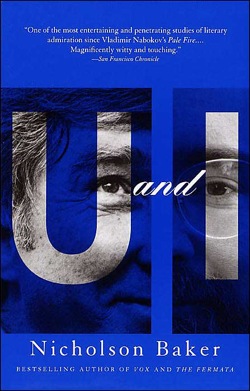
U and I: A True Story — Nicholson Baker

U and IThere’s something weirdly winsome about U and I, but it’s definitely an acquired taste; much as you wouldn’t recommend a friend who’d never eaten fish start off by trying raw eel, I wouldn’t recommend a friend read U and I unless I already knew they were a) quirky, b) at least moderately well-read and c) interested in the process of writing. U and I is like—I keep resorting to similes because, really, I don’t know what else to do—the best written, longest blog post you’ve ever read.

It’s a meditation on memory that shouldn’t be taken too seriously (sample: Nabokov “detailed his three-by-five method of fictional composition so comprehensively that Gore Vidal said in some essay that he was sick of hearing about it”). And Baker has a sense of the absurd, which I find absurd and love; he gets academia too well: “I count myself fortunate in being able to extract all the pretend-scholarly pleasure I want out of my method without urging it on anyone else.” Actual scholars appear to get real pleasure by inflicting their method on others. “Urging” is too light a word for the things I’ve seen. Baker is very polite to use “urging,” and he’s polite in general, for all his opinions.

If he’s retained that politeness, House of Holes ought to be a rather unusual book given its reputedly pornographic and hallucinatory premise (a copy is sitting on my table, waiting for me to get around to it, while I slog through The Condition of Postmodernity—which is a definitive infliction of an academic system and the kind of book that ought to be paired with Grand Pursuit: The Story of Economic Genius so that one will at least come out the other side knowing where many problems in the first book lie. Sorry for the preceding paragraph. U and I makes me more digressive than usual. If you read it, you’ll understand. It’s an acquired taste, as I said, one that sometimes needs a bit more sugar and olive oil, but one I rather liked, though I can’t recommend it except to book obsessives, writers, bibliophiles, or the people foolish enough to want to understand them. Which probably covers a fair number of readers of this blog, but still. The warning is part of being polite.

He must not be an academic at heart: academics love to apply their theories to others, with as much intellectual violence as necessary to make it stick. It turns out that Baker hadn’t read all of Updike’s books, and, with many of them, he’d only read parts, which he doesn’t remember entirely. In fact, the book isn’t really about Updike all that much at all: it’s more about artistic neuroses, learning how to write, and playing with that fickle memory beast. For example: “Once you decide on a profession, you riffle back through your past to find early random indications of a learning toward your chosen interest and you nurture them into a false prominence: so it was naturally very important to me, as a writer on the make, to have this sixth-grade vocabularistic memory in its complete form.” Baker wants us to know that we create a narrative of success and set up retrospective wayposts that make success seem foreordained, when it probably isn’t. Even the less successful among us might think so: I remember my parents being astonished that I was going to major in English. They told me they expected business or econ. Now I better understand why. But in the long run, I’m not sure it matters. There were other possibilities one could’ve guessed based on my past. But I picked one and rolled with it. This is an example of me trying not to do intellectual violence to an idea: instead of saying, “Everyone works this way!” I posit some possibilities and move on from there.

Baker mentions “early Updike, whose boy-heroes are sometimes more sensitive and queasier-stomached than one wants them to be.” But he doesn’t go on to explain. He doesn’t really explain anything. He leaves the explaining to the reader; you get what he’s doing, or you don’t. In this respect, he’s the least academic of all: instead of wanting to elaborate us to death, he wants to let us be. I know what he means about boy-heroes; sometimes you want a giant animal to attack Rabbit and see what he’s made of, or for aliens to invade in Couples, offering Piet an opportunity to do something more than carpentry and cuckoldry. Not that there’s anything wrong with those things, precisely, but, well, you hope for a bit more at times. Baker also gives good sentence, but they are often long sentences, like this one:

[. . .] many of the novels that I’ve liked lately (The Beautiful Room is Empty, The Swimming-Pool Library, A Single Man) have been so directly premised on gaiety: you feel their creators’ exultation at having so much that wasn’t sayable finally available for analysis, and you feel that the sudden unrestrained scope given to the truth-telling urge in the Eastern homosphere has lent energy and accuracy to these artists’ nonsexual observations as well [. . .]

Notice the ellipses on either end. Notice too Baker’s use of the funny word “homosphere” with the funnier adjective “Eastern.” Is there a “Western” homosphere? If so, how is it different? More tans, fewer references to ascots? And what is an ascot anyway? I’ve never known it save for the butt of a joke, and the word “butt” should be funny here in the context of the “homosphere.” Kind of, anyway. Like I was saying—Baker does go on. But that’s the pleasure in him. With him. Through him. Whatever. Still, this is enough quote for now.

No, actually, I change my mind. Writing about Updike’s book Of the Farm, Baker says that “A photographer would not so directly use his professional equipment in the metaphors he applied to his immediate surroundings—he would use it sometimes, but not in the first paragraph of the story he told. Film and f-stops are huge real presences to him, and can’t be so easily manipulated as tokens of comparison.” Not necessarily. Consider all the writers who use book and writing metaphors; I think our profession does get into our minds deeply enough that we might reach to professions for our first metaphors. Paul Graham’s writing is full of metaphors involved software and computers. That’s part of what makes it so rich.

It bugs me when I read books about doctors or lawyers or hookers or whatever and find characters who don’t think in the world in terms of their profession. I mean, a hooker probably doesn’t need to see every interaction as like something with a John, and a lawyer doesn’t need to view every interaction as adversarial or use terms like “estoppel” on every page, but once in a while, you know, it’d be nice. It’d work. I haven’t read Of the Farm, however, so I can’t comment on it. The problem with being a reader is that you’ll never have enough time to read everything you should. So you rely on memory, that uncertain beast, more than you should, and you end up be a scholarly pedant or a scatterbrained essayist. A false binary, but roll with it. On average, the latter seem funnier, and, in my own view, when in doubt, go funny.

For all U and I’s weirdness, I’m keeping the book instead of giving it away or reselling it. Maybe in a couple years it’ll say something new to me. I only worry that, instead of seeing it as weird, I’ll see it as normal.

Bare: On Women, Dancing, Sex, and Power — Elisabeth Eaves

Bare has lots of good parts but goes on too long, follows too many random tangents (the “Kim” character doesn’t illustrate anything), and repeats itself too often. But I also liked it and learned some things from it I might not have otherwise, and Eaves is usually a perceptive reader of both her own and larger social hypocrisy. She seems sensitive, or she adopts a sensitive persona in the book. I only wish she’d taken more economics classes; the big thing she’s missing is micro 111 and 201. She’s missing game theory. And evolutionary biology and psychology. Those taken together explain a lot about the double standards she justifiably complains about. Take this section, about Eaves’s dawning sexual awareness:

I had this notion until my teens that my body was my own. How to clothe it, how to gratify it, whether to impregnate it—I had believed these to be matters of personal choice. And I had a notion that the rules of society should be applied fairly to all. With the discovery of a sexual morality especially for girls, equality suddenly seemed to have been an idea meant to go the way of Santa Claus. My shock and anger would have been difficult to overstate.

She’s right. But the main disappointment of Bare is that it doesn’t go deeper into why these social forces exist, especially in the discrepancy between what parents want for their offspring and what offspring want for themselves. Girls bear the greater cost of pregnancy, and society believes that they are at greater risk of sexual predators, so parents take much greater efforts to restrict that sexuality (for more on this, see, for example, “The Daughter-Guarding Hypothesis“). If you want to deal with double standards, attack parents first, since a lot of the double standards are parentally inflicted. When parents say, “You can’t go out looking like that,” they usually mean, “you’re sending signals about sexual availability and interest that I disapprove of.” Almost no parents say the second one, however. If you could get them to, you might at least move toward greater honesty. Good luck using this vector, however.

And girls will sometimes impose double standards on themselves. Here’s another example of a spot where Eaves notes this but doesn’t go deeper:

Fraternities permitted the consumption of alcohol, whereas sororities did not. Guys could have girls over to fraternity houses any time of the day or night, but girls could have guys over only under heavy restrictions. In my sorority we could invite boys to our rooms only on Tuesday evenings from seven to ten, and most girls had three or four roommates. The upshot was that boys never made the walk of shame. The rules of the Greek system upheld an intricate web of double standards. Sororities had to have a resident ‘house mother,’ a supervising adult; the fraternities had no equivalent. When I asked other sorority girls about this rule, they told me that a house mother was required to get around an old law that classified a group of women living together as a brothel.

But sorority girls (and, perhaps, the parents who pay for their college experience) are willing to put up with “heavy restrictions”. Why doesn’t a sorority house offer a frat-style experience? If the market is there, girls will join it. That girls are willing to accept sorority rules shows that those same girls are getting something out of them, even if they complain. Think about reveled preferences here: if what people say and what they do diverge, look at what they do first.

If girls refused to enter a system that “upheld an intricate web of double standards,” the system would change. Yet they don’t. Note that I’m not advocating for double standards or saying they should exist: I believe the opposite. But Eaves should look harder for what powers and purposes these guys of social rules serve, who is enforcing them, and why, in the face of logic and the rhetoric of freedom, they persist. As I said previously, I think you can trace a lot of double-standard behavior to parents, and until you deal with that issue, you basically haven’t dealt with anything substantive. You’re making the same arguments women have been making since at least the 1960s and probably earlier. Also, I’m not convinced other sorority girls are a sound source of legal advice, or that such rules about multiple females living together would pass contemporary constitutional muster, especially if a lawsuit regarding them found its way in front of a female judge.

Plus, I can imagine what would happen to a fraternity that forbade its members from having women in their rooms: the fraternity would quickly have no members, since so much of its real purpose is ensuring sex to its members. That women don’t respond similarly en-masse to sorority rules shows that sorority girls are getting something; I could make up stories as to what (many are probably uncomfortable with having strange or partially clothed men wandering their halls), and so could you, but the important thing is starting the analysis.

This leads toward questions of how one can change larger cultures. Eaves does engage those; she starts with whether she’ll speak to others about her profession. She mostly doesn’t:

I was nowhere near as open as Zoe, a dancer with whom I became friends. She believed firmly in telling everyone. Her parents knew, as did her sister, boyfriend, and most anyone she met. I told her once that I didn’t tell certain people because I didn’t want to deal with their judgments and preconceptions. ‘That’s why you have to tell them!’ she said. ‘How are those stereotypes going to change if people like you and me don’t talk about what we do?’ She had an energy for changing minds that I lacked.

Zoe is right: maybe if people were more open about what they actually did, the many stigmas around sexuality would fade over time: but by hiding what one actually does, one allows assumptions to go unchallenged and to calcify into convention. By not speaking of then, Eaves lets the double standard get infinitesimally stronger, and by speaking of it in her writing, she at least makes it slightly weaker. You can’t complain about the double standards and simultaneously lack the “energy for changing minds” someone else has. And it makes sense that Zoe told “most anyone she met.” In high school, the essential question is, “What kind of music do you like?”, in college it’s, “What’s your major?” and once you leave the educational system it’s, “What do you do?” I don’t hide my professions. To do so would seem to hide an essential part of myself.

Still, the mere fact of being a stripper causes some change in the person. Here’s Eaves discussing some:

Stripping put me in a new world with new conventions. Having ditched the moral framework of the outside world, I was now ethically adrift where nudity and sexuality were concerned. I actually felt as if I had divorced myself from the moral norm years previously, simply by growing up and becoming sexual. But when I entered pink-and-red stripperland, my departure became official. Having given up the old norms I needed new ones, and where none were provided, I had to make my own.

Good. That comes from page 88. Two hundred pages later, from 291 – 292, we’re still there:

The sexual morality I grew up with was rife with inconsistencies. It had words to insult promiscuous women but not men, it ticketed strippers but not their customers. It imposed on women, far more than men, an intricate code of modesty that came down to a few inches of fabric, and then read a woman’s clothing or lack thereof as an indication of character. I didn’t want the morality that said I must cover my body, and that if I didn’t I was responsible for whatever came my way. I didn’t want the morality that said I should be coy and shameful about sex.

Again: there’s lots of “what” but very little “why,” which is disappointing. Why do strippers accept a sexual morality that “tickets” them (note the nice word, implying just the right amount of censure). If Eaves doesn’t want the morality—and I can’t blame her—she should be looking for more about why the morality exists. She also understands her power—”Being young, female, and attractive was one long bout of intoxication, with all the dizzy pleasure and vulnerability the word implies. In the careening, can’t-get-off, sex-saturated roller coaster from puberty to adulthood, I discovered I could hold sway over boys and men”—but not why people might use different means of finding what they want. She doesn’t like placing lonely hearts ads:

A column inch of newspaper, struck me as a sterile way to find someone compatible, whether for life or just an affair. I didn’t think of myself as romantic, but when it came to meeting men, I was attached to ideas of chemistry and coincidence. I was convinced that sex and love would follow naturally from other things I did—work, hobbies, or friends. By definition they would be unplanned and messy, but all the more exciting for it. I couldn’t understand why I would want to engineer an affair as though I were buying or selling a used bed.

Spoken truly like someone who’s attractive enough to have plenty of offers to accept or reject. The rest of us need to gin up more offers and do what it takes to do so. It’s easy to be “attached to ideas of chemistry and coincidence” when you’re young and attractive. Lots of men will offer their services, so to speak, and she gets to pick from them. For others—who are either bored with the standard offers or looking for something better—she doesn’t speak or acknowledge why they might do what they do. I know very attractive women who’ve signed up for online dating because they’re tired of the men they meet in their everyday lives. Eaves seems unusually lucky with “work, hobbies, or friends.”

Bear in mind, too, that Bare has over-readings and inconsistencies of its own, as in this description of one of Eaves’s boyfriends who has admitted to hiring a prostitute:

For men to pay for sex as a matter of course seemed to show a profound insecurity or worry about women—that women wouldn’t want to sleep with him without payment, or that when they did they wouldn’t be kind and acquiescent enough, or that a man’s and a woman’s sexual wishes simply couldn’t coincide. I also thought paying for sex indicated a subtle sense of guilt—if a man was uncomfortable facing the women he had sex with, he could pay for the promise that he wouldn’t have to.

Alternately, it’s possible that men paying for sex doesn’t mean anything, and that women who dance for sex doesn’t mean anything more or less than any other profession. She doesn’t consider that the men might just want to get laid. Not everything has to mean something. That would make for a much shorter book, of course, since books about sexuality thrive on analysis even when that analysis might not be warranted. And, sometimes, “a man’s and a woman’s sexual wishes simply [don’t] coincide”: how many women want a tall, handsome, wealthy alpha male with an impressive job who could get any woman he wants but chooses her? How many men want a perky young pneumatic blond with who is, as Ludacris once put it, “a lady in the street but a freak in the bed,” and who also thinks he’s witty and looks up to him and doesn’t make the very reasonable demands women in the real world tend to want?

Maybe Eaves isn’t really unhappy about a subtle sense of guilt: maybe she’s actually unhappy that sex-for-money subverts her own sexual power by making it easier for men to obtain a lot of what they want quickly. She has her own sexual morality that might not be much better than the one she derides. She can’t or doesn’t want to imagine why people would use dating services, and the same is true of prostitution. By writing what she wrote, Eaves has helped ensure that more men will lie about the hookers they’ve hired, since they know they’ll be judged by women like Eaves.

Consider this, on the same subject:

What angered me, specifically, was his easy acceptance of a buyer-seller relationship between men and women. In some ways I came to regard Paul as I would a customer: someone cynical, who didn’t place a high value on sexual honesty, who was easily manipulated by female facades. I could never bring myself to trust him completely. And though I wasn’t fully conscious of it, on some level I decided that he wasn’t due the respect I would have accorded a different kind of man. For me, Paul symbolized men who preferred buying women to knowing them.

Is a “hard” acceptance somehow better? Is nattering on about morality and improvement? And maybe Paul is just a dude, not someone who should be held as a symbol for all men. This preference Eaves expresses actually indicates she doesn’t like conflating market and gift norms, or that she doesn’t like it when a man she’s with does it but doesn’t mind when she herself does. Or this is another random boundary. I suspect it’s conflating gift and market economies; lots of people have addressed this, including Lewis Hyde in The Gift: Creativity and the Artist in the Modern World Geoffrey Miller in Spent: Sex, Evolution, and Consumer Behavior. But these are issues Eaves doesn’t address: her own blindspots are there for people to see. Mine probably are too, but no one has taken the trouble to observe them.

Eaves also makes the mistake some of my freshmen do in their papers: she assumes there is some unified thing called “society” “culture,” or “the media,” which gives her and others a single message. It’s not that easy. Words we use to flatten the dialectical nature of collective individual desires, like “society” or “the media” leave so much out of them. This is one lesson of Michel Foucault, however problematic some of his other comments might be. Eaves, for example, listens to this idea:

There was very little stigma attached to being a passive sex object. Images of the legs, breasts, and lips of strangers suffused my life thoroughly, from billboards to magazines to television. Far from shaming the bodies’ owners, society made them starlets, supermodels, and video queens, glorifying them with money and fame. Yet to actively pursue sex-object status—to say, ‘Okay, I agree, please look at me’—in this I felt as if there was reproach. The difference between a stripper and a woman modeling bathing suits was that the stripper acknowledged her intention to arouse, whereas the model could pretend ignorance.

Do most people make the “passive sex object” and active pursuit of “sex-object status?” Maybe they do, but it seems like an unlikely distinction to me. Plus, as I said in the paragraph above there is no “society” inflicting a sole message on you. There are only individuals who respond. It sounds like Eaves is wrestling with her own feelings and her own internalized demons and then re-projecting those on a nebulous “society” at large. The experiences of someone growing up in a small town with a highly religious family probably experiences a much different “society” than Kate Winslet’s children, since the actress “talks to her kids about same-sex feelings — reminding even liberal parents to go beyond pink and blue.”

Those two are extremes. Eaves probably grew up somewhere in the middle; she says this about when she starts having sex as a teenager:

Sex also mitigated an asphyxiating boredom. I lived on a dead-end street on a hillside, where every house sat in the middle of its own private patch of green, with views of the water and the mountains. The street was surrounded for miles by detached houses and an occasional park or school. It took about an hour on city buses to get downtown, and I had no car. [. . .] It was beautiful, peaceful, and the urban equivalent of a sensory deprivation chamber. [. . .] Boys, though, were a world to be discovered. While I waited for my life to begin, I had sex.

Suburbs are boring. That’s why parents move there: to protect their children from perceived dangers. But they don’t realize that, to a 15-year-old, the boringness of suburbia makes life itself look boring and pointless. No wonder so many yearn for college. Paul Graham gets this too:

If I could go back and give my thirteen year old self some advice, the main thing I’d tell him would be to stick his head up and look around. I didn’t really grasp it at the time, but the whole world we lived in was as fake as a Twinkie. Not just school, but the entire town. Why do people move to suburbia? To have kids! So no wonder it seemed boring and sterile. The whole place was a giant nursery, an artificial town created explicitly for the purpose of breeding children.

Where I grew up, it felt as if there was nowhere to go, and nothing to do. This was no accident. Suburbs are deliberately designed to exclude the outside world, because it contains things that could endanger children.

And as for the schools, they were just holding pens within this fake world.

Notice how Graham goes a little further than Eaves, to the “why:” “Suburbs are deliberately designed to exclude the outside world, because it contains things that could endanger children.” Eaves’s parents, whatever they did right or wrong, presumably thought they were doing the right thing. She was also doing the right thing, since sex does quite effectively mitigate (some might even say “relieve”) “asphyxiating boredom.” But she’s old enough to be able to empathize with her parents—to ask, “Why did they do what they do?” She’s smart enough to empathize with men like the hooker-hiring boyfriend. Unlike, say, Norah Vincent in Self-Made Man, however, she doesn’t. It’s too bad, because the stretch is so easily within her reach.

Bare has its problems, and it has too many weak sentences like this one: “He was tall and angular, with chiseled features, pale skin, and black hair and eyes.” It’s too much description and too little analysis. But it’s fun, and it offers access to a world not easily entered by outsiders. At the very least Eaves starts the conversation, and she does so in a way better than how many others would try to finish it.

We believe what we can see: In the Garden of Beasts edition

From Erik Larson’s In the Garden of Beasts: Love, Terror, and an American Family in Hitler’s Berlin, which is worth getting from the library (this section deals with 1933):

It was one thing to read newspaper stories about Hitler’s erratic behavior and his government’s brutality toward Jews, communists, and other opponents, for throughout America there was a widely held belief that such reports must be exaggerated, that surely no modern state could behave in such a manner. Here at the State Department, however, Dodd read dispatch after dispatch in which Messersmith [the Consul General] described Germany’s rapid descent from democratic republic to brutal dictatorship. Messersmith spared no detail—his tendency to write long had early on saddled him with the nickname ‘Forty-Page George.’ He wrote of the widespread violence that had occurred in the several months that immediately followed Hitler’s appointment and of the increasing control the government exerted over all aspects of German society.

People in the 1930s simply couldn’t believe that Germany would act as it did. This might be one reason why cell phones and cell phone cameras are so powerful: it’s very hard to deny video. If cell phone cameras had been widely available in 1930, could the Holocaust have unfolded as it did, in a major Western country? The answer, of course, will always be “maybe,” but I think the shock of seeing footage of Jews and others being beaten and murdered in the streets might have had a powerful effect around the world.

I wonder if we’re on the cusp of seeing cell phone cameras reduce the amount of police brutality in public places, since police will know they’re likely to be taped. Cops don’t like this (see here and here for more).

Although I obviously love reading, it’s relatively easy to deny a written description of an event. It’s much harder to deny a video that shows the people involved. That’s not to say video can’t be manipulated—it obviously can—but sometimes a short video can do what “Forty-Page George” can’t. It’s hard or impossible to “exaggerate” video, even if it can be maliciously edited. We should still read, as “Twilight of the Books” makes clear, but video still changes things (it changes what can happen in fiction, for example; people have been writing about blue movies or explicit pictures for a long time, but the plausibility of something like Anita Shreve’s Testimony depends on widespread access to inexpensive video equipment (see also Caitlin Flanagan’s somewhat misguided but interesting essay on the novel). That’s relatively recent, and we’re still dealing with what it means.)

EDIT: See also this discussion of police and cameras from Crooked Timber.

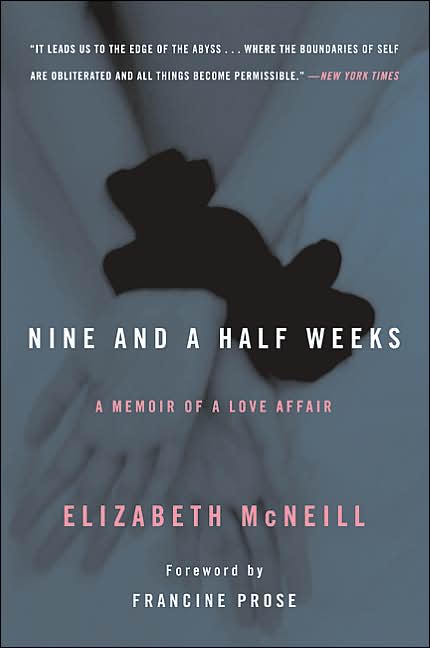
Nine and a Half Weeks: A Memoir of a Love Affair — Elizabeth Mcneill

Most novels (and memoirs) leave you with a sense of distance, a sense of being at a comfortable remove. Nine and a Half Weeks doesn’t: it’s too graphic, too immediate, too flat. One sees this effect in the first sentences, without any preamble as to who these people are and how they came to be: “The first time we were in bed together he held my hands pinned down above my head. I liked it. I liked him. He was moody in a way that struck me as romantic; he was funny, bright, interesting to talk to; and he gave me pleasure.” One senses quickening thoughts and pulses in those short sentences, and even in the long one, where semicolons could be periods, and the last descriptor—”he gave me pleasure”—is the really important one. You don’t get the very ironic tone of a book like Alain de Botton’s On Love, letting us see that love is irrational but really understandably so. Alain, the narrator of On Love is basically a needy, endearing, neurotic weakling; his self-consciousness contrasts so much with the man in Nine and a Half Weeks that they’re practically different species.

There are clever phrases in the memoir, as when the narrator says of her lover, “His face turns attractive when he talks;” I like the strange word choice, as if the head is physically turning, or as if he has two, or multiple, faces. A few moments are archaic—the man describes a friend or rival coming over as “This dope” (emphasis in original), which hasn’t been currently slang in decades and stands out in a book that otherwise stands out for not being part of any particular time. The prose holds up, and the narrator has an eye for tedious rituals, as when she tells of a “statistical tale,” where the contrast of statistics and narrative stands out:

In the middle of the statistical tale he’s requested from me—brothers and sisters and parents and grandparents, hometown, schools, jobs—I stop and close my eyes . . . please, I think, inarticulate even in my own mind, unable to turn to him and make the first move, please . . .

There’s a pervasive fear of dullness running through the memoir. The narrator notes that she and her lover looked like “An attractive, well-educated couple in New York City, average, middle-class, civilized.” That contrasts with what came before and will come after. Or does it? The memoir teases us by making us wonder if the the narrator isn’t so unusual as public discourse would make her out to be. I think the story’s flatness, the unwillingness to engage in direct commentary on what’s happening, points us in this direction, as when the narrator says, “I am standing, nearly on tiptoes, across the room from him, my arms raised above my head. My hands are tied to the hook on the wall on which his one large painting hangs during the day.” She’s hung like a painting and enjoys it. There is no further morality or analysis. Sixty Minutes plays in the background, a reminder of the middle America the narrator feels like she’s leaving behind even when she imagines it as a foil to her own actions.

Images repeat through the memoir. Scarves reappear. The words “like” and “love” are reconfigured like body parts. One senses Nabokovian echoes in the prose that one distantly hears on the first read but can’t make out. The narrator also feels her internal sense of self discombobulating, like a washing machine that shakes itself apart from within. She knows this is happening and imagines the reactions of otherwise course, until she writes of her experience.

We don’t know what the narrator wants beyond the obvious: sexual satisfaction. That she might only want the obvious might be the most frightening thing of all. What if everything else she has—a job, presumed communal respect, literary and political opinions—don’t matter very much? What if your real self isn’t those frontal cortex developments, but something deeper, more primal? I find posing the questions unsettling. The answers implied by Nine and a Half Weeks are more so. The patina of everyday experience conceals so much, especially in the realm of inchoate desire that social life is designed to channel. What happens when the channeling breaks? What happens when we want it to break? I’m reminded of Donna Tartt’s The Secret History, which also features the discarding of the mind in pursuit of a mental state or feeling very unlike the one most of us presumably inhabit most of the time—the mental state worried about how much money we have, what other people think about us, whether we’ll get the job / life partner / degree / accommodates of our dreams.

The narrator likes the man’s dominance above all other traits, which derive from that dominance. He says of a friend or rival, “he’s got no guts whatsoever.” Note what she likes in the contrast he offers by comparison. He shows mastery by reading Gide in French and Kafka in German, both implying continental expertise and sexuality. Some moments are obvious, as when the narrator reads with “his thick pen solid and comfortable in my hand.” One doesn’t need to be Freud to imagine that the pen is not just a pen. In the same scene, the narrator says, “I write the letter (‘. . . met this man a few days ago, nice start, very different from Gerry, who’s more than happy with Harriett these day, you remember her . . .’)” (sic). The dig at her ex-boyfriend is subtle but present: he isn’t dominant, won’t tie her up, and presumably has settled with a lesser woman.

He demonstrates great knowledge too: “[. . .] whatever else he may do [in] it, this man clearly does read his original-language books in bed; why would anyone want to miss out on one of the most satisfying pleasures available? All he’d need is a better bulb, a few more pillows, and a reading lamp. . . .” The room sounds sad and denuded, but it doesn’t matter much, even if the narrator is right about beds, which are good for more than just sleeping and that other thing. He offers commands, as when the narrator says:

He guides my hands between my legs and says, ‘I’d like to watch you make yourself come.’

He is sitting idly, comfortably, one leg crossed over the other, the creases sharp in the freshly cleaned suit. I do not try to move my hands. He waits. ‘You don’t understand.’ My voice cracks. ‘I never . . .’ He is silent. ‘I’ve never done that in front of anybody. It embarrasses me.’ “

She does, of course. That it embarrasses her is part of the point. What embarrasses her in the moment becomes the fodder for memoir, even under a pseudonym, long after. She likes giving power to him, which she does by letting him watch her masturbate. She also does by repeating how much she loves him, but I don’t think he ever says it back. It’s like he doesn’t need to, and by withholding the confirmation of his love he creates a neurotic fear in her. Only at one moment does he crack, when “All at once he is a decade my junior, a very young man asking me to have a drink with him, expecting to be refused.” But that doesn’t last long. Little does in this memoir, including their relationship, whose duration is given away by the title. But the narrator learns a lot in a short period. She says, “If you’ve never screamed, out of control, you can’t imagine how it feels. Now I know how it feels, it’s like coming.” She never goes the Biblical or mythological root and thinks there are things we shouldn’t know. For her, all knowledge is knowledge.

You can see that McNeill’s memoir doesn’t sit well with current ideals of equality and mutual respect in all fields. As Laura Kipnis says in “Off Limits: Should students be allowed to hook up with professors?” for Slate.com, “Feminism has taught us to recognize the power dynamics in these kinds of relationships, and this has evolved into a dominant paradigm, the new propriety.” Feminism has taught us to recognize power dynamics, but it should also teach us to recognize points of view. The narrator gets this; she thinks the man’s room is “too plain to be called plain. It’s austere, if you want to be charitable, or chic, if you want to be snide, or boring, if you want to be honest. It is not, in any event, a room you’d call cozy” {McNeill “Love”@9}. So the narrator is aware of angles, points of view, possibilities. I’ve been told I use “or” a lot in my own writing. It’s a useful word for people who perceive many ways of describing things, and here it betrays an openness to experience that the memoir exploits. She has a strong theory of mind that weakens as she awakens to herself.

I should point out that I call the narrator “the narrator” as opposed to “McNeill” or something more conventional because she feels like a fictional person more than a real person (which is strange, given how many fictional characters seem real, but that’s a topic for another time). Elizabeth McNeill is itself a pseudonym. We don’t know who the real author is. The man is never given a name—he’s only given traits, like his penchant for Brooks Brothers and sadomasochism (sometimes, especially when it comes to belts, simultaneously). So I don’t entirely know what to call them, or what to call their madness, if it is indeed madness. Can we find pleasure in madness? The narrator’s point is that many of these normally distinct categories eventually blur. I think that’s one of Tartt’s points in The Secret History too. There is more to be written about the book—its strange tenses, leaping from past to present to future, to what extent we should indulge in or avoid attempting to apply universal lessons—but this gives flavor of it and why its merits still show.

Summary Judgement: In the Basement of the Ivory Tower: Confessions of An Accidental Academic — Professor X

In the Basement of the Ivory Tower is fun, filled with anecdotes, and describes many of the feelings I’ve had in the higher education sausage mill, but you’re better off reading the eponymous Atlantic article from which it sprang. You’ll get 80% of the content with 20% of the time. Still, I especially like this bit from the book because nearly the same thing happened to me four weeks ago:

On the first night, I ask a few questions. How many of you took this class because of an abiding love of literature? No hands go up, ever—they are honest, I will give them that. How many of you are taking this class only because you have to? Now all hands shoot up, to the accompaniment of some self-conscious laughter.

I taught a technical writing course to a room full of public health, nutritional science, and engineering majors and asked how many were in the class because they want to learn more about the great and mysterious power of the English language. No hands. How many were taking it because they had to? All the hands. More of my students could write coherent sentences than Professor X’s students, probably because they’re juniors and seniors who’ve been through a fair number of classes, but “more” is not the same as “all.” Few of them cared. I want to imagine that I imparted real skills through longer and more difficult writing assignments than most of them had faced, but I’m not sure I did. It’s not easy to interest people in a topic when they lack intrinsic interest and don’t see it as valuable to their careers.

Professor X is a good writer (note too that his name is a pseudonym, and he isn’t, to my knowledge, claiming to the leader of the X-Men); he says, for instance, that his students “lack rudimentary study skills; in some cases, they are not even functionally literate. Many of them are so dispossessed of context that every bit of new information simply raises more questions.” Notice that phrase, “dispossessed of context,” which I’ve never thought of in that way before, and yet it fits: the Oxford American Dictionary says that dispossessed means to “deprive (someone) of something that they own, typically land or property,” and one gets the sense that educational system have failed Professor X’s students as much as they have failed the systems (note that there is plenty of blame to go around, and I don’t wish to sling it in this post). There are many moments like this, when unexpected artistry arrives.

This sense of the unexpected extends to Professor X’s grasp of the larger institutional and societal forces at work; he notes that college is supposed to be for everyone even when we’re supposed to have high standards. These two ideals seldom leave unbloodied when they meet in the real world. But he doesn’t have a lot of answers to problems, which is okay because a) large, complex problems often don’t have answers and b) he’s trying to tell his own story, not write a polemic. If you know someone of questionable literacy attempting to go to college and frustrated by the experience, you should recommend this book to them. They probably won’t read it, but if they did, they’d know more. I get the sense that Professor X is working more at the individual than societal level. That might also be what makes his book fun.

Some of the responses to his Atlantic article are bizarre, written by people who seem to have no idea what’s happening on the ground. Some of the later material drags. I like the book but would only recommend it to specialists; I read it because I’m working on my own academic work related to university novels. If it weren’t for that, I don’t think I would’ve gotten enough from it, beyond the Atlantic article, to justify reading.

Life: Failing to understand ourselves, part 387

“Humans don’t seem well-designed for dispassionate intellectual discourse about domains that have profound personal relevance.”

—David Buss, from the preface of The Evolution of Desire, which holds up surprisingly well. I think Buss gives too much credit for the design of human beings for dispassionate intellectual discourse in general, but the thought stands.

A Billion Wicked Thoughts: What The World’s Largest Experiment Reveals About Human Desire — Ogi Ogas and Sai Gaddam

A Billion Wicked Thoughts is good but not great; it covers a lot of much-discussed studies from an angle that, although novel, isn’t quite novel enough. The book is like Why Women Have Sex: both are written by pairs of popularizing intellectuals who probably want to earn more money and affect the social conversation more than they could through writing purely academic work. Anyone really interested in issues around sexuality and evolution is better served by The Evolutionary Biology of Human Female Sexuality, which is insanely detailed and concomitantly worth reading.

In A Billion Wicked Thoughts, the forward by Catherine Salmon notes, “There is a lot of truth to the belief that if you can imagine it, you can find it as Internet porn.” If you can imagine it and can’t find it, you probably have a good business model. Or you can make the porn yourself. But the ubiquity of online porn, combined with its breadth, makes it a trove of information about behavior that, as Ogas and Gaddam point out, most people are reluctant to share. If they do share, what they share and how they shade information can render that information nearly useless. In contrast, the Internet feels anonymous enough to let your search engine rip. So Ogas and Gaddam decided to study search queries, sort them (apparently using Amazon’s Mechanical Turk), classify them, and analyze them. We also get lots of specific sample search queries, like “family nude beach” (167), “anal sex benefits” (168), and “nude construction workers” (168). These illustrate important points, I’m sure, and I’m not including them in this post purely to ensnare unwary search engine users.

Using Internet search queries reduces some forms of bias while presumably introducing others—like what we know about people who don’t use the Internet. What can see about all those searchers who aren’t looking for porn? What can we say about sample bias?
The authors are aware of this and say, for example:

The male desire for older women is also reflected in the popularity of ‘mom’ searches on PornHub (since teen content is highly visible and easily accessible on PornHub, users may be more likely to manually type in searches for content they don’t immediately seen.

But how do we know about the proportions of searchers to non-searchers? This may be an example of the old joke about the “Streetlight Effect:

A policeman sees a drunk man searching for something under a streetlight and asks what the drunk has lost. He says he lost his keys and they both look under the streetlight together. After a few minutes the policeman asks if he is sure he lost them here, and the drunk replies, no, that he lost them in the park. The policeman asks why he is searching here, and the drunk replies, “this is where the light is.

Internet searches are where the light is right now.

Still, the project is interesting, and, in the absence of other data, it makes some sense to use what’s available. Ogas and Gaddam structure the book as a series of chapters that use Internet porn search classifications as headers, note some of those searches, and explain what those searches might mean using research that draws from evolutionary biology, evolutionary psychology, sexology, and similar fields. It’s a readable introduction, but it’s also part of a torrent of pop sex books over the last decade, which you can find through Amazon’s “if you bought this, you’ll also like this. . .” feature. If you’ve read enough of those books, you probably don’t need this one. Read this Salon Q&A instead.

The prose in A Billion Wicked Thoughts is competent—and, unlike Sex at Dawn‘s whacky metaphors and comparisons that strive for style and instead hit silliness, it rarely strays into the ludicrous. Although the purpose of nonfiction is to convey information, the best nonfiction goes beyond that stage to become art (Umberto Eco makes this as a subsidiary point in Confessions of a Young Novelist). A few jokes might even be intentional—I particularly like “On the web, group sex porn has exploded into a variety of sub-genres” (emphasis added)—but A Billion Wicked Thoughts doesn’t quite get there, although there’s nothing wrong with it.

Having little wrong isn’t enough to be right, and they still use coinages like “The Miss Marple Detective Agency” to describe a large body of research demonstrating that women’s physical reactions to sexual stimuli often differ markedly from their psychological reactions to sexual stimuli. You can get a lot of the material in this chapter from the New York Times article “Women Who Want to Want,” starring psychologist Lori Brotto instead of psychologist Meredith Chivers instead of psychologist Lori Brotto.

The upshot shot of the chapter is that many women appear to physically respond to sexual stimuli even when their conscious minds aren’t responsive or even find it disturbing—and those same women are frequently unaware of the phenomenon. Ogas and Gaddamn analogize the situation to the mind-body problem in philosophy (which also happens to be the name of an excellent novel by Rebecca Goldstein). The upshot: “women need to be psychologically aroused.” This appears to be true, but although the research points in that direction, it isn’t perfect; we have effects, but the causes remain uncertain.

There’s still evidence in that direction, and Ogas and Gaddam discuss much of it, including the female penchant for romance novels (which, although sexual, also focus much more on narrative and emotional connection than porn) and the male penchant for porn featuring anonymous sex focused in particular on body parts. They’re also aware of their own biases, as when they note “We all have our favorite theories that fit our experiences and prejudices.” That’s true, and it’s hard to shake ideology out of sex research. It’s also hard to shake one’s own training, and mine in literature makes me think some of their literary analysis is suspect, but they’re good at a naive version of Franco Moretti’s distant reading, as when they note how rare it is for heroes in romance novels to be truly, consistently poor:

In modern romances, the heroine often has a high-powered, high-paying job of her own. Romances feature women who are corporate executives, politicians, and financiers. Since such heroines no longer require a man to provide for their needs, has this cultural transformation led to more romance heroes with limited resources?

Not at all. If a heroine is rich, then the hero is even more rich.

They cite Janice Radway’s Reading the Romance, which studies the genre from a politically inflected but still fascinating perspective. They cite a lot in general, and their notes / bibliography is close to 100 pages. I always admire a book with a very, very big bibliography. In this respect, A Billion Wicked Thoughts satisfies.