Life: Clarity edition

“Eventually I was admitted to the emergency rom, where doctors removed the gravel from my knees, x-rayed my arm, informed me that my elbow was broken, and outfitted me with a cast and sling. The bill came to $1,700. This experience caused me to take a cold, hard look at the direction my life was headed. What was I doing, running around this world—a place about which I clearly understood nothing—writing an endless novel about God knows what? A week later, the department head called and asked if I wanted to return to Stanford. I said yes.”

Okay, so it’s funnier in context (humor is the dominant trope in this book), but some of the flavor comes through (“a place about which I clearly understood nothing”), as does the author’s directness. I don’t remember where I read about Elif Batuman’s The Possessed: Adventures with Russian Books and the People Who Read Them, but I’m glad I took that unknown person’s advice.

February links: DevonThink Pro, advice for novelists, dull global English, and more

* DevonThink Pro 2.0 came out today. Read about it at the link; I’m a regular user thanks to Steven Berlin Johnson’s Tool For Thought.

* TSA arrests a student for having Arabic flash cards. Something must be very, very wrong with that institution.

* Mark Sarvas is writing on The Elegant Variation more often again; this post on the lessons of reading a bunch of first novels is compelling for its advice, although that advice feels somewhat vague without specific examples in it.

* “The Real Danger of Debt: The United States is deep in the red — and doesn’t have the political tools to get out.”

* “What’s a Degree Really Worth?” The answer might be “not as much as you think,” at least monetarily. Still, according to the article,

Most researchers agree that college graduates, even in rough economies, generally fare better than individuals with only high-school diplomas. But just how much better is where the math gets fuzzy.

But the article doesn’t deal with a) how much different majors earn and b) what students gain outside of mere earning power, which might not translate directly into money. The first is particularly significant: hard science majors tend to make way more than liberal arts majors like me. The headline might better state, “college is what you make of it, and if you don’t make much of it, don’t expect a huge amount of money on the other end.”

* On foreign currency reserves as a metric of wealth.

* What readers think they want writers to know. There are a lot of questionable assumptions and comments in it, like this: “Readers are what every novelist really wants […]”. Many novelists want readers, but since the Modernists many literary writers have considered scaring away readers to be a sign of success.

The pleas for story also reminds of what James Wood called “the essential juvenility of plot” in How Fiction Works. Although I disagree with Wood’s comment, I think it’s indicative of the fact that different readers have different demands: highly sophisticated readers who’ve experienced thousands of novels probably look for somewhat different things than those who haven’t.

* The Dull New Global Novel:

More importantly the language is kept simple. Kazuo Ishiguro has spoken of the importance of avoiding word play and allusion to make things easy for the translator. Scandinavian writers I know tell me they avoid character names that would be difficult for an English reader.

If culture-specific clutter and linguistic virtuosity have become impediments, other strategies are seen positively: the deployment of highly visible tropes immediately recognizable as “literary” and “imaginative,” analogous to the wearisome lingua franca of special effects in contemporary cinema, and the foregrounding of a political sensibility that places the author among those “working for world peace.” So the overstated fantasy devices of a Rushdie or a Pamuk always go hand in hand with a certain liberal position since, as Borges once remarked, most people have so little aesthetic sense they rely on other criteria to judge the works they read.

* The value of cities, and note in particular the value of New York, which reflects how the city is organized more than anything else. Metropolises like Phoenix, Tucson, and those in Texas should take note.

* Almost no one knows anything about North Korea, including me, despite having opinions on nuclear sanctions and so forth against the country. Two new books try to remedy that: Barbara Demick’s Nothing To Envy: Ordinary Lives in North Korea and B.R. Myers’ The Cleanest Race: How North Koreans See Themselves and Why It Matters. Both those links go to good Slate articles about the books in question.

* Jason Fisher on the online Literary Encyclopedia.

Amusing edit of the day

I’m going through a friend’s edits on the novel I’ve been writing for the last few months and came across this: “Each time you enter a bar you use religious imagery.”

I like how my friend uses the uses the second person “you” to imply that I’m the character. She’s also picked up on the joke regarding modern places of worship. I would consider that success.

(There haven’t been a lot of substantive posts over the last week or so because I’ve been spending every spare moment writing. At some point, space for real thoughts on novels will emerge.)

Life (and love)

“Is not general incivility the very essence of love?”

—Jane Austen, Pride and Prejudice

The Old Man and Me — Elaine Dundy

The Old Man and Me is The Dud Avocado retold by a slightly older protagonist pursuing a slightly older target man. It has some of the same moments of impressive language use, as when Honey Flood—not her stage name, but apparently an invented one—says that:

Bollie was a sort of chain-talker, lighting one end of a conversation to another without letting the first go out.

The image fits, and with Bollie puffing on both conversations where most of us only have the capacity or manners for one, and the good sense to keep it that way. With that small detail, I feel like I’ve met Bollie, or if not him precisely, than someone much like him. Still, the same page has dated slang (what’s a “mizbag?”), and the dialog can be hard to follow at times. Perhaps that dialog is representative of Honey, another American in Europe whose interests are men, money, status, and fun (not necessarily in that order), ideally combined in the same man. Said man turns out to be, chiefly, C.D. McKee, a writer in a day when writers still had groupies and hadn’t been replaced by celebrities as objects of fixation.

Honey’s voice will make the novel—or not. More often it’s the former; she’s clever if irritating at times, and the banter between her and McKee usually works, although sometimes it feels obvious. Consider this exchange about a park, in which C.D. speaks first:

“Parks are for the poor. Alas, that they haven’t a chance to enjoy them. Only the very young and the time-wasters like us can.”
“That’s because you hide them so well. This beauty, for instance. How d’you expect them to find it. I wouldn’t if you hadn’t led me to it.”

It’s not hard to take the park as a metaphor for Honey’s growth as a person in dealing with C.D. The undercurrent of class, if not warfare, then consciousness, continues (“I had been a rich man’s darling, all right. A very rich man’s very darling”), but not to the point of annoyance. But it gets close enough to that state to warrant a mention; Honey isn’t as developed intellectually or socially as someone like Renee Feuer in The Mind-Body Problem, who’d catch the solipsism in comments like this:

Radiating joy, confidence, and anticipation [C.D.] shone like a beacon in contrast to the milling crowd: the careful ones checking and rechecking their tickets, luggage, and timetables; the frantic ones overburdened and rushing in all directions […]

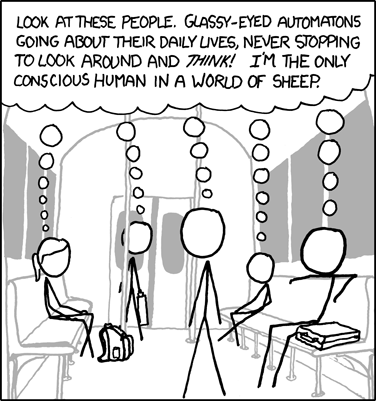
My internal editor drew a line through “the milling crowd,” figuring that we’d understand the milling crowd through the image that follows it. And someone like Renee would catch herself and realize that others are probably having the same thoughts she is, as shown in this XKCD:

It’s the same comic I linked to in my post on Pages For You: narrators and characters who aren’t able to see themselves in the larger sense, or see themselves as other people might see them, become decreasingly satisfying over time, as one reads more novels. Being (or at least feeling) significantly smarter than the character about whom one is reading, without some significantly unusual formal feature to make up for it, makes for tedious reading. The Old Man and Me isn’t tedious, most of the time, and it’s refreshing to find female narrators who are willing to sleep around without shame and connive to get what they want: I’m not sure this is a feminist testament, but at least it makes for an amusing story with writing that keeps Honey from devolving into stereotype and the story from devolving into senescence.

The bottom line: Read The Dud Avocado. Then read The Mind-Body Problem. Still want more? Then find this quasi sequel, but your urge will probably have been satiated unless you’re an American going to Europe, in which case you might empathize with and want to understand those whose footsteps you follow in. Then you can view The Old Man and Me as a learning experience.

The Second Pass also recently wrote on the The Old Man and Me. It’s a blog that I find moving steadily higher in my “must reads.”

Hope or despair for the would-be novelist?

I’m reading the edition of Sherwood Anderson’s Winesburg, Ohio edited by Ray Lewis White, and the introduction says:

On September 13, 1915, Sherwood Anderson (1876 – 1941) became thirty-nine years old. He was living in Chicago for the third time, writing advertising copy to support himself while trying to achieve his greatest ambition: to become a published novelist.

It took Anderson—now, if not a major author, then at least an important one—until middle age to find and execute that ambition. Many writers seem to take longer, and at times I wonder how they persevere. Perhaps they are afflicted with what Robertson Davies said novelists must be. I’m reminded of a famous quote, given here in the Guardian: “Robertson Davies, the great Canadian novelist, once observed: ‘There is absolutely no point in sitting down to write a book unless you feel that you must write that book, or else go mad, or die.’ “

(500) Days of Summer with, as a bonus, Alain de Botton's On Love

(500) Days of Summer is about the mating habits of angsty hipsters. Said hipsters are endlessly concerned with the nature of love in a deep, romantic fashion when they should be thinking more about the mechanics of how and why someone is actually attracted to another person. To heal the anxiety that hipsters feel about attraction and love, I would prescribe Belle de Jour, Neil Strauss’ The Game, and Kundera’s The Unbearable Lightness of Being, which, taken together, remind one that the important thing about love is having enough game to get someone else to love you, not merely mooning over another person—which is more likely to drive them away than attract them.

In (500) Days of Summer, Tom does the mooning and Summer is indifferent and perhaps callous to his puppyish attention. Tom wants romance so bad that his 11-year-old sister says, “Easy Tom. Don’t be a pussy” at one point. We’re thinking the same thing, although perhaps not in those words, which are given to the sister chiefly, I assume, for getting a laugh out of the incongruity of hearing her say them. In the next scene, Tom asks Summer, “What are we doing?” The better question, at least for the audience, is, “Should we care?” If Tom doesn’t get with Summer—who manifests no special or particular interests, talents, abilities, thoughts, capability, or expertise—there are another thousand girls right behind her, exactly like her, who are also part of the quirk genre, as described in the linked Atlantic article:

As an aesthetic principle, quirk is an embrace of the odd against the blandly mainstream. It features mannered ingenuousness, an embrace of small moments, narrative randomness, situationally amusing but not hilarious character juxtapositions (on HBO’s recent indie-cred comedy Flight of the Conchords, the titular folk-rock duo have one fan), and unexplainable but nonetheless charming character traits. Quirk takes not mattering very seriously.

Quirk is odd, but not too odd. That would take us all the way to weird, and there someone might get hurt.

Over time, quirk gets boring and reminds you why you like the real feeling of, say, King Lear, or the plot of The Usual Suspects. The mopey plight of undifferentiated office workers is less compelling, and, once sufficiently repeated, it feels like disposable culture: another story about two modern people with no serious threats to their existence save the self-imposed ones that arise chiefly from their minds.

Love stories about the relatively pampered can work: I watched (500) Days of Summer because a bunch of students mentioned it in relation to Alain de Botton’s On Love. But the novel is better: a philosophically minded and self-aware narrator is fascinating precisely because he is aware of the ridiculousness of his own predicament and the randomness of love. He has a therapist and a philosophy professor in his mind. The dichotomy between how he should feel (she’s just another girl) and how he does (transformed through love!) fuels much of the comedy, as does the narrator’s tendency toward self-sabotage thanks to Marxism as applied to love: he would never want to be a member of any club that would have him as a member. Tom would, apparently, sign up to be a member of any club that would have him as a member. His lack of interiority makes him boring. His lack of exteriority makes the movie boring.

Whoever wrote (500) Days of Summer must have read On Love (Tom is a wannabe architect and gives Alain de Botton’s The Architecture of Happiness as a gift) and wanted to do a film version, or at least steal from it. Stealing from On Love, by the way, is a brilliant idea: the novel still leaves much territory to be explored, and it’s probably impossible to draw a complete map to represent the problems that love provide. But the interior commentary that makes the novel special can’t be effectively represented on screen. So we’re stuck with two people whose averageness is painful and unleavened by any real sense of awareness of their own situation. One of my favorite passages from On Love goes:

But there wasn’t much adventure or struggle around to be had. The world that Chloe and I lived in had largely been stripped of possibilities for epic conflict. Our parents didn’t care, the jungle had been tamed, society its disapproval behind universal tolerance, restaurants stayed open late, credit cards were accepted almost everywhere, and sex was a duty, not a crime.

On Love is acknowledging that the stuff that makes good fiction has largely been evacuated from modern love stories. In doing so, I laughed with recognition and at the narrator’s neuroticism about his own love stories. Moments like this abound in On Love and make it such a wonderful novel. Moments like this are absent in (500) Days of Summer, which make it a tedious movie.

Rereading Nick Hornby's High Fidelity

There are two really remarkable things about High Fidelity: how funny it is and how well constructed it is, especially given that the subject matter (romantic entanglements and existential dilemmas for the aging man and relationship) could easily be a plotless mess.

A novel about extended adolescence (or extended adolescence in general) can become vague, wishy-washy, and meandering. I’m trolling for specific examples of constructedness, but most aren’t as good out of context as they are in context as they are in it. Still, the novel moves: it starts with Rob’s “desert-island, all-time, top five most memorable split-ups, in chronological order,” proceeds through them, brings him back to the cause of his most recent breakup, propels him forward to his most recent hook-up, and then moves through scenes involving a funeral, a dinner party, a move-out, and a real party, each of which feels developed and connected to each other. There’s a strong sense of Rob moving, and him both acting and being acted upon that’s so often absent in similar novels, like Bret Easton Ellis’ Less Than Zero, Richard Price’s Ladies’ Man, or Kate Christensen’s Trouble, all of which ramble and drift and make you long for the cohesiveness you don’t realize you’re missing until you see something like High Fidelity, or Elmore Leonard’s caper novels, or Robert Penn Warren’s All the King’s Men.

Not that jokes are everything, but High Fidelity is filled with them, and the tremendous humor gives poignance to moments of seriousness, especially when those moments are tinged with existential fear about the future and one’s social position:

You need as much ballast as possible to stop you from floating away; you need people around you, things going on, otherwise life is like some film where the money ran out, and there are no sets, or locations, or supporting actors, and it’s just one bloke on his own staring into the camera with nothing to do and nobody to speak to, and who’d believe in this character then?

(Not to worry: in the next paragraph, a woman asks “Have you got any soul?” and the narrator thinks, “That depends […] some days yes, some days no.”)

Rob both rationalizes and sees himself as others might:

Me, I’m unmarried—at the moment as unmarried as it’s possible to be—and I’m the owner of a failing record shop. It seems to me that if you place music (and books, probably, and films, and plays, and anything that makes you feel) at the center of your being, then you can’t afford to sort out your love life, start to think of it of it the finished product. You’ve got to pick it up, keep it alive and in turmoil, you’ve got to pick at it and unravel it until it all comes apart and you’re compelled to start all over again […] Maybe Al Green is directly responsible for more than I ever realized.

He knows the argument is wrong and unlikely—art comes from the most unlikely places and conditions, much like the appreciation of art—yet he still half-believes it, just as we half-believe the joking things we say to ourselves to get through the day, or to convince ourselves of our value and self-worth. The alternative is often a depressing sense of how you look in others’ eyes, a kind of objectivity that might be a cure worse than the disease of being wrong. This doubleness of Rob’s view—he’s joking, but aware that he’s half-serious, which makes the joke funnier—is one of the novel’s great pleasures.

To return to the blockquote above, it should be obvious based on the plentitude bordering on plethora of novels about marriage in all its configurations (see: the collected work of Updike and Roth), one’s love life isn’t finished until one decides it is or one dies. Rob knows this: he warns against starting “to think of it as finished,” rather than knowing it is finished. And blaming your love life on listening to pop music is a cute pop psychology theory that’s hilariously wrong and yet plausible enough for us to appreciate it.

The novel’s humor and voice combined with its structure to give it meaning where so many not dissimilar set ups fail. The TV show Californication, though mildly entertaining, is basically about the difficulties of information hiding: Hank is a frequently blocked writer who derives pleasure from sleeping with various women, which he in turn has to conceal from various women because of the potential sexual and emotional side effects of revelation. But the show trades in a narrow range: who can Hank sleep with, and who matters enough to keep it from? If the show has a larger plot, it’s not evident: Hank’s relationship with his ex-wife, whose name I can’t remember because she isn’t that important to the show, oscillates in a narrow band between reconciliation and estrangement from which it cannot escape with eliminating the show’s potential for future seasons. Although the show isn’t pornography, its limits become steadily clearer over time.

One of the few disappointing things about High Fidelity isn’t the book itself— the other output of its author. Like Robert Penn Warren, Hornby seems to have only one really, really good book in him; I’ve at least started most of the rest of his work. Some books, like A Long Way Down, aren’t bad but aren’t compelling, and they don’t have that sense of drive and purpose High Fidelity. They’re like the story about a dream your friend wants to relay in exhaustive detail. The events in those other books are exhaustive even when they’re short, and they don’t have the pep and vigor of High Fidelity, which almost has too many short and wonderful asides to mention them all.

The end of High Fidelity trends toward sentimentality, but it’s saved by a continuing self-awareness that its concerns are silly. By making them serious while retaining its essential lightness, the novel works. And, the ending implies, life trends toward sentimentality: if you never indulge in any sort of authentic feeling, then you’re left alone and an agglomeration of preferences in music, books, or movies, dangling before a world that will, more likely than not, be mostly indifferent to your existence. But that’s an awfully heavy premise: I’d rather hear about Rob’s top five breakups and the linguistic implications of “I haven’t slept with him yet” as compared to “I haven’t seen Evil Dead 2 yet.”
Buying a Kindle: Why Didn't I Think of This Last Semester?

Despite my extensive carping about the Digital Restrictions Management on the Amazon Kindle, I ordered one earlier today and now wish I’d been smart enough to do so last semester.

Why? I’m a graduate student in English Lit, and I looked at my reading requirements for this semester and found that the vast majority of the assigned books are out-of-copyright (meaning they were published before 1923), and I can download them free; most are also famous enough to make them easily accessible online. In other words, buying all my books for the semester will cost $200. Buying a Kindle will cost $259, plus another $30 for a case. The Kindle + free books effectively makes the Kindle $59. If I’d realized this last semester, it already would’ve paid for itself. In addition, I won’t have to lug around nearly as many .pdfs as I do now.

Given that the English curriculums appear to focus on pre-1923 texts, I’d be surprised if more English majors and grad students don’t take this path. At the moment, it’s possible to read class books either on a computer screen or print them out, but neither solution works all that well. I suspect this one will, though, as always, we shall see.

Oh, Zuckerman…

“I gave myself to him and he’ll never forgive me for it. He’s not merely a monster, he’s a great moralist too.”

—That’s from Philip Roth’s Zuckerman Unbound, although the edition I have is called Zuckerman Bound. It’s funnier still in context. I’m reading Zuckerman because I was inspired by a quote in Katie Roiphe’s much-discussed essay, “The Naked and the Conflicted:”

“The sight of the Zipper King’s daughter sitting on the edge of the bathtub with her legs flung apart, wantonly surrendering all 5 feet 9 inches of herself to a vegetable, was as mysterious and compelling a vision as any Zuckerman had ever seen.” I can’t decide what’s so compelling—I think it’s the middle, with the adverb adjective duo of “wantonly surrendering,” which seem like they should be pornographic but are mostly comic, or vice-versa. “Vice-versa” seems like a useful pair of words when dealing with Roth, because he’s constantly got me wondering exactly where in the circuit I stand: at the bottom, the top, the sides, somewhere else? It’s complexity that isn’t complex to read or enjoy.

Or maybe it’s something else about the sentence, like how incongruous or outrageous it is: the Zipper King has a sense of pathos, the idea of the daughter of the Zipper King is vaguely medieval despite the American seen, and the mystery that Zuckerman feels is almost religious in a very much not religious context. It’s got a lot of ingredients in the stew, and trying to pick them out isn’t easily accomplished, even if we appreciate the taste.