Tampa — Alissa Nutting

Tampa starts with a bang, so to speak—the first line says, “I spent the night before my first day of teaching in an excited loop of hushed masturbation”—and also explains the narrator’s curious, never-resolved marital predicament: “I find it hilarious that people think Ford and I are the perfect couple based solely on our looks.” I find it curious that the narrator, who is obsessed with teenage boys, wanted to marry Ford or stay married to him. Her marriage exists for no reason outside of the needs of plot mechanics; there are occasional references to Ford’s money, but based on the novel Celeste has a single overriding focus on sex.

That focus doesn’t take a lot of money to maintain, and indeed it would be greatly enhanced by her divorcing Ford, or never marrying him. The closest we get to some kind of rationale, emotional or otherwise, is that “I hoped his wealth might provide me with a distraction, but this backfired—it left me with no unfulfilled urges but the sexual.” In 1900, it might have been very hard to “fulfill” sexual urges, but today that is not the case, and someone so single-mindedly focused on sex doesn’t need to be and shouldn’t be married. The “wealth” doesn’t seem to matter to her: other than name-checking one or two luxury items, money doesn’t seem to matter for Celeste. Explaining her husband to her teenage lover, she “didn’t have to feign indifference” and tells him “He’s just a husband.” Why bother? When Humbert Humbert married, he at least had a reason.

To be sure people are rarely fully rational and most of us are riven by conflicting desires, by Celeste’s desire to marry or stay marry makes little sense at the beginning of the novel and less as it goes on. Ford’s presence offers useful plot mechanic friction.

A novel like Dare Me works more effectively than Tampa because its protagonists are supposed to be vacuous twits. A twenty-six-year old with a classics degree, even a very horny one, should have more going on between her ears than Celeste does, and what’s between her ears shouldn’t harm what’s going on between her legs. She says, for example, that “At university I began throwing myself into classics studies, finding brief solace from my sexual frustrations in texts depicting ancient battles of fervent bloodshed.” But for someone interested in classics, she references them very rarely; her studies seem to have left no mark in her mind. Contrast that with a novel like Donna Tartt’s The Secret History, where Greek appears and an obsession with the past fuels the characters’ actions in the present. Those are characters whose thought is fully colored by classics. Here, classics get mentioned as empty window dressing, like material objects.

Toni Bentley deals with the money issue in The Surrender, her memoir of anal sex, where she says:

You let a man into your bowels—your deepest space, the space that all your life you are taught to ignore, hide, keep quiet about—and consciousness is born. Who needs diamonds, pearls, and furs? Those who’ve never been where I have been. The promised land, the Kingdom.

In asking “Who needs diamonds, pearls, and furs?”, she could be speaking for Celeste, who is also indifferent-seeming to possessions because she has her own “promised land,” albeit of a different though even more forbidden sort than Bentley’s (I say “even more forbidden” because while Bentley’s favorite act used to be illegal, it now mostly isn’t; while Celeste’s used to be not prosecuted, these days it is, thanks to feminists seeking equality in an instance where many teenage boys would probably be happy without it).

There are bizarrely hilarious moments in Tampa, as when Celeste narrates:

Sex struck me as a seafood with the shortest imaginable shelf life, needing to be peeled and eaten the moment the urge ripened. Even by sixteen, seventeen, it seemed that people became too comfortable with their desires to have any objectivity over their vulgar moments. They closed their eyes to avoid awkward orgasm faces, slipped lingerie made for models and mannequins onto wholly imperfect bodies.

Actually, sex is not at all like sea food in the sense Celeste describes, but we do see how Celeste totally misconceptualizes the world and thus a lot about her own, non-universal, proclivities. She also asks rhetorically, “Why did anyone pretend human relationships had value?”, when the better question is why she pretends they do, since most of us who aren’t sociopaths have obvious, readily available answers. Yet the metaphor is compelling, like enough of the writing in Tampa to make the book writing about. There are interesting questions about the extent to which desire clouds judgment, but that assumes the characters have any kinds of judgment in the first place, and the ones in Tampa mostly don’t.

Like Humbert Humbert, her obvious antecedent and another character with desire problems, Celeste is obsessed with guys on the cusp of manhood, and her chosen crush gets described in ways similar to Humbert’s nymphets: “I loved the lanky-limbed smoothness, the plasticity of his limbs, the way his frame shunned both fat and muscle.” The alliteration is there, but that kind of poetic style isn’t sustained. There is room in literature for a female Humbert, but she is not Celeste, and Jack is not Dolly. It is a novel with no animating soul beyond the purely carnal. I can appreciate the purely carnal but Celeste doesn’t even both arranging her life in ways that make sense (which may be why carnality is so often depicted in adolescents, who are still faced with strictures of schools and parents).

It is painful reading a book in which there is an obvious solution to an obvious problem that the protagonist doesn’t notice; Celeste’s situation in Tampa doesn’t rise to the TV trope “Too Dumb to Live,” but there should be a lesser term for characters who fail to perceive simple ways of dramatically improving their lots. In addition, Ford appears happy not having sex with—or having bad sex with—his wife. Marrying someone hot but sexually uninteresting doesn’t seem like a great deal, but we see little of him either.

I wanted Tampa to be a better novel; it wasn’t bad yet it feels wrong. I’m writing at length about the book because it’s not badly written and has a lot of promise. Tampa is not bad but should be better than it is. Books like that often generate the most response in me, because truly bad books aren’t worth bothering about and one runs out of empty superlatives with the good ones. There is so much promise, but Tampa isn’t quite executed in a way that makes sense. The supposed shock of what Celeste wants is a good premise that doesn’t go anywhere useful.

Thoughts on the movie Closed Circuit

* The movie, though still ridiculous, is less ridiculous than it would’ve been even a year or two ago. Yet it is less stupid than most movies of its type while still living up to its “thriller” designation. Most movies feel like a waste of time and this one did not.

* The language abuses Orwell described in 1946 are still alive in 2013, although in movies it’s easy to let those moments slide right by.

* I confirmed that I was not the only person disappointed by the lack of a sex scene, which was set up and then sadly unconsummated.

* Many if not most of us have secrets, and I wonder what the world will look like when the secrets of the watchers get revealed.

What makes interesting fiction: Stephenson edition

In his Salon interview,* Neal Stephenson says this about “the broader vision of what science fiction is about:”

[Science] Fiction [is fiction] that’s not considered good unless it has interesting ideas in it. You can write a minimalist short story that’s set in a trailer park or a Connecticut suburb that might be considered a literary masterpiece or well-regarded by literary types, but science fiction people wouldn’t find it very interesting unless it had somewhere in it a cool idea that would make them say, “That’s interesting. I never thought of that before.” If it’s got that, then science fiction people will embrace it and bring it into the big-tent view of science fiction. That’s really the role that science fiction has come to play in literature right now. In arty lit, it’s become uncool to try to come to grips with ideas per se.

The implied vacuousness of “arty lit” is clear and, more depressingly, accurate. It’s something a lot of people who like to read but who don’t care much for a lot of contemporary lit fic feel but don’t always articulate. It’s a tendency I’ve been been noticing in one form or another for years. It helps to account for why nonfiction may be winning the perceived quality race. A lot of highly praised fiction is, at bottom, boring, and about boring people.

Many self-consciously literary novelists and critics don’t seem to mind. So lit-fic books accumulate blurbs that make them sound like the next coming of Shakespeare when they’re actually about dull people leading dull lives, but with interesting language that is supposed to elevate dull people above their surroundings. Sometimes this works (Raymond Carver, Ulysses). More often it doesn’t, or, even if it works, who cares? Murder mysteries are popular for many reasons, but one may be that there’s automatically at stake. Per Megan McArdle:

Eventually I decided the truth is this: We watch so many crime dramas because there are no big stakes in middle-class American life. The criminal underworld is one place where decisions actually matter — and can be shown to matter, dramatically”).

Science fiction also tends to focus on encounters with aliens, threats to the human race, jarring technology changes, and so forth. The stakes are high. Literary fiction writers might want to take some cues from Stephenson and, strangely enough, TV.**


* Collected in Some Remarks, which is a way of collecting previously published pieces in one convenient place and turning them into money.

** Stephenson is also fond of novels with plot:

What I’m doing here is writing novels, and novels — never mind what anyone else might tell you — novels are pop entertainment, and they have to tell a story and they have to engage the emotions. There are a few basic tricks they use to do that. One is to tell a good yarn and the other is to make you feel empathy for the characters involved in the doings of that yarn, but you’ve got to have that yarn. That’s what I seize on first. That’s what gives me confidence that I’ve got a pony I can ride. Characters tend to come out of that, and ideas — I don’t know where they come from. The yarn that got me going on “Quicksilver” was Newton pursuing and prosecuting an archvillain in London at the same time as the dispute with Leibniz is at its peak.

Bureaucratic Heroism

Merve Emre’s “Bureaucratic Heroism” is among the best pieces I’ve read about contemporary movies and fiction; it’s hard to excerpt because the entire piece feels essential and it makes many subtle points, but I will point to this:

Bureaucratic heroes are not cartoon heroes, heroes for children who do not yet understand that the social world places limits on their actions. Nor are they adolescent, “dark” heroes like Batman, alternately rebelling against and ingratiating himself to lame authority figures. Bureaucratic heroes are “ultrareal” heroes for working, law-abiding adults: beholden to, yet eager to please, the systems of governance in which they operate. The rules they follow are not universal rules of justice, morality, or even common sense. They are rules that only make sense—that are only justifiable—within a particular institutional context, be it the CIA, the CDC, the corporation, or Hollywood itself. They are rules that perpetuate the self-preserving logic of the institutions that articulate them in the first place

The last bit is especially important: the “self-preserving logic” that holds institutions together is also always incomplete and inadequate for dealing with the needs of the complex real world. Everyone in the institution still has to make judgment calls of various kinds, and, because those judgment calls often entail breaking the rules, they leave violators vulnerable to institutional censure later on (here’s one example of an absurd experience that comes from refusing to break the mindless rules; the phrase “Kafkaesque” is surely used in the modern world with the rise of the bureaucratic state and corporation).

Following those rules also often yields sub-optimal or absurd outcomes, as pretty much everyone in industrialized countries has experienced at some point or another. Yet institutions still need those rules, and, as Emre points out in the introduction to his piece, “[Contagion‘s] true hero turns out to be the CDC, a tight regiment of epidemiologists and administrators whose acts of heroism are largely bureaucratic in nature: functional and routine, incremental and hierarchically situated, and keyed to the collection of data.”

San_Francisco-1905Contagion, maybe not coincidentally, is one of the few really good movies I’ve seen in the last few years. It’s taut and plot-driven yet simultaneously thoughtful; too few movies rise above being stupid spectacles. There is a place for stupid spectacle but it’s not in practically every movie, which is the impression I get from most movie ads and reviews.

Novels are better in this respect, but even then relatively few plumb what modern bureaucracies are like; one thing I like about Tom Perrotta’s Election is his subtle but real portrayal of education politics. Francine Prose is similarly skilled in Blue Angel, in which sexual harassment tribunals in universities utterly fail to understand what actual human relationships are like. Automatic, incorrect assumptions about life and sexuality get applied in a way that distributes tremendous power to the potentially unhinged.

Perhaps the best novel I’ve read in the last year also has a bureaucratic, corporate facet: Ann Patchett’s State of Wonder, in which scientist Anneck Swenson wrangles the funders of her research as a jungle guide might wrangle a python. Most of the novel occurs among a remote Amazonian tribe, yet even there athletic company symbols and university apparel appear on people otherwise living a pre-agricultural existence. Swenson fits into the heroic mode described this way by Emre, as “a ‘cinema of volition’ whose narrative tensions trade on the clean break between the hero’s boundless animus and the inertia that surrounds him.” In this case the hero is a her, but Swenson does experience “boundless animus” and overcomes the bureaucratic inertia that simultaneously enables her by providing money and holds her back by demanding results.

Links: Fiction and plot, false rape accusations, group sex and politics, and more!

* “Nothing Happens, Deliberately: Why Necessary Errors feels like a new model for contemporary fiction.” I would draw the opposite conclusion: Necessary Errors is how not to do fiction, or at least fiction a writer wants anyone else to read.

* “The ‘Shadow Resume’: A Career Tip for Grad Students,” which is yet another version of “Don’t go to grad school.”

* Woman hilariously posts a rape threat to herself, reports it, is shocked to find her IP traced.

* “Sexy spring: How group sex will liberate Iran, China;” I am dubious of the political slant but liked Plays Well In Groups, from which this was excerpted.

* Science is Not Your Enemy: An Impassioned Plea To Neglected Novelists, Embattled Professors, And Tenure-Less Historians.

* Possibly related to the above: “Technopessimism Is Bunk” by Joel Mokyr of The Enlightened Economy fame. I would note that his claims and Cowen’s claims in The Great Stagnation are not incompatible, and Cowen is not a long-term pessimist (the last part of his book’s title is “Will (Eventually) Feel Better”). In addition, I’m struck by how backwards many practices in my own small corner of the academic universe, English lit, feel, from a relentless focus on printed and overpriced books to printed (and unread) journals to the need to include the city of publication in bibliographic citations. I’ve heard older professors talk about their adventures in tracking down materials in libraries and am puzzled: it’s never been hard for me to find a book, and the age of Amazon and Google books is making it easier, not harder. The real challenges are legal (indefinite copyright) and cultural (disdain for blogs, etc.) .

* “In Vancouver, Traffic Decreases as Population Rises.”

Counterpoint to the sex-plot post: Jenny Diski on The Sexual Life of Catherine M.

It’s intellectually important to acknowledge being wrong and to look for ways you can be wrong and yet very few people do this or do it honestly. I probably don’t do it honestly either, but I will still post a long quote that somewhat contravenes my recent essay “The sex plot: a discussion for novelists and readers:”

the great open space of sexuality permits all the possibilities of abjection, power, narcissism, pleasure-seeking, dour determination, creativity and mechanisation. It would be very hard to devote such a great deal of life and thought, time and effort to it as Millet does without getting it all pretty much confused. Everyday pornography is linear in order to keep a single idea afloat in an ocean of polymorphous potential. Sexuality gets out of hand, it runs rampant with meaning unless you keep to a very firm remit. The sexual story can transform from pumpkin to princess to swan with injured wing and back again in the blink of a thought. It is a nothing, an empty arena, that might be everything. And everything is more than we can cope with. The obsessive, fetishistic, single account that pornography provides is what keeps sexuality within bounds. Here is the danger of writing the sexual life: you lose the boundaries unless you steadfastly restrict yourself to the detail. At times Millet seems to be attempting to do this, but again and again, like a painter who writes explanatory notes over her picture, she tries to explicate, to flesh out the doing with her intellect, and then the sexual life is shown up for the kaleidoscopic and random playground of ideas it is.

That’s from Jenny Diski’s 2002 review of The Sexual Life of Catherine M; if sexuality is “a great open space” that “permits all the possibilities of objection, power, narcissism” and so forth then sex plots really can or should propel a lot of fiction. Diski’s view (I believe she is speaking for herself here and not describing the memoir in question) is not necessarily incompatible with the essay but certainly it feels different, especially with the way she says that “sexuality gets out of hand, it runs rampant with meaning.”

A subject or person or feeling that “runs rampant with meaning” could be one surprisingly complete definition of art, which may also encourage “the kaleidoscopic and random playground of ideas” that nonetheless must be somehow restricted if a work of art is going to take any form at all. Art without some form does not exist, like a platonically perfect work of art that never goes further than conception. Execution is everything.

Still, I’m not sure that sexuality can really get “out of hand” and run “rampant with meaning,” at least in terms of the physical act itself, because there are a limited number of physical acts and, in practical terms, a limited number of partners and configurations. Contrast this with, say, science: there doesn’t appear to be any obvious limits to the things that people want or the weirdness of the present universe. That doesn’t mean that sexuality doesn’t usually interact with other parts of life, but in the modern Western world I’m not sure that sexuality and relationships need to be the primary focus of so many novels.

The sex plot: a discussion for novelists and readers

I wrote to a friend:

I wonder about the extent to which novels in general are continuing to have trouble with sexual liberalization; so many major novels in the canon deal with that topic, but it’s much harder to use those tropes in a permissive age.

He replied: “This intrigues me, but I’m not sure what you mean. Can you elaborate?”

Yes!

The novel as a genre has tended to thrive on sexual repression, and has used steadily increasing sexual liberation as fuel for plots. Leslie Fiedler wrote about this in Love and Death in the American Novel, and Tony Tanner wrote about it in Adultery and the Novel. In taking courses about the novel as a genre, I was struck by how many times I heard or read phrases like, “X pushed the limits of the sexual mores of his / her day,” where X is any number of writers ranging from Richardson to Flaubert to Dreiser to Roth and Updike. (Weirdly, however, the Marquis de Sade has always been lurking beneath the history of the novel as a genre, mostly unacknowledged and often hidden from the reading public).

But working against sexual repression as such doesn’t really work so well as a plot device anymore because the barriers are mostly down. If you’re over age 18 today, you can more or less do whoever you want as long as they’re not under 18. This may be why professor-student plots are somewhat popular: it’s one of the few forbidden-but-plausible-and-not-gross relationships left.

There are only so many sexual lines one can cross, and too many books like 100 Strokes of the Brush Before Bed, to make the mere crossing of the few lines left all that interesting. When an entire society is set up to repress, re-channel, and control sexuality, a novel like Lady Chatterley’s Lover is shocking. In our society, it’s not. Today, if you want it, go get it—just don’t make promises you can’t keep. It’s not hard to live a life of constant sexual novelty and most parts of society won’t really censure you, provided that you don’t marry someone else, and even then lots of people divorce.

It’s much harder to get wring major consequences from affairs and what not. Don’t want to cheat? Don’t get married. It’s not impossible to use sex and romance plots—my to-be-self-published novel, Asking Anna, is a comedy about such subjects—to get material from these fields, but it’s a greater challenge than it used to be, and hard if not impossible to shock. A novel with the sexual politics of Stranger in a Strange Land wouldn’t have the same shock-value today then it did when it was published, though actually now that I think about it I still think it would raise a few eyebrows.

Some genres, like science fiction, don’t rely on sex plots as much, but even in SF sex plots are still often present. The growth of murder mysteries and thrillers may also represent some veering from sex plots, since premature death is still a big deal and is likely to remain so for the foreseeable future.

On a separate but related note, it also seems that many “literary” writers borrow SF-ish ideas. Think of Ian McEwan’s Solar. Not a great novel, but I liked a lot of what McEwan was doing by meshing discovery, politics, social ideas, environmentalism, science, and a not-very-nice character into one bunch. It’s McEwan, so the writing is good on a sentence-by-sentence level. The technical descriptions are also interesting and too uncommon in novels. I like the idea of writing about intellectual, social, technical, or business discovery as a motive. It’s underutilized as a driver of plot.

One section of Paul Graham’s essay “The Word ‘Hacker’” addresses this point and continues to have a profound impact on me:

Hacking predates computers. When he was working on the Manhattan Project, Richard Feynman used to amuse himself by breaking into safes containing secret documents. This tradition continues today. When we were in grad school, a hacker friend of mine who spent too much time around MIT had his own lock picking kit. (He now runs a hedge fund, a not unrelated enterprise.)

It is sometimes hard to explain to authorities why one would want to do such things. Another friend of mine once got in trouble with the government for breaking into computers. This had only recently been declared a crime, and the FBI found that their usual investigative technique didn’t work. Police investigation apparently begins with a motive. The usual motives are few: drugs, money, sex, revenge. Intellectual curiosity was not one of the motives on the FBI’s list. Indeed, the whole concept seemed foreign to them.

Most novels focus on money, sex, revenge. Why don’t they focus more on intellectual curiosity: perhaps how intellectual curiosity relates to money, sex, revenge, and similar topics? That seems like a fruitful avenue, especially because we might be moving towards a world where many people’s material needs are met, making money less immediately important; though of course many people are still driven by keeping up with the Joneses, in large swaths of the industrialized world we have plenty of money and plenty of stuff.

(A relevant side note about money: Among people interested in “game” and picking up women, it has become a common observation that additional money above the amount needed to buy drinks, dress reasonably well, and live independently doesn’t do much help most guys. A guy making $50,000 a year and a guy making $200,000 a year are mostly on a level playing field, and if the guy making $200,000 has to work 60+ hours a week, he’s at a disadvantage. Personalities and tenacity count far more than incomes, all else being equal. This could be seen as a variant on one of Geoffrey Miller’s points in Spent: Sex, Evolution, and Consumer Behavior.)

I don’t see money, sex, or revenge—and motives for revenge usually reduce to money and sex—becoming unimportant as long as humans remain humans and not brains in vats or on chips, but intellectual curiosity and a sense of wonder and discovery should be more emphasized in narrative. I think the tedium of Jonathan Franzen’s novels can in part be explained by the tedium of his characters: if those characters had a greater sense of discovery and possibility, they wouldn’t be so annoying. The other day I was listening to a friend describing single electron chain reactions in photosynthesis and how she misses research and life in the lab. It’s very interesting stuff, and the sort of thing that is rarely really discussed in novels.

But it should be!

Plus, the progression of science, technology, economics, and the attitudes that go along with them have ameliorated a lot of the money-revenge resource-distribution fights that used to define every aspect of human existence, instead of most aspects of human existence. To the extent major societal problems in the future are going to be solved—most obviously involving energy, but certainly involving other topics too—the solutions are going to come from intellectual curiosity and the intellectually curious. Maybe we, collectively, should be thinking about art that cultivates and glorifies those traits, instead of art that cultivates or glorifies simple status domination, or the ability to be cooler than the other guy or girl.

Another Paul Graham quote, from “How To Make Wealth:”

Making wealth is not the only way to get rich. For most of human history it has not even been the most common. Until a few centuries ago, the main sources of wealth were mines, slaves and serfs, land, and cattle, and the only ways to acquire these rapidly were by inheritance, marriage, conquest, or confiscation. Naturally wealth had a bad reputation.

Two things changed. The first was the rule of law. For most of the world’s history, if you did somehow accumulate a fortune, the ruler or his henchmen would find a way to steal it. But in medieval Europe something new happened. A new class of merchants and manufacturers began to collect in towns. Together they were able to withstand the local feudal lord. So for the first time in our history, the bullies stopped stealing the nerds’ lunch money. This was naturally a great incentive, and possibly indeed the main cause of the second big change, industrialization.

A great deal has been written about the causes of the Industrial Revolution. But surely a necessary, if not sufficient, condition was that people who made fortunes be able to enjoy them in peace. One piece of evidence is what happened to countries that tried to return to the old model, like the Soviet Union, and to a lesser extent Britain under the labor governments of the 1960s and early 1970s. Take away the incentive of wealth, and technical innovation grinds to a halt.

People still steal to get rich, and even more people make many movies and write many books about stealing, along with efforts to thwart thieves. Making stuff people want is, again, an under-explored avenue. It’s also harder to represent dramatically. The movie The Social Network does this successfully, albeit at the expense of accuracy; most of the important parts of Facebook actually happened in the heads of Zuckerberg and other programmers, not in interpersonal drama.

Still, The Social Network works as a movie, and it does something very different than yet another version of Fast & Furious, which is about sex, power, tribal loyalty, and blowing shit up—like most movies (sample from the link: “Like any reasonable person, I watch the Fast and the Furious film franchise primarily for its insights into moral philosophy and political economy. At a fundamental level, the franchise is about what Harvard philosopher Christine Korsgaard identifies in The Sources of Normativity as the ‘intractable conflicts” that arise from our conflicting practical identities'”). I like Solar despite its flaws in part because the protagonist, Michael, makes his money and gains status by discovering something that may turn out to be essential in solar panels.

Solar and The Social Network don’t deploy straightforward sex / family plots, and that’s refreshing. They’re part of an answer to the question of what happens in a world where you can, if you have sufficient skill or are sufficiently desirable, sleep with anyone who’ll have you? Because that’s the world most people above the age of 18 or 19 find themselves in. Marriage rates are dropping. Arguably the most interesting parts about marriage and children right now are economic: what’s happening with alimony and child support, and how those issues affect behavior and emotions.

Moreover, for the highly sexually experienced—people who’ve had their share of three-ways, sex work, group sex, etc.—the sex plot is going to be dull. Juvenile. If you’ve slept with five people in a week, agonizing over who you’re going to sleep with for the rest of your life isn’t going to seem that important. It’s going to be more important that you find someone who loves you but who also has an sufficient level of adventure compatibility. Arguably a more interesting question is what it takes to be a highly desirable person, which a lot of romance novels appear to be exploring (strangely enough) and how to become that desirable person if you aren’t already. Becoming the sort of person who can get the man / woman / men / women of your dreams is often more interesting than the immediate process of getting him / her / them.

Sex plots need a sense of the sacred attached to sex, along with the dangers of pregnancy that can be ameliorated by IUDs and other forms of birth control. Danger used to generate sacredness. Most people today still don’t want their significant others to sleep with random people, even though many obviously do anyway, but taking away or reducing the risk of pregnancy also reduces the fear and risk of affairs or multiple partners. One reason Vow: A Memoir of Marriage (and Other Affairs) got written is not just because of the affairs Plump and her husband have, but because he knocks up the other woman, or the other woman deliberately gets knocked up by him. Women tend to fear that their man will impregnate another woman and thus split his resources / time / affection, and men tend to fear that their woman will be impregnated by another man and thus stick them with the costs of raising another man’s child. While these fears can obviously be alleviated by the judicious use of birth control, not everyone is diligent about birth control and deeply seated fears aren’t always allayed by modern technologies laid over atavistic drives.

The highly adventurous and experienced probably don’t represent a hugely overwhelming portion of the general population, but they probably represent a portion that is either growing or coming out of the closet. Through divorce and other means, many people are already leading a serially monogamous and/or hypocritically adventurous life, though perhaps because they are bad at anticipating what temptation and desire feel like in the moment and good at rationalizing. The only thing missing is intellectual honesty, which may itself be rarer than fidelity.

There will probably always be challenges in admitting to fantasies or taboo desires, and it will probably always be difficult to find another person with roughly similar tastes, predilections, and preferences, but I’m not sure how easy it is to build a novel around those ideas. That question might be best answered in novel form.

Once you get away from the sex plot, where do novels go? Martha McPhee’s Dear Money is one successful recent example. Cryptonomicon is another. Solar, which I mentioned before, is a third. Ann Patchett’s State of Wonder is a fourth. More writers need to get this memo, and more readers need to use their attention to direct writers towards topics that matter instead of those that have been exhausted by the tradition.

Further discussion:

* Sexting and society: How do writers respond? Sample:

Questions like “What happens when people do things sexually that they’re not supposed to? How does the community respond? How do they respond?” are the stuff novelists feed on. They motivate innumerable plots, ranging from the beginnings of the English novel at Pamela and Clarissa all the way to the present.

Pamela and Clarissa are interesting as historical documents, but it’s not easy to project the modern mind backward into the dilemmas of someone with a very different set of social and intellectual concerns.

Rereading Nick Hornby’s High Fidelity

I still laughed aloud many times at High Fidelity, although the jokes are almost all context-dependent and so can’t be quoted without causing a quizzical look that says, “You really think that’s funny?” Flipping through it doesn’t yield anything obvious, but I kept smiling at many moments. This is the closest I can get:

There were some nights with Laura when I’d kind of nestle into her back in bed when she was asleep, and I’d be filled with this enormous, nameless terror, except now I have a name for it: Brian. Ha, ha. OK, not really a name, but I can see where it came from, and why I wanted to sleep with Rosie the pain-in-the-arse simultaneous orgasm woman, and if that sounds feeble and self-serving at the same time—oh, right! He sleeps with other women because he has a fear of death!—well, I’m sorry, but that’s the way things are.

Rob’s voice and attitude carry the book, as does the writing, which is largely about nothing yet still moves rapidly from incident to incident, creating plot, which is easily overlooked in novels like this, such as Wilson’s Flatscreen. The continuous happening in the plot contrasts with the non-happening in many of the characters’ lives.

There are moments of astute observation too, as when Laura says “sometimes you need someone to lob into the middle of a bad relationship like a hand grenade and blow it all apart.” Which is true, even if the hand grenade is often made out to be the bad guy (or girl) in the relationship. Often the grenade is the bad guy. But sometimes he (or she) is the catalyst for doing what should have been done long before. When big, life-changing transitions stop happening on a regular basis, (from high school to college, college to grad school and/or work), it becomes distressingly easy to slip into a single path and lose the willingness necessary to make radical changes, whether in work, the mind, or love.

Rob basically knows as much:

None of us is young anymore, but what has just taken place could have happened when I was sixteen, or twenty, or twenty-five. We got to adolescence and just stopped dead; we drew up the map then and left the boundaries exactly as they were.

Life changes even if you don’t. This should be obvious. It takes Laura to tell him what he should already know; when Rob asks “So what should I be doing?”, she replies:

I don’t know. Something. Working. Seeing people. Running a scout troop, or running a club even. Something more than waiting for life to change and keeping your options open. You’d keep your options open for the rest of your life, if you could. You’d be lying on your deathbed, dying of some smoking-related disease, and you’ll be thinking, ‘Well, at least I’ve kept my options open.’

She’s right. Whatever else you’re doing, you should be doing something. But Rob doesn’t, mostly, and as a result his problems are largely self-imposed. He says:

It’s only beginning to occur to me that it’s important to have something going on somewhere, at work or at home, otherwise you’re just clinging on. [. . .] You need as much ballast as possible to stop you from floating away; you need people around you, things going on, otherwise life is like some film where the money ran out, and it’s just one bloke on his own staring into the camera with nothing to do and nobody to speak to, and who’d believe in this character then?

Rob lacks that intellectual ballast. He only listens to music and doesn’t play; at his level of obsession, connoisseurship and taste should pale compared to making (Rob hooks up with an American singer named Marie and says of her place, “thrillingly, there are two guitars leaning against the wall.” He could have two guitars leaning against his wall, although I think one would suffice). Still, I am struck by the extent to which many YouTube videos can be reduced to “one block on his own staring into the camera with nothing to do,” except talk to an audience that isn’t present. Jenna Marbles is a useful approximation of this idea.

There are moments of poignance and useful articulations of the obvious, as when Rob says:

You run the risk of losing anyone who is worth spending time with, unless you are so paranoid about loss that you choose someone unlosable, somebody who could not possibly appeal to anyone else at all.

Being overly fearful of loss increases the likelihood of loss, and Rob is disproportionately anxious. As a college student dating Charlie Rob is “fretful about my abilities as a lover,” and fifteen or so years later he is still fretful about his abilities as a lover. Eventually shouldn’t he just let the anxiety go and figure out what he’s doing? Though he apparently hasn’t in his economic life so perhaps his love and economic lives reflect each other. Rob is a sort of what-not-to-do when it comes to women. He even says, “There are still enough of the old-style, big-mouthed, self-opinionated egomaniacs around to make someone like me appear refreshingly different.” That might work for him, but the big-mouthed egomaniacs are the way they are because what they do tends to work (link is text but potentially NSFW).

For a guy who thinks a lot about his love life, and pop songs that are almost entirely about love, sex, and romance, Rob appears to know very little about actual women. Most pop culture, however, appears to be highly misleading on this score, which may explain why a pop-culture junkie like Rob is or has been highly misled. People who don’t make a concerted effort to learn about actual women. But this is true of much narrative art, especially American narrative art.

In my reading over the last few days, I’m struck by how much more pathetic Rob seems: as I said before, his problems are largely self-imposed, or imposed by his personality, and the solutions also must come from within. Rob fears the women he’s attracted to, like a fifteen-year-old; he goes to a small gig where Marie plays and afterwords she sells CDs: “We all buy one from her, and to our horror she speaks to us.” Most guys are happy to be talking to the people they’re attracted to, and the same obviously applies to women.

In addition, High Fidelity feels like a period piece: Rob owns a record store in an era when CDs and records are mainstream, and people who want to hear a particular song must track down a physical copy of it. Though I was born into that era it feels very long ago and foreign. So does the difficulty of getting ahold of people through the phone. The default state of more people as “alone” then. Computers are almost totally absent. It also feels highly PC, as when Rob recounts “a terribly unsound joke” that is only mildly funny and not really offensive. Why qualify it by saying that it’s “terribly unsound” when it’s not and when interesting humor by its nature is “unsound,” using Rob’s definition?

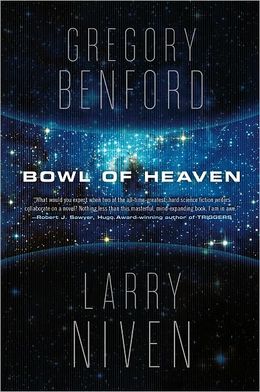
Bowl of Heaven — Larry Niven and Gregory Benford

Bowl_of_heavenIt’s almost always a mistake to represent alien consciousness in science fiction. Aliens, if we ever encounter them, are likely to be so alien that we can’t or won’t understand them—not at first, and conceivably not ever. The bigger problem with representing alien consciousness in science fiction comes from the language that is doing the representing.

Language, as pretty much everyone who has ever learned a foreign one knows, shapes what and how you think, as does the culture that carried by that language. Languages, though translatable, have different flavors. And the aliens in Bowl of Heaven sound like the humans, who sound like each other, and all of whom sound like Americans. They can’t do much better than call the human-built spacecraft “boldly simple.” These are aliens who, even more than most aliens in fiction, feel like humans dressed in exotic garb and wielding exotic technology.

Arthur C. Clarke wisely avoided this problem in Rendezvous with Rama, which is one reason the first one is so good and the latter ones less so.

It’s very hard to create fully differentiated human characters, each with a style all their own. Few accomplish this, which is why most writers choose a single first-person narrator, or a limited third-person narrator. One accomplishment in a novel like Anita Shreve’s Testimony is that the characters don’t sound alike, as they do in, say, Tom Perrotta’s Election, or many of Elmore Leonard’s novels. Hell, the style of, say, Remains of the Day, Jonathan Strange & Mr Norrell, and Atonement are as different as they are because each of their authors is trying to achieve (and achieving) a very specific effect and way of thinking. Niven and Benford aren’t.

I got into Bowl of Heaven because Peter Watts blurbed it and wrote about it in Circling the Bowl. I should’ve paid more heed to the way he described it: “Bowl of Heaven resonates with me, not so much as a work of fiction but as an artefact of the publishing industry.” I can see why it wouldn’t resonate with him “much as a work of fiction,” because by that standard it doesn’t succeed well. I should’ve read his post more carefully and noticed that sentence, though he also notes that “Bowl of Heaven seems to have done just fine with the advance reviewers.”

_MG_9690-1Watts looked at Amazon reviews for the book and noticed that “27% of the reviews complain about sloppy editing and continuity errors.” I’m going to complain about sloppy editing too: a lot of my pages looked like the one on the right, in which extraneous words and sentences are crossed out. This is the sort of thing nearly all authors do on their own (many pages of my own work are filled with cross-outs), and that line and copy editors do too. Generally I ignore extraneous sentences in novels, because everyone commits a couple. But when page after page looks like the one depicted to the right, I get annoyed.

Anyway, Watts’s recommendation kept me reading despite editing problems, but I quit reading when the English-speaking aliens appeared, with all of their Capitalized Proper Nouns (“For Memor was not amid the fevered straits of the Change;” there are also mentions of “the Dancing,” “the Watchers,” and capital-A “Astronomers”). There’s better work out there: before Bowl of Heaven, make sure you’ve read Blindsight and Starfish first: those are Watts novels, and I don’t remember where I first learned about them, and both are hard to read at their beginnings but dazzling by their ends as pieces click into place.

To return to the language issue, novels like Bowl of Heaven tend to give SF a bad rep among lit-fic types, who are obsessively attentive to language and how people use language in very particular way. As I noted above, these authors aren’t attentive to those issues, and they also seem to have a confused point of view—and not one that’s intentionally confused for artistic effect, like Virginia Woolf. The effect feels like a mess: it seems like the novel is following Cliff from a first-person limited view, but then it slips into a paragraph or two with only things that Redwing, or other characters, could know. It’s the sort of thing that undergrads learn about in creative writing classes.

Maybe there’s an artistic purpose here, but if so I’m not seeing it. If not, it’s just a mistake, and seeing novels with many simple mistakes praised by many eminent science fiction writers will tend to subtly and unfairly devalue the genre as a whole.