The inequality that matters II: Why does dating in Seattle get left out?

In “Amazon is killing my sex life: The tech boom in Seattle is bringing in droves of successful, straight single guys — all of them insufferable,” Tricia Romano writes about how she “wasn’t going to be able to get it up for a boring tech dude” and says that “as Amazon grows, the number of (boring) men grows too.” In Palo Alto, men “had money, but they were boring.” Meanwhile, “On the dates, they flash money around.” By now you sense a theme. In Romano’s narrative—which I don’t entirely buy, but let’s roll with it—these guys could make an effectively infinite amount of money and that money in her view wouldn’t improve their dating prospects. They are yuppie losers to a refined writerly sensibility.

Romano doesn’t make an interesting connection to national income inequality. By now much of that argument is well-known, and Piketty’s Capital is one surprisingly famous take, though I am a bleacher skeptic. Still, there is a lot of media noise around income inequality, perhaps in part because media people tend to congregate in very expensive cities like New York and L.A., where making six figures can feel genuinely middle class and where the proximity to the stupendously wealthy invites invidious comparisons.

Nonetheless, Romano’s article should be required reading for anyone who writes about or inveighs against inequality in purely financial terms. In the U.S. there are many different status ladders and finance is only one. For many, like Romano, it’s not even the most important one.

Income is not the only thing that one can choose to optimize and indeed of the guys I know the ones who get or seem to get more / better women tend not to be the richest. Artists or the artistically inclined tend to have lower income but higher-seeming satisfaction. The “seeming” qualifications are important because it’s hard to tell from the outside what someone really feels, but in the absence of better measures I tend to accept what appears on the surface.

Elliott Rodger, the guy who murdered half a dozen people at UCSB, apparently “Led A Life Of Luxury” but still felt like he couldn’t get laid. Clearly there were many things wrong with Rodger, but money did not alleviate those things. He was on the right side of monetary inequality and the wrong side of dating inequality.

I don’t have a major point in this except to note that there is a (media) obsession with income inequality. That obsession tends to gloss other status ladders and other things people value. Some kinds status can also convert into money: certain kinds of fame, for example. Attractive women can earn supernormal wages through stripping or prostitution; I’m not arguing those are desirable life choices but they are viable options for some people and not others. There are still some strength- and endurance-based jobs that guys find within reach—think commercial fishing and fracking.

I’m focusing on sex in this post but that is merely a salient one and there are others, like academia. Romano probably values being a writer more than making a lot of money. In “Taxing a Professor’s Privilege,” Megan McArdle writes about how job guarantees are financially valuable even if that value isn’t traditionally measured in dollars (she also wrote the post that gave this post its title: “The Inequality That Matters“).

If those guys Romano dated imbibed the messages that a) their earnings matter tremendously to women and that b) being at the top of the financial heap matters most, then they’ve presumably misallocated resources. They’d be better off with less time working at Amazon and more time reading Starting Strength and hitting the gym.

Romano’s post doesn’t sit alone. It’s got a similar vibe to “I Got Shipped to California to Date Tech Guys,” which sounds like the beginning of a romantic comedy but is really a jeremiad about what it seems to be about.

To be sure, everyone seems to like to complain about dating, so maybe everyone, everywhere, complains all the time. For most of my life I’ve heard straight women complain about men and straight men complain about women. The specifics of the complaints change but the complaints themselves remain.

Finally, as with so many modern social issues this is tied into building restrictions and real-estate issues, since many guys who are exciting but not rich presumably can’t afford to live in Seattle. Seattle and many other areas (New York, L.A.) could improve both dating prospects and finances through increasing the supply of housing, as Matt Yglesias argues at the link, but they choose not to.

How the politics of envy (or “income inequality”) work in the broadest sense

Tyler Cowen writes in “Paul Krugman on the political salience of inequality” that

I see the inequality issue as having high salience for NYT readers, for Democratic Party donors, and for progressive activists. It has very little salience for the American public, especially with say swing voters in southern Ohio or soccer moms. Unlike in Singapore or South Korea, where the major concentrations of wealth are pretty hard to avoid for most people, American income inequalities are well hidden for the most part.

McLean is one of the wealthiest towns in Virginia, but if you drive through the downtown frankly it still feels a bit like a dump. I’ve never wanted to live there, not even at lower real estate prices. You don’t stumble upon the nicest homes unless you know where to look. Middleburg is wealthier yet, but it has few homes, feels unreal, and most people don’t go there anyway. If they do, they more likely admire well-groomed horses and still read Princess Diana biographies. They are not choking with envy over the privileges of old money rentiers, and there is no Walmart in town to bring in the masses (who probably would not care anyway).

(Emphasis added.)

This describes greater Seattle as well: how many people outside the area have heard of Medina, city of mansions? Even within the area, most people who mention it only do so as “the place where Bill Gates lives,” despite the many other freakish palaces there. Those who live in Issaquah (further east, away from Seattle proper) don’t appear to care what happens in Medina and even if they did their political ability to affect Medina is limited. Seattle is not exactly like Cowen’s Virginia—Bellevue now has a real downtown where people want to live and go, for example—but the similarities are real.

The only place I’ve lived which seems to generate envy of major concentrations of wealth is New York, perhaps because a) of the demographics, or at least the people I tend to hang out with and b) many average people see / walk by very expensive buildings. I regularly walk by the new skyscraper on 23rd and Park or Lex where Rupert Murdoch is reputed to have bought a $80 million penthouse. Though he seems unlikely to invite me up for a martini and canapés, his dwelling is much more in your face than Medina or other wealthy places in Seattle; when I live in and near Seattle I never walked by or even got near Bill Gates’s house.

Among those I know who have been to Bill Gates’s house, all were Microsoft interns who are more likely to want to be the next Gates than they are to resent him. Gates and other tech zillionaires also appear to generate very little ill will locally. That may be another difference from New York, since tech zillionaires are widely seen as having earned their money by providing value, while finance riches may not be seen in the same way.*

Later in the post Cowen also links to Seattle’s $15 minimum wage debate, despite the many well-known problems of the minimum wage. If Seattle were serious about making poor and lower-middle class people better off, the city would be focused on providing more housing and not in effect putting gates in front of current and potential residents. But the same people who want higher minimum wages are the ones who hate and protest housing supply increases. There are many ways to make people materially better off and some ways, like building, are much closer to being Pareto efficient. The same political dysfunctions that afflict Seattle are common elsewhere too, in places like Santa Monica.


* I don’t have a strong opinion on those because I don’t know enough to judge, though I have heard plausible views about why finance increases liquidity and enables capital to find useful purposes and plausible views about how finance is an increasingly zero-sum game focused on enriching insiders and corrupting the political process.

Links: Cars and cities, antibiotics and sex, mattresses, universities, writing advice and more

* Cars Kill Cities.

* How to design happier cities.

* Computer science professor leaves, explains the problems with his institution, and doesn’t include the standard false-guilt genuflection. Or, as he puts it, he’s “going feral.”

* How Tuft & Needle is disrupting the wildly corrupt mattress industry; I’d buy from them next time I need a mattress.

* The media doesn’t talk about suicide and statistics about suicide with guns are nonexistent or bad.

* “No Antibiotics, No Sexual Revolution,” or, “how the legal system is holding back medical innovation.” See also Alex Tabarrok’s wonderful and short book Launching the Innovation Renaissance.

* “Are Graduate Students At Private Schools ‘Employees’?” Given the amount and kind of work they do, it’s hard to answer “no.” At the University of Arizona, English grad students taught two classes per semester, for pay—the same amount of teaching professors did.

* “Solving the Shortage in Primary Care Doctors;” see also my essay “Why you should become a nurse or physicians assistant instead of a doctor: the underrated perils of medical school.”

* Yet another reason why public schools are as fucked up as they are: Student Gets Suspended, Loses Scholarship After Hugging a Teacher.

* The politics of science fiction.

* “Doctors and nurses need to be replaced by computers and robots.”

* “How to Write: A Year in Advice from Franzen, King, Hosseini, and More: Highlights from 12 months of interviews with writers about their craft and the authors they love.” Perhaps the most notable part is the number of people who give opposing or at least semi-contradictory advice. From that we might infer a meta rule: what works for other people won’t necessarily work for you (or me), and there isn’t necessarily a perfectly “right” way to do it.

Hipsters haven’t ruined Paris; Parisian voters have

Last week’s New York Times has a somewhat dumb article by Thomas Chatterton Williams called “How Hipsters Ruined Paris,” which describes how Paris is changing:

Today, the neighborhood has been rechristened “South Pigalle” or, in a disheartening aping of New York, SoPi. Organic grocers, tasteful bistros and an influx of upscale American cocktail bars are quietly displacing the pharmacies, dry cleaners and scores of seedy bar à hôtesses that for decades have defined the neighborhood.

Elsewhere, the usual complaints appear: “Our neighborhood, though safe and well on its way to gentrification…” But demand to live in Paris is rising while the supply of housing remains constant, or close to constant—which means prices rise, and richer people move into once-poorer neighborhoods, and bring with them their predilections for high-end coffee and fancy bars and all the similar stuff I and my ilk like. If you want more diverse neighborhoods, you have to get lower rents, and the only effective way to accomplish that is through taller buildings—which, quelle horreur, destroy the character of the neighborhood!

Matt Yglesias wrote about this basic problem in The Rent is Too Damn High, which continues to go unread and uncited by people writing about neighborhoods, whose work would be improved by knowledge.

Why would you want to own a car if you could avoid it?

My Dad sent “Who’s Buying ‘Youth’ Cars? Seniors Aging Boomers Are Prime Buyers for Small Vehicles That Auto Makers Target at Hipsters,” because he bought a Mini Cooper a few years ago, which is probably targeted at “young” people. But I replied with a larger point:

Why would you want a car if you could avoid having one?

Young people don’t care about cars. They care about smartphones. See here for more:

Why are younger Americans driving less?

Brad Plumer considers several good hypotheses, including the recession, gas prices, student debt, tougher legal requirements, and a stronger desire to live in places such as Brooklyn. I would add one other factor to his list: because they are working less. A more speculative additional hypothesis would be “because it is easier to have sex without driving to get it.”

Ugh

Ugh

A nice car is still a status symbol but a much less important status symbol than it used to be. Cars are expensive, dirty, and cause a lot of traffic. Old people like you (wrongly) associate cars with freedom and the open road, because when you grew up the roads were relatively empty.

Young people today associate cars with traffic and their parents and death. Cars are like jails. In ye olde days getting laid meant cruising to drive-ins or malls or whatever. Today getting laid means texting, Facebook, and OKCupid. Former students have talked about Tinder (sp?), which is Grindr for straight people. Going back to the status symbol point, is it more useful for a guy looking to get laid to work his ass off for a BMW or to learn guitar and get a YouTube channel? For someone with no financial constraints the obvious answer is “both,” but for someone choosing between them I suspect guitar + YouTube would win.

An iPhone is much cheaper than a car. Even an iPhone, iPad, and laptop together are much cheaper than a car. See also Philip Greenspun on this.

DUI laws are also now heavily enforced and draconian (A BAC of .1 is much more reasonable than .08) and everyone knows someone who’s had ten thousand dollars or more in court costs and hassles related to DUI. Even so, a cop can ruin your night and next day for pretty much any reason if he suspects you’ve had anything to drink. Gas is much more expensive in real terms than it was even in the late 90s / early 2000s.

No one with half a brain would want to drive more than they absolutely must, so I am skeptical that any “youth-oriented pitches” will succeed because really who cares? Driving sucks. Part of selling is having something to sell that people want. And, as you yourself pointed out, you spent much of your working life in high school and college trying to keep a car in working order. AAA estimates that the average car costs $10,000 TCO, or about one quarter of median income. Even knocking $2000 off for a cheaper car, I suspect a lot of people could allocate $2000 to transit / bikes / Zipcar / etc. and come out way ahead.

Almost anyone who can avoid commuting by car is better off ditching their wheels. Even you, Dad, would be much more financially secure by selling your car, renting your parking spaces, and getting a Zipcar subscription.

[Note: My Dad doesn’t have to drive to his office.]

Jane Jacobs is everywhere, even when you don’t see her

In a Reddit thread someone recently asked:

Who the hell actually thinks Jane Jacobs has any influence on Seattle’s urban planning?

Through The Death and Life of Great American Cities, Jacobs has influenced urban planning in every American city at the very least and perhaps every city in the world, though I can’t speak to the experience of other countries.

Jacobs correctly observed that city planners, most notably and famously Robert Moses, were bulldozing important areas for highways and other sub-optimal uses, and that communities should have more of a say in what happens regarding development, especially development that uses eminent domain. In addition, she correctly observed that city planners were frequently disconnected from the way people actually live, which is somewhat similar to the way academic literary critics today are disconnected from the way people actually read.

But by now the pendulum between “planners ruler” and “community veto” has swung too far in the opposite direction: today NIMBYs and People United Against Everything (PUAE) have too much power, and we’re seeing the consequences in most places anytime anyone tries to build subways, rail, or housing. In many places, with San Francisco and New York leading the pack, supply restrictions on building have led to enormous housing cost increases, but markets can’t effectively respond because a small number of incumbent property owners can block new, private developments.

I’m optimistic about cities over the medium term, but in the short term the real problem faced by cities is not too little “community” input but too much, usually represented by a relatively small number of NIMBYs and busybodies—the process privileges existing homeowners and the fact that “only socially and psychologically abnormal people want to waste their evening showing up to neighborhood hearings.”

Still, Jacobs’ influence remains, and this essay by Edward Glaeser, comparing Jacobs and Robert Moses, demonstrates how their ideas have come to define a great deal of what people think about cities. This is especially important:

Moses was also right that cities need infrastructure. People cannot just argue forever on an unpaved street corner. They need homes to live in and streets to travel along and parks for relaxation. Jacobs underestimated the value of new construction—of building up.

Jacobs didn’t understand one important part of basic economics, which is that restricting supply in the face of increasing demand raises prices. Someone like Jacobs can’t afford to live in Greenwich Village today because the housing is too expensive. Most of Manhattan and much of New York more generally has priced out the middle class, in part due to the rules and laws that stem from Jacobs’ victories; instead of living in the city, those people are now driving cars in Atlanta, Houston, and Phoenix. Places like Seattle and Portland are somewhere between Atlanta and New York, but even Seattle won’t allow sufficient development to allow for middle-class growth.

The language Jacobs uses in The Death and Life of Great American Cities is sometimes dangerous, as when she says that “streets or districts which do have good primary mixtures and are successful at generating city diversity should be treasured, rather than despised for their mixture and destroyed by attempts to sort out their components from one another.” She’s right about mixed-use areas being valuable, but the word “treasured” is a problem: a mixed-used building that is three stories tall can be equally good at being mixed-use with thirty stories. Treasuring buildings that already exist can lead to the San Francisco problem, and San Francisco itself is only the furthest along example of what happens when supply can’t meet demand.

There is one thing I think Glaeser gets wrong in his article:

Jacobs was right that cities are built for people, but they are also built around transportation systems. New York was America’s premier harbor, and the city grew up around the port. The meandering streets of lower Manhattan were laid down in a pedestrian age. Washington Square was urban sprawl in the age of the omnibus. The Upper East Side and Upper West Side were built up in the age of rail, when my great-grandfather would take the long elevated train ride downtown from Washington Heights. It was inevitable that cars would also require urban change. Either older cities would have to adapt, or the population would move entirely to the new car-based cities of the Sunbelt. [. . . ] No matter what Jacobs thought, there simply was not a car-less option for New York.

The issue with older cities is less about cars than about older cities doing what they do well: density, public interfaces, and so forth. Instead of trying to capitalize on the strengths of older cities, older cities built the massive highways and parking lots Jacobs and her acolytes eventually learned to fight. Sometimes the response to a technology shift isn’t to attempt to ape the shift but to make sure you focus on doing your core strength better—which many cities have utterly failed to do.

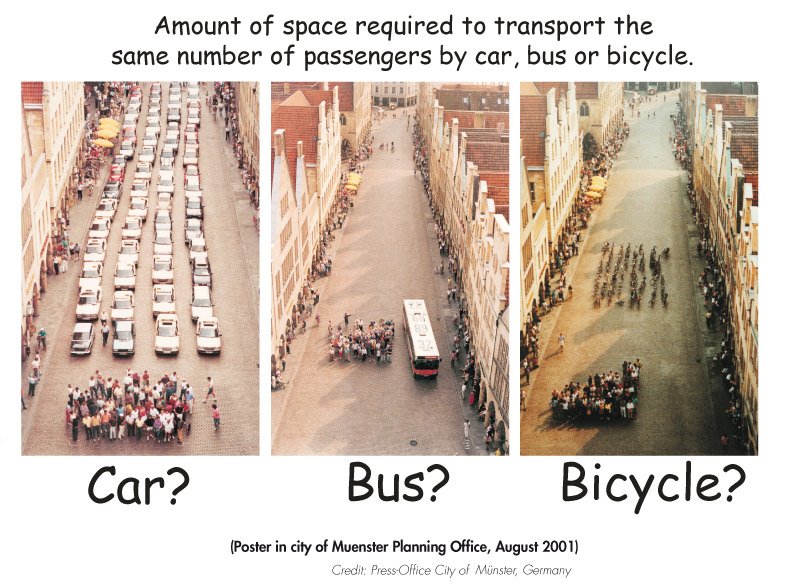
When the car began spreading in earnest in the 1920s, the total U.S. population was 106,021,537. In 1930 it was 122,775,046. Today it’s approximately 316,000,000. Moving to a highly car-dependent lifestyle made sense for a long time, but now a lot of urban areas are simply choked by them. This famous photo from the City of Muenster Planning Office succinctly demonstrates the problem, as does L.A. during rush hour:

Cities, buses, and bikes

Education is also part of the city puzzle, since it’s provided publicly and, usually, on a per-city basis. For much of the period from approximately 1970 – 2010, it was possible for parents to outrun well-meaning but poorly executed court degrees pertaining to school districting. It’s hard to measure the extent to which school busing and similar schemes drove many parents to the suburbs, even if they would’ve liked to stay in cities. This 2006 WSJ piece describes some of the pernicious consequences that are still reverberating in Seattle, which is a microcosm for the problems elsewhere. Schools and real estate both show the same basic principle: when principles meet self-interest, self-interest usually wins. Everyone favors low- and moderate-income housing in theory but don’t want it in their neighborhood, and everyone favors racial integration in theory unless their kid gets moved to the worse school.

Still, that’s tangential to Jacobs’s main points and how they affect contemporary decisions in cities. That I’m still citing Jacobs’ work more than 50 years later demonstrates its importance. To the extent any normal person has heard of anyone having anything to do with urban planning, they’ve heard of Jacobs and Moses. Pretty much anyone with any formal education in the subject has not only heard of them but read at least excerpts of their writing. It’s like being in English lit and wondering who this Shakespeare guy is.

Summary judgment: Planet of Cities — Shlomo Angel

Planet of Cities is for a specialized audience, but it has one very big point that I didn’t realize:

New empirical evidence on the average population density of cities across space and time confirms that these densities have been in decline almost everywhere for a century or more. The new evidence is counterintuitive, since numerous academic researchers believe that urban densities have been on the increase. Were that true, it would lend encouragement and support to those favoring densification. However, urban density decline has been persistent and global in scope, and it predated the automobile. It is not restricted to the United States or other industrialized countries, but is pervasive in developing countries as well. [. . .]

The forces driving density decline—rising per capita incomes, cheap agricultural lands, efficient transport, and income inequality—are quite formidable. Accordingly, absent a highly effective policy intervention or a steep increase in travel costs in the future, there is little reason for the global decline in densities to slow down anytime soon.

Planet-of-citiesI like living in cities (if New York were less expensive—as it was until the ’90s—I’d happily live here forever) and attack legal rules that prohibit higher buildings. But the research Angel has both conducted and cited indicates that, even in the absence of such rules, cities would still probably be getting less dense, or at most evening out. That is news to me; he also says, “No matter how we choose to act, however, we should remain aware that conscious and conscientious efforts to increase the density of our cities require the reversal of a powerful and sustained global tendency for urban densities to decline.” Newer cities, like Phoenix or Dallas, are even less dense than older cities, which is an innovation problem for the reasons described in Steven Berlin Johnson’s Where Good Ideas Come From and Edward Glaeser’s The Triumph of the City.

Cities like New York and Boston remain so important because creating dense neighborhoods like those found in both areas is effectively impossible in today’s climate of urban land-use controls. Building such areas doesn’t have to be impossible, but we, collectively, make it so. Take Seattle, a city I’m very familiar with. In downtown Seattle, rents have effectively increased by 40 – 50% from 2002 – 2012, even though some construction has been permitted. Rapid increase indicates that much more could be commercially built, and that many people want to live there and will pay to do so.

Some cities have attempted to limit horizontal urban sprawl, and presumably increase vertical urban height. Portland is a case in point, because it created an “urban growth boundary” (UGB) and thus has been a test case for some city planning. By density, which is arguably the most important measure of whether an UGB succeeds, the UGB failed:

The chief aim of the UGB was to contain urban sprawl and preserve the natural beauty of the surrounding countryside within reach of city residents. Sprawl was not defined precisely, but presumably it included both low-density development and fragmentation. After examining the change in built-up area density within the UGB between 1973 and 2005, we found that densities decreased rather than increased.

Even cities that have explicitly attempted to contain sprawl by increasing density have not fully succeeded. This points to the obvious need to plan for sprawl, and to plan for less centralization:

The possibility that cities worldwide are now in a process of transformation from a monocentric to a polycentric spatial structure poses an interesting challenge. It suggests that if public transport is to be a viable option in areas of expansion to economize on the energy expended and to limit greenhouse gas emissions, then it cannot be limited to continued reliance on radial routes to the city center. The transport network must be two-dimensional, providing frequent and reliable service among suburban destinations over the entire metropolitan area, rather than a one-dimensional network of radial routes into the city center. Some public transport systems that already provide such service are the bus lines of Edmonton and Toronto in Canada.

To provide reliable point-to-point service throughout metropolitan areas and to function effectively, bus lines or new transportation technologies will need to operate on a grid of arterial roads.

Again, this is certainly true in Seattle: I can’t find a citation, but for a time there was more Class-A office space in downtown Bellevue than downtown Seattle. In the greater Seattle area, there are major population and employment centers in Seattle itself, Bellevue, downtown Kirkland, Redmond (where Microsoft is headquartered) and Renton (where Boeing has or had many facilities). Many people I went to high school with live on the Eastside and seldom cross Lake Washington, and they can live a relatively urban experience in downtown Bellevue or Kirkland. Seattle as a city still imposes severe height limits in areas adjacent to downtown, and, as a result, some of the development and population infill that might otherwise take place, say, east of 12th Avenue or North of Olive / John on Capitol Hill, instead moves to Kirkland and Bellevue.

The style in Planet of Cities is unimpressive, verging on non-existent, as the quotes above demonstrate. But its insights impress, as does its re-evaluation of the conventional wisdom about rising densities in cities. As I wrote in the first paragraph, it’s a specialist book for specialist interests. Still, most people hold naive views on city planning, even if they don’t realize they hold such views. Planet of Cities replaces naiveté with knowledge. It could use panache, but that’s true of almost all textbooks and monographs.

EDIT: Anthony Flint of the Lincoln Institute of Land Policy wrote to ask me to note that the Lincoln Institute of Land Policy published this book. I’m not sure why this is important, but here it is.

Links: Silicon Valley as a city, Parfit on Kant, language weirdness, Kevin Kelly, notebooks, and more

* “A Grand Plan to Make Silicon Valley Into An Urban Paradise: Maybe the suburban land of the tech giants could become a thriving dense metropolis.” Sounds good if improbable to me.

IMG_1878* I added to “On bad writing in philosophy: Derek Parfit on Kant.”

* Awesome: “Tenants’ Deal Removes Bar To New Tower.”

* A weird language moment, from the article “The Winners and Losers in the Fiscal-Cliff Deal:” “The Obama administration has gotten a lot done since Inauguration Day 2009, but what it’s never done is give strong partisan Democrats the kind of to-the-mattresses battle against the GOP that they crave” (emphasis added). The professional minutia of imagined gangsters is apparently well-known enough to use without any explanation of what a “to-the-mattresses battle” is, and how it differs from a non-to-the-mattresses battle.

* Kevin Kelly: The Post-Productive Economy and why we’ve barely seen growth from computing and the Internet, at least yet.

* Why women reject eager men.

* The death of the American shopping mall. Good.

* A random thought: It’s hard to be alive and intellectually engaged without contemplating our relationship with technology.

* Perhaps related to the above, WordPress picked up “Why little black books instead of phones and computers,” and I must say that bloggers are chatty: there are 112 comments on the post (and rising), which beats “Unicomp Customer / Space Saver and the IBM Model M.” That one may have had many more readers, but it only has 68 comments.

* “Prostitutes in Brazil Take Free English Classes Ahead of 2014 World Cup;” the best quote is “I don’t think we will have problems persuading English teachers to provide services for free [. . .] We already have several volunteer psychologists and doctors helping us.”

Links: Teen sex attitudes, writing lessons, sentence origins, math, cities, tea, languages, and more

* Parents Just Don’t Understand: A sociologist says American moms and dads are in denial about their kids’ sexual lives. See also: “ Sex? Not my kid! A new book explores parental delusions about their teens’ sexuality.” Notice this: “[S]exual threats are seen [by parents] as ever present — from someone else’s sex-crazed kid, someone else’s corruptive parental influence, someone else’s perversion. Rarely do parents attribute the risk to their own child’s sexual desire or agency. Surprise, surprise.”

* The Most Important Writing Lesson I Ever Learned; unfortunately, I think most academics either never learn or forget this:

When you understand that nobody wants to read your shit, your mind becomes powerfully concentrated. You begin to understand that writing/reading is, above all, a transaction. The reader donates his time and attention, which are supremely valuable commodities. In return, you the writer, must give him something worthy of his gift to you.

* Where do sentences come from?

* “[A]lgebra isn’t harder than other subjects, it’s more objective. Therefore, it tends to make educational fraud more visible. People rarely fail algebra and succeed in other subjects; they fail in all subjects and algebra is the only one where it can’t be ignored any longer.”

* How communities are banding together to create high-speed, affordable broadband access.

* Allen Wyler’s Dead Ringer unintentionally shows the importance of creative writing classes. The novel starts: “A dark, ill-formed premonition punched Lucas McRae in the guy so hard it stole his breath.” But premonitions don’t punch people in the gut—other people do. “A second later it vanished, leaving only a lingering vague sense of foreboding.” We don’t need “lingering” and “vague” one word will do, and the phrase itself is a cliche anyway. This is the sort of stuff college sophomores discuss in “Introduction to Writing the Novel.”

* Survival Lessons From an Ancient Failed City:

Today’s sprawling cities expanded in a period of mild weather too, with no anticipation that seas might rise or energy resources could be depleted. Angkor and modern cities resemble one another in that they were built to survive in only the most benign weather regimes. The roads, sewers and the like of the modern suburb are based on an assumption of mild weather and cheap energy. Recent events like Hurricane Katrina in New Orleans and subsequent Midwestern intense storms show how poorly modern infrastructure performs in extreme weather.

* Everyone loves smut, says Patty Marks of Ellora’s Cave, who turned kinky fiction into millions before E.L. James.

* How to start an online tea business. My best guess: don’t.

* Bryan Caplan: “To understand why Americans don’t learn foreign languages, simply reverse this reasoning. We don’t learn foreign languages because foreign languages rarely helps us get good jobs, meet interesting people, or enjoy culture.” I approve of learning foreign languages and admire people who do, but I doubt the typically American derives much benefit because the typical American has to travel too far to make use of the foreign language. For most people, learning programming languages is probably far more useful in terms of both job skills and “learning how to think.” This view is close to David Henderson’s point: “Thoughts on Second Language.” Here is a counterpoint. It is possible that foreign languages would be much more useful from a very young age, but then the same could be said of Python. It’s possible that I haven’t seen foreign language benefits in my life because I haven’t learned enough of a foreign language to receive real benefits.

* You’ll never be Chinese.

Triumph of the City: How Our Greatest Invention Makes Us Richer, Smarter, Greener, Healthier, and Happier — Edward Glaeser

When I lived in Seattle, I was driving a friend home when she said she didn’t like all the new buildings because they pushed poor people out of the city. I was confused by her argument and that building more housing units will make it easier for poor people—any people, really—to afford to live in the city, but she argued that wasn’t true because the existing buildings were “worse.” But that doesn’t matter much: if a given parcel of land goes from having four units on it to four hundred, that’s vastly more supply. The conversation’s already low level of intellectual content degenerated, but I thought of it as I read Triumph of the City, which gathers a lot of useful information about cities and what they offer in one place. Yes, the title is overwrought, but the content is useful, and I especially noticed this, about Jane Jacobs:

Because she saw that older, shorter buildings were cheaper, she incorrectly believed that restricting heights and preserving old neighborhoods would ensure affordability. That’s not how supply and demand work. When the demand for a city rises, prices will rise unless more homes are built. When cities restrict new construction, they become more expensive.

It’s basic supply and demand, but, from what I can tell, relatively few cities actually discuss supply, demand, and housing costs—which is unfortunate given the extreme costs of many desirable cities that offer intensive knowledge spillover effects. If how we live affects what we think and how we think, we should pay a lot of attention to how we live. Yet few of us do, though more of us should. Triumph of the City is the kind of book unmoored young people and people contemplating career changes need to read, because where you live affects so much of how you live. This part speaks to a dilemma I’m facing:

In the year 2000, people were willing to accept lower real wages to live in New York, which means that they were coming to New York despite the fact that higher prices more than erased higher wages. It’s not that New York had become less productive; the city’s nominal wages, which reflect productivity, were higher than ever. But housing prices, fueled by the robust demand to live and play in the city, had risen even more than nominal earnings. If housing prices rise enough relative to nominal incomes, as they do when cities become more pleasant, then real incomes can actually fall during a period of great urban success. Manhattan had changed from a battlefield to an urban playground, and people were willing to pay, in the form of lower wages, for the privilege of living there.

I’m likely to move to New York and live for at least two years. Which raises questions: am I willing to “accept lower real wages” because of the housing cost increases? How valuable is “an urban playground?” Perhaps not valuable enough to keep me there. I love New York and just wish I could live there. L.A. has similar problems, and I have some friends who want to leave Tucson—for which I blame them not at all—and are contemplating where to go; based on their disposition and temperaments, Seattle or Portland would be obvious choices. They’re much less expensive, and moving to either will probably result in an increase of 10 – 20% in real income terms, as Virginia Postrel shows in “A Tale of Two Town Houses.” (Glaeser speaks to L.A., too, however indirectly: “Cities grow by building up, or out, and when a city doesn’t build, people are prevented from experiencing the magic of urban proximity.” L.A. has replaced proximity with traffic.)

And there tend to be clusters of artists and other creative types in cities that offer dense environments, not totally dysfunctional politics, and cheap housing. The 1920s Paris immortalized by Hemingway and Fitzgerald, and recently recreated in Woody Allen’s Midnight in Paris was such a place; today, as Glaeser says, “Restrictions on new construction have ensured that Paris—once famously hospitable to starving artists—is now affordable only to the wealthy.” It’s a useful reminder that you can’t beat economics with raw policy alone, and so many articles about rising rent prices or changing demographics utterly fail to connect housing costs with the needs of the poor outsiders who will one day start startups or be artists (for a recent, positive example, see Megan McArdle’s post “Empty Apartments, Stupid Laws“).

Artists simply can’t afford Paris anymore, and New York is becoming expensive too.

The really famous, important parts of the world—New York, London, Tokyo, Beijing—are important because of what large networks of hundreds of millions of people have done with and to them. They’re not intrinsically important because of the land they occupy. Cities that want to emulate their example and distinguish themselves from surrounding suburbs and rural lands need to build up, not out (or not at all). New York’s housing prices are so high because lots of people want to live there—because it’s awesome. As Glaeser shows, we should want them to be able to live there, too. But we often can’t.

This doesn’t just hurt us as individuals, or economies composed of people who can’t live in spaces where they connect with one another: it also hurts the environment because: “Traditional cities have fewer carbon emissions because they don’t require vast amounts of driving. [. . .] Department of Energy data confirms that New York State’s per capita energy consumption is next to last in the country, which largely reflects public transit use in New York.” And:

Good environmentalism means putting buildings in places where they will do the least ecological harm. This means that we must be more tolerant of tearing down the short buildings in cities in order to build tall ones, and more intolerant of the activists who oppose emissions-reducing urban growth.

But I think he misses something here: for a lot of people, environmentalism is just a pose, a way to show they care—provided it doesn’t harm or affect their life in some immediate, substantial way (those of you firing up your e-mail clients to send me angry missives should hold off: this applies to lots of other subjects too, like religion). So the people who claim to be environmentalists are really claiming that they want you to think they care about the environment, and that’s a cheap stance until people start to complain about construction noise, or loss of a neighborhood’s dubious “character,” or whatever other excuse comes up. As Alex Tabarrok says in Launching The Innovation Renaissance, one major, underappreciated problem the U.S. faces is the sheer number of veto players who can affect any building project at any scale. Glaeser is in effect pointing to a single facet of this general principle.

In essence, there’s too much regulation of what happens in most cities. For example, take parking policies: if people (especially those who claim to be environmentalist) want good public transportation, one useful strategy is to raise the real cost of cars, which is an especially good idea because Free Parking Comes at a Price. And that price is innumerable underutilized parking spaces. I see this price every day in Tucson, where miles and miles of land are given over to hideous parking lots that make walking virtually anywhere impossible.

One interesting missing piece: a concrete theory of why cities offer the advantages they do. We have lots of indirect information showing the advantage of cities, combined with some theories about why they offer the things they do, but little else. Steven Berlin Johnson is similarly indirect in Where Good Ideas Come From; like Triumph of the City, it’s a fascinating book (and he speaks to cities as innovative environments in it), but it also has this gap that I don’t know how to fill. Perhaps no one can at current levels of technology and understanding.

A lot of the prose in Triumph of the City is uninspired, and occasionally garbled, like this: “Urban proximity enables cross-cultural connection by reducing the curse of communicating complexity, the fact that a garbled message increases the amount of information that is being transferred.” But the density of ideas makes up for the weakness of the language, and Glaeser is also a native economist, rather than a writer.


Here’s Slate’s (positive) review. I don’t think I’ve read any negative reviews; if you’ve seen any, post a comment.