Questioning the academic enterprise. . .

Here’s Robertson Davies from an interview in Conversations with Robertson Davies:

There are a lot of things in that book [by Elspeth Buitenhuis; the work in question is not named, though it discusses Davies] that I never said and don’t agree with but she must say what she thinks. There’s a lady at McGill who teaches Fifth Business in a course on Canadian literature and she says that the stone which Ramsay carried all his life and which Boy Staunton had in his mouth when he died is the stone of judgment out of the Talmud. I have never read the Talmud. I don’t know anything about the stone of judgment, but when you fall into the hands of academics you’re a gone goose. They will interpret and say what they think and there’s nothing you can do about it. It doesn’t really very much matter unless we take it too seriously.

Sometimes I’ve wanted to pull the stunt Woody Allen does in Annie Hall:

If what literary academics are doing “doesn’t really very much matter,” the question becomes, what then are we doing?

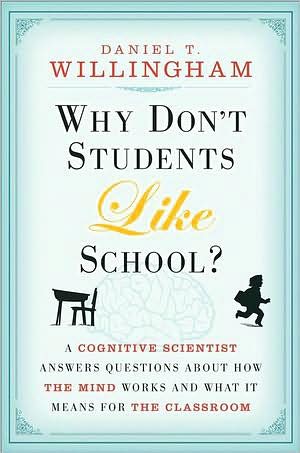
Why Don’t Students Like School? – Daniel T. Willingham

Daniel T. Willingham’s Why Don’t Students Like School: A Cognitive Scientist Answers Questions About How the Mind Works and What It Means for the Classroom is too long a title for a book that is surprisingly good, especially given how short it is. Although the title mentions the “classroom,” the book is useful not only for teachers and students, but for anyone who needs to be aware of the cognitive processes involving in learning—which should be anyone involved in the knowledge economy, since that economy is based almost entirely on being smarter and more efficient than the next guy. The only way to accomplish that is through education—and not only the kind that goes on in schools.

Although Willingham’s book focuses on the “school” part of the equation, his advice can be translated elsewhere, to anyone who has information that must be imparted to others. He says students don’t like school in part because they’re being taught poorly. This probably isn’t news to anyone who has ever attended school. The problem is what “poorly” means and how it might be improved, both on the level of an individual teacher and on the institutional level at which K-12 education and universities operate. The two aren’t often treated as a single unit for teaching purposes, in part because K-12 teachers are just supposed to teach, while university instructors are also supposed to be doing research. Nonetheless, both obviously struggle with student (and sometimes teacher) boredom.

The problem goes beyond the classroom and into life: “[. . .] unless the cognitive conditions are right, we will avoid thinking.” In essence, we avoid thinking more than we embrace it, on average, which makes a certain amount of sense: the more we have to think about a particular thing, the less we can think about anything else. I’ve been dimly aware of this for a reasonably long time, in part because of Paul Graham’s essay Good and Bad Procrastination, where he says:

There are three variants of procrastination, depending on what you do instead of working on something: you could work on (a) nothing, (b) something less important, or (c) something more important. That last type, I’d argue, is good procrastination.

Most of us probably spend most of our time on (a). In normal cognitive conditions, we’re probably at (b). Willingham (and teachers) want us to be at (c). He says, “Most of the problems we face are ones we’ve solved before, so we just do what we’ve done in the past.” But this does little for learning, and we have to find a space between what we already know and where we’d like to be. Too little, and we’re not really learning. Too much, and we’re likely to shut down because we don’t understand. You can’t really vector calculus to someone who doesn’t know geometry. You probably can’t teach regular calculus to someone who doesn’t.

People need opportunities to solve problems, not just be talked at. This is one reason lectures are often ineffective and/or boring: they evolved to solve the problem of paper being expensive and knowledge dissemination difficult. For their time and place in the Middle Ages, they were pretty effective. Today, however, when knowledge transmission in written form can be virtually free, lectures don’t make as much sense because in too many cases they don’t offer the chance to solve real problems. Yet teachers and professors keep using them in part out of habit.

Habit can be dangerous for both groups, unless the habit in question is the habit of breaking out of habits. Enthusiasm and boredom are both contagious. Willingham doesn’t talk about the two or how they interact, but most people like to be around those who are enthusiastic about doing something and dislike the opposite. When the person standing in front of a room doesn’t care, it’s probably not surprising that the room doesn’t care either. In my experience, better teachers have a childlike sense of wonder about the world, which makes them enthusiastic; weaker teachers don’t care. Apathy is the opposite of good teaching, and yet there are relatively few penalties against apathy in the school systems (the plural is important: there isn’t just one) operating in the United States. Willingham doesn’t discuss this, which might be a function of his method (he uses data whenever possible), an oversight, or simply beyond the scope of his argument.

He also doesn’t discuss one of the bigger problems with school: the relentless focus on GPAs and hoop jumping; Robin Hanson recently noted what might be the best advice I’ve ever read regarding studying in his post Make More Than GPA:

Students seem overly obsessed with grades and organized activities, both relative to standardized tests and to what I’d most recommend: doing something original. You don’t have to step very far outside scheduled classes and clubs to start to see how very different the world is when you have to organize it yourself.

Still, Willingham writes, “I don’t know why some great thinkers (who undoubtedly knew many facts) took delight in denigrating schools, often depicting them as factories for the useless memorization of information.” They probably did so because many schools were and are factories for the useless memorization of information. Just because one observes that, however, doesn’t mean that any memorization of facts is automatically useless. As he says on the next page, “Critical thinking is not a set of procedures that can be practiced and perfected while divorced from background knowledge.” But background knowledge is necessary, not sufficient, for critical thinking, and too many schools stop at background knowledge.

Perhaps the most useful thing teachers could to make school better is the same thing all professionals do: concentrate on ceaselessly improving their craft through incremental efforts at daily improvement. This is what we have to do for any kind of learning, and Willingham describes how we move from a state of no knowledge to shallow knowledge to deep knowledge in particular problem domains. People with no knowledge and who have some introduced tend not to retain that knowledge well; people who have shallow knowledge tend not to connect that knowledge to other knowledge; and people who have deep knowledge can fit new information into existing schemas, webs, or ideas much more effectively than those who can’t.

Books like Why Don’t Students Like School are a good place to start: I’ve changed some of my habits because of it, especially in terms of seeking feedback loops and engagement through things like polling, movement in physical space itself, and working toward asking questions that actively lead toward whatever it is I’m trying to get at—which usually involves close reading, understanding what the author is saying, or working toward analysis in papers. I focus more on the feedback loops involved in teaching, thinking, and memory. Those last two are important because “memory is the residue of thought.” This means we need to think if we’re going to remember things more effectively than we would otherwise, and this process requires dedicated practice: “If you don’t pay attention to something, you can’t learn it! You won’t remember much of the seminar if you were thinking about something else.” This might explain why I ban laptops from my classrooms: they encourage students to think about something else. But merely “thinking” isn’t enough: Willingham says “[. . .] a teacher’s goal should almost always be to get students to think about meaning.” One way to do this is simply by asking, but relatively few teachers appear to make this leap. Even that isn’t enough:

The emotional bond between students and teacher—for better or worse—accounts for whether students learn. The brilliantly well-organized teacher whom fourth graders see as mean will not be very effective. But the funny teacher, or the gentle storytelling teacher, whose lessons are poorly organized won’t be much good either. Effective teachers have both qualities. They are able to connect personally with students, and they organize the material in a way that makes it interesting and easy to understand.

We need practice to learn intellectually, just as we need practice at sports and music: “It is virtually impossible to become proficient at a mental task without extended practice.” But precisely what practice entails also remains unclear.

But the problems with Why Don’t Students Like School as a book remain. It a) has an irritating habit of using poorly formatted pictures and b) often feels under-researched. But the fact that its suggestions are real, concrete, and applicable make it useful to teachers in any capacity: many if not most of us have to teach something over the course of our lives, whether work processes to mentors, cooking to spouses, life skills to children, or technical skills to people on the Internet. And it’s sometimes vague: Willingham writes, “We are naturally curious, and we look for opportunities to engage in certain types of thought.” But what types do we try to think in? He doesn’t say. There are pointless pictures and graphs, no doubt designed to somehow make us remember things better but mostly an insult to our intelligence, as if we’re in high school instead of aspiring to teach high school and beyond.

Why Don't Students Like School? – Daniel T. Willingham

Daniel T. Willingham’s Why Don’t Students Like School: A Cognitive Scientist Answers Questions About How the Mind Works and What It Means for the Classroom is too long a title for a book that is surprisingly good, especially given how short it is. Although the title mentions the “classroom,” the book is useful not only for teachers and students, but for anyone who needs to be aware of the cognitive processes involving in learning—which should be anyone involved in the knowledge economy, since that economy is based almost entirely on being smarter and more efficient than the next guy. The only way to accomplish that is through education—and not only the kind that goes on in schools.

Although Willingham’s book focuses on the “school” part of the equation, his advice can be translated elsewhere, to anyone who has information that must be imparted to others. He says students don’t like school in part because they’re being taught poorly. This probably isn’t news to anyone who has ever attended school. The problem is what “poorly” means and how it might be improved, both on the level of an individual teacher and on the institutional level at which K-12 education and universities operate. The two aren’t often treated as a single unit for teaching purposes, in part because K-12 teachers are just supposed to teach, while university instructors are also supposed to be doing research. Nonetheless, both obviously struggle with student (and sometimes teacher) boredom.

The problem goes beyond the classroom and into life: “[. . .] unless the cognitive conditions are right, we will avoid thinking.” In essence, we avoid thinking more than we embrace it, on average, which makes a certain amount of sense: the more we have to think about a particular thing, the less we can think about anything else. I’ve been dimly aware of this for a reasonably long time, in part because of Paul Graham’s essay Good and Bad Procrastination, where he says:

There are three variants of procrastination, depending on what you do instead of working on something: you could work on (a) nothing, (b) something less important, or (c) something more important. That last type, I’d argue, is good procrastination.

Most of us probably spend most of our time on (a). In normal cognitive conditions, we’re probably at (b). Willingham (and teachers) want us to be at (c). He says, “Most of the problems we face are ones we’ve solved before, so we just do what we’ve done in the past.” But this does little for learning, and we have to find a space between what we already know and where we’d like to be. Too little, and we’re not really learning. Too much, and we’re likely to shut down because we don’t understand. You can’t really vector calculus to someone who doesn’t know geometry. You probably can’t teach regular calculus to someone who doesn’t.

People need opportunities to solve problems, not just be talked at. This is one reason lectures are often ineffective and/or boring: they evolved to solve the problem of paper being expensive and knowledge dissemination difficult. For their time and place in the Middle Ages, they were pretty effective. Today, however, when knowledge transmission in written form can be virtually free, lectures don’t make as much sense because in too many cases they don’t offer the chance to solve real problems. Yet teachers and professors keep using them in part out of habit.

Habit can be dangerous for both groups, unless the habit in question is the habit of breaking out of habits. Enthusiasm and boredom are both contagious. Willingham doesn’t talk about the two or how they interact, but most people like to be around those who are enthusiastic about doing something and dislike the opposite. When the person standing in front of a room doesn’t care, it’s probably not surprising that the room doesn’t care either. In my experience, better teachers have a childlike sense of wonder about the world, which makes them enthusiastic; weaker teachers don’t care. Apathy is the opposite of good teaching, and yet there are relatively few penalties against apathy in the school systems (the plural is important: there isn’t just one) operating in the United States. Willingham doesn’t discuss this, which might be a function of his method (he uses data whenever possible), an oversight, or simply beyond the scope of his argument.

He also doesn’t discuss one of the bigger problems with school: the relentless focus on GPAs and hoop jumping; Robin Hanson recently noted what might be the best advice I’ve ever read regarding studying in his post Make More Than GPA:

Students seem overly obsessed with grades and organized activities, both relative to standardized tests and to what I’d most recommend: doing something original. You don’t have to step very far outside scheduled classes and clubs to start to see how very different the world is when you have to organize it yourself.

Still, Willingham writes, “I don’t know why some great thinkers (who undoubtedly knew many facts) took delight in denigrating schools, often depicting them as factories for the useless memorization of information.” They probably did so because many schools were and are factories for the useless memorization of information. Just because one observes that, however, doesn’t mean that any memorization of facts is automatically useless. As he says on the next page, “Critical thinking is not a set of procedures that can be practiced and perfected while divorced from background knowledge.” But background knowledge is necessary, not sufficient, for critical thinking, and too many schools stop at background knowledge.

Perhaps the most useful thing teachers could to make school better is the same thing all professionals do: concentrate on ceaselessly improving their craft through incremental efforts at daily improvement. This is what we have to do for any kind of learning, and Willingham describes how we move from a state of no knowledge to shallow knowledge to deep knowledge in particular problem domains. People with no knowledge and who have some introduced tend not to retain that knowledge well; people who have shallow knowledge tend not to connect that knowledge to other knowledge; and people who have deep knowledge can fit new information into existing schemas, webs, or ideas much more effectively than those who can’t.

Books like Why Don’t Students Like School are a good place to start: I’ve changed some of my habits because of it, especially in terms of seeking feedback loops and engagement through things like polling, movement in physical space itself, and working toward asking questions that actively lead toward whatever it is I’m trying to get at—which usually involves close reading, understanding what the author is saying, or working toward analysis in papers. I focus more on the feedback loops involved in teaching, thinking, and memory. Those last two are important because “memory is the residue of thought.” This means we need to think if we’re going to remember things more effectively than we would otherwise, and this process requires dedicated practice: “If you don’t pay attention to something, you can’t learn it! You won’t remember much of the seminar if you were thinking about something else.” This might explain why I ban laptops from my classrooms: they encourage students to think about something else. But merely “thinking” isn’t enough: Willingham says “[. . .] a teacher’s goal should almost always be to get students to think about meaning.” One way to do this is simply by asking, but relatively few teachers appear to make this leap. Even that isn’t enough:

The emotional bond between students and teacher—for better or worse—accounts for whether students learn. The brilliantly well-organized teacher whom fourth graders see as mean will not be very effective. But the funny teacher, or the gentle storytelling teacher, whose lessons are poorly organized won’t be much good either. Effective teachers have both qualities. They are able to connect personally with students, and they organize the material in a way that makes it interesting and easy to understand.

We need practice to learn intellectually, just as we need practice at sports and music: “It is virtually impossible to become proficient at a mental task without extended practice.” But precisely what practice entails also remains unclear.

But the problems with Why Don’t Students Like School as a book remain. It a) has an irritating habit of using poorly formatted pictures and b) often feels under-researched. But the fact that its suggestions are real, concrete, and applicable make it useful to teachers in any capacity: many if not most of us have to teach something over the course of our lives, whether work processes to mentors, cooking to spouses, life skills to children, or technical skills to people on the Internet. And it’s sometimes vague: Willingham writes, “We are naturally curious, and we look for opportunities to engage in certain types of thought.” But what types do we try to think in? He doesn’t say. There are pointless pictures and graphs, no doubt designed to somehow make us remember things better but mostly an insult to our intelligence, as if we’re in high school instead of aspiring to teach high school and beyond.

How to get coaching, mentoring, and attention

Introduction

Students regularly say that professors, teachers, coaches, mentors, and others don’t care about them or don’t offer real help and advice. In a recent discussion on the forum Hacker News, someone wrote, “[…] coaching/mentorship is probably found a lot more in a grad program than undergrad, where it’s pretty much nonexistent.” That commenter is somewhat right, but the deeper issue is that professors (and others with knowledge and competence) are most inclined to help people who won’t waste their time.

The challenge is to figure out who is going to waste time and who isn’t. Professors accomplish this through implicit tests. The challenge for you, the student who wants help, is to demonstrate that you’re worth the investment. I’m going to describe the incentives acting on both professors (or people with expertise) and students (or people seeking to develop expertise) and explain how to show that you’re better than the average student.

“How to get your Professors’ Attention” is biased towards universities because I’m a grad student in one and therefore more attuned to universities and the peculiar people who inhabit them. But this advice can be generalized to other situations where someone is knowledgeable and someone else is trying to seek knowledge or mentorship.

This essay is also biased toward English, which is my field. But if you’re working in computer science, for example, you’ll probably get more and better help if you walk into a professor’s office and say something like, “I’m having a problem with this program, which I suspect is related to X, but I’m not sure. I’ve tried sources Y and Z, which might be related, but I can’t figure out what’s going on. Am I missing something?” This will almost always go over better than saying, “Explain binary search trees to me” or “I don’t get this class,” which will probably yield a pointer to the relevant section of the book, with the instruction that you come back once you’ve read it and explain more explicitly where you’ve gotten lost.

Background

I majored in English and went to Clark University, where I think I got a lot of mentorship and connected with my professors. That might be because I took a lot of time to seek them out or because Clark is a small liberal arts school where professors are expected to interact with students. Even there, however, most, though not all, professors offered real mentorship/guidance to the extent the students seek it. When I was an undergrad, I was doing many of the things described in this essay, albeit unconsciously.

What do you care about?

The idea that professors don’t care about their students is a pernicious half-truth. Most professors do care about their students (otherwise they wouldn’t be professing), but professors know that many students don’t care about the subject or about learning—they care about grades. Professors don’t care about grades, and they often care about their students to the extent that their students care about learning.

If a student really wants to learn, the professor will usually help, but most students don’t—so the professor builds a wall between herself and her students to make sure that the only students who breach the wall are the ones who do care about learning. Professors do this through the tests described in the next section. Students often perceive this wall as indifference or callousness, when it’s really just a practical means of separating out the students whose primary goal is to get an A from the students whose primary goal is to understand why Ulysses was a major break from the tradition of the novel and why it became an emblematic text of modernism…

And so on. Life is complex and simple questions often have complex answers. Those complex answers are often found in the form of text, since good writing is far more idea-dense than speech can hope to be, which leads to my next point.

Books

Now I’m a grad student at the University of Arizona and tell my students the same thing: if they want to go beyond whatever is required in class, they should start by showing up in their professors’ office hours, ideally with somewhat smart or at least well-considered questions or comments. Most professors respond well to this and will often give recommendations on books to read and/or projects to work on. A few days ago I taught Paul Graham’s essay “What You’ll Wish You’d Known,” and students glommed onto this paragraph:

A key ingredient in many projects, almost a project on its own, is to find good books. Most books are bad. Nearly all textbooks are bad. So don’t assume a subject is to be learned from whatever book on it happens to be closest. You have to search actively for the tiny number of good books.

Professors are a good place to find good books because they’ve read so many. If you follow their recommendations and talk to them afterwards, coaching and mentorship relationships will be much more likely form. Demonstrate interest in their subject if you want their attention.

Obviously, there are exceptions, but this principle usually works reasonably well. If you show up in office hours and say “mentor me!” you’re probably not going to get much. But if you show up and ask questions x, y, and z, then read whatever the prof recommends, then come back, you’ll probably have a much better shot at their attention.

Another person on the Hacker News discussion said, “I get the impression that some undergraduates at some colleges do get good coaching and mentorship, and I would like to hear from other HN participants if they know of examples of that.” They’re right: some undergraduates do get good coaching and mentorship, but I suspect that depends less on the college or university and more on the undergraduate—and the undergraduate realizing how things work from her professors’ perspectives.

Reading

Professors tell you to read more or read particular books / essays for two reasons. The primary one is that reading is simply more information dense than talking, as mentioned earlier. Try this sometime: copy a half hour of TV news verbatim. You’ll find that it comes to maybe a page of text. To have a reasonable conversation, it often makes sense to read something related to the topic first, then talk about where to go from there. To learn more, read more. To learn faster, read more.

Secondarily, your professor will often recommend reading to test your seriousness. If she says, “Go read X and Y,” and you do, you’ve demonstrated that you’re not wasting the professor’s time and are genuinely interested in the topic. If you go away and don’t come back, you’ve demonstrated that you would’ve wasted her time had she spent an extra hour talking to you outside of class and office hours.

In English and related fields, a deep interest in reading is a pre-condition to doing other interesting things, like knowing about the world. It’s necessary but not sufficient. You don’t need to have read obsessively since you were 12 to catch my attention—but it does help if you say something like, “Oh, yeah, I read Heart of Darkness last summer and noticed the narrative structure, with Marlow telling the story to a random guy on the deck of the boat…” If you tell your computer science professors, “I’m working on a system to save and organize the comments I leave on blogs and read about this association algorithm…” they’re probably going to be more impressed than if you say that you’re ranked on the StarCraft II Battle.net ladder.

There are a handful of people who for whatever reason can’t get around to reading. But all of us make time for what’s important to us. If you can’t make time to read whatever your professor suggests, that indicates the topic isn’t of great importance to you—and therefore your professor shouldn’t waste time doing something that’s not important.

Once I had a student who said in class that he didn’t like to read fiction. Fair enough; not everyone does and it doesn’t offend me when others don’t share my vices. A week or two later, however, he wanted me to edit his 43 pages of Starcraft fan fiction; when I said that it isn’t possible to be a good writer without being a good reader, he didn’t believe me. Nonetheless I told him that if he read How Fiction Works and discussed it with me, I would read his Starcraft fan fiction. And I would have. He didn’t, of course, and acted like I I had kicked his puppy when I suggested that he prove himself.

To summarize: reading teaches you faster than talking can, and it efficiently sorts people who are willing to put in some time investment from those who aren’t. It’s necessary if you’re going to do interesting work.

Doing

People know I’m a wannabe “novelist” (as Curtis Sittenfeld said of her success with Prep in “The Perils of Literary Success,” “I was excited by the thought of no longer having to use air quotes when referring to myself as a ‘writer’ working on a ‘novel’ ”) with many rejection letters and near acceptances to prove how much of a wannabe I am. Sometimes friends and others say things like, “I want to be a novelist,” or “I want to write a novel.” I usually say, “Okay: start today.” Then I tell them: write Chapter One by date X (usually two or three days out) and send it to me.

I’ve probably made this offer to between one and two dozen people over the last couple years. One person has taken me up; she sent me Chapter One, I sent her some comments, and I didn’t hear back (we’re still friends; she says she’s writing other things). When people say they want to be better writers, I tell them what I told my Starcraft fan fiction writer: read James Wood’s How Fiction Works and Francine Prose’s Reading Like a Writer. The rare ones who read show me they’re serious.

By now, I’ve been trained to assume that most people who say things like “I want to write a novel” a) have no idea how hard it is to write a novel, b) how much harder it is to write a novel someone else might actually want to read, and c) the fact that, based on experience, most people who say, “I want to write a novel” are full of shit.

Almost everyone in the United States who wants a computer has one. If you have a working computer and two or three hours a day, you can write a novel. Nothing is stopping you: you don’t need a $10,000 piano. You don’t need a mass spectrometer.[1] You don’t need permission. You don’t need to pass a test. You don’t need to be told you’re special.

All you need to do is sit down and write every day for a couple of hours. Eventually, you’ll have a novel, or at least a very large pile of words. Few people really want to.[2]

Most people who say they do, don’t, just like most people who say they want to lose weight don’t read Michael Pollan’s In Defense of Food and then stop eating simple carbohydrates and highly processes meats. They say they want to lose weight and keep buying Coke. Comparing statements to actions reduces to, “I want to write a novel / lose weight, but not as much as I want to watch TV / drink soda.”

The funny thing is that both novel writing and losing weight are actually fields where relatively minor changes, accumulated over time, can lead to relatively large changes: try writing for one hour a day. Then two. Then three (maybe only on the weekends). Try to drink nothing but water (most drinks are just easily removed empty calories). Take most forms of bread out of your diet; eat fruit instead of candy. Go for a walk at the end of the day. You’ll eventually have a largish pile of words or drop some pounds. A large enough number of people do both to prove they’re possible—if you want them.

Your professors are asking themselves: “Does this student want it? Really want it?” The value of “it” varies by discipline, but the idea remains the same.

A lot of students say or imply they’re not ready or incapable to do a real project, or that they don’t have the time to do so. The former excuses about readiness might be true, but students should still start doing something. I wasn’t capable of writing a novel anyone wanted to read when I was 19—or even finishing one. It took me three tries to get a coherent, complete narrative together, which was still unpublishable. But I wouldn’t have the skills I have now if I hadn’t started trying then. Here’s Curtis Sittenfeld again, this time in an interview with The Atlantic: “I don’t think that you can learn to write a book except by writing a book.”

This isn’t just true of writing books. I didn’t start or stop my work based on what classes I was in or whether I was somehow authorized or trained to do what I was doing. In effect, I mostly trained myself, which I wouldn’t have done without all those early hours writing unpublishable crap. Most novelists tell the same story: lots of early crap and rejection that they ultimately overcome.

If you have a choice between building or making something and not building or making something, always choose “building or making something,” which will be more impressive than not trying even if you fail. Plus, if you look for it, you’ll see people in almost every field saying the same thing: the only way to learn is via the work itself. Here’s Patrick Allitt in I’m the Teacher, You’re the Student:

[. . .] but the way to improve as a teacher is by actually teaching; hypothetical situations or abstract discussions are too different from the real thing. The best you can hope for, short of actually getting down to the job, is to learn a handful of principles, on the one hand, and a handful of useful techniques, on the other.

You can learn those principles and techniques, but you still have to—above all—do. And your professors, like coaches and mentors, are looking for the people who will do whatever it takes. A lot of students say, “I’m just a student, and the president of club X, and I have homework to do, and I want to have sex with my boyfriend / girlfriend / neighbor / person-from-the-party-whose-name-I-forget, and my parents are breathing down my neck…” That might all be true, and all of those are fine things to do or worry about. I have to worry about many of them myself.

But you’ll only have more work over time, and the work done in college is nothing compared to the real work people do to support themselves. From what friends have told me, college schoolwork and life is nothing like the work of having a baby and being responsible for feeding and keeping alive a small, helpless, somewhat boring human. So in your professors’ minds, saying that you have so many responsibilities often reduces to an excuse not to start now. A base excuse. The best time to start anything is now. Today.

People who really want to do something… do it. Or they make changes so they can; you might notice that most people are not too busy to find time to date and/or have sex with the person of their dreams. But most people say they want to do something and then they don’t (I’ve repeated this a couple of times in the hopes that it sticks). Over time, others notice this (like me), and they start to assume that most people who say they want to do or know something are full of shit, in part because experts can’t distinguish at first glance who’s full of shit and who is genuine and thus worth investing in.

So experts assume that someone is full of shit until they prove otherwise. In the case of someone who wants to write a novel, I assume they’re no longer full of shit if they’ve written a complete first novel and started on a second one (the first one is almost certainly no good, although there might be useful lessons to draw from it. That was true for me). In the case of someone who wants to lose weight, I assume they’re full of shit until they start carrying around a Nalgene bottle and a bag of peanuts instead of a Coke and a Snickers. Your professors will start to think you’re not full of shit when you read the books they recommend, ask for more recommendations, read those, and come back for more.

In addition, if you do enough stuff, you’ll have something to bring to the table. A random person with no skills is less appealing than a random person who can say, “I’ll get your blog up and running” or “I’ll write the first draft of the boring NIH proposal for you” or even “I’m obsessed with coffee and will make you a single-original brew in a Chemex.” People who develop skills tend to develop the meta-skill of developing skills, and they’re more appealing because of the skills they already have.

Caveats

This basic advice won’t always work: some professors won’t pay any attention to you no matter what you do. They might be more interested in their own research than teaching, or they might be having personal problems, or they might be off in their own world, or they might be burned out. Some professors will go out of their way to try and inflict mentoring on students who don’t particularly want it, although I don’t think there are very many of these professors, especially in big public schools; most professors who try this approach will also probably encounter enough apathy to scale it back once they’re rebuffed enough times.

There are probably also variations by field: enough people have reported that professors in technical fields are less inclined to work with undergrads to make me wonder if there is some truth to this stereotype. I suspect that science professors just have a different mode of mentoring, which goes something like: “Come to the lab, we’ll see if you can do anything there.”[3] Most professors, however, will fall somewhere in the middle of this spectrum, and those are the professors who can most be reached via this guide. It would be very unusual to find a school where following the basic outline presented here will result in nothing.

A story…

I had a student who I’ll call “Joe.” He habitually wanted to hang out and chat after class. This is good: at first I interpreted it as meaning that he was intellectually curious and driven.

But as the semester went on, I got progressively more annoyed because he’d ask questions that couldn’t be reduced to sound bites. I kept telling him to drop by office hours if he wanted to really talk, but he never showed up. I’d suggest he read X, and when I asked him about it a week later, he’d say he’d been busy, but he was never too busy to waste ten or fifteen minutes of my time in class. We were reading Jane Austen’s Pride and Prejudice, and he said something about her place in literary history that was… unlikely, let us say, so I told him to read a few of the essays in the back of the Norton critical edition. I don’t think he did.

Before their first papers are due, I usually meet with my freshmen individually to go over their work. I close read, edit, talk to them about ideas, catch disastrously bad papers so they can be rewritten, and so on. Joe didn’t show up to his conference; he didn’t come to my office hours; and when I finally did read his paper, it had incredible howlers in terms of both fact and interpretation, my favorite being his assertion that the Toyota Prius is in some way like a perpetual motion machine, which demonstrated that he didn’t know anything about physics or perpetual motion machines or even general knowledge.

Joe got back a paper that was charitably graded, given its quality, and he dropped the class. Joe is an extreme example of a time waster: I think he would’ve been more than happy to chat for an hour after class each day, shooting the breeze while I had pressing concerns. I get at least one Joe every year. I separate Joe from students who want to learn by a) telling them to read something and b) seeing if they do it. The ones who do, I spend as much time talking to outside of class as they want—because I know they’re not wasting time. I love chatting with students who are engaged by the material and by life, and I’ll spend a lot of time with them, as long as they’re not bogus.

Criticism

Most of us don’t like being criticized: we’d prefer to imagine that we’re good at everything, that we don’t need the help of others, and that whatever we’re working on is perfect. Don’t change a thing! We get prickly when people try to help us and often denigrate the person giving us advice, assuming that person doesn’t understand our genius or is too hard a grader or has malice in their heart.

Grades are a form of criticism and a form of ranking you against other people: they’re a statement from your professor to you about how well the professor thinks you’ve mastered the material. Even in an era of rampant grade inflation, grades can still sting, and few students achieve a 4.0. A small but noisy minority of students will come back after every semester to fight about their grades, which is one of the least pleasant aspects of teaching.

Most people who are nominally looking for help in truth want to have their current ideas or beliefs gratified and validated. If professors offer real, constructive criticism, it’s often viewed as a personal attack. The student on the receiving end is then hostile to the critic; that hostility turns into negative responses on the end-of-semester evaluations, awkward moments when the professor and student run into each other on campus or at a bar, and so on.

Still, some fields are culturally disposed towards rapid, yes/no assessment. One friend who read this essay mention that his vector calculus professor often says things like, “No, you’re doing it wrong—here’s how it should be done.” My friend said it took him aback at first, and he realized that the professor’s honesty could be mistaken for cruelty and indifference. But the professor’s demeanor is actually about efficiency: he wants his students to get the right answer as fast as possible. Most of us aren’t used to being told we’re wrong on a regular basis, so we interpret this as hostility when it’s not.

“Don’t shoot the messenger” is a cliché because few people are capable of listening dispassionately to criticism, evaluating it, and ignoring it if they think it invalid and accepting it if they think it’s valid. Most of us suffer from some level of confirmation bias, which is a term psychologists use to describe what Wikipedia calls “a tendency for people to favor information that confirms their preconceptions or hypotheses regardless of whether the information is true.”[4] We all want to believe we are smart and capable. But we often aren’t, and we don’t like to accept it when people tell us this or imply it. When students do attempt something, fail, and accept credit, it’s almost as impressive as if they get it on the first try.

From the professor’s perspective, it’s easier to avoid giving the real criticism necessary for improvement. If you’re a student who wants to learn, you’ll need to demonstrate that you’re capable of taking criticism, that your ego is not overly inflated, and that you’re willing to accept that you don’t know everything and that you could be wrong. Some people never learn how to do this. Others do only after a great struggle. Professors will assume that you can’t take criticism until you show you can. This problem inhibits your professors from forming real bonds and sharing real knowledge with you, especially if that knowledge contradicts what you already believe to be true. If a professor gives you real commentary, use it to improve.

That doesn’t mean you have to believe your professor or take all the advice anyone gives you, but you should at least not be hostile to it. If the professor is right, modify your behavior; if the professor is wrong, pity them for their ignorance or incorrect interpretation. But don’t get angry because someone is trying to help you, however imperfectly.

Professors, and most people who do good or interesting work, need to have a peculiar temperament: they need an open mind (Paul Graham in “What You Can’t Say:” “To do good work you need a brain that can go anywhere”) but also the rigor not to become too infatuated with or attached to particular ideas. Few people achieve this balance, and very few people have the kind of openness that I associate with great intelligence, which manifests itself in a willingness to take in new ideas and be wrong when necessary. When I see these kinds of traits in anyone, they arrest my attention. This is doubly true for students, because so few students have or manifest them.

Real education

In “Who Are You and What Are You Doing Here?“, Mark Edmundson writes:

If you want to get a real education in America you’re going to have to fight—and I don’t mean just fight against the drugs and the violence and against the slime-based culture that is still going to surround you. I mean something a little more disturbing. To get an education, you’re probably going to have to fight against the institution that you find yourself in—no matter how prestigious it may be. (In fact, the more prestigious the school, the more you’ll probably have to push.) You can get a terrific education in America now—there are astonishing opportunities at almost every college—but the education will not be presented to you wrapped and bowed. To get it, you’ll need to struggle and strive, to be strong, and occasionally even to piss off some admirable people.

This guide is basically teaching you how “to fight,” because the regular education that you get solely from sitting in classes won’t be real impressive. You won’t learn as much from formal, explicit education as you will from informal, tacit education. Both have their place, but you have to go beyond the given to get the tacit education. That’s where the “struggle and strive” come from. If you’re perceptive and attending a big American school, you’ve probably noticed that you’re not getting much out of a 500- or 1,000-person lecture class.

Of course you aren’t—those classes are designed to balance the university’s budget, since they cost only marginally more to run than ten-person seminars, yet the university charges you, the student, the same amount per credit hour as it does to the ten seminarians. If you’re not perceptive or you just want to party and get laid, it probably doesn’t matter. But if you are that student who really wants to get something more than a particular kind of fun from the college experience, you need to know how to “get a terrific education,” which “will not be presented to you wrapped and bowed.” You have to take it for yourself—you have to prove yourself. In movies about sports, you may notice that the team or individual doesn’t get to the championship match or fight the first time it hits the field or enters the ring.

You won’t either. You have to prove to your professors and to others that you have what it takes. That you have tenacity, grit, strength. That you want the education, not merely the piece of paper at the end that says you’ve sat through four years of stultifying classes and managed not to fail out. Depending on your major, it’s shockingly hard to fail, as Richard Arum and Josipa Roksa show in Academically Adrift: Limited Learning on College Campuses.

It’s important to learn how to cultivate teachers. In A Jane Austen Education: How Six Novels Taught Me About Love, Friendship, and the Things That Really Matter, William Deresiewicz writes:

The need for teachers: there is something in the modern spirit that bridles at the notion. It seems inegalitarian, undemocratic. It injures our self-esteem, the idea of having to confess our incompleteness and submerge our ego beneath another person. It outrages our Romantic temper, which feels that the self is autonomous and the self is supreme. [ . . .] But Austen accepted it, even celebrated it. Nearly all of her heroines have teachers of one kind or another, and in her own life, we know, her mentors were many crucial.

Most teachers are not very good, despite our need for them. But we need to learn how much we need them, if we’re really going to do the things we want to do in our lives. We might be “autonomous,” but we also need to have someone else’s perspective and experience.

Conclusion

Many professors will help you, but you need to know how to make them want to help you. You need to learn how to signal a willingness to learn, which you can do mostly by formulating good questions and doing the reading or projects your professor suggests. As stated earlier, some professors won’t help you no matter what. They’re not very common, since if they didn’t have a strong desire to teach, they’d have gone into a more lucrative field, since there are few fields less lucrative than teaching at the university level (adjusted for education and opportunity costs). Many, however, will have been burned by students who are dilettantes and time wasters. You need to prove you’re not one of them and learn how to breach their defenses. This is a guide to doing so, but reading the guide is the easy part. The hard part is doing the reading and finishing the projects. That is up to you.

Thanks to Bess Stillman, Derek Huang, and Andrew Melton for reading this essay. For further reading, consider Excellent Sheep: The Miseducation of the American Elite and the Way to a Meaningful Life. Leading a meaningful life is not easily accomplished, and for evidence of that assertion I’d submit the tragically small number of people who seem to do so.

[1] But really, who doesn’t want one?

[2] Maybe they are afraid of ending up with that very large pile of words.

[3] They want to know: Are you competent? Can you do math? Will you break the $10,000 PCR machine? Okay, go play with chemicals, read this paper, get back to me in a week.

[4] Learning about confirmation bias is one of the first steps toward combating it, which Steve Joordens discusses in his lecture “You Can Lead Students to Knowledge, But How Do You Make Them Think?” The lecture is about critical thinking, but it’s really about how to think and why.

Signaling, status, blogging, academia, and ideas

Jeff Ely’s Cheap Talk has one of those mandatory “Why I Blog” posts, but it’s unusually good and also increasingly describes my own feeling toward the genre. Jeff says:

There is a painful non-convexity in academic research. Only really good ideas are worth pursuing but it takes a lot of investment to find out whether any given idea is going to be really good. Usually you spend a lot of time doing some preliminary thinking just to prove to yourself that this idea is not good enough to turn into a full-fledged paper.

He’s right, but it’s hard to say which of the 100 preliminary ideas one might have over a couple of months “are worth pursuing.” Usually the answer is, “not very many.” So writing blog posts becomes a way of exploring those ideas without committing to attempting to write a full paper.

But to me, the other important part is that blogs often fill in my preliminary thinking, especially in subjects outside my field. I’m starting my third year of grad school in English lit at the University of Arizona and may write my dissertation about signaling and status in novels. My interest in the issue arose partially because of Robin Hanson’s relentless focus on signaling in Overcoming Bias, which got me thinking about how this subject works now.

The “big paper” I’m working on deals with academic novels like Richard Russo’s Straight Man and Francine Prose’s Blue Angel (which I’ve written about in a preliminary fashion—for Straight Man, a very preliminary fashion). Status issues are omnipresent in academia, as every academic knows, and as a result one can trace my reading of Overcoming Bias to my attention to status to my attention to theoretical and practical aspects of status in these books (there’s some other stuff going on here too, like an interest in evolutionary biology that predates reading Overcoming Bias, but I’ll leave that out for now).

Others have contributed too: I think I learned about Codes of the Underworld from an econ blog. It offers an obvious way to help interpret novels like those by Elmore Leonard, Raymond Chandler, and other crime / caper writers who deal with characters who need to convincingly signal to others that they’re available for crime but also need not to be caught by police, and so forth.

In the meantime, from what I can discern from following some journals on the novel and American lit, virtually no English professors I’ve found are using these kinds of methods. They’re mostly wrapped up in the standard forms of English criticism, literary theory, and debate. Those forms are very good, of course, but I’d like to go in other directions as well, and one way I’ve learned about alternative directions is through reading blogs. To my knowledge no one else has developed a complete theory of how signaling and status work in fiction, even though you could call novels long prose works in which characters signal their status to other characters, themselves, and the reader.

So I’m working on that. I’ve got some leads, like William Flesch’s Comeuppance: Costly Signaling, Altruistic Punishment, and Other Biological Components of Fiction and Jonathan Gottschall’s Literature, Science, and a New Humanities, but the field looks mostly open at the moment. Part of the reason I’ve been able to conceptualize the field is because I’ve started many threads through this blog and frequently read the blogs of others. If Steven Berlin Johnson is right about where good ideas come from, then I’ve been doing the right kinds of things without consciously realizing it until now. And I only have thanks to Jeff Ely’s Cheap Talk—it took a blog to create the nascent idea about why blogging is valuable, how different fields contribute to my own major interests, and how ideas form.

Life: loser edition, courtesy of Lucky Jim

“Your attitude measures up to the two requirements of love. You want to go to bed with her and can’t, and you don’t know her very well. Ignorance of the other person topped with deprivation, Jim. You fit the formula all right, and what’s more you want to go on fitting it. The old hopeless passion, isn’t it?”

—Kinglsey Amis, Lucky Jim

Problems in the Academy: Louis Menand’s The Marketplace of Ideas: Reform and Resistance in the American University

The problems in American universities are mostly structural and economic, and the biggest are occurring on the faculty side of the liberal arts and social sciences: since around 1975, too many professors (or at least people earning PhDs) vie for faculty slots relative to the number of undergraduates. Menand says (twice) that “Between 1945 and 1975, the number of American undergraduates increased by 500 percent, but the number of graduate students increased by nearly 900.” Undergraduates clear out of the system in four to six years; graduate students who get PhDs (presumably) stay or wish to stay for whole careers. Since 1975, college enrollments have grown much more modestly than they did from 1945 – 1975, and the department that’s grown most is business, since so many undergraduates now major in it. But grad programs haven’t scaled back, leaving humanities types to fight for scarce jobs and write polemics about how much it sucks to fight for scarce jobs.

Menand doesn’t identify the supply/demand problems as the major root cause of the other issues around political/social conformity, time to degree for academic grad students, and so forth, but it’s hard not to trace “the humanities revolution,” “interdisiplinarity and anxiety,” and why all professors think alike to supply and demand. Each of those topics are each covered in a long chapter, and Menand’s first, on “The Problem of General Education,” seems least related to the others because it is mostly inside baseball: how we ended up requiring undergrads to take a certain number of courses in a certain number of fields, and what academia should be like. But the others make up for it.

The Marketplace of Ideas is worth reading for knowledge and style: the book has the feeling of a long New Yorker article—Menand is a staff writer there—and if he occasionally pays for it with the generalization that gets coldly stamped out of peer-reviewed writing, the trade-off is worthwhile. Menand is also unusually good at thinking institutionally, in terms of incentives, and about systems: those systems tend to evolve over time, but they also tend to harden in place unless some catastrophic failure eventually occurs. Such failures are often more evident in business than in public life, since businesses that fail catastrophically go bankrupt and are much more susceptible to competitors and regulators than governments. The academic system is, as Menand points out, something out of the 19th Century in its modes of tenure, promotion, displinarity, and so forth. But it’s unlikely to go anywhere in an immediate and obvious way because public universities are supported by taxpayers and even private ones are most often nonprofit. Furthermore, whatever problems exist, universities do well enough, especially from the perspective of students, and having a glut of PhDs to choose from doesn’t harm universities themselves. Consequently, I don’t see as great an impetus for change as Menand implies, very loosely, that there is.

Take, for example, the PhD production problems from earlier in this post. The logical conclusion would be for fewer people to enter PhD programs, for universities to close some programs, for degrees to take less time (the natural sciences often end up requiring five years from entering to conferring degrees, while humanities programs creeping above ten years), and so on. But there’s no real incentive for that on the part of an individual university: having graduate programs is impressive, grad students are cheap teachers, and people keep applying—even though they know the odds (this basically describes me).

Thus supply and demand stay out-of-whack. University departments can remain perhaps more insular than they should be. Publishing requirements increase as publishing becomes more difficult. But there’s little need to change so long as enough students enter PhD programs. Menand suggests shortening the time to graduate degrees, making them more immediately relevant, and closing some programs—none of which seem likely in the near future unless students stop enrolling. But they don’t because, once again like me, they see professors and think, “that looks like fun. I’ll take a flyer and see what happens.” Nonetheless, the professoriate is already changing in some ways: about half of students, as Menand observes and the Chronicle of Higher Education does too, are now taught by part-timers. With as many choices among instructors as universities have, that trend seems ripe for further acceleration.

Menand says that “For most of the book, I write as a historian.” He also says that he’s “not a prescriptivist” and implies pragmatism, rather than polemic. That’s wise: identifying the problems are probably easier than finding those pragmatic solutions to them. He uses English as an example of what’s going on more broadly, and he is an English professor at Harvard. Part of the crisis is within English departments—what exactly does it mean to study “English?”—and part of it is external. The part outside English departments has to do with rationale and economics—as Menand says, “People feel, out of ignorance or not, that there is a good return on investment in physics departments. In the 1980s, people began wondering what the return on investment was in the humanities.” Note his “people feel” formulation, which is unsourced but occurs throughout; most of the time, speaking of a common culture feels right because Menand has his finger on the intellectual zeitgeist enough to pull off such comments, and elsewhere he has the numbers to back those comments up, especially regarding the flatlining and even decline in the absolute and relative percentages of English majors on campus.

The other interesting thing is the word “crisis,” which I’ve used several times. The Oxford American Dictionary included with OS X says that crisis is “a time of intense difficulty, trouble, or danger.” The word “time” implies that crises should pass; but in English, the one or ones Menand identifies has lasted for more than a generation of academics. According to “The Opening of the Academic Mind” in Slate, “The state of higher education in America is one of those things, like the airline industry or publishing, that’s always in crisis.” In Rebecca Goldstein’s The Mind-Body Problem, the protagonist, Renee, thinks:

In the great boom of the late fifties and early sixties, graduate departments, particularly at state universities, had expanded and conferred degrees in great abundance. But then the funds, from both government and private foundations, had dried up, and departments shrunk, resulting in diminishing need. Suddenly there was a large superfluity of Ph.D.s, compounded by demographic changes […] The result has been a severe depression, in both the economic and psychological senses, in the academic community.

That was published in 1983. People are still publishing the same basic argument today, only now they often do it online. Perhaps the real lesson is that academics are great at learning many things, but supply/demand curves and opportunity costs are not among them, except for economists.

The problems are exacerbated in the humanities and social sciences because grad students in those fields don’t have industry to fall back on, but the natural sciences are not immune either. As Philip Greenspun points out in “Women in Science,” America seems more than willing to source its science graduate students from developing countries, which takes care of supply from that angle (if you read his essay, ignore the borderline or outright sexist commentary regarding women, even if his point is that women are too smart to go to grad school in the sciences; pay attention to the institutional and systematic focus, especially when he points out that “Adjusted for IQ, quantitative skills, and working hours, jobs in science are the lowest paid in the United States”).

Of course, even as I make myself aware of works like The Marketplace of Ideas, I continue working toward that PhD, convinced that I’ll be the one who beats the odds that are still better than Vegas, though not by a lot. But I’m also part of the imbalance: too many people seeking PhDs for few too jobs, particularly too few jobs of the sort we’re being trained to do. Yet academics still provide a vital function to society in the form of knowledge, and in particular knowledge that’s undergone peer review, however difficult or abstruse peer review may have become in the humanities (for more, see Careers—and careerism—in academia and criticism).

The question of what academia should be like is to some extent driven by what professors think it should be like, but it’s also driven by what students think it should be like. Students ultimately drive academia by choosing where to go to school. An increasing number of them are choosing community and online higher education. It’s not clear what this shift means either. Still, professors have blame as well: as the aforementioned Slate article suggests, “[…] Professors, the people most visibly responsible for the creation of new ideas, have, over the last century, become all too consummate professionals, initiates in a system committed to its own protection and perpetuation.” True. But given that they have tenure, control departments, and confer the PhDs necessary to become professors, it seems unlikely that major change will come from that quarter.

Rereading A.S. Byatt's Possession: A Romance

The key moment in A.S. Byatt’s Possession: A Romance comes when Roland Mitchell, a prematurely desiccated academic, wonders why he might have stolen letters written by an invented 19th Century poet from the British Library. In explaining why, he says, “Because they were alive. They seemed urgent[….]” Nothing else in his life does, which straddles comedy and sadness. The act propels the action of the novel as well as a return of urgency and of discovery to his own life, implying that when we lack such attributes, we begin to die ourselves.

I’ve previously discussed Possession here), and the novel concerns academics who begin emotionally dead, and their intellects are perilously close to the same state. The key to their resurrection—their return to what one might skeptically call “the real world”—comes in an act of very minor theft by Roland. It’s out of character but brings him rolling to a beautiful academic, to a secret, and to the double discovery of his own romance and of someone else’s. Tracing the path of another person’s romance teaches him how to live his own; without that signal, perhaps he would remain among the academic undead, or the undead more generally. A rare forbidden act—sex has lost its forbiddenness, so theft of an academic nature will have to do—has a rejuvenating effect, reminding us of the limits and limiting nature of bounds and boundaries, sexual, textual, and otherwise. For a novel that is composed heavily of invented texts, stealing carries a larger moral rigor that it might otherwise not, and it helps Roland see his own life and work in way that is, again, finally, urgent.

Late November Links: Academia, artistic dangers, reading, and more

The Ph.D. Problem: On the professionalization of faculty life, doctoral training, and the academy’s self-renewal.

* A Little-Known Occupational Hazard Affecting Writers: writing (or wanting to write) outside your field.

* When Great Artists Dry Up.

* Cellphones, Texts, and Lovers, on how technology is or is not reshaping romance in the digital age. I don’t really buy the argument, but I find it suggestive nonetheless.

* James Fallows has a typically nuanced, brilliant series on Obama’s trip to Asia, and especially its Chinese implications.

* Das Keyboard is sponsoring the Ultimate Typing Championship. Do you have the “fiercest typing skills around?” Me neither. But those who do can win $2,000 at the SXSW festival in Austin. The e-mail I got says, “Oh, and don’t forget to sign-up yourself to compete! At a minimum, it’s an opportunity for bragging rights among your friends and co-workers. :)”

Alas: I’m a relatively slow typist at 50-ish WPM. Usually the problem isn’t typing speed—it’s thinking speed, and I haven’t found a hardware solution for that yet.

* Local Bookstores, Social Hubs, and Mutualization. Like me, Clay Shirky finds it more than a little difficult to believe that cheap hardcover books are bad for readers, even if they might be bad for publishers as they currently exist.

* What the iPod tells us about Britain’s economic future.

* Secret copyright treaty leaks, and it’s bad. Very bad.

* Sunday afternoon at the Shenzhen Public Library. As James Fallows says at the link, “No wonder Shenzhen is on the rise.”

* Gossip Girl might be worth watching again.

* Are too many students going to college?

* Learn your damn homophones.

* No one wants America to be the sole global superpower, but no one wants to share the load.

* I love it: the bookstore Lorem Ipsum is having an “anti-sale.” As they say: “Everyone like’s a sale, right? But does anyone like an anti-sale? We hope so!

What’s an anti-sale, you ask? It’s when nothing in the store is on sale. We’re proud to announce that none of our items are on sale, instead they are for purchase for regular price. We think it’s ground-breaking.”

* Inculcating a Love for Reading: Children’s books that might help repel the armies of electronic distraction.

* From Oxford to Wall Street: what the rising number of Rhodes Scholars in business and finance means. Or, according to actual Rhodes scholar, maybe not.

* Are U.S. Wages Too High?

* Why are some cities more entrepreneurial than others?

* The Writing Habits of Great Authors.

* Hilarious search query of the day that brought someone to The Story’s Story: “bookworms sex.”