On “50 Shades of Grey” and Alan Moore’s “Lost Girls”

There are good parts of 50 Shades but it feels like a luxury “lifestyle”* commercial, written and executed by people with no experience of actual rich people imagining what rich people might be like. It also feels like a bondage story by people with no experience of actual BDSM imagining what BDSM people might be like. Reality is of course often not the primary purpose in a given movie but reality can be bent in an intelligent way to make a significant point or in an unintelligent way that detracts from the point.

fifty-shades-of-grey_poster50 Shades of Dull” gets it right: boredom is the movie’s real enemy, and the movie is unwilling to go “all the way,” with “all the way” defined broadly. The male lead is like a walking piece of injection-molded plastic. The woman is better but both have an essentially impossible acting test. On the way out of the theater I mentioned that he seems more like a serial killer than lover, and someone else said that he’d actually played a serial killer before. Makes sense.

The real fairy tale or fantasy aspect is that a guy like Christian Grey would pick out and obsess over a girl with nothing special about her. This is an interesting reversal of many movies and TV shows, in which a pretty girl improbably picks the quirky, initially low-status guy (“Don’t follow Hollywood movie examples if you want to get laid” analyzes this well, though I don’t endorse everything in the post or indeed much of the site). Anastasia is annoying and generically pretty, without any personality, and yet this very high status guy chases her around—and in ways that, if he were low status, would elicit a restraining order. “Creepy” is a term most often used to describe someone sexually interested in someone who does not reciprocate that interest. Both of us agree that the roommate and brother seem like they’re having a better time and are much more fun than the protagonists.

Still, the lighting was astoundingly good, particularly compared to the movie’s likely relevant comparison pieces. An unrated DVD edition may be a better movie. Much analysis focuses on the audience / societal signals the movie’s popularity emits, rather than the qualities of the movie itself, because the latter are so weak and the former much richer and more interesting. Something is being said, but by the consumers much more than the producers.

Auden said that “the proof that pornography has no literary value is that, if one attempts to read it in any other way than as a sexual stimulus, to read it, say, as a psychological case-history of the author’s sexual fantasies, one is bored to tears.” By this standard 50 Shades is porn but another book, commonly described as porn, is not: Lost Girls.
lost_girls_mooreLost Girls describes the way entire societies decided they hated each other much more than they loved themselves. The really horrific, shocking acts in the book are not threatened rape or young girls or incest; they’re wholescale industrialized death. Next to the latter the former may be serious and vile on an individual level but death is so final, and the delusions around war are even more powerful than the delusions around erotic life. Lost Girls is much weirder, scarier, and truer than 50 Shades and for that reason it will never be as popular, at least in its own time. But 50 years from now, I suspect people will still pick up Lost Girls and the rest of the Moore oeuvre. Like American Sniper, Lost Girls is vehemently anti-war, but it comes to an anti-war place from a much different direction and cannot be reliably read as a pro-war movie, as many have read American Sniper.

Lost Girls is also a novel or set of novels that bend reality in interesting ways that convey the characters’s psychological states, fears, desires, and lives. In this sense too it is not pornography. Sexuality is not automatically pornographic, and though this point is often made I don’t think most people act or interpret as if it’s been accepted.

Lost Girls is art and 50 Shades is commerce. Neither is really porn. Readers of either or watchers of 50 Shades should read Geoffrey Miller’s book Spent: Sex, Evolution, and Consumer Behavior, in which Miller points out that most women judge men much less on their material possessions and much more on their health, bodies, and minds. Men tend to do the same. For most people most of the time it’s not about the money, though the money is nice. Men who say women only want money are usually covering for their own deficiencies (this embarrassing post may be relevant).

As usual, books can go deeper and have fewer restrictions on them than movies. Even today there is a freedom-to-depict in books that doesn’t extend into movies and TV, at least in the U.S. It’s also possible to turn a book that’s not very good on the level of the sentence into a movie (or TV show) that’s better.

50 Shades’s great antecedent is the Marquis de Sade; like de Sade, the movie is actually funny when read properly. But the movie is unlikely to be read properly (Tyler Cowen’s post “Two misunderstood movies, two Rorschach tests” is relevant here. Camille Paglia’s chapter on de Sade is excellent.

Despite the above I didn’t regret seeing 50 Shades and you probably won’t either. It’s a very popular movie but not a stupid one, unlike, say, Transformers, or many action movies. I wonder if (following link NSFW) X-Art.com is doing unusual business this weekend.


Here is the NYT on the movie’s director. Here is a characteristically elegant evisceration, from The New Yorker. The London Review of Books is also good: “When it comes to erotic writing, the more explicit it gets – the more heaving, the more panting – the more I want to laugh.” There was much laughter in my theater.

* The term “lifestyle” is so vague and yet so popular among marketers. If you hear a real person use it, be wary. She’s probably been  corrupted by marketers and marketing language. Despite saying this I feel like participating in modern life makes everyone who pays attention a connoisseur of marketing talk.

The Anthropology of Childhood and the common rejoinder to your friends’s parenting delusions

The only baby book you’ll ever need” has been widely shared for good reason, and as of this writing I’m about 15% through The Anthropology of Childhood but know it’s going to become the default gift to reproducing friends. Something about American culture seems to bring out neuroticism in people doing what billions of others have done before them; see also Jennifer Senior’s All Joy and No Fun: The Paradox of Modern Parenthood. Expensive, large-scale programs like New York’s Universal Pre-Kindergarten (UPK) or the national Early Head Start (EHS) get launched under the assumption that more schooling, earlier, is better for children, it is not obvious that that is true: “While schooling for us may begin with the fetus (if you can believe the hype about expectant mothers listening to Mozart), most societies don’t see children as readily teachable until their cognitive and linguistic skills have mature. This change usually occurs during the fifth to seventh year [. . .]” (16).

anthropology_of_childhoodInsights occur at the national and personal level. I for example was a mostly unhappy child and adolescent, not I think due to my parents or circumstances or whatever but due to inner disposition, and I interestingly became happier when I realized that we’ve not evolved to be happy: we’ve evolved to survive and reproduce. I wish someone had pointed that out earlier. Happiness may or may not be a byproduct and our default “happiness point” probably varies substantially by individual. Furthermore, in an evolutionary sense happiness may be much more contingent than it is widely considered to be in contemporary America: “In the decision to create a child – whether in an Ethiopian village or elsewhere – their wellbeing and happiness is rarely the issue” (26). And farmer societies tend to take small children and put them to work, while forager societies tend to take steps to limit the number of total children had because children take much longer to become economically viable.

To return to my own experience, even as a child I found other children brutal and stupid. Yet almost no one speaks to this idea. Lancy notes that “Our own society views children as precious, innocent, and preternaturally cute cherubs. However, for much of human history, children have been seen as anything but cherubic.” That was my intuition and still is to some extent; few others, apart from Camille Paglia and Robertson Davies have made this point. It may be wrong but it’s barely part of the debate. Many cultures consider babies and small children “sub-human” (16). To be clear, I’m not arguing that American society should do so, but I am arguing that we should know more about our species’s own history and the contingency of our own widespread practices and assumptions.

This topic may, however, be especially resistant to inquiry; childhood and parenting may be particularly fraught because almost everyone has opinions on them (and every adult has been a child) but few of us try to figure out what the research says. The Anthropology of Childhood is a $40 academic book and thus may not be a particularly accessibly way of entering the mainstream, but it should be better known.

It is the sort of book that will repay rereading many times over; this post was meant to be a link, but the writing kept pouring forth until it was a post. Lancy writes that the book began as a short article that was 500 words over his journal’s limit, and he just kept going. It could be read in conjunction with Melvin Konner’s The Evolution of Childhood successfully.

Broadband, sports! go sports!, dirty writers, illiberalism, human flourishing, and more!

* “FCC on verge of killing state laws that harm municipal broadband,” file this under “great news.”

* What life is like for non-sports fans; a shockingly good metaphor.

* “American Schools Are Training Kids for a World That Doesn’t Exist.”

* Another unhappy University of East Anglia (UEA) Student opines.

* On Andrew Jefferson Offutt V, who you probably haven’t heard of and I hadn’t until this article, who was a writer of more than 400 books and is now headlined as “My Dad, the Pornographer.” Article goes to the NYTimes.

* Secret Confessions of the Anti-Anti-P.C. Movement, which contrary to the sound of the title is hilarious, and which demonstrates a massive inability to closely read and interpret an argument.

* “The internet is full of men who hate feminism. Here’s what they’re like in person,” a topic about which I’ve often wondered. See also “Confessions of a Pickup Artist Chaser — Clarisse Thorn.”

* Let’s Talk About Sex—in English Class.

* “Legal Weed Is Making Colorado So Much Money The State Has To Give Some Back;” all drugs should be next.

Nick Hornby in New York City for “Funny Girl”

Nick Hornby spoke at the Union Square Barnes and Noble on Wednesday, in support of his novel Funny Girl, parts of which he read and supported the claim to comedy in the title. Comedic writers may in general read more successfully than other sorts of writers, or perhaps Hornby is unusually engaging. His talk and the book suggested that perhaps obsession makes us interesting and shows who we are, though Sophie, the protagonist of the novel, has nothing in its beginning save what she wants to become.

Nick HornbyFunny Girl is well-observed (“He said that the bevy of beauties in front of him—and he was just the sort of man who’d use the expression ‘bevy of beauties’—made him even prouder of the town than he already was”) and a keen sense of absurdity shadows the opening of the novel (which is all I can comment on so far).

At one point Hornby said that “Acquiring a family of choice is the dream, isn’t it?” but the challenge of a family of choice may be that it is easier to choose to leave such a family than a genetically intertwined family. Some of his talk also implicitly asked why collaboration is simultaneously so hard yet so essential; the book explores that question on an interpersonal level but per Peter Watts it may also apply on a cellular level.

The audience questions were as usual mumbly democracy in action, but Hornby, like T. C. Boyle, seemed to like or fake liking them. Many, many of them took photos with their cellphones held up high, as depicted above; many saw Hornby through their phones as much as their eyes.

On a separate note, Hornby’s novel High Fidelity holds up well and among other things implies that lists are a way of eliding criticism, real knowledge, and rhetoric. This description however makes it sound boring when it is not.

Hornby Funny GirlHere is a Slate interview between Hornby and Dan Kois.

The Friendship Challenge

The Limits of Friendship” is primarily about the Dunbar number, and the article’s attendant Hacker News discussion evolved or devolved toward discussing friendship more generally (“Reading the comments, I’d say many members of HN should probably invest more time fostering friendships”). Both remind me of discussions with friends, about the nature of friendship, and how most people seem ill-prepared for social life after school.

In American and perhaps Western society as a whole like-minded people at similar life stages continuously mix together from age five up to at least age 18 and often well into the 20s through school. Then people often stop routinely mixing with new people, different people find themselves in different stages of life, and the friend machine often stops.* Yet it doesn’t have to, but making friends and meeting people becomes a skill more than a side effect of being.

A friend observed that I have a “gift” for talking to strangers, which would probably be a funny observation to my family or people who knew me in high school. Still I thought the comment was awesome because I’m quite the opposite: when I was a teenager I was pathologically shy for a lot of my life, and it’s taken a lot of effort to cultivate the ability to be social with strangers. I wrote to the friend that casually and regularly making friends is a learned behavior for me.

I used to never do it (flirting with women was also a learned behavior, as extensively and embarrassingly discussed here). Now that I do, however, I’ve noticed that people think I’m automatically good at it. A lot of things people now identify as characteristic Jake behaviors are really, really learned. I think that the temptation to see them as innate is attractive because it excuses us from doing the work necessary to cultivate and practice them.

I don’t want to be one of those people who hit 30 and are like, “Gee, I don’t have any friends anymore…” Part of the challenge comes from friendships being defined by time-of-life. Single people want to party and mingle with other single people. Couples (often) with couples, since single people can be threatening to relationship stability. Parents of young children rarely hit the bars at 10:00 p.m. on Thursday night.

Generalizations are obviously not universally applicable to all people all the time, but they exist for a reason. People with kids identify with other people with kids and so on. Parents talk about babysitting and their children’s shitting habits (I seriously hope to never do that). Your best friend at 20 might have nothing in common by 30 depending on when / where / how you evolve.

I see more and more lonely people who are like “Why am I lonely?!?” Let me be harsh for a moment and say they’re like fat people who are like, “Why am I fat?” and “I want to lose weight.” Some people have medical or medication issues, but for most the answers are straightforward: “Stop eating cookies and drinking soda and do some pushups and ride your bike instead of driving your car.” The response is usually, “I don’t have time blah blah blah.” Problems have solutions and there are many ways to falsely divide people into two groups, and one of those ways is between people who do the shit necessary to be effective and the ones who don’t.

Everything I have learned I feel like I have learned the hard way, through enormous amounts of error. That’s one reason I’m not too pissed about being told I’m a novice lifter at the gym. Chances are the trainer is right and I need to practice. Practice is everything. I suck at everything until I try, really hard and really repeatedly, to get better at it.

Friendship also isn’t quantifiable, which probably dissuades some high achievers who want everything measured in grades, dollars, or some other metric (that Facebook can be measured in this way may be one problem with it). There are still guides to becoming better at people. For example, How to Win Friends and Influence People is surprisingly good. I heard about it through reputation and assumed it would be stupid. I was wrong. Read it, annotate it, read it again in three months. There is a reason it has endured for (literally) generations—I think it first came out in the 1920s or 1930s—and that’s because its advice is timeless.

How to Be Polite” has one or two paragraphs that are brilliant (it also has some other paragraphs):

Here’s a polite person’s trick, one that has never failed me. I will share it with you because I like and respect you, and it is clear to me that you’ll know how to apply it wisely: When you are at a party and are thrust into conversation with someone, see how long you can hold off before talking about what they do for a living. And when that painful lull arrives, be the master of it. I have come to revel in that agonizing first pause, because I know that I can push a conversation through. Just ask the other person what they do, and right after they tell you, say: “Wow. That sounds hard.”

Because nearly everyone in the world believes their job to be difficult. I once went to a party and met a very beautiful woman whose job was to help celebrities wear Harry Winston jewelry. I could tell that she was disappointed to be introduced to this rumpled giant in an off-brand shirt, but when I told her that her job sounded difficult to me she brightened and spoke for 30 straight minutes about sapphires and Jessica Simpson. She kept touching me as she talked. I forgave her for that. I didn’t reveal a single detail about myself, including my name. Eventually someone pulled me back into the party. The celebrity jewelry coordinator smiled and grabbed my hand and said, “I like you!” She seemed so relieved to have unburdened herself. I counted it as a great accomplishment. Maybe a hundred times since I’ve said, “wow, that sounds hard” to a stranger, always to great effect. I stay home with my kids and have no life left to me, so take this party trick, my gift to you.

The resources are there. The challenge is implementation. Let me repeat myself: Making and keeping friends is a learned skill, which many of us never learn and some of us learn much later than we should.


* (Adolescence is hard because it scrambles all the rules and principles learn about friendship from approximately toddlerhood to say age 12. Tom Perrotta’s Election has a great line in which a character observes that sex habitually turns friends into strangers and strangers into friends. Francine Prose’s young adult novel Touch hits similar themes. It may be that many people are unhappy that we never really return to those pre-puberty rules and roles because our desires and incentives change, and we have powerful evolutionarily shaped drives to do certain things and behave in certain ways.)

Links: Mate-choice copying, incentives, college, oppression in the U.S., and more!

* Mate-choice copying in single and coupled women: The influence of mate acceptance and mate rejection decisions of other women.

* Uncle Sam is coming for your savings; live perpetually in the hedonic present or be prepared to be called one of the one percenters. What will happen to the millionaires next door? (Link goes to one of the best books I’ve ever read). Is it worth the work to become wealthy?

* Top ten reasons why heterosexual women report having sex; the title is mine and as always linking does not imply endorsement.

* “Why college isn’t always worth it: A new study suggests the economic return on a college degree may be a lot more modest than you think.” This better matches anecdotal yet seemingly universal observation, and it better matches work like that in Paying for the Party. The more I learn about college and about pre- preschool education the more skeptical I am of both as panaceas.

* I Was Arrested for Learning a Foreign Language. Today, I Have Some Closure.

* The U.S. used to be a haven for dissidents and a place where Darkness at Noon could be published. Now we inflict Darkness at Noon on others: “From Inside Prison, a Terrorism Suspect Shares His Diary: ‘Guantánamo Diary.’”

* When Bread Bags Weren’t Funny, or, we are now spectacularly rich in ways that rarely make the news.

* “The One Thing No One Tells You Before You Have Kids: Don’t get a dog.” Though to me this seems obvious.

* “Not a Very P.C. Thing to Say: How the language police are perverting liberalism.” The vehemence of the reaction against this piece supports its points.

Life: The purpose of life edition

“I may think socializing is a way to waste time,” Zhang says. “Also, maybe I’m a little shy.” [. . .]

Seven days a week, he arrives at his office around eight or nine and stays until six or seven. The longest he has taken off from thinking is two weeks. Sometimes he wakes in the morning thinking of a math problem he had been considering when he fell asleep. Outside his office is a long corridor that he likes to walk up and down. Otherwise, he walks outside.

“What is the purpose of life” is a question everyone answers with their life.

The blockquote is from “The Pursuit of Beauty: Yitang Zhang solves a pure-math mystery,” and the article is itself beautiful and brilliant. Edward Frenkel gets name checked, and his book Love and Math: The Heart of Hidden Reality could be profitably read in tandem.

Sometimes when I read articles about income distribution and fights over slicing up the massive economic pie I think of articles like “The Pursuit of Beauty.” What would a world in which people signaled less and did more look like? But the preceding sentence is itself signaling, so I’m part of the problem by saying so.

Life: Laughter and “Rapture” edition

“They were both laughing. Laughing made everything harmless and carefree and sweet. That’s the sort of idiot she was, taken by an easy laugh. Laughter took danger out of it. It was one way to get a woman: make her laugh. It disarms her and distracts her from the perils that may, and most likely do, lie ahead. Laughing throws a person’s balance off, and in that state she is more easily toppled.”

—Susan Minot, Rapture; I find the book funny although I’m not sure most people would. “thought it was funny” may be the ultimate subjective assertion. Rapture is available for $4 on Amazon, and for that price you should definitely read it if you think you’ll at all enjoy the subject matter. The product description makes it sound more gimmicky than it actually is.

The quote above is on page 17 and to me is the key to the novel.

Thoughts on “Mozart in the Jungle”

* Mozart in the Jungle is charming if sadly devoid of the sexposition that HBO and Showtime have become famous for. Most writers take a too-holy-for-nudes attitude. Bullshit. The show also provides many, many opportunities for double entendres and obvious metaphors.

Related perhaps to the above, charm is hard to define but easy to feel.

*mozart-in-the-jungle-poster Why aren’t there any classical venues that let listeners stand up and drink beer and buy t-shirts with clever slogans on them? Or do such venues exist and I’m unaware of them? I’m interested in listening—see this, from 2008, for example—but the symphonic experience I find stultifying.

* The show admittedly chose many clichéd pieces. Hardcore classical music people—all nine of you—may dislike it for that reason, or may dislike it for the same reason cops dislike cop shows and doctors dislike hospital shows.

* The unions are reasonably vilified. So are police over-responses. Though this hasn’t arisen much yet in the show, “You can’t protect yourself from the market” could be one Cowenian economic takeaway.

* Arts and artists are inevitably more glamorous in TV shows and in movies than in real life.

* Here is the New York Times on Mozart. I haven’t seen many intelligent pieces on it. Like Entourage before it, Mozart may be too light and charming to attract essayists. Why write an essay when the first asterisk in this post encapsulates the show?

GeekDesk “Max” sit-stand desk review: Two years with a motorized desk

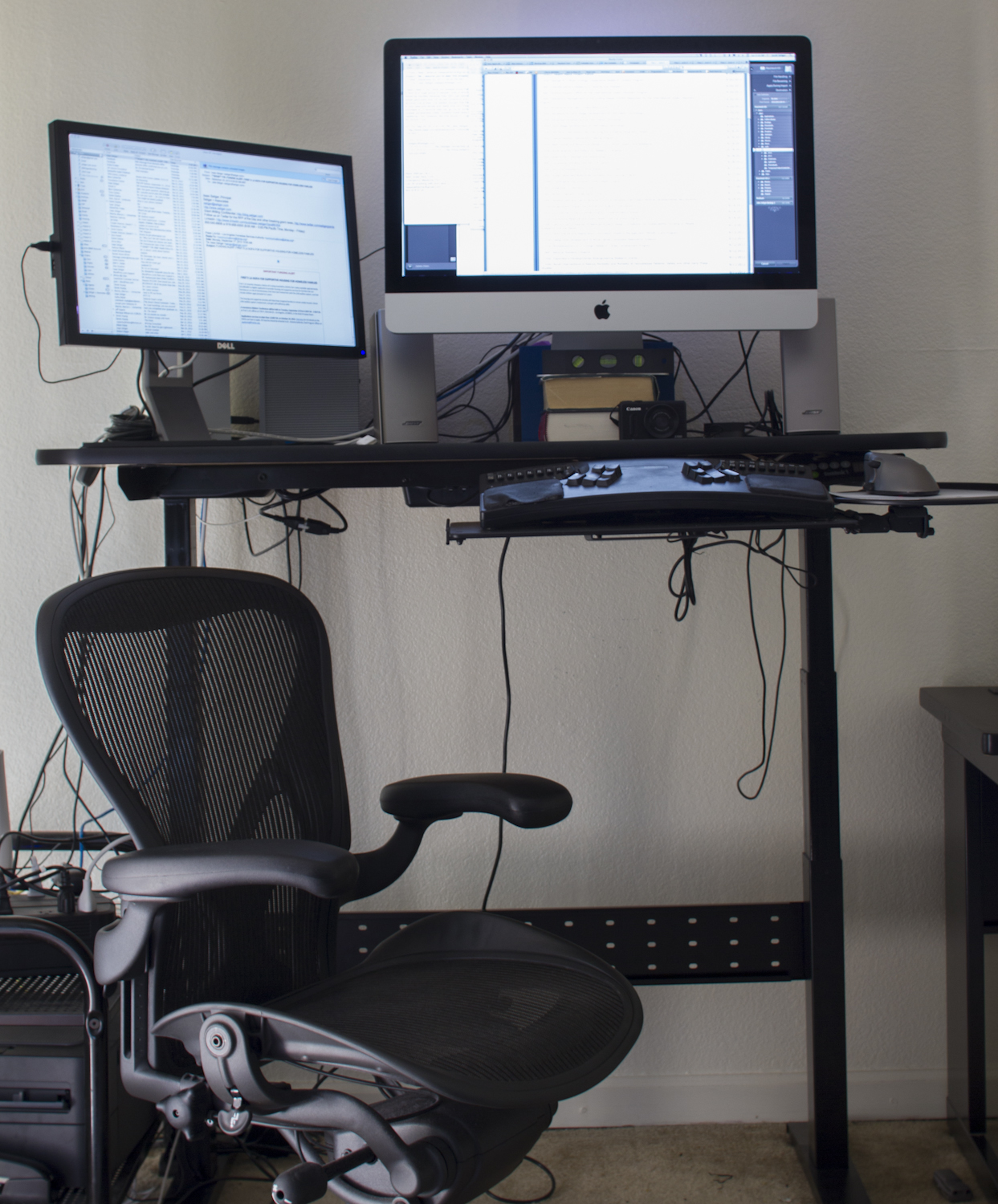
The single, most important thing about this GeekDesk review can be encapsulated in a single sentence: I’d never return, full-time and voluntarily, to a conventional desk. The rest is mere commentary. Detailed commentary, to be sure, but the important stuff should be up front.

I’m going to divide this review into two major sections: the first is about using the sit-stand desk, and the second is about installing it.

Usage

Geekdesk_and_iMac_2There is by now extensive evidence that sitting for long periods of time is terrible for both health and for concentration. The former has only recently hit the news; see this New York Times story or “The health hazards of sitting” from The Washington Post. Others may be easily found. Yet standing for long periods is also unlikely to be good for you, as anyone who has worked retail or restaurants already knows. Hence the sit-stand desk. Sites like Hacker News are rife with testimonials about standers. Let me add to the cacophony.

The latter issue—concentration—is less easily measured, but many of us who do brainwork at desks know the impossible-to-ignore feeling that we must stand and pace. A standing desk facilitates that kind of concentration.

For a long time I got a magical “wow” feeling when I tire of standing and watch the desk lower, or when I tire of sitting and watch the desk rise. Very few products of any sort offer that “Wow.” By now, however, having a sit-stand desk is mundane. We can acclimate to almost anything—and in one particular domain acclimation is called the “Coolidge Effect“— but, as mentioned earlier, I wouldn’t want to go back.

Like any sort of change there is a break-in period, and someone used to sitting for most of the day shouldn’t go to standing for most of it. Start with half an hour or an hour at a time. To the extent I have a method it’s simple: when I’m tired of standing I sit and vice-versa.

Geekdesk_and_iMac_3One other point: pretty much everyone I’ve seen who has tried a mat recommends getting a mat (see, for example, this thread for a wide array of testimonials). I haven’t seen anyone who tried a mat and didn’t like or recommend one. The good ones cost at least $60. Geekdesk now sells a mat, and I’m sure theirs is fine.

Otherwise, I don’t have much to report about usage—which is probably good; like any tool, a desk exists to support some other end. The memory feature on the GeekDesk Max works well. I haven’t thought about it in ages. The desk’s motor (or, more properly, motors: I believe it has one in each leg) is quiet and smooth. In the years I’ve had mine I’ve discerned no changes in the quality of the motor. I suppose it could die tomorrow, and the official warranty is only for two years, but GeekDesk seems like the kind of company that’ll either replace the desk if it dies the day after the warranty expires or cut you a deal on a new one. More on the quality of the company is below.

My desk also has a Humanscale keyboard tray attached. The Humanscale systems have become much more expensive since I bought mine, but I don’t know much about the alternatives. I do know that used versions are available on eBay and Craigslist. I also know that the keyboard trays will last for decades because my parents originally bought ones about twenty years ago. Most of the keyboard trays also offer 360 degree ranges of motions, which can be handy.

The motor—or more properly motors, because I believe there is one in each leg—is still quiet and smooth after about two years of use.

Cost

I like to imagine money spent on computer / desk setups to be allocated pretty damn well, considering how many hours a week I spend working at a computer. But people are funny about money: Dan Ariely describes some of the ways people mis-allocate money based on anchor points in Predictably Irrational.

Most people, if you press them, have some important indulgence they think “worth” spending money on. It might be shoes, lingerie, cars, boats, sports, travel, or hobbies, but it’s almost always there. The surprise at the expense of really good desks is, to my mind, an indication of priorities more than any comment on the absolute value or lack thereof in a workspace.

It’s almost impossible to say whether something like this is “worth it” to another person, but the usual points in favor a sit-stand desk are simple: many people spend 20 to 60 hours a week at a desk. On a cost-per-day basis, a good desk costs less than coffee or ramen. Put that way the upfront costs seem much smaller. It is interesting that many people are willing to pay four figures for minor car creature comforts but spend much less on desks or beds, which are often occupied for ten times as long as a car. Nonetheless anchoring effects are strong and perhaps they can’t be overcome.

I don’t know how long the motor on this desk will last. A conventional desk can probably endure for decades, and that’s obviously not true of a desk with moving parts. This desk comes with a two-year warranty. I’m guessing too that GeekDesk the company will either knock some cash off a new version or do something else nice if the desk dies the day after the warranty expires.

Installation

If you’re not accustomed to using power tools and building things on your own, pay the $95 or so to have your desk built for you. If I’d done this, I would’ve saved a lot of time and hassle. When I first bought the desk, I had no idea what I was doing and screwed up the screwing-in process by not having a drill-bit extender. Seems like an obvious point in retrospect, but at the time I messed up in the installation and ended up stripping a screw and installing others at an angle. In addition, although the screws Geekdesk sent were “self-starting,” they should still be installed with pilot holes.

desk_problems-7416I’m jumping ahead of myself, and I could tell the long and somewhat boring story about how this happened, but the short version is that I called GeekDesk not really sure about what I’d fucked up. GeekDesk’s customer service is insanely fabulous. About 80 – 85% of the problems were my own damn fault, and I should’ve been more careful when I assembled the desk, and I should’ve been more careful with the screws. But I wasn’t, and when I gave up and punted, Isaiah actually hired the installer at GeekDesk’s expense. I volunteered to pay, but they said they’d do it. Very few companies go this far.

The installer was a third-party company; perhaps not surprisingly, GeekDesk does not have a horde of desk installers across the nation. Unfortunately, the guy GeekDesk sent installed the screws at an angle just like I did, and in the process of screwing around (haha!) with them, managed to strip two heads, which then caused him to go to Home Depot for some more screws. This doesn’t inspire confidence in him, or in the self-starting screw system.

stripped_screw-7394In my case, I’ve seldom had any need to use power tools and am an amateur. But his entire profession involves putting things like desks together correctly. He was also ready to leave the mis-screwed screws, until I pointed out that the desk was still wobbling.

Anyway, for the Humanscale track I drilled small pilot holes, and now the desk doesn’t wobble, provided that it’s braced against a wall sufficient to absorb shock but not so much as to impede the motor. The desk doesn’t feel as solid as the Maxon Series 1000 desk it replaced, but I haven’t notice any monitor shake either.

(A side note: most reviews for newspapers or magazines appear after the writer has tried the product for a few days or weeks. I prefer to write them after a few months or years: that’s often how long it takes to really evaluate value.)

There are other, similar sit-stand desks, like the NextDesk Terra, but it’s $1,500 and I can’t discern any obvious improvements. It’s also wider, at 63 inches, than the GeekDesk. The Wirecutter‘s reviewers like it better; still, I’d rather save the money and use the Geekdesk.


Here is an earlier post on GeekDesk; note the datestamp.