Links: Shame storms (be shameless), Agatha Christie, paganism?, Houellebecq, and more!

* “Shame Storm;” I’m surprised so many people want to enroll in the “impeccably correct [liberal] opinions” faction.

* What’s going on with protein folding? Why is Google kicking the academic folding community’s ass? Have I wasted a lot of cycles supporting folding@home? I’ve thought about writing a long, reported nonfiction piece about what’s really going on, and what’s really gone on, with folding@home, a very interesting project that doesn’t get the press it once did, but I have no venue for it.

* The Case Against Agatha Christie, an excellent piece.

* Why are construction costs rising?

* The return of Paganism? Better than the title implies.

* “The internet war on sex is here.” Sort of. We all choose. Many of us choose, and then repudiate our choice, and then we choose again the next day, but the repudiation phase occupies more time.

* “World’s first fully electric bus fleet quietens Chinese megacity.” It is worth asking why almost all American cities are behind on this metric.

* Michel Houellebecq, contrarian: “Donald Trump is a Good President.”

* American Entrepreneurs Who Flocked to China Are Heading Home, Disillusioned.

* The Planet Has Seen Sudden Warming Before. It Wiped Out Almost Everything. The book The Ends of the World is highly recommended on this topic.

* Chinese billionaire Jack Ma correctly observes that the US wasted trillions on warfare instead of investing in infrastructure.

* “Academics Should Not Be Activists,” seems obvious and yet here we are.

* Europe Is Dying?

* American is experiencing a crisis of meaning? Not for people working at Tesla or SpaceX!

* “I Have Seen the Future of a Republican Party That Is No Longer Insane.”

* Nashville’s Star Rises as Midsize Cities Break Into Winners and Losers.

* In defense of hate. Agreed. But we need more intelligent hate, as opposed to the kind on Twitter.

Links: The academic-industrial complex, Victorian millennials, the scooter race, the good life, and more!

* “Censorious millennials are the new Victorians.” Interesting throughout and my favorite of this batch.

* “Lime and Bird are each worth 10B+.” Even though I’m intellectually aware of the fact that politics is rarely about policy and often about identity, virtue-signaling, etc., it’s striking to me that superficially “progressive” cities are busy attacking a small, lightweight, and simple technology that can make differences at the margins regarding global warming.

* “The U.S. Appetite for Sugar Has Skyrocketed: Americans are eating too much of the sweet stuff, and a staggering portion of it is coming from drinks like soda.” If you are wondering why everyone in the U.S. is fat, this is why.

* Why many people are less-than-thrilled with the police.

* Funny, charming interview with Quinn Lewis, daughter of Michael Lewis.

* Brexit: A Test for Humanity. We are failing.

* Nightclubs are hell. What’s cool or fun about a thumping, sweaty dungeon full of posing idiots?

* “The Housing Boom Is Already Gigantic. How Long Can It Last?” It may already be over, as interest rates are going up.

* “The Pension Hole for U.S. Cities and States Is the Size of Germany’s Economy.” The Feds ought to mandate defined-benefit plans for all levels of government, to prevent precisely this problem.

* The State of the Publishing Union.

* “Macron Just Doesn’t Get It: He and others on the left are being swept along by world-historical forces they do not fully understand.” The most interesting book on this subject is The Revolt of The Public and the Crisis of Authority in the New Millennium. Highly recommended and better than many of the fragmented, surface-level news stories you’ll read.

* The Feminist Life Script Has Made Many Women Miserable? I would prefer avoiding one-size-fits all structures for billions of individual persons, but it is striking how rarely one sees this perspective.

* “I had pushed for a college education, believing that with it came job security and the freedom to pursue my writing without the burden of poverty.” Another person lied to by the academic industrial complex. The problem is, the world is awash in “writing.” Just “writing” is not a lucrative field. There is a lot of this: “applied to art grants and startup-accelerator programs, and even joined an innovative female-owned co-working space, Splash Coworking” and “I had to host a 12-hour poetry reading to raise money on GoFundMe,” but there is a distinct shortage of “I took an operating system course, which finally taught me how to master pointers and prevent memory leaks.”

Books versus the Internet

A friend and I were talking about how read fewer books and spend more time online than we used to—a conversation that I’m sure is common among readers of this blog. Before the Internet got good (or bad, depending on your perspective), if you wanted to read something, your only choice was the book or magazine or whatever in front of you. I used to read a lot of not-very-good books because I happened to have them lying around.

Now I don’t do that and I’m much more likely to give up on a book. That just happened to me: I read about 100 pages of Herman Hesse’s The Glass Bead Game and gave up. Ponderous, pointless-seeming, and why bother with it when Twitter is right there? Or, better, yet, Instapaper in conjunction with a Kindle?

There’s some bad in this—I probably don’t finish some books that would turn out to be great—but some good in it, too. People are probably not reading some of the great books they ought to read. But we’re also probably not reading some of the crap that we’d otherwise read because we have it at hand.

To me, now, the biggest problem is finding books worth reading. And some of those appear via Twitter. Others appear in my mailbox, from writers or publishers. Some of them I forget to recommend in turn (I have a half-finished essay on Golden Hill sitting on my computer). The hard part for me is now searching, sorting, and discovering. That ought to give me a stronger impetus to write and finish more of the books that I’d like to read. I think of some books I like and admire (Joe College, Self-Made Man, Perfect Rigor, Love Me Back) that I bought after a single exposure and am so glad I did. How many good books are out there, but I haven’t had that single exposure to them?

Links: Friendship, dual brains, literature as pain, fusion news, unintended consequences, and more!

* “The Friendship That Made Google Huge,” an extremely charming and positive story.

* “China ‘Is the Only One in the Race’ to Make Electric Buses, Taxis and Trucks.” Perhaps we ought to be thinking less about culture war things and more about who is building the future.

* “Should Studying Literature Be Fun? ‘No’ is too often the answer, as scholars signal their ‘professionalism.'” And people wonder why the number of humanities majors keeps dropping. It’s strange how “fun” has become a suspect value on campus. This article is a long argument against grad school in the humanities.

* Achieving an 80x increase in plasma lifespan (and what it means for fusion energy).

* “Maximizing Your Slut Impact: An Overly Analytical Guide to Camgirling.” It’s extremely detailed and I learned of it via Alex Tabarrok’s Cam Girl Economics. The psychological readings are impressive. I can’t fathom why men would choose to watch “Cam Girls.”

* “Wall Street Rule for the #MeToo Era: Avoid Women at All Cost.” It’s like no one imagined unintended consequences, or understands that incentives affect behavior. Plus, anyone involved in this issue should read Skin in the Game by Taleb—there are a lot of people, especially online, who have no skin in the game while criticizing those who do. More people thinking about this issue should also read my own essay, “Ninety-five percent of people are fine, but it’s that last five percent.” Tail risks are real!

* “Tumblr will ban all adult content on December 17th.” The end of Tumblr, it would seem.

* “In LA, land dedicated to parking is larger than Manhattan. A new study asks, “What if that space was used for housing instead?” We are all paying The High Cost of Free Parking. We just don’t realize it.

* How electric bikes make cities safer.

* Heads up: “Civilisation will collapse if humanity doesn’t take action on global warming.”

* “Are Academics Cowards? The Grip of Grievance Studies and the Sunk Costs of Academic Pursuit.” The short answer is “yes.” Tenure is also supposed to make academics free to speak and free from coercion, yet many seem not to be very interested in free speech.

* Greenhouse Gas Emissions Rise Like a ‘Speeding Freight Train’ in 2018. See previous entry on “civilisation.”

* “Taiwan Can Win a War With China?” “Win” is not my favorite word here, as it’s not apparent that anyone, anywhere, would win such a war, but that doesn’t mean it won’t happen, as World War I teaches us.

* “Why Doesn’t America Love the Novella?” I thought ebooks would help this situation. I favor a story being as long as it should be and no longer. That is sometimes very long (Lord of the Rings is too short, I feel, and Cryptonomicon is just right), but there are many novels that make me think, “This would be much better if it were 1/4 or 1/2 shorter.”

Links: The state of science, learning relationship skills, attention, Lululemon, and more!

* Scott Alexander asks, “Is science slowing down?

* “The First Lesson of Marriage 101: There Are No Soul Mates.” Improve yourself, first.

* Attention and Memory in the Age of the Disciplinary Spectacle.

* We are heading for a New Cretaceous, not for a new normal. This is important.

* GenZe electric bike review; looks like a good value.

* Is literary glory worth chasing? Probably not, but most people who achieve it are probably not chasing it—or are only chasing it indirectly.

* “Lululemon’s Founder Is an Unlikely Guru. That Might Be Why He’s a Billionaire. Chip Wilson has some odd ideas: Some made him rich, some got him fired.” Is anyone else reminded of Peter Thiel’s Zero to One? Startup founders, like artists, are often different not just in one domain but in many. If they were normal, they wouldn’t be doing what they’re doing. And this is one of the problems in modern universities, as addressed by Haidt and Lukianoff in The Coddling of the American Mind: universities are increasingly against anyone, anywhere, being weird or different, and they will punish weirdness and difference in speech.

* ‘Talent Wants Transit’: Companies Near Transportation Gaining the Upper Hand.

* Meet Alexa: inside the mind of an Instagram person. Sounds depressing.

* Academia’s Case of Stockholm Syndrome.

* Do we need to hide who we are to speak freely in the era of identity politics?

* The Prophet of Envy: a good review of the many Rene Girard books.

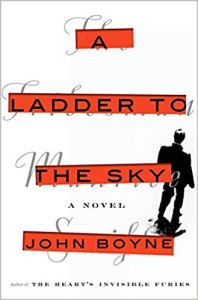
A Ladder to the Sky — John Boyle

A Ladder to the Sky is a surprise, and has many mini-surprises in it: I kept almost putting it down, thinking that writers writing about writing has been done too many times. Every time I started to think the novel basic, it confounded me. If you have the “Seen it already” impulse, push through the next 30 pages, as you may be surprised, as I was.

I don’t want to spoil those surprises; if the regular writerly bildungsroman is about books progressively emerging, this one is about the ambition monster getting progressively bigger, like a dragon, until it eats its owner. Or does the owner thrive at the end? I can’t say more here.

The third section is narrated by Maurice’s wife; she’s a writer, too (one possible reading of this novel: writers should spend less time with each other), and has just taken a gig at the University of East Anglia teaching creative writing. She has a Polish student who “just seems to hate everyone, me included. I don’t know why.” Hate is an underrated fuel for art and for achievement more generally. We ought to give it greater respect and pride of place. In today’s twee, overly genteel literary environment that seems impossible, which is part of the reason it’s nice to encounter hate as a motivator in this novel.

“I want to be a success,” the early Maurice Swift says, but it’s an oddly empty formulation, like “I want to be an entrepreneur.” A success—but at what? Measured by who? How? It’s an aspiration too vague to be useful, and maybe even counterproductive: don’t focus on success, focus on what you need to do, today, to achieve it.

Maurice doesn’t, and if he did, there wouldn’t be a novel. Instead, he goes through increasingly gross gyrations to be a “success.”

“A ladder to the sky” is, of course, a ladder to nowhere—which may be what this book is about. It reminds me, in some odd ways, of Clancy Martin’s How to Sell. To sell, first believe the lie. Maurice seems to believe the lie.

There is a lot of “And are you working on anything at the moment, Maurice?” talk. It works, yes, but how about a novel about plumbers? The literary status-jockeying does begin to tire, like a long day of riding horses in a circle. By some point, isn’t it nice to do something else or go somewhere else? It’s tempting to call for a five-year ban of writer-narrators in fiction.

Many of the naive statements are deliberate—they are the statements of naive people, or a naive person—but there are a whole lot of them. Getting A Ladder to the Sky requires at least two readings, though, and that’s one mark of a good book.

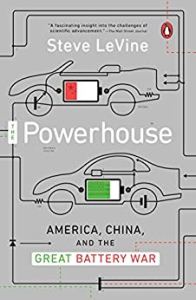
Steve Levine’s “The Powerhouse” and the Chevy Volt

The Powerhouse: America, China, and the Great Battery War describes how we got to today’s electric cars, and it does so by following the vicissitudes of Argonne National Labs, which played a key role in battery development, as well as many of the scientists and players who help develop batteries. Much of the narrative structure comes from GM’s quest to build the Chevy Volt, a car that is amazing and widely underappreciated, because the conditions and assumptions that led to its development have changed.

In the late ’00s and early ’10s, almost no one foresaw the rise of fracking, which has put a lid on oil prices. If fracking hadn’t come along when it did, oil would probably be between $100 and $200 a barrel today, and GM wouldn’t be able to build enough Volts. GM’s management would look like geniuses. Instead, as has been widely reported, GM is closing a bunch of plants, likely including the one that makes Volts. People are short-sighted and, when gas prices fall, we buy bigger cars.

The Volt is neither as cheap as a conventional internal combustion engine (ICE) car nor as interesting as an electric. It appears that most people want a pure electric or a conventional ICE car, and hybrids like the Volt are stuck in between. Most people don’t give a damn about climate change or Saudi and Russian repression, at least as measured by their behaviors when it comes to buying cars (You might argue that this is bad—I would—but, at least in terms of mass behavior, it’s true). Today, articles like, “Why Oil Prices Took Such a Tumble, and What Comes Next” are common:

It was only at the start of October that analysts were wondering if oil would soon cost $100 a barrel. Then a trap door opened and oil prices have been in a rapid descent since, losing nearly a third of their value in about eight weeks.

The spread of electric vehicles is also going to cap oil price rises. As prices rise, more people will shift towards electrics. But people who rag on the Volt don’t understand why it was green-lit in the first place, and they should read The Powerhouse. Aside from being an account of the Volt, The Powerhouse is about the way science and engineering actually get done. Those fields are rarely about single individuals and often about groups, companies, universities, and the interactions among the individuals that compose the larger structures. To be sure, individuals are important (John Goodenough is a battery hero, and there are many others named in the book), but we rarely succeed alone.

The Powerhouse has flaws, as a book. Its timeline jumps around, from chapter to chapter, at times. Most of its chapters are 800 – 2,000 words, a sign that many originated as blog posts or news stories, and their integration isn’t ideal. Levine is a working journalist and so may have had less time than he would have liked to complete the book. The acknowledgements page starts, “When I began to consider a book on batteries, the reception from friends and advisers was all but unanimous: don’t do it.” I’m glad he wrote the book and will recommend it, despite its firm place in a particular time and its structural challenges. Levine created a coherent story out of many disparate pieces, and that alone is admirable.

Links: Philanthropy popups, scientific credit, nuclear fusion, free speech, free being, and more!

* TALENT SEARCH: Tyler Cowen on the value of sole proprietor pop-up philanthropic shops.

* The Problem with Scientific Credit.

* On Paying for the Party, another work critical of academia.

* “The Rise of the Resentniks: And the populist war on excellence.”

* Science is Getting Less Bang for Its Buck.

* The Fading Battlefields of World War I.

* Inside Bill Browder’s War Against Putin ought to be made into a movie.

* Successful second round of nuclear fusion experiments with Wendelstein 7-X.

* “The new boomtowns: Why more people are relocating to ‘secondary’ cities.” Exclusionary zoning along the coasts has spillover effects, in other words.

* Eric Schmidt on the Life-Changing Magic of Systematizing, Scaling, and Saying Thanks.

* Rebecca Kulka has had an impressive, insane, and amazing life. This interview is incredible. I didn’t think I’d care for it and I was wrong.

* Why Is the Fight for Free Speech Led by the Psychologists? This seems plausible to me. English literature was lost to darkness long ago, which I wish I’d realized before I went to grad school in it. See also me on The Coddling of the American Mind.

* “Making what Harvard is about transparent.” Money, prestige, exclusivity; it is another brand.

* “Make School gains accreditation for 2-year applied computer science bachelor’s degree.” This is a bigger deal than it at first looks: accreditation bodies are among the major barriers that stop comprehensive higher education reform. And accreditors are an underappreciated barrier by anyone unfamiliar with the deeper, institutional and structural forces that keep college tuition high.

The Coddling of the American Mind — Jonathan Haidt and Greg Lukianoff

Apart from its intellectual content and institutional structure descriptions, The Coddling of the American Mind makes being a contemporary college student in some schools sound like a terrible experience:

Life in a call-out culture requires constant vigilance, fear, and self-censorship. Many in the audience may feel sympathy for the person being shamed but are afraid to speak up, yielding the false impression that the audience is unanimous in its condemnation.

Who would want to live this way? It sounds exhausting and tedious. If we’ve built exhausting and tedious ways to live into the college experience, perhaps we ought to stop doing that. I also find it strange that, in virtually every generation, free speech and free thought have to be re-litigated. The rationale behind opposing free speech and thought changes, but the opposition remains.

Coddling is congruent with this conversation between Claire Lehmann and Tyler Cowen, where Lehmann describes Australian universities:

COWEN: With respect to political correctness, how is it that Australian universities are different?

LEHMANN: I think the fact that they’re public makes a big difference because students are not paying vast sums to go to university in the first place, so students have less power.

If you’re a student, and you make a complaint against a professor in an Australian university, the university’s just going to shrug its shoulders, and you’ll be sort of walked out of the room. Students have much less power to make complaints and have their grievances heard. That’s one factor.

Another factor is, we don’t have this hothouse environment where students go and live on campus and have their social life collapsed into their university life.

Most students in Australia live at home with their parents or move into a share house and then travel to university, but they don’t live on campus. So there isn’t this compression where your entire life is the campus environment. That’s another factor.

Overall, I suspect the American university environment as a total institution where students live, study, and play might be a better one in some essential ways: it may foster more entrepreneurship, due to students being physically proximate to one another. American universities have a much greater history of alumni involvement (and donations), donations likely being tied into the sense of affinity with the university generated by living on campus.

But Haidt and Lukianoff are pointing to some of the potential costs: when everything happens on campus, no one gets a break from “call-out culture” or accusations of being “offensive.” I think I would laugh at this sort of thing if I were an undergrad today, or choose bigger schools (the authors use an example from Smith College) that are more normal and less homogenous and neurotic. Bigger schools have more diverse student bodies and fewer students with the time and energy to relentlessly surveil one another. The authors describe how “Reports from around the country are remarkably similar; students at many colleges today are walking on eggshells, afraid of saying the wrong thing, liking the wrong post, or coming to the defense of someone who they know to be innocent, out of fear they themselves will be called out by a mob on social media.”

Professors, especially in humanities departments, seem to be helping to create this atmosphere by embracing “micro aggressions,” “intersectionality,” and similar doctrines of fragility. Perhaps professors ought to stop doing that, too. I wonder too if or when students will stop wanting to attend schools like Smith, where the “Us vs them” worldview prevails.

School itself may be becoming more boring: “Many professors say they now teach and speak more cautiously, because one slip or simple misunderstanding could lead to vilification and even threats from any number of sources.” And, in an age of ubiquitous cameras, it’s easy to take something out of context. Matthew Reed, who has long maintained a blog called “Dean Dad,” has written about how he would adopt certain political perspectives in class (Marxist, fascist, authoritarian, libertarian, etc.) in an attempt to get students to understand what some of those ideologies entail and what their advocates might say. So he’d say things he doesn’t believe in order to get students to think. But that strategy is prone to the camera-and-splice practice. It’s a tension I feel, too: in class I often raise ideas or reading to encourage thinking or offer pushback against apparent groupthink. Universities are supposed to exist to help students (and people more generally) think independently; while courtesy is important, at what point does “caution” become tedium, or censorship?

Schools encourage fragility in other ways:

“Always trust your feelings,” said Misoponos, and that dictum hay sound wise and familiar. You’ve heard versions of it from a variety of sappy novels and pop psychology gurus. But the second Great Untruth—the Untruth of Emotional Reasoning—is a direct contradiction of much ancient wisdom. [. . .] Sages in many societies have converged on the insight that feelings are always compelling, but not always reliable.

More important than ancient sages, modern psychologists and behavioral economists have found and argued the same. Feelings of fear, uncertainty, and doubt are strangely encouraged: “Administrators often acted in ways that gave the impression that students were in constant danger and in need of protection from a variety of risks and discomforts.” How odd: 18- and 19-year-olds in the military face risks and discomforts like, you know, being shot. Maybe the issue is that our society has too little risk, or risk that is invisible (this is your occasional reminder that about 30,000 people die in car crashes every year, and hundreds of thousands more are mangled, yet we do little to alleviate the car-centric world).

Umberto Eco says, “Art is an escape from personal emotion, as both Joyce and Eliot had taught me.” Yet we often treat personal emotion as the final arbiter and decider of things. “Personal emotion” is very close the word “feelings.” We should be wary of trusting those feelings; art enables to escape from our own feelings into someone else’s conception of the world, if we allow it to. The study of art in many universities seemingly discourages this. Perhaps we ought to read more Eco.

I wonder if Coddling is going to end up being one of those important books no one reads.

It is also interesting to read Coddling in close proximity to Michael Pollan’s How to Change Your Mind: What the New Science of Psychedelics Teaches Us About Consciousness, Dying, Addiction, Depression, and Transcendence. Perhaps we need less iPhone and more magic mushrooms. I’d actually like to hear a conversation among Pollan, Haidt, and Lukianoff. The other day I was telling a friend about How to Change Your Mind, and he said that not only had he tried psychedelics in high school, but his experience cured or alleviated his stutter and helped him find his way in the world. The plural of anecdote is not data, but it’s hard to imagine safety culture approving of psychedelic experiences (despite their safety, which Pollan describes in detail).

In The Lord of the Rings when Aragorn and his companions believe that Gandalf has perished in Moria; Gimli says that “Gandalf chose to come himself, and he was the first to be lost… his foresight failed him.” Aragorn replies, “The counsel of Gandalf was not founded on foreknowledge of safety, for himself or for others.” And neither is life: it is not founded on foreknowledge of safety. Adventure is necessary to become a whole person. Yet childhood and even universities are today increasingly obsessed with safety, to the detriment of the development of children and students. In my experience, military veterans returning to college are among the most intersting and diligent students. We seem to have forgotten Gandalf’s lessons. One advantage in reading old books may be some of the forgotten cultural assumptions beneath them; in The Lord of the Rings risk is necessary for reward, and the quality of a life is not dependent on the elimination of challenge.

Here’s a good critical review.
Links: Cars and death, why the rent is too damn high, doctors as debt collectors, and more!

* “Murder Machines: Why Cars Will Kill 30,000 Americans This Year.” An evergreen article. Imagine 30,000 people were killed by terrorism in the United States.

* Single-Family Home Zoning vs. ‘Generation Priced Out.’ Useful for anyone who thinks their rent is too damn high (like I do).

* “Doctors Are Fed Up With Being Turned Into Debt Collectors.” Maybe we ought to go back to a world of transparent pricing, paid in advance?

* “Chicago Expelled a Male Student 4 Days Before Graduation Because His Ex Made a Dubious Sexual Violence Claim.” More of the usual, in other words. And universities wonder why they have a PR problem!

* “Eric Schmidt on the Life-Changing Magic of Systematizing, Scaling, and Saying Thanks,” a conversation with Tyler Cowen.

* “Oil Demand for Cars Is Already Falling: Electric vehicles are displacing hundreds of thousands of barrels a day, exceeding expectations.” We get too little good news; here is some.

* “The Creation of Deviance,” note: “The activities of university administrators may also fit a larger pattern, one in which agents of social control readily create the need for their own services.”

* It is becoming more plausible to remove CO2 from air.

* The myth of stagnant incomes.

* Demand for humanities majors is low in the job market, although that is not the actual title of this essay, and you probably already know it, but I will pass it along anyway. In addition, “Telling a Lame Joke in an Elevator Can Endanger an Academic Career.” The obvious point: don’t go to grad school in the humanities.

* “The Disaster That Was the Vietnam War.” A war with few if any truly good guys.

* Robert Langlands, The Greatest Mathematician You’ve Never Heard Of. Unless, of course, you’ve read Love and Math: The Heart of Hidden Reality, as I recommend!

* Tyler Cowen’s Stubborn Attachments—A Review.