Thoughts on the movie Objectified

I watched the documentary Objectified last night and would recommend the first 30 or so minutes via Netflix streaming, if you have a Netflix account. If not, check out the Jonathan Ives portion on YouTube, which feels like an ad but still has content. The movie gets slower as it goes on and the real content is in the first half hour. Some other thoughts:

1) A lot of these designers (or the filmmakers) are really, disproportionately interested in chairs. As far as I can tell, outside of office chairs made by Herman Miller, Steelcase, Humanscale, and a couple of others, not much has really happened to chairs in the last couple decades. Most of the chairs shown in the film looked uncomfortable, especially the ones by the guys in Paris.

EDIT May 2012: Apparently I’m not the only one to have noticed the designer fascination with chairs: see also “Against Chairs.” Note that I’ve switched to a Herman Miller Embody, which I like less than the Aeron and may sell.

2) Speaking of the guys in Paris, they were really annoying. I’m not sure why.

3) The movie got slower as it went on.

4) Some comments made me think of Paul Graham’s essay Stuff, which begins: “I have too much stuff. Most people in America do.” I think he’s right. I don’t want more stuff. I want the right stuff. Too much of the movie focused on “more” rather than “right.” I don’t want to be a consumer.

5) Someone asked something very close to, “do you rule your stuff, or does your stuff rule you?” In the movie, it seemed like only designers were really capable of ruling their stuff. Graham: “once you’ve accumulated a certain amount of stuff, it starts to own you rather than the other way around.”

6) The bit about peelers at the very beginning was fascinating, especially because of the prototypes and CAD drawings.

7) The movie should have focused more on technology.

8) There was a guy who said he was depressed as a teenager, so he looked at his alarm clock, which made him feel better somehow and presumably acted like Paxil. I was depressed as a teenager too, which was alleviated somewhat by losing my virginity.

9) See number four again. I’ll quote Graham more: “the people whose job is to sell you stuff are really, really good at it.” Is this movie’s goal to sell me stuff, or make me want to buy, or to really explain the stuff in my life? The makers would no doubt argue the latter, but I think the former might be the actual outcome.

On writing young-adult fiction

On writing young-adult fiction, much of which is euphemistic and fascinating:

It’s hard to find the same reader gratification as a writer of literary fiction. You have to be thankful to get reviewed at all, even if they pan you. And literary fiction readers are tough. We’ve both had some really appreciative fans, and when they tell us nice things, we want to make out with them. But readers of literary fiction are also very excited to judge you. Like the woman who turned to Katie at a reading and said: “Your writing is really coming along! Your voice is not really developed yet, but keep at it!”

This is another way of saying that readers of literary fiction have a strong sense of history and have spent a lot of time both reading and considering what good writing is. If your reader is someone who’s read thousands of books ranging from, say, The Iliad to Cryptonomicon, you’re going to have a fundamentally different experience than someone whose reading ranges from a handful of young adult novels to today’s Facebook messages. The authors write that they like teenagers because “No one’s forced them to sit through college lit courses yet, so they’re still fresh and unjaded.” That might be another way of saying, “They have no taste.”

By the way, this isn’t a post designed to slander books that have been marketed as “young adult.” The marketing of a book isn’t an indicate of its quality. Novels like Philip Pullman’s His Dark Materials Trilogy, which is marketed as young adult, or Carlos Ruiz Zafón’s The Shadow of the Wind, which isn’t but deals with teenagers, retain their power regardless of their labels. A lot of throwaway young adult novels won’t.

This is also not to deny that self-consciously literary people can be patronizing, stupid, dense, or various other things. They can also miss the point of novels that offer something new but don’t conform to the pieties of literary fiction. But I still get the impression that the problem is more often that a lot of people writing young adult fiction are happy to write young adult because you don’t have the same standards for quality and insight that you would writing for those persnickety adult literary readers. For writers, I think the real question is how well you’re going to write regardless of your target audience: having fidelity to the craft means writing well, or as well as you can, even when no one is looking.

Brady Udall Interview for The Lonely Polygamist: Part I

Brady Udall’s The Lonely Polygamist, follows a suite of characters orbiting around Golden Richards, a polygamist with four wives and more than two dozen children who is trying to keep his construction business afloat and manage a family that practically requires an MBA due to its size. The novel shies away from overt religious discussion and towards the day-to-day comic combat necessary to merely the family together and functional.

This interview was conducted in May 2010 at Changing Hands bookstore in Tempe, Arizona. Although this is an incredibly lame comment, it’s nonetheless true that I simply forgot to post it when other issues arose. It’s here now, however. As we got started, Udall mentioned Daughter of the Saints: Growing Up in Polygamy by Dorothy Allred Solomon.

Udall reminded me of someone slightly too small and far too wary to make it on a high school football team. He spoke with a paradoxical mix of certainty and exploration. The first half of the interview is below.

Jake Seliger: I was listening to Bookworm on the way up here. It’s a radio show on KCRW, and Michael Silverblatt was talking to Michael Cunningham, and Silverblatt said Cunningham’s book was really about the primal relationship between fathers and sons. I heard that and thought to myself, “That’s a lot of what’s going on in The Lonely Polygamist as well,” except I was too dense to notice it the first time through.

Brady Udall: There’s a lot of distractions. Right? There’s no doubt that one of the things I was interested is that Golden, the main character, is an only child abandoned by his father. And then, he manages to have 28 children of his own.

JS: Almost overcompensating.

BU: Yes, yes. But is no better a father because of it. And I think that’s where I’m interested. Numbers have nothing to do with it, really. It’s just there’s something in men—and this is a gross generalization, but we have difficulty taking care of our obligations, emotionally. That’s part of what the book is about: Golden’s not up to taking care of his obligations emotionally.

JS: He seems unable to deal with his emotions in relation to Royal [Golden’s father]. It seems that there’s this Royal-Golden-Rusty [Golden’s son]—I don’t want to call the eternal golden braid, but—

BU: Yeah, you look at the names and there’s something going on. There’s definitely something there, and somewhere in the book I talk about the curse of the father. And we all live with that in some way or another.

JS: Sometimes the absent father, too.

BU: Yeah. So that’s definitely part of what I was doing.

JS: You mentioned that it’s not an issue of numbers, but it seems like there’s something going on—when you scale a family from, say, a two-person couple, to four children, to twenty-eight children, it seems like something has to change there. There’s a passage about that I wrote down somewhere—I can’t find it right now—

BU: Well, I don’t know what it says, but it might be the passage that says something about, when you have 28 children, and you’re a father, you have to try to treat them all equally. Which is nearly impossible. Because he’s not up to the task—if you pat one kid on the head, then everybody’s going to have to have a pat on the head—at some point you can’t balance—

JS: It’s a matter of time.

BU: Yes. He’s just not up to the challenge. He doesn’t know how to manage this. Could he have managed it with three or four children? Maybe, I don’t know.

JS: It’s funny that you use the word “manage,” because it seems like at this scale you almost need to have a managerial mindset.

BU: You have to be a logistical genius of some kind.

JS: And it’s strange, because there’s section on page 21—early in the novel, and Golden says that “whenever he walked into one of his houses he felt more than ever like a stranger, an outlander unfamiliar with the customs of the place.” It seems like you almost have to be unfamiliar with the customs of a place if you’re doing this rotation.

BU: The thing I’d say about that, those houses aren’t his. The family is a stranger. The wives are controlling the houses. He’s just an intruder in some ways. And it makes some sense because at the center of everything, yet he’s on the outside of it all. Which I think is cool.

JS: It’s interesting too that you use that kind of language—the center of everything but outside of it all—because to my mind I almost hear an aspect of the religious part of the novel, because religion seems to influence everything that’s going on, and yet it doesn’t seem as constant a presence. So it’s like the center that’s also outside. I don’t know if you agree or not, but that’s what I was hearing.

BU: Religion dominates these people’s lives, but I try to avoid it as much as possible.

JS: Which you succeeded at.

BU: I tried to, so if I include that I’m going to have to write a book that’s 2,000 pages long.

JS: You said in another interview that this one started out at 1,400—

BU: Fourteen, and I did address some of the religious or spiritual stuff. But really what I’m interested in is really—and I’ve said it before—how, how do you do it? How does somebody manage this? And there’s enough there to easily fill 1,400 pages. Some of the more esoteric stuff got left out.

JS: I think when I was coming in, I expected religion to be more front and center, and more important than interpersonal politics. Maybe it’s unfair. I don’t know if my perception is off—I might be unfairly stereotyping a lot of these people.

BU: If you think about it, even for religious people, who would take their religion very seriously, the religion disappears in some ways. It’s just their life. And so when you write fiction, that’s what you tend to focus on—the details of everyday life. How people live, how people interact, is what I think as a fiction writer you really have to think about. That’s going to make interesting fiction. Ideas . . .

JS: Have to be embodied in the events—

BU: Right, right. You can’t—they talk about a novel of ideas. I don’t think there’s ever been a successful novel of ideas, to be honest with you. There’s no such thing. People make the attempt. I’ve always felt, if you’re going write about ideas, write an essay.

JS: Pick a different genre?

BU: Exactly.

JS: That’s funny, because I wrote this paper for one of my grad seminars on Melville’s Pierre, which—I don’t know what to call it besides being about ideas—

BU: I’ve never read it, so I don’t know.

JS: Because no one has read Melville after Moby-Dick, because he seems to—my academic adviser is a guy named Ed Dryden. He’s written a lot about Melville and argues that Melville wants to break with fiction after Moby-Dick.

BU: That’s interesting. I’ve never heard that. That’s why people don’t read Melville after Moby-Dick.

JS: Well, that’s how you get Pierre and Israel Potter and The Confidence Man, which are novels that as far as I can tell no one but academics read.

BU: I’ve read The Confidence Man, I can tell you that. I have virtually no memory of it.

JS: Maybe that says something if you have virtually no memory of it.

BU: Yeah.

JS: As far as religion goes, there’s also a book by a critic named J. Hillis Miller called The Disappearance of God. He argues that in the Nineteenth Century God basically goes from being an active presence in people’s lives in fiction to being an absent center.

BU: And it’s continued to this day. Not to ask you this question, but—

JS: Why not?

BU: Can you name any contemporary fiction writers who address God in the lives of people? It’s very rare.

JS: I wonder if they’re out there, but they’re being published by religious presses that I don’t read.

BU: It could be, but Flannery O’Connor was writing about this in a certain way.

JS: Or a lot of Catholic writers, like Evelyn Waugh or Graham Greene.

BU: Jewish writers don’t tend to write a lot about God. And it’s weird because America’s such a religious place. We’re not Europe. We’re very religious, yet if you read fiction of the past 50, 70 years, you’d never have any idea we’re a religious place.

JS: Yeah, or at least mainstream fiction. A lot of the Jewish writers are dealing with Judaism and Jewish culture more.

BU: Right. They’re not dealing with God. And it’s because it’s difficult, that’s really why. Most writers—I feel the same way—don’t feel like they have the authority to deal with such a large subject. But it’s still disturbing to see the lack of people—religious people—in fiction. And very often they’re the villain. And I’m not religious, so I’m not defending this in any way. I’m not a religious person.

JS: It’s like Michael Chabon’s book, The Yiddish Policemen’s Union. I don’t know if you’ve read it.

BU: Of course I’ve read it.

JS: The black hats, the Orthodox, are the villains.

BU: And he gets in trouble. Among Jews, he gets in trouble for his depiction.

JS: A little bit. But I don’t think he does like Philip Roth did—

BU: But people still get upset. I think one of the reason writers aren’t address it—if they don’t come from a religious background—I know this from experience—people get upset. If you’re going to depict the religion and religious people of that culture, they want you to depict it in a positive light. And if you don’t, they see it as betrayal.

JS: But it seems like people, oftentimes, whether they’re religious or not, reading about people in a positive light is boring. You want to read about foibles—

BU: That’s absolutely right. Life—fiction is about trouble. It’s about nastiness. It’s not about nice things. It never is.

JS: We have plenty of nastiness here—especially with Golden’s boss. Also with Rusty to some extent. Because he’s—

BU: He’s a little jerk. He’s not a kind—you know, there are idealized children in fiction. They’re education, they’re overly smart, they read in their spare time, I don’t know what. And you know, you don’t see that in real kids. A lot of them are little brats, like Rusty.

[Food shows up.]

Rusty’s a tough one.

JS: At the same time, he’s somewhat justified, and some of his behaviors are understandable. I mean, there’s the scene with his birthday party. And because there’s all these birthday parties—they get back to this individual / privacy issue. At that moment June says about Rusty, “I know he’s going to end up like me. No family, lost, wondering who he’s supposed to be with, what he’s supposed to do.” And it seems like a pretty accurate comment—this idea of lacking family or being lost. It’s easy to get lost in all these people.

BU: In families that large, you do get lost very easily. If you go along with the program, you’re okay, but some people aren’t cut out for that. You can be in trouble. And there’s no place for you. It’s especially true for the boys.

JS: Yeah. It never happens, but it seems like if Rusty were to go on, he’d be really lost, really wondering. Kind of like Golden.

BU: This happens to polygamous boys all the time. If you think about it, the math doesn’t work. There can’t be—all the boys can’t have four wives. All the men can’t have four wives. It just doesn’t work that way. So three out of those four men have to go somewhere else. They can’t hang around.

JS: It’s like what Tim Harford wrote about in The Logic of Life. He had a chapter called “The Marriage Supermarket,” where he develops a theoretical model of what happens if you have 20 men and 20 women who all want to marry. If you take one away from either side, the gender politics shift very rapidly. You can actually see stuff like this happening on college campuses, because now more women than men go to college.

BU: That’s right! It’s in our favor now. Well, too bad I’m not in school. You’ve got it better than we did.

JS: Yeah, and these shifts bring out different kinds of politics.

BU: It’s happening in China, where there are more boys born than girls. And that’s one of the inherent weaknesses of that culture—it’s just mathematics.

JS: And it’s a problem for the men and boys who will end up wandering, like Rusty probably will.

BU: You can end up with no place. You make one false move, you end up on the outs. That’s what happens.

JS: Even Golden growing up with his father, there was wandering for different reasons.

BU: There was a lot of unhappiness. And so there is a correlation between Golden and Rusty, obviously. I guess the way of thinking of it—it’s just easy to end up going over the edge.

JS: If Rusty gets away from the mob—if he survives—maybe he goes on.

BU: You could take it a long ways. Rusty’s sort of like the sacrificial lamb of the family. Somebody has to—something has to happen to bring this family back together. The one who doesn’t belong, is having the hardest time with the family—is the one who’s sacrificed for the greatest good.

JS: You have a feeling Rusty would not perceive it that way.

BU: No, no, the sacrificial virgin never does. It’s like, “Why me, man? Why am I getting thrown in the volcano? This sucks.”

JS: The issue of sacrifice is interesting to me. At the end—I think it’s the second-to-last page—we have Beverley’s voice, and she says, “She would spend the rest of her time tutoring Maureen and making peace with the other wives, to ensure that once she was gone the Richards family would soldier forward in harmony and righteousness until the promised day, on the others side of the vil, when they would be joined together again.” To me, I hear a lot of irony regarding what Bev really thinks, because if she really soldiers towards harmony and righteousness, that’s going to be a pretty big change.

BU: That’s true. The quote that I love—I just heard her say it—I don’t know if you know it—Mary Karr, she wrote The Liars’ Club—is that a dysfunctional family is any family with more than one person. Once the numbers start going up more—

JS: The possible connections go up exponentially.

BU: It goes exponential. So the chances are, that they will soldier forward in harmony and righteousness, believe me, are just about nil. They just added, not only a wife, but two new kids to the family. Good luck to them.

JS: Wastrels, who’re happy to get away—

BU: They’ll just take Rusty’s place. So yeah, there’s The Liars’ Club.

JS: I get the impression from the passages that I’ve seen from Beverley’s consciousness, she probably believes that.

BU: Oh yeah, she does. You have to.

JS: It explains some of her obsessive ordering of the household too.

BU: In the background that she comes from, she believes that if you obey all the rules and in righteousness, having rules and regulations keep anarchy at bay. That’s what she strives for throughout the book. She’s right in some ways. I suppose what I’m saying is that you can try all you want.

JS: Too much order is as stifling as anarchy, and that might be what’s driving Rusty. He’s unhappy.

BU: And it probably drives the other wives, who don’t agree with her approach. So that’s why they’re all fighting with her, because they don’t go that far. Those wives are born and raised in the principle. She’s a newcomer to it. If you’re a convert to something, you get fired up.

JS: The convert’s zeal. There’s a section about it. I can’t remember off the top of my head, but the conflicts between Beverley and the others is a conflict between the first and the others. It’s hard because there has to be a disciplinarian, but no one likes the disciplinarian.

BU: Yeah.

JS: Yet there has to be one.

BU: I can tell you that in my family I’m the disciplinarian, and nobody likes me. My wife’s like, the super safe place to go. I’m like Nurse Ratchet or someone like that. It’s the oldest story in the world, I guess. In this case, it’s the wife.

JS: Because of Golden’s job, and because of how he rotates, in The Lonely Polygamist it would have to be the wife, or the wives, because he’s not there enough.

BU: That’s the truth about anything. Pierre and I were talking to this—a guy who’s gone all the time, working his ass off—he’s not going to be around to have much influence at all, positive or negative. Without influence there’s no power. So the only power he has is to pick his clothes every day. But I’ve seen it in these families.

JS: The power and the attention, because there’s so many children—

BU: Exactly. Because the kids know where the power is. You know what? I don’t think it would be that different if it was a family of four kids, and their father is gone all the time. The mother’s the one who has the influence. He’s not there, he doesn’t develop what he needs to. The entire story and situation—everything that’s true of a family of four or five people is just amplified four or five times. To me that’s interesting for the sake of seeing how far we can take this. For me, it makes things clearer. It helps you see what I’d call a regular family a little bit more clearly when you exaggerate more.

JS: Even regular families seem to be steadily declining, if we mean by that a mom and dad and 2.1 kids and a golden retriever. It’s a smaller proportion—

BU: Right. What I love—let me back up. I’ve put it this way before: what fascinates me about polygamy is that you can look at it as this alternative thing. Like gay marriage. Or you can look at it like this chauvinistic, terribly old-fashioned, ridiculous, unfair way to live. So you want to look at it.

JS: It probably depends in part on where you grow up, and whether you can really make an independent decision about where you want to live. It seems like not everyone grows up as a polygamist gets that.

BU: Most of the polygamist communities are closed, so it makes it hard for people to make their own choices. That’s not true of all polygamist families. But again, the same could be said of many cultures and subcultures in this country and around the world.

JS: You have ideological conformity.

BU: Exactly. Within family, within a neighborhood.
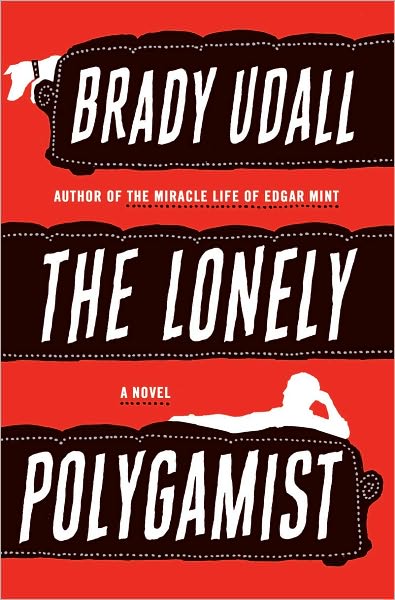
Summary Judgment: Naked on the Internet — Audacia Ray

I had high hopes for Naked on the Internet: Hookups, Downloads, and Cashing in on Internet Sexploration, but it turned out to be shallow and to lack real depth. Read Belle de Jour’s Diary of an Unlikely Call Girl instead.

Ray points out:

Women avidly use technologies like chat, blogging, and photo- and video-hosting services as recreational ways to explore their sexuality and meet partners for all kinds of sexual play, as well as for relationships. They use these online tools to build and strength relationships and to capitalized on their sexuality in big and small ways [. . .]

Isn’t this obvious? Elsewhere, she makes the point that blogging isn’t therapy, even if it may have some therapeutic aspects. We learn that. . . only therapy is therapy. Most of her work is built around interviews of dubious value, which is okay if there’s an original story to be told or real analysis to be presented.

I think I’m disappointed because because Naked on the Internet promises to cover the intersection of technology and culture, which I find fascinating. But it lacks substance. The Internet lets people evade conventional gatekeepers and do their own work without substantial oversight. The flourishing of material that might’ve never been created otherwise is a powerful testament to the possibility of creativity and discovery. I keep looking for people who are chronicling this.

Week 36 Links: A Jane Austen Education, what Facebook is like, The Longform.org Guide to the Porn Industry, A Game of Thrones as comedy, and more

Who put a bikini on this poor statue?

* Reading this review of William Deresiewicz’s A Jane Austen Education is bizarre because it’s like reading about myself, right down to the love for Madame Bovary:

In 1990, William Deresiewicz was on his way to gaining a Ph.D. in English literature at Columbia University. Describing that time in the opening pages of his sharp, endearingly self-effacing new book, “A Jane Austen Education,” Deresiewicz explains that he faced one crucial obstacle. He loathed not just Jane Austen but the entire gang of 19th-century British novelists: Hardy, Dickens, Eliot . . . the lot.

At 26, Deresiewicz wasn’t experiencing the hatred born of surfeit that Mark Twain described when he told a friend, “Every time I read ‘Pride and Prejudice’ I want to dig her up and hit her over the skull with her own shinbone.” What Deresiewicz (who has considerable fun at the expense of his pompous younger self) was going through was the rebel phase in which Dostoyevsky rules Planet Gloom, that stage during which the best available image of marriage is a prison gate.

Sardonic students do not, as Deresiewicz points out, make suitable shrine-­tenders for a female novelist whose books, while short on wedding scenes, never skimp on proposals. Emma Bovary fulfilled all the young scholar’s expectations of literary culture at its finest; Emma Woodhouse left him cold. “Her life,” he lamented, “was impossibly narrow.” Her story, such as it was, “seemed to consist of nothing more than a lot of chitchat among a bunch of commonplace characters in a country village.” Hypochondriacal Mr. Woodhouse, garrulous Miss Bates — weren’t these just the sort of bores Deresiewicz had spent his college years struggling to avoid? Maybe, he describes himself conceding, the sole redeeming feature of smug Miss Woodhouse was that she seemed to share his distaste for the dull society of Highbury.

The major difference is that I’m 27 and he describes himself at 26.

* A description of Facebook: “It seemed too much like tv, in reverse. Everybody transmits and nobody watches.” This is why I read Hacker News comments.

* Slate.com posted “The Longform.org Guide to the Porn Industry, which has a bunch of fascinating essays that are safe for work in the sense that they don’t have explicit photos on them. None are quite as good as David Foster Wallace’s “Big Red Sun” in Consider the Lobster, but that’s like accusing a basketball player of not being Michael Jordan. As I read the essays, I kept thinking of Philip K. Dick in some inchoate, ill-defined fashion—perhaps because he’s done so much to shape my thinking about reality and unreality.

Anyway, the next couple links stem from the Slate links:

* “Larry Flynt used to defend Hustler by calling the nude photo layouts “art.” I would come to joke that the porn video is indigenous Southern California folk art. The cheesy aesthetic — shag-carpet backdrops, tanning-salon chic, bad music, worse hairdos — and the everyman approach to exhibitionism are honest expressions of life in the land of mini-malls, vanity plates and instant stardom.” Evan Wright.

* “Those who enjoy whatever private pleasure is to be gained from receiving physical pain publicly would appear not to overlap at all with those who enjoy whatever private pleasure is to be gained from inflicting shame collectively.” From an article nominally about Sasha Grey and the porn industry, but really about expectations in cultural narratives of shame and redemption.

* “I’d call your right now, but I think you’re attending a retrograde ceremony for the artificial binding of two people in a legal contract regarding their sexual and financial behavior. I hope said ceremony at least has an open bar.”

* “Publishing—at least in general, and at least below the very top echelons of management—is not a fast-paced business, and the sense of urgency and desire for efficiency you might find in the offices of an investment bank or law firm don’t generally exist, simply because publishing doesn’t generally attract the sorts of people you often find in those fields.” This may bode ill for the future of the industry as it exists now.

* “I don’t know exactly what the future [of publishing] will look like, but I’m not too worried about it. This sort of change tends to create as many good things as it kills. Indeed, the really interesting question is not what will happen to existing forms, but what new forms will appear.”

* This is pretty funny: “A Game of Thrones” (the TV show) as a buddy comedy.

Effi Briest — Theodore Fontane, with a side of James Wood and Samuel Delany's Paris Review interview

Despite what I wrote in this post, I got a copy of Effi Briest. And you know what? I couldn’t finish it. There were some great lines—my favorite is Effi’s father saying, “There’s nothing so good for one as a wedding, provided of course it isn’t one’s own”—but I couldn’t take the rest, even though I stopped reading the very nice introduction by Helen Chambers after realizing it was prejudicing me against the book:

The sexual dimensions of the age gap [between Effi and her husband] remain beneath the surface of this discreet and allusive novel. They are suggested, as is much that is vital in the inner action, by the symbolic texture of the narrative. Effi’s sexual inexperience at the beginning of the novel is beyond question, and the premature loss of her virginity is prefigured by the twins calling her back to the garden through a window framed by Virginia Creeper

This explains why little seems to happen, since “remain beneath the surface” feels like another phrase for “buried so deeply that you need an even dirtier mind than mine to excavate it. In a Paris Review interview, Robertson Davies says:

I do not respond quite so immediately and warmly to writers in the United States, because their concerns are different from mine and their approach to them is different from mine. They seem to be infinitely concerned with very subtle details of feeling and life. I find this exemplified, for instance, in many stories in The New Yorker where whether the family will have pumpkin pie or something else on Thanksgiving Day is a decision with infinite psychological and sexual repercussions. I take this quite seriously. I admire their subtlety—but I get so sick of it. I wish they would deal with larger themes.

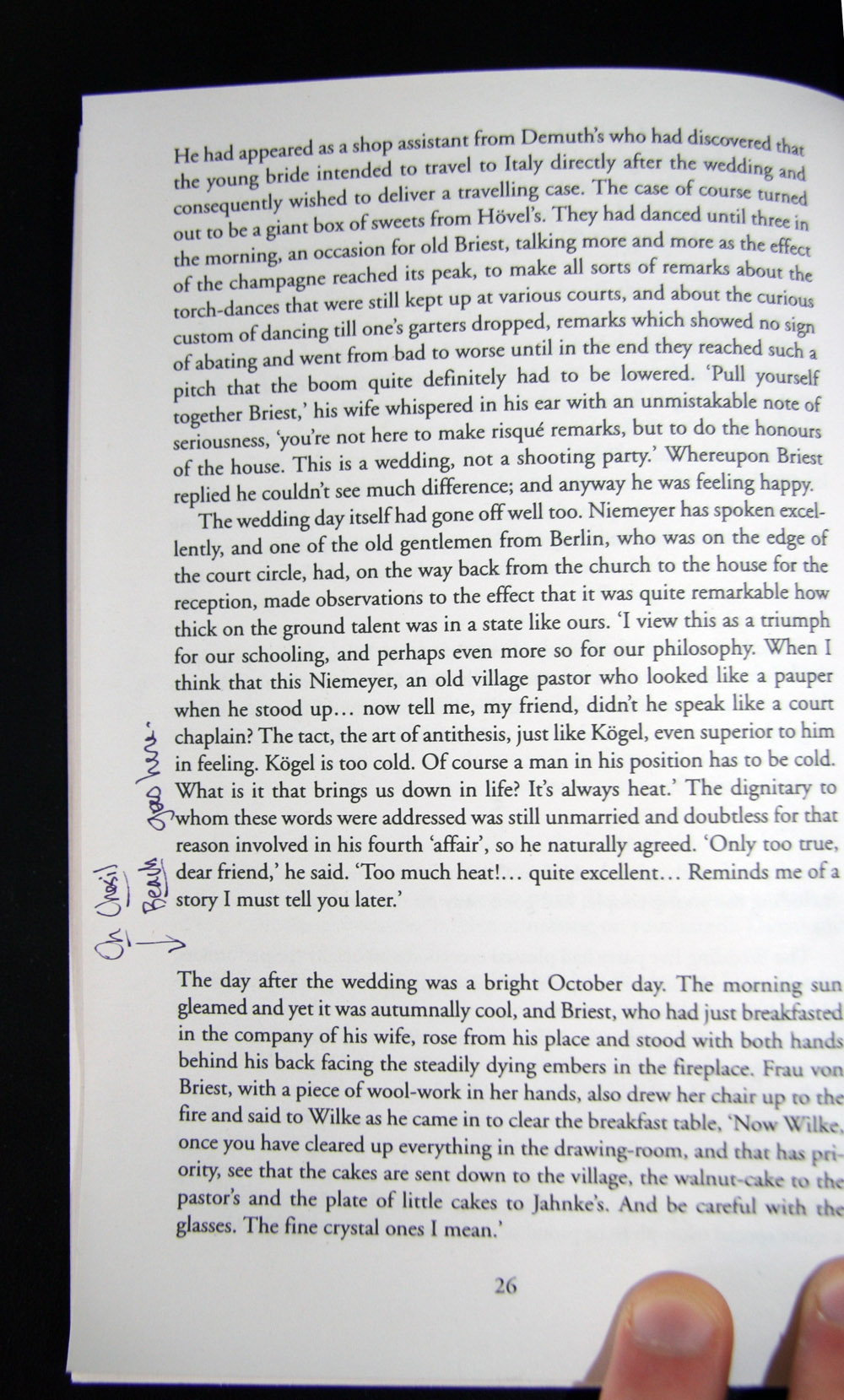
With enough subtlety, substance disappears, and I love his characterization of American Thanksgivings as portrayed in stories. Anyway, Chambers also says of Effi’s husband, “It seems that after years of self-discipline and mortification of the flesh Innstetten has regulated his natural urges into a state of atrophy.” In the margin I wrote, “Yawn,” a judgment that still seems reasonable a week later. Practically the entire text of Ian McEwan’s On Chesil Beach could fit between the end of the wedding scene on page 26 and the next paragraph, which begins, “The day after the wedding was a bright October day,” as if one of the presumably major events of Effi’s life hadn’t just happened. And I’m not talking about the wedding.

I was thinking about Effi Briest when I read Samuel Delany’s Paris Review interview in the Summer 2011 issue. He talks about two characters in his work Nova who almost have an incestuous relationship. The interviewer begins this exchange:

Did you intentionally want to make something the reader could only speculate about, rather than be certain of?

Delany: Certainly as far as the incest goes. Suggestion is a literary strategy. But when, in 1968, works like Henry Miller’s Tropic of Cancer and Black Spring and Lawrence’s Lady Chatterley’s Lover were legal to publish and sell in this country, the age of innuendo and the coyly placed line of white space, as the hero envelops the heroine in his arms, ended. Fifteen years later, AIDS rendered them permanently obsolete.

Today, I watch seminar rooms full of graduate students misread both [Alfred] Bester and [Joseph] Conrad, because they no longer have to wonder about the possibility of such illegal elements occurring in the story and the compensating possibility of suggestion as a writerly strategy for representing sex and violence.

I am one of those graduate students, and I evidently don’t have the exquisitely tuned sex detector that pre-’68 readers might have developed. This became especially clear in a seminar on Henry James’ The Golden Bowl, when one of my professors at the University of Arizona began to point out the many euphemisms and double entendres left by James, beginning with the name “Assingham” and proceeding from there. I mostly wondered what the big fuss was about, given the modesty of the phrases in questions, but I didn’t realize how generational my readings were until I discovered the Delany interview an hour ago.

Delany is right—I don’t have a lot of tolerance of “innuendo and the coyly placed line of white space.” That doesn’t mean I want every novel to be wildly explicit, or that I want pornography to merge with literary fiction, but it does mean that a lot of older books seem coy. Like Effi Briest. Today, when McEwan’s aforementioned novel takes those white spaces and turns them into entire works of their own, it’s hard to accept the white space, or an extraordinarily “discreet and allusive novel” where Virginia Creepers (or pumpkin pie) have “infinite psychological and sexual repercussions”

I didn’t expect to have my malady so accurately and suddenly diagnosed, however, and it wasn’t until I read Delany that I was able to write this post. He makes me want to be a more careful and considerate reader. Or maybe novels do have a sense of technological progression, or something like progress, or even progress itself. James Wood speculates on the subject in his review of Chang-Rae Lee’s The Surrendered:

Does literature progress, like medicine or engineering? Nabokov seems to have thought so, and pointed out that Tolstoy, unlike Homer, was able to describe childbirth in convincing detail. Yet you could argue the opposite view; after all, no novelist strikes the modern reader as more Homeric than Tolstoy. [. . .] Perhaps it is as absurd to talk about progress in literature as it is to talk about progress in electricity—both are natural resources awaiting different forms of activation. The novel is peculiar in this respect, because while anyone painting today exactly like Courbet, or composing music exactly like Brahms, would be accounted a fraud or a forger, much contemporary fiction borrows the codes and conventions—the basic narrative grammar—of Flaubert or Balzac without essential alteration.

If literature progresses technologically, it still doesn’t do so in quite the same way as technology: no one would use a camera from 1925 unless they were a masochist, had a historical fetish, or were trying to achieve some very peculiar artistic effect. The rest of us use digital cameras manufactured in the last five years, or phones, given the obvious advantages of convenience. But many writers from 1925 still feel quite modern—Fitzgerald, most obviously, but many others too. Yet I don’t find that much 19th Century fiction really moves me (exceptions: Moby-Dick, The Scarlet Letter). Contemporary writers have a greater and perhaps infinite rein to express what they need to express, and by contrast older writers do seem coy, even if this is an unfair judgment on my part—or the kind of judgment that might be tempered by age. The more I think about the idea, the more I see how others have considered it. For example, this review of William Deresiewicz’s A Jane Austen Education is bizarre because it’s like reading about myself, right down to the love for Madame Bovary:

In 1990, William Deresiewicz was on his way to gaining a Ph.D. in English literature at Columbia University. Describing that time in the opening pages of his sharp, endearingly self-effacing new book, “A Jane Austen Education,” Deresiewicz explains that he faced one crucial obstacle. He loathed not just Jane Austen but the entire gang of 19th-century British novelists: Hardy, Dickens, Eliot . . . the lot.

At 26, Deresiewicz wasn’t experiencing the hatred born of surfeit that Mark Twain described when he told a friend, “Every time I read ‘Pride and Prejudice’ I want to dig her up and hit her over the skull with her own shinbone.” What Deresiewicz (who has considerable fun at the expense of his pompous younger self) was going through was the rebel phase in which Dostoyevsky rules Planet Gloom, that stage during which the best available image of marriage is a prison gate.

Sardonic students do not, as Deresiewicz points out, make suitable shrine-­tenders for a female novelist whose books, while short on wedding scenes, never skimp on proposals. Emma Bovary fulfilled all the young scholar’s expectations of literary culture at its finest; Emma Woodhouse left him cold. “Her life,” he lamented, “was impossibly narrow.” Her story, such as it was, “seemed to consist of nothing more than a lot of chitchat among a bunch of commonplace characters in a country village.” Hypochondriacal Mr. Woodhouse, garrulous Miss Bates — weren’t these just the sort of bores Deresiewicz had spent his college years struggling to avoid? Maybe, he describes himself conceding, the sole redeeming feature of smug Miss Woodhouse was that she seemed to share his distaste for the dull society of Highbury.

I’m 27. Maybe I’ll have considerable fun at the expense of my pompous younger self one day.

I bought A Jane Austen Education, which shouldn’t be surprising given my feelings about Deresiewicz. Maybe he will teach me to read Austen more kindly, more attentively (Wood has succeeded at least somewhat in that respect: his discussion of free indirect speech in How Fiction Works finally gave me the tools to figure out why people like Austen). I’m still not sure that it will bring Effi Briest to life, and even if it does, it might be more like reanimating a corpse (which, as genre fiction teaches us, is replete with dangers) than interacting with a live person.

Effi Briest — Theodore Fontane, with a side of James Wood and Samuel Delany’s Paris Review interview

Despite what I wrote in this post, I got a copy of Effi Briest. And you know what? I couldn’t finish it. There were some great lines—my favorite is Effi’s father saying, “There’s nothing so good for one as a wedding, provided of course it isn’t one’s own”—but I couldn’t take the rest, even though I stopped reading the very nice introduction by Helen Chambers after realizing it was prejudicing me against the book:

The sexual dimensions of the age gap [between Effi and her husband] remain beneath the surface of this discreet and allusive novel. They are suggested, as is much that is vital in the inner action, by the symbolic texture of the narrative. Effi’s sexual inexperience at the beginning of the novel is beyond question, and the premature loss of her virginity is prefigured by the twins calling her back to the garden through a window framed by Virginia Creeper

This explains why little seems to happen, since “remain beneath the surface” feels like another phrase for “buried so deeply that you need an even dirtier mind than mine to excavate it. In a Paris Review interview, Robertson Davies says:

I do not respond quite so immediately and warmly to writers in the United States, because their concerns are different from mine and their approach to them is different from mine. They seem to be infinitely concerned with very subtle details of feeling and life. I find this exemplified, for instance, in many stories in The New Yorker where whether the family will have pumpkin pie or something else on Thanksgiving Day is a decision with infinite psychological and sexual repercussions. I take this quite seriously. I admire their subtlety—but I get so sick of it. I wish they would deal with larger themes.

With enough subtlety, substance disappears, and I love his characterization of American Thanksgivings as portrayed in stories. Anyway, Chambers also says of Effi’s husband, “It seems that after years of self-discipline and mortification of the flesh Innstetten has regulated his natural urges into a state of atrophy.” In the margin I wrote, “Yawn,” a judgment that still seems reasonable a week later. Practically the entire text of Ian McEwan’s On Chesil Beach could fit between the end of the wedding scene on page 26 and the next paragraph, which begins, “The day after the wedding was a bright October day,” as if one of the presumably major events of Effi’s life hadn’t just happened. And I’m not talking about the wedding.

I was thinking about Effi Briest when I read Samuel Delany’s Paris Review interview in the Summer 2011 issue. He talks about two characters in his work Nova who almost have an incestuous relationship. The interviewer begins this exchange:

Did you intentionally want to make something the reader could only speculate about, rather than be certain of?

Delany: Certainly as far as the incest goes. Suggestion is a literary strategy. But when, in 1968, works like Henry Miller’s Tropic of Cancer and Black Spring and Lawrence’s Lady Chatterley’s Lover were legal to publish and sell in this country, the age of innuendo and the coyly placed line of white space, as the hero envelops the heroine in his arms, ended. Fifteen years later, AIDS rendered them permanently obsolete.

Today, I watch seminar rooms full of graduate students misread both [Alfred] Bester and [Joseph] Conrad, because they no longer have to wonder about the possibility of such illegal elements occurring in the story and the compensating possibility of suggestion as a writerly strategy for representing sex and violence.

I am one of those graduate students, and I evidently don’t have the exquisitely tuned sex detector that pre-’68 readers might have developed. This became especially clear in a seminar on Henry James’ The Golden Bowl, when one of my professors at the University of Arizona began to point out the many euphemisms and double entendres left by James, beginning with the name “Assingham” and proceeding from there. I mostly wondered what the big fuss was about, given the modesty of the phrases in questions, but I didn’t realize how generational my readings were until I discovered the Delany interview an hour ago.

Delany is right—I don’t have a lot of tolerance of “innuendo and the coyly placed line of white space.” That doesn’t mean I want every novel to be wildly explicit, or that I want pornography to merge with literary fiction, but it does mean that a lot of older books seem coy. Like Effi Briest. Today, when McEwan’s aforementioned novel takes those white spaces and turns them into entire works of their own, it’s hard to accept the white space, or an extraordinarily “discreet and allusive novel” where Virginia Creepers (or pumpkin pie) have “infinite psychological and sexual repercussions”

I didn’t expect to have my malady so accurately and suddenly diagnosed, however, and it wasn’t until I read Delany that I was able to write this post. He makes me want to be a more careful and considerate reader. Or maybe novels do have a sense of technological progression, or something like progress, or even progress itself. James Wood speculates on the subject in his review of Chang-Rae Lee’s The Surrendered:

Does literature progress, like medicine or engineering? Nabokov seems to have thought so, and pointed out that Tolstoy, unlike Homer, was able to describe childbirth in convincing detail. Yet you could argue the opposite view; after all, no novelist strikes the modern reader as more Homeric than Tolstoy. [. . .] Perhaps it is as absurd to talk about progress in literature as it is to talk about progress in electricity—both are natural resources awaiting different forms of activation. The novel is peculiar in this respect, because while anyone painting today exactly like Courbet, or composing music exactly like Brahms, would be accounted a fraud or a forger, much contemporary fiction borrows the codes and conventions—the basic narrative grammar—of Flaubert or Balzac without essential alteration.

If literature progresses technologically, it still doesn’t do so in quite the same way as technology: no one would use a camera from 1925 unless they were a masochist, had a historical fetish, or were trying to achieve some very peculiar artistic effect. The rest of us use digital cameras manufactured in the last five years, or phones, given the obvious advantages of convenience. But many writers from 1925 still feel quite modern—Fitzgerald, most obviously, but many others too. Yet I don’t find that much 19th Century fiction really moves me (exceptions: Moby-Dick, The Scarlet Letter). Contemporary writers have a greater and perhaps infinite rein to express what they need to express, and by contrast older writers do seem coy, even if this is an unfair judgment on my part—or the kind of judgment that might be tempered by age. The more I think about the idea, the more I see how others have considered it. For example, this review of William Deresiewicz’s A Jane Austen Education is bizarre because it’s like reading about myself, right down to the love for Madame Bovary:

In 1990, William Deresiewicz was on his way to gaining a Ph.D. in English literature at Columbia University. Describing that time in the opening pages of his sharp, endearingly self-effacing new book, “A Jane Austen Education,” Deresiewicz explains that he faced one crucial obstacle. He loathed not just Jane Austen but the entire gang of 19th-century British novelists: Hardy, Dickens, Eliot . . . the lot.

At 26, Deresiewicz wasn’t experiencing the hatred born of surfeit that Mark Twain described when he told a friend, “Every time I read ‘Pride and Prejudice’ I want to dig her up and hit her over the skull with her own shinbone.” What Deresiewicz (who has considerable fun at the expense of his pompous younger self) was going through was the rebel phase in which Dostoyevsky rules Planet Gloom, that stage during which the best available image of marriage is a prison gate.

Sardonic students do not, as Deresiewicz points out, make suitable shrine-­tenders for a female novelist whose books, while short on wedding scenes, never skimp on proposals. Emma Bovary fulfilled all the young scholar’s expectations of literary culture at its finest; Emma Woodhouse left him cold. “Her life,” he lamented, “was impossibly narrow.” Her story, such as it was, “seemed to consist of nothing more than a lot of chitchat among a bunch of commonplace characters in a country village.” Hypochondriacal Mr. Woodhouse, garrulous Miss Bates — weren’t these just the sort of bores Deresiewicz had spent his college years struggling to avoid? Maybe, he describes himself conceding, the sole redeeming feature of smug Miss Woodhouse was that she seemed to share his distaste for the dull society of Highbury.

I’m 27. Maybe I’ll have considerable fun at the expense of my pompous younger self one day.

I bought A Jane Austen Education, which shouldn’t be surprising given my feelings about Deresiewicz. Maybe he will teach me to read Austen more kindly, more attentively (Wood has succeeded at least somewhat in that respect: his discussion of free indirect speech in How Fiction Works finally gave me the tools to figure out why people like Austen). I’m still not sure that it will bring Effi Briest to life, and even if it does, it might be more like reanimating a corpse (which, as genre fiction teaches us, is replete with dangers) than interacting with a live person.

How should teenage characters speak? Engaging Janet Reid, Gossip Girl, and 90210

In a query letter critique, Janet Reid says:

If you’re writing a 14-year old character, you need to know how they talk: “Threatening us with violence” sounds like a sociologist; “told us he’d mess us up” sounds like what the kids on my corner say to each other.

This might be true in many instances, but I’m reminded of something this Salon.com review of “Gossip Girl” and “90210” says:

Where Blair and Serena’s lines snap, crackle and pop with wit and cleverness, the soggy stars of “90210” stumble over one cliché after another. “Awkward!” Annie blurts at Ethan after they encounter Ethan’s ex Naomi, then Annie does her best impression of the cynical teenage eye roll, as Ethan mutters, “Good times!” Oof.

But every scene is filled with such teen-bot tripe: “Whatever works for you.” “Helloo-ooo?” “Shut up!” “Me and Ethan? Not so much.” Maybe real teens sound like that, but real teens are repellent and worthless, remember? Plus, nothing’s worse than shoving such drivel into the mouths of a bunch of airbrushed anorexics and overgrown child actors.”90210’s” Annie has more in common with Broadway’s Annie than a real human being. Putting teen lingo in her mouth is like dressing a cat in a little nurse outfit. It’s sort of cute at first, but then it just gets sad.

“Repellant and worthless” is overstatement, very. The characters from “Gossip Girl” are more interesting because they don’t speak like teenagers, or like regular ones. If they did, they’d be boring (or, depending on your view, more boring than they already are). I suspect that’s why so many teen narrators are “precocious.” The alternative is dull. If you have a normal 15-year old, even 15-year olds will find them boring and insipid on the page. So you need a precocious 15-year old who adults can tolerate, and perhaps enjoy, while 15-year olds will imagine themselves to be equally witty even if they’re probably not. But your precocious 15-year-old still probably shouldn’t sound like Umberto Eco. That’s the challenge: giving a character enough of a voice and enough intelligence to make them interesting while not overwriting them. This challenge might explain why so many books starring teenagers are told from a distant, adult future recalling events from the past.

The first season of Gossip Girl, by the way, is pretty funny. I referenced it in class one day because, being a West Coaster, I had no idea what “cotillion” was until an episode featured it. That allusion elicited shock from students. Apparently I come across as a very hard core literary type. Which, of course, I am. A friend and I watched a few episodes and the last one from the second season, but it was so repetitive that we gave up.

On another note, the rest of Reid’s advice on the query letter is typically accurate. If you’ve ever wanted to try and get a literary agent or publisher to read your manuscript, take a couple hours to look through Query Shark first.

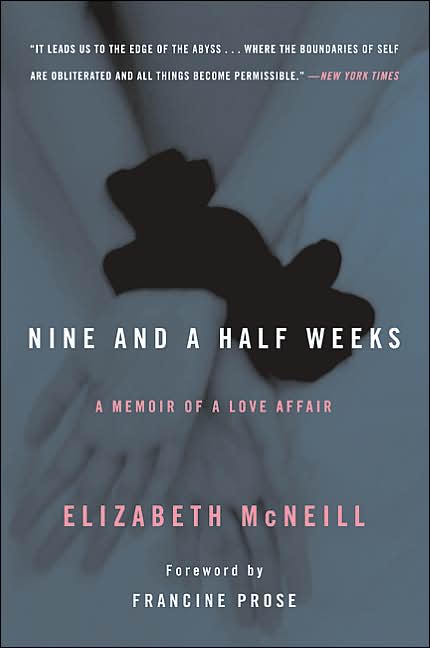
Nine and a Half Weeks: A Memoir of a Love Affair — Elizabeth Mcneill

Most novels (and memoirs) leave you with a sense of distance, a sense of being at a comfortable remove. Nine and a Half Weeks doesn’t: it’s too graphic, too immediate, too flat. One sees this effect in the first sentences, without any preamble as to who these people are and how they came to be: “The first time we were in bed together he held my hands pinned down above my head. I liked it. I liked him. He was moody in a way that struck me as romantic; he was funny, bright, interesting to talk to; and he gave me pleasure.” One senses quickening thoughts and pulses in those short sentences, and even in the long one, where semicolons could be periods, and the last descriptor—”he gave me pleasure”—is the really important one. You don’t get the very ironic tone of a book like Alain de Botton’s On Love, letting us see that love is irrational but really understandably so. Alain, the narrator of On Love is basically a needy, endearing, neurotic weakling; his self-consciousness contrasts so much with the man in Nine and a Half Weeks that they’re practically different species.

There are clever phrases in the memoir, as when the narrator says of her lover, “His face turns attractive when he talks;” I like the strange word choice, as if the head is physically turning, or as if he has two, or multiple, faces. A few moments are archaic—the man describes a friend or rival coming over as “This dope” (emphasis in original), which hasn’t been currently slang in decades and stands out in a book that otherwise stands out for not being part of any particular time. The prose holds up, and the narrator has an eye for tedious rituals, as when she tells of a “statistical tale,” where the contrast of statistics and narrative stands out:

In the middle of the statistical tale he’s requested from me—brothers and sisters and parents and grandparents, hometown, schools, jobs—I stop and close my eyes . . . please, I think, inarticulate even in my own mind, unable to turn to him and make the first move, please . . .

There’s a pervasive fear of dullness running through the memoir. The narrator notes that she and her lover looked like “An attractive, well-educated couple in New York City, average, middle-class, civilized.” That contrasts with what came before and will come after. Or does it? The memoir teases us by making us wonder if the the narrator isn’t so unusual as public discourse would make her out to be. I think the story’s flatness, the unwillingness to engage in direct commentary on what’s happening, points us in this direction, as when the narrator says, “I am standing, nearly on tiptoes, across the room from him, my arms raised above my head. My hands are tied to the hook on the wall on which his one large painting hangs during the day.” She’s hung like a painting and enjoys it. There is no further morality or analysis. Sixty Minutes plays in the background, a reminder of the middle America the narrator feels like she’s leaving behind even when she imagines it as a foil to her own actions.

Images repeat through the memoir. Scarves reappear. The words “like” and “love” are reconfigured like body parts. One senses Nabokovian echoes in the prose that one distantly hears on the first read but can’t make out. The narrator also feels her internal sense of self discombobulating, like a washing machine that shakes itself apart from within. She knows this is happening and imagines the reactions of otherwise course, until she writes of her experience.

We don’t know what the narrator wants beyond the obvious: sexual satisfaction. That she might only want the obvious might be the most frightening thing of all. What if everything else she has—a job, presumed communal respect, literary and political opinions—don’t matter very much? What if your real self isn’t those frontal cortex developments, but something deeper, more primal? I find posing the questions unsettling. The answers implied by Nine and a Half Weeks are more so. The patina of everyday experience conceals so much, especially in the realm of inchoate desire that social life is designed to channel. What happens when the channeling breaks? What happens when we want it to break? I’m reminded of Donna Tartt’s The Secret History, which also features the discarding of the mind in pursuit of a mental state or feeling very unlike the one most of us presumably inhabit most of the time—the mental state worried about how much money we have, what other people think about us, whether we’ll get the job / life partner / degree / accommodates of our dreams.

The narrator likes the man’s dominance above all other traits, which derive from that dominance. He says of a friend or rival, “he’s got no guts whatsoever.” Note what she likes in the contrast he offers by comparison. He shows mastery by reading Gide in French and Kafka in German, both implying continental expertise and sexuality. Some moments are obvious, as when the narrator reads with “his thick pen solid and comfortable in my hand.” One doesn’t need to be Freud to imagine that the pen is not just a pen. In the same scene, the narrator says, “I write the letter (‘. . . met this man a few days ago, nice start, very different from Gerry, who’s more than happy with Harriett these day, you remember her . . .’)” (sic). The dig at her ex-boyfriend is subtle but present: he isn’t dominant, won’t tie her up, and presumably has settled with a lesser woman.

He demonstrates great knowledge too: “[. . .] whatever else he may do [in] it, this man clearly does read his original-language books in bed; why would anyone want to miss out on one of the most satisfying pleasures available? All he’d need is a better bulb, a few more pillows, and a reading lamp. . . .” The room sounds sad and denuded, but it doesn’t matter much, even if the narrator is right about beds, which are good for more than just sleeping and that other thing. He offers commands, as when the narrator says:

He guides my hands between my legs and says, ‘I’d like to watch you make yourself come.’

He is sitting idly, comfortably, one leg crossed over the other, the creases sharp in the freshly cleaned suit. I do not try to move my hands. He waits. ‘You don’t understand.’ My voice cracks. ‘I never . . .’ He is silent. ‘I’ve never done that in front of anybody. It embarrasses me.’ “

She does, of course. That it embarrasses her is part of the point. What embarrasses her in the moment becomes the fodder for memoir, even under a pseudonym, long after. She likes giving power to him, which she does by letting him watch her masturbate. She also does by repeating how much she loves him, but I don’t think he ever says it back. It’s like he doesn’t need to, and by withholding the confirmation of his love he creates a neurotic fear in her. Only at one moment does he crack, when “All at once he is a decade my junior, a very young man asking me to have a drink with him, expecting to be refused.” But that doesn’t last long. Little does in this memoir, including their relationship, whose duration is given away by the title. But the narrator learns a lot in a short period. She says, “If you’ve never screamed, out of control, you can’t imagine how it feels. Now I know how it feels, it’s like coming.” She never goes the Biblical or mythological root and thinks there are things we shouldn’t know. For her, all knowledge is knowledge.

You can see that McNeill’s memoir doesn’t sit well with current ideals of equality and mutual respect in all fields. As Laura Kipnis says in “Off Limits: Should students be allowed to hook up with professors?” for Slate.com, “Feminism has taught us to recognize the power dynamics in these kinds of relationships, and this has evolved into a dominant paradigm, the new propriety.” Feminism has taught us to recognize power dynamics, but it should also teach us to recognize points of view. The narrator gets this; she thinks the man’s room is “too plain to be called plain. It’s austere, if you want to be charitable, or chic, if you want to be snide, or boring, if you want to be honest. It is not, in any event, a room you’d call cozy” {McNeill “Love”@9}. So the narrator is aware of angles, points of view, possibilities. I’ve been told I use “or” a lot in my own writing. It’s a useful word for people who perceive many ways of describing things, and here it betrays an openness to experience that the memoir exploits. She has a strong theory of mind that weakens as she awakens to herself.

I should point out that I call the narrator “the narrator” as opposed to “McNeill” or something more conventional because she feels like a fictional person more than a real person (which is strange, given how many fictional characters seem real, but that’s a topic for another time). Elizabeth McNeill is itself a pseudonym. We don’t know who the real author is. The man is never given a name—he’s only given traits, like his penchant for Brooks Brothers and sadomasochism (sometimes, especially when it comes to belts, simultaneously). So I don’t entirely know what to call them, or what to call their madness, if it is indeed madness. Can we find pleasure in madness? The narrator’s point is that many of these normally distinct categories eventually blur. I think that’s one of Tartt’s points in The Secret History too. There is more to be written about the book—its strange tenses, leaping from past to present to future, to what extent we should indulge in or avoid attempting to apply universal lessons—but this gives flavor of it and why its merits still show.

Thoughts on J. J. Abrams’ movie Super 8

1) It’s surprisingly good. I say “surprisingly” because most heavily advertised summer blockbusters are terrible. See it in the theater if you can, ideally on an IMAX screen. I did.

2) The movie is very good at conveying a lot in a small space—the cluttered domestic scenes set up family tension. Details proliferate at the edge of the movie. Watch for video cameras and film-related objects.

3) I identify with the fat kid because he’s the artist. He’s not the hero and doesn’t get the girl. When mysterious things begin happening, he’s the one who still cares most about getting the shot. Good for him. Intense focus on “production values!” (his rallying cry) never hurts.

4) Like Umberto Eco’s The Name of the Rose, this text speaks to other texts. For some reason, I always love the scenes where animals run away while doofus humans tarry. Someone says, “You heard what old man Woodward said,” as if the movie was a Scooby Do variant.

5) Super 8 feels like one the 12-year-old Abrams would’ve liked to make, if he’d had the skill; now he does. It’s nice to see adolescent dreams rise.

6) Ignore the plot holes and implausibilities, which are numerous.

7) Anything that disrupts electricity and electrical devices is scary. If you’re writing a novel with any kind of supernatural element, remember this. We’re still afraid of the dark, and we’re dependent on an electrical grid few of us understand.

8) Embrace the impetus to explore.

9) This is a kids’ movie primarily because there weren’t real consequences; I will leave that statement ambiguous for those who haven’t seen the movie.

EDIT: Even if you don’t normally read the comments, see those left by Jason Fisher.