Highet says that “This book is called The Art of Teaching because I believe that teaching is an art, not a science.” He might be right. But he doesn’t present much evidence as to why it is, or how one can become a better artist in a significant way. A lot of his advice is obvious or vague. Among the obvious parts:
The first essential of good teaching… is that the teacher must know the subject That really means he must continue to learn it.
The second essential is that he must like it.
Among the vague parts:
Learn the peculiar patterns of [your students’] thought and emotions just as you would learn to understand horses or dogs—or other animals (for there are all kinds of different animals implicit in children: the very small ones are often more like birds)—and then you will find that many of the inexplicable things they do are easy to understand, and many of the unpardonable thing easy to forget.
What does it mean to “learn the peculiar patterns” of students’ thought? Highet never says. And I’m leaving aside the double aside he uses, or the fact that he compares students to animals. What’s next—the freshman whisperer?
The Art of Teaching is big on ideas and short on execution. There’s not much to say about it other than a warning to stay away from it.
The Old Man and Me is The Dud Avocado retold by a slightly older protagonist pursuing a slightly older target man. It has some of the same moments of impressive language use, as when Honey Flood—not her stage name, but apparently an invented one—says that:
Bollie was a sort of chain-talker, lighting one end of a conversation to another without letting the first go out.
The image fits, and with Bollie puffing on both conversations where most of us only have the capacity or manners for one, and the good sense to keep it that way. With that small detail, I feel like I’ve met Bollie, or if not him precisely, than someone much like him. Still, the same page has dated slang (what’s a “mizbag?”), and the dialog can be hard to follow at times. Perhaps that dialog is representative of Honey, another American in Europe whose interests are men, money, status, and fun (not necessarily in that order), ideally combined in the same man. Said man turns out to be, chiefly, C.D. McKee, a writer in a day when writers still had groupies and hadn’t been replaced by celebrities as objects of fixation.
Honey’s voice will make the novel—or not. More often it’s the former; she’s clever if irritating at times, and the banter between her and McKee usually works, although sometimes it feels obvious. Consider this exchange about a park, in which C.D. speaks first:
“Parks are for the poor. Alas, that they haven’t a chance to enjoy them. Only the very young and the time-wasters like us can.”
“That’s because you hide them so well. This beauty, for instance. How d’you expect them to find it. I wouldn’t if you hadn’t led me to it.”
It’s not hard to take the park as a metaphor for Honey’s growth as a person in dealing with C.D. The undercurrent of class, if not warfare, then consciousness, continues (“I had been a rich man’s darling, all right. A very rich man’s very darling”), but not to the point of annoyance. But it gets close enough to that state to warrant a mention; Honey isn’t as developed intellectually or socially as someone like Renee Feuer in The Mind-Body Problem, who’d catch the solipsism in comments like this:
Radiating joy, confidence, and anticipation [C.D.] shone like a beacon in contrast to the milling crowd: the careful ones checking and rechecking their tickets, luggage, and timetables; the frantic ones overburdened and rushing in all directions […]
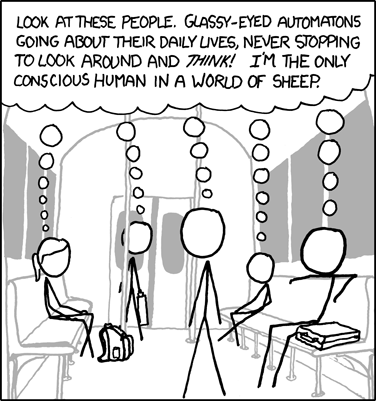
My internal editor drew a line through “the milling crowd,” figuring that we’d understand the milling crowd through the image that follows it. And someone like Renee would catch herself and realize that others are probably having the same thoughts she is, as shown in this XKCD:
It’s the same comic I linked to in my post on Pages For You: narrators and characters who aren’t able to see themselves in the larger sense, or see themselves as other people might see them, become decreasingly satisfying over time, as one reads more novels. Being (or at least feeling) significantly smarter than the character about whom one is reading, without some significantly unusual formal feature to make up for it, makes for tedious reading. The Old Man and Me isn’t tedious, most of the time, and it’s refreshing to find female narrators who are willing to sleep around without shame and connive to get what they want: I’m not sure this is a feminist testament, but at least it makes for an amusing story with writing that keeps Honey from devolving into stereotype and the story from devolving into senescence.
The bottom line: Read The Dud Avocado. Then read The Mind-Body Problem. Still want more? Then find this quasi sequel, but your urge will probably have been satiated unless you’re an American going to Europe, in which case you might empathize with and want to understand those whose footsteps you follow in. Then you can view The Old Man and Me as a learning experience.
The Second Pass also recently wrote on the The Old Man and Me. It’s a blog that I find moving steadily higher in my “must reads.”
(500) Days of Summer is about the mating habits of angsty hipsters. Said hipsters are endlessly concerned with the nature of love in a deep, romantic fashion when they should be thinking more about the mechanics of how and why someone is actually attracted to another person. To heal the anxiety that hipsters feel about attraction and love, I would prescribe Belle de Jour, Neil Strauss’ The Game, and Kundera’s The Unbearable Lightness of Being, which, taken together, remind one that the important thing about love is having enough game to get someone else to love you, not merely mooning over another person—which is more likely to drive them away than attract them.
In (500) Days of Summer, Tom does the mooning and Summer is indifferent and perhaps callous to his puppyish attention. Tom wants romance so bad that his 11-year-old sister says, “Easy Tom. Don’t be a pussy” at one point. We’re thinking the same thing, although perhaps not in those words, which are given to the sister chiefly, I assume, for getting a laugh out of the incongruity of hearing her say them. In the next scene, Tom asks Summer, “What are we doing?” The better question, at least for the audience, is, “Should we care?” If Tom doesn’t get with Summer—who manifests no special or particular interests, talents, abilities, thoughts, capability, or expertise—there are another thousand girls right behind her, exactly like her, who are also part of the quirk genre, as described in the linked Atlantic article:
As an aesthetic principle, quirk is an embrace of the odd against the blandly mainstream. It features mannered ingenuousness, an embrace of small moments, narrative randomness, situationally amusing but not hilarious character juxtapositions (on HBO’s recent indie-cred comedy Flight of the Conchords, the titular folk-rock duo have one fan), and unexplainable but nonetheless charming character traits. Quirk takes not mattering very seriously.
Quirk is odd, but not too odd. That would take us all the way to weird, and there someone might get hurt.
Over time, quirk gets boring and reminds you why you like the real feeling of, say, King Lear, or the plot of The Usual Suspects. The mopey plight of undifferentiated office workers is less compelling, and, once sufficiently repeated, it feels like disposable culture: another story about two modern people with no serious threats to their existence save the self-imposed ones that arise chiefly from their minds.
Love stories about the relatively pampered can work: I watched (500) Days of Summer because a bunch of students mentioned it in relation to Alain de Botton’s On Love. But the novel is better: a philosophically minded and self-aware narrator is fascinating precisely because he is aware of the ridiculousness of his own predicament and the randomness of love. He has a therapist and a philosophy professor in his mind. The dichotomy between how he should feel (she’s just another girl) and how he does (transformed through love!) fuels much of the comedy, as does the narrator’s tendency toward self-sabotage thanks to Marxism as applied to love: he would never want to be a member of any club that would have him as a member. Tom would, apparently, sign up to be a member of any club that would have him as a member. His lack of interiority makes him boring. His lack of exteriority makes the movie boring.
Whoever wrote (500) Days of Summer must have read On Love (Tom is a wannabe architect and gives Alain de Botton’s The Architecture of Happiness as a gift) and wanted to do a film version, or at least steal from it. Stealing from On Love, by the way, is a brilliant idea: the novel still leaves much territory to be explored, and it’s probably impossible to draw a complete map to represent the problems that love provide. But the interior commentary that makes the novel special can’t be effectively represented on screen. So we’re stuck with two people whose averageness is painful and unleavened by any real sense of awareness of their own situation. One of my favorite passages from On Love goes:
But there wasn’t much adventure or struggle around to be had. The world that Chloe and I lived in had largely been stripped of possibilities for epic conflict. Our parents didn’t care, the jungle had been tamed, society its disapproval behind universal tolerance, restaurants stayed open late, credit cards were accepted almost everywhere, and sex was a duty, not a crime.
On Love is acknowledging that the stuff that makes good fiction has largely been evacuated from modern love stories. In doing so, I laughed with recognition and at the narrator’s neuroticism about his own love stories. Moments like this abound in On Love and make it such a wonderful novel. Moments like this are absent in (500) Days of Summer, which make it a tedious movie.
The Glass Room is filled with portents, which, given its setting in 1920s Europe relative to its composition in more recent times, might seem unsurprising. But those portents become portentous, as defined by the Oxford American Dictionary built into OS X: “done in a pompously or overly solemn manner so as to impress.” The novel is ceaselessly concerned with tension between old and new, ancient and modern, the way of progress and the way of regression, but it tends to be delivered with the subtlety of a brick through a window:
* “Beneath the calm surface of the new country Viktor felt the tremors of uncertainty.”
* “It’ll be a revolution […] a casting off of the past. A new way of living.” Maybe, but I wouldn’t count on it: there is no such thing as a genuine casting off of the past.
* “I have laboured day and night, to the disadvantage of my current work. But the demands of true love are more powerful than mere artistic patronage.”
* “I’m certainly not going to tell you what I am letting him do. Some things are sacred.”
“My darling, these days nothing is sacred” (emphasis in original).
* “This is the artistic future of our country […] Vitulka and people like her. A young country with so much energy and so much talent.” Until the Nazis and then Soviets roll through, anyway.
And these are only a few obvious moments from the first 80 pages. I counted zero jokes in the same territory.
Have I not mentioned characters yet? There may be a reason for that. Viktor and Liesel Landauer are religiously mismatched (Jew, Gentile—or is it the other way around? Confusion would be easy) and eventually become erotically mismatched, with somewhat predictable affairs sprouting between a couple who cannot yet have read The Unbearable Lightness of Being. Rainer von Abt is the German architect who designs their “upside down” house/metaphor, where the bottom is made of glass, and is fond of pompous pronouncements like the one above regarding true love versus artistic patronage. There is also a pianist, who allows allusions to Dr. Faustus, and other minor characters of artistic bent who positively breathe meaning until they become suffocating.
The Glass Room isn’t a bad novel, but it’s one that I couldn’t get into. Why is it that some short books feel long (Ethan Frome), some long books feel short (Cryptonomicon, The Name of the Rose) and some mid-length to longish books feel longer than they are, like The Glass Room? I doubt I can find a consistent, unified theory regarding objective length and metaphysical length, but books that don’t have enough grab to feel short despite their length often get dropped before they’re finished. The Glass Room might fall into this category because it’s a novel that has aspirations towards being a novel of ideas, but it’s told chiefly through characters whose endless banal observations and cares don’t seem leavened with the promised ideas, and the narrator doesn’t provide them either. So I start skipping pages, waiting, waiting, hoping, hoping, and never finding until, eventually, I wander back toward the congenial fields of Alain de Botton and Francine Prose.
Criminals use nicknames both to separate insiders from outsiders and to stymie potential investigations into their activities (which is itself a form of stonewalling outsiders). They use violence strategically rather than randomly, and prefer to send hard-to-fake signals about their badness and their inability to fit in any part of the larger world: hence the tendency toward showing incompetence at tasks other than criminality, as seen on The Sopranos, the tendency toward extreme tattoos, and the tendency toward group participation in criminal events. The last binds the participants together. You can see some of the same behavior in almost any group of people; for example, a group of teenagers might decide they’re poor math students, they like to wear black, and they prefer to smoke weed with one another, the last being necessary to ensure group culpability—”they try to force each other to participate and torment or ostracize those who refuse.”
This comes from Codes of the Underworld, a clever book that is actually about signaling, semiotics, and economics more than any other subjects, despite my introduction. Its conclusions feel obvious after reading, but I doubt I could’ve articulated them prior. It has an impressive range of detailed examples supporting its general observations.
For example, criminals are good at finding liminal spaces where criminality might be implied, but not completely; Gambetta cites drivers who would nominally “forget” cash when handing over their license to police:
A quick-witted and corrupt policeman could choose to pocket the banknote (or bargain for more); if not corrupt, he was unable to treat the display of the ostensibly “forgotten” banknote as sufficient evidence of attempted bribery.
Steven Pinker makes similar claims about linguistic issues in The Stuff of Thought, where he describes the verbal tango people in crimes, love affairs, and other situations undergo. In both crime and love affairs, very good reasons often exist for evading overt, blunt language: being caught by police in the former and being unambiguously rejected in the latter.
As the above issue regarding bribes perhaps shows, criminals are more rational than they’re often made out to be: “Far from being driven by a feudal or monarchic mentality, mafiosi display a surprisingly modern mind-set in managing their organization, at odds with much of the Italian nepotistic and corrupt style.” I like the sentence itself as well as the thought behind it: the sentence compacts a lot of material into a short space (“monarchic mentality,” “Italian nepotistic”), which alludes to allegedly common knowledge while also correcting that knowledge. Some parts are wonderfully academic in their obtuse cleverness, as when Gambetta says, “This sort of usage seems a jocular custom, a form of bantering, and it would be a stretch to attribute it to an instrumental motive.” In other words, friends sometimes greet each other affectionately and informally. But those moments are few, especially relative to the easy density in Codes of the Underworld and the fact that it also nearly functions “semiotics for dummies,” with a fair amount of the theory one might otherwise find in Umberto Eco or Roland Barthes. In short, it’s multidisciplinary and academic in the best sense of both words.
A blurb from Thomas Schelling on the back says that “[…] the book’s interpretations will carry well beyond the field of conventional crime.” He’s right, and one major strength is that, as with the best nonfiction books, Gambetta uses a particular field or example from a particular field (in this case, criminality) to comment simultaneously on a much larger issue (how people communicate and form social bonds) without straining too far to either side, which would destroy the whole.
I meant to write a long review of Pops: A Life of Louis Armstrong, but enough very competent sources have that I have little I contribute beyond generic praise. I know virtually nothing about Armstrong and read few biographies; therefore I’m little able to comment on how Pops deals with the genre. But those who presumably know more than I do are impressed: The Atlanticspeaks here, for example, and you can read more here, here, or here, at The Second Pass.
Teachout argues that Armstrong was more complex than his jovial public persona demonstrated. To me, the more interesting part of Pops is its subtler meditation on the relationship of the artist to society—in Armstrong’s case, race was an abiding the issue—and the virtuosity of the writing of both subject and object. Two samples will have to suffice: one of my favorite lines Teachout wrote comes early, on page 23, when he says of Louisiana, “Rarely does [the Northerner] linger long enough to pierce the veneer of local color with which the natives shield themselves from the tourist trade.” I suspect that applies to many places, and it echoes Samuel Johnson’s apt, “When a man is tired of London, he is tired of life.” That could apply any vibrant, culturally ambitious, and expanding city, just I might Teachout’s comment reveals more about place than many stories of travel.
As for Armstrong, he saw through much that not all do, judging from shows like Entourage or the laments of other celebrities:
I can’t go no place they don’t roll up the drum, you have to stand up and take a bow, get up on the stage. And sitting in an audience, I’m signing programs for hours all through the show. And you got to sign them to be in good faith. And afterwards all those hangers-on get you crowded in at the table—and you know you’re going to pay the check.
It’s that last bit—”and you know you’re going to pay the check”—that resonates most, the little indignant detail that is nonetheless part of what Armstrong implies one has to do to succeed in the music and show business. Other businesses have their little indignities, and it’s one of Teachout’s considerable strengths that he never leaves the grounding of his subject yet offers many roads from his subject to the wider world. I point to just one, but there are many other available if you’re willing to walk through 400 short pages in Louis Armstrong’s shoes.
Coders at Work is consciously modeled on the Paris Review Interviews with famous writers and comes out better for it. The interviews are deep, thoughtful, wide-ranging, and show strong opinions without pedantry or needless prejudice. Many such opinions aren’t unique to programming or can be transferred easily to a wider domain area; Dan Ingalls, for example, says that “[M]y feeling about the powerful ideas that are necessary to lead a good life, it’s not clear how many of them are in this space,” this space being the intersection of computers and math. The expression is a bit awkward, which shouldn’t be surprising given that these interviews were conducted in person, but the idea of tremendous respect for powerful ideas is an attractive one that’s expressed over and over in these essays.
Coders at Work is surprisingly fun and useful, even for people whose connection to computer science is tenuous, chiefly because its metaphors and ideas about work and beauty travel. The author’s bio says, “An English major and would-be journalist in college, Peter was seduced by the web […]” and eventually became a hacker. Perhaps not surprisingly, then, I see a lot of ideas that one can apply to writing in this book. Joe Armstrong says that writing is an essential skill for programmers, and he says that writing is “actually very difficult to teach because it’s very individual.” Since I teach writing, that resonates with me, but it seems that coding is equally difficult if not quite equally individual, but the difficulty in learning both seems like a similar problem space. I write this from the position of someone with about a dilettante’s Computer Science 102 view of these things, but I see nothing in Coders at Work that’s incompatible with such a view. Both hacking and writing seem like what I call “10,000-hour problems,” or those that will require that much time to master. Ingalls implicitly agrees:
[…] I still love to just take a problem and sit down and pore over it until it’s right. There’s an analogy here: I tried to learn to play the piano fairly late in life. People said, “Oh, you should learn when you’re young. You learn so much quicker.” Although I didn’t go very far, my conclusion was that it isn’t that young people learn that much faster; it’s just they have more time. When I would put time in, I made progress.
I feel a bit the same thing with programming. When I look back on earlier times in my life, I had all the time I wanted. I would just work and work. Now there are other things going on in my life and I’ve got responsibilities that aren’t just programming. That undermines a bit of that intense focus.
Replace “programming” with “writing,” and I think the ideas about the process of learning stand. Ideas about beauty seem to transfer as well. L. Peter Deutsch says, “[… I]t’s just seeing anything around me that’s being done badly has always offended me mightily, so I thought I could do better.” Perhaps not surprisingly, Deutsch also says:
As crazy as it may seem now, a lot of my motivation for going into software in the first place was that I thought you could actually make the world a better place by doing it. I don’t believe that anymore. Not really. Not in the same way.
Maybe not: but I suspect that we make the world a better place by becoming really, really good at something—so good that no one else can do it as well as us, or some small coterie of skills that interact with one another—and then ultimately teach others that skill or suite of skills too.
The dominant idea in Coders at Work is not how to apply the skills once you have them, but the challenge and process of acquiring those skills. The coders interviewed acquire and apply them in diverse ways, but the dominant theme in all of them is starting early and intense, dedicated work. There is no other way to learn and to develop “Taste for Makers.”
One question is why more people don’t find and excel in coding, or in any particular, demanding field. Donald Knuth speculates that only about 2% of the population has the aptitude and desire for coding. Maybe. And maybe some segments of the population are turned off by the culture or cultures of coding. In a blog post, Seibel wonders whether there are “Enough women in Coders at Work?” The obvious answer from a gender parity perspective is “no,” but from a practical prospective I’d observe that a) there has been an overly low proportion of women in computer science for as long as one can remember and b) many of the interviewees came of age in the 60s and 70s, when the problem was even worse than it was now because of other institutional and cultural barriers.
Fran Allen takes up some of these issues. But Seibel is also a writer, and not directly responsible for the number of prominent, expert women coders; the fact that the issue arises is a sign of progress. Still, it is not effective to order people to learn to code or to like to code any more than it is effective to order people to become writers; the best you can do is give them an environment conducive to growth and remove institutional barriers and see what happens. Maybe some of them will learn taste and, better still, beauty.
(You can—and should—also read Joel Spolsky’s take on Coders at Work. His point: sometimes you need people who get things done.)
Really good and really bad books often announce themselves early: in the case of the former, you find that moment of shock and astonishment that propels you forward. In Max Jamison, that moments hits on page 7, when Flashman is described not as “a theater critic at all, but a maid-of-all-work gossip columnist and second-string reviewer who scooped up free tickets like a mechanical crane and prowled the lobbies for carrion.” Status and aesthetic contempt intermingle: Flashman doesn’t appreciate art because he’s “like a mechanical crane,” and yet at the same time he feeds on the dead—dead plays, dead reviewers, dead everything.
Max, on the other hand, sees himself as an antidote of sorts to that: he’s a theater critic with, if not heart, then at least acerbic taste, which is better than no taste at all. But he’s not terribly happy and is too aware of his own faults to let something like sentimental happiness buoy him; in another early scene, he thinks that “The actors he talked to were dull as ballplayers and degradingly anxious to please.” Or, more likely, the actors are worried about angering critics on whose fancy rides their career. But if that critic is sufficiently cantankerous, their actions simply won’t matter, and Max is holding the line against—what? Not the cavalry charge, certainly, but against something, even if he’s not sure what.
In the two paragraphs above, I’ve utterly failed to convey how funny Max Jamison is, perhaps because explaining the joke also kills it. Max is funny to himself but to few others; his estranged wife says, “I wish you wouldn’t attend so much. I wish I could split an infinitive with you sometime, or have a really silly discussion.” If Max worries about split infinitives, he truly is a nasty pedant, since split infinitives are a problem in Latin, not in English. Pedants who half understand their problems and are trying to remedy them are sometimes the most amusing of all, since they’re in the joke enough to be aware of their situation but not so much that they can remedy it.
Saul Bellow frequently exploits this metaphysical, intellectual, and sometimes sexual state; so does Mordecai Richler in Barney’s Version. It also might lend heft to a novel that could otherwise flutter—what’s most fascinating about Max is his sense of infinity within a confined space, which avoids the flutter problem. He’s a theater critic, unlikely to change professions, and stuck (if one can ever use the word “stuck” with this city) in New York by virtue of that profession. He’s confined, like so many of us, by those proverbial silk chains, given that he makes enough money, gets to sleep with admirers if he wants to, doesn’t have to worry about food, and only carps about status—which is difficult, since he’s at the top of his pyramid. But the pyramid is too short for him, and there’s probably none tall enough for him, and seeing him try to climb is hilarious without being mean.
(Note: I read Max Jamison thanks to D.G. Myers’ post on The Hack, which says that Sheed wrote “… perhaps the best novel ever written about a critic. Max Jamison (1970) is about a Broadway theater critic who no longer believes in what he does for a living.” It used to be that we thrashed when we no longer believed in God. Now we thrash when we no longer believe in ourselves. What will we thrash about next?)
Like many teenager narcissists, Flannery Jansen thinks that she’s a special and unique sunflower “alongside such sour-souled people” as those she has to attend class and live with at college. By her own theory, “They were all planning to laugh at her, clearly, every single day, until she finally gave in and went back to the land of computers and eucalyptus, where everyone wanted you—sincerely—to have a nice day.” It’s a bit like the problem expressed so succinctly and beautifully in XKCD:
Alas, she’s probably not right, and we find out why in Pages For You, a novel that I want to be better than it is. The story follows Flannery as she chases and acquires Anne, a 28-year-old grad student in English whose idea of a good time is having or encouraging Flannery to write short quasi-diary entries about their relationship, and these pages form for the pages of the novel—the “you” in the title being Anne. The novel is written almost pornographically, in spurts that are supposed to represent Flannery’s daily writing assignments or letters to Anne.
As often happens to teenage narcissists—are we sensing a pattern here?—”Flannery had nothing to do but watch that mouth smoking, and though she couldn’t have said why it was so beautiful or described the thrill of its shape—she was too young to have anything like a vocabulary for such things—she could not stop herself from watching it, shaded a darkish persimmon that left its trace on the cigarette.” I like a nice mouth too, and having the vocabulary to describe it, but by the time I acquired the vocabulary to describe such a mouth I no longer needed said vocabulary. And smoking isn’t attractive. Even so, I like the phrase “shaded a darkish persimmon” enough that it saves the sentence from being turgid. Much of Pages For You feels like it’s about to become tedious, and then a moment later it recovers.
Take this description: Flannery stands “over a rickety kitchen table that had been flash-flooded with alcohol,” which so perfectly captures what those equally unruly college parties are like, with their sticky counters that were at least somewhat clean a few hours prior and probably won’t be clean again till much later. Long sections are oddly flat and affectless (“Flannery bundled up her items and took them away to the bookstore/cafe where she intended to enjoy them slowly, with a cup of decent coffee…”), but at least Pages For You is unusual in that it deals with a female/female romance, rather than the usual boy-meets-girl or vice-versa, then loses said boy/girl. It’s also refreshingly free of the professor-sex-plot machinations that drive many campus novels, like Francine Prose’s Blue Angel (which, to be fair, transcends its sex plot), or Bernard Malamud’s A New Life.
I like or want to like Flannery, who, even though she’s writing this at some point in the future, still doesn’t get who she was. But “Flannery did not know New York except as a movie and a myth,” much like me before I visited. And now I’d like to live there, if only it weren’t so damn expensive.
Chapters end before they really get going: that’s the major drawback for a novel structured like Pages for You, and the unusual form doesn’t have enough to do with the content to justify it. In another blow for equality, I’ve discovered something that I’ve always suspected: lesbian romances can be just as boring as their heterosexual counterparts for those not immediately involved in them. That being said, I like a coming-of-age story as much as the next fellow, and I rolled with this one to the last page, waiting for those phrases—”flash-flooded with alcohol”—that made me look again. And I kept waiting for Flannery to want something more than action and meaning, but the flash-floods of those epiphanies, alas, weren’t readily forthcoming.
The main question about the Das Keyboard Professional Model “S” is not whether it’s a very nice keyboard: let me get that out of the way by saying it is. The keys are precise and smooth, and the amount of force necessary to generate a letter is far more appropriate than the standard keyboards shipped with most computers.
Instead, the main question is whether the Das Keyboard is substantively better than the Unicomp Customizer and Space Saver, both of which use the time-tested IBM Model M design and manufacturing equipment. The answer is probably “no,” especially when one considers their relative cost: as of this writing, the Unicomp keyboards are $69 and made in the United States, while Das Keyboards are $129 and made in Taiwan.*
First impressions
The slim keyboard and its housing:
As shown, the Das Keyboard is black and unadorned by anything save a “daskeyboard” logo in the upper right. The keys are matte black with white letters etched in by laser—a nice touch—while the borders are glossy and probably prone to fingerprints and smudging over time. The attractive minimalist design makes the keyboard look like part of a set when placed next an iMac and Aeron, as though it were designed to complement them.
The chief drawback aesthetically and practically is the split USB cord:
Not surprisingly, a picture like this one doesn’t appear on the Das Keyboard website. It’s reminiscent of the Matias Tactile Pro 2, and not in a positive way.
But the Das Keyboard does have two USB ports on the side, which is a useful feature the Customizer lacks. To me extra USB ports don’t make much difference: I taped a four-port, powered USB hub to the bottom of my desk, and that’s where I plug in peripherals, my printer, and an iPhone cord. The hub cost $10.
The keys
Each stroke brings a satisfying but muted clack. I like typing on the Das Keyboard. Its keys don’t travel quite as far as the Customizer or Space Saver’s, and it’s also easier to bottom out because one doesn’t have the curious resistance that a buckling spring provides, as described here:
The most widely produced buckling-spring keyswitch keyboard is the IBM model M keyboard. When pressing an individual key, the operator is physically applying increasing force (approximately 60-70 grams of force) against a coiled spring. The spring provides slight resistance, so that you can rest your fingers on the keyboard and not cause an accidental or inadvertent key press. Once the key travels a particular distance (approx. 2.5 – 3.5mm), the spring reaches the “catastrophic buckling” point and produces an audible click at the same exact instance that the computer records the keystroke.
With the Das Keyboard, you can still rest your fingers on the keys, but when typing you won’t have the catastrophic buckling that prevents bottoming out. Consequently, the Das Keyboard has a slightly harsher feel than the Customizer or Space Saver. It seems to take approximately the same amount of force to generate a keystroke, but that’s based solely on feel rather than on testing. There might be an objective difference between the two, but if so, it’s not great.
The key switches themselves appear to Cherry MX Blues, which are explained in greater detail at the link and in this Hot Hardware essay.
These switches are louder, though not enormously so, than the Cherry MX “Brown” switches in the Kinesis Advantage Ergonomic Keyboard or the Majestouch Tenkeyless Keyboard. You could use the Kinesis Advantage or Majestouch Tenkeyless keyboard in a dorm or office without offending those in the same room, but the Das Keyboard is probably too loud for those environments. I assume the “silent” version uses Cherry MX “Brown” switches that are quieter and also appropriate for group settings. To get a sense of how loud each keyboard is, check out this video, which compares the Advantage, Customizer, and Das Keyboard:
What do all these models mean?
If you’ve visited the Das Keyboard website, you’re probably aware that you can buy four models: the “Original Das Keyboard Professional, “Das Keyboard Model “S” Professional,” which I am reviewing, the “Das Keyboard Model “S” Professional Silent,” and the “Das Keyboard Model “S” Ultimate.”
Here’s how the somewhat confusing nomenclature and model numbers work: A Das Keyboard “Professional” means there are letters on the keyboard, like mine; not having any letters doesn’t seem to confer any benefit aside from sheer geek street cred, about which I care less than practicality. A Das Keyboard “Ultimate” is identical to the “Professional” except that it’s blank. The Das Keyboard “Silent” is quieter, presumably due to using Cherry MX “Brown” switches like those mentioned above.
The Original Das Keyboard Professional lacks media function keys, has only a single USB connector, isn’t compatible with KVM switches, and doesn’t have “Full n-key rollover,” which means that if you mash, say, six keys at once, the keyboard might not register all of them. The last feature is apparently useful for gaming.
The differences between the “Original” and “Model S” are marginal and not very important. I’d probably take the original.
Mac support
The Das Keyboard supports OS X and Linux as well as Windows. A set of Mac- and Linux-friendly keycaps goes for $14.95, which is comparable to Unicomp’s cost for OS-specific keys. You’ll have to swap the Option and Command key in OS X’s system preferences, as described here.
A strange problem
Edit Nov. 12 2009: Thomas Aitchison of Das Keyboard sent me an e-mail saying that the problem I described below is a known bug and that the company is recalling the keyboards in the affected serial number range, so this probably no longer applies.
Every couple hours, a key would stop working. The first time it was the “e:” I typed “swt” instead of “sweet” in TextMate. The same thing happened in Word and Mellel. But when I plugged the keyboard into my MacBook, the “e” was back, and switching back to my iMac also solved the problem. The same thing happened a few hours later with the “control” key. Unplugging the keyboard and plugging it back in did the trick. It happened again with the “p” key.
In addition, the remapped “option” key doesn’t function properly. In OS X, option-shift-hyphen generates an em dash, like this: —. But I had to remap the caps lock key to option to generate that dash. I have no idea why. This hasn’t happened with any of the other keyboards I’ve used with this computer: the Matias Tactile Pro, the Customizer, the Advantage, or the Apple Aluminum Keyboards. I assume this is a problem unique to this particular Das Keyboard or to this Das Keyboard with my iMac. Fortunately, the company promises: “For repair and exchange: no waiting, no hassle. We will ship you a replacement as soon as we receive your shipment.”
A second opinion
My girlfriend used the Das Keyboard for a day and didn’t like it as much as I did: she said she heard a high-pitched squeak. Of the keyboards I’ve tried recently, she likes the Kinesis Advantage best. In comparison to the Unicomp Customizer, she wrote, “WAY better than the daskeyboard. […] It takes a little more effort, and maybe I’ll find at the end of the day my muscles aren’t a fan of it, but for now, it’s definitely better. Feels more solid.”
Conclusion
Even Das Keyboard’s website says that “Das Keyboard compares to the legendary IBM model M. Its best-in-class mechanical gold-plated key switches provide a tactile and audio click that makes typing a pure joy.” They’re right: it does compare to the Model M. Either keyboard is an good choice.
But I’d take the Model M. Its durability is proven, the key travel is slightly better, and it sounds more like a typewriter and slightly less “plasticky” to my ears. It’s about $50 cheaper after shipping. The only drawback is the lack of USB ports, which is minor.
* I don’t highlight where the keyboards are made out of a misplaced and ignorant jingoistic nativism, but rather because, all else being equal, I’d generally choose the item made in a western country (Canada, the United States, most of Europe) over one not made there under the assumption that the workers are probably treated better and make living wages. Taiwan is an industrialized country, so this probably doesn’t apply, but I notice the difference anyway. In addition, products made elsewhere usually cost less; I find it suggestive that, in this case, the opposite is true.
* Note: The review unit was provided by Das Keyboard and returned to the manufacturer after this review was written.




 The Story's Story