Highly recommended — the Best Book Stand "Jasmine"

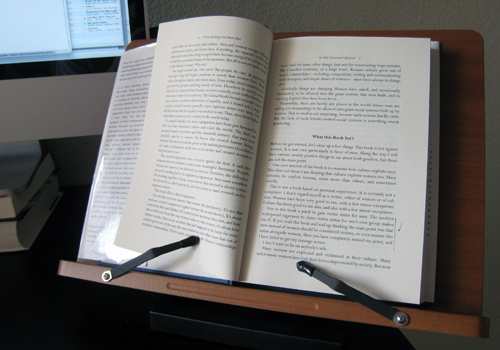
A few months ago I realized that I needed a better way to hold books as I copy passages for both reviews on this blog and for my academic work. A bit of Googling found some really janky looking products that led me to sigh and rig a solution that consisted of a bunch of heavy anthologies (those of you who were English majors might remember the infamous Nortons; they’ve finally become useful again, albeit in a way slightly different from their intent) to lean a book against, while the heaviest of them all sat slightly in front to hold the relevant book up.

Then Kevin Kelly’s blog Cool Tools came to the rescue through a review of the Freesia Book Stand:

This is a simple but well-designed book stand that does exactly what it sets out to do. It is sturdy enough to hold big, heavy textbooks, but [it] looks nice. It is impressively adjustable, allowing for nearly any reading angle . Amazingly, despite the ability to hold heavy books, the stand itself is relatively light (around 3 lbs). The stand has an anti-skid coating on the bottoms so that it stays where I put it.

Exactly what I wanted. Thank you, Stephanie Misono, for suggesting this. She says, “I now wish I had gotten it years ago.” Me too; I chose the Best Book Stand Jasmine, and it would’ve been insanely useful as an undergrad, when I spent many hours looking at computer science textbooks in particular, going back and forth from page to screen.

The Freesia version is too big, so I ordered the smaller version. I have something similar for standalone printed papers, but even that isn’t nearly as satisfying; I was making edits to a novel earlier, and I flipped from one page to another with greater ease by using the Jasmine. So it’s not only good for copying passages from books, but for holding edited pages.

Does this sound minor? Maybe it is, but managing to find the perfect tool to fulfill a major need is incredibly satisfying, and this is perhaps the best solution I’ve found to a major problem in my life since reading “Tool for Thought” by Steven Berlin Johnson, which concerns DevonThink Pro. Although these tools are useful on a micro level, they probably also change the nature of what I do; as Nicholas Carr says in The Shallows:

Even as our technologies become extensions of ourselves, we become extensions of our technologies […] every tool imposes limitations even as it opens possibilities. The more we use it, the more we mold ourselves to its form and function. […] Whenever we use a tool to exert greater control over the outside world, we change our relationship with that world.

I’m probably more likely to copy marginal passages from books now that it’s become marginally easier both to do so and to organize the output once I have done so. The Jasmine hasn’t yet faded to the point of it reaching what Heidegger called “readiness-to-hand” or “Zuhandenheit,” which, to use Graham Harman’s formulation, “refers to objects insofar as they withdraw from human view into a dark subterranean reality that never becomes present to practical action any more than it does to theoretical awareness.” I’m entirely aware of the Jasmine, which is part of its pleasure, but when it fades “into a dark subterranean reality,” it will be really incorporated into my work (I suspect that writing the dissertation might force this state on me, as one book after another checks in and check out).

The Jasmine cost about $30, with about $10 in shipping. I probably would’ve paid $100 for it. Maybe more. It’s difficult to overstate its usefulness, given the kind of work I do. Students, academics, and bloggers are an obvious audience, but I’m sure other groups would find it useful too.

Highly recommended — the Best Book Stand “Jasmine”

A few months ago I realized that I needed a better way to hold books as I copy passages for both reviews on this blog and for my academic work. A bit of Googling found some really janky looking products that led me to sigh and rig a solution that consisted of a bunch of heavy anthologies (those of you who were English majors might remember the infamous Nortons; they’ve finally become useful again, albeit in a way slightly different from their intent) to lean a book against, while the heaviest of them all sat slightly in front to hold the relevant book up.

Then Kevin Kelly’s blog Cool Tools came to the rescue through a review of the Freesia Book Stand:

This is a simple but well-designed book stand that does exactly what it sets out to do. It is sturdy enough to hold big, heavy textbooks, but [it] looks nice. It is impressively adjustable, allowing for nearly any reading angle . Amazingly, despite the ability to hold heavy books, the stand itself is relatively light (around 3 lbs). The stand has an anti-skid coating on the bottoms so that it stays where I put it.

Exactly what I wanted. Thank you, Stephanie Misono, for suggesting this. She says, “I now wish I had gotten it years ago.” Me too; I chose the Best Book Stand Jasmine, and it would’ve been insanely useful as an undergrad, when I spent many hours looking at computer science textbooks in particular, going back and forth from page to screen.

The Freesia version is too big, so I ordered the smaller version. I have something similar for standalone printed papers, but even that isn’t nearly as satisfying; I was making edits to a novel earlier, and I flipped from one page to another with greater ease by using the Jasmine. So it’s not only good for copying passages from books, but for holding edited pages.

Does this sound minor? Maybe it is, but managing to find the perfect tool to fulfill a major need is incredibly satisfying, and this is perhaps the best solution I’ve found to a major problem in my life since reading “Tool for Thought” by Steven Berlin Johnson, which concerns DevonThink Pro. Although these tools are useful on a micro level, they probably also change the nature of what I do; as Nicholas Carr says in The Shallows:

Even as our technologies become extensions of ourselves, we become extensions of our technologies […] every tool imposes limitations even as it opens possibilities. The more we use it, the more we mold ourselves to its form and function. […] Whenever we use a tool to exert greater control over the outside world, we change our relationship with that world.

I’m probably more likely to copy marginal passages from books now that it’s become marginally easier both to do so and to organize the output once I have done so. The Jasmine hasn’t yet faded to the point of it reaching what Heidegger called “readiness-to-hand” or “Zuhandenheit,” which, to use Graham Harman’s formulation, “refers to objects insofar as they withdraw from human view into a dark subterranean reality that never becomes present to practical action any more than it does to theoretical awareness.” I’m entirely aware of the Jasmine, which is part of its pleasure, but when it fades “into a dark subterranean reality,” it will be really incorporated into my work (I suspect that writing the dissertation might force this state on me, as one book after another checks in and check out).

The Jasmine cost about $30, with about $10 in shipping. I probably would’ve paid $100 for it. Maybe more. It’s difficult to overstate its usefulness, given the kind of work I do. Students, academics, and bloggers are an obvious audience, but I’m sure other groups would find it useful too.

Summary judgment – Lust in Translation: The Rules of Infidelity from Tokyo to Tennessee – Pamela Druckerman

Pamela Druckerman’s Lust in Translation is light on research, heavy on anecdote, and a nonetheless entertaining book in its examination of the contradictory responses adultery raises. It’s wrong, unless you’re in love, in which case it’s okay; it’s wrong, unless you’re in a country that permits multiple marriages, in which case it’s not adultery; it’s right, because everyone does it, in which case it’s okay, unless it’s not. Some countries appear more opposed to adultery and commit more of it while other appear less opposed while committing less. Opportunity matters: affairs are easier to arrange in rich countries where people have access to hotels, cars, and so on, but many rich countries (like the United States) engaged in relatively little adultery. Most of all, examining adultery brings out contradictions on both individual and societal levels.

Druckerman says, “Outside America, people have their own ideas about whom to have an affair with, how obliged the parties are to each other, and even how the whole thing should end.” Ditto for inside America, which, like most places, actually has many sexual cultures, not few. Druckerman points out that in some situations, like baseball teams, the culture conspires to allow adultery. Some novels play this idea took; think of Désirée Zapp in David Lodge’s Changing Places, who says, “I’ve always wanted to be chaste. It’s been so nice these last few weeks, don’t you think, living like brother and sister? Now we’re having an affair like everybody else. How banal.” In Désirée’s academic world (the novel was published in 1975 and probably has its roots closer to 1970 or 1965), everyone was having, or seemed to be having, affairs (Malcolm Bradbury’s The History Man portrays a similar effect). Now, on the contrary, more academics appear to be leading the relatively tame sexual lives of businesspeople.

Unless they’re not. “They” could refer to businesspeople or academics. Today’s scandal de jour involves Mark Hurd, the former HP CEO, who didn’t get offed for adultery, but for falsifying company reports to try and hide the adultery. Tomorrow it will be someone else. Druckerman points out that American rhetoric about cheating often involves the lying being as bad or worse than the sex. That’s a rule she’s intuited through many conversations and some reading. It’s the kind of rule many people pick up:

Infidelity may seem like a secret, lawless realm, in which people make private decisions about how to behave. We learn the rules through, among other sources, stories and gossip about how affairs play out. These shared narratives defined what is ‘normal’ in each place and shape our expectations about what should happen to a couple in the course of a long marriage. Of course, no one’s life follows the rules exactly. The point is that everyone in a society knows what the rules are and where their own behavior stands in relation to the rules.

The question is, how many people know “what the rules are,” don’t like them, and want to change them? Probably a small number, and an even smaller number actively work to change them. Yet those few are where change comes from: Gay Talese might be on example, since Thy Neighbor’s Wife chronicles sexual change in America and implicitly endorses changing mores. Of course, since that book came out around 1980, and Lust in Translation came out in 2010, Talese’s book arguably hasn’t had the effect he might have intended.

Social scientists call these “rules” about any subject of human behavior “scripts,” which people implicitly learn from the culture around them. That we have imbibed scripts even for forbidden behavior shouldn’t surprise us: if the behavior is common enough to be forbidden and to have norms or laws prohibiting it, that behavior is also probably common enough to occur. Scripts change based on context. In Hooking Up: Sex, Dating, and Relationships on Campus, Kathleen Bogle describes how the hookup script operates on college campuses—the same campuses that were once in loco parentis and now are closer to “anything goes as long as no one complains.” To Bogle, women complain about the hookup culture but feel powerless to do anything about it; this seems odd to me because women are the choosers and men are the chosen.

Their Chinese counterparts probably feel the same way at times, to return to Druckerman:

China’s sexual revolution [since the introduction of market capitalism] is very contagious. I keep hearing stories about married Western men who, after working in China for a few months, decide that monogamy really isn’t for them. Peer pressure shapes a sexual culture. When everyone around you is saying that cheating is normal, and that you’re entitled to indulge yourself and no harm will come of it, it starts to sound like a good idea.

“It starts to sound like a good idea:” presumably everyone thinks what they are doing is a good idea, while what their neighbor is doing is wrong, and what the people on the other side of the world are doing is worst of all, especially if those people are women. The most common thread running through Lust in Translation is hypocrisy, although Druckerman doesn’t take pains to point that out and follow where it might lead. She’s a journalist for the Wall Street Journal, which shows; I would’ve liked the book to draw broader, deeper conclusions, to examine more research on sexuality and culture, and to look more at evolutionary biology. Regarding the last, Druckerman says that “I assume that people everywhere have roughly the same mix of biological urges. I want to know how people in different cultures channel those urges.” But you can only do so if you have a reasonably strong understanding of what those urges might be and how incentives alter them.

You’re mostly left to draw your own conclusions from Lust in Translation, but the book is easy enough to read that you can finish it in three hours and still have enough substance to change the way you think—if you want to. Lust in Translation suggests that you’re less likely to change how you think and more likely to find cunning ways of justifying what you do and castigating what thy neighbor does. It’s not just the American way, but a common method of dealing with life all around the world.

Sex at Dawn — Christopher Ryan and Cacilda Jethá

EDIT: This review, from the journal Evolutionary Psychology, is the one I would’ve written if I’d been better read in the field and had more time to read extensively in it. Read the linked review if you really want to understand the problems with Sex at Dawn.

Furthermore, “The Myth of Promiscuity: A review of Lynn Saxon, Sex at Dusk: Lifting the Shiny Wrapping from Sex at Dawn” discusses the (many) problems with Sex at Dawn in a more complete fashion than I did. So if you’re looking for a deeper discussion than the one I can offer, consider Sex at Dusk.


My bottom-line assessment of Sex at Dawn: The Prehistoric Origins of Modern Sexuality is that the book would never get past peer review because so many of its descriptions of existing research and ideas are wrong or skewed. The book argues that humans are not “naturally” monogamous. That might be true. But Sex at Dawn doesn’t prove it. The data are ambiguous.

The biggest problem with the book starts on page 46, with the chapter “A Closer Look at the Standard Narrative of Human Sexual Revolution.” But there is no standard narrative of human sexual revolution: there are a wide array of people who have made inferences about the evolutionary basis of sexuality, but their narratives aren’t consistent and new papers and ideas constantly jostle or replace old ones. Ryan and Jethá don’t cite anyone else who claims a “standard” narrative, because to my knowledge no one has, and the standard narrative they cobble together is just that: cobbled together from a variety of sources with a variety of views.

I mentioned the lack of citations as a problem that occurs in their chapter on the standard narrative. It continues throughout the book. On page 293, Ryan and Jethá say that “To avoid the genetic stagnation that would have dragged our ancestors into extinction long ago, males evolved a strong appetite for sexual novelty and a robust aversion to the overly familiar.” But they don’t have any evidence for that. Similarly, they accuse scientists and others of claiming that monogamy is “natural” or inborn and cite, the anthropologist Owen Lovejoy as saying, “The nuclear family and human behavior may have their ultimate origin long before the dawn of the Pleistocene” (34). And he’s right: such behaviors may have their origins there. Or they may not have. Good scientists tend to be more tentative than polemicists because scientists recognize the fragility of so much human knowledge.

In Melvin Konner’s The Evolution of Childhood, he writes:

A double standard of sexual restriction is common across cultures; still, most human marriages have been mainly monogamous, owing either to environmental constraint or cultural principle. Modern cultures are monogamous in principle, but both adultery and serial monogamy are common. In at least thirty-seven countries, men express preference for women several years younger than themselves and place more emphasis on appearance, while women prefer men several years older and emphasize status and wealth (41).

The “environmental constraint” is important because it takes a lot of resources to support multiple spouses; this means that most men in most places and most conditions cannot afford to support multiple women. One woman might be able to support or be supported by multiple men, but polyandry is far less common than polygyny, as Konner points out. This is probably as close to accurate as one is likely to get regarding the historical or anthropological record on the subject of polygamy. It also has the advantage of coming from someone who spent his entire career on the subject of childhood development and who is deeply familiar with the vast literature surrounding evolution, anthropology, and childhood.

Ryan and Jethá also have many sections where they ask rhetorical questions or pit themselves against imaginary foes of great power; the page after the Lovejoy quote, they say, “This is what we’re up against. It’s a song that is powerful, concise, self-reinforcing, and playing on the radio all day and all night . . . but still wrong, baby, oh so wrong” (35). Enough with the polemics: if you’re right, show us that you’re right and leave the judgment up tot he reader.

Dan Savage called Sex at Dawn “the single most important book about human sexuality since Alfred Kinsey unleashed Sexual Behavior in the Human Male on the American public in 1948.” The statement is hyperbolic and unlikely but nonetheless demonstrates the power of the book, especially when America’s most famous sex columnist is pimping it, so to speak.

In addition, Kinsey was at least doing original research by taking and compiling sexual histories. Ryan and Jethá aren’t: they’re rehashing a variety of other people’s research, and in doing so regularly misrepresenting that research. Furthermore, Kinsey was reacting to a much, much different culture than ours today; Sexual Behavior in the Human Male had essentially no real forerunners, while Sex at Dawn is a weak entry to a crowded field of evolutionary biologists and psychologists like Geoffrey Miller (The Mating Mind), Sarah Blaffer Hrdy (The Woman Who Never Evolved, and David Buss). All three get cited, but out of context, and their deeper arguments are never really engaged. I don’t think it a coincidence that all three are academics.

For another example of imprecision in Sex at Dawn, Ryan and Jethá point out that men are only 10% – 20% larger than women (in polygynous species, the larger the size difference between sexes, the greater the number of sex partners). But that raw size or height difference way underestimates how that size translates to muscle. Consider David Potts’ work:

When fat-free mass is considered, men are 40% heavier (Lassek & Gaulin, 2009; Mayhew & Salm, 1990) and have 60% more total lean muscle mass than women. Men have 80% greater arm muscle mass and 50% more lower body muscle mass (Abe, Kearns, & Fukunaga, 2003). Lassek and Gaulin (2009) note that the sex difference in upper-body muscle mass in humans is similar to the sex difference in fat-free mass in gorillas (Zihlman & MacFarland, 2000), the most sexually dimorphic of all living primates.

These differences in muscularity translate into large differences in strength and speed. Men have about 90% greater upper-body strength, a difference of approximately three standard deviations (Abe et al., 2003; Lassek & Gaulin, 2009). The average man is stronger than 99.9% of women (Lassek & Gaulin, 2009). Men also have about 65% greater lower body strength (Lassek & Gaulin, 2009; Mayhew & Salm, 1990), over 45% higher vertical leap, and over 22% faster sprint times (Mayhew & Salm, 1990).

(That’s from Puts, David, A. “Beauty and the Beast: Mechanisms of Sexual Selection in Humans.” Evolution & Human Behavior 31.3 (2010): 157-75.)

The weird thing is that this information supports their assertion that humans are polygynous but hurts their assertion that early societies were mostly kind and peaceful, which they probably weren’t, per Lawrence Keeley’s War Before Civilization. Both the Potts paper and the Keeley book are the kinds of things that peer reviewers should be apt to point out.

Even when they aren’t simplifying the research others have done or selectively quoting writers without fully engaging in their arguments, Ryan and Jethá are merely poor writers. Take this: “For better or worse, the human female’s naughty bits don’t swell up to five times their normal size and turn bright red just to signal her sexual availability,” which is true in many species of apes. But note how bad this writing is: the sentence starts with a cliche, moves on to a childish description of women more appropriate to 14-year-olds than a real book and that also reinforces the very cultural forces the authors are trying to counteract, and then proceeds to something that has already been stated earlier in the chapter. The writing in much of the book is equally bad, the reasoning sloppy, and the thought underdeveloped. Which isn’t to say the book doesn’t have interesting or useful elements—it does—but those tend to get subsumed by its flaws.

The more I read about humanity, history, and the rhetoric of authenticity, naturalness, human instinct, and the like, the more I think there aren’t such things and the claims about what is “natural” reflect more about the person making the claim than anything about humanity itself. I would say that it’s natural for people to make claims about what is natural, but relatively little else is; circumstances affect so much that it’s hard to perceive many higher order behaviors as anything other than reflecting the bizarre combinations of self and environment.

People simply vary widely in their preferences, and most appear to view whatever society and subculture they grew up in as normal and natural. I posit that it’s not normal or abnormal to be polygamous or monogamous: in some circumstances one might make more sense, and in others the other strategy would. And people are too variable to say one mode is completely correct for all people under all circumstances.

I had actually begun this post before I read Paul Graham’s latest essay, “The Top Idea in Your Mind.” This part especially resonated:

I’ve found there are two types of thoughts especially worth avoiding—thoughts like the Nile Perch in the way they push out more interesting ideas. One I’ve already mentioned: thoughts about money. Getting money is almost by definition an attention sink. The other is disputes. These too are engaging in the wrong way: they have the same velcro-like shape as genuinely interesting ideas, but without the substance. So avoid disputes if you want to get real work done. [3]

To really catalog everything that’s wrong with Sex at Dawn, I’d have to go back through at least five or six books (and probably more) and at least a dozen papers. It would take me all day. Why spend that much time on a book that’s not very good? A while ago I promised myself that I wasn’t going to write many more posts on books that are bad in a generic way that doesn’t do anything special because I’m usually not spending my time in an optimal way. And reading Sex at Dawn is unlikely to be an optimal use of your time.

Anathem — Neal Stephenson

I read Anathem when it came out and tried it again recently because I’m a literary masochist. It concerns a giant graduate school/university where really smart people gather in seclusion from the rest of humanity, who are busy running around distracted by cell phones (now called “jeejahs”), futuristic TV, and religious-style demagogues. Erasmus (get it?) is in the middle of this and realizes something bad is going to happen. He’s a low-ranked “avout” who lives in one of those cloisters, which demands an kind of autarky of ideas, a bit like Vermont without Internet access. There are a lot of passages like this, taken from the beginning:

Guests from extramuros, like Artisan Flec, were allowed to come in the Day Gate and view auts from the north nave when they were not especially contagious and, by and large, behaving themselves. This had been more or less the case for the last century and a half.

It’s unfair to take this out of context and not explain what the hell is going on. But for the first quarter to half of the book, there is no context until you’ve created your own.

Confused yet? Hopefully not too much; if you pick up Anathem, you will be further. The novel famously comes with a glossary, which reads like code with too many GOTOs in it. And if I make the novel sound ridiculous, I’m doing so intentionally and picking up the flavor of those lofty New Yorker reviews whose greatest tactic against the manufactured noise and lights that sometimes pass as popcorn movies is ridicule. In Stephenson’s case, the noise is highbrow and intellectual, or maybe pseudo-intellectual, but noise nonetheless, regardless of the number of philosophic references put in it.

The biggest problems with the silly vocabulary is that it a) makes the the novel harder to take seriously, even in a humorous way, and b) make it more likely that readers will abandon the novel before reading it, and in turn badmouth it to their friends (and on their blogs, as I’m doing). I wanted to like the novel, but Neal Stephenson is beginning to feel like Melville: someone who peaked before he stopped writing novels, to the detriment of his readers, but who nonetheless still writes a lot of unconventional and interesting stuff. Stephenson’s Moby Dick is Cryptonomicon, a novel still justifiably beloved, and his earlier novels The Diamond Age and Snow Crash are both unusually strong science fiction.

By now, one gets the sense no one restrains Stephenson’s grandest impulses: the long well-done novel is a unique beauty, but the poorly done long novel is more likely to be abandoned than finished, and one could say that all the more of a poorly done series of long novels like The Baroque Trilogy , which is destined not to be a collected in a single physical volume thanks to its heft.

In Further Fridays, John Barth writes of great thick books that “One is reminded that the pleasures of the one-night stand, however fashionable, are not the only pleasures. There is also the extended, committed affair; there is even the devoted, faithful, happy marriage. One recalls, among several non-minimalist Moderns, Vladimir Nabokov seconding James Joyce’s wish for ‘the ideal reader with the ideal insomnia.’ ” Neal Stephenson answers this call for heft and then some: Cryptonomicon is a marvelous book that would demand more than a single night of insomnia to read, and yet none of it seems extraneous, or at least not in a way that deserves to be cut. Even the several page description of how one should eat Captain Crunch seems apt to the mind of the hackers and proto-hackers Stephenson follows. So it is again with Anathem, a novel whose demands are much greater.

Stephenson has made steadily greater demands of his readers, and I wonder if those demands were most justified for Cryptonomicon. Midway through Quicksilver I gave up, and what The Baroque Trilogy demands in sheer length, Anathem demands in depth. As has often been mentioned in reviews, it has a glossary, and the dangers of it are well-expressed by this graph:

(I will note, however, that one of my favorite novels of all times has not just made up words, but an entire made-up language embedded: Lord of the Rings. So it’s important to note that the probability of a book being good descends but never reaches zero, at least as far as we can tell from this graph.)

One other point: as Umberto Eco said of The Name of the Rose:

But there was another reason [beyond verisimilitude to the perspective of a 14th C. monk] for including those long didactic passages. After reading the manuscript, my friends and editors suggested I abbreviate the first hundred pages, which they found very difficult and demanding. Without thinking twice, I refused, because, as I insisted, if somebody wanted to enter the abbey and live there for seven days, he had to accept the abbey’s own pace. If he could not, he would never manage to read the whole book. Therefore those first hundred pages are like penance or an initiation, and if someone does not like them, so much the worse for him. He can stay at the foot of the hill.
Entering a novel is like going on a climb in the mountains: you have to learn the rhythm of respiration, acquire the pace; otherwise you stop right away.

Or, worse, you might think you get to the mountain’s summit and then intellectually die during the descent (and yes, the link embedded in this sentence is highly relevant to the issue at hand).

In the novel, Stephenson is dealing with the potential for an increasingly bifurcated society with supernerds on one side and proles on the other. You can see the same ideas in 800 words instead of 120,000 in his essay Turn On, Tune In, Veg Out, which I assign to my freshmen every semester and which almost none of them really get.

Still, the concern that smart people are going to rule others does have a certain pedigree, and the idea of a cerebral superclass detached from the material world is hardly a new one; monks were an expression of it in a religious context for centuries if not longer. H.G. Wells thought of something not dissimilar in his idea of an “Open Conspiracy,” through which leading scientists and philosophers would form a benevolent world government. In Richard Rhodes’ The Making of the Atomic Bomb, he describes physicist Leo Szilard similar conception of an improbably super-competent elite ruling the world:

[…] we could create a spiritual leadership class with inner cohesion which would renew itself on its own.

Members of this class would not be award wealth or personal glory. To the contrary, they would be required to take on exceptional responsibilities, “burdens” that might “demonstrate their devotion.”

Sounds great. Keep them away from me.

People who like second-hand philosophy and who need a superiority complex or to feed one that’s developing might like Anathem. Mastering it is perhaps as esoteric as being able to quote at will from Hegel The Phenomenology of Spirit and about as fun. I’ve barely talked about the novel, the text, and the story because the story feels like a skeleton for the novel’s concerns. Again, like Melville, Stephenson seems to have forgotten about the pull of story in his later.

Umberto Eco, in contrast, is another writer of enormous books filled with ideas, and his two best—The Name of the Rose and Foucault’s Pendulum contrast with weaker efforts in those others—like The Island of the Day Before and The Invisible Flame of Queen Loanna—become obsessed with how story is told rather than the story itself. The “how” is a fine subject to address in novels, as many postmodernist novels do, but it can’t be subjugated to the what—otherwise one isn’t writing a novel; one is writing literary criticism. Trying to shoehorn the latter into the former isn’t going to create anything but boredom, with characters who aren’t characters but Vessels of Great Meaning. Erasmus in Anathem isn’t a person—he’s a convenient way to explore ideas. I’d like a character who explores the idea of why idea must be integrated into characters rather than vice-versa.

Is there something wrong with story? For a novel to work, its meaning has to be at most equal to, but more likely subsumed beneath, its story and the language used to convey that story. But Anathem is too busy preening to let that happen. I’m reminded of something Philip Pullman said regarding the His Dark Materials Trilogy: for every page he wrote he threw five away, and he concentrated ceaselessly on moving it along. That has our hero, Lyra, in a closet, where she’s hiding because she’s broken a rule and sees someone attempt to poison her father, a returning hero. The novel moves ever faster from there.

It’s a beginning so forceful that I’m recalling it by memory. Where does Anathem begin again? I can’t remember, and I look at the tome on my desk and considering finding out. If I were to force myself to remember, it would be doing so with all the joy of memorizing for school. His Dark Materials, in contrast, I remember for pure joy, and for its impact.

This is, to be sure, an overlong post, but it suits an overlong novel. Let this serve as a warning regarding and substitute for Anathem.

The Shallows: What the Internet is Doing to Our Brains — Nicholas Carr

One irony of this post is that you’re reading a piece on the Internet about a book that is in part about how the Internet is usurping the place of books. In The Shallows, Carr argues that the Internet encourages short attention spans, skimming, shallow knowledge, and distraction, and that this is a bad thing.

He might be right, but his argument misses one essential component: the absolute link between the Internet and distraction. He cites suggestive research but never quite crosses the causal bridge from the Internet as inherently distracting, both because of links and because of the overwhelming potential amount of material out there, and that we as a society and as a people are now endlessly distracted. Along the way, there are many soaring sentiments (“Our rich literary tradition is unthinkable without the intimate exchanges that take place between reader and writer within the crucible of a book”) and clever quotes (Nietzsche as quoted by Carr: “Our writing equipment takes part in the forming of our thoughts”), but that causal link is still weak.

I liked many of the points Carr made; that one about Nietzsche is something I’ve meditated over before, as shown here and here (I’ve now distracted you and you’re probably less likely to finish this post than you would be otherwise; if I offered you $20 for repeating the penultimate sentence in the comments section, I’d probably get no takers); I think our tools do cause us to think differently in some way, which might explain why I pay more attention to them than some bloggers do. And posts on tools and computer set ups and so forth seem to generate a lot of hits; Tools of the Trade—What a Grant Writer Should Have is among the more popular Grant Writing Confidential posts.

I use Devonthink Pro as described by Steven Berlin Johnson, which supplements my memory and acts as research tool, commonplace book, and quote database, and probably weakens my memory while allowing me to write deeper blog posts and papers. Maybe I remember less in my mind and more in my computer, but it still takes my mind to give context to the material copied into the database.

In fact, Devonthink Pro helped me figure out a potential contradiction in Carr’s writing. On page 209, he says:

Even as our technologies become extensions of ourselves, we become extensions of our technologies […] every tool imposes limitations even as it opens possibilities. The more we use it, the more we mold ourselves to its form and function.

But on page 47 he says: “Sometimes our tools do what we tell them to. Other times, we adapt ourselves to our tools’ requirements.” So if “sometimes our tools do what we tell them to,” then is it true that “The more we use it, the more we mold ourselves to its form and function?” The two statements aren’t quite mutually exclusive, but they’re close. Maybe reading Heidegger’s Being and Time and Graham Harman’s Tool-Being will clear up or deepen whatever confusion exists, since he a) went deep but b) like many philosophers, is hard to read and is closer to a machine for generating multiple interpretations than an illuminator and simplifier of problems. This could apply to philosophy in general as seen from the outside.

This post mirrors some of Carr’s tendencies, like the detour in the preceding paragraph. I’ll get back to the main point for a moment: Carr’s examples don’t necessarily add up to proving his argument, and some of them feel awfully tenuous. Some are also inaccurate; on page 74 he mentions a study that used brain scans to “examine what happens inside people’s heads as they read fiction” and cites Nicole K. Speer’s journal article “Reading Stories Activates Neural Representations of Visual and Motor Experiences,” which doesn’t mention fiction and uses a memoir from 1951 as its sample text.

Oops.

That’s a relatively minor issue, however, and one that I only discovered because I found the study interesting enough to look up.

Along the way in The Shallows we get lots of digressions, and many of them are well-trod ones: the history of the printing press; the origins of the commonplace books; the early artificial intelligence program ELIZA; Frederick Winslow Taylor and his efficiency interest; the plasticity of the brain; technologies that’ve been used for various purposes, including metaphor.

Those digressions almost add up to one of my common criticisms of nonfiction books, which is that they’d be better as long magazine articles. The Shallows started as one, and one I’ve mentioned before: “Is Google Making Us Stupid?” The answer: maybe. The answer now, two years and 200 pages later: maybe. Is the book a substantial improvement on the article? Maybe. You’ll probably get 80% of the book’s content from the article, which makes me think you’d be better off following the link to the article and printing it—the better not to be distracted by the rest of The Atlantic. This might tie into the irony that I mentioned in the first line of this post, which you’ve probably forgotten by now because you’re used to skimming works on the Internet, especially moderately long ones that make somewhat subtle arguments.

Offline, Carr says, you’re used to linear reading—from start to finish. Online, you’re used to… something else. But we’re not sure what, or how to label the reading that leads away from the ideal we’ve been living in: “Calm, focused, undistracted, the linear mind is being pushed aside by a new kind of mind that wants and needs to take in and dole out information in short, disjointed, often overlapping bursts—the faster, the better.”

Again, maybe, which is the definitive word for analyzing The Shallows: but we don’t actually have a name for this kind of mind, and it’s not apparent that the change is as major as Carr describes: haven’t we always made disparate connections among many things? Haven’t we always skimmed until we’ve found what we’re looking for, and then decided to dive in? His point is that we no longer do dive in, and he might be right—for some people; but for me, online surfing, skimming, and reading coexists with long-form book reading. Otherwise I wouldn’t have had the fortitude to get through The Shallows.

Still, I don’t like reading on my Kindle very much because I’ve discovered that I often tend to hop back and forth between pages. In addition, grad school requires citations that favor conventional books. And for all my carping about the lack of causal certainty regarding Carr’s argument, I do think he’s on to something because of my own experience. He says:

Over the last few years I’ve had an uncomfortable sense that someone, or something, has been tinkering with my brain, remapping the neural circuitry, reprogramming the memory. My mind isn’t going—so far as I can tell—but it’s changing. I’m not thinking the way I used to think. I feel it most strongly when I’m reading. I used to find it easy to immerse myself in a book or a lengthy article. My mind would get caught up in the twists of the narrative or the turns of the argument, and I’d spend hours strolling through long stretches of prose. That’s rarely the case anymore. Now my concentration starts to drift after a page or two. I get fidgety, lose the thread, begin looking for something else to do. I feel like I’m always dragging my wayward brain back to the text. The deep reading that used to come naturally has become a struggle.

I think I know what’s going on. For well over a decade now, I’ve been spending a lot of time online, searching and surfing and sometimes adding to the great databases of the Internet.

He says friends have reported similar experiences. I feel the same way as him and his friends: the best thing I’ve found for improving my productivity and making reading and writing easier is a program called Freedom, which prevents me from getting online unless I reboot my iMac. It throws enough of a barrier between me and the Internet that I can’t easily distract myself through e-mail or Hacker News (Freedom has also made writing this post slightly harder, because during the first draft, I haven’t been able to add links to various appropriate places, but I think it worth the trade-off, and I didn’t realize I was going to write this post when I turned it on). Paul Graham has enough money that he uses another computer for the same purpose, as he describes in the linked essay, which is titled, appropriately enough, “Disconnecting Distraction” (sample: “After years of carefully avoiding classic time sinks like TV, games, and Usenet, I still managed to fall prey to distraction, because I didn’t realize that it evolves.” Guess what distraction evolved into: the Internet).

Another grad student in English Lit expressed shock when I told him that I check my e-mail at most once a day and shook for every two days, primarily in an effort not to distract myself with electronic kibble or kipple. Carr himself had to do the same thing: he moves to Colorado and jettisons much of his electronic life, and he “throttled back my e-mail application […] I reset it to check only once an hour, and when that still created too much of a distraction, I began to keeping the program closed much of the day.” I work better that way. And I think I read better, or deeper, offline.

For me, reading a book is a very different experience from searching the web, in part because most of the websites I visit are exhaustible much faster than books. I have a great pile of them from the library waiting to be read, and an even greater number bought or gifted over the years. Books worth reading seem to go on forever. Websites don’t.

But if I don’t have that spark of discipline to stay off the Internet for a few hours at a time, I’m tempted to do the RSS round-robin and triple check the New York Times for hours, at which point I look up and say, “What did I do with my time?” If I read a book—like The Shallows, or Carlos Ruiz Zafon’s The Shadow of the Wind, which I’m most of the way through now—I look up in a couple of hours and know I’ve done something. This is particularly helpful for me because, as previously mentioned, I’m in grad school, which means I have to be a perpetual reader (if I didn’t want to be, I’d find another occupation).

To my mind, getting offline can become a comparative advantage because, like Carr, “I’ve had an uncomfortable sense that someone, or something, has been tinkering with my brain,” and that someone is me and that someone is the Internet. But I can’t claim this is true for all people in all places, even as I tell my students to try turning off their Internet access and cell phones when they write their papers. Most of them no doubt don’t. But the few who do learn how to turn off the electronic carnival are probably getting something very useful out of that advice. The ones who don’t probably would benefit from reading The Shallows because they’d at least become aware of the possibility that the Internet is rewiring our brains in ways that might not be beneficial to us, however tenuous the evidence (notice my hedging language: “at least,” “the possibility” “might not”).

Alas: they’re probably the ones least likely to read it.
The Enlightened Economy: An Economic History of Britain 1700 – 1850 — Joel Mokyr

Ideas matter. So does the ability to execute those ideas. Britain had both, in the form of the Enlightenment and the Industrial Revolution, both of which were important but neither of which has been fully considered as twinned phenomena. Nows they have been, and have been impressively.

The Enlightened Economy sounds boring but isn’t, and it ties together two trends that Mokyr argues should be appreciated more: the dovetailing of the Enlightenment and the Industrial Revolution, both of which are entangled and driven by ideas to a greater extent than previously appreciated. Both were concerned with ideas; both occurred around the same time; and many participants in one also participated in the other. Furthermore, ideas motivated both; as Mokyr says, “Ideas, in the eighteenth century as much as the twentieth, competed in a market for ideas.” But the idea of a marketplace of ideas was new and relied on a lessening of religious control and a greater willingness to challenge existing ideas and beliefs. Ideas had to be “contestable,” as well as cumulative and consensual, to become useful and lead toward exponential growth. The strange thing is still that the Industrial Revolution didn’t happen earlier or in some other place. The other strange thing is how many ideas that played out across the eighteenth century continue to play out today, as reading The Enlightened Economy or Louis Dupré’s excellent The Enlightenment and the Intellectual Foundations of Modern Culture shows.

In terms of economic structure and organizations, consider that Mokyr writes that “More than anything else, the reduction in [the power of British trade guilds] was hastened by mobility; many of the activities that urban craft guilds controlled could and did move out of their geographic sphere to the countryside or to towns free from guild control.” Later on the same page, he says that “The London guilds, known as ‘livery companies’ saw their powers erode when economic activity moved to the suburbs such as Whitechapel and Spitalfields.” You can see the same issues with union or government control versus the private sector, which is still widely debated.

The same basic dynamic has been occurring in the United States for decades: heavy manufacturing in the Northeast and Midwest has become more mobile, both abroad to places like China and Mexico as well as to union-unfriendly Southern states like Alabama. Recent wrangling around car company bailouts showed that political logic follows economic logic: senators representing states with BMW, Toyota, Honda, and Audi plants fulminated against bailouts, while northern states where unions still have some power favored bailouts. In the meantime, however, union power has been waning in the private sector for years, even as it has grown in the public sector, where the inability of cities, towns, school districts, and the like to go bankrupt thanks to immediate competition allows unions to exist. Still, the overall direction of the world is obvious to current observers, even if it wasn’t to many eighteenth Century ones. The power of individual and capital mobility lessens the power of rent seekers (Mokyr: “In the second half of the eighteenth century, most important intellectuals became increasingly hostile to what modern economists would call rent-seeking, namely the use of political power to redistribute rather than create wealth”).

As mentioned previously, one major issue and still unresolved issue is why the Industrial Revolution happened when and where it did. Almost no one knows. The discovery process itself became systematized:

The pre-modern economies were at times capable of creating radical inventions, but such advances tended to settle down rather quickly into new dominant design largely because most inventions were arrived at through trial and error and hit-and-miss procedures. Systematic research and development based on something we would recognize today as scientific rigor was still highly uncommon.

And those techniques are only more common because we pass them down and forget less successful techniques.

Of course, Mokyr is in part writing about the current economy: he writes about workers, locations, idea transmission, and more. Today, Richard Florida relies heavily on concept of “the creative class” (I wonder if I’m a member) in his writing and “highly qualified personnel” (HPQs), as Alex Usher calls them in an academic context. The most interesting thing is how (relatively) few of such people, networked together, can make an enormous difference in not just the quality of their own lives but the productivity of everyone around them. As Paul Graham says in “Taste for Makers“, “Nothing is more powerful than a community of talented people working on related problems. Genes count for little by comparison […]” I’ve been looking for more formal studies of the general ideas around talent clustering but haven’t been able to find any. Nonetheless, such people are likely to be the ones who push society forward through thinking or finding new ideas, becoming repositories of ideas, or seeking new methods of doing things. As Mokyr says:

[… I]t is important to realize that an economy in which there are innovators is not one in which all or even most people are inclined to experiment or to take risks, much less express their disrespect for the wisdom of their teachers and ancestors by declaring the new to be better.

We still see elements of this kind of thinking in the education system, although the system seems better at critiquing itself than it once might have been in the past. Self-modification is relatively rare. The absolute number of people willing to be innovators might now be higher, the percentage might be the same. The comparisons between the eighteenth century and now, which Mokyr sometimes makes and sometimes leaves to the reader, might be the most radical and unusual parts of this book.

It is a book about ideas that on its own contains many ideas that illuminate how the world was changing—and how it is today, as we live in a society that is saturated with ideas—provided that we are willing to find and follow those ideas. And think about them on a meta level—in other words, deal with ideas about ideas. This is relatively hard and requires a lot of training to accomplish. Mokyr reminds us of why it is important.


A final note about the materiality of the book in question: The Enlightened Economy is scholarly and concomitantly expensive. It’s also very nicely bound and easy to read. It feels like it will last a very long time, which is good, because I haven’t digested it yet and doubt many could in a first reading.

The Possessed: Adventures with Russian Books and the People Who Read Them — Elif Batuman

I’ve been trying and failing to satisfactorily describe The Possessed: Adventures with Russian Books and the People Who Read Them to friends and failing to get across the book’s humor, which is unusually rich and deep. Whoever wrote the back cover blurb, with its weird melange of subject matters like a demented person’s shopping list, outdoes me:

If you’re going to read just one book about conference planning, Isaac Babel, Leo Tolstoy, boys’ leg contests, giant apes, Uzbek poetry, the life of the mind, and the resignation of the soul—seek no farther: this is the book for you!!!

It’s funnier still in Roz Chast’s handwriting. The humor, taken out of context, falls flat without the build up from earlier material, as Batuman describes situations that become jokes absurd academic setups involving the relatives of Isaac Babel or the relationship traumas experienced by our plucky, self-aware narrator. Actually, plucky isn’t a fair word: Batuman is deep, and not just because she reads a lot and lives a lot and finds ways to combine living and not living, as when she sees Don Quixote:

Don Quixote, I realized, had broken the binary of life and literature. He had lived life and read books; he lived life through books, generating an even better book. Foucault, meanwhile, broke my idea of literary theory: instead of reducing complexity and beauty, he had produced it. My interest in truth came only later, but beauty had already begun to draw me into the study of literature.

Except that Don Quixote pays for his broken binary with social opprobrium that he, wisely or not, doesn’t realize (or chooses not to realize), and his end on a deathbed leads to his famous renunciation of books of chivalry.

The life lived through books is, to some extent, the only kind of life we can have—or, alternately, we learn to lead our own lives through the narrative examples that others set for us, whether through their being or their stories. And we understand the stories of a single other person better by understanding the stories told by cultures better.

That last sentence is somewhat vague. Let me cite a comic example of someone utterly failing to do so:

While it’s true that, as Tolstoy observed, every unhappy family is unhappy in its own way, and everyone on planet Earth, vale of tears that it is, is certainly entitled to the specificity of his or her suffering, one nonetheless likes to think that literature has the power to render comprehensible different kinds of unhappiness. If it can’t do that, what’s it good for? On those grounds I once became impatient with a colleague at a conference, who was trying to convince me that the Red Cavalry cycle would never be totally accessible to me because of Lyutov’s ‘specifically Jewish alienation.’
‘Right,’ I finally said. ‘As a six-foot-tall first-generation Turkish woman growing up in New Jersey, I cannot possibly know as much about alienation as you, a short American Jew.’
He nodded: ‘So you see the problem.’

We moved from the high brow, about the power of literature and the reference to the “vale of tears,” to the very low brow, which entails virtually anything having to do with New Jersey, to the middle brow of self absorption. This is good stuff.

And if literature can’t render comprehensible different kinds of unhappiness, maybe it’s still good for passing the time until death, or at least idle cocktail party chatter, or at least impressing potential sexual partners with literary repartee, assuming you find the right sort of partner. For Batuman, grad school is that sort of place, although she also dates a banker (it doesn’t work out), and one or two others I’ve forgotten.

There are other grad school jokes, which I have a special appreciate for because I’m in it, and those sometimes combine jokes about Russia (which are also common): “The title of this book is borrowed from Dostoevsky’s weirdest novel, The Demons, formerly translated as The Possessed, which narrates the descent into madness of a circle of intellectuals in a remote Russian province: a situation analogous, in certain ways to my own experiences in graduate school.”

Batuman actually ends up in a remote, former Russian province, in the form of Uzbekistan, where a series of bureaucratic and financial snafus combined with questionable decision making lead her. During a tedious bit of orientation in preparation for going to Uzbekistan, Batuman leaves to find a hat. Despite the risk of death, maybe Batuman is better off in the Caucuses, thinking:

Somehow I ended up in an Urban Outfitters. All around me, girls were buying absolutely unwearable-looking clothes: sheer dresses with V-necks down to the navel; jeans measuring literally two inches from waist to crotch; rhinestone encrusted G-strings with no elasticity whatsoever. I found a hideous white ill-fitting sun hat, bought it, and fled to Barnes & Noble.

She’s not one of them; she’s one of us, which I can say merely because she agrees with me about airports and airplanes (“Air travel is like death: everything is taken from you.”) Compare that to one of my recent ruminations:

As I write this, I sit in a Tucson airpot bar. Airports have everything wrong with them: they are transitional, one-off spaces filled with strangers, the “restaurants” they offer consist of pre-made food with character slightly above a TV dinner, and for some reason we as a society have decided that Constitution rights and privacy don’t apply here. People I don’t know can stop me at will, and merely flying requires that I submit to security theater that is simultaneously ineffective and invasive. Everything is exorbitantly expensive but not of particularly high quality. Menus don’t have beer prices on them.

The airport, in short, is designed to extract money from a captive audience; this might be in part why I don’t care much for sports stadiums, Disneyland, and other areas where I feel vaguely captive.

But I’m less funny than Batuman, which is a good reason to read her, despite the improbability of her subject matter. Batuman’s language is wonderful too: she says that she’s going to Tashkent with “Dan… who was indescribably average in both appearance and demeanor, like some kind of composite sketch.” The comparison is fresh, describes Dan without describing him, and, more importantly, shows exactly how Batuman thinks of him, even if he has some kind of vibrant inner life not apparent on the surface. If so, alas, we get little indication of that inner life, which might be part of his problem, and the problem of many of those who don’t have adventures in Russian books—or any kind at all.

(Here’s a comment on The Possessed from the Literary Saloon.)

Non-Places: Introduction to an Anthropology of Supermodernity — Marc Augé

Marc Augé’s Non-Places: Introduction to an Anthropology of Supermodernity is fascinating because it describes a process and some places that almost all of us feel like we’ve been. In my post about Lewis Hyde’s The Gift, I wrote about one such bureaucratized space in the form of airports:

As I write this, I sit in a Tucson airpot bar. Airports have everything wrong with them: they are transitional, one-off spaces filled with strangers, the “restaurants” they offer consist of pre-made food with character slightly above a TV dinner, and for some reason we as a society have decided that Constitution rights and privacy don’t apply here. People I don’t know can stop me at will, and merely flying requires that I submit to security theater that is simultaneously ineffective and invasive. Everything is exorbitantly expensive but not of particularly high quality. Menus don’t have beer prices on them.

The airport, in short, is designed to extract money from a captive audience; this might be in part why I don’t care much for sports stadiums, Disneyland, and other areas where I feel vaguely captive.

And it’s miserable, at least to me, and Augé traces that feeling at least partially to a place’s relationship or lack thereof with history. His book is useful because it offers a theoretical framework for understanding why we think of some places the way we do and frustrating because it’s written in French academic-ese. John Howe translates it but can’t change the fact that most of the book is actually concerned with how ethnologists view places. In other words, the major action described by the title isn’t reached until about two thirds of the way through the book. And it takes until page 94, and nearly at the end, to get a somewhat clear definition of what constitutes a “non-place:”

Clearly the word ‘non-place’ designates two complementary but distinct realities: spaces formed in relation to certain ends (transport, transit, commerce, leisure), and the relations that individuals have these spaces. Although the two sets of relations overlap to a large extent, and in any case officially (individuals travel, make purchases, relax), they are still not confused with one another; for non-places mediate a whole mass of relations, with the self and with others, which are only indirectly connected with their purposes. As anthropological places create the organically, so non-places create solitary contractuality.

Any time someone uses “clearly” or “obviously,” they should have their text examined more carefully, because anything that is genuinely clear or obvious doesn’t need the modifier. The text itself is unsure: what are “certain ends” as opposed to “non-certain ends?” I’m not sure: maybe he means where people live. What is the ‘organically social?’ Presumably something like neighborhoods, common cause, not “Bowling Alone” and the like. The gap between what is said and what is probably meant looms large with these phrases, even if the passage as a whole at least yields some kind of framework for discussing the problem.

I would say that non-places are basically commerce or exchange economies, while places are gift economies. In other words, in non-places one cannot have any real recourse to common humanity: you can’t ask to borrow something, to be done a favor, or to expect to know the myriad of strangers you cross. In a place, you can expect to have local knowledge, to not have to rely entirely on signs, to be able to decorate it as you will, and to have the opportunity for whimsy.

One thing I like about universities is that they do a decent job of being both gift and commerce economies, thanks in part to state subsidies: although my students have to pay the bursar’s office to take my class, once they are within it, we do not discuss or exchange money directly, and this mediating bureaucratic influence helps maintain something closer to a gift economy. Most professors I have met are more than willing to give their time to those who do not waste it and who wish to learn. By “do not waste it,” I mean those who are prepared, conscientious, and willing to read or experiment per the professor’s instructions, as opposed to the inevitable students who, at least in English, want the professor to read a half-baked paper the night before it is due in order to receive a higher grade. Professors are willing, in short, to make what Augé calls a “relational” space that is “concerned with identity,” or, as his long quotes have it:

If a place can be defined as relational, historical and concerned with identity, then a space which cannot be defined as relation, or historical, or concerned with identity will be a non-place. The hypothesis advanced here is that supermodernity produces non-places, meaning spaces which are not themselves anthropological places and which, unlike Baudelairean modernity, do not integrate the earlier places: instead these are listed, classified, promoted to the status of ‘places of memory’, and assigned to a circumscribed and specific position. A world where people are born in the clinic and die in hospital, where transit points and temporary abodes are proliferating under luxurious or inhuman conditions (hotels chains and squats […]) (78 – 9).

This is the sort of assertion that almost works: notice how it starts with a major “if” at the start and never quite defines the terms relational, historical, and concerned with identity: although airports feel like they have none of those attributes today, they might a hundred years from now. Maybe airpots will one day be places in the sense that Belltown or the University District in Seaattle are. It’s hard to say, even if I feel like the idea that “supermodernity produces non-places” is correct, since those kinds of spaces (like airports, as stated above) produce the unhappy torpor of being totally unmoored and being buffeted by bureaucratic forces that cannot be directly negotiated with.

The last comparison Augé uses is curious: hotel chains feel quite different squatter camps, although I only have direct experience of the former. And being born in the clinic and dying in the hospital sounds like an improvement over being born in a hut and dying in a house, if the latter involve an earlier death. And what it means to be modern is something that seems like it’s being ceaselessly re-described—to be modern is to debate what it means to be modern, or to be acutely aware of history. This is another way of thinking about connections between people, among groups, and the like. Here’s one way Augé gets at that:

Collectivities (or those who direct them), like their individual members, need to think simultaneously about identity and relations; and to this end, they need to symbolize the components of shared identity (shared by the whole group), particularly identity (of a given group or individual in relation to the others) and singular identity (what makes the individual or group of individuals different from any other). The handling of space is one of the means to this end, and it is hardly astonishing that the ethnologist should be tempted to follow in reverse the route from space to the social, as if the latter had produced the former once and for all (Augé 51).

Neither wholly produces the other, but they both work systematically, space constraining daily contact and time constraining members in terms of particular history. Notice the idea of the “reverse […] route from space to the social,” although the social also affects space. In Jane Austen this happens less, but the space of the manor or inheritance affects everything the characters do: think of the vitality of the entailment on the actions of the characters in Pride and Prejudice. Love does not conqueror all in that novel, even if it affects relations with space and vice-versa. It is hard to imagine Charlotte Lucas loving the irritating Mr. Collins if not for his eventual, deferred wealth.

The book’s penultimate paragraph suddenly moves away from place and toward humanity:

One day, perhaps, there will be a sign of intelligent life on another world. Then, through an effect of solidarity whose mechanisms the ethnologist has studied on a small scale, the whole terrestrial space will become a single place. Being from earth will signify something. In the meantime, though, it is far from certain that threats to the environment are sufficient to produce the same effect. The community of human destinies is experienced in the anonymity of non-place, and in solitude (120).

The idea of distance and perspective is evoked from the first words: “one day” implies a day so distant that it cannot be envisaged, only held up as a trope. And the sense of vastness continues, with the “whole terrestrial space,” as opposed to the way we divide up now, and the possibility that such an orientation, however improbable that it will come to pass, might bring. I hope we get there, unlikely though it may seem, and unlikely as it is that non-places will bring us closer to place.

Tender is the Night — Fitzgerald

Early in Tender is the Night, we find this about a relatively minor character named McKisco:

“I don’t see what it’s all about,” he said helplessly. “I don’t see why I’m doing it.”

The context is a conversation putatively about duels, but one could take McKisco’s confusion as a synecdoche for the novel as a whole: no one see what it’s all about or why they’re doing it. Even Dick Diver, psychologist, doesn’t really; he’s supposed to have mastered the mind but hasn’t mastered his own. Some of the novel’s descriptions and transitions mirror this confusion or uncertainty, which makes Tender is the Night feel more Modernist than its predecessors. Take, for example, this:

When there were enough Americans on the platform the first impression of their immaculacy and their money began to fade into a vague racial dusk that hindered and blinded both them and their observers.

The description goes from a relatively literal rendition of the Americans’ surface into a metaphoric one of their souls. But I have no idea what “vague racial dusk” means, which is perhaps why it needs “vague” out in front, or why that would blind observers; perhaps those theoretical observers are used to judging based on categories that Americans defy, or think they defy. If so, the novel is a journey into the ways Americans are more ensnared by history than we might want to be, and why we might be more obscure than we’d like to imagine. In this way, the structure of the novel mirrors its themes: it cuts many of the “she shifted her attention to the fight” transitions that might otherwise make this easier to follow:

Nicole was glad he had known so many women, so that the word itself meant nothing to him; she would be able to hold him so long as the person in her transcended the universals of her body.
“Hit him where it hurts!”
“Yah-h-h-h!”
“Hey, what I tell you get inside that right!”

A chorus shouts after Nicole’s Deep Thought, and in re-reading Tender is the Night I see where Tom Wolfe got some of his techniques for representing speech.

Some of the stylistic tics, like the “vague racial dusk” are meant to make us poetically see something in a new light, but they often feel more like work compared to a novel like Gatsby. It feels more indulgent, too: this is Fitzgerald wanting to write a novelist’s novel, meaning that it should have enough strangeness to make it hard to figure out what’s happening and why. This brings pleasures of its own, especially on second reads, but the danger of obscurity for obscurity’s sake remains, as when a voice suddenly shifts from third person limited to first:

All that saved it [the offer of marriage? something else?] this time was Nicole finding their table and glowing away, white and fresh and new in the September afternoon.

How do you do, lawyer. We’re going to to Como tomorrow for a week and then back to Zurich. That’s why I wanted you and sister to settle this […] (166)

My confusion mirrored McKisco’s in this narrative jump. Eventually that confusion was (mostly) remedied, but not so remedied as to make the novel boring.

Continuing was worth it: Fitzgerald knows how to end a novel. Tender is the Night isn’t quite so overtly poetic as Gatsby, with its boats being beaten back into the past, but it has a sense of melancholy and emotion that few novels do. I’m being vague because I don’t know how to describe the feelings evoked; perhaps that is one definition of a powerful novel. Melancholy is a part, but like a good wine, it’s only a single strand of a complex weave, one cannot appreciate the whole without appreciating all its parts.

There’s one other thing that Tender is the Night reminds me of: the habit that literary history has of doubling back on itself. Received opinion—so received that I don’t know where I got it from—holds that people didn’t start really writing about divorce and affairs and torrid sex and so forth until Updike and Roth. Marriages were more stable, at least as depicted artistically, and the really great fireworks caused by social changes didn’t hit until the 1960s. But the more I read the less that narrative seems to fit: Tender is the Night encapsulates Updike’s Marry Me: A Romance and maybe even Couples. Middlemarch has marriages that end. Even Pride and Prejudice has its affair between Lydia and Wickham, although the sex they’re having is so powerful that it remains unspoken.

Madame Bovary doesn’t encapsulate Tender is the Night but at least presages it. The drama of adult relationships, which I’d thought a (relatively) recent invention in fiction, isn’t. Neither is the childishness that such relationships sometimes entail. More continuity exists over the course of history than I thought, and what seems new in terms of content no longer does. Even the style of Tender is the Night holds up: if it were published today, I’d not know the difference. one can see greater stylistic continuity from Fitzgerald to the present than from, say, Middlemarch to Fitzgerald (this is part of what James Wood discusses in his nominal discussion of Chang-Rae Lee’s The Surrendered, a topic that I will return to later).

I don’t know what to do with this idea concerning continuity and change save note its existence, at least in my reading. Perhaps the rhetoric of the love story hasn’t changed that much, except perhaps for the inclusion of overt female desire in a larger number of more recent novels; it’s hard to see a good precursor of Allison Poole in Jay McInerney’s Story of My Life. Poole feels a long way from Nicole Diver, but the feeling of a search for something that cannot be adequately defined continues, and the inability to find that absent something propels novels and stories forward.