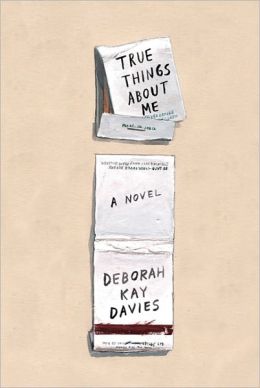
True Things About Me — Deborah Kay Davies

True Things About Me is disturbing and compelling, especially because it doesn’t want to explain. Its unnamed protagonist doesn’t want to explain. She just wants to act and in acting without explanation she may in some ways be truer to life, in which we so often act and then come up with rationalizations about why we acted after the fact. The disturbing implication of the novel may be that our reasons for doing things are opaque even to us and always will be. Like markets, we just can’t predict our own behavior.
True_things_about_meIn the novel the unnamed narrator has unplanned, unexpected sex with a man just out of prison who is registering for benefits. It is unexpected, a disjunction, a call to action in a mythic sense, and beyond the initial bang, so to speak, True Things About Me is at most loosely plotted. The scary thing about the story is not that it may be sick but that it may be normal, or at least more common than is commonly supposed, despite the evidence in fiction and art that few of us, Paglia aside, want to face. Much of the online commentary mentions “mental illness,” which is a comforting but wrong misreading. Desire can be neither legislated nor medicalized away. It will reemerge in different forms, and its verbal component is weak or nonexistent. When Alison, the narrator’s boring foil friend, wants to know what’s happening with the narrator, the narrator says “Somehow I couldn’t be bothered to explain it all.” “Somehow:” why bother analyzing what can’t be fully analyzed?

Her parents are either delusional or right; when the narrator invents a boyfriend for her parents’ benefit her mother says, “I just hope he’s a nice boy.” The irony is obvious. Her mother describes Alison as “so sensible,” which may read here as a synonym for boring. There may be no greater modern relationship sin than being boring or needy.* When madness intrudes in normal life we don’t know how to react, unless perhaps we live a continually mad life, like a different Alison, the protagonist in Story of My Life. For the narrator of True Things About Me everything is permitted and nothing matters, which may be the nature of modern adulthood for many nulliparous people.

For the narrator internal changes inspire external changes. After her encounter she thinks that “It seemed to me that I hadn’t looked at clothes properly before.” The clothes she buys says things other than what her old clothes presumably said: “a pair of low-slung cream linen trouser, and a scarlet and cream striped bustier” are new to her, and make one see fashion as part of the story. Silence is power, which is strange in a book composed of words; at one point she says that “He didn’t say much.” What and how he does counts.

Alison and her coworkers are twits. At one moment “They were talking about a television programme. Everyone was really into it. Alison was the most knowledgable.” There is nothing wrong with being into a TV show but in this context the TV show is a stand-in for a life the coworkers are too scared to live. The narrator becomes an outsider by dint of secret knowledge. She drifts away or is separated from from Alison’s world and that is arguably an improvement. Halfway through the novel she considers getting “back into the real world,” raising the usual question of what constitutes reality beyond knowing it when you see it.

In Nine and a Half Weeks one gets many sentences like “His face is blank. The gray pupils on which mine are focused reflect two miniature faces.” There are many descriptions of movement (same page: “I walk slowly across the carpet”) but few of feeling or context. Here is one extended, reasonably representative passage from True Things About Me, and it’s representative in both style and in raising questions about whether one should trust this narrator:

I began to see how it was, how it had always been. Alison was one of those types who loved to sit on the sidelines of someone else’s fascinating life and shout advice at them. She fed off me, and I let her. It made people like that feel even more smug about themselves when they could observe another human being struggling. Unravelling, if they were lucky. . . . She sounded like a second-rate actress in a daytime soap.

Who does the narrator sound like?

True Things About Me may be obliquely related to Susan Minot’s Rapture. Both could be construed as arguments that things don’t matter—people and experiences do. True Things About Me is also a commentary on soulless bureaucratic jobs and their deadening effects on the human condition.

At one point an old woman says, “That girl is on the game [. . .] living off immoral earnings. It’s disgusting. Someone ought to come round and investigate.” The contemporary term “hater” describes her well. The old woman hates the player because she is “living like she doesn’t have a care in the world. It shouldn’t be allowed.” Why not? The narrator doesn’t ask and the old woman doesn’t volunteer. The narrator is about to live without a seeming care in the world either. She leaves her work as an anonymous, Houellebecq-esque bureaucrat processing welfare claims forms to meet a dissolute but presumably sexy man. She blows off her friend, Alison, who is the voice of boredom, restraint, wisdom, and creation, to go “underground.”

There are numerous references to going underground, with connotations that go back to Persephone if not earlier. While there her mind “had stretched and blanked, like a washed sheet on a clothes line.” Is that how the best sexual encounters always happen? Maybe. But the metaphor can be extended through the novel, in which her mind is never really not “blank.”

True Things About Me is probably too uncomfortable to be of interest to most people; in this respect it resembles Never the Face, an underrated and under-known book. I imagine True Things About Me doing better in Europe than here, based solely on stereotype. The truth is out there, the book implies, and you will not like it.

See also Rebecca Barry’s NYT review, although she doesn’t get the novel and wants to throw around the word “abuse,” as if the novel is a cautionary, modern liberal, story about leading a sanitized life purged of dark impulses. Camille Paglia would be the ideal reviewer: she might not like the book—in some ways it may stick too close to the tradition—but she would get it.


* Reminder: Linking does not imply endorsement.

Arts & Entertainments — Christopher Beha

Arts & Entertainments is among other things very good, very New York, a comedy complement to Gillian Flynn’s Gone Girl (mid book: “I don’t like living this way. I’ve barely been outside in a week. I want to come home”), a defense of privacy and explanation of its importance (see also “Solitude and Leadership“), a surprise critique of the NSA, a reminder to trust liars, and a reminder that attention is the scarcest commodity of all and becoming scarcer.

Arts and entertainmentsI want to write that the plot is absurd. But is it? The vast celebrity-industrial complex is so large and amorphous that it is difficult to judge the plausibility of the plot, or of Eddie’s fatal sex-tape miscalculation. Does he not read the news? Every week some teacher or other gets fired not for being a stripper but for becoming known as one. Digital life is rife with such stories. People as a whole (and the culture we create) are hypocritical, as the novel is aware; though this is taken out of context it reinforces the point:

People don’t want to go overboard with the sad stuff. Mostly, they want to be able to judge people, and they can’t judge a girl in a coma. If she was older and had some kids, they could judge her for being selfish and irresponsible. But she’s too young for that. Maybe they can judge her father for a little while, but that’s his daughter in the coma, so that will only last so long. They can judge, like, the culture at large, but that means judging themselves, so that gets tiresome too. And there’s another episode of Desperately Expecting Susan to watch on Tuesday. Everyone will want an excuse to return their attention to the usual entertainment. We give them a nice opportunity.

The judgment reflex and public morality lag behind reality and rarely moreso than in putative education. The joy of altruistic punishment is real and rarely more powerful than in sexual mattes, with financial matters probably coming in second.

Arts & Entertainments picks up a millennia-old conversation about the self and how much, if at all, we can really know another person. In “In its second season premiere, Masters of Sex takes on the hardest questions of love,” Todd VanDerWerff writes:

One reason so many have tried to repress their sexual desires or legislate them away throughout human history is because when it comes to sex, we’re reduced to our most basic selves. There’s a moment where we are uncontrolled, and our true face appears, even if only for a second. To “fix” this, we try to introduce a rigidity, a script to stick to. We try to set up carefully delineated divisions between that true self and the version of ourselves we present to the world. Yet the fear is always there that in a moment of weakness, that face will appear, and we’ll finally be seen for who we truly are, even if no one would blink for a second.

This may be one reason people like porn, especially of celebrities or other people they know: they imagine that they are getting a moment of the “true” self, and that one gets to see through the personality. But Masters of Sex undercuts that: think of the scene in which Masters is told by Jane Martin, a prostitute in the show, that virtually all women can fake it and have faked it. Masters is astonished, and his astonishment comes from a massive revision about human nature. Most people, I suspect, go through such revisions over and over again, their views on nature changing until they come to a realization like this paraphrase of Terence, by way of Montaigne: “Nothing human is foreign to me.”

Art is filled with moments that remind us of the liars we are. Can we accept an answer of “no,” we do not know and cannot really know another person? Take a moment at the end of Generation War, a fantastic German miniseries that follows five German friends through World War II, in which a Jewish survivor returns to Germany after the war only to discover that a highly-placed Nazi shifted allegiances after the war and continued to be part of the German government. The Nazi’s allegiance was to power itself, and the implication is that we don’t know what a person will do when the circumstances in which they live change.

That we may not be able to know another is not a new idea, but the jones for “reality” TV and celebrity gossip fuels it. There is also an old idea that only God can see our true selves, but the true self may be an outgrown idea, like that other somewhat outgrown idea. In “Scientists discover that atheists might not exist, and that’s not a joke,” Nury Vittachi writes that “a metaphysical outlook may be so deeply ingrained in human thought processes that it cannot be expunged.” I’m unconvinced but I do think most if not all people need an attachment to an idea greater than and outside themselves. Celebrity, Arts & Entertainments suggests, could be that idea, but it is ultimately a hollow one. The cameras lie as effectively as we lie to each other and ourselves. Eddie’s weakness as an actor and a character is his inability to lie effectively. Poor deception skills make him ironically unable to exist on reality TV. The book is filled with subtle ironies like this, and that’s one reason why I think it catches the attention of critics who might be otherwise inclined to write it off as basic, lightweight satire. It isn’t just that. It’s a book of pleasures and of depth.

People who truly live and die an ideology or belief are the real exceptions. Standing for something is the uncommon thing, which may be why it’s so valorized in proportion to the number of people who actually do it. It may also be one of the many reasons religion keeps sneaking into this book. Eddie went to a Catholic school at which he teaches, and he appears to want on some level to do the time without doing the crime, so to speak, but this comment will appear inscrutable without having read the book, but I don’t want to give it more context for fear of spoiling the surprisingly twisty plot. Nothing feels like it’s happening as everything does.

One character, a reality TV producer named Moody, describes how he spent time in “a retreat house in Minnesota, run by the Order of St. Clement” while studying to become a priest; but he left after contact with a film crew that had arrived to make a video that showed what happened. As he says

The crew had their own problems. The things that were really going on in that place couldn’t be captured on film, because they were meant for God, not for the audience. They happened inside people. I watched all this, and somehow I knew what the audience would want to see.

If what you’re doing, or thinking, or feeling can’t be seen, does it matter? Does it “exist?” Is the audience God? Moody also highlights a challenge in any sort of narrative fiction, which can’t effectively depict what happens during the having of an idea, or when someone is doing an intellectual activity. Intellectual effort is mostly invisible, though it may be represented by books or typing or the like. Biographies of many artists are boring because the artists don’t necessarily do that much with their lives. Unless they’re unusually social or unusually sexual, they draw, they pain, they write—none of which lend themselves to narrative. One can write about influences and encounters and so on, but many people have interesting influences and encounters but never go on to do important work, as the artist does.

Movies have an especially hard time with boring writers and thinkers. The Social Network needs a lot of tarted-up, amped up drama to make it compelling; in real life Mark Zuckerberg appears to have spent most of his life at a keyboard and to have been in a monogamous relationship since he was 19 or 20. A Beautiful Mind also dramatizes the discovery moments in math, but the bulk of the movie focuses on dramatizing schizophrenia instead. Novels have similar problems. Few works of narrative art have plots that are motivated by ideas or intellectual curiosity—instead they focus on the interwoven meanings of sex, money, social status, and death. All are fine topics but one wonders if there is more out there.

TV and film, even more than the novel, are about dramatizing the exterior. Anything inside that can’t be represented outside doesn’t exist, but it’s so often what’s inside that counts most. If the soul does not live outside the body, it must not exist at all. The camera reminds us that we do exist, and we live for the adulation of others. That is so hard to resist that we barely know the people who do resist it; for one thing, they aren’t on TV, are rarely in any media, and as such they are the dark matter of contemporary society, everywhere and nowhere simultaneously. Yet they may be the real-ist people of all. If there once was such a thing as natural existence, TV has taken that away, and those who actively cultivate the TV-social-media-Internet-gossip mindset may not have it all. They are faux people, pod people, and that scares because they cannot be relied on to produce a consistent set of behaviors over time, which we usually call personality. One purpose of religion is to enforce a set of behavior codes that allow reasonable forward planning and projection. Arts & Entertainments encourages us to think that maybe there are parts of religion that we think more seriously about, and that fame as a secular religion has its perils that are often not seen until after it has been achieved.

“Some Hope” and “Bad News” — Edward St. Aubyn

Both Some Hope (the better or at least less gross novel, since it lacks the precise drug descriptions) and Bad News are novels about nothing, or self-destructiveness, or family, or themselves, or critiques of a lack of financial need that leads to a lack of financial discipline that leads to both snobbish and waste. But it is redeemed by humor, on almost every page, though of a nasty sort. There are clever descriptions everywhere:

‘It’s too bad your not being able to come,’ said David Windfall to his wife, slipping a couple of condoms into the inside pocket of his dinner jacket, just in case.

Is “come” a double entendre here, whether intentional or not? Maybe. Or consider this this, when a girl begs her father to read a story to her, and he eventually caves:

‘Of course I will. I’d be delighted,’ said Sonny with a little bow, as if he’d been asked to address an agricultural fair.

“An agricultural fair:” he is pompous, distant, and yet slightly pleased to oblige an inferior at the same time. As a father he will inspire therapy, an inability to form close relationship, cloying clinginess, or all three paradoxically at once. One can only hope that he will spend enough of “his” money—the scare quotes are warranted—to not perpetuate the next generation of vaguely aristocratic and worthless assholes of the sort that make one see why Europeans were more susceptible to the otherwise idiotic temptations of Marxism than Americans. The U.S. has plenty of rich, pointless heirs and heiresses, but few have been enshrined in ten or more generations of land-holding assholes.

Every work of fiction creates its own moral universe. That universe may be obscured and debatable, but it’s there. In Some Hope, the good guys recognize their own snobbishness, ridiculous beliefs, nastiness, pettiness, forbidden desire, awkward desire, and cruelty (petty or mortal). If they don’t recognize those aspects of themselves, they at least recognize the search for them. Patrick and Johnny may be the only good guys in the novel. The bad guys don’t recognize their own snobbishness, ridiculous beliefs, nastiness, pettiness, forbidden desire, awkward desire, and cruelty (petty or mortal). By this definition almost everyone in the novel is bad. Like Seinfeld, there is no hugging and no learning.

No one builds or makes anything except jokes (“[Bridget] ought to get on with the arrangements, which, in her case, meant worrying, since all the work had been delegated to somebody else”). There are only parties, art, aesthetics, and jockeying for status for its own sake, rather than based on some external measure of achievement. Social form without content is meaningless and spiritually deadening, a fun place to visit—which is why the Patrick Melrose novels work—but not a great place to live. The Patrick Melrose novels can be read as an argument against large hereditary transfers of wealth and against a basic or guaranteed annual income.

There are no social obligations aside from being witty and beautiful. “Witty” usually also means “self-aware,” as only Patrick and Johnny might be.

Their lives are works of art paid for by the industriousness of their ancestors, or by others in their society. Do most people who are doing or making interesting things have time to think, “The meaning of life was whatever meaning one could thrust down its reluctant throat”? That may be true; on the same page Patrick is thinking about Measure for Measure “while he bared his teeth to rip open a sachet of bath gel.” Is this a brilliant example of the profound and banal mixing, as they do in real life, or an example of the flight of ideas and intellectual incoherence?

At one point another rich dilettante named Kitty says:

So, you see, I know what I’m talking about. Children give off the most enormous sexual feeling; they set out to seduce their parents. It’s all in Freud, I’m told, although I haven’t read his books myself.

Some Hope is filled with people who have strong opinions despite or because of not having read the books themselves. Most haven’t cooked for themselves, cleaned for themselves, or other activities that might connect them with reality, and they don’t realize how much of life’s fabric they’re missing. Their regular complete missing the point—any point—makes them funny. Kitty in context is comedic, though out of it she may not show it. Almost everyone can, in the right context, be shown to be ridiculous, but the characters in the Patrick Melrose novels need even less removal than most.

Here is The New Yorker on Aubyn. Here is Tyler Cowen, and note his genre description (“Derelict” fiction?). Most reviews and interviews focus on his life’s relationship to his fiction, which I find an uninteresting and unedifying set of concerns, yet I appear to be almost alone in that regard.

Briefly Noted: The Truth About the Harry Quebert Affair, and the meaning of the thriller

Francophone Hit, American Letdown” inspired me to read The Truth About the Harry Quebert Affair, but “Francophone Hit” describes the book’s sentence-by-sentence weaknesses well:

The dialogue barely surpasses lorem ipsum in its specificity: “Do you have any change?” “No.” “Keep it, then.” “Thank you, writer.” “I’m not a writer anymore.” And life advice from an alleged literary genius takes the form of shampoo-bottle nonsense: “Rain never hurt anyone. If you’re not brave enough to run in the rain, you’ll certainly never be brave enough to write a book.”

Let me add to that list: towards the beginning of the book, Marcus’s first novel is an incredible sales success; he says that “Even the harshest critics on the East Coast all agreed: young Marcus Goldman was destined to become one of our great writers.” I don’t think I’ve read any critic, ever, who announces that a writer is “destined” to become great, because no one is destined to do anything. The vagueness of “East Coast” critics—who are these people, exactly?—is symptomatic of a vagueness infecting the entire novel, as if the narrator has learned to speak through advertising platitudes and brand names: “New Writer! More Popular and Absorbent Than the Competition!” There are occasional bursts of cleverness (“I bought a new laptop, in the hope that it would come pre-loaded with good ideas”), but they are rare. More often we find that “I treated myself to a five-star hotel in Miami.” Which hotel? What makes a “five-star” hotel? Little of the novel rings true to life, and it also doesn’t ring true to an alternate reality constructed from artifice in the fashion of someone like Carlos Ruiz Zafón. For writers, both Marcus and Harry Quebert seem incredibly uninterested in the work of other writers.

There are shades of Gillian Flynn but the comparison does not flatter Dicker; anyone tempted to read Harry Quebert should start with Gone Girl and work backwards through Flynn first.

What made Harry Quebert popular in Europe? I don’t know, though the mystery of why some works become popular and others don’t continues to fascinate me. It isn’t the literary quality of a book: bestseller lists are filled, seemingly indiscriminately, with a mixture of books so horribly written that they’re unreadable to me, along with some books so good that I recommend them to everyone. Being poorly written, or at least not well written, isn’t a barrier.

The real answer to “Who killed Lola Kellergan?” is “Who cares?” Most thrillers are not thrilling and most mysteries are not mysterious; they’re simply boringly written, as if the authors have not read thousands of other books before and lack the will, interest, or ability to try something new and/or beautiful. Literary fiction, whatever its characteristic generic flaws, generally tries to do something linguistically different, and few readers or critics of lit fic consider a specific example successful unless it does something fresh with the language.

The books that do something different—like Zafón’s The Shadow of the Wind and The Angel’s Game. I’m not a person who sniffs at fiction because of the tags marketers choose. Every book is begun with the greatest hope. Few fulfill it. Dicker shows promise and may eventually write something great, but it will probably come at the expense of an obsession with greatness as a concept.

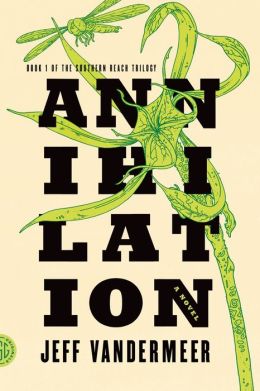
Annihilation — Jeff Vandermeer

Annihilation works and lives up to its hype but may not live up to predecessors like Solaris or Peter Watt’s brilliant, bizarre novel Blindsight. I say “may not” because Annihilation is a simpler book, which I say descriptively rather than derogatorily, written in an easy-to-understand style that isn’t as demanding as Blindsight. Because the protagonist of Annihilation knows very little, she doesn’t have the knowledge or vocabulary to explain what is happening to her. Most of the characters in Blindsight speak in sentences like this: “The geometry—it’s not so symmetrical. Looks almost like the Phaistos Disk.” The what disk? And the chapters skip confusingly around.

Annihilation_coverBlindsight is much harder SF, but the last third, like the novel as a whole, is as good as any fiction I’ve read, ever. It is a book that needs to be started again from the beginning to be understood, which is both a strength and weakness. One could say that Ulysses is the greatest novel ever written—I don’t think so, despite the commonness of the view—but it is also not for everyone or even most people.

Annihilation and Blindsight should be compared because they share an important theme: what happens when we can’t trust our own senses. Annihilation is scary not just because it’s about exploring the unknown but because the protagonist can’t trust memory, which can be directly manipulated in the novel. In a world without reliable memory it becomes impossible to know what you know or don’t. There is no real way to make sense of human life or to receive meaningful feedback from the environment.

This isn’t a totally new fear—Lovecraft’s stories often involve cosmic horror overcoming the senses of humans and causing madness in them, such that they can no longer rationally evaluate what they see and process with their senses. Descartes asked how we know what we know and how we can trust it in 1641’s First Meditation. The difference between then and the near future is the possibility of being able to systematically alter memories. Contemporary science fiction (and, increasingly, science), however, points out that we’re getting much closer to the point at which direct brain or sensory manipulation could be used to make it impossible to trust one’s senses. That sort of thing existing as a fantastical horror scenario is very different from knowing that it could be done to you and, almost as bad, you might not even know.

The narrator’s epistemological gaps are wide. She says: “We had also been assured that it was safe to live off the land if necessary.” Who had done the assuring? When? Why? The party reaches “the camp” and “set about replacing obsolete or damaged equipment.” What equipment is gone and what remains? The narrator doesn’t say. She hears “a lot, powerful moaning at dusk,” but no one tries to figure out what it is. Blindsight is a voyage of discovery; Annihilation is a voyage of strange passivity.

The part of the brain that deals with curiosity seems to have disappeared, and a few pages later the narrator says as much: that “Curiosity could be a powerful distraction.” For someone exploring the unknown, however, curiosity is a motivator, not a distraction. The term “unreliable narrator” is common, but it doesn’t describe Annihilation’s narrator, who better be termed “wildly delusional.” She seems not to search for explanations when the explanation might save her life and its lack might kill her. At times she is anti-rationalist:

I found the psychologist’s faith in measurements and her rationalization for the tower’s absence from maps oddly. . . endearing? Perhaps she meant only to reassure us, but I would like to believe she was trying to reassure herself. Her position, to lead and possibly to know more than us, must have been difficult and lonely.

Almost no one could know less than the narrator. She knows nothing at the beginning of the novel: of one of her party, she says “I think we all believed she came from some kind of management background.” I’d want to know more about someone I hired to edit proposals, let alone someone I’m accompanying into an unknown area long cut off from the rest of the world and human society. She realizes that “we might now be living in a kind of nightmare,” and that sense never goes away. Neither do questions about the narrator’s reliability; towards the end of the novel, she says:

It may be clear by now that I am not always good at telling people things they feel they have a right to know, and in this account thus far I have neglected to mention some details about the brightness. My reason for this is, again, the hope that any reader’s initial opinion in judging my objectivity might not be influenced by these details.

Worries about “objectivity” are standard fare in novels. The quality of the writing in Annihilation, on a sentence-by-sentence basis, is average, but the novel remains fun, even if the narrator’s ineptness is not to my taste. That the ineptness may be an artifact of whoever sent her is scarier than the things she sees, or think she sees, in Area X.

Creativity, Inc.: Overcoming the Unseen Forces That Stand in the Way of True Inspiration — Ed Catmull and Amy Wallace

Creativity, Inc. is an interesting book marred by consistently, distractingly bad writing. I read it based on John Siracusa’s review, which doesn’t mention style (and doesn’t quote). But writing about a book without discussing style is like writing about Apple’s laptops without mentioning it.

Many of Catmull’s stories are interesting; for example, he tells one about holding meetings around a long, narrow table that by its physicality tended to exclude people and produce hierarchy, especially since some people would get reserved seats. But he missed the problems at the time: “the seating arrangements and place cards were designed for the convenience of the leaders, including me. Sincerely believing that we were in an inclusive meeting, we saw nothing amiss because we didn’t feel excluded.”

But two of Creativity, Inc.’s main points—about the need to tolerate failure in the right circumstances and the need to foster a creative working environment—are dealt with by much better-written books: Megan McArdle’s The Up Side of Down: Why Failing Well Is the Key to Success and Steven Berlin Johnson’s Where Good Ideas Come From. Not surprisingly they’re both professional writers; either would’ve been a better choice to ghost / “assist” with his book, but they might’ve been a lot more expensive too.

The book should be great; instead, Creativity, Inc. is decent, with redeeming qualities. Had it been a Pixar movie subjected to the process Catmull describes, I think it would’ve been trashed or straightened out before hitting the metaphorical screen. Creativity, Inc. is so painful because it has the potential to be a monument rather than a moment. Its errors are elementary; its insights aren’t. In writing, it appears that Catmull doesn’t know what he doesn’t know. At Pixar he learned to know what he doesn’t know, but in writing he’s not there yet.

There are weird metaphors: “Sutherland and Dave Evans, who was chair of the university’s computer science department, were magnets for bright students with diverse interests, and they led us with a light touch.” So are they like magnets, which attract metal rapidly, or are they like human riding horses, which is probably where the “light touch” metaphor comes from? The mixing in this sentence is jarring. He has “a ringside seat” to ARPANET. Catmull writes that early film editors at Lucasfilm “couldn’t have been less interested in making changes that would slow them down in the short term.” But that seems unlikely: it’s almost impossible to get to a true zero level of interest. Chances are those editors could have been less interested, perhaps through hostility. In 1983, we learn that “George [Lucas] hadn’t lost an ounce of his ambition,” but how many ounces are there in the average person’s ambition? How many in Lucas’s? Talking about ambition in terms of ounces is common but whatever freshness and vitality the metaphor might have once had is gone. These examples come from the first 37 pages. There are so many other examples of weak writing and clichés that I stopped marking them.

Not every sentence must be brilliant or unexpected—that would be alienating—but some should be.

The best part of Creativity, Inc. is the last pages: “Afterword: The Steve We Knew:”

[Steve Jobs] used to say regularly that as brilliant as Apple products were, eventually they all ended up in landfills. Pixar movies, on the other hand, would live forever. He believed, as I do, that because they dig for deeper truths, our movies will endure, and he found beauty in that idea. John talks about ‘the nobility of entertaining people.’

It has fewer clichés, though I’m not sure why. Nonetheless, I wish the rest of the book had been more like the last ten pages. For the right person in the right industry at the right time, Creativity, Inc. is still worth reading. For the rest of us it’s a lesson in what might have and should have been.

The Innocent — Ian McEwan

The Innocent is deceptively brilliant: for at least the first half of the novel it seems slight, thrillerish without the thrills, about a weakling and pushed-around fool. In the second half it explodes. The character violations that would normally damn the book instead make sense yet aren’t anticipated in advance, at least by me; much of the story is shockingly tense in ways that shouldn’t be. McEwan is very good at delayed resolution and gratification in a way most literary writers aren’t.

There are many essays to be written about The Innocent’s subtleties: about secrets, about sexuality, about the role of the unexpected, about fear, about pride, about loss, about the collision between fantasy and reality, about the instability of personality and its unpredictable development.

McEwan_The_innocentFirework sentences—the ones with elaborate metaphors or epiphanies or rhetoric—are relatively few, but almost all of them hum along and even the mundane sentences like “Maria reached for her skirt and blouse” are often given menace by their context. “Relatively few” does not mean none and some of the obvious ones stand out: “Leonard Marnham [. . . ] had never actually met an American to talk to, but he had studied them in depth at his local Odeon.” An Odeon is a great way to study foreign cultures, of course, a sort of science lab for the soul. Of Maria’s parents, she thinks or explains that “They still resented their daughter for the marriage she had made at twenty against their wishes, and took no satisfaction in the fulfillment of all their worst predictions.” Most of us find our prophecies wrong of failed.

Leonard is the innocent of the title, who discovers emotion at the behest of a woman. He is beset by apparently important work that conflicts with an inner life newly freed from his parents and the constraints of home, and after he meets Maria he thinks that “He knew that if only he had a little more leisure and were a little less tired he could be obsessed, he could be a man in love.” As if he plays a role: he could be “a man in love,” instead of more directly saying that he loves Maria. He needs that mediating, cultural desire to feel his own at this early stage of his development. As the novel proceeds things naturally change.

Without giving anything I’ll also note that the novel uses McEwan’s characteristic end-stage “zoom” effect, in which decades elapse in the final pages. Such a change is disconcerting, disconsoling—yet appropriate. It is brutal but in an acceptable way, or maybe just melancholy.

Here is James Wood on McEwan, though Wood does not share my love of plot. Here is Daniel Zalewski in The New Yorker.

How to Sell — Clancy Martin

How to Sell works, or at least the first half does while the second descends to melodrama. It’s a novel of surfaces and not an easily quotable book. The narrator notices but doesn’t do up the descriptions:

I should have known that as soon as the pitch started Jim believed the lines he was throwing me. It’s like being an actor or prime minister, you get all worked up with the audience and you think can can say nothing false or unbelievable.

How to sellOne could say many professions involve lying as a central component of the work; one could say that science does the opposite and is one of the only fields in which lying, while possible, is at least also discoverable. In How to Sell the narrator and his brother, Jim, work the jewelry business in a pre-Internet age, though I’m not sure how much the Internet has changed that business.

How to Sell starts with an Elmore Leonard-esque word slide: “Our father told it that Jim was caught dressing up in my grandmother’s black Mikimotos when he was scarcely two years old.” He “told it?” To who, when, how? It doesn’t matter since we don’t find it, but it and that weird “scarcely” tell us that the narrator isn’t quite level and maybe the story won’t be either.

It isn’t, not really, and much of the discussion revolves around who is lying (everyone) and who isn’t (no one, not really, including the narrator). Yet a lot of people want to be lied to and put themselves in a position to be lied to and then others do the lying and justify it, as Jim explains:

Look, Bobby, the appraisal is not a lab report. [. . .] We are not calculators, we are people and so are our customers.

W’re people and we want to be lied to. The people who want the truth take the time to learn how jewelry works and the rest take the bullshit the salesman tells them. But information has a cost and so in some circumstances it’s easier to just do it without paying attention to the niggling gaps between details; a lot of romantic relationships function on the same principles as selling jewelry, as the novel makes clear since it is about how the one activity is a metaphor for another. Jewelry is a potent metaphor here because it’s also unnecessary: no one dies because they can’t wear it. As a pure luxury item it is sold as glamor, and one element of glamor is a lie plausible or well-presented enough to be believed.

No one in this book should be married or in a monogamous relationship, yet many characters are and their dilemmas would go away if they could undergo that simple change. But they can’t, or won’t.

Characters are constantly giving bad advice. One, a man named Kizakov, says “In this business, always trust your eyes.” Except that eyes can be deceived, which is why humans build so many tools to augment what we can see. Our senses should be verified rather than trusted; in this way do they also resemble lovers? In that domain broken promises may not be the norm but the evolutionary and other pressures are so strong that everyone at least knows stories about crumbling and breakage and base metals.

Jim gives brotherly advice: “Sometimes it’s better to stay on the surface with somebody.” People who say that often mean, “Stay on the surface with me.” Jim is a man of surfaces more than most people, and when he stays “on the surface” he means that he’ll do what he wants, when he wants it, and you’re only “in” with him to the extent you can do something for him. For men that means selling and for women that not surprisingly means something else.

The owner of the store, Mr. Popper, has a post-modernist view of the truth, as when he says that “It don’t really matter [what’s real and what’s fake], so long as she’s done right.” The similarities to love are again obvious; the bad outcome for Mr. Popper is also not surprising.

A few other points: Clancy knows enough about the jewelry business to describe it or learned enough about the jewelry business to fake it. There is substance amid the love lines and too many novels forget that. The second half of the novel is less about the technical facets of the jewelry business and that’s part of why it is weaker.

* There is more in common with selling jewelry and religion than is commonly supposed.

* To some extent no one knows anyone and that fact continues to drive fiction.

The Second Machine Age — Brynjolfsson and McAfee

The Second Machine Age: Work, Progress, and Prosperity in a Time of Brilliant Technologies is worth reading if you haven’t read Tyler Cowen’s Average is Over or the various other books about the influence of computers, networks, and the Internet on society and the labor market. If you’ve already read some of those books, then by osmosis you’ve already The Second Machine Age.

The Second Machine AgeIn it many now-familiar stories appear: Moore’s Law, superstar economics, Coming Apart: The State of White America, 1960-2010, chess-playing computers, the importance of teachers in education. Each subject is worthy in itself but much of the content has appeared elsewhere. Brynjolfsson and McAfee are decent writers but no one, except maybe a machine, will mistake them for excellent stylists. They wisely import wits at appropriate moments, thus achieving specialization and appropriately divided labor:*

The journalist A. J. Liebling famously remarked that, ‘Freedom of the press is limited to those who own one.’ It is no exaggeration to say that billions of people will soon have a printing press, reference library, school, and computer all at their fingertips.

Maybe: but we’re also in a race against censorship, as anyone in China knows well. The UK has instituted a mandatory porn filter on ISPs (which is the start of censorship creep) and that filter has already blocked a videogame update; how long until it “accidentally” blocks the opposition party’s website in the days before an election? The revelations from Snowden indicate that the U.S. may already have the ability to shut down Internet “printing presses” or block dissemination of their content. When such efforts are made in the future the reasoning will no doubt involve Protecting Our Children, which is already how the U.S. limits speech and conduct that is distasteful and/or disliked by most voters and the politicians they elect.

The parts about education stand out for their policy implications:

Conclusions by education researchers Ernest Pascarella and Patrick Terenzini [. . .] summarized more than twenty years of research in their book How College Affects Students. They write that ‘the impact of college is largely determined by individual effort and involvement in academic, interpersonal, and extracurricular offerings on campus.’

This work leads directly to our most fundamental recommendation to students and their parents: study hard, using technology and all other available resources to ‘fill up your toolkit’ and acquire skills and abilities that will be needed in the second machine age.

Schools often won’t do this effectively; right now it’s up to students to take on the burden themselves as best they can. But motivation is hard, and many if not all things are more easily imbibed when they’re presented by a guide who knows how to explain by analogy and where to find effective resources for learning. A lot of books are bad and that includes how-to books; one small but rarely stated purpose of teachers and professors is to read thousands of books and then recommend the handful of really good ones, or the ones most likely to be of utility to students. “Good” and “good for young / inexperienced people” are often different and experienced people can forget such an important difference.

Brynjolfsson and McAfee also write:

Perhaps unsurprisingly, records show that the electric motors did not lead to much of an improvement in performance [in early factories]. There might have been less smoke and a little less noise, but the new technology was not always reliable. Overall, productivity barely budged.

Only after thirty years—long enough for the original managers to retire and be replaced by a new generation—did factory layouts change [to accommodate electric motors]. The new factories looked much like those we see today: a single story spread out over an acre or more. Instead of a single massive engine, each piece of equipment had its own small electric motor.

Universities appear to suffer from this too, as do hospitals; perhaps we will see them change in response to conditions and to pressure generated from rising prices.

I had enough context to read the book in a few hours and wish that I’d waited for a library copy instead of buying. If you’re looking for a big-picture view of the contemporary world that grounds itself in many micro-observations, you should read The Second Machine Age. It will also help you think about your own career and life and where both should go. To some extent everyone is in the technology business, whether they realize it or not.


* Things economists love almost as much as children.

Antifragile: Things That Gain From Disorder — Nassim Taleb

The Black Swan is so good that I’ve been running around telling everyone to read it, which naturally led me to its successor, Antifragile. It, by contrast, is an excellent book to get from the library (per this accurate warning) and an excellent book to read skeptically, given its many dubious claims and stories.

Antifragile_coverThe top-level idea of Antifragile is a good one (many random events trade small gains for tremendous losses, and vice-versa; focus on making sure that you can sustain small losses for big gains, which makes you “antifragile,” as opposed to merely “robust”), but rarely have I read a book with such a correct thesis and so many misrepresentations, needless ad-hominem attacks, and dubious stories that may not demonstrate what the author thinks they demonstrate. Many amuse along the way but could have been removed; for a guy who is fond of the term “narrative fallacy,” Taleb is awfully fond of narratives that could be called fallacious.

I meant to write a real review, but I’ve been beaten to it and would direct you instead to the link, where David Runciman does a better job than I’m likely to. If The Black Swan is an unexpectedly fascinating and insightful work with a deceptively simple main idea that is helpfully explained and elaborated on with virtually every page, Antifragile is the sort of book that can be better read through the reviews than the book itself. As noted in the first paragraph, if you feel the need to verify this claim, at least get Antifragile from the library.

Let’s take one small example of a dubious claim: on pages 83 – 84, Taleb tells a parable about two men, one a banker and one a taxi driver. In that parable the taxi driver differs from the banker:

Because of the variability of his income, [the taxi driver]” keeps moaning that he does not have the job security of his brother—but in fact this is an illusion, for he has a bit more. [. . .] Artisans, say, taxi drivers, prostitutes (a very, very old profession), carpenters, plumbers, tailors, and dentists, have some volatility in their income but they are rather robust to a minor professional Black Swan, one that would bring their income to a complete halt.

But taxi drivers are interesting example because we’re approaching the point at which self- driving cars may become common, which would be a major professional Black Swan for taxi drivers. The Industrial Revolution has been hell on “Artisans,” who today still find it very hard to compete with factories. To be sure, the Internet has made it easier for artisans to do their thing by allowing them to sell on their own websites and on aggregators like Etsy, but artisans as a group are never going to be as important as they were in, say, 1700.

There are also paragraphs so stupid that they defy rational explanation:

both governments and universities have done very, very little for innovation and discovery, precisely because, in addition to their blinding rationalism, they look for the complicated, the lurid, the newsworthy, the narrated, the scientistic, and the grandiose, rarely for the wheel on the suitcase. Simplicity, I realized, does not lead to laurels.

Government and universities have been pivotal in everything from computers to nuclear power to medicine, and saying they “have done very, very little for innovation and discovery” is incredibly, stupidly wrong—the sort of wrong that tempts one to disregard the entire rest of the book. It is useful to have outsiders throwing intellectual stones at academic insiders, but only when the outsiders know more than the insiders. In this case, Taleb is just a crank. A few pages later he does qualify the quoted paragraph, but he shouldn’t have written it.

Elsewhere, Taleb writes that “The intellectual today is vastly more powerful and dangerous than before,” which I find flattering but also unlikely; I also suspect many if not most intellectuals would agree with that assessment, given how many of them write lamentations about their lack of influence.

There are moments like this, which is fascinating: “Criticism, for a book, is a truthful, unfaked badge of attention, signaling that it is not boring: and boring is the only very bad thing for a book,” and then Taleb considers books we now admire that were banned or controversial, like Madame Bovary. But he doesn’t consider other highly criticized books that are now shunned for good reason, like Mein Kampf, or The Protocols of the Elders of Zion. He also doesn’t consider books that are wrong and important and should be relegated to the highly of ideas, like Das Kapital, which still gets read and taken seriously in some academic precincts. All three are bad books for reasons that have been much discussed, and there is something else that can be very bad for a book: it inspires people to steal things from others or hurt others. That’s what all three encourage.

That’s four samples. And yet he also produces gems like “men of leisure become slaves to inner feelings of dissatisfaction and interests over which they have little control.” In many ways I am reminded of Camille Paglia, who also has much to say about the ruthlessness of nature, often mentions prostitutes, and often goes further than her evidence or ideas merit. Yet as far as I and Google know, very few others have observed the connection.

Let’s talk some more about the positive; one chapter in Antifragile, “Skin in the Game,” is an especially important way to assess the world and assess risk. Taleb quotes Hammurabi’s code:

If a builder builds a house and the house collapses and causes the death of the owner of the house—the builder shall be put to death. If it causes the death of the son of the owner of the house, a son of the builder shall be put to death. If it causes the death of a slave of the owner of the house—he shall give to the owner of the house a slave of equal value.

Someone who puts people at risk should be at equal risk themselves. CNN just published “Yemen says U.S. drone struck a wedding convoy, killing 14,” in which 14 people were murdered by the United States; they are probably classified internally as “collateral damage” or by some similarly Orwellian euphemism (although “U.S. officials declined to comment on the report,” because why does the truth matter, anyway?). Imagine that those who ordered or authorized the strike would have their own husbands and wives and children killed in proportion to the number of civilians they killed. No one would order such strikes.

Nor would politicians authorize such strikes if the struck could vote, or if CNN and Fox News covered them for weeks or months at a time, as they would if something similar happened in the U.S. As Conor Friedersdorf correctly observed in The Atlantic, “If a Drone Strike Hit an American Wedding, We’d Ground Our Fleet.” But those who are launching the missiles have no skin in the game, to use Taleb’s favored phrase.

If someone does something wrong, what bad thing happens to them? If a doctor screws up too badly, they at least get sued. But if, say, a teacher’s students can’t read or do math, nothing bad happens to them. Long before I read Taleb, I remember explaining to students that, if they emerge from my classes unable to write effectively, nothing bad happens to me—I’ve never heard about a U of Arizona T.A. being fired for incompetence. The only bad things happen to them, in that they won’t be as good at writing or reading as they would be otherwise. That seemed to be a revelation to them: I don’t think they’d considered how they, not their teachers, bear the risks of a lousy education. Those risks are even more pronounced at the high school level, where most public school teachers are unionized and can’t really be fired.

Academia and government share the property of not having much skin in the game. As Taleb says, “An academic is not designed to remember his opinions because he doesn’t have anything at risk from them.” You often don’t get tenure for being right; you get tenure for publishing, regardless of whether what you’ve said is right.

In his books Taleb is weirdly reluctant to address global warming and climate change, which may be the ultimate nonlinear Black Swan system of our age—prone to sudden shocks that may have catastrophic results. There is a brief mention of the issue on page 415 of Antifragile, but he doesn’t discuss the issue in any detail. The collective response of the world to these dangers is to shrug, make minor changes, and hope for the best.

The danger is real and yet almost no one does anything significant to mitigate those challenges—though the risk of catastrophic change is extraordinarily high and the things that could be done to reduce it are relatively easy compared to what may come. Taleb implicitly endorses action when catastrophic risks are high even when probabilities are low in this section:

which is more dangerous, to mistake a bear for a stone, or mistake a stone for a bear? It is hard for humans to make the first mistake; our intuitions make us overreact to the smallest probability of harm and fall for a certain class of false patterns—those who overreact upon seeing what may look like a bear have had a survival advantage, those who made the opposite mistake left the gene pool.

The metaphor is clear, yet he barely addresses, either in The Black Swan or Antifragile, the way we might be making the global climate extremely fragile through our use of fossil fuels. In the U.S., some of the obvious means to mitigate fossil fuel usage, like building denser urban cores or switching towards nuclear power, are barely on the national agenda and, even when they are on the national agenda, they can easily be blocked by short-sighted local NIMBYs. Nuclear power is particularly curious, since coal power emissions kill far more people in the West than any form of nuclear power. But coal kills people slowly, over time, and mostly invisibly; it never ends up in the news, while any problem with nuclear power sears the media’s collective eyes.

Overall, with climate change, we may be mistaking a bear for a stone, and we may collectively pay the price.

Since Taleb has cultivated an outsider’s persona and portrayed himself, often accurately, as a teller of truths no one else wants to hear, or whose logic others attack despite its accuracy, he seems to have decided that attacks on his logic or his perceived truths automatically make his logic or perceived truths correct. But that’s a simple error in itself, since the attacks are not sufficient to show that he is right, and with any much-attacked thinker there is a danger in becoming so impervious to outside criticism that the work suffers. I suspect that Taleb has moved into that latter category, and there may be an interesting psychological meta narrative about how he moved from his initial outsider, but intellectually rigorous position, to a hybrid insider-outsider in which he no longer feels as compelled to write tightly and correctly as he did before fame (justifiably) found him.

Success breeds the danger of surrounding yourself with yes-men, but a good editor should be the opposite and should tell you hard truths that you don’t necessarily want to hear. Taleb, one feels, is not the sort of guy looking for constructive disagreement. Yet despite the mess in the book, some of its ideas are important. If I were a philosopher I’d be more willing to excuse bad writing and a dubious execution. Since I’m not, it’s hard to get past the book’s many moments in which I went, “That’s not right” or “That doesn’t belong.” But Antifragile also can’t be dismissed outright, because some of its ideas are important and rarely discussed. Given the form those ideas take, I doubt they will get the attention they deserve.