Being wrong and a partial list of ways I’ve been wrong

A variety of somewhat big deal bloggers in economics have written about things they now believe they were wrong about. Looking back on changed opinions (which is a slightly more polite of saying “I was wrong”) is an exercise in intellectual honesty—a trait widely lacked.

Some (unsorted) things I’ve been wrong about:

1) I basically believed that the stock market’s average rate of return would remain 10% per year over reasonable time periods. That it will still average somewhere close to 10% per year still seems probable, but the “reasonable time periods” (like two decades or so) no longer does, and in the long run, as a famous economist whose name escapes me observed, we’re all dead.

2) Like McArdle, the “Great Moderation” seemed real up until the last six months or so.

3) There are some things I was wrong about that turned out well: I didn’t think we’d see a black president in my lifetime. In 2004, if you’d told me that a black man would be president in 2008, I probably would’ve laughed.

4) I didn’t get why people liked Jane Austen until I read James Wood’s How Fiction Works, with its description of free indirect speech, and his examples from Austen. Now I do.

5) The iPhone? Nice, but a fad. I didn’t think it would be as big a deal as it has been, or that other phone manufacturers would be so slow to respond.

6) I didn’t think Facebook would become and stay as popular as it is; I signed as an undergrad chiefly as a quick way of figuring out which girls already had boyfriends. Now I seldom log on, but evidently I’m in the minority. Pictures of dogs, food, babies… I don’t care but the evidence shows many, many people do.

7) I used to believe that it was possible to have rational discussions about religion and/or politics with most people. Both subjects are seldom subjected to empirical tests, so no feedback mechanism can demonstrate when or if a belief is wrong. Politics are (slightly) more subject to such tests, via election, studies, and the like, but the broadest political beliefs aren’t really. See Paul Graham’s “Keep Your Identity Small” for more on this subject, along with “What You Can’t Say.”

8) During the ramp-up to the Iraq war, I was in college, and many of my professors were virulently against the war and thought that the government was perfectly capable of dissembling and distorting the debate about weapons of mass destruction; some had lived through Vietnam, with its phony Gulf of Tonkin incident, and the later Iran-Contra hearings. I hadn’t and thought it wildly implausible that so many people and institutions would be hoodwinked by faulty information, so I was more or less in favor of the war, like a lot of my equally gullible compatriots.

9) On first reading Carlos Ruiz Zafón’s The Shadow of the Wind, I didn’t appreciate many of its most impressive qualities, especially regarding the narrative, the dialogue, and the extent to which the novel combines post-modern games with immense readability. Now I do.

10) I used to think that the sexual double standard was primarily due to misinformation, the cruel application of religious principles to individual lives, ignorance, and malice. Now I think the sexual double standard is primarily due to daughter guarding by parents and parents’ influence on culture, female efforts to guard men through slandering their potential competitors’ reputations, general female competitiveness, and the fact that the choosier sex is always the one that invests more in offspring.

These forces help explain cultural incoherence about sexuality, especially among the young. A laissez-faire, I’m-okay-you’re-okay attitude seems very far off.

(See “The Weekly Standard on the New-Old Dating Game, Hooking Up, Daughter-Guarding, and much, much more.”)

11) A student question from two years ago prompted me to realized that, although I used to believe something close to the classical economic model of man in which behavior automatically reveals preferences and if someone does something, it must be because they rationally believe it will benefit them, now I’ve realized that context, framing effects, peer pressure, time preferences, and the like have a far greater effect than I once gave them credit for. Reading Dan Ariely’s Predictably Irrational, Philip Zimbardo’s The Lucifer Effect and The Time Paradox, Neil Strauss’ The Game, and Tim Harford’s The Logic of Life contributed to my change in views.

Try the “What I’ve been wrong about” test for yourself. If you can’t think of anything you’ve been wrong about, does that mean that you’re consistently right about everything, or does that mean something quite different? If you need help, see Kathryn Schulz’s Being Wrong: Adventures on the Margins of Error, although I haven’t actually read said book yet.

Don’t rent an apartment from Navid Abedian in Tucson, Arizona, or, how I learned to be wary of lawsuits

In 2008 I moved in Tucson for grad school and rented a condo that turned out to be a decent place to live, except for the landlord and a neighbor universally referred to as “Crazy Nick” (he was not crazy in a good way). When my roommate and I moved, the landlord kept about $500 of our deposit after promising that he wouldn’t and saying that he’d refund it. Stealing our security deposit violated Arizona’s Residential Landlord & Tenant Act, which regulates the usual tenant-landlord problems.

Because I’m such a smart guy and was both unhappy about his lies and interested in our money, I decided to sue him in small claims court, where I eventually won a $1,350 judgment. He paid $350 after a debtor’s hearing in January and promised to pay the rest; in June I sought another debtor’s hearing to compel him to pay at which point he threatened to come over to my apartment and kill me. For those of you keeping score, this marks the second time someone has done so in one summer, up from zero times previously in my entire life.

I filed a police report, stayed at friends’ houses for a few days, and canceled the hearing: improbable though Abedian’s threat might be, it’s not worth shooting or being shot over $1,000. He’s also a cipher to me: all I know is that he works in a carpet store, bought a condo in Tucson near the height of the ’00s real estate boom and, according to a Google search, might have his house foreclosed on. In other words, he might be desperate, and people have killed each other over far less than $1,000.

Although running away sets a bad precedent—will he just threaten to kill the next tenant who comes along? am I not doing the right thing for my fellow man—I still think capitulating wiser than continuing.

What originally seemed to mostly be entertainment (i.e. going to court and pontificating), began to suck up way too much mental energy. In the Hacker News discussion of Paul Graham’s “The Top Idea In Your Mind,” grellas wrote, “There is a lesson here about lawsuits, which will drain you of both money and peace of mind all at the same time. Sometimes you can’t turn the other cheek, much as you would like to do so, and have no choice but to fight. Having the guts to stand up for yourself (or for your company) is in itself a virtue and there are times when it is best not to walk away.”

He’s right, and a lawsuit I’d imagined as entertainment and teaching a useful lessons that might turn into dividends for the next tenants backfired. It also occupied way too much space in my mind—space that I should’ve spent writing or doing research. Instead I worried about the sanity and desperation of a guy I didn’t know and who was probably armed.

In Francine Prose’s novel Touch, the protagonist is a 14- or 15-year-old girl named Maisie, who tells her preening stepmother, Joan, a version of what happened on a bus when two or three boys touched her breasts in somewhat murky circumstances. It isn’t clear at the narrative’s start whether she consented, but the event as narrated to us is also one in which the characters act without enough culpability to call what they did anything beyond adolescent horseplay and power struggles.

Joan wants to meet a lawyer, which makes Maisie think that “I was filled with dread. Pure dread. It felt like icy water trickling down my back.” Joan says, “It would be a matter of principle.” Most people don’t lead their lives solely according to principle; pragmatics matter too. Few of us want to be martyrs for a cause, and if we do, that cause better be worth it. Most of us want to get along. Altruistic punishment is real but can be overrated. Maisie would be harming her own well-being and self-interest. I thought I was standing up for the principle of tenants’ rights and for fairness, but I chose to give up that principle when Navid threatened to kill me. Pragmatics won.

Like Maisie, I’m choosing pragmatism—which I probably should’ve learned in the first place. I’ve started Bleak House a couple of times (I’m not a Dickens fan) and understand Jardyce vs Jardyce well enough to know that lawsuits are often vehicles for mutually assured destruction more than they are about fairness or rights. When in doubt or when it’s avoidable, don’t get the law involved. And, apparently, be ready to write off your security deposit.

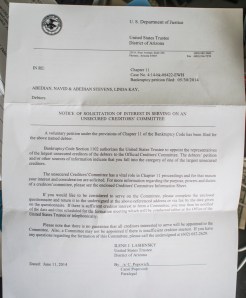
OLYMPUS DIGITAL CAMERAEDIT: It’s 2014 and I’d mostly forgotten about Navid, but I just got a letter saying that he declared bankruptcy. I’m a) somehow listed as a creditor and b) the Department of Justice somehow got my current address, in order to c) invite me on some kind of creditors’ committee. I wish I couldn’t say that I don’t feel a little schadenfreude, but, alas, I’m too small a person. Apparently his wife or ex-wife, Linda Kay Abedian Stevens—or Linda Kay Stevens? the wording is unclear—was also on the lease and on the property deed.

Since leaving Tucson I have been threatened with death zero times.

Life (and love)

“Is not general incivility the very essence of love?”

—Jane Austen, Pride and Prejudice

Why de Botton (and The Pleasures and Sorrows of Work)

Alain de Botton’s The Pleasures and Sorrows of Work has two wonderful passages on page 27: the first, concerning ship spotters—or those who watch and log ships coming in and out of a harbor:

They behave like a man who has fallen deeply in love and asks his companion if he might act on his emotions by measuring the distance between her elbow and her shoulder blade.

The ship spotters focus on statistics in large part because statistics can be found more readily than, say, aesthetic theories, or meta ideas about why we like spotting, or statistics, or fountain pens. Why do some of our activities, like ship spotting, dwell in the countable, while others, like love, tend to dwell in most people’s minds in the land of emotion? I say “most people’s mind” because some writers, like Tim Harford in The Logic of Life, have brought game theory to bear on love in the group sense in order to see what one might see.

De Botton has a partial answer:

It seems easier to respond to our enthusiasms by trading in facts than by investigating the more naive question of how and why we have been moved.

He’s right, and I think this is why many book blogs tend pay disproportionate attention to, for example, the publishing industry or a writer’s habit than the works that the industry publishes or that the writer writes. It’s simply easier, to steal de Botton’s accurate word, to deal with systematic issues than to analyze why de Botton’s simile of the lover works so well, which at bottom might be simply “because it does,” or an unattractive analysis of how something is both like and unlike something else. Like explaining a joke, such an analysis might render the subject being analyzed dead, and thus no longer worthy of analysis.

Tyler Cowen's political (and general) wisdom

“[…] we are accustomed to judging the truth of a claim by the moral status of the group making the claim.”

That’s Tyler Cowen speaking of “Climategate” in his post “The limits of good vs. evil thinking.” Normally I would put something like this in a links post, but “The limits of good vs. evil thinking” is so good that I’m emphasizing it with an independent post.

The major problem is that sometimes people we perceive as morally palatable can make untruthful or not optimally useful claims, while the opposite—people we perceive as morally unpalatable can make truthful or optimally useful claims—can also occur. Notice that I’m intentionally not providing examples of either phenomenon. As Paul Graham says in the notes to “What You Can’t Say:”

The most extreme of the things you can’t say would be very shocking to most readers. If you doubt that, imagine what people in 1830 would think of our default educated east coast beliefs about, say, premarital sex, homosexuality, or the literal truth of the Bible. We would seem depraved to them. So we should expect that someone who similarly violated our taboos would seem depraved to us.

If I said this kind of thing, it would be like someone doing a cannonball into a swimming pool. Immediately, the essay would be about that, and not about the more general and ultimately more important point.

The more important point is about avoiding ad hominem attacks and being able to consider claims independently of the person making the claims in some circumstances. As Cowen says, this is really hard.

Dune and its laughable honor code relative to Beowulf and Fast & Furious

Note: this is an addendum to an earlier post on Dune.

In Faculty Towers: The Academic Novel and Its Discontents ,* Elaine Showalter quotes a letter that Kingsley Amis wrote as a student regarding the Old English requirement at Oxford: “The warriors and broken-down retainers who strut bawling across its pages repel by their childish fits of self-glorification and self-pity. The cheapest contemporary novel has more to teach us than those painful reminders of what we have long outgrown.” Although I think Old English has more merit than Amis gives it here, the sentiment regarding the sentiment of that time is one I can get behind, and one of my major criticisms of Frank Herbert’s Dune is essentially that it is guilty of the same sins: childish warriors, ceaseless strutting, and the acceptance/embrace of retrograde cultural ideals regarding the roles of women and the need for killing.

You can see the worship of honor in Seamus Heaney’s translation of Beowulf, when the eponymous warrior’s death is occasion for twelve warriors to ride around the king and for them to “extoll… his heroic nature and exploits / and [give] thanks for his greatness; which was the proper / thing.” This scene wouldn’t be out of place in Dune, which is a problem for a novel written in 1965 rather than, say, the tenth century.

That’s not to say that these problems are limited to Dune, or to novels. Take the recent movie Fast & Furious, which is is astonishingly good when measured by decibel. In it, Paul Walker is compared unfavorably to Vin Diesel when a character implies, with a completely straight face, that Walker has no “code.” It was one of many unintentionally funny moments because the creators of the movie apparently missed, say, the last two hundred years of cultural development away from the idea of rigid masculinity codes and towards a great sense of irony and fluidity. If your code of honor forces you to kill someone because they’ve disrespected your MacGuffin, or whatever, your most likely destination is jail, which is appropriate, and your code is likely to prevent or hamper you from adapting to new social or environmental situations. But Dune and Fast & Furious both present having codes and what not as positive. In that respect they resemble Beowulf

I would like to imagine that at some point the culture as a whole will move beyond its silly obsession with tit-for-tat internecine identity fighting that causes people, usually of the male persuasion, to behave like moose who ceaselessly charge against one another because it’s mating season. Still, given the deep cultural, and maybe even biological, roots of this disorder, I’m not counting on this happening anytime soon, but maybe recognizing malady, as Amis did, is a step towards dialectically surpassing it.


* Which I’m reading in preparation for a conference. More perhaps on that later.

Rereading Rebecca Goldstein’s The Mind-Body Problem

Some novels grow in rereading while others shrink,* and Rebecca Goldstein’s The Mind-Body Problem, first discussed here, is among the former.** It’s wry and self-aware; after modestly painful cultural experiences at elite universities that perhaps consider themselves more elite than they actually are, Renee feels mentally inferior to peers and professors and responds with the body while still contemplating why, as a creature of thought, she is also so firmly a creature. This might sound as boring as the too-extensive academic philosophy papers on the subject. But instead of futile attempts at resolution, The Mind-Body Problem explores its general ridiculousness, both for the consciousness and the social structures in which the consciousness resides:

I had gotten used to thinking of myself as an intellectual. I had assumed that certain properties of mind and body were entailed by this description and had designed myself accordingly. It’s hard to discover you’ve constructed yourself on false premises.

She hasn’t, of course, and bad feedback from her environment (both scholastic and familial) combined with her own, Woody Allen-esque neuroticism that leads her to this conclusion. Besides, we know or would like to think we know that her conclusion is false because we are, after all, reading about her, and a smarter person is usually though not always more interesting to read about. That brings up the question of intellectuals and intelligence, which might not be fully overlapping categories.

One subtler observation: what distinguishes intellectuals from most people isn’t the size of their pomposity, but their ability to question assumptions (including their own) and perceive the world from different perspectives, while most people seem are stuck—frozen, really—in their own, unable to make impressive cognitive leaps into another’s imagination. They haven’t thawed sufficiently to mentally leap from person to person; this, I would argue, is the great cognitive change in Noam at the end of the novel, when he can or will no longer see the world from the perspective of math and instead tries to see it from the perspective of people. Renee, meanwhile, does so almost instinctively, and her assessments of herself and others are some of The Mind-Body Problem‘s funniest moments.

The Mind-Body Problem is like—or maybe just is—philosophy done really, really well in the sense that it can see the larger, abstract picture based on specific events and vice-versa, and it’s intelligible in seeing those events. Few novels or philosophy tracts have both sides, and most of those philosophy tracts have forgotten how to express themselves comprehensibly. (Quick Studies: The Best of Lingua Franca has an excellent piece on this subject, which compares Orwell and Theodore Adorno.) The narrator’s skill is part of this effect, since Renee is aware of herself and aware of how ridiculous she is, much like the unnamed protagonist in Norman Rush’s Mating. Recursive self-awareness begets cerebral humor, especially dirty cerebral humor. What’s not to like? Renee is muddling through choices that aren’t appealing, and her compromises look less like betrayals of fundamental beliefs and more like adult compromises the closer she gets to them:

My first year [at the Princeton Philosophy department] had been disastrous, and my second, just beginning, gave every indication of being worse. In short, I was floundering, and thus quite prepared to follow the venerably old feminine tradition of being saved by marriage.

But she can still laugh about it. When Noam arrives at his epiphanies—though they feel contrived—we’re relieved, and he, like Renee, grows along with the novel. I could ask for little more.


* Robert Heinlein, I’m looking at you, and in particular Stranger in a Strange Land, a novel that, while still not bad, is too philosophically simplistic and, by the end, silly. Every person in the novel but Mike is completely flat, and Mike only avoids that fate by being a symbolic repository for the feelings of all the flat characters. Even then, he’s not fully developed. It is possible to a symbolic repository and developed—think of Ahab in Moby Dick—but Mike isn’t even close. Nonetheless, I still retain a great deal of fondness for Stranger in a Strange Land, and it’s still enormously fun even when you’re rolling your eyes. 

** Much like Michael Chabon’s Wonder Boys.

Rereading Rebecca Goldstein's The Mind-Body Problem

Some novels grow in rereading while others shrink,* and Rebecca Goldstein’s The Mind-Body Problem, first discussed here, is among the former.** It’s wry and self-aware; after modestly painful cultural experiences at elite universities that perhaps consider themselves more elite than they actually are, Renee feels mentally inferior to peers and professors and responds with the body while still contemplating why, as a creature of thought, she is also so firmly a creature. This might sound as boring as the too-extensive academic philosophy papers on the subject. But instead of futile attempts at resolution, The Mind-Body Problem explores its general ridiculousness, both for the consciousness and the social structures in which the consciousness resides:

I had gotten used to thinking of myself as an intellectual. I had assumed that certain properties of mind and body were entailed by this description and had designed myself accordingly. It’s hard to discover you’ve constructed yourself on false premises.

She hasn’t, of course, and bad feedback from her environment (both scholastic and familial) combined with her own, Woody Allen-esque neuroticism that leads her to this conclusion. Besides, we know or would like to think we know that her conclusion is false because we are, after all, reading about her, and a smarter person is usually though not always more interesting to read about. That brings up the question of intellectuals and intelligence, which might not be fully overlapping categories.

One subtler observation: what distinguishes intellectuals from most people isn’t the size of their pomposity, but their ability to question assumptions (including their own) and perceive the world from different perspectives, while most people seem are stuck—frozen, really—in their own, unable to make impressive cognitive leaps into another’s imagination. They haven’t thawed sufficiently to mentally leap from person to person; this, I would argue, is the great cognitive change in Noam at the end of the novel, when he can or will no longer see the world from the perspective of math and instead tries to see it from the perspective of people. Renee, meanwhile, does so almost instinctively, and her assessments of herself and others are some of The Mind-Body Problem‘s funniest moments.

The Mind-Body Problem is like—or maybe just is—philosophy done really, really well in the sense that it can see the larger, abstract picture based on specific events and vice-versa, and it’s intelligible in seeing those events. Few novels or philosophy tracts have both sides, and most of those philosophy tracts have forgotten how to express themselves comprehensibly. (Quick Studies: The Best of Lingua Franca has an excellent piece on this subject, which compares Orwell and Theodore Adorno.) The narrator’s skill is part of this effect, since Renee is aware of herself and aware of how ridiculous she is, much like the unnamed protagonist in Norman Rush’s Mating. Recursive self-awareness begets cerebral humor, especially dirty cerebral humor. What’s not to like? Renee is muddling through choices that aren’t appealing, and her compromises look less like betrayals of fundamental beliefs and more like adult compromises the closer she gets to them:

My first year [at the Princeton Philosophy department] had been disastrous, and my second, just beginning, gave every indication of being worse. In short, I was floundering, and thus quite prepared to follow the venerably old feminine tradition of being saved by marriage.

But she can still laugh about it. When Noam arrives at his epiphanies—though they feel contrived—we’re relieved, and he, like Renee, grows along with the novel. I could ask for little more.


* Robert Heinlein, I’m looking at you, and in particular Stranger in a Strange Land, a novel that, while still not bad, is too philosophically simplistic and, by the end, silly. Every person in the novel but Mike is completely flat, and Mike only avoids that fate by being a symbolic repository for the feelings of all the flat characters. Even then, he’s not fully developed. It is possible to a symbolic repository and developed—think of Ahab in Moby Dick—but Mike isn’t even close. Nonetheless, I still retain a great deal of fondness for Stranger in a Strange Land, and it’s still enormously fun even when you’re rolling your eyes. 

** Much like Michael Chabon’s Wonder Boys.

Life: Existential humor edition

“The hero of my first novel beings by believing that ‘nothing makes any ultimate difference,’ and decides to end his life; he ends by realizing that if nothing makes any difference, that truth makes no ultimate difference either, and so rather than committing suicide he predicts that he’ll go on living in much the same manner as before.”

—John Barth, The Friday Book

The Time Paradox — Philip Zimbardo and John Boyd

As with many great works of nonfiction, Philip Zimbardo and John Boyd’s The Time Paradox: The New Psychology of Time That Will Change Your Life has that paradoxical quality of being incredibly profound and yet, in retrospect, blindingly obvious. It encompasses philosophical debates that occur at all levels of art; fiction often represents our feelings about time, while The Time Paradox lists a few dozen pop songs that contain messages about forms of time orientation. Last weekend I saw Woody Allen’s new movie, Vicky Christina Barcelona, in which one character, Vicky, lives oriented toward the stable future: a nice house, a boring but wealthy husband, and a life that is unlikely to end in a crater but also unlikely to offer stimulating adventures. Christina, played by the luscious and perfectly cast Scarlett Johansson, is a sensual hedonist who pursues novelty and risk-taking. Their contrasting ways of life begin the story, with the two balanced against Juan Antonio’s foil.

The movie is more sophisticated than this, as any art that can be accurately captured in summary is not worth experiencing. Nonetheless, just as The Hero With A Thousand Faces explicitly analyzes the scaffolding of many adventure stories, The Time Paradox implicitly discusses the dominant time views of many works of art. Some, like The Great Gatsby, show opposing characters who see time, and hence one another, in different ways; in such a reading, Nick Carraway is a present-oriented fatalist with little personality of his own, while Jay Gatsby combines a past-positive perspective of Daisy with a future-oriented work ethic that he thinks will win her back. Gatsby on a larger level criticizes both views: in bending all his time orientations toward a particular person, Gatsby’s obsession ultimately leads to a ruinous car crash, destroying himself in crime, like the crime that his wealth is built on, while Nick, without the focus of his attention, seems to drift without learning. The novel’s last line, one of my favorites in all literature, soothes or terrifies the reader by reminding us of how life will continue for others even when it does not for us:

Gatsby believed in the green light, the orgastic future that year by year recedes before us. It eluded us then, but that’s no matter—tomorrow we will run faster, stretch out our arms farther. . . . And one fine morning—
So we beat on, boats against the current, borne back ceaselessly into the past.

Whether we are terrified by this receding light depends on our reaction to it and how we handle that past.

Zimbardo also wrote The Lucifer Effect: Understanding How Good People Turn Evil, which together with Dan Ariely’s Predictably Irrational, pokes holes in traditional economic thinking concerning man as as a rational actor. All three argue that things are not as simple. In Zimbardo and Boyd’s case, the problem is that we don’t consciously realize how we tend to think about past, present, and future, or if we do, we aren’t able to step outside ourselves to realize how we’re thinking. What is “rational?” in the context of past, present, and future? To enjoy the moment, or to work toward a future moment? Zimbardo and Boyd implicitly argue neither, and they point to the poorly understood trade-offs we make regarding how we orient ourselves chronologically. That I use the language of economics to present this parallels Zimbardo and Boyd, who discuss “The Economics of Time” along with the nature of opportunity costs—another well-known issue too little referenced in everyday discourse.

Learning about opportunity costs, including those of being oriented toward present, past, or future, gives one more information and hopefully leads to better decision making. This meta-critical force is powerful, if poorly understood, and what I like so much about Zimbardo’s books is their ability to take on this meta-critical function and put it to paper—like a good therapist or friend—pointing to the blind spots we don’t realize exist. Self-help books should do this but often don’t, or if they do—like Marti Olsen Laney’s The Introvert Advantage: How to Thrive in an Extrovert World*—they’re filled with clichés or otherwise poorly written. The Introvert Advantage is especially painful because it conveys a useful message to both introverts and extroverts, but is marred by stylistic problems. The Time Paradox’s promises as a self-help book are slightly deceiving: it is more like a book discussing research that happens to dress in self-help clothing. And aren’t all books, or all art, on some level designed to provide “self-help?” But no matter: the genre, if any, is transcended by the content, as happens here.

The Time Paradox is also clever in its examples of traps each kind of person creates for themselves, whether those focused on the past to the detriment of their daily lives, those focused on the present to the detriment of their belief in their own ability to change the future, or those focused on the future who lose their sense of joy. Regarding the latter, for example, the authors write that “[…] future-oriented workaholics who do not cultivate sensuality and sexuality have little interest in making friends or “wasting” time in playful activities—a recipe for sexual deprivation. In contrast, the present-oriented might be too focused on such aspects, resulting in pregnancy, disease, or awkward pictures on the Internet.

Elsewhere, regarding those who are oriented toward the future, Zimbardo and Boyd say “[…] they do not spend time ruminating on negative past experiences. They focus on tomorrow, not yesterday.” This has advantages, especially in societies that reward delayed gratification, but also problems, as such “futures” can appear callous, or uninterested in the past, or less capable of building friendships based on experiences—perhaps leading them to feel emotionally isolated, or even held back in work. Futures might succeed through plotting and the aforementioned delayed gratification, but they might also miss some aspects of creativity. For example, Zimbardo and Boyd describe a maze game in which futures tended to outperform presents in navigating a mouse through a maze. But, as the authors write:

Many of the presents who failed got frustrated at not finding the right path and ended up making a straight line to the gaol, bursting through the cul-de-sac barriers.

Perhaps some measure of conventional success is thanks not due to following rules and accepting constraints, but through redefining problems and solutions. As one character says to another in The Matrix, some rules can be bent; others, broken. Technological and artistic progress** often stem from such unconventionality. That isn’t to make a logic error and say that unconventionality automatically equates with progress, but channeled in the right area, it might be necessary if not sufficient.

The Sept. 1 issue of The New Yorker shows a cartoon in which a man says, “I’m not losing my memory. I’m living in the now,” implying a past orientation moved into the present caused by age. Mental faculty creates time impressions, and physical changes, including drugs, can alter them—and not necessarily for the worse. In a section regarding how to become more present-oriented, for example, Zimbardo and Boyd offer the recommendation “drink alcohol in moderation,” which is the sort of self-help I’m only too happy to indulge. Perhaps so many writers and artists are alcoholics because they need to get out of the past (Faulkner) or future.

In suggesting this, however, I’m succumbing to the book’s major potential weakness: presenting time disorders or problems as an overly major source of anxiety and in turn diagnosing time as a source of maladies, rather than perhaps an effect. For example, Zimbardo and Boyd come perilously close to implying that correlation is causation when they discuss the outcomes of the time scales they developed to measure one’s attitude; in an early section, they attribute a focus on immediate gratification, self-stimulation, and short-term payoffs to perhaps too great a degree.

Other sections should be qualified, as when Zimbardo and Boyd write that “Our scarcest resource, time is actually much more valuable than money.” That depends on, for example, how much money we have; if I had no food, I would very readily trade some time for money, and almost every day I engage in some transaction designed to turn time into money. For, say, billionaires, time is more scarce than money or virtually any other resource, and it’s worth noting here what economists call the backward bending shape of the labor curve—that is to say, as a person’s earnings increase, they tend to work more hours, but at a certain point, they tend to cut back in order to enjoy the results of those earnings. An extreme example of that tendency can open between generations: the hard-working parents provide so plentifully for their offspring that the offspring tend to adopt a hedonistic, present-oriented lifestyle that ultimately destroys the future-oriented values of work and thrift that led to creation of the fortune in the first place. Today, it’s Paris Hilton or the ceaseless articles about how we damn kids lack the work ethic of the old days; yesterday it was Vanderbilts and Astors whose descendants are now mostly middle-class, and tomorrow it will be the tech titans’ legacy.

Yet even if I don’t entirely agree with sections or nit-pick, merely raising the issues leads us to consider them, our own behavior, and most importantly, how to best lead our lives and allocate a resource Zimbardo and Boyd imply many barely consider. At the end of the last paragraph, I analogized time perspectives to family and social dynamics—an idea I wouldn’t have considered prior to reading The Time Paradox.

Zimbardo and Boyd rightly caution readers not to assume that a person is entirely one orientation, since all people have some level of all orientations within them. Instead, the reader should try applying their own (past, presumably) behavior to the models in order to evaluate them within the framework both offer. Perhaps their most powerful recommendation is one that echoes Viktor Frankl’s Man’s Search for Meaning and Stoic philosophers: that although we can’t always control events, we can control our reactions and try to influence them. Zimbardo and Boyd write:

[…] psychological principles are elastic: They bend and change according to the situation and frame of reference […] We have no control over the laws of physics, but we do have some control over the frames of reference in which we view time. Recognizing how and when these frames of reference are advantageous may allow you to get more out of life and help you recognize those occasions when time perspectives hinder and impede you.

The most valuable sections of the book can get buried: they don’t come later in that quote, but earlier, when Zimbardo and Boyd discuss how much our perceptions count and can change how we feel. Their biggest purpose is first to increase our sense of agency and our ability to believe in our own influence, limited as it might be. Call this the difference between science and The Secret, a book I won’t dignify with a link: one sees self-empowerment as a first step of many to come, while the latter is an excuse for the first step and then stopping in a myopic haze of wishful thinking.

Finally, if the book has an overarching, abstract message, it is that we should, like a character from a Herman Hesse novel, ask what we want from life and how to find it. The Time Paradox provides guidance in finding the answer by, for example, discouraging “a kind of learning helplessness,” but the actual journey belongs to the reader, not the authors.


* For decent coverage of the same idea, see Jonathan Rauch’s “Caring for Your Introvert” in The Atlantic.

** Assuming these aren’t simply two sides of the same coin.