Susan Engel doesn't get the problems with schools, but she'll tell us to "Teach Your Teachers Well" anyway

Susan Engel’s Teach Your Teachers Well completely misses the point. She says:

And if we want smart, passionate people to become these great educators, we have to attract them with excellent programs and train them properly in the substance and practice of teaching.

But the problems with teacher training probably have less to do with teacher training and more to do with institutional structures and incentives within teaching itself.

She says, “Our best universities have, paradoxically, typically looked down their noses at education, as if it were intellectually inferior.” The reason they probably look down upon education is that most educators, in the sense of public school teachers, have little incentive to excel at teaching once they earn tenure; consequently, most don’t. There’s been a lot of material published on this subject:

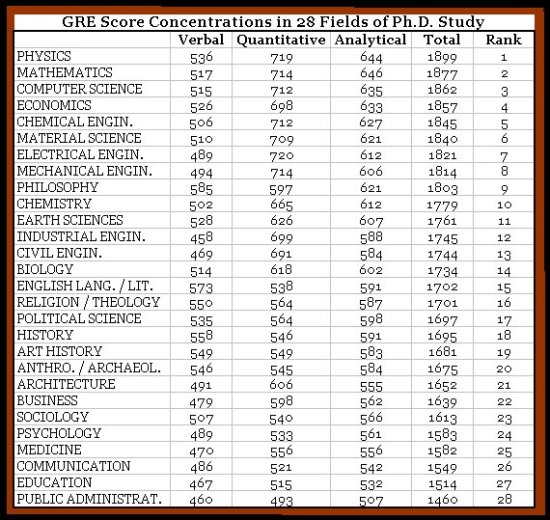
Taken together, these pieces paint the proverbial damning indictment of how teaches are hired, promoted, and (not) fired. Once you’ve read them, it’s hard to accept the dissembling evident from teachers’ unions. Given the research cited regarding the importance of good teachers and how few incentives there are to become a good teacher, maybe it shouldn’t be a surprise that education majors and graduate students typically have incredibly low standardized test scores and GPAs, as shown in the following chart (2002; source):
gre_scores_by_department

Notice that education is at the bottom. Should it be much of a surprise that the best universities, which are almost by definition hyper-competitive, look down on the profession? Susan Engel thinks so.

If you change the incentives around teaching, the programs that teach teachers will change, and so will the skill of the teachers more generally. Over the last thirty years, the larger economy has undergone a vast shift toward greater competition and freer markets—a vast boon to consumers. The market for primary and secondary education has seen virtually none of this competition, or, to the extent it has seen such competition, has seen it on a district-by-district level, which requires geographical moves to take advantage of it.

This topic is one I attend to more than others because I think I’d like teaching high school and that I might even be good at it. But the pay is low, even relative to academia (which isn’t most remunerative field in existence), and, worse, there’s virtually no extrinsic reward for excellence. Almost anyone with a slightly competitive spirit is actively driven out; even those who have it begin with probably lose it when they realize they’ll make the same money for less work than those with it. And you’ll basically have to spend an extra year or two and lots of money to get an M.A. in education, which sounds like a worthless degree.

If you teach computer science in most districts, you make as much as someone who teaches P.E. You might notice that, according to Payscale.com‘s average salary by major table, education majors usually start at about $36,200 and make a mid-career average of $54,100. That’s probably low because it doesn’t take into account the extra time off teachers get during the summer. Still, notice the numbers for Math: $47,000 / $93,600, Computer Science: $56,400 / $97,400 or even my own major, English: $37,800 / $66,900.

But I doubt money will solve the problem without institutional reform, which is very slowly picking up. Susan Engel’s comments, however, only muddy the water with platitudes instead of real solutions.

EDIT: And if you want further hilarity as far as teaching incentives go, check out Edward Mason’s story, “Union blocks teacher bonuses.” As Radley Belko says, “The Boston teacher’s union is blocking an incentive bonus for exceptional teachers sponsored by the Bill and Melinda Gates and Exxon Mobil foundations unless the bonuses are distributed equally among all teachers, good, bad, and average.”

(Legitimately) free music: The Orange Mountain Music Philip Glass Sampler Vol.I

Amazon is currently giving away The Orange Mountain Music Philip Glass Sampler Vol.I, which caught my attention because I’ve liked Glass since really hearing him for the first time last year during a University of Arizona dance showcase when some of the students used “Metamorphosis.”

I’m listening to the “sampler” now, which has more variation in style than a complete album for obvious reasons. While some transitions between songs verge on jarring, but the album still seems worth downloading.

(Hat tip Crooked Timber.)

Breaking the News follow-up

My post on James Fallows’ Breaking The News: How the Media Undermine American Democracy generated a fair amount of e-mail and commentary. In the comments section, Steve Karger pointed to The 3 key parts of news stories you usually don’t get, which rehashes of some of Fallows’ points but without acknowledgement except at the top, which has a quote, and the very bottom of the page, which says “With fond apologies to James Fallows.” Nonetheless, it’s worth reading.

I found What should be “the new rules of news” in The Guardian, one of the UK’s major newspapers. I especially like this rule:

3. Transparency would be a core element of our journalism. One example of many: every print article would have an accompanying box called “Things We Don’t Know,” a list of questions our journalists couldn’t answer in their reporting. TV and radio stories would mention the key unknowns. Whatever the medium, the organisation’s website would include an invitation to the audience to help fill in the holes, which exist in every story.

Sadly, its recommendations seem unlikely to come to pass: the incentives against better journalism seem too deeply entrenched, especially compared with the cost of real journalism.

Salon.com reports that “Journalists like Evan Thomas now admit the Clinton scandals were bogus. When will they admit they played along?” And the answer appears to be “never.” These kinds of retrospective pieces remind us of what’s wrong with the news business: reporters are participating in the practices that weaken confidence in the business, much like individual investors who make decisions that collectively shake the market’s foundation yet are personally beneficially.

Finally, Fallows himself caught my post and wrote in reply:

I have thought several times about revising or updating the book but have held back for two reasons. One is the shark-like instinct that it’s worth always moving ahead to new territory. The other, that the central points to make remain the same; the details would differ and be more depressing.

He’s correct, and others have been gathering plenty of fresh examples, as “The 3 key parts of news stories you usually don’t get” shows. I have no idea what arrangements he has with his publisher, but perhaps a new edition with a new forward/afterward would a) give a reason for additional coverage of the book and b) give the benefit of a small number of new examples without having to overhaul the entire thing. Then again, as far as I can tell, Breaking the News got a fairly loud reception the first time and the problems it discusses are fairly well-known, so maybe this wouldn’t matter much.

As I said in my first post, I think the individual’s response to lousy news is likely to be limited, since I can’t immediately make structural changes in the big news organizations that produce lousy “news,” which some people seem to prefer, like Fox News. But if you are interested in better news, try The Atlantic, The New Yorker, the Wall Street Journal (which still seems pretty good) and the New York Times.

Late September links: Little to do with books, much to do with life

* The best I’ve read concerning “overrated” novels, courtesy of the Little Professor.

* The humanities are in the same state financial markets were in before they crashed. Assessing the growing mountain of toxic intellectual debt, Philip Gerrans considers going short on some overvalued research.

Except that I’m not sure his analogy works, since “intellectual debt” doesn’t have to be “repaid,” doesn’t hurt anyone, and might point the way forward regarding ideas in ways that aren’t necessarily obvious at the time such “debt” is being produced/acquired.

* What kinds of inequalities bother people, and what kind do not?

* In Conniptions from me on urban economics, Tyler Cowen lists his opinions on urban issues, which I essentially agree with save for number 3, which I know nothing about:

1. I would not have brought the U.S. down the path of water subsidies, many of which are pro-suburban. (Admitted they are not always easy to repeal.)

2. I think pollution externalities should be priced in Pigouvian fashion; this would penalize many suburban developments.

3. I oppose the widening of Route 7 at Tysons Corner and I expect a disaster from the current plans.

4. I favor school choice and charter schools, which would make many U.S. cities livable again for couples with children.

5. I would price many roads for congestion, although as Bryan points out this could either help or hurt cars as a mode of transport.

6. I would allow U.S. cities to become much taller, thereby accommodating more residents. I would weaken many urban building codes in the interests of a greener America.

7. I much preferred the time when I lived near a gas station and a 7-11.

* Laws have become too vague and the concept of intent has disappeared. Notice in particular this problematic line: “Prosecutors identify defendants to go after instead of finding a law that was broken and figuring out who did it.” If the theory is that everyone is a criminal if you look hard enough, something very serious has gone amiss in our notions of justice.

* A chat with blogger Penelope Trunk:

Ben: You blog about sex a lot. Why?

Penelope: I think about it all the time. So it comes into my head a lot when I’m writing blog posts. I sort of wonder why it doesn’t come into more peoples’ heads when they are writing blog posts.

Ben: People censor themselves.

Penelope: Yeah. Well. I censor myself too. I guess it’s just we each have different types of self-censoring….

Ben: Alain de Botton has an interesting point on this. He says the professionalization of writing — novelists who write fiction full time — has made it so much fiction is disconnected from life as it’s experienced by most people.

Penelope: Totally agree. And the French have this problem more than any other culture.

* I wasn’t going to write about Dan Brown till I found this hilarious discussion of his expert style. One day I hope to be as great a writer.

* Dvorak keyboard devotees and their battle with smartphones.

* Population growth drives innovation?

* Andrew Sullivan of The Atlantic makes the pitch for print. I subscribe to The Atlantic and recommend that others do as well.

* America can’t be the world’s tech leader without immigration reforms.

* The Man Who Saved a Billion Lives has died.

* Megan McArdle and Matt Yglesias on education, in a post I almost completely agree with.

* Wow: from I was an Ambassador and Taken Hostage by Militants:

I learned a lot from my time as ambassador and Marine. Paperwork means stuff to people: really important stuff. Thinking you have to solve every problem on your own is an additional problem to your other problems: one that makes all the others worse. No matter how much you love something, it’s not going to make a square peg fit into a round hole. What people experience in the service has to do with the type of work they do and the unit they are in. Hidden assumptions hurt. A lot….

This “bad experience” changed a passive, wait-for-life-to-happen person into and active, go-make-it-happen person.

(Emphasis added.)

I wish I’d realized the power of paperwork earlier, or how important documentation is in a modern, complex, and bureaucratic society.

* Two kinds of libertarians.

What I like in this essay is also an acknowledgement of its limitations (the “cartoon” version of libertarian), but also the acknowledgment that those limitations are useful in describing broader phenomenon.

* The value of a college education.

A friendly reminder to those who think they know the answer to everything

“Humans are suckers for finding patterns where none really exist, like seeing the shapes of lions and giraffes in the clouds.”

William Easterly’s review of Leonard Mlodinow’s The Drunkard’s Walk: How Randomness Rules Our Lives and Ha-Joon Chang’s Bad Samaritans: The Myth of Free Trade and the Secret History of Capitalism is very much worth reading for its own sake, as well as being a timely reminder for the limits of our ability to understand cause/effect, whether in developmental economics or other fields.

Bookshelves, offices, and Neil Gaiman

Photos of Neil Gaiman’s impressive bookshelves have been making rounds of the literary blagosphere, and let me be the latest to link to them and say “wow.”

Gaiman Shelves

(There are more pictures in the original post.)

My own are humbler; I posted some pictures of the shelves in my old apartment here, and you can see one of them here:

seliger_shelves

Not nearly as impressive as Gaiman’s, to be sure. But then I haven’t been reading as long and have purged much of my library twice: once when I left for college and discarded much of the pulp fantasy (like DragonLance and The Wheel of Time) that I used to like, and again when I graduated from college and figured that many of the books, both ones I’d read in general and in class, I was unlikely to read again. So far that’s proven right regarding, for example, Spenser’s The Faerie Queen. Someday, when I’m less mobile than I am now, I wouldn’t mind a setup like Gaiman’s. And by “wouldn’t mind,” I probably mean something closer to “would love to have.”

“The moral obligation to write well”

From A Commonplace Blog:

No other writer I can name has accepted with such utter self-abnegating devotion to what I can only call, in a blatant allusion to John Erskine’s famous 1915 essay, the moral obligation to write well. This is, I believe, the sum and substance of what it means to respect the institution of literature. The writer shoulders a double burden.

If you think you know the writer, post your guess in the comments section.

No peeking!

"The moral obligation to write well"

From A Commonplace Blog:

No other writer I can name has accepted with such utter self-abnegating devotion to what I can only call, in a blatant allusion to John Erskine’s famous 1915 essay, the moral obligation to write well. This is, I believe, the sum and substance of what it means to respect the institution of literature. The writer shoulders a double burden.

If you think you know the writer, post your guess in the comments section.

No peeking!

Good Books Don’t Have to Be Hard

In my essay on Lev Grossman’s The Magicians, I cited his Wall Street Journal article Good Books Don’t Have to Be Hard:

It’s not easy to put your finger on what exactly is so disgraceful about our attachment to storyline. Sure, it’s something to do with high and low and genres and the canon and such. But what exactly? Part of the problem is that to find the reason you have to dig down a ways, down into the murky history of the novel. There was once a reason for turning away from plot, but that rationale has outlived its usefulness. If there’s a key to what the 21st-century novel is going to look like, this is it: the ongoing exoneration and rehabilitation of plot.

Where did this conspiracy come from in the first place—the plot against plot? I blame the Modernists. Who were, I grant you, the single greatest crop of writers the novel has ever seen. In the 1920s alone they gave us “The Age of Innocence,” “Ulysses,” “A Passage to India,” “Mrs. Dalloway,” “To the Lighthouse,” “Lady Chatterley’s Lover,” “The Sun Also Rises,” “A Farewell to Arms” and “The Sound and the Fury.” Not to mention most of “In Search of Lost Time” and all of Kafka’s novels. Pity the poor Pulitzer judge for 1926, who had to choose between “The Professor’s House,” “The Great Gatsby,” “Arrowsmith” and “An American Tragedy.” (It went to “Arrowsmith.” Sinclair Lewis prissily declined the prize.) The 20th century had a full century’s worth of masterpieces before it was half over.

Read the whole thing. I’m drawing special attention to it because there are few essays I’ve read recently, or maybe ever, that I agree with more, ranging from Grossman’s analysis of the current situation to its historical roots to his call for future action.

The next step is B.R. Myers’ A Reader’s Manifesto.


EDIT: See also Jeff’s excellent comment.

Good Books Don't Have to Be Hard

In my essay on Lev Grossman’s The Magicians, I cited his Wall Street Journal article Good Books Don’t Have to Be Hard:

It’s not easy to put your finger on what exactly is so disgraceful about our attachment to storyline. Sure, it’s something to do with high and low and genres and the canon and such. But what exactly? Part of the problem is that to find the reason you have to dig down a ways, down into the murky history of the novel. There was once a reason for turning away from plot, but that rationale has outlived its usefulness. If there’s a key to what the 21st-century novel is going to look like, this is it: the ongoing exoneration and rehabilitation of plot.

Where did this conspiracy come from in the first place—the plot against plot? I blame the Modernists. Who were, I grant you, the single greatest crop of writers the novel has ever seen. In the 1920s alone they gave us “The Age of Innocence,” “Ulysses,” “A Passage to India,” “Mrs. Dalloway,” “To the Lighthouse,” “Lady Chatterley’s Lover,” “The Sun Also Rises,” “A Farewell to Arms” and “The Sound and the Fury.” Not to mention most of “In Search of Lost Time” and all of Kafka’s novels. Pity the poor Pulitzer judge for 1926, who had to choose between “The Professor’s House,” “The Great Gatsby,” “Arrowsmith” and “An American Tragedy.” (It went to “Arrowsmith.” Sinclair Lewis prissily declined the prize.) The 20th century had a full century’s worth of masterpieces before it was half over.

Read the whole thing. I’m drawing special attention to it because there are few essays I’ve read recently, or maybe ever, that I agree with more, ranging from Grossman’s analysis of the current situation to its historical roots to his call for future action.

If you haven’t clicked the link, you shouldn’t be reading this. Once you have clicked it, however, consider the next step: B.R. Myers’ A Reader’s Manifesto.


EDIT: See also Jeff’s excellent comment.