The year's best in reading, not in publishing

Like D.G. Myers, I don’t find much interest in “year’s best” lists and the like. Most of them are, as he says, boring; maybe that has something to do with the nature of the list and the arbitrary divisions that we use to mark milestones in our lives.

That being said, I read a lot, and I’d prefer to write about what’s new to me, rather than what happens to be published in a particular 12 month period. Last year I wrote about “pointless listmaking,” and I’m reminded of a comment from Rob, the narrator of Nick Hornby’s High Fidelity, when he’s at a party given by an ex-girlfriend:

The difference between these people and me is that they finished college and I didn’t… as a consequence, they have smart jobs and I have a scruffy job, they are rich and I am poor, they are self-confident and I am incontinent, they do not smoke and I do, they have opinions and I have lists.

(Emphasis added. The novel’s first sentence involves a list: “My desert-island, all-time, top five most memorable split-ups, in chronological order: 1. Alison Ashworth…”)

Umberto Eco likes lists, or at least studies them. As previously mentioned, he said that “The list is the origin of culture.” Being the origin, however, is very different from being the destination, or the evolution, of culture, and so in that light the list might be a primitive device that is still nonetheless useful to consider. As such, after a great deal of meta commentary regarding the nature of the activity in which I’m about to engage, I’m going to give a non-numbered, non-ordered list of books I happened to read in the previous 12-month period that are books I now recommend to others, found moving, or otherwise think deserve special attention.

* Carlos Ruiz Zafón, The Angel’s Game, which I keep meaning to write about and then not doing. If one were writing an ad for the novel, it could say, accurately, “Did you love The Shadow of the Wind? Then you’ll love The Angel’s Game!” The two novels are written in the same half-mocking Gothic style, are both set in Barcelona, and both deal with murder, love, and literature.

* Max Jamison, Wilifred Sheed’s improbably hilarious novel about an unhappy theater critic.

* The Magicians, Lev Grossman’s take on what magic school might seem like to those who are already aware of magic school and fantasy conventions. As with real school, nobility takes front seat to sex and power, which occupy the back. I also read (and haven’t written about) Donna Tart’s The Secret History, which features school and murder in a surprisingly pleasant literary package.

* Daniel Gilbert’s Stumbling on Happiness ought to be required reading for those who are alive.

* John Barth’s The Sot-Weed Factor.

One nice part about reading is that books are effectively inexhaustible: given constraints on time, no one can read everything worthwhile (although Harold Bloom is apparently trying). Therefore we need developed opinions, yes, but we also need pointers to books that are worth having developed opinions about, and to my mind the handful of books above meet that criterion. Apologies to those of you who have read this far and just wanted a couple books to read, and to those of you who think the whole idea of lists so noxious and boring that, even with the aforementioned meta commentary, you don’t know how you managed to get this far into the post.

New Year's Links: Elliott Bay Books, Amanda Knox, Netherland, eBooks, and more

* Nobody Told Me It’s Impossible, So I Did It.

* Why does it take so long to publish a book? As the article says:

“It’s not the technology that’s the problem; it’s the humans that are the problem,” said Jonathan Karp, the publisher of Twelve, which releases one title a month.

* Elliott Bay Books is moving from its home in Pioneer Square to Capitol Hill, about three blocks from where I used to live in Seattle. I visited the soon-to-be-old place two weeks ago:

* Netherland for great-novel status:

No novel better captures the background dread of everyday life these days — terrorism jitters, credit-default swaps, mutant flu strains — than Joseph O’Neill’s “Netherland”. Like “The Great Gatsby” — to which it bears obvious resemblance — “Netherland” compresses the American experience into a critical mass, and then proceeds to pick it apart. Like Fitzgerald, O’Neill works principally with two characters: Hans van den Broek, a Dutch banker living in New York whose wife has returned to London following 9/11, and Chuck Ramkissoon, a Trinidadian immigrant with countless moneymaking schemes, the grandest of which is the New York Cricket League.

Really?

* Is handwriting a hindrance to thinking?

* E-books spark battle inside the publishing industry.

* It’s an ominous sign when even the New York Times is publishing editorials like “There’s Only One Way to Stop Iran,” that one way being military attack. What’s more frightening too is that the editorial’s logic, according to my limited understanding of the situation and of geopolitics, seems correct.

* Charities Rise, Costing U.S. Billions in Tax Breaks, according to the New York Times. If we can just work for 1% of those nonprofits, we’ll consider ourselves successful.

* Terry Teachout on “Technology and the End of Trend: A Critic Looks in Vain for Sweeping Movements: Now Artists Feed an Audience of Instantly Gratified Individualists.”

Our culture was always more diverse than the media let on, and now that anyone with a laptop has near-instant access to a near-infinite array of art objects, it’s becoming harder for anyone to sculpt the tastes of millions of people into anything remotely resembling a lemming-like consensus. America is well on the way to becoming a country of cultural individualists who want what they want when they want it.

* How China wrecked the Copenhagen talks.

* Ask an Academic: Why Women Have Sex talks to Cindy M. Meston and David M. Buss, who you might recognize from my mostly negative review of their book, “Why Women Have Sex.”

* Andrew Sullivan’s book The View From Your Window is attractive.

* Arizona’s completely bizarre criminal justice system, or lack thereof, has devolved into some kind of surreal play just this side of Kafka, as The Phoenix New Times describes. I’d excerpt a piece of the post, but it’s so strange as to resist summarization because of the bizarre accusations between levels of local government and law enforcement. The last line, however, is money:

By the time we reached the end of this press conference and read through the convoluted paperwork proffered by Thomas’ prosecutors, we only had one question: Where are the feds?

Another way of saying this is, “Where are the grownups?”

* Sprint fed customer GPS data to cops over 8 million times. Civil libertarians and patriots, sharpen your pitchforks and light your torches.

* Along those lines: Days of government regulation, from Philip Greenspun.

E-Readers: They’re Hot Now, But the Story Isn’t Over:

But e-reader buyers may be sinking cash into a technology that could become obsolete. While the shiny glass-and-metal reading gadgets offer some whiz-bang features like wirelessly downloading thousands of books, many also restrict the book-reading experience in ways that trusty paperbacks haven’t, such as limiting lending to a friend. E-reader technology is changing fast, and manufacturers are aiming to address the devices’ drawbacks.

“If you have the disposable income and love technology—not books—you should get a dedicated e-reader,” says Bob LiVolsi, the founder of BooksOnBoard, the largest independent e-book store. But other people might be better-off repurposing an old laptop or spending $300 on a cheap laptop known as a netbook to use for reading. “It will give you a lot more functionality, and better leverages the family income,” he says.

* The Amanda Knox case and gender politics.

Rereading A.S. Byatt's Possession: A Romance

The key moment in A.S. Byatt’s Possession: A Romance comes when Roland Mitchell, a prematurely desiccated academic, wonders why he might have stolen letters written by an invented 19th Century poet from the British Library. In explaining why, he says, “Because they were alive. They seemed urgent[….]” Nothing else in his life does, which straddles comedy and sadness. The act propels the action of the novel as well as a return of urgency and of discovery to his own life, implying that when we lack such attributes, we begin to die ourselves.

I’ve previously discussed Possession here), and the novel concerns academics who begin emotionally dead, and their intellects are perilously close to the same state. The key to their resurrection—their return to what one might skeptically call “the real world”—comes in an act of very minor theft by Roland. It’s out of character but brings him rolling to a beautiful academic, to a secret, and to the double discovery of his own romance and of someone else’s. Tracing the path of another person’s romance teaches him how to live his own; without that signal, perhaps he would remain among the academic undead, or the undead more generally. A rare forbidden act—sex has lost its forbiddenness, so theft of an academic nature will have to do—has a rejuvenating effect, reminding us of the limits and limiting nature of bounds and boundaries, sexual, textual, and otherwise. For a novel that is composed heavily of invented texts, stealing carries a larger moral rigor that it might otherwise not, and it helps Roland see his own life and work in way that is, again, finally, urgent.

Coders at Work: Reflections on the Craft of Programming – Peter Seibel

Coders at Work is consciously modeled on the Paris Review Interviews with famous writers and comes out better for it. The interviews are deep, thoughtful, wide-ranging, and show strong opinions without pedantry or needless prejudice. Many such opinions aren’t unique to programming or can be transferred easily to a wider domain area; Dan Ingalls, for example, says that “[M]y feeling about the powerful ideas that are necessary to lead a good life, it’s not clear how many of them are in this space,” this space being the intersection of computers and math. The expression is a bit awkward, which shouldn’t be surprising given that these interviews were conducted in person, but the idea of tremendous respect for powerful ideas is an attractive one that’s expressed over and over in these essays.

Coders at Work is surprisingly fun and useful, even for people whose connection to computer science is tenuous, chiefly because its metaphors and ideas about work and beauty travel. The author’s bio says, “An English major and would-be journalist in college, Peter was seduced by the web […]” and eventually became a hacker. Perhaps not surprisingly, then, I see a lot of ideas that one can apply to writing in this book. Joe Armstrong says that writing is an essential skill for programmers, and he says that writing is “actually very difficult to teach because it’s very individual.” Since I teach writing, that resonates with me, but it seems that coding is equally difficult if not quite equally individual, but the difficulty in learning both seems like a similar problem space. I write this from the position of someone with about a dilettante’s Computer Science 102 view of these things, but I see nothing in Coders at Work that’s incompatible with such a view. Both hacking and writing seem like what I call “10,000-hour problems,” or those that will require that much time to master. Ingalls implicitly agrees:

[…] I still love to just take a problem and sit down and pore over it until it’s right. There’s an analogy here: I tried to learn to play the piano fairly late in life. People said, “Oh, you should learn when you’re young. You learn so much quicker.” Although I didn’t go very far, my conclusion was that it isn’t that young people learn that much faster; it’s just they have more time. When I would put time in, I made progress.

I feel a bit the same thing with programming. When I look back on earlier times in my life, I had all the time I wanted. I would just work and work. Now there are other things going on in my life and I’ve got responsibilities that aren’t just programming. That undermines a bit of that intense focus.

Replace “programming” with “writing,” and I think the ideas about the process of learning stand. Ideas about beauty seem to transfer as well. L. Peter Deutsch says, “[… I]t’s just seeing anything around me that’s being done badly has always offended me mightily, so I thought I could do better.” Perhaps not surprisingly, Deutsch also says:

As crazy as it may seem now, a lot of my motivation for going into software in the first place was that I thought you could actually make the world a better place by doing it. I don’t believe that anymore. Not really. Not in the same way.

Maybe not: but I suspect that we make the world a better place by becoming really, really good at something—so good that no one else can do it as well as us, or some small coterie of skills that interact with one another—and then ultimately teach others that skill or suite of skills too.

The dominant idea in Coders at Work is not how to apply the skills once you have them, but the challenge and process of acquiring those skills. The coders interviewed acquire and apply them in diverse ways, but the dominant theme in all of them is starting early and intense, dedicated work. There is no other way to learn and to develop “Taste for Makers.”

One question is why more people don’t find and excel in coding, or in any particular, demanding field. Donald Knuth speculates that only about 2% of the population has the aptitude and desire for coding. Maybe. And maybe some segments of the population are turned off by the culture or cultures of coding. In a blog post, Seibel wonders whether there are “Enough women in Coders at Work?” The obvious answer from a gender parity perspective is “no,” but from a practical prospective I’d observe that a) there has been an overly low proportion of women in computer science for as long as one can remember and b) many of the interviewees came of age in the 60s and 70s, when the problem was even worse than it was now because of other institutional and cultural barriers.

Fran Allen takes up some of these issues. But Seibel is also a writer, and not directly responsible for the number of prominent, expert women coders; the fact that the issue arises is a sign of progress. Still, it is not effective to order people to learn to code or to like to code any more than it is effective to order people to become writers; the best you can do is give them an environment conducive to growth and remove institutional barriers and see what happens. Maybe some of them will learn taste and, better still, beauty.

(You can—and should—also read Joel Spolsky’s take on Coders at Work. His point: sometimes you need people who get things done.)

Max Jamison — Wilfrid Sheed

Really good and really bad books often announce themselves early: in the case of the former, you find that moment of shock and astonishment that propels you forward. In Max Jamison, that moments hits on page 7, when Flashman is described not as “a theater critic at all, but a maid-of-all-work gossip columnist and second-string reviewer who scooped up free tickets like a mechanical crane and prowled the lobbies for carrion.” Status and aesthetic contempt intermingle: Flashman doesn’t appreciate art because he’s “like a mechanical crane,” and yet at the same time he feeds on the dead—dead plays, dead reviewers, dead everything.

Max, on the other hand, sees himself as an antidote of sorts to that: he’s a theater critic with, if not heart, then at least acerbic taste, which is better than no taste at all. But he’s not terribly happy and is too aware of his own faults to let something like sentimental happiness buoy him; in another early scene, he thinks that “The actors he talked to were dull as ballplayers and degradingly anxious to please.” Or, more likely, the actors are worried about angering critics on whose fancy rides their career. But if that critic is sufficiently cantankerous, their actions simply won’t matter, and Max is holding the line against—what? Not the cavalry charge, certainly, but against something, even if he’s not sure what.

In the two paragraphs above, I’ve utterly failed to convey how funny Max Jamison is, perhaps because explaining the joke also kills it. Max is funny to himself but to few others; his estranged wife says, “I wish you wouldn’t attend so much. I wish I could split an infinitive with you sometime, or have a really silly discussion.” If Max worries about split infinitives, he truly is a nasty pedant, since split infinitives are a problem in Latin, not in English. Pedants who half understand their problems and are trying to remedy them are sometimes the most amusing of all, since they’re in the joke enough to be aware of their situation but not so much that they can remedy it.

Saul Bellow frequently exploits this metaphysical, intellectual, and sometimes sexual state; so does Mordecai Richler in Barney’s Version. It also might lend heft to a novel that could otherwise flutter—what’s most fascinating about Max is his sense of infinity within a confined space, which avoids the flutter problem. He’s a theater critic, unlikely to change professions, and stuck (if one can ever use the word “stuck” with this city) in New York by virtue of that profession. He’s confined, like so many of us, by those proverbial silk chains, given that he makes enough money, gets to sleep with admirers if he wants to, doesn’t have to worry about food, and only carps about status—which is difficult, since he’s at the top of his pyramid. But the pyramid is too short for him, and there’s probably none tall enough for him, and seeing him try to climb is hilarious without being mean.

(Note: I read Max Jamison thanks to D.G. Myers’ post on The Hack, which says that Sheed wrote “… perhaps the best novel ever written about a critic. Max Jamison (1970) is about a Broadway theater critic who no longer believes in what he does for a living.” It used to be that we thrashed when we no longer believed in God. Now we thrash when we no longer believe in ourselves. What will we thrash about next?)

Pages For You — Sylvia Brownrigg

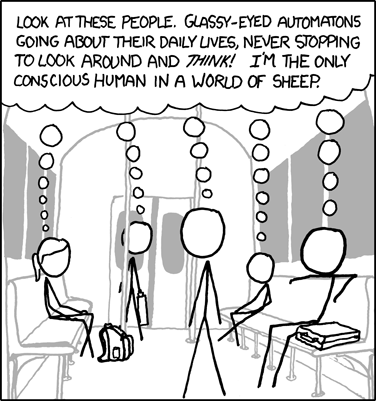
Like many teenager narcissists, Flannery Jansen thinks that she’s a special and unique sunflower “alongside such sour-souled people” as those she has to attend class and live with at college. By her own theory, “They were all planning to laugh at her, clearly, every single day, until she finally gave in and went back to the land of computers and eucalyptus, where everyone wanted you—sincerely—to have a nice day.” It’s a bit like the problem expressed so succinctly and beautifully in XKCD:

Alas, she’s probably not right, and we find out why in Pages For You, a novel that I want to be better than it is. The story follows Flannery as she chases and acquires Anne, a 28-year-old grad student in English whose idea of a good time is having or encouraging Flannery to write short quasi-diary entries about their relationship, and these pages form for the pages of the novel—the “you” in the title being Anne. The novel is written almost pornographically, in spurts that are supposed to represent Flannery’s daily writing assignments or letters to Anne.

As often happens to teenage narcissists—are we sensing a pattern here?—”Flannery had nothing to do but watch that mouth smoking, and though she couldn’t have said why it was so beautiful or described the thrill of its shape—she was too young to have anything like a vocabulary for such things—she could not stop herself from watching it, shaded a darkish persimmon that left its trace on the cigarette.” I like a nice mouth too, and having the vocabulary to describe it, but by the time I acquired the vocabulary to describe such a mouth I no longer needed said vocabulary. And smoking isn’t attractive. Even so, I like the phrase “shaded a darkish persimmon” enough that it saves the sentence from being turgid. Much of Pages For You feels like it’s about to become tedious, and then a moment later it recovers.

Take this description: Flannery stands “over a rickety kitchen table that had been flash-flooded with alcohol,” which so perfectly captures what those equally unruly college parties are like, with their sticky counters that were at least somewhat clean a few hours prior and probably won’t be clean again till much later. Long sections are oddly flat and affectless (“Flannery bundled up her items and took them away to the bookstore/cafe where she intended to enjoy them slowly, with a cup of decent coffee…”), but at least Pages For You is unusual in that it deals with a female/female romance, rather than the usual boy-meets-girl or vice-versa, then loses said boy/girl. It’s also refreshingly free of the professor-sex-plot machinations that drive many campus novels, like Francine Prose’s Blue Angel (which, to be fair, transcends its sex plot), or Bernard Malamud’s A New Life.

I like or want to like Flannery, who, even though she’s writing this at some point in the future, still doesn’t get who she was. But “Flannery did not know New York except as a movie and a myth,” much like me before I visited. And now I’d like to live there, if only it weren’t so damn expensive.

Chapters end before they really get going: that’s the major drawback for a novel structured like Pages for You, and the unusual form doesn’t have enough to do with the content to justify it. In another blow for equality, I’ve discovered something that I’ve always suspected: lesbian romances can be just as boring as their heterosexual counterparts for those not immediately involved in them. That being said, I like a coming-of-age story as much as the next fellow, and I rolled with this one to the last page, waiting for those phrases—”flash-flooded with alcohol”—that made me look again. And I kept waiting for Flannery to want something more than action and meaning, but the flash-floods of those epiphanies, alas, weren’t readily forthcoming.

The pleasures of Bellow and the unexpected moment in Herzog

One of the pleasures of reading and rereading Bellow comes from the unexpected moments that ceaseless arise. I’ve read most of Bellow’s novels two or three times, but this bit regarding Herzog’s mind stands out: “It was too full of his grant projects to think anything clearly.” The contradiction of a full mind, which we usually consider orderly, brilliant, professorial, and the failure to think “clearly,” which is normally a problem of the undereducated or the thoughtless, seems perfectly right for someone who is being put back together by falling apart (or vice-versa; with Bellow, you never know). Here’s the larger context for that passage:

But it would never happen to her daughter, not if she could help it. And Madeleine was just as determined that it should not. And this was where Moses came in, on the bench of Verdi Square. His face was shaven, his shirt was clean, his nails clean, his legs, somewhat heavy in the thighs, were crossed, and he listened to Tennie very thoughtfully—for a man whose mind had stopped working. It was too full of his grant projects to think anything clearly.

So who is Moses, the man whose mind isn’t working clearly but who is also presented as a good and thoughtful bourgeois provider, at least here, with his cleanliness and full/empty mind? That I don’t have a good answer, two or three or however many times through, reminds me of Bellow’s subtlety, his habit of slipping in that idea that’s endlessly forgotten and rediscovered, and which makes him unexpected even when I superficially know what’s going to happen.

Moses Herzog and Bellow also know what’s going to happen, of course, which is why images of death are so pervasive in Herzog and many of Bellow’s other novels. The question is how we deal with that fact and how it animates our social and intellectual lives. The (partial) answer to that question is the complete works of Saul Bellow; I say “partial” because I suspect the larger point is that there is no answer, only more questions. No wonder so many people exist in such a neurotic world.

Life: Children and The Children’s Book

“The young desire to be free of the adults, and at the same time were prepared to resent any hint that the adults might desire to be free of them.”

—A.S. Byatt, The Children’s Book (which is excellent and highly recommended so far).

Life: Children and The Children's Book

“The young desire to be free of the adults, and at the same time were prepared to resent any hint that the adults might desire to be free of them.”

—A.S. Byatt, The Children’s Book (which is excellent and highly recommended so far).

Malcolm Gladwell on Harper Lee's To Kill A Mockingbird

I have two fundamental problems with Malcolm Gladwell’s piece in the New Yorker concerning To Kill a Mockingbird: one is philosophical/moral, and the other aesthetic. The philosophical/moral problem is that incrementalism is not necessarily an invalid approach to major social injustice. Gladwell says:

Old-style Southern liberalism—gradual and paternalistic—crumbled in the face of liberalism in the form of an urgent demand for formal equality. Activism proved incompatible with Folsomism.

That’s true: but it doesn’t mean that the James Folsom approach—who was progressive by southern standards in the first of the twentieth century—wasn’t an improvement over what came later as part of the unjustified backlash. Gradual change can set the stage for radical change, as it did with the Civil Rights movement, and pragmatism is sometimes more effective than attempting to radically alter social, economic or political life.

The Stanford Encylopedia of Philosophy describes the philosopher Richard Rorty this way: “Rorty is a self-proclaimed romantic bourgeois liberal, a believer in piecemeal reforms advancing economic justice and increasing the freedoms that citizens are able to enjoy.” Rorty gives a convincing defense of those piecemeal reforms in his various books, and I’m not wholly convinced of Gladwell’s interpretation that To Kill a Mockingbird is problematic for that reason.

And this idea applies to more than politics. Megan McArdle just posted a piece on Federal Reserve Chairman Ben Bernacke that ended, “As it says in To Kill a Mockingbird, Bernanke did the best he could with what he had. It was not perfect. But looking around at the mostly employed people on the streets, I’m glad he was there.” From what I understand of the recent financial crisis, I basically agree with her assessment: Bernacke and the other players in Washington did the best they could given the information they had at the time, which is based on pieces like The Final Days of Merrill Lynch in The Atlantic and Inside The Crisis: Larry Summers and the White House economic team in the New Yorker.

The second problem is aesthetic: like Nabokov, I don’t think novels need to play the role of social arbiter or champion. A novel that is sufficiently abhorrent—like one that actively praises segregation in the fashion that Soviet novels would advance inaptly named social realism, or one that shills for retrograde religious ideals—would probably be bad by virtue of their social commentary, but I think To Kill a Mockingbird is subtler than that, and to me the novel’s most interesting component is the development of Scout as a person. That’s inherently tied up with morality and politics, of course, but how and whether the novel succeeds in that respect ought to be the major consideration in evaluating a novel.

In other words, once the novel passes the relatively low bar of not being actively abhorrent, it should be judged on other principles than whether it conforms to what appear to be a person or age’s moral norms.