Life: The loss of memory and the living in the moment edition

“A public that tries to do without criticism, and asserts that it knows what it wants or likes, brutalizes the arts and loses its cultural memory.”

—Northrop Frye, Anatomy of Criticism, first published in 1957 and yet a shockingly good description of today.

My novel, Asking Anna, is out today

Wordpress cover image-3My first published novel, Asking Anna, is out today as an eBook; the print book should follow next week. It’s fun and cheap and you should definitely read it. Here’s the dust-jacket description:

Maybe marriage would be like a tumor: something that grows on you with time. At least that’s what Steven Deutsch thinks as he fingers the ring in his pocket, trying to decide whether he should ask Anna Sherman to marry him. Steven is almost thirty, going on twenty, and the future still feels like something that happens to other people. Still, he knows Anna won’t simply agree to be his long-term girlfriend forever.

When Steven flies to Seattle for what should be a routine medical follow up, he brings Anna and hits on a plan: he’ll introduce her to his friends from home and poll them about whether, based on their immediate judgment, he should ask Anna. But the plan goes awry when old lovers resurface, along with the cancer Steven thought he’d beaten, and the simple scheme he hoped would solve his problem does everything but.

Asking Anna is a comedy, in the tradition of Alain de Botton’s On Love and Nick Hornby’s High Fidelity, about how the baggage you bring on a trip isn’t just the kind packed in a suitcase.

I’ll be writing more about Asking Anna next week. I’ve been writing fiction with what I’d call a reasonably high level of seriousness since I was 19; I’d rather not do the math on how long ago that was, but let’s call it more than a decade. It took me four to six false starts to get to the first complete novel (as described in slightly more detail here) and another two completed novels to finish one that someone else might actually want to read. Asking Anna came a couple novels after that.

People who don’t write novels are often surprised to hear about aborted and unreadably bad novels, but producing a few before finding the knack is a pretty common trajectory among writers who, again, produce work that someone else might actually want to read (this may sound like a low standard, but even hitting it is much harder than is widely supposed). It takes a long time to really figure out how to tell a story and how to use the primary tool authors use to tell stories (words) effectively. It’s also hard to find other people who can a) know enough to give good feedback (which doesn’t mean “nice” feedback), b) who are sufficiently sympathetic to what you’re trying to do to not dismiss it outright and c) are interested enough to really talk about writing in general and one’s work in specific.

The preceding paragraph may be getting too far into the weeds of novel writing, but everything in it was a surprise to me when I finally figured it out, and surprises are often worth sharing and worth writing about.

Briefly Noted: Tenth of December — George Saunders

George Saunders Has Written the Best Book You’ll Read This Year” inspired me to read Tenth of December, but as often happens the headlines deceive. In the last twelve months I’ve read phenomenal books like The Great Man and The Black Swan. I’ve also read Tenth of December, which isn’t exactly bad; I felt like a Good Person for having read it.

Yet feeling like a Good Person isn’t the same as saying a book is fun or great (which are not always the same thing). Some stories in Tenth of December are funny; “Exhortation” in particular made me laugh, written as a deranged memo from the “Divisional Director” to the “Staff” and saying things like

We all know very well that that ‘shelf’ is going to be cleaned, given the current climate, either by you or the guy who replaces you and gets your paycheck…

Saunders does corporate euphemism frequently (“given the current climate”) and often well. He also does sad, as in this diary extract:

When kids born, Pam and I dropped everything (youthful dreams of travel, adventure, etc., etc.) to be good parents. Has not been exciting life. Has been much drudgery. Many nights, tasks undone, have stayed up late, exhausted, doing tasks. On many occasions, disheveled + tired, baby-poop and/or -vomit on our shirt or blouse, one of us has stood smiling wearily/angrily at camera being held by other, hair shaggy because haircuts expensive, unfashionable glasses slipping down noses because never had time to get glasses tightened.

There’s a Raymond Carver feel* (the dropped “youthful dreams of travel,” the unforeseen children, the sense of potential squandered in the detailed “unfashionable glasses”) mixed with Modernism’s dropped words. Yet it’s hard for me to get excited about passages like this one, which I feel like I’ve read before; too many stories leave me saying, “So what?”, even though there are some extravagantly wonderful passages:

At that point, I started feeling like a chump, like I was being held down by a bunch of guys so another guy could come over and put his New Age fist up my ass while explaining that having his fist up my ass was far from his first choice and was actually making him feel conflicted.

Yet these sections are too rare for me and the random detritus of fiction too frequent. Too often I found myself thinking, “So what?” There is admirable weirdness in some stories but less so perhaps than Ian McEwan’s early short stories. I read people saying things about how Saunders has the pulse of America or writes about an America others don’t or whatever, but I’m not sure that his work reflects America so much as it does an imagined reflection of America common in many journalistic and academic minds.

In addition, literary fiction habitually condescends to jobs, workplaces, and businesses. Sometimes that condescension is justified but more often it feels like misunderstanding intensified by the expert use of language. Saunders treads the lines where satire, condescension, and realism meet. There are interesting literary novels set in workplaces that have yet to be written—something like Last Night at the Lobster, a novel that I think will stay with me long after Tenth of December has faded.


More Carvarian, reproduction-related unhappiness, from another story: “We left home, married, had children of our own, found the seeds of meanness blooming also within us.” From this and countless similar renditions of the same perhaps we should assume that maintaining equanimity in the face of children should be an explicit goal.

Briefly noted: The Great Man — Kate Christensen

The Great Man is one of the best novels I’ve read recently; it should be cited more often. Almost every page delights. It’s the sort of novel I should hate but yet don’t. A longer essay on it is coming, but it’s coming far behind work on Asking Anna, a novel of mine you’ll see more about shortly, and work-for-money. Nonetheless here is one characteristic passage from early in the novel:

“Please sit down,” said Teddy; she intended it as a command. She wasn’t impressed by Henry. She guessed he was forty or thereabouts. He looked like a lightweight, the kind of young man you saw everywhere these days, gutless and bland. He wore soft cotton clothing, a little rumpled from the heat and long drive in the car—she would have bet it was a Volvo. She could smell domesticity on him, the technologically up-to-date apartment on the Upper West Side, the ambitious, hard-edged wife—women were the hard ones at that age. Men turned sheepish and eager to please after about forty. Oscar had been the same way; he’d turned into a bit of hangdog at around forty and hadn’t fully regained his chutzpah until he’d hit fifty or so, but even then, she had never lost interest in him, and she was still interested in him now, even though he was gone.

We learn more about Teddy than about the stages of life and yet she, like almost every character, is half right half the time. One could spend an hour well on this paragraph in a fiction-writing class.

Briefly noted: The Monogamy Gap — Eric Anderson

Any book that claims rigor but approvingly cites Michel Foucault undermines its claim to rigorousness. While the subject of The Monogamy Gap is interesting, the book draws on 120 interviews of university men. That’s all. Its conclusions might be mildly useful for understanding that particular group but its claims shouldn’t be applied beyond that tiny group. There are many useful things to be said about monogamy, but most of them have been and are being said by evolutionary biologists, psychologists, novelists, and memoirists (“memoir writers?”), and to a lesser extent economists.

What Camille Paglia said in “Scholars in Bondage” also applies to The Monogamy Gap.

If this is what his admirers think, what do his detractors think?

“Like Austen’s plots, [Henry] James’s lack adventure and suspense. His novels progress at a very slow pace: his characters waver and postpone action interminably, and their conversations revolve awkwardly around unclear goals without ever seeming to reach them.”

That’s from Thomas Pavel’s The Lives of the Novel: A History, which is unlikely to be of interest to non-specialists but is much more interesting than most of its peers in the genre. There are a surprisingly small number of direct quotes and a surprisingly number of plot summaries but I’m going to read to the end. One paragraph also gave me an idea for a novel, which relatively few books do.

I would probably be less even less charitable than Pavel to Henry James, but a lot of old and well-read people say my view of him is likely to change in the future. Nonetheless I am struck by how few non-academics read him.

Antifragile: Things That Gain From Disorder — Nassim Taleb

The Black Swan is so good that I’ve been running around telling everyone to read it, which naturally led me to its successor, Antifragile. It, by contrast, is an excellent book to get from the library (per this accurate warning) and an excellent book to read skeptically, given its many dubious claims and stories.
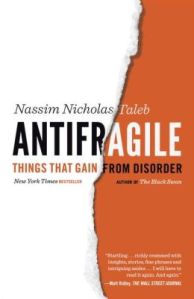
Antifragile_coverThe top-level idea of Antifragile is a good one (many random events trade small gains for tremendous losses, and vice-versa; focus on making sure that you can sustain small losses for big gains, which makes you “antifragile,” as opposed to merely “robust”), but rarely have I read a book with such a correct thesis and so many misrepresentations, needless ad-hominem attacks, and dubious stories that may not demonstrate what the author thinks they demonstrate. Many amuse along the way but could have been removed; for a guy who is fond of the term “narrative fallacy,” Taleb is awfully fond of narratives that could be called fallacious.

I meant to write a real review, but I’ve been beaten to it and would direct you instead to the link, where David Runciman does a better job than I’m likely to. If The Black Swan is an unexpectedly fascinating and insightful work with a deceptively simple main idea that is helpfully explained and elaborated on with virtually every page, Antifragile is the sort of book that can be better read through the reviews than the book itself. As noted in the first paragraph, if you feel the need to verify this claim, at least get Antifragile from the library.

Let’s take one small example of a dubious claim: on pages 83 – 84, Taleb tells a parable about two men, one a banker and one a taxi driver. In that parable the taxi driver differs from the banker:

Because of the variability of his income, [the taxi driver]” keeps moaning that he does not have the job security of his brother—but in fact this is an illusion, for he has a bit more. [. . .] Artisans, say, taxi drivers, prostitutes (a very, very old profession), carpenters, plumbers, tailors, and dentists, have some volatility in their income but they are rather robust to a minor professional Black Swan, one that would bring their income to a complete halt.

But taxi drivers are interesting example because we’re approaching the point at which self- driving cars may become common, which would be a major professional Black Swan for taxi drivers. The Industrial Revolution has been hell on “Artisans,” who today still find it very hard to compete with factories. To be sure, the Internet has made it easier for artisans to do their thing by allowing them to sell on their own websites and on aggregators like Etsy, but artisans as a group are never going to be as important as they were in, say, 1700.

There are also paragraphs so stupid that they defy rational explanation:

both governments and universities have done very, very little for innovation and discovery, precisely because, in addition to their blinding rationalism, they look for the complicated, the lurid, the newsworthy, the narrated, the scientistic, and the grandiose, rarely for the wheel on the suitcase. Simplicity, I realized, does not lead to laurels.

Government and universities have been pivotal in everything from computers to nuclear power to medicine, and saying they “have done very, very little for innovation and discovery” is incredibly, stupidly wrong—the sort of wrong that tempts one to disregard the entire rest of the book. It is useful to have outsiders throwing intellectual stones at academic insiders, but only when the outsiders know more than the insiders. In this case, Taleb is just a crank. A few pages later he does qualify the quoted paragraph, but he shouldn’t have written it.

Elsewhere, Taleb writes that “The intellectual today is vastly more powerful and dangerous than before,” which I find flattering but also unlikely; I also suspect many if not most intellectuals would agree with that assessment, given how many of them write lamentations about their lack of influence.

There are moments like this, which is fascinating: “Criticism, for a book, is a truthful, unfaked badge of attention, signaling that it is not boring: and boring is the only very bad thing for a book,” and then Taleb considers books we now admire that were banned or controversial, like Madame Bovary. But he doesn’t consider other highly criticized books that are now shunned for good reason, like Mein Kampf, or The Protocols of the Elders of Zion. He also doesn’t consider books that are wrong and important and should be relegated to the highly of ideas, like Das Kapital, which still gets read and taken seriously in some academic precincts. All three are bad books for reasons that have been much discussed, and there is something else that can be very bad for a book: it inspires people to steal things from others or hurt others. That’s what all three encourage.

That’s four samples. And yet he also produces gems like “men of leisure become slaves to inner feelings of dissatisfaction and interests over which they have little control.” In many ways I am reminded of Camille Paglia, who also has much to say about the ruthlessness of nature, often mentions prostitutes, and often goes further than her evidence or ideas merit. Yet as far as I and Google know, very few others have observed the connection.

Let’s talk some more about the positive; one chapter in Antifragile, “Skin in the Game,” is an especially important way to assess the world and assess risk. Taleb quotes Hammurabi’s code:

If a builder builds a house and the house collapses and causes the death of the owner of the house—the builder shall be put to death. If it causes the death of the son of the owner of the house, a son of the builder shall be put to death. If it causes the death of a slave of the owner of the house—he shall give to the owner of the house a slave of equal value.

Someone who puts people at risk should be at equal risk themselves. CNN just published “Yemen says U.S. drone struck a wedding convoy, killing 14,” in which 14 people were murdered by the United States; they are probably classified internally as “collateral damage” or by some similarly Orwellian euphemism (although “U.S. officials declined to comment on the report,” because why does the truth matter, anyway?). Imagine that those who ordered or authorized the strike would have their own husbands and wives and children killed in proportion to the number of civilians they killed. No one would order such strikes.

Nor would politicians authorize such strikes if the struck could vote, or if CNN and Fox News covered them for weeks or months at a time, as they would if something similar happened in the U.S. As Conor Friedersdorf correctly observed in The Atlantic, “If a Drone Strike Hit an American Wedding, We’d Ground Our Fleet.” But those who are launching the missiles have no skin in the game, to use Taleb’s favored phrase.

If someone does something wrong, what bad thing happens to them? If a doctor screws up too badly, they at least get sued. But if, say, a teacher’s students can’t read or do math, nothing bad happens to them. Long before I read Taleb, I remember explaining to students that, if they emerge from my classes unable to write effectively, nothing bad happens to me—I’ve never heard about a U of Arizona T.A. being fired for incompetence. The only bad things happen to them, in that they won’t be as good at writing or reading as they would be otherwise. That seemed to be a revelation to them: I don’t think they’d considered how they, not their teachers, bear the risks of a lousy education. Those risks are even more pronounced at the high school level, where most public school teachers are unionized and can’t really be fired.

Academia and government share the property of not having much skin in the game. As Taleb says, “An academic is not designed to remember his opinions because he doesn’t have anything at risk from them.” You often don’t get tenure for being right; you get tenure for publishing, regardless of whether what you’ve said is right.

In his books Taleb is weirdly reluctant to address global warming and climate change, which may be the ultimate nonlinear Black Swan system of our age—prone to sudden shocks that may have catastrophic results. There is a brief mention of the issue on page 415 of Antifragile, but he doesn’t discuss the issue in any detail. The collective response of the world to these dangers is to shrug, make minor changes, and hope for the best.

The danger is real and yet almost no one does anything significant to mitigate those challenges—though the risk of catastrophic change is extraordinarily high and the things that could be done to reduce it are relatively easy compared to what may come. Taleb implicitly endorses action when catastrophic risks are high even when probabilities are low in this section:

which is more dangerous, to mistake a bear for a stone, or mistake a stone for a bear? It is hard for humans to make the first mistake; our intuitions make us overreact to the smallest probability of harm and fall for a certain class of false patterns—those who overreact upon seeing what may look like a bear have had a survival advantage, those who made the opposite mistake left the gene pool.

The metaphor is clear, yet he barely addresses, either in The Black Swan or Antifragile, the way we might be making the global climate extremely fragile through our use of fossil fuels. In the U.S., some of the obvious means to mitigate fossil fuel usage, like building denser urban cores or switching towards nuclear power, are barely on the national agenda and, even when they are on the national agenda, they can easily be blocked by short-sighted local NIMBYs. Nuclear power is particularly curious, since coal power emissions kill far more people in the West than any form of nuclear power. But coal kills people slowly, over time, and mostly invisibly; it never ends up in the news, while any problem with nuclear power sears the media’s collective eyes.

Overall, with climate change, we may be mistaking a bear for a stone, and we may collectively pay the price.

Since Taleb has cultivated an outsider’s persona and portrayed himself, often accurately, as a teller of truths no one else wants to hear, or whose logic others attack despite its accuracy, he seems to have decided that attacks on his logic or his perceived truths automatically make his logic or perceived truths correct. But that’s a simple error in itself, since the attacks are not sufficient to show that he is right, and with any much-attacked thinker there is a danger in becoming so impervious to outside criticism that the work suffers. I suspect that Taleb has moved into that latter category, and there may be an interesting psychological meta narrative about how he moved from his initial outsider, but intellectually rigorous position, to a hybrid insider-outsider in which he no longer feels as compelled to write tightly and correctly as he did before fame (justifiably) found him.

Success breeds the danger of surrounding yourself with yes-men, but a good editor should be the opposite and should tell you hard truths that you don’t necessarily want to hear. Taleb, one feels, is not the sort of guy looking for constructive disagreement. Yet despite the mess in the book, some of its ideas are important. If I were a philosopher I’d be more willing to excuse bad writing and a dubious execution. Since I’m not, it’s hard to get past the book’s many moments in which I went, “That’s not right” or “That doesn’t belong.” But Antifragile also can’t be dismissed outright, because some of its ideas are important and rarely discussed. Given the form those ideas take, I doubt they will get the attention they deserve.

Clublife: Thugs, Drugs, and Chaos at New York City’s Premier Nightclubs — Rob the Bouncer

Clublife is a rare example of a book weaker than the originating, (and eponymous) blog. The blog used to be filled with posts containing subtle and sometimes surprising points about bouncers and standard bump-n-grind clubs. The book has some of that, though perhaps less subtle (“I’ve never met anyone who goes to clubs who’s worth a shit” or “They come to these places and toss aside the conventions of a civilized society, doing shit you wouldn’t see them do anywhere but there”) than the source material. Many of the later blog are about blogging instead of bouncing.

The major fringe benefit of being a bouncer appears to be hitting on the women in the clubs, or being hit on by them. If you’re not interested in that—and Rob isn’t—one of the prime reasons to work in that environment goes away. It’s like staffing a restaurant where you don’t like the food. Many people don’t want and aren’t interested in casual sex with strangers. Which is okay, but disliking that activity is naturally going to make clubs seem bizarre and stupid; English departments must seem bizarre and stupid to people who don’t like to read. Regardless of the quality of the experience to someone who enjoys the experience, it’s going to be crap for the wrong sort of person.

Rob is the wrong sort of person. Everyone else at the club seems to be working an angle, either sexually (in Rob’s words: “looking for a place to park their genitals for a night”) or by selling drugs. Not working one of those two angles defeats the point of the club experience. I want to encourage Rob to read Camille Paglia, who is so fond of socially sanctioned Dionysian excess.

Rob depicts the business this way at the end of the book:

Taking, after all, is what the nightclub business is all about. It takes and takes and takes, and gives nothing back. The entire thing is a setup. It’s a scam. It’s a great big mound of shit, all painted up in pastels and fluorescents and hosed down with enough cologne and perfume to disguise the stink.

The scatological metaphor is effective—Rob is good and often very good on a sentence-by-sentence level—but he’s only partially right about nightclubs: they do take. But they also give people a place to sleep with or attempt to sleep with strangers. How many men in particular achieve their purpose there is less clear: presumably some do but many don’t. The minute you don’t want that, then a club is “a scam.”

The book eschews the random, disconnected format of a blog and instead uses a memoir narrative that shows Rob getting into the business and going through the lifecycle of a single club. But the narrative seems forced and false, and a Diary of an Unlikely Call Girl-style reprint might’ve been an improvement.

The Rob we see in the book has a long “history of screwing things up for myself,” which is okay, but he seems to hate everything about what he’s doing and to have built a decent shell of bitterness and resentments that may or may not reflect the real person. He especially hates the many “guidos” who populate New York nightlife for whom he “stands on a box and plays zookeeper [with] for eight hours.” His disdain for guidos occurs primarily because disdain for most racial and ethnic groups is now politically incorrect, and for good reason; imagine that every time he uses the word “guido,” he uses the term “black.”

Still, there’s a lot to be said for first-person accounts of unusual, poorly understood market niches. To some extent my father and I are doing that for grant writing and nonprofits in Grant Writing Confidential, but the dearth of lascivious or potentially lascivious detail means that few people who aren’t involved in trying to get the money are going to be interested. There are things to like in Clublife.

T.C. Boyle’s The Inner Circle reconsidered

The Inner Circle is better than I remember it, and subtler: it uses Alfred Kinsey’s pioneering sex research to explore what happens to a man who isn’t his own man but instead belongs, always, to someone else. The narrator, John Milk, tells the story retrospectively, but, like the butler Stevens from The Remains of the Day, he has learned very little from his experience. In the first lines, Milk says that he doesn’t think he was “ever actually ‘sex shy,'” but he does admit that “I was pretty naive when I first came to him, not to mention hopelessly dull and conventional.”

He ends the novel the same way, only instead of being under the power a great man and guru like Kinsey, he is under the power of his wife—a perhaps more common masters for many colorless men who need direction from some external source. He says initially that “As for sex, I was eager but inexperienced, and shy in the usual way—unsure of myself and just about as uninformed as anyone you could imagine.” At the end he is experienced and informed yet still knows nothing. The ignorance regarding sexuality is enforced by law, custom, and culture at the start of the novel, but ignorance about character and individuality is not, at least for those who care to notice. Milk gets superficially important matters—like the way “all women are every man’s type, under the right circumstances,” but not how he molds himself to the needs of others.

Milk does note, accurately, that “this isn’t about me, this is about Prok”—but it’s about the Prok that Milk experiences. Prok is a stereotypical surrogate father, but he fulfills other roles: to Milk, Prok has a tremendous power:

It was uncanny. The longer we spoke, and it was almost speaking with your inner self or confiding in the family doctor behind closed doors, the more he seemed to know what I was thinking and feeling.

It was probably very canny—Milk just doesn’t realize that he’s in the presence of a charismatic man. And for a young man starved of sexual attention or knowledge, the probable range of basic needs and desires is probably not hard to conceive. Moreover, Milk is predictable as a person, by his own admission—”I always did what was expected”—though the word “was” is sneaky here: who is doing the expecting? What Kinsey, or Prok as the novel calls him, expects is very different from what others expect. Prok expects extensive sexual experience, homosexual and heterosexual, and a level of sexual transparency few people even today are comfortable with. How many porn stars, even, wish for every aspects of their sexual lives to be known? And glamor, as Viginia Postrel argues, partially emerges from intriguing silence.

Still, the novel’s main theme keeps circling back to Milk and his lack of autonomy. If you want to be your own dog you should be your own dog; if you want to be someone else’s dog, you should do so. And there’s nothing wrong with or dishonorable about being someone else’s dog: fitting into a hierarchical organization and making the unit stronger than the sum of its parts is rarely lionized in our highly individualistic society but is still a valuable skill. Milk’s problem, as a person and as a narrator, is that he belongs to and is an extension of Kinsey, but Iris doesn’t want him to be: she wants him to be an extension of herself, and devoted to her above all. Yet she knew or should have known, before she married, that Milk was Kinsey’s first, and given the group’s proclivities towards group sex, she would end up being Kinsey’s. She is, on some level, however little she wants to be by the end of the novel, and regardless of the way she ultimately rejects Kinsey.

Iris pulls Milk away from Kinsey, though it’s not complete: Milk reminds us, as fictional characters often do, that “in life, as distinct from fiction, things don’t always tie up so neatly.” Still, the battle of the novel is the battle, between Kinsey and Iris, for Milk. I see what Kinsey sees in Milk but don’t see what Iris sees. Milk never really has anything he wants, apart from appeasing Prok or Iris. The obvious question arises: how many of us are Milks, and how many are Proks? Milk narrates; most of us probably don’t stand up. Maybe we’re better off that way.

The Inner Circle is a little flatter, a little less tense than I remember: knowing the outcome is an inherent problem in historical fiction. Yet it is still compelling. Many of Milk’s misconceptions, about great men and other matters, are still common today—like when he mentions that he’d “been awkward with girls, terrified of them—I’d placed them on a pedestal and never saw them as sexual beings just like me, who had the same needs and desires as I.” Plenty of men need to overcome the same issues; the Internet is filled with their complaints. Maybe those complaints will exist as long as people are people; at the very least, I expect that the Milks of the world, blind to their places, will.

Links: Adjunct unhappiness, the art of translation, marriage plots, men, and more.

* Why Adjunct Professors Don’t Just Find Another Job? There is a lot of blah-blah-blah in this article, because the real answer is something kind, like “They’re acculturated to academia,” or something less kind but equivalent, like “Despite advanced degrees, they’re stupid.”

* The Art of Translation: William Weaver, who translated The Name of the Rose.

* “Why the Marriage Plot Need Never Get Old” (unlikely).

* “Simple answers to the questions that get asked about every new technology,” in comic form.

* “Why Men are Withdrawing from Courtship.”

* I edited “An economic model of paid sex: Coase’s ‘The Nature of the Firm,’ gains from trade, and the gift economy.”

* Related to link one: “Death of a Professor: An 83-year-old French instructor’s undignified death became a cause célèbre for exploited academics. But what really happened to Margaret Mary Vojtko?” Side note: this is an extreme example showing why it’s not a great idea to start a humanities grad program.

* The American Police State: A sociologist interrogates the criminal-justice system, and tries to stay out of the spotlight.