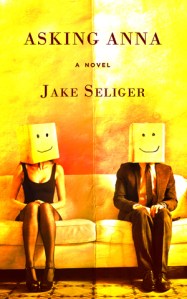
 A couple people asked about the paper version of Asking Anna, and it’s now out. Take a look at the link.
(The original announcement is here.)
A couple people asked about the paper version of Asking Anna, and it’s now out. Take a look at the link.
(The original announcement is here.)
 My first published novel, Asking Anna, is out today as an eBook; the print book should follow next week. It’s fun and cheap and you should definitely read it. Here’s the dust-jacket description:
Maybe marriage would be like a tumor: something that grows on you with time. At least that’s what Steven Deutsch thinks as he fingers the ring in his pocket, trying to decide whether he should ask Anna Sherman to marry him. Steven is almost thirty, going on twenty, and the future still feels like something that happens to other people. Still, he knows Anna won’t simply agree to be his long-term girlfriend forever.
When Steven flies to Seattle for what should be a routine medical follow up, he brings Anna and hits on a plan: he’ll introduce her to his friends from home and poll them about whether, based on their immediate judgment, he should ask Anna. But the plan goes awry when old lovers resurface, along with the cancer Steven thought he’d beaten, and the simple scheme he hoped would solve his problem does everything but.
Asking Anna is a comedy, in the tradition of Alain de Botton’s On Love and Nick Hornby’s High Fidelity, about how the baggage you bring on a trip isn’t just the kind packed in a suitcase.
I’ll be writing more about Asking Anna next week. I’ve been writing fiction with what I’d call a reasonably high level of seriousness since I was 19; I’d rather not do the math on how long ago that was, but let’s call it more than a decade. It took me four to six false starts to get to the first complete novel (as described in slightly more detail here) and another two completed novels to finish one that someone else might actually want to read. Asking Anna came a couple novels after that.
People who don’t write novels are often surprised to hear about aborted and unreadably bad novels, but producing a few before finding the knack is a pretty common trajectory among writers who, again, produce work that someone else might actually want to read (this may sound like a low standard, but even hitting it is much harder than is widely supposed). It takes a long time to really figure out how to tell a story and how to use the primary tool authors use to tell stories (words) effectively. It’s also hard to find other people who can a) know enough to give good feedback (which doesn’t mean “nice” feedback), b) who are sufficiently sympathetic to what you’re trying to do to not dismiss it outright and c) are interested enough to really talk about writing in general and one’s work in specific.
The preceding paragraph may be getting too far into the weeds of novel writing, but everything in it was a surprise to me when I finally figured it out, and surprises are often worth sharing and worth writing about.
“George Saunders Has Written the Best Book You’ll Read This Year” inspired me to read Tenth of December, but as often happens the headlines deceive. In the last twelve months I’ve read phenomenal books like The Great Man and The Black Swan. I’ve also read Tenth of December, which isn’t exactly bad; I felt like a Good Person for having read it.
Yet feeling like a Good Person isn’t the same as saying a book is fun or great (which are not always the same thing). Some stories in Tenth of December are funny; “Exhortation” in particular made me laugh, written as a deranged memo from the “Divisional Director” to the “Staff” and saying things like
We all know very well that that ‘shelf’ is going to be cleaned, given the current climate, either by you or the guy who replaces you and gets your paycheck…
Saunders does corporate euphemism frequently (“given the current climate”) and often well. He also does sad, as in this diary extract:
When kids born, Pam and I dropped everything (youthful dreams of travel, adventure, etc., etc.) to be good parents. Has not been exciting life. Has been much drudgery. Many nights, tasks undone, have stayed up late, exhausted, doing tasks. On many occasions, disheveled + tired, baby-poop and/or -vomit on our shirt or blouse, one of us has stood smiling wearily/angrily at camera being held by other, hair shaggy because haircuts expensive, unfashionable glasses slipping down noses because never had time to get glasses tightened.
There’s a Raymond Carver feel* (the dropped “youthful dreams of travel,” the unforeseen children, the sense of potential squandered in the detailed “unfashionable glasses”) mixed with Modernism’s dropped words. Yet it’s hard for me to get excited about passages like this one, which I feel like I’ve read before; too many stories leave me saying, “So what?”, even though there are some extravagantly wonderful passages:
At that point, I started feeling like a chump, like I was being held down by a bunch of guys so another guy could come over and put his New Age fist up my ass while explaining that having his fist up my ass was far from his first choice and was actually making him feel conflicted.
Yet these sections are too rare for me and the random detritus of fiction too frequent. Too often I found myself thinking, “So what?” There is admirable weirdness in some stories but less so perhaps than Ian McEwan’s early short stories. I read people saying things about how Saunders has the pulse of America or writes about an America others don’t or whatever, but I’m not sure that his work reflects America so much as it does an imagined reflection of America common in many journalistic and academic minds.
In addition, literary fiction habitually condescends to jobs, workplaces, and businesses. Sometimes that condescension is justified but more often it feels like misunderstanding intensified by the expert use of language. Saunders treads the lines where satire, condescension, and realism meet. There are interesting literary novels set in workplaces that have yet to be written—something like Last Night at the Lobster, a novel that I think will stay with me long after Tenth of December has faded.
More Carvarian, reproduction-related unhappiness, from another story: “We left home, married, had children of our own, found the seeds of meanness blooming also within us.” From this and countless similar renditions of the same perhaps we should assume that maintaining equanimity in the face of children should be an explicit goal.
The Great Man is one of the best novels I’ve read recently; it should be cited more often. Almost every page delights. It’s the sort of novel I should hate but yet don’t. A longer essay on it is coming, but it’s coming far behind work on Asking Anna, a novel of mine you’ll see more about shortly, and work-for-money. Nonetheless here is one characteristic passage from early in the novel:
“Please sit down,” said Teddy; she intended it as a command. She wasn’t impressed by Henry. She guessed he was forty or thereabouts. He looked like a lightweight, the kind of young man you saw everywhere these days, gutless and bland. He wore soft cotton clothing, a little rumpled from the heat and long drive in the car—she would have bet it was a Volvo. She could smell domesticity on him, the technologically up-to-date apartment on the Upper West Side, the ambitious, hard-edged wife—women were the hard ones at that age. Men turned sheepish and eager to please after about forty. Oscar had been the same way; he’d turned into a bit of hangdog at around forty and hadn’t fully regained his chutzpah until he’d hit fifty or so, but even then, she had never lost interest in him, and she was still interested in him now, even though he was gone.
We learn more about Teddy than about the stages of life and yet she, like almost every character, is half right half the time. One could spend an hour well on this paragraph in a fiction-writing class.
The Inner Circle is better than I remember it, and subtler: it uses Alfred Kinsey’s pioneering sex research to explore what happens to a man who isn’t his own man but instead belongs, always, to someone else. The narrator, John Milk, tells the story retrospectively, but, like the butler Stevens from The Remains of the Day, he has learned very little from his experience. In the first lines, Milk says that he doesn’t think he was “ever actually ‘sex shy,'” but he does admit that “I was pretty naive when I first came to him, not to mention hopelessly dull and conventional.”
He ends the novel the same way, only instead of being under the power a great man and guru like Kinsey, he is under the power of his wife—a perhaps more common masters for many colorless men who need direction from some external source. He says initially that “As for sex, I was eager but inexperienced, and shy in the usual way—unsure of myself and just about as uninformed as anyone you could imagine.” At the end he is experienced and informed yet still knows nothing. The ignorance regarding sexuality is enforced by law, custom, and culture at the start of the novel, but ignorance about character and individuality is not, at least for those who care to notice. Milk gets superficially important matters—like the way “all women are every man’s type, under the right circumstances,” but not how he molds himself to the needs of others.
Milk does note, accurately, that “this isn’t about me, this is about Prok”—but it’s about the Prok that Milk experiences. Prok is a stereotypical surrogate father, but he fulfills other roles: to Milk, Prok has a tremendous power:
It was uncanny. The longer we spoke, and it was almost speaking with your inner self or confiding in the family doctor behind closed doors, the more he seemed to know what I was thinking and feeling.
It was probably very canny—Milk just doesn’t realize that he’s in the presence of a charismatic man. And for a young man starved of sexual attention or knowledge, the probable range of basic needs and desires is probably not hard to conceive. Moreover, Milk is predictable as a person, by his own admission—”I always did what was expected”—though the word “was” is sneaky here: who is doing the expecting? What Kinsey, or Prok as the novel calls him, expects is very different from what others expect. Prok expects extensive sexual experience, homosexual and heterosexual, and a level of sexual transparency few people even today are comfortable with. How many porn stars, even, wish for every aspects of their sexual lives to be known? And glamor, as Viginia Postrel argues, partially emerges from intriguing silence.
Still, the novel’s main theme keeps circling back to Milk and his lack of autonomy. If you want to be your own dog you should be your own dog; if you want to be someone else’s dog, you should do so. And there’s nothing wrong with or dishonorable about being someone else’s dog: fitting into a hierarchical organization and making the unit stronger than the sum of its parts is rarely lionized in our highly individualistic society but is still a valuable skill. Milk’s problem, as a person and as a narrator, is that he belongs to and is an extension of Kinsey, but Iris doesn’t want him to be: she wants him to be an extension of herself, and devoted to her above all. Yet she knew or should have known, before she married, that Milk was Kinsey’s first, and given the group’s proclivities towards group sex, she would end up being Kinsey’s. She is, on some level, however little she wants to be by the end of the novel, and regardless of the way she ultimately rejects Kinsey.
Iris pulls Milk away from Kinsey, though it’s not complete: Milk reminds us, as fictional characters often do, that “in life, as distinct from fiction, things don’t always tie up so neatly.” Still, the battle of the novel is the battle, between Kinsey and Iris, for Milk. I see what Kinsey sees in Milk but don’t see what Iris sees. Milk never really has anything he wants, apart from appeasing Prok or Iris. The obvious question arises: how many of us are Milks, and how many are Proks? Milk narrates; most of us probably don’t stand up. Maybe we’re better off that way.
The Inner Circle is a little flatter, a little less tense than I remember: knowing the outcome is an inherent problem in historical fiction. Yet it is still compelling. Many of Milk’s misconceptions, about great men and other matters, are still common today—like when he mentions that he’d “been awkward with girls, terrified of them—I’d placed them on a pedestal and never saw them as sexual beings just like me, who had the same needs and desires as I.” Plenty of men need to overcome the same issues; the Internet is filled with their complaints. Maybe those complaints will exist as long as people are people; at the very least, I expect that the Milks of the world, blind to their places, will.
“But there is no precise rule: it depends on the individuals, on the circumstances. This holds true also for the secular lords. Sometimes the city magistrates encourage the heretics to translate the Gospel into the vernacular: the vernacular by now is the language of the cities, Latin the language of Rome and the monasteries. And sometimes the magistrates support the Waldensians, because they declare that all, men and women, lowly and mighty, can teach and preach, and the worker who is a disciple after ten days hunts for another whose teacher he can become.”
“And so they eliminate the distinction that makes clerics irreplaceable!”
That’s from Umberto Eco’s The Name of the Rose, and we can see a similar situation happening now among many professional, privileged, and credentialed classes: with the Internet, the cost of being able to “teach and preach” goes down; anyone motivated can learn, or start to learn almost anything, and anyone inclined to teach can start writing or videoing on whatever topic they believe themselves to be an expert in. The key of course is motivation, which is in scant supply now and probably always will be.
Whether the existing power structures want to encourage self-learning, like many of the “secular lords” and “city magistrates,” or want to preserve existing institutions, depends on the person speaking and their aims. But “the distinction that makes clerics irreplaceable” is similar to the one that makes professors or other professional teachers irreplaceable. It’s a distinction that’s less important than the knowledge and skill underlying the distinction. Some with the distinction are not very good at their jobs and some without distinction are incredibly skilled. Those lines are blurring. Blurring slowly, to be sure. The language of knowledge is spreading. The issue of credentialing remains, but the number of jobs in which work product is a better examination than formal credentials is probably growing.
Does the average software startup want a famous degree, or an extensive Github repository? Right now I’m sifting through freelance fiction editors, and I’ve asked zero of them where they got their degrees or if they have any. I’m very interested in their sample edits and other novels they’ve edited. Clients almost never ask Seliger + Associates about formal degrees—they want to know if we can get the job done.
In writing this post, I am also conforming to the second of Umberto Eco’s “three ways” of reading The Name of the Rose:
The first category of readers will be taken by the plot and the coupes de scene, and will accept even the long bookish discussions and the philosophical dialogues, because it will sense that the signs, the traces and the revelatory symptoms are nesting precisely in those inattentive pages. The second category will be impassioned by the debate of ideas, and will attempt to establish connections (which the author refuses to authorize) with the present. The third will realize that this text is a textile of other texts, a ‘whodunnit’ of quotations, a book built of books.
Eco published this novel in 1980, around the dawn of the personal computer age and long before the consumer Internet. Whatever connections existed in the 1970s between The Name of the Rose and that era—the ones Eco presumably had in mind, whatever his view of authorization—are not the ones I most notice. That the novel’s correspondences can grow and change with decades make it so powerful and deep. Few works of art transcend their immediate context. This one does. It deals with the eternities much more than the news, though the author has demonstrated in essays his interest in the daily news.
If someone had told me before I read The Name of the Rose that a novel set in 1327 and utterly enmeshed in the recondite politics of Christianity would be one of my favorite novels, I would’ve scoffed. Religion as a subject is of little interest to me, except in meta sense. But sufficiently great novels transcend their context, even as they adapt the language, rhetoric, and world of their context. As Eco’s third category of reader indicates, the novel is composed of many other novels, books, articles, and speech. He has, it seems, 800 years of literary history composted into a single work. Few novels do, and fewer still do so in a novel with an actual plot.
That evening, as he was returning home, Charles took up again one by one the words she had used, trying to recall them, to complete their meaning, in order to re-create for himself the portion of her life that she had lived during the time when he did not yet know her. But he could never see her, in his mind, differently from the way he had seen her the first time, or the way had just left her.
We all become close readers in romance, where words matter so much and yet are never sufficient. Charles is speaking early in Madame Bovary, which feels shockingly modern (especially read in conjunction with How Fiction Works); most capital-C Classics don’t. Lydia Davis’s introduction is helpful.
Novels in which I root for everyone and no one at the same time are rare, and rarer still in a novel in which most characters express commonplace sentiments like Charles’s. Those ideas work in the context of Madame Bovary. I wonder how and maybe always will.
All of us have had the moments of trying to take “up again one by one the words she had used,” although the gender pronoun will change based on orientation, and all of us have had those words feel inadequate as we try to “complete their meaning”—an infinite amount of commentary can’t complete meaning. In romance and art this is especially painful until it is accepted.
Claudia Roth Pierpont’s “The Book of Laughter: Philip Roth and his friends” is unfortunately hidden behind a paywall, but one section stood out to me: she writes that Philip Roth and John Updike met around 1959, when both were getting their first publishing successes, and, “A decade later, they profitably scandalized the country with ‘Couples’ (1968) and ‘Portnoy’s Complaint’ (1969).” Times change: I saw them not as scandalous but as slightly tedious in their obsession with the transgressions of their era. Is the three-way in Portnoy really so shocking?
I thought not. In the context of the novel I understand the Monkey’s fuss, which is primarily a play for power over Portnoy, and one that she sort of wins because he lets her, or doesn’t know any better (the Monkey: “What do I care what happens to her? . . . She’s the whore! And all you really wanted to do was to fuck her! You couldn’t even wait until I was out of the john to do it!”, and then the Monkey threatens to leave. I heard lots of conversations like this in college, when melodrama ran high). Portnoy does have the sense to start disentangling himself: “Then in Athens she threatens to jump from the balcony unless I marry her. So I leave.”
In Portnoy, however, the voice persists even though what seems to have been a shocking scandal has gone away. In Couples I found it merely hard to care about who sleeps with who and why. There were numerous beautiful sentences put to little good use. Updike makes me want to write better sentences but also to construct more interesting plots. I lack his and his characters’s religious sense, which often makes me feel like he’s writing about a foreign culture. Battles over religious feelings are like battles over Communism: important in their day but long-since decided.
Tampa starts with a bang, so to speak—the first line says, “I spent the night before my first day of teaching in an excited loop of hushed masturbation”—and also explains the narrator’s curious, never-resolved marital predicament: “I find it hilarious that people think Ford and I are the perfect couple based solely on our looks.” I find it curious that the narrator, who is obsessed with teenage boys, wanted to marry Ford or stay married to him. Her marriage exists for no reason outside of the needs of plot mechanics; there are occasional references to Ford’s money, but based on the novel Celeste has a single overriding focus on sex.
That focus doesn’t take a lot of money to maintain, and indeed it would be greatly enhanced by her divorcing Ford, or never marrying him. The closest we get to some kind of rationale, emotional or otherwise, is that “I hoped his wealth might provide me with a distraction, but this backfired—it left me with no unfulfilled urges but the sexual.” In 1900, it might have been very hard to “fulfill” sexual urges, but today that is not the case, and someone so single-mindedly focused on sex doesn’t need to be and shouldn’t be married. The “wealth” doesn’t seem to matter to her: other than name-checking one or two luxury items, money doesn’t seem to matter for Celeste. Explaining her husband to her teenage lover, she “didn’t have to feign indifference” and tells him “He’s just a husband.” Why bother? When Humbert Humbert married, he at least had a reason.
To be sure people are rarely fully rational and most of us are riven by conflicting desires, by Celeste’s desire to marry or stay marry makes little sense at the beginning of the novel and less as it goes on. Ford’s presence offers useful plot mechanic friction.
A novel like Dare Me works more effectively than Tampa because its protagonists are supposed to be vacuous twits. A twenty-six-year old with a classics degree, even a very horny one, should have more going on between her ears than Celeste does, and what’s between her ears shouldn’t harm what’s going on between her legs. She says, for example, that “At university I began throwing myself into classics studies, finding brief solace from my sexual frustrations in texts depicting ancient battles of fervent bloodshed.” But for someone interested in classics, she references them very rarely; her studies seem to have left no mark in her mind. Contrast that with a novel like Donna Tartt’s The Secret History, where Greek appears and an obsession with the past fuels the characters’ actions in the present. Those are characters whose thought is fully colored by classics. Here, classics get mentioned as empty window dressing, like material objects.
Toni Bentley deals with the money issue in The Surrender, her memoir of anal sex, where she says:
You let a man into your bowels—your deepest space, the space that all your life you are taught to ignore, hide, keep quiet about—and consciousness is born. Who needs diamonds, pearls, and furs? Those who’ve never been where I have been. The promised land, the Kingdom.
In asking “Who needs diamonds, pearls, and furs?”, she could be speaking for Celeste, who is also indifferent-seeming to possessions because she has her own “promised land,” albeit of a different though even more forbidden sort than Bentley’s (I say “even more forbidden” because while Bentley’s favorite act used to be illegal, it now mostly isn’t; while Celeste’s used to be not prosecuted, these days it is, thanks to feminists seeking equality in an instance where many teenage boys would probably be happy without it).
There are bizarrely hilarious moments in Tampa, as when Celeste narrates:
Sex struck me as a seafood with the shortest imaginable shelf life, needing to be peeled and eaten the moment the urge ripened. Even by sixteen, seventeen, it seemed that people became too comfortable with their desires to have any objectivity over their vulgar moments. They closed their eyes to avoid awkward orgasm faces, slipped lingerie made for models and mannequins onto wholly imperfect bodies.
Actually, sex is not at all like sea food in the sense Celeste describes, but we do see how Celeste totally misconceptualizes the world and thus a lot about her own, non-universal, proclivities. She also asks rhetorically, “Why did anyone pretend human relationships had value?”, when the better question is why she pretends they do, since most of us who aren’t sociopaths have obvious, readily available answers. Yet the metaphor is compelling, like enough of the writing in Tampa to make the book writing about. There are interesting questions about the extent to which desire clouds judgment, but that assumes the characters have any kinds of judgment in the first place, and the ones in Tampa mostly don’t.
Like Humbert Humbert, her obvious antecedent and another character with desire problems, Celeste is obsessed with guys on the cusp of manhood, and her chosen crush gets described in ways similar to Humbert’s nymphets: “I loved the lanky-limbed smoothness, the plasticity of his limbs, the way his frame shunned both fat and muscle.” The alliteration is there, but that kind of poetic style isn’t sustained. There is room in literature for a female Humbert, but she is not Celeste, and Jack is not Dolly. It is a novel with no animating soul beyond the purely carnal. I can appreciate the purely carnal but Celeste doesn’t even both arranging her life in ways that make sense (which may be why carnality is so often depicted in adolescents, who are still faced with strictures of schools and parents).
It is painful reading a book in which there is an obvious solution to an obvious problem that the protagonist doesn’t notice; Celeste’s situation in Tampa doesn’t rise to the TV trope “Too Dumb to Live,” but there should be a lesser term for characters who fail to perceive simple ways of dramatically improving their lots. In addition, Ford appears happy not having sex with—or having bad sex with—his wife. Marrying someone hot but sexually uninteresting doesn’t seem like a great deal, but we see little of him either.
I wanted Tampa to be a better novel; it wasn’t bad yet it feels wrong. I’m writing at length about the book because it’s not badly written and has a lot of promise. Tampa is not bad but should be better than it is. Books like that often generate the most response in me, because truly bad books aren’t worth bothering about and one runs out of empty superlatives with the good ones. There is so much promise, but Tampa isn’t quite executed in a way that makes sense. The supposed shock of what Celeste wants is a good premise that doesn’t go anywhere useful.
The New Yorker‘s “Briefly Noted” book review section (behind a paywall, but check here if you’re curious) has a review Very Recent History that displays all the telltale signs of pointlessly plotless modern novels: adrift protagonists; problems with few or no important stakes; expecting the world to be automatically interesting, instead of you being interesting to the world; consumption for its own sake rather than for the sake of pleasure. Even the language of the review is stupid, saying that Very Recent History “serves to underscore the sense of trauma that is daily life in a late-capitalist moment.”
What? How do we know this is “a late capitalist moment?” Assuming capitalism as such dates to the 18th Century and, say, Adam Smith, and is the dominant organization of successful societies in 200 years, this is a “mid capitalist moment.” And there is little or no “sense of trauma” in “daily life” for most urban dwellers: If you want fucking trauma, try getting gassed in Syria, or AIDS in much of Africa, or live as one of hundreds of millions of people without electricity or running water in India. Get some fucking perspective people. Being laid off from a white-collar job is not the same as being shot by the regime’s uniformed thugs.
The other funny thing, as a friend mentioned in an e-mail, is that “no novelist who manages to write an entire book and get it mentioned in the major media is anything like those adrift protagonists; that’s someone with purpose.”
There’s a whole genre of these novels about people who behave stupidly in transparent ways. My favorite example is Adam Wilson’s Flatscreen, because it helped crystallize the problem for me, though there are many others examples. It’s also not a badly written book. These kinds of novels can actually be fabulously well-written, and have all sorts of brilliant micro observations. Claire Messud’s The Emperor’s Children fits this designation. All those wonderful sentences about a bunch of boring fools leading unimportantly literary lives in New York. I wanted one of them to get a job as a foreign correspondent in Afghanistan instead of debating about whether they should Follow Their Muse or sell out.
The Emperor’s Children is an example of the apparently growing number of people who have no direction or purpose in life and choose not to have one. Call it the Girls problem, which is not having real problems while simultaneously not trying anything and not knowing about anything.
About the TV show Girls: it has probably engendered more essays about it than viewers, but my fiancée and I watched the first couple episodes and the beginnings of a couple episodes after that, but it was too dumb to keep going: the characters were privileged morons. I wanted to climb in the TV and say, “Hey! There are real problems out there! People are starving in various places! Science is finding and doing all kinds of awesome stuff. Programs need to be written. There are sick people in hospitals and children who need education. Why don’t you all get real fucking jobs?”
I would love to see one of the girls on Girls get a job as an ER nurse or doctor. They’d learn a little about what’s fucking important. Or they could be working on democracy in Guinea. None of the characters in Girls appear to be learning how to paint, draw, write education grants, keep tropical fish, hack, solder, cook, sew… the list goes on. None seem to appreciate that SpaceX is sending rockets into space and is probably our best collective shot at visiting Mars in the next 40 years. Wow!
Whole industries are being shaken and rebuilt all around us (publishing, for example, by the colossus in Seattle).
Their collective response to this, however, is to continue to gaze lovingly at the lint gathered in their own navels, and to wonder why people aren’t beating a path to their door to offer them fame and fortune. Hell, they can’t even make the bad sex they’re sometimes having into a politically or intellectually interesting act, as someone like Catherine Millet or Toni Bentley can. They have no sense of the past. They have no sense beyond the most rudimentary knowledge of other cultures. They’re not trying to be an amazing novelist like Anne Patchett.
 The Story's Story