Flashback — Dan Simmons

There are shades of Philip K. Dick’s The Man in the High Castle all over Flashback. Problem is, they don’t really go anywhere. The novel opens in the near future with a mystery: Hiroshi Nakamura is a wildly wealthy Japanese man who needs Nick Bottom to solve the mystery of his son’s death using a drug called Flashback, which lets one relive in the past as if it’s the present. The setup is clever; Nick, rather than being a classic detective-alcoholic, is a flashback addict and feels “the flashback itch crawling in him like a centipede. He wanted to get out of this room and pull the warm wool covers of then, not-now, her, not-this over himself like a blanket.” He wants his time warped, in other words, as the centipede tells him. He wants to retreat to childhood: hence the blanket. It’s a nice image, and double so because the novel doesn’t have many of them.

Flashback is frustrating because it has so much promise that goes unfilled. There are lots of “as-you-know-captain speeches” (as there were A Game of Thrones), like this one, six pages in:

The polishes cedar floors and fresh tatami mats, in contrast, seemed to emanate their own warm light. A sensuous, fresh dried-grass smell rose from the tatami. Nick Bottom had had enough contact with the Japanese in his previous job as a Denver homicide detective to know that Mr. Nakamura’s compound, his house, his garden, this office, and the ikebana and few modest but precious artifacts on display here were all perfect expressions of wabi (simple quietude) and sabi (elegant simplicity and the celebration of the impermanent.

How do you have fresh dried grass? Shouldn’t it be fresh or dried? Beyond that, the phrase “Nick Bottom had had enough contact” signals that we’re about to be told a bunch of stuff. In and of itself, that’s fine. The problem is the sheer number of times the story pauses for no particular reason to regurgitate stuff at us. Susan Bell’s essay “Revisioning The Great Gatsby” (part of The Writer’s Notebook: Craft Essays from Tin House) details how deftly F. Scott Fitzgerald avoids such problems in The Great Gatsby, with the help of Maxwell Perkins. We’re not so lucky here. In Neal Stephenson’s Cryptonomicon, digressions feel organic. Here they feel forced.

So do the italics that give us Nick’s thoughts; toward the end of chapter one, he thinks, “You know why you’re going to hire me for this job, jerkwad. Let’s get to it. Yes or no.” I’ve heard similar sentiments in a thousand detective novels and movies. They don’t add anything to the story or Nick’s character. They’re distracting. The problems in the first chapter continue throughout.

There are good bits, as when Nick decides not to flashback to sex: “he was simply glad that his video-recorded idiot’s face wouldn’t be showing the uncoordinated spastic echoes of his orgasms from eighteen years earlier.” We get the self-loathing, the professional’s unhappiness at being caught unaware, the thought of “uncoordinated spastic echoes” that capture a look in a way that’s fresh and vital. Such moments are just too rare. The book is too fat. It deals with balkanization and terrorism in ways that are interesting and imagines a future without state or national infrastructure, which is a scary one. It just doesn’t do so well. There’s a palpable fear of Muslims and what, for lack of a better word, I would call multiculturalism or pluralism; a character thinks:

Los Angeles [was] celebrating the events of that old holiday called 9-11, September 11, 2001, the date—as Val had been taught in school—of the beginning of successful resistance to the old imperialist American hegemony and a turning point in the creation of the New Caliphate and other hopeful signs of the new world order.

We get a lot of conservative ideology here: the distribution of dangerous ideas in schools; the idea that liberals see American hegemony as dangerous and imperialist; and the fear of Islamists taking over the world. Women “in full burkas” sit, and one has “bright blue eyes” who Val says “was Cindy from his Wednesday Social Responsibility class.” None of these fears seem likely, and after the Arab Spring, they seem even more ludicrous. The world is mostly inching toward liberalism, not authoritarianism, bikinis, not burkhas, despite the United States’ present penchant for spying on its own citizens. A college professor begins to question his own received wisdom, and experiences “Doubt [about] whether America’s eventual retreat from the rising success of radical Islam’s influence around the world was the wisest course.” Except that the U.S. is successful precisely because its culture promotes letting people live as they choose, so long as they don’t harm others: this is part of the reason why the U.S. is very good at integrating minorities, while Europe struggles. The idea that the U.S. will ‘retreat,” whatever that means in the context, is ludicrous.

I’m not opposed to novels with political messages, as long as those messages are thoughtful, reasonable, and well-integrated, and dumb politics aren’t limited to the right (on the left, see: John Steinbeck). I’m opposed to novels with dumb politics, like this one, but I’m even more opposed to weak writing.

You can have a book with little plot and spectacularly unusual sentences or language use; this is basically what Joyce and John Banville do (or, think of Banville’s alter ego detective fiction writer, Benjamin Black). You have a book with lots of plot and uninteresting or banal sentences, which is what a lot of thrillers do. But it’s really hard to have little plot and average sentences, which is what you see in Flashback. It’s got a great premise and doesn’t deliver. I got to page 200, mostly because I had time to kill while waiting to meet a friend. Flashback did fill time and did offer an intriguing premise. It didn’t do much else.


EDIT: I am not the only one who is disappointed in Flashback.

Slam — Nick Hornby

Slam starts with great promise: a list of bullets that show a lot of Sam’s life in a short space and show why it’s going well (“For example: Mum got rid of Steve, her rubbish boyfriend.”) It’s got a fun, fantastical conceit in that Tony Hawk talks to the narrator and comes to represent a kind of externalized consciousness, giving Sam a dialogic way of bouncing ideas off another person. But the novel itself meanders. I look for the great sentences and don’t find them. To be fair, there are strong sections.; for example, in analyzing (as best he can) his family, Sam says:

The story of my family, as far as I can tell, is always the same story, over and over again. Someone—my mum, my dad, my grandad—starts off thinking that they’re going to do well in school, and then go to college, maybe, and then make pots of money. But instead, they do something stupid, and they spend the rest of their lives trying to make up for the mistake they made. Sometimes it can seem as though kids always do better than their parents. You know—someone’s dad was a coal miner, or whatever, but his son goes on to play for a Premiership team, or wins Pop Idol, or invents the Internet. Those stories make you feel as though the whole world is on its way up. But in our family, people always slip up on the first step. In fact, most of the time they don’t even find the stairs.

Notice the metaphor at the end: most of the world “is on its way up,” without noting the transportation method (flight? an elevator?), but his family doesn’t “even find the stairs.” It’s a bittersweet passage, with him not exactly castigating his family but still fundamentally aware of social class. Yet why not start the metaphor at the beginning of the paragraph? His family’s story is always the same, with them looking up as other people go by, or being on the ground floor of a building whose top they can’t even conceptualize, or something to that effect? You could do much better than the ideas I’ve come up with in 30 seconds, but the point is that there’s no reason not to extend the metaphor—maybe throughout not just the paragraph but the book. We appreciate that Sam’s awareness is a step on the road to change, but he could be slightly more aware without harming the fundamental structure of the story.

Perhaps not surprising, some of the story’s tension involves whether Sam will continue the family tradition or break it. He meets a higher class, very attractive girl named Alicia. They talk music. He works to avoid being subservient to her, but later thinks that “I knew that I didn’t want to be [Alicia’s] friend, if you know what I mean, and I was worried that her being friendly to me meant that I didn’t stand a chance with anything else. I know that’s wrong. Mum is always telling me that friendship has to come first, before anything else.” Sam knows the score even when his mother doesn’t, or doesn’t want him to know. She is, in essence, pitching him the idealized version of romance, which he has internalized to the extent that he says he knows that not wanting to be Alicia’s conventional friend is “wrong,” imputing a sense of morality on an act that’s more about strategy than morality. In a different world, friendship would come first. If you search Google for “Friend Zone, you’ll find a wide array of articles with advice on how to avoid becoming “just a friend.” Sam’s Mum is trying to give him advice that isn’t highly applicable to the real world.

If you’re already aware of these dynamics, however, the novel will feel like old news. It’s not bad, exactly, but it’s not exciting, either. A lot of the book is fun. It just feels average, unlike Francine Prose’s Touch. I’m looking for ways that make it more than average and not finding them. Hornby’s best book, by far, is still High Fidelity. Maybe it always will be. I often think about it when writing contemporary novels that feature love stories; he fundamentally understands that such love stories tend towards comedy, that indecision is the great modern problem, and that love stories need more than just a should-I-or-shouldn’t-I plot. Whenever I read High Fidelity, I’m impressed again at how surprisingly well constructed it is. I keep trying his other books (A Long Way Down, How to be Good, Slam) in search of the same kind of mastery. I keep not finding it.

Brady Udall's The Lonely Polygamist Interview: Part II

You can find part I of the interview here, including the context of this interview.

Jake Seliger: [Ideological conformity] seems like one of the conflicts between Beverley, who I think is homeschooling all of her children, and the—

Brady Udall: Right, Roland and Rose-of-Sharon, when all the other kids are at public school.

JS: Where they’re known as what Rusty is very aware of—as a Plig kid, which has a pretty obvious negative connotation.

BU: Polygamists face these kinds of feelings almost anywhere they live.

JS: It reminds me of—I went to high school outside of Seattle [in Bellevue, for those of you wondering]. At my high school, we had a relatively large Mormon population. There were also some—not a lot, but some—mainline Christians. The mainline Christians often thought the Mormons weren’t real Christians.

BU: Sure.

JS: And the Mormons would sometimes be a little, well—I mean, most of us were busy drinking and taking SATs and having sex, but—

BU: But that goes on and on. We’re out trying to convert the Baptists, and the Baptists are saying we’re not Christians. There’s going to be those conflicts everywhere. And more. Those conflicts exist in my own marriage. You know, it’s me and one wife. I just can’t imagine—you put two or three more wives in there.

JS: There’s also this establishment of what Golden’s life feels like. Early on, there’s a section that says, “Normally there would’ve been a crush of children waiting at the door, all of them shouting at once, pulling his clothes and asking what he brought them. The little ones standing on their heads, displaying some new bruise. Look at me! Look at me!” That little interjection there—look at me, look at me—is a lot of what’s going on among the children and among the wives. The wives are hanging back, waiting for their chance to lay claim on him, almost like he’s a piece of land. Just that phrase, “to lay claim on him—”

BU: Yeah, well that’s exactly it. The active verb is not his—it belongs to everybody else. And so he becomes more of a figurehead.

JS: Right.

BU: He’s like the president, you know what I mean? He is who you want him to be. But there’s a person there.

JS: When we enter his consciousness, we see his point of view, and he’s not really—he’s less concerned about dealing with each individual child and more concerned with Huila. He’s concerned the construction site. He’s concerned with his wives. It seems like the children are more concerned about him in many ways, than vice-versa.

BU: Yeah. He doesn’t have the wherewithal to deal with anybody individually. And I really wonder sometimes if the person who exists who can do this. You know what I mean? Maybe there is. I don’t know.

JS: It’s hard to wear the crown. Even if you want to be the king.

BU: I guess so. I just don’t know that this could be done. I don’t know where the cutoff. I was one of nine kids. My Dad did the best he could. But is it enough? What does a kid need? I’m not sure. I think it’s a pretty interesting question, actually. Most cultures, you know, want you to have more kids. Now we have two. Has it gotten any better? Have parents gotten better? Do kids become, you know, more mature, better readers now? It doesn’t seem like it. You know what I mean? I don’t know. . .

JS: What’s ideal. Or if there is such a thing.

BU: That’s what I’m saying. I don’t think there is. We’re telling ourselves that we think we know. It’s better to have fewer kids. I just went and said, is 28 obviously too many? I don’t know. It’s a good question.

JS: The issue of children is present because—in the interview you did with Powell’s Books, you said your characters were like having children. So what’s it like, then, having a child in the form of Golden, who’s in turn dealing with all the rest of these children?

BU: That’s a good question. As a writer, that’s very difficult. I look at myself as kind of a Golden. I put myself in his place, and I’d be like, “Damn.” So as a writer, dealing with all these characters, trying to keep track of them all, trying to understand what all their motivations are—it’s just a huge, daunting task. That’s why I write 1,400 pages. It was hard. But I guess I just wanted to do it right. And I had to go all out. I couldn’t do it halfway. I couldn’t easily. . .

JS: Abandon your literary children?

BU: I could have, you know, ten children. It would’ve made things easier, with only two wives, or three.

JS: But that would probably be less chaotic feeling.

BU: Yeah, that’s what I really wanted—that really big family. Because, you know, when I grew up, it was a family that wasn’t polygamous, but there were 16 kids. So it still happens. I want to go beyond anything that could naturally happen, in a regular American household. And it does, in polygamous households, around this country.

JS: Sixteen children goes back to the old Groucho Marx quote, I like my cigar but I take it out of my mouth every once in a while.

BU: [Laughing.] I haven’t heard that one.

JS: I’m surprised. It seems appropriate.

BU: It seems applicable, doesn’t it? I should mention that one to my Dad.

JS: Yeah.

BU: And we have versions of that, but yeah. But sometimes you wonder why. You see people with all these kids and sometimes the first question you want to ask is, “Why?”

JS: If you have a religious injunction against birth control, that’s where some of the culture gets going—

BU: That’s right, that’s right. And that’s an important part of all this. And you probably remember that Golden looks at the thing, the condoms, I remember the thing—it was imbued with the power of dark and benevolent Gods, or something like that, like a ring in a fantasy novel.

JS: That’s not at all how I view you. You know, you go into Rite Aid to buy 20—

BU: You know, with 28 kids—it’s such a possibility that’s not even available to you. That was the question—why would women have so many children? Well, that’s the whole point.

JS: Yet at the same time, that’s ultimately the tipping point for Trish to cheat.

BU: Absolutely.

JS: Because feels he’s not going to get the job done.

BU: He’s not going to get the job done. And that’s a very simple equation. You’re right. Their desires are at cross purposes. She wants to increase the family. He’s scared of the family. He doesn’t want it to increase anymore.

JS: He also has a million other things that are concerning him.

BU: Anyway, so that works out. That kind of conflict. That’s what story is. Put two characters in the same place with different desires, and that’s a story.

JS: I feel like I just walked into the Brady Udall creative writing seminar—

BU: Yes, yes, this is creative writing class.

JS: How do your students respond when you tell them variations on that theme?

BU: Well, they listen, but I don’t know if they always act. I just try to make it sound simple. They don’t seem to always believe me, that it’s that simple.

JS: It reminds me of your comment—I think you said, that’s the only thing worth addressing in literature—death and how we deal with the loss of people we care about.

BU: That’s right.

JS: Obviously, a fair amount of that comes in here. It sounds like you’re channeling Leslie Fiedler, in Love and Death in the American Novel. So my question would be, why death? Why not the love half of that as well?

BU: Well, obviously, there’s love and death. And love is the only thing that can overcome death. I think Fiedler talks about that. I’m just more interested in the death part. And the reason death is so meaningful is because of love. It all becomes the same thing. It wouldn’t matter if we didn’t love the people who go [I wonder if science fiction is exploring this space], who disappear from our lives. So love is a huge part of that. It’s not just death. I’m not as interested in romantic love. I don’t know why. I guess I’m just not a romantic person. I tend to leave that out. Even in this book, there’s certain kinds of romance going on, but I think it’s clear I’m not as interested in it. So it’s probably just a personal thing.

JS: Right. And the characters—they all seem to be driven by desire, but often not by desire for the person who they should want to desire.

BU: Right.

JS: You see that with Golden—

BU: We use other people to escape the people we should be with.

JS: Part of Rusty’s problem is his age, part is because of his circumstances—there is no one for him. No one who would be appropriate for him.

BU: Right. It’s totally true. His desires are totally inappropriate.

JS: And yet they make sense within the context.

BU: Sure. But if you think about it—for any 11-year-old kid, everything’s pretty much inappropriate. There’s no appropriate anything. Like most 11-, 12-, 13-year-old boys, he’s in a bad place.

JS: He’s in a particularly bad place, because even if he has an object of affection, and she’s another polygamist, she’s pretty strictly controlled.

BU: And June, June is kicked out. His group, someone shows affection for a certain girl, and that’s out of bounds.

JS: It seems like in some cases it would actually be harder for the girls to rebel. There’s a fairly strong hold to try to keep them. . .

BU: Absolutely. It’s almost impossible.

JS: So I don’t know what it would take, if you were a 16- or 18-year-old girl, to say, “Fuck this,”—

BU: “I don’t want this.”

JS: Do you have to call 911? Can you call 911?

BU: It’s much more difficult. It’s such an almost, I don’t want to say it’s wonderful. It is a great irony. In certain ways, the female has more power. It’s interesting stuff.

JS: The power of no, which it seems like they have.

BU: It’s power in a way, because they have a commodity. Which is horrible, obviously. They’re the ones, if you have five, six, seven wives, the more righteous and powerful you are. . . but the women become a commodity, and therefore have significant power.

JS: Assuming they manage to exercise it.

BU: Yeah, if they figure out how to do that.

JS: I believe there are a couple of older teenager girls in the novel.

BU: Sure.

JS: I love, by the way, the little family web at the front of the novel.

BU: Right, I made them do it. They wanted to just list it, but I made them do it that way.

JS: The thing is, instead of being a family tree, there’s a family web, with Golden at the center.

BU: Golden had to be at the center. That’s the whole point of it. That’s exactly the place he does not want to be.

JS: So it’s obviously not their story, but we don’t hear as much from those girls, the older kids. Em and Nephi are getting towards—

BU: If you remember, Em comes and stays with Trish for a while. She dresses up. She dances to the Beejees. But Beverley comes and shuts it down. So she has a little moment where she feels free, though.

JS: Perhaps Beverley is doing that because Beverley is thinking back to her own past.

BU: Yeah, sure. It’s the worst thing that she can see her daughter doing. Going anywhere near that sort of lifestyle. The world, or whatever.

JS: Here are some of my big, standard questions: What question do you wish interviews would ask and they never do?

BU: [Laughs.] Well. I wish I had a good, quick quip for that one, but I don’t.

JS: All right, I’ll give you my card. If you think of an answer, send me an e-mail.

BU: You probably want a real answer, and I don’t have one.

JS: Any kind of answer is okay.

BU: I get asked mostly about—you know. The same stuff. You do a good job, because you’re not asking all the same questions. You usually have to answer the same questions over and over again.

JS: Any time I interview a writer, I try to read at least a couple of other interviews so I don’t go over the same territory.

BU: Yes, and you’ve done a good job, sort of—what I like is talking about the book. Too often it’s about—and you see this in criticism—is a focus on the writer as opposed to the work. Which I have to say—I think it’s nearly useless. But people seem to find it interesting. That’s why there’s a magazine called People.

JS: People always ask you, “Do you use a Mac, or do you use a PC?”

BU: That’s right. They want to know. You know, I understand.

JS: I did see in one of your interviews, you said you like old typewriters.

BU: I don’t use a typewriter.

JS: Have you ever gotten a—for a while I used a keyboard called an IBM Model M, which is from the 80s. It’s got a very clicky. [We trade e-mail addresses.]

BU: I love that. The keyboard I have is that chunk, chunk-chunk chunk. You have to whack the keys to get it to respond.

JS: Do you have any final thoughts or things I should know?

BU: No, I don’t think so. I do appreciate the focus on the book, and the characters.

JS: I tried to talk about the language some.

BU: Language is very important to me. I’m trying to do two things at once. I don’t want the reader to notice the language, most of the time. But I’m trying to make language that’s, I don’t know, extraordinary. I don’t want it to disappear. I want the reader to sometimes go, “Wow.” To be moved by the language as much as the story itself. So that’s what most writers, anyway, look for—the Holy Grail. To have it both ways.

JS: I remember Stephen King, when someone said, “I want to be a writer,” or something like that, said, “Do you love sentences?”

BU: I love that. I love it. In the end, that’s all we have as writers. We just have words and sentences. We have nothing else. We don’t have pictures.

JS: Well—

BU: Yeah, you could. I mean, I might try that sometime. It might be easier than doing sentences. But I tell my students, you have to care for the sentence. You have to really care. Or your work’s not going to be worth that damn.

JS: I guess your last comment is, love sentences. I think that’s appropriate.

BU: Yeah, I like that. That’s appropriate.


No answer as to whether he got a different keyboard in response to this interview.

Brady Udall’s The Lonely Polygamist Interview: Part II

You can find part I of the interview here, including the context of this interview.

Jake Seliger: [Ideological conformity] seems like one of the conflicts between Beverley, who I think is homeschooling all of her children, and the—

Brady Udall: Right, Roland and Rose-of-Sharon, when all the other kids are at public school.

JS: Where they’re known as what Rusty is very aware of—as a Plig kid, which has a pretty obvious negative connotation.

BU: Polygamists face these kinds of feelings almost anywhere they live.

JS: It reminds me of—I went to high school outside of Seattle [in Bellevue, for those of you wondering]. At my high school, we had a relatively large Mormon population. There were also some—not a lot, but some—mainline Christians. The mainline Christians often thought the Mormons weren’t real Christians.

BU: Sure.

JS: And the Mormons would sometimes be a little, well—I mean, most of us were busy drinking and taking SATs and having sex, but—

BU: But that goes on and on. We’re out trying to convert the Baptists, and the Baptists are saying we’re not Christians. There’s going to be those conflicts everywhere. And more. Those conflicts exist in my own marriage. You know, it’s me and one wife. I just can’t imagine—you put two or three more wives in there.

JS: There’s also this establishment of what Golden’s life feels like. Early on, there’s a section that says, “Normally there would’ve been a crush of children waiting at the door, all of them shouting at once, pulling his clothes and asking what he brought them. The little ones standing on their heads, displaying some new bruise. Look at me! Look at me!” That little interjection there—look at me, look at me—is a lot of what’s going on among the children and among the wives. The wives are hanging back, waiting for their chance to lay claim on him, almost like he’s a piece of land. Just that phrase, “to lay claim on him—”

BU: Yeah, well that’s exactly it. The active verb is not his—it belongs to everybody else. And so he becomes more of a figurehead.

JS: Right.

BU: He’s like the president, you know what I mean? He is who you want him to be. But there’s a person there.

JS: When we enter his consciousness, we see his point of view, and he’s not really—he’s less concerned about dealing with each individual child and more concerned with Huila. He’s concerned the construction site. He’s concerned with his wives. It seems like the children are more concerned about him in many ways, than vice-versa.

BU: Yeah. He doesn’t have the wherewithal to deal with anybody individually. And I really wonder sometimes if the person who exists who can do this. You know what I mean? Maybe there is. I don’t know.

JS: It’s hard to wear the crown. Even if you want to be the king.

BU: I guess so. I just don’t know that this could be done. I don’t know where the cutoff. I was one of nine kids. My Dad did the best he could. But is it enough? What does a kid need? I’m not sure. I think it’s a pretty interesting question, actually. Most cultures, you know, want you to have more kids. Now we have two. Has it gotten any better? Have parents gotten better? Do kids become, you know, more mature, better readers now? It doesn’t seem like it. You know what I mean? I don’t know. . .

JS: What’s ideal. Or if there is such a thing.

BU: That’s what I’m saying. I don’t think there is. We’re telling ourselves that we think we know. It’s better to have fewer kids. I just went and said, is 28 obviously too many? I don’t know. It’s a good question.

JS: The issue of children is present because—in the interview you did with Powell’s Books, you said your characters were like having children. So what’s it like, then, having a child in the form of Golden, who’s in turn dealing with all the rest of these children?

BU: That’s a good question. As a writer, that’s very difficult. I look at myself as kind of a Golden. I put myself in his place, and I’d be like, “Damn.” So as a writer, dealing with all these characters, trying to keep track of them all, trying to understand what all their motivations are—it’s just a huge, daunting task. That’s why I write 1,400 pages. It was hard. But I guess I just wanted to do it right. And I had to go all out. I couldn’t do it halfway. I couldn’t easily. . .

JS: Abandon your literary children?

BU: I could have, you know, ten children. It would’ve made things easier, with only two wives, or three.

JS: But that would probably be less chaotic feeling.

BU: Yeah, that’s what I really wanted—that really big family. Because, you know, when I grew up, it was a family that wasn’t polygamous, but there were 16 kids. So it still happens. I want to go beyond anything that could naturally happen, in a regular American household. And it does, in polygamous households, around this country.

JS: Sixteen children goes back to the old Groucho Marx quote, I like my cigar but I take it out of my mouth every once in a while.

BU: [Laughing.] I haven’t heard that one.

JS: I’m surprised. It seems appropriate.

BU: It seems applicable, doesn’t it? I should mention that one to my Dad.

JS: Yeah.

BU: And we have versions of that, but yeah. But sometimes you wonder why. You see people with all these kids and sometimes the first question you want to ask is, “Why?”

JS: If you have a religious injunction against birth control, that’s where some of the culture gets going—

BU: That’s right, that’s right. And that’s an important part of all this. And you probably remember that Golden looks at the thing, the condoms, I remember the thing—it was imbued with the power of dark and benevolent Gods, or something like that, like a ring in a fantasy novel.

JS: That’s not at all how I view you. You know, you go into Rite Aid to buy 20—

BU: You know, with 28 kids—it’s such a possibility that’s not even available to you. That was the question—why would women have so many children? Well, that’s the whole point.

JS: Yet at the same time, that’s ultimately the tipping point for Trish to cheat.

BU: Absolutely.

JS: Because feels he’s not going to get the job done.

BU: He’s not going to get the job done. And that’s a very simple equation. You’re right. Their desires are at cross purposes. She wants to increase the family. He’s scared of the family. He doesn’t want it to increase anymore.

JS: He also has a million other things that are concerning him.

BU: Anyway, so that works out. That kind of conflict. That’s what story is. Put two characters in the same place with different desires, and that’s a story.

JS: I feel like I just walked into the Brady Udall creative writing seminar—

BU: Yes, yes, this is creative writing class.

JS: How do your students respond when you tell them variations on that theme?

BU: Well, they listen, but I don’t know if they always act. I just try to make it sound simple. They don’t seem to always believe me, that it’s that simple.

JS: It reminds me of your comment—I think you said, that’s the only thing worth addressing in literature—death and how we deal with the loss of people we care about.

BU: That’s right.

JS: Obviously, a fair amount of that comes in here. It sounds like you’re channeling Leslie Fiedler, in Love and Death in the American Novel. So my question would be, why death? Why not the love half of that as well?

BU: Well, obviously, there’s love and death. And love is the only thing that can overcome death. I think Fiedler talks about that. I’m just more interested in the death part. And the reason death is so meaningful is because of love. It all becomes the same thing. It wouldn’t matter if we didn’t love the people who go [I wonder if science fiction is exploring this space], who disappear from our lives. So love is a huge part of that. It’s not just death. I’m not as interested in romantic love. I don’t know why. I guess I’m just not a romantic person. I tend to leave that out. Even in this book, there’s certain kinds of romance going on, but I think it’s clear I’m not as interested in it. So it’s probably just a personal thing.

JS: Right. And the characters—they all seem to be driven by desire, but often not by desire for the person who they should want to desire.

BU: Right.

JS: You see that with Golden—

BU: We use other people to escape the people we should be with.

JS: Part of Rusty’s problem is his age, part is because of his circumstances—there is no one for him. No one who would be appropriate for him.

BU: Right. It’s totally true. His desires are totally inappropriate.

JS: And yet they make sense within the context.

BU: Sure. But if you think about it—for any 11-year-old kid, everything’s pretty much inappropriate. There’s no appropriate anything. Like most 11-, 12-, 13-year-old boys, he’s in a bad place.

JS: He’s in a particularly bad place, because even if he has an object of affection, and she’s another polygamist, she’s pretty strictly controlled.

BU: And June, June is kicked out. His group, someone shows affection for a certain girl, and that’s out of bounds.

JS: It seems like in some cases it would actually be harder for the girls to rebel. There’s a fairly strong hold to try to keep them. . .

BU: Absolutely. It’s almost impossible.

JS: So I don’t know what it would take, if you were a 16- or 18-year-old girl, to say, “Fuck this,”—

BU: “I don’t want this.”

JS: Do you have to call 911? Can you call 911?

BU: It’s much more difficult. It’s such an almost, I don’t want to say it’s wonderful. It is a great irony. In certain ways, the female has more power. It’s interesting stuff.

JS: The power of no, which it seems like they have.

BU: It’s power in a way, because they have a commodity. Which is horrible, obviously. They’re the ones, if you have five, six, seven wives, the more righteous and powerful you are. . . but the women become a commodity, and therefore have significant power.

JS: Assuming they manage to exercise it.

BU: Yeah, if they figure out how to do that.

JS: I believe there are a couple of older teenager girls in the novel.

BU: Sure.

JS: I love, by the way, the little family web at the front of the novel.

BU: Right, I made them do it. They wanted to just list it, but I made them do it that way.

JS: The thing is, instead of being a family tree, there’s a family web, with Golden at the center.

BU: Golden had to be at the center. That’s the whole point of it. That’s exactly the place he does not want to be.

JS: So it’s obviously not their story, but we don’t hear as much from those girls, the older kids. Em and Nephi are getting towards—

BU: If you remember, Em comes and stays with Trish for a while. She dresses up. She dances to the Beejees. But Beverley comes and shuts it down. So she has a little moment where she feels free, though.

JS: Perhaps Beverley is doing that because Beverley is thinking back to her own past.

BU: Yeah, sure. It’s the worst thing that she can see her daughter doing. Going anywhere near that sort of lifestyle. The world, or whatever.

JS: Here are some of my big, standard questions: What question do you wish interviews would ask and they never do?

BU: [Laughs.] Well. I wish I had a good, quick quip for that one, but I don’t.

JS: All right, I’ll give you my card. If you think of an answer, send me an e-mail.

BU: You probably want a real answer, and I don’t have one.

JS: Any kind of answer is okay.

BU: I get asked mostly about—you know. The same stuff. You do a good job, because you’re not asking all the same questions. You usually have to answer the same questions over and over again.

JS: Any time I interview a writer, I try to read at least a couple of other interviews so I don’t go over the same territory.

BU: Yes, and you’ve done a good job, sort of—what I like is talking about the book. Too often it’s about—and you see this in criticism—is a focus on the writer as opposed to the work. Which I have to say—I think it’s nearly useless. But people seem to find it interesting. That’s why there’s a magazine called People.

JS: People always ask you, “Do you use a Mac, or do you use a PC?”

BU: That’s right. They want to know. You know, I understand.

JS: I did see in one of your interviews, you said you like old typewriters.

BU: I don’t use a typewriter.

JS: Have you ever gotten a—for a while I used a keyboard called an IBM Model M, which is from the 80s. It’s got a very clicky. [We trade e-mail addresses.]

BU: I love that. The keyboard I have is that chunk, chunk-chunk chunk. You have to whack the keys to get it to respond.

JS: Do you have any final thoughts or things I should know?

BU: No, I don’t think so. I do appreciate the focus on the book, and the characters.

JS: I tried to talk about the language some.

BU: Language is very important to me. I’m trying to do two things at once. I don’t want the reader to notice the language, most of the time. But I’m trying to make language that’s, I don’t know, extraordinary. I don’t want it to disappear. I want the reader to sometimes go, “Wow.” To be moved by the language as much as the story itself. So that’s what most writers, anyway, look for—the Holy Grail. To have it both ways.

JS: I remember Stephen King, when someone said, “I want to be a writer,” or something like that, said, “Do you love sentences?”

BU: I love that. I love it. In the end, that’s all we have as writers. We just have words and sentences. We have nothing else. We don’t have pictures.

JS: Well—

BU: Yeah, you could. I mean, I might try that sometime. It might be easier than doing sentences. But I tell my students, you have to care for the sentence. You have to really care. Or your work’s not going to be worth that damn.

JS: I guess your last comment is, love sentences. I think that’s appropriate.

BU: Yeah, I like that. That’s appropriate.


No answer as to whether he got a different keyboard in response to this interview.

Brady Udall Interview for The Lonely Polygamist: Part I

Brady Udall’s The Lonely Polygamist, follows a suite of characters orbiting around Golden Richards, a polygamist with four wives and more than two dozen children who is trying to keep his construction business afloat and manage a family that practically requires an MBA due to its size. The novel shies away from overt religious discussion and towards the day-to-day comic combat necessary to merely the family together and functional.

This interview was conducted in May 2010 at Changing Hands bookstore in Tempe, Arizona. Although this is an incredibly lame comment, it’s nonetheless true that I simply forgot to post it when other issues arose. It’s here now, however. As we got started, Udall mentioned Daughter of the Saints: Growing Up in Polygamy by Dorothy Allred Solomon.

Udall reminded me of someone slightly too small and far too wary to make it on a high school football team. He spoke with a paradoxical mix of certainty and exploration. The first half of the interview is below.

Jake Seliger: I was listening to Bookworm on the way up here. It’s a radio show on KCRW, and Michael Silverblatt was talking to Michael Cunningham, and Silverblatt said Cunningham’s book was really about the primal relationship between fathers and sons. I heard that and thought to myself, “That’s a lot of what’s going on in The Lonely Polygamist as well,” except I was too dense to notice it the first time through.

Brady Udall: There’s a lot of distractions. Right? There’s no doubt that one of the things I was interested is that Golden, the main character, is an only child abandoned by his father. And then, he manages to have 28 children of his own.

JS: Almost overcompensating.

BU: Yes, yes. But is no better a father because of it. And I think that’s where I’m interested. Numbers have nothing to do with it, really. It’s just there’s something in men—and this is a gross generalization, but we have difficulty taking care of our obligations, emotionally. That’s part of what the book is about: Golden’s not up to taking care of his obligations emotionally.

JS: He seems unable to deal with his emotions in relation to Royal [Golden’s father]. It seems that there’s this Royal-Golden-Rusty [Golden’s son]—I don’t want to call the eternal golden braid, but—

BU: Yeah, you look at the names and there’s something going on. There’s definitely something there, and somewhere in the book I talk about the curse of the father. And we all live with that in some way or another.

JS: Sometimes the absent father, too.

BU: Yeah. So that’s definitely part of what I was doing.

JS: You mentioned that it’s not an issue of numbers, but it seems like there’s something going on—when you scale a family from, say, a two-person couple, to four children, to twenty-eight children, it seems like something has to change there. There’s a passage about that I wrote down somewhere—I can’t find it right now—

BU: Well, I don’t know what it says, but it might be the passage that says something about, when you have 28 children, and you’re a father, you have to try to treat them all equally. Which is nearly impossible. Because he’s not up to the task—if you pat one kid on the head, then everybody’s going to have to have a pat on the head—at some point you can’t balance—

JS: It’s a matter of time.

BU: Yes. He’s just not up to the challenge. He doesn’t know how to manage this. Could he have managed it with three or four children? Maybe, I don’t know.

JS: It’s funny that you use the word “manage,” because it seems like at this scale you almost need to have a managerial mindset.

BU: You have to be a logistical genius of some kind.

JS: And it’s strange, because there’s section on page 21—early in the novel, and Golden says that “whenever he walked into one of his houses he felt more than ever like a stranger, an outlander unfamiliar with the customs of the place.” It seems like you almost have to be unfamiliar with the customs of a place if you’re doing this rotation.

BU: The thing I’d say about that, those houses aren’t his. The family is a stranger. The wives are controlling the houses. He’s just an intruder in some ways. And it makes some sense because at the center of everything, yet he’s on the outside of it all. Which I think is cool.

JS: It’s interesting too that you use that kind of language—the center of everything but outside of it all—because to my mind I almost hear an aspect of the religious part of the novel, because religion seems to influence everything that’s going on, and yet it doesn’t seem as constant a presence. So it’s like the center that’s also outside. I don’t know if you agree or not, but that’s what I was hearing.

BU: Religion dominates these people’s lives, but I try to avoid it as much as possible.

JS: Which you succeeded at.

BU: I tried to, so if I include that I’m going to have to write a book that’s 2,000 pages long.

JS: You said in another interview that this one started out at 1,400—

BU: Fourteen, and I did address some of the religious or spiritual stuff. But really what I’m interested in is really—and I’ve said it before—how, how do you do it? How does somebody manage this? And there’s enough there to easily fill 1,400 pages. Some of the more esoteric stuff got left out.

JS: I think when I was coming in, I expected religion to be more front and center, and more important than interpersonal politics. Maybe it’s unfair. I don’t know if my perception is off—I might be unfairly stereotyping a lot of these people.

BU: If you think about it, even for religious people, who would take their religion very seriously, the religion disappears in some ways. It’s just their life. And so when you write fiction, that’s what you tend to focus on—the details of everyday life. How people live, how people interact, is what I think as a fiction writer you really have to think about. That’s going to make interesting fiction. Ideas . . .

JS: Have to be embodied in the events—

BU: Right, right. You can’t—they talk about a novel of ideas. I don’t think there’s ever been a successful novel of ideas, to be honest with you. There’s no such thing. People make the attempt. I’ve always felt, if you’re going write about ideas, write an essay.

JS: Pick a different genre?

BU: Exactly.

JS: That’s funny, because I wrote this paper for one of my grad seminars on Melville’s Pierre, which—I don’t know what to call it besides being about ideas—

BU: I’ve never read it, so I don’t know.

JS: Because no one has read Melville after Moby-Dick, because he seems to—my academic adviser is a guy named Ed Dryden. He’s written a lot about Melville and argues that Melville wants to break with fiction after Moby-Dick.

BU: That’s interesting. I’ve never heard that. That’s why people don’t read Melville after Moby-Dick.

JS: Well, that’s how you get Pierre and Israel Potter and The Confidence Man, which are novels that as far as I can tell no one but academics read.

BU: I’ve read The Confidence Man, I can tell you that. I have virtually no memory of it.

JS: Maybe that says something if you have virtually no memory of it.

BU: Yeah.

JS: As far as religion goes, there’s also a book by a critic named J. Hillis Miller called The Disappearance of God. He argues that in the Nineteenth Century God basically goes from being an active presence in people’s lives in fiction to being an absent center.

BU: And it’s continued to this day. Not to ask you this question, but—

JS: Why not?

BU: Can you name any contemporary fiction writers who address God in the lives of people? It’s very rare.

JS: I wonder if they’re out there, but they’re being published by religious presses that I don’t read.

BU: It could be, but Flannery O’Connor was writing about this in a certain way.

JS: Or a lot of Catholic writers, like Evelyn Waugh or Graham Greene.

BU: Jewish writers don’t tend to write a lot about God. And it’s weird because America’s such a religious place. We’re not Europe. We’re very religious, yet if you read fiction of the past 50, 70 years, you’d never have any idea we’re a religious place.

JS: Yeah, or at least mainstream fiction. A lot of the Jewish writers are dealing with Judaism and Jewish culture more.

BU: Right. They’re not dealing with God. And it’s because it’s difficult, that’s really why. Most writers—I feel the same way—don’t feel like they have the authority to deal with such a large subject. But it’s still disturbing to see the lack of people—religious people—in fiction. And very often they’re the villain. And I’m not religious, so I’m not defending this in any way. I’m not a religious person.

JS: It’s like Michael Chabon’s book, The Yiddish Policemen’s Union. I don’t know if you’ve read it.

BU: Of course I’ve read it.

JS: The black hats, the Orthodox, are the villains.

BU: And he gets in trouble. Among Jews, he gets in trouble for his depiction.

JS: A little bit. But I don’t think he does like Philip Roth did—

BU: But people still get upset. I think one of the reason writers aren’t address it—if they don’t come from a religious background—I know this from experience—people get upset. If you’re going to depict the religion and religious people of that culture, they want you to depict it in a positive light. And if you don’t, they see it as betrayal.

JS: But it seems like people, oftentimes, whether they’re religious or not, reading about people in a positive light is boring. You want to read about foibles—

BU: That’s absolutely right. Life—fiction is about trouble. It’s about nastiness. It’s not about nice things. It never is.

JS: We have plenty of nastiness here—especially with Golden’s boss. Also with Rusty to some extent. Because he’s—

BU: He’s a little jerk. He’s not a kind—you know, there are idealized children in fiction. They’re education, they’re overly smart, they read in their spare time, I don’t know what. And you know, you don’t see that in real kids. A lot of them are little brats, like Rusty.

[Food shows up.]

Rusty’s a tough one.

JS: At the same time, he’s somewhat justified, and some of his behaviors are understandable. I mean, there’s the scene with his birthday party. And because there’s all these birthday parties—they get back to this individual / privacy issue. At that moment June says about Rusty, “I know he’s going to end up like me. No family, lost, wondering who he’s supposed to be with, what he’s supposed to do.” And it seems like a pretty accurate comment—this idea of lacking family or being lost. It’s easy to get lost in all these people.

BU: In families that large, you do get lost very easily. If you go along with the program, you’re okay, but some people aren’t cut out for that. You can be in trouble. And there’s no place for you. It’s especially true for the boys.

JS: Yeah. It never happens, but it seems like if Rusty were to go on, he’d be really lost, really wondering. Kind of like Golden.

BU: This happens to polygamous boys all the time. If you think about it, the math doesn’t work. There can’t be—all the boys can’t have four wives. All the men can’t have four wives. It just doesn’t work that way. So three out of those four men have to go somewhere else. They can’t hang around.

JS: It’s like what Tim Harford wrote about in The Logic of Life. He had a chapter called “The Marriage Supermarket,” where he develops a theoretical model of what happens if you have 20 men and 20 women who all want to marry. If you take one away from either side, the gender politics shift very rapidly. You can actually see stuff like this happening on college campuses, because now more women than men go to college.

BU: That’s right! It’s in our favor now. Well, too bad I’m not in school. You’ve got it better than we did.

JS: Yeah, and these shifts bring out different kinds of politics.

BU: It’s happening in China, where there are more boys born than girls. And that’s one of the inherent weaknesses of that culture—it’s just mathematics.

JS: And it’s a problem for the men and boys who will end up wandering, like Rusty probably will.

BU: You can end up with no place. You make one false move, you end up on the outs. That’s what happens.

JS: Even Golden growing up with his father, there was wandering for different reasons.

BU: There was a lot of unhappiness. And so there is a correlation between Golden and Rusty, obviously. I guess the way of thinking of it—it’s just easy to end up going over the edge.

JS: If Rusty gets away from the mob—if he survives—maybe he goes on.

BU: You could take it a long ways. Rusty’s sort of like the sacrificial lamb of the family. Somebody has to—something has to happen to bring this family back together. The one who doesn’t belong, is having the hardest time with the family—is the one who’s sacrificed for the greatest good.

JS: You have a feeling Rusty would not perceive it that way.

BU: No, no, the sacrificial virgin never does. It’s like, “Why me, man? Why am I getting thrown in the volcano? This sucks.”

JS: The issue of sacrifice is interesting to me. At the end—I think it’s the second-to-last page—we have Beverley’s voice, and she says, “She would spend the rest of her time tutoring Maureen and making peace with the other wives, to ensure that once she was gone the Richards family would soldier forward in harmony and righteousness until the promised day, on the others side of the vil, when they would be joined together again.” To me, I hear a lot of irony regarding what Bev really thinks, because if she really soldiers towards harmony and righteousness, that’s going to be a pretty big change.

BU: That’s true. The quote that I love—I just heard her say it—I don’t know if you know it—Mary Karr, she wrote The Liars’ Club—is that a dysfunctional family is any family with more than one person. Once the numbers start going up more—

JS: The possible connections go up exponentially.

BU: It goes exponential. So the chances are, that they will soldier forward in harmony and righteousness, believe me, are just about nil. They just added, not only a wife, but two new kids to the family. Good luck to them.

JS: Wastrels, who’re happy to get away—

BU: They’ll just take Rusty’s place. So yeah, there’s The Liars’ Club.

JS: I get the impression from the passages that I’ve seen from Beverley’s consciousness, she probably believes that.

BU: Oh yeah, she does. You have to.

JS: It explains some of her obsessive ordering of the household too.

BU: In the background that she comes from, she believes that if you obey all the rules and in righteousness, having rules and regulations keep anarchy at bay. That’s what she strives for throughout the book. She’s right in some ways. I suppose what I’m saying is that you can try all you want.

JS: Too much order is as stifling as anarchy, and that might be what’s driving Rusty. He’s unhappy.

BU: And it probably drives the other wives, who don’t agree with her approach. So that’s why they’re all fighting with her, because they don’t go that far. Those wives are born and raised in the principle. She’s a newcomer to it. If you’re a convert to something, you get fired up.

JS: The convert’s zeal. There’s a section about it. I can’t remember off the top of my head, but the conflicts between Beverley and the others is a conflict between the first and the others. It’s hard because there has to be a disciplinarian, but no one likes the disciplinarian.

BU: Yeah.

JS: Yet there has to be one.

BU: I can tell you that in my family I’m the disciplinarian, and nobody likes me. My wife’s like, the super safe place to go. I’m like Nurse Ratchet or someone like that. It’s the oldest story in the world, I guess. In this case, it’s the wife.

JS: Because of Golden’s job, and because of how he rotates, in The Lonely Polygamist it would have to be the wife, or the wives, because he’s not there enough.

BU: That’s the truth about anything. Pierre and I were talking to this—a guy who’s gone all the time, working his ass off—he’s not going to be around to have much influence at all, positive or negative. Without influence there’s no power. So the only power he has is to pick his clothes every day. But I’ve seen it in these families.

JS: The power and the attention, because there’s so many children—

BU: Exactly. Because the kids know where the power is. You know what? I don’t think it would be that different if it was a family of four kids, and their father is gone all the time. The mother’s the one who has the influence. He’s not there, he doesn’t develop what he needs to. The entire story and situation—everything that’s true of a family of four or five people is just amplified four or five times. To me that’s interesting for the sake of seeing how far we can take this. For me, it makes things clearer. It helps you see what I’d call a regular family a little bit more clearly when you exaggerate more.

JS: Even regular families seem to be steadily declining, if we mean by that a mom and dad and 2.1 kids and a golden retriever. It’s a smaller proportion—

BU: Right. What I love—let me back up. I’ve put it this way before: what fascinates me about polygamy is that you can look at it as this alternative thing. Like gay marriage. Or you can look at it like this chauvinistic, terribly old-fashioned, ridiculous, unfair way to live. So you want to look at it.

JS: It probably depends in part on where you grow up, and whether you can really make an independent decision about where you want to live. It seems like not everyone grows up as a polygamist gets that.

BU: Most of the polygamist communities are closed, so it makes it hard for people to make their own choices. That’s not true of all polygamist families. But again, the same could be said of many cultures and subcultures in this country and around the world.

JS: You have ideological conformity.

BU: Exactly. Within family, within a neighborhood.

Effi Briest — Theodore Fontane, with a side of James Wood and Samuel Delany's Paris Review interview

Despite what I wrote in this post, I got a copy of Effi Briest. And you know what? I couldn’t finish it. There were some great lines—my favorite is Effi’s father saying, “There’s nothing so good for one as a wedding, provided of course it isn’t one’s own”—but I couldn’t take the rest, even though I stopped reading the very nice introduction by Helen Chambers after realizing it was prejudicing me against the book:

The sexual dimensions of the age gap [between Effi and her husband] remain beneath the surface of this discreet and allusive novel. They are suggested, as is much that is vital in the inner action, by the symbolic texture of the narrative. Effi’s sexual inexperience at the beginning of the novel is beyond question, and the premature loss of her virginity is prefigured by the twins calling her back to the garden through a window framed by Virginia Creeper

This explains why little seems to happen, since “remain beneath the surface” feels like another phrase for “buried so deeply that you need an even dirtier mind than mine to excavate it. In a Paris Review interview, Robertson Davies says:

I do not respond quite so immediately and warmly to writers in the United States, because their concerns are different from mine and their approach to them is different from mine. They seem to be infinitely concerned with very subtle details of feeling and life. I find this exemplified, for instance, in many stories in The New Yorker where whether the family will have pumpkin pie or something else on Thanksgiving Day is a decision with infinite psychological and sexual repercussions. I take this quite seriously. I admire their subtlety—but I get so sick of it. I wish they would deal with larger themes.

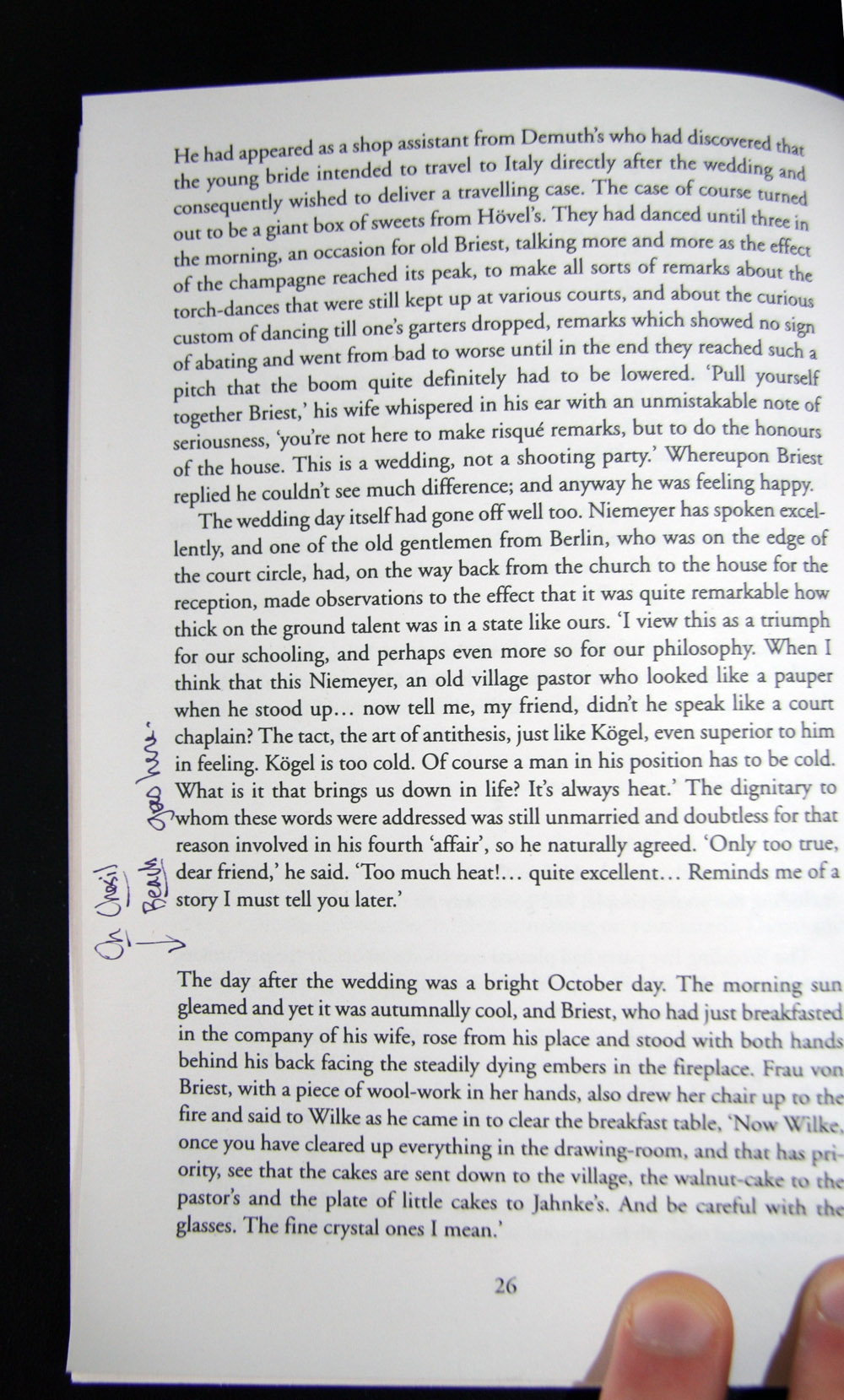
With enough subtlety, substance disappears, and I love his characterization of American Thanksgivings as portrayed in stories. Anyway, Chambers also says of Effi’s husband, “It seems that after years of self-discipline and mortification of the flesh Innstetten has regulated his natural urges into a state of atrophy.” In the margin I wrote, “Yawn,” a judgment that still seems reasonable a week later. Practically the entire text of Ian McEwan’s On Chesil Beach could fit between the end of the wedding scene on page 26 and the next paragraph, which begins, “The day after the wedding was a bright October day,” as if one of the presumably major events of Effi’s life hadn’t just happened. And I’m not talking about the wedding.

I was thinking about Effi Briest when I read Samuel Delany’s Paris Review interview in the Summer 2011 issue. He talks about two characters in his work Nova who almost have an incestuous relationship. The interviewer begins this exchange:

Did you intentionally want to make something the reader could only speculate about, rather than be certain of?

Delany: Certainly as far as the incest goes. Suggestion is a literary strategy. But when, in 1968, works like Henry Miller’s Tropic of Cancer and Black Spring and Lawrence’s Lady Chatterley’s Lover were legal to publish and sell in this country, the age of innuendo and the coyly placed line of white space, as the hero envelops the heroine in his arms, ended. Fifteen years later, AIDS rendered them permanently obsolete.

Today, I watch seminar rooms full of graduate students misread both [Alfred] Bester and [Joseph] Conrad, because they no longer have to wonder about the possibility of such illegal elements occurring in the story and the compensating possibility of suggestion as a writerly strategy for representing sex and violence.

I am one of those graduate students, and I evidently don’t have the exquisitely tuned sex detector that pre-’68 readers might have developed. This became especially clear in a seminar on Henry James’ The Golden Bowl, when one of my professors at the University of Arizona began to point out the many euphemisms and double entendres left by James, beginning with the name “Assingham” and proceeding from there. I mostly wondered what the big fuss was about, given the modesty of the phrases in questions, but I didn’t realize how generational my readings were until I discovered the Delany interview an hour ago.

Delany is right—I don’t have a lot of tolerance of “innuendo and the coyly placed line of white space.” That doesn’t mean I want every novel to be wildly explicit, or that I want pornography to merge with literary fiction, but it does mean that a lot of older books seem coy. Like Effi Briest. Today, when McEwan’s aforementioned novel takes those white spaces and turns them into entire works of their own, it’s hard to accept the white space, or an extraordinarily “discreet and allusive novel” where Virginia Creepers (or pumpkin pie) have “infinite psychological and sexual repercussions”

I didn’t expect to have my malady so accurately and suddenly diagnosed, however, and it wasn’t until I read Delany that I was able to write this post. He makes me want to be a more careful and considerate reader. Or maybe novels do have a sense of technological progression, or something like progress, or even progress itself. James Wood speculates on the subject in his review of Chang-Rae Lee’s The Surrendered:

Does literature progress, like medicine or engineering? Nabokov seems to have thought so, and pointed out that Tolstoy, unlike Homer, was able to describe childbirth in convincing detail. Yet you could argue the opposite view; after all, no novelist strikes the modern reader as more Homeric than Tolstoy. [. . .] Perhaps it is as absurd to talk about progress in literature as it is to talk about progress in electricity—both are natural resources awaiting different forms of activation. The novel is peculiar in this respect, because while anyone painting today exactly like Courbet, or composing music exactly like Brahms, would be accounted a fraud or a forger, much contemporary fiction borrows the codes and conventions—the basic narrative grammar—of Flaubert or Balzac without essential alteration.

If literature progresses technologically, it still doesn’t do so in quite the same way as technology: no one would use a camera from 1925 unless they were a masochist, had a historical fetish, or were trying to achieve some very peculiar artistic effect. The rest of us use digital cameras manufactured in the last five years, or phones, given the obvious advantages of convenience. But many writers from 1925 still feel quite modern—Fitzgerald, most obviously, but many others too. Yet I don’t find that much 19th Century fiction really moves me (exceptions: Moby-Dick, The Scarlet Letter). Contemporary writers have a greater and perhaps infinite rein to express what they need to express, and by contrast older writers do seem coy, even if this is an unfair judgment on my part—or the kind of judgment that might be tempered by age. The more I think about the idea, the more I see how others have considered it. For example, this review of William Deresiewicz’s A Jane Austen Education is bizarre because it’s like reading about myself, right down to the love for Madame Bovary:

In 1990, William Deresiewicz was on his way to gaining a Ph.D. in English literature at Columbia University. Describing that time in the opening pages of his sharp, endearingly self-effacing new book, “A Jane Austen Education,” Deresiewicz explains that he faced one crucial obstacle. He loathed not just Jane Austen but the entire gang of 19th-century British novelists: Hardy, Dickens, Eliot . . . the lot.

At 26, Deresiewicz wasn’t experiencing the hatred born of surfeit that Mark Twain described when he told a friend, “Every time I read ‘Pride and Prejudice’ I want to dig her up and hit her over the skull with her own shinbone.” What Deresiewicz (who has considerable fun at the expense of his pompous younger self) was going through was the rebel phase in which Dostoyevsky rules Planet Gloom, that stage during which the best available image of marriage is a prison gate.

Sardonic students do not, as Deresiewicz points out, make suitable shrine-­tenders for a female novelist whose books, while short on wedding scenes, never skimp on proposals. Emma Bovary fulfilled all the young scholar’s expectations of literary culture at its finest; Emma Woodhouse left him cold. “Her life,” he lamented, “was impossibly narrow.” Her story, such as it was, “seemed to consist of nothing more than a lot of chitchat among a bunch of commonplace characters in a country village.” Hypochondriacal Mr. Woodhouse, garrulous Miss Bates — weren’t these just the sort of bores Deresiewicz had spent his college years struggling to avoid? Maybe, he describes himself conceding, the sole redeeming feature of smug Miss Woodhouse was that she seemed to share his distaste for the dull society of Highbury.

I’m 27. Maybe I’ll have considerable fun at the expense of my pompous younger self one day.

I bought A Jane Austen Education, which shouldn’t be surprising given my feelings about Deresiewicz. Maybe he will teach me to read Austen more kindly, more attentively (Wood has succeeded at least somewhat in that respect: his discussion of free indirect speech in How Fiction Works finally gave me the tools to figure out why people like Austen). I’m still not sure that it will bring Effi Briest to life, and even if it does, it might be more like reanimating a corpse (which, as genre fiction teaches us, is replete with dangers) than interacting with a live person.

Effi Briest — Theodore Fontane, with a side of James Wood and Samuel Delany’s Paris Review interview

Despite what I wrote in this post, I got a copy of Effi Briest. And you know what? I couldn’t finish it. There were some great lines—my favorite is Effi’s father saying, “There’s nothing so good for one as a wedding, provided of course it isn’t one’s own”—but I couldn’t take the rest, even though I stopped reading the very nice introduction by Helen Chambers after realizing it was prejudicing me against the book:

The sexual dimensions of the age gap [between Effi and her husband] remain beneath the surface of this discreet and allusive novel. They are suggested, as is much that is vital in the inner action, by the symbolic texture of the narrative. Effi’s sexual inexperience at the beginning of the novel is beyond question, and the premature loss of her virginity is prefigured by the twins calling her back to the garden through a window framed by Virginia Creeper

This explains why little seems to happen, since “remain beneath the surface” feels like another phrase for “buried so deeply that you need an even dirtier mind than mine to excavate it. In a Paris Review interview, Robertson Davies says:

I do not respond quite so immediately and warmly to writers in the United States, because their concerns are different from mine and their approach to them is different from mine. They seem to be infinitely concerned with very subtle details of feeling and life. I find this exemplified, for instance, in many stories in The New Yorker where whether the family will have pumpkin pie or something else on Thanksgiving Day is a decision with infinite psychological and sexual repercussions. I take this quite seriously. I admire their subtlety—but I get so sick of it. I wish they would deal with larger themes.

With enough subtlety, substance disappears, and I love his characterization of American Thanksgivings as portrayed in stories. Anyway, Chambers also says of Effi’s husband, “It seems that after years of self-discipline and mortification of the flesh Innstetten has regulated his natural urges into a state of atrophy.” In the margin I wrote, “Yawn,” a judgment that still seems reasonable a week later. Practically the entire text of Ian McEwan’s On Chesil Beach could fit between the end of the wedding scene on page 26 and the next paragraph, which begins, “The day after the wedding was a bright October day,” as if one of the presumably major events of Effi’s life hadn’t just happened. And I’m not talking about the wedding.

I was thinking about Effi Briest when I read Samuel Delany’s Paris Review interview in the Summer 2011 issue. He talks about two characters in his work Nova who almost have an incestuous relationship. The interviewer begins this exchange:

Did you intentionally want to make something the reader could only speculate about, rather than be certain of?

Delany: Certainly as far as the incest goes. Suggestion is a literary strategy. But when, in 1968, works like Henry Miller’s Tropic of Cancer and Black Spring and Lawrence’s Lady Chatterley’s Lover were legal to publish and sell in this country, the age of innuendo and the coyly placed line of white space, as the hero envelops the heroine in his arms, ended. Fifteen years later, AIDS rendered them permanently obsolete.

Today, I watch seminar rooms full of graduate students misread both [Alfred] Bester and [Joseph] Conrad, because they no longer have to wonder about the possibility of such illegal elements occurring in the story and the compensating possibility of suggestion as a writerly strategy for representing sex and violence.

I am one of those graduate students, and I evidently don’t have the exquisitely tuned sex detector that pre-’68 readers might have developed. This became especially clear in a seminar on Henry James’ The Golden Bowl, when one of my professors at the University of Arizona began to point out the many euphemisms and double entendres left by James, beginning with the name “Assingham” and proceeding from there. I mostly wondered what the big fuss was about, given the modesty of the phrases in questions, but I didn’t realize how generational my readings were until I discovered the Delany interview an hour ago.

Delany is right—I don’t have a lot of tolerance of “innuendo and the coyly placed line of white space.” That doesn’t mean I want every novel to be wildly explicit, or that I want pornography to merge with literary fiction, but it does mean that a lot of older books seem coy. Like Effi Briest. Today, when McEwan’s aforementioned novel takes those white spaces and turns them into entire works of their own, it’s hard to accept the white space, or an extraordinarily “discreet and allusive novel” where Virginia Creepers (or pumpkin pie) have “infinite psychological and sexual repercussions”

I didn’t expect to have my malady so accurately and suddenly diagnosed, however, and it wasn’t until I read Delany that I was able to write this post. He makes me want to be a more careful and considerate reader. Or maybe novels do have a sense of technological progression, or something like progress, or even progress itself. James Wood speculates on the subject in his review of Chang-Rae Lee’s The Surrendered:

Does literature progress, like medicine or engineering? Nabokov seems to have thought so, and pointed out that Tolstoy, unlike Homer, was able to describe childbirth in convincing detail. Yet you could argue the opposite view; after all, no novelist strikes the modern reader as more Homeric than Tolstoy. [. . .] Perhaps it is as absurd to talk about progress in literature as it is to talk about progress in electricity—both are natural resources awaiting different forms of activation. The novel is peculiar in this respect, because while anyone painting today exactly like Courbet, or composing music exactly like Brahms, would be accounted a fraud or a forger, much contemporary fiction borrows the codes and conventions—the basic narrative grammar—of Flaubert or Balzac without essential alteration.

If literature progresses technologically, it still doesn’t do so in quite the same way as technology: no one would use a camera from 1925 unless they were a masochist, had a historical fetish, or were trying to achieve some very peculiar artistic effect. The rest of us use digital cameras manufactured in the last five years, or phones, given the obvious advantages of convenience. But many writers from 1925 still feel quite modern—Fitzgerald, most obviously, but many others too. Yet I don’t find that much 19th Century fiction really moves me (exceptions: Moby-Dick, The Scarlet Letter). Contemporary writers have a greater and perhaps infinite rein to express what they need to express, and by contrast older writers do seem coy, even if this is an unfair judgment on my part—or the kind of judgment that might be tempered by age. The more I think about the idea, the more I see how others have considered it. For example, this review of William Deresiewicz’s A Jane Austen Education is bizarre because it’s like reading about myself, right down to the love for Madame Bovary:

In 1990, William Deresiewicz was on his way to gaining a Ph.D. in English literature at Columbia University. Describing that time in the opening pages of his sharp, endearingly self-effacing new book, “A Jane Austen Education,” Deresiewicz explains that he faced one crucial obstacle. He loathed not just Jane Austen but the entire gang of 19th-century British novelists: Hardy, Dickens, Eliot . . . the lot.

At 26, Deresiewicz wasn’t experiencing the hatred born of surfeit that Mark Twain described when he told a friend, “Every time I read ‘Pride and Prejudice’ I want to dig her up and hit her over the skull with her own shinbone.” What Deresiewicz (who has considerable fun at the expense of his pompous younger self) was going through was the rebel phase in which Dostoyevsky rules Planet Gloom, that stage during which the best available image of marriage is a prison gate.

Sardonic students do not, as Deresiewicz points out, make suitable shrine-­tenders for a female novelist whose books, while short on wedding scenes, never skimp on proposals. Emma Bovary fulfilled all the young scholar’s expectations of literary culture at its finest; Emma Woodhouse left him cold. “Her life,” he lamented, “was impossibly narrow.” Her story, such as it was, “seemed to consist of nothing more than a lot of chitchat among a bunch of commonplace characters in a country village.” Hypochondriacal Mr. Woodhouse, garrulous Miss Bates — weren’t these just the sort of bores Deresiewicz had spent his college years struggling to avoid? Maybe, he describes himself conceding, the sole redeeming feature of smug Miss Woodhouse was that she seemed to share his distaste for the dull society of Highbury.

I’m 27. Maybe I’ll have considerable fun at the expense of my pompous younger self one day.

I bought A Jane Austen Education, which shouldn’t be surprising given my feelings about Deresiewicz. Maybe he will teach me to read Austen more kindly, more attentively (Wood has succeeded at least somewhat in that respect: his discussion of free indirect speech in How Fiction Works finally gave me the tools to figure out why people like Austen). I’m still not sure that it will bring Effi Briest to life, and even if it does, it might be more like reanimating a corpse (which, as genre fiction teaches us, is replete with dangers) than interacting with a live person.

More on fiction versus nonfiction

Most of the books I’ve been wanting to write about and not getting around to are nonfiction, and I’m not sure why this is. It might be because both good and bad nonfiction are easier to write about than good fiction. Good fiction demands attention and time, which are in chronically short supply for me and virtually everyone else. So I foolishly put off writing about good fiction and instead spread time among lesser though still interesting vessels (this post comes as a followup to Nonfiction, fiction, and the perceived quality race, which got started from the question, “The quality of fiction seems to be decreasing relative to the quality of non-fiction, or am I just biased against active fiction writers vs. dead ones?”).

I expend a lot of my time thinking about good fiction in the context of making my own novel writing better, instead of writing about what makes good fiction good on this forum. So even though I think a lot about good novels, I write about them in a different context. For instance, the last novel I finished stole from Alain de Botton’s On Love and Rebecca Goldstein’s The Mind-Body Problem; I’ve written about both books here, but not nearly to the proportion I’ve been thinking about. Alas: the novel I wrote got the most encouraging rejections, many along the lines of “I like it but can’t sell it.” If it had sold and eventually been published, I think it would be much easier for me to write about novels I care deeply about.

Even so, there are a bunch of novels—a couple by Michel Houellebecq, Elmore Leonard’s latest, Brady Udall’s The Lonely Polygamist, more about Robertson Davies—I mean to write about, but but they’re outnumbered by nonfiction. This might seem strange, coming from a person in English graduate school, where we study nonfiction all the time, and when we study fiction, it’s often more like studying nonfiction than we care to admit.

I also simply don’t read as much fiction as I used to; I wonder if fiction is most useful to the young (who are trying to figure out who they are and how the social world works) and the old (who are trying to figure out what this crazy thing they just did actually means). A lot of people in the middle don’t appear to derive as much immediate benefit from reading fiction, although I have no data on this idea.

Finally, I can often read nonfiction much faster than fiction. This isn’t a change, but it is true: nonfiction often telegraphs where it’s going, which makes skipping large sections easier. Being able to read faster also indicates that too many books are too long, as Cowen has argued in various places, but it nonetheless means I very seldom have to invest as much in deep, close reading. I wish more nonfiction books rose to the level of deep, close reading, but few do, relative to good fiction.

George Eliot’s Daniel Deronda and the Graham Handley’s description of it

In his introduction to George Eliot’s Daniel Deronda, Graham Handley writes:

Yet if all the research and criticism of Daniel Deronda, including scholarly articles of the type which discover but do not evaluate, were put together, a consensus would doubtless reveal that it is generally thought of either as a remarkable failure, a flawed success, or even an aberration unredeemed by incisive insights or distinguished writing. The character of Gwendolen is always praised; those of Mirah, Mordecai, and Daniel are often denigrated.

It is my opinion, as someone who regularly miscegenates evaluation and discovery, that the critical consensus is correct. I particularly like the description of the novel as an “aberration unredeemed by incisive insights or distinguished writing.” I’m also still amused that Handley would announce this in the introduction, as if inviting us to agree with the consensus and not his defense.

Reading Handley’s defense, it’s hard not to like the critical consensus more:

It is my contention that Daniel Deronda needs no apology. [. . .] Its greatness consists in its artistic integrity, its moral and imaginative cohesion, its subtle and consistent presentation of a character with psychological integration as its particular strength, together with what Colvin called the ‘sense of universal interests and outside forces.’

Most of those words and phrases don’t mean anything on their own. What is “moral and imaginative cohesion?” Do you get it or them with glue and spackle? And how does the “subtle and consistent presentation of a character” work? Those sound like code words for “nothing happens,” other than that characters talk to each other about who’s going to boff who after they get married or, if we’re lucky, before.

The introduction goes on:

The form is fluid and vital, not static and diagrammatic, and the sophisticated and studied use of image and symbol is tremulous with life, with the feelings, responses, and pressures of the individual moral and spiritual experience of fictional character registering with the factual reader.

Spare me “sophisticated and studied use of image and symbol” when they aren’t deployed to tell much of a story. “Moral and spiritual experience” sounds remarkable tedious. Once again, with accolades like these, who needs haters?

I will say, however, that Daniel Deronda makes me feel incredibly virtuous for having read it, or at least parts of it. This is more or less true of every novel I’ve read whose title consists solely of a name.

George Eliot's Daniel Deronda and the Graham Handley's description of it

In his introduction to George Eliot’s Daniel Deronda, Graham Handley writes:

Yet if all the research and criticism of Daniel Deronda, including scholarly articles of the type which discover but do not evaluate, were put together, a consensus would doubtless reveal that it is generally thought of either as a remarkable failure, a flawed success, or even an aberration unredeemed by incisive insights or distinguished writing. The character of Gwendolen is always praised; those of Mirah, Mordecai, and Daniel are often denigrated.

It is my opinion, as someone who regularly miscegenates evaluation and discovery, that the critical consensus is correct. I particularly like the description of the novel as an “aberration unredeemed by incisive insights or distinguished writing.” I’m also still amused that Handley would announce this in the introduction, as if inviting us to agree with the consensus and not his defense.

Reading Handley’s defense, it’s hard not to like the critical consensus more:

It is my contention that Daniel Deronda needs no apology. [. . .] Its greatness consists in its artistic integrity, its moral and imaginative cohesion, its subtle and consistent presentation of a character with psychological integration as its particular strength, together with what Colvin called the ‘sense of universal interests and outside forces.’

Most of those words and phrases don’t mean anything on their own. What is “moral and imaginative cohesion?” Do you get it or them with glue and spackle? And how does the “subtle and consistent presentation of a character” work? Those sound like code words for “nothing happens,” other than that characters talk to each other about who’s going to boff who after they get married or, if we’re lucky, before.

The introduction goes on:

The form is fluid and vital, not static and diagrammatic, and the sophisticated and studied use of image and symbol is tremulous with life, with the feelings, responses, and pressures of the individual moral and spiritual experience of fictional character registering with the factual reader.

Spare me “sophisticated and studied use of image and symbol” when they aren’t deployed to tell much of a story. “Moral and spiritual experience” sounds remarkable tedious. Once again, with accolades like these, who needs haters?

I will say, however, that Daniel Deronda makes me feel incredibly virtuous for having read it, or at least parts of it. This is more or less true of every novel I’ve read whose title consists solely of a name.