Links: Shit sorority girls say, health care, the beach, the writing life, grammar

* Shit sorority girls say; this is depressingly accurate.

* “The average health care insurance premium today is over $15,000 and by 2021 it may be headed to $32,000 or so (admittedly that estimate is based on extrapolation);” that’s from “The median wage figure and the health care costs figure.”

* Related? “How U.S. Lost Out on iPhone Work.”

* Why the video pros are moving away from Apple. And I can’t blame them, given Apple’s behavior.

* On the Beach:

I wrote, a couple of months ago, about the ways that being exposed to the free market as a professional writer has helped bring into focus some of the injustices at work in academia: the dishonesty, the cronyism, the hidden agendas. What I didn’t say is that they also treat you like an equal in the market. It isn’t just an endless series of hazing rituals. You’re a potential partner, and there are always other people you can work with. But in academia you are forever trembling, like a figure out of Kafka, before the next tribunal: graduate admissions, graduate courses, orals, chapter conferences, dissertation committee, hiring committees, peer reviews for publications and grants, promotion reviews, tenure review, more peer reviews and promotion reviews. And because it’s always up or out—you can’t just muddle along at the same level, the way you can in other occupations—everything is always on the line; every test is existential.

* Are the grammar books all right about alright?

* Counterintuitive advice for literary critics: don’t read other critics before you write your review or criticism.

* How Amazon is killing publishers.

* The Internet won the Congressional battle again censorship. This time.

* Preservation Push in Bohemian Home Stirs Fear of Hardship; bizarrely, there is no mention of supply, demand, or city-wide housing costs:

The East Village is arguably America’s bohemian capital, home to the major countercultural waves of the second half of the 20th century [. . .]

New York City is trying to honor the neighborhood’s legacy and preserve it, as well as the signposts of earlier generations that housed and entertained the immigrants, artists and political radicals who peopled the coarse-edged streets.

This is another way of saying, “The housing will be so expensive that 21st century artists and political radicals won’t be able to afford the East Village.” Which they already can’t. See further my review of Triumph of the City: How Our Greatest Invention Makes Us Richer, Smarter, Greener, Healthier, and Happier

* How Big-Time Sports Ate College Life recapitulates Murray Sperber’s Beer and Circus: How Big-Time Sports Is Crippling Undergraduate Education. College sports should start by paying players, since it’s obvious that players are big football and basketball programs are professionals.

* What you (really) need to know; see also Student choice, employment skills, and grade inflation.

* Key to productivity: Choose phone calls [and interviews] carefully. When I interview someone, I try to be the exact opposite of this Michael Zenn guy.

The Novel

“If the novel should really disappear, it will do so not because it has exhausted its powers but because it exists in a world grown alien to it.”

—Milan Kundera, The Art of the Novel

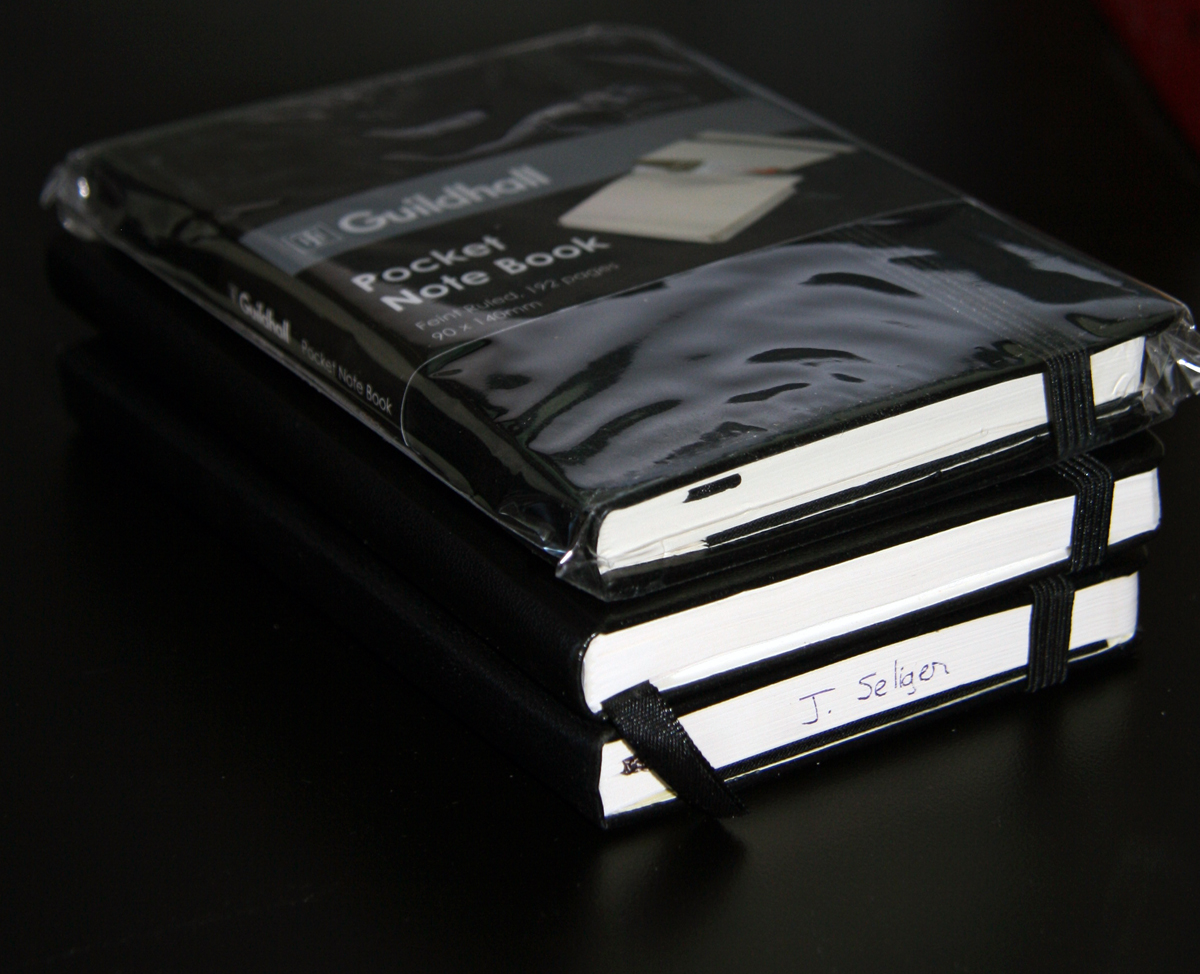
Product Review: Guildhall Pocket Notebook

This is part of a series of pocket notebook reviews that I began after Moleskine’s quality control problems and from reading Rands’ notebook discussion.

The Guildhall Pocket Notebook’s great strength and weakness is its flexibility: it has a softer cover than most pocket notebooks and stitching that allows the notebook to easily lie flat. But its cover also bends out of shape over time, like a cardboard insert or cereal box, and the pages bend with it. Still, this is a minor problem in a largely successful notebook—one that’s better than Moleskines but not quite as good or readily available as Rhodia Webbies.

The “loose” quality to the Guildhall’s binding is pleasing—insert joke here—and the notebook is much easier to flip through than the Design.Y Record 216, which I haven’t really used because my current notebook still has space (and the Design.Y’s cost precludes it from being compared with $5 – $20 notebooks). A sewn binding means the Guildhall is unlikely to fall apart over the short to medium term; though it doesn’t feel as sturdy as a Rhodia Webbie, the Guildhall did survive many months in pockets, backpacks, suitcases, and assorted other gear without corner tears.

Mine arrived smelling like fish, although I attribute that to shipping from England rather than an inherent property of the notebook. I sent them back to UKGE for a new pair, only to have UKGE send them back to me, still smelling of fish, though not nearly as badly.

The pages had narrow lines that allow more writing per page without being cramped; there are an extra two to three lines per sheet over Rhodia’s Webbie, though the lines didn’t quite extend to the page’s edge. The cover has a pleasant feel and stitching around it; I can’t tell if the stitching is decoration or essential to holding the cover in place. The paper feels good under a pen, and there’s very little bleed through (in the picture with writing, above, the back page is covered with fountain pen ink). It’s very easy to flip through the Guildhall.

Unfortunately, most of this doesn’t matter: Exaclair, the American distributor for Guildhall, isn’t producing them any longer. Christine Nusse, who works for Exaclair, sent me an e-mail saying that “the Guildhall journals are no longer available for export in the US because they were redundant with the Quo Vadis’ Habanas [. . .] and Clairefontaine’s notebooks.” To me, the Habana is quite different, but the issue is moot anyway: she also said “My understanding is that they are discontinued.” That understanding may have changed, but if it hasn’t, the notebook is gone. Some places online still list Guildhall notebooks, like The Dyslexia Shop in the U.K., but I don’t know if those retailers are getting new stock or depleting what inventory remains.

In the realm of “normal” notebooks, this is the best or second best I’ve tried, the best being the Rhodia, which I prefer only because I don’t like the cover bend. The Guildhall seems like a natural fit for the U.S., and that Exaclair chooses not to distribute it is puzzling, given its superiority over the market-leading behemoth.

Brief product review: The Quo Vadis Habana

This is part of a series of pocket notebook reviews that I began after Moleskine’s quality control problems, and in reading Rands’ notebook discussion.

The Habana’s big problem is simple: it’s not quite a pocket notebook. It’s also not quite a full-sized notebook, either, at 4″ x 6″, it’s uncomfortably in between, too large to carry around and too small for classrooms. Instead of being in the pleasant middle, they’re in the awkward middle. These shots compare it to a Moleskine and Guildhall notebook, both of which are 3.5″ x 5.5″:

The Habana is still wrapped, and that’s because of its size: too large to be portable. If it doesn’t fit in reasonably slender pockets, it might as well be a laptop or tablet. There isn’t further discussion of the paper quality or construction because the Habana has already been disqualified from competition. Which is unfortunate, because there aren’t a huge number of high-quality, appropriately sized notebooks around.

I want it to be right. It just isn’t.

EDIT: The Rhodia Webnotebook is better, although its pages obnoxiously don’t extend to the edge of each page.

Commenting, community deterioration, and Hacker News

The people who most need to read and understand this post are the ones least likely to. Nonetheless, I’m going to post because the topic is important yet neglected topic restraint when speaking and writing. In real life, the problem isn’t nearly as acute as it is on the Internet: few people will ignore social cues that say, “You’re being a jerk,” but on the Internet there are few or no social cues, especially in the comments sections of websites. I try to comment when I have useful, unique, original, or non-standard things to say. That isn’t so often, but it’s often enough that I leave a reasonably large number of comments; some of them are the first drafts of blog posts (and some of those blog posts may eventually find their way into books, a topic that I’ve been thinking about more and more lately).

And when I don’t have something useful, unique, original, or non-standard to say (or ask), I just shut up. But Internet comments tend to degrade as a website grows; it attracts more people who just comment, often in ways that aren’t negative enough to silence through moderation but still annoying enough to lower the quality of the conversation. This, it seems to me, is a problem separate from trolls: the commenters who are leaving thoughtless comments aren’t necessarily doing so for attention, and they may not realize what they’re doing. And we can’t just state it in the negative: don’t don’t this. We should state it in the positive: do add substance. Hacker News tries to solve this problem with its Guidelines and through culture, but the site has been growing faster, it seems, than its culture.

There may not be anything that can be done about this problem; it appears to take a certain and unusual mind to appreciate long-form discussion, be courteous, not feed or respond to trolls, and contribute only things of substance. The early (or earlier) readers of Hacker News, and other big news sites, appear to have understood this. The more recent readers don’t, or a critical mass of people is developing who don’t work to contribute substantive material. I hadn’t really thought about the issue until about a month ago, in this comment thread, where I pointed out that single-function devices can still have utility. A poster named Dextorious replied: “Yeah. So on top of owning an iPhone, you are also a hipster with a (trendy but useless, considering the iPhone also tells the time) watch and a notebook (it’s even a Moleskine). Way to prove the parent poster’s point.”

Argh. I replied:

1) I don’t know what you mean by a “hipster,” or what a “hipster” is, other than that you’re using the term as a slur: http://paulgraham.com/disagree.html . I also don’t know what “hipster culture” means or is.

2) The original poster who I’m responding to said, “the days of the wristwatch and one-function cell-phone are gone [. . .],” so I’m not sure how one can be simultaneously “trendy” and part of a declining trend (that is, watch-wearing).

3) If you’d read the link, you’d know that I don’t use Moleskine notebooks any more because their quality variability appears to have increased over time.

But I bet my reply took way longer than Dextorious’s comment, and by the time I was done replying I felt like I’d wasted my time. I wanted to add another part:

4) I worry that this level of stupidity, and repeated stupidity, is becoming more normal; it’s very hard to wade through that stupidity as an individual. Dextorious has a lot of problems with reason; he tends to post things like “Thanks for the “democratic” downvoting.”

I looked through his comment history; there are many one-line, two-sentence comments like this one, which led to a pointless flame war. He calls Facebook “hyper-valued web crap,” but not in the context of providing real insight. Likewise, consider this comment. Others tell him that he’s not being very nice, as in a comment where Dinkumthinkum says, “You’re missing the point.” But how do you tell someone who chronically misses the point that they’re missing the point? In another thread, talmand says, “Wow, overreact much?” Yes, he does; but you can’t tell from looking a single comment what dextorious is doing, and most people aren’t going to look for a pattern of useless behavior in a poster’s comment history. I only did to make a point.

And I’m not doing this to pick on Dextorious; he’s one guy, but he’s symptomatic of similar threads I’ve seen. The latest happened today, in which jacquesm said:

The thread because this is one of the most hateful and ugly threads I’ve ever seen on HN. A thread like this would be literally unthinkable a year or more ago, and now I’m not even surprised it is here.

I’m not surprised either, and I’m not sure what to do with it in the face of cultural change. I’m not sure there’s a good algorithmic way of dealing with weak comments; one might have a Dunning-Kruger effect at work: the people who are least likely to provide valuable and non-jerky comments are also least likely to realize they’re not doing it. Most of the time, when you’re thinking about writing a comment, you should stop and ask: Is this important? Is it important enough to give it its own post? Is it cruel? Most people don’t do this. I suppose Hacker News could solve this problem by appointing super users or something like that, but such a solution doesn’t scale and has the problem of borderline-useful comments, like many of Dextorious’s. And sometimes it is genuinely hard to separate people telling difficult truths and people being jerks. Self-policing works much better but is imperfect, and its imperfection grows faster than the number of users.

This post is an effort towards cultural change, not only on Hacker News but elsewhere on the Internet. I’ve discussed the problem before and doubt it’s going to go away. I’m still going to try to help people write better comments and think better, but I worry that it’s a losing battle in most circumstances.

Links: Peter Norvig, Coders at Work, Tucson tedium, bookselling, teachers, Tolkien

* Peter Norvig in Coders at Work: “Certainly I would do things because they were fun. Especially when I was a grad student and I was less beholden to schedules. I’d say, ‘Oh, here’s an interesting problem. Let’s see if I can solve that.’ Not because it’s progress on my thesis, but just because it was fun.”

This is basically my problem, if that’s the correct term, in grad school: I find something interesting and want to write about that, instead of whatever’s immediately applicable in seminars or for my dissertation. In the short term it’s a problem, though in the long term I’d like to think of it as an asset.

* “The secret lives of feral dogs: A Pennsylvania city instructs police to shoot strays, opening a sad window on animal care in the age of austerity.”

* Now that I live in Tucson, AZ, I totally understand this comment; emphasis added:

In Zoellner’s riskiest chapter, he remembers Tucson as a rotten place to grow up. “My skateboard was no good on those new asphalt streets. … I would sometimes steal into an unfinished house in the late afternoons to smash out the windows with rocks.” He’s not excusing Loughner, just describing what an isolated lifestyle in Arizona can do to people. The state ranks 48th among places where “people trade favors with neighbors” and 45th among places where people eat dinner with their families.

In my case the university ameliorates some of the loneliness, but the “city” of Tucson is laid out so poorly and so widely that it promotes isolation.

* Good Writing Isn’t Enough: How to Sell a Book in the Digital Age.

* The value of teachers; see also “Should teachers be paid more or less? The answer is: both.”  Which comes to a very similar conclusion as my own post, “Are teachers underpaid? It depends.

* See too Jason Fisher’s reply to my last post.

* Yet another reason I don’t pay attention to literary prizes, this one regarding Tolkien.

* “The fragile teenage brain: An in-depth look at concussions in high school football.” After reading about the many football concussion studies, I’ve learned that a lot of the brain damage football causes isn’t from single big hits—it’s from many small hits that accrue in practice and elsewhere. There is no way I’d let my kid play football.

* A friend who read The Hunger Games didn’t especially like the novel and neither did I, despite three-quarters of America having read the novel and its sequels. I mostly thought the writing flat; my friend Heather simply said, “The metaphors are bad.” Perhaps I can get her to yield some examples soon.

Thoughts on the movies “Shame” and “Sleeping Beauty”

1) Both movies substituted sex for plot; this might’ve kind of worked in an era before Internet porn and HBO (and both also show why HBO’s original shows are successful), but these days people who want to see naked people are only a click away.

2) I mostly agree with Dan Kois in “Shame should be ashamed of itself,” especially when he compares it to The Social Network, which didn’t seem to have inherently riveting material—it’s a movie about a bunch of guys who type for a living—but is riveting. Notice this paragraph:

Shame [. . .] feels fraudulent in every way, from its gleaming surfaces to its laughably overblown soundtrack to the perfect teardrop rolling over Michael Fassbender’s perfect cheekbone in that perfect lounge where, in real life, no one would ever let Carey Mulligan sing a shoe-gaze “New York, New York.” Oh and what about the scene where he jogs to classical music? Or the part where his addiction drags him so deep into hell that he (gasp) gets a blowjob from a dude in a dimly-lit sex club? (As the writer Bryan Safi noted on Twitter, “I’d love to see a movie where a strung-out gay guy sinks so low and degrades himself so much for his addiction, he hooks up with a woman.”)

Shame has nothing to do with actual addiction, or the actual New York, or even actual human beings.

Yet Shame has gotten decent reviews, for reasons not obvious to me. Ditto for Sleeping Beauty. Are critics merely happy to have something other than blowing-shit-up-and-punching-bad-guys movies? To be fair, this is part of what inspired me to see them.

3) There’s no particular reason the movies had to be plotless; they look more like examples of giving up.

4) I’m reminded of my own process when I’m starting a novel and writing down ideas, premises, and characters—but long before I’m starting to link and weave those ideas, premises, and characters. Unfortunately, the people behind shame appear to have stopped at the first step. They were more like shorts than features, which is a problem I’m too aware of in novels, where the short-story-writers-cum-novelists sometimes don’t know where to go with 70,000 – 90,000 words.

5) For an example of movies like these (nudity, psychological tension, internal turmoil manifested in external ways) but better, try Swimming Pool.

6) Music is a complement to, not a substitute for, character development.

7) Is it a comedy and we are missing the joke?

The 99% are watching four to five hours of TV a day, and other tales from the present

I’m reading “Streaming Dreams: YouTube turns pro” and noticed this:

But there is one category in which YouTube has made little progress. The average ’Tuber spends only fifteen minutes a day on the site—a paltry showing when compared with the four or five hours the average American spends in front of the TV each day.

Emphasis added; the quote is from The New Yorker; Nielsen, who does the most TV tracking, agrees with the four hours number. In all of the contemporary reports and newspaper accounts and blog posts about income equality, I’ve never seen TV consumption mentioned. To me TV consumption is astonishing and might also be linked to Americans’ larger economic problems—I can’t imagine that most successful, people who earn a lot of money watch anything like four hours of TV a day, because where would they get the time? I also doubt TV probably isn’t imparting the skills and knowledge that future high earners need to be high earners. It could be that I’m succumbing to the availability bias and assuming that the high earners I know are representative, but the fact itself still amazes.

This also reminded me of Bryan Caplan’s post “Kahneman, Greed and Success,” in which Caplan says: “Kahneman highlights an important, neglected reason why some people are rich and others are poor: some people care about money more than the rest of us. People who want to be rich make the choices and sacrifices conducive to that end – and on average they succeed.” The key words there are “on average,” but that’s probably true of most things people want: the ones who really strive to achieve something are on average more likely to get it, though no one foresees the future and even those who strive to do everything right may still fail. Those of us who spend four hours a day watching TV, however, are probably not trying—which means it shouldn’t surprise us when we fail to earn as much as we otherwise could. And, to me, skipping TV doesn’t even look like much of a “sacrifice,” because so much of it is boring.

I’m reminded too of friends and acquaintances who mention their artistic aspirations in writing, movies, or music. When they say they want to make movies, write, or record music, I ask to read, see, or hear their work. Very few of them have any to show, or blogs, YouTube shorts, or albums online, and when I express surprise, they seem disconnected from the art they claim they want to make. Which makes me think their ambitions aren’t real ambitions: they’re conversational pieces, or status poses. Or the holders of false artistic ambitions are stuck in antiquity, waiting for someone to give them permission or degrees or deadlines. Whatever the case, I’ve learned to be very skeptical of the people who claim they want to be artists but aren’t actively being artists. Given the proliferation and low cost of the tools necessary to make art, the only thing standing between people and being artists is themselves.

Income doesn’t work quite that way, but the people who really want to make money are taking proactive steps to make money. The people who say they want to earn more but instead watch four or five hours of TV a day are posing, or complaining without taking action, like my would-be artist friends and acquaintances. The obsessives are the ones who succeed as artists. They also appear to be the ones who succeed as startup founders. It looks increasingly like the complaints about income inequality are really based on resentment—not just of those with wealth, but resentment of the complainer’s earlier consumption and time choices, and it comes from people who haven’t chosen professions based on income—like journalism, teaching, or professing. It comes from people who made trade-offs away from earning more and toward consuming more (like TV), but who eventually find that they don’t like the trade-offs they made.

Some might also not realize they’re making choices; I’m reminded of John Scalzi in “Being Poor,” where he says “Being poor is having to live with choices you didn’t know you made when you were 14 years old.” But that probably applies to a minority of people, not a majority, and it would be stupid and misleading to compare the median to the genuinely poor.*

A lot of us probably aren’t, as Caplan points out, “racing for the same finish line: material success” (and, as we’ve been exhorted numerous times, maybe we shouldn’t be). If you race for that materialistic or monetary line and not some other, it’s hard to imagine “normal” behavior more detrimental to getting there than watching four hours of TV a day. The people who are making the money are the ones building YouTube, not watching YouTube and TV. I suppose four hours of TV is an improvement on, say, four hours staring at a wall. But very few people are really building what economists call “human capital” when they watch TV. They’re instead regressing to the mean, in income and in so many other fields.


Read too Scalzi’s later essay, “Why Not Feeling Rich is Not Being Poor, and Other Things Financial,” where he cautions people again the mistake of using “Being Poor” as a stick to beat the wealthy—even those wealthy whose comparison groups make them think they’re not wealthy. One thing that might make us all feel wealthier is simple: not comparing ourselves to our wealthiest neighbors or the people on TV, especially since the extravagance depicted on many TV shows is so astonishing compared to what normal people have. Such a principle doesn’t apply solely to wealth, either: subconsciously assuming that the people you date or marry should be as hot and witty as TV stars is as unwise as using such people for financial comparisons.

EDIT: William Gibson in Distrust That Particular Flavor: “I suspect I have spent just about exactly as much time actually writing as the average person my age has spent watching television, and that, as much as anything, may be the real secret here.”

Why I write fewer book reviews

When I started writing this blog I mainly wrote book reviews. Now, as a couple readers have pointed out, I don’t write nearly as many. Why?

1) I know a lot more now than I did then and have lived, read, and synthesized enough that I can combine lots of distinct things into unique stories that share non-obvious thins about the world. When I started, I couldn’t do that. Now my skills have broadened substantially, and, as a result, I write on different topics.

2) For many writers, reviewing books for a couple years is extremely useful because it introduces a wide array of narratives, styles, and so forth, forcing you to develop, express, and justify your opinions if you’re going to write anything worthwhile. Few other environments force you to do this; in academia, the books you’re assigned are already supposed to be “great,” so you’re not asked to say if they’re crap—even though many of the assigned books in school are crap, you’re not supposed to say so. After going through dozens or hundreds of books and explaining why you think they’re good and bad and in between, you should end up developing at least a moderately coherent philosophy of what you like, why you like it, and, ideally, how you should implement it. You shouldn’t let that philosophy become a set of blinders, but it does help to think systematically about tastes and preferences and so forth.

You might not be saying much about the books you’re reviewing, but you are saying a lot about what you’ve come to think about books.

3) No one cares about book reviews. If people in the aggregate did care about book reviews, virtually every newspaper in the country wouldn’t have shuttered what book review section it once had. What a limited number of people do want to know is what books they should read and, to a lesser extent, why. Having established, I’d like to imagine, some level of credibility by going through 2), above, I think I’m better able to do this now than I was when I started, and without necessarily dissecting every aspect of every book.

It’s also very hard and time consuming to write a great review, at least for me.

Lev Grossman also points out a supply / demand issue in an interview:

There was a time not long ago when opinions about books were a scarce commodity. Now we have an extreme surplus of opinions about books, and it’s very easy to obtain them. So if you’re in the business of supplying opinions about books, you need to get into a slightly different business. Being a critic becomes much more about supplying context for books, talking about new ways of reading, sharing ways in which it can be a rich experience.

He’s right, and his economic perspective is useful: when something is plentiful, easy to produce, and thus cheap, we should do something else. And I’m doing more of the “something else,” using as my model writers like Derek Sivers and Paul Graham.

To return to Grossman’s point, we might also treat what we’re doing differently. Clay Shirky says in Cognitive Surplus: Creativity and Generosity in a Connected Age

Scarcity is easier to deal with than abundance, because when something becomes scarce, we simply think it more valuable than it was before, a conceptually easy change. Abundance is different: its advent means we can start treating previously valuable things as if they were cheap enough to waste, which is to say cheap enough to experiment with. Because abundance can remove the trade-offs we’re used to, it can be disorienting to people who’ve grown up with scarcity. When a resource is scarce, the people who manage it often regard it as valuable in itself, without stopping to consider how much of the value is tied to its scarcity.

Lots of people are writing lots of reviews, some of them good (I like to think some of mine are good) but most not. Most are just impressionistic or empty or garbage. By now, opinions are plentiful, which means we should probably shift towards greater understanding and knowledge production instead of raw opinion. That’s what I’m doing in point 1). I’m no longer convinced that book reviews are automatically to be regarded “as valuable in [themselves],” as they might’ve been when it was quite hard to get ahold of books and opinions about those books. Today, for any given book, you can type its name into Google and find dozens or hundreds of reviews. This might make pointing out lesser known but good books useful—which I did with Never the Face: A Story of Desire—and the New York Review of Books is doing on a mass scale with its publishing imprint. Granted, I’ve found few books in that series I’ve really liked aside from The Dud Avocado, but I pay attention to the books published by it.

4) It’s useful to keep When To Ignore Criticism (and How to Get People to Take Your Critique Seriously) by John Scalzi in mind; he says critics tend to have four major functions: consumer reporting, exegesis, instruction, and polemic (details at his site). The first is useful but easily found across the web, and it’s also of less and less use to me because deciding what’s “worth it” is so personal, like style. My tastes these days are much more refined and specific than they were, say, 10 years ago (and I suspect they’ll be more refined still in 10 years). The second is basically what academic articles do, and I’d rather do that for money, however indirectly. The third is still of interest to me, and I do it sometimes, especially with bad reviews. The fourth is a toss-up.

When I started, I mostly wanted to do one and two. Now I’m not that convinced they’re important. In addition, books that I really love and really think are worth reading don’t come along all that frequently; maybe I should make a list of them at the top. Every week, there’s an issue of the New York Times Book Review with a book on the cover, but that doesn’t mean every week brings a fabulous book very much much worth reading by a large number of people. Having been fooled by cover stories a couple of times (Angelology being the most salient example), I’m much warier of them now.

Unfortunately, academic writing is also usually less fun, less intelligent, more windy, and duller than writing on the Internet. Anything is accomplishes rhetorically or intellectually is usually done through a film of muck thrown on by the culture of academic publishing, peer reviewers, and journal editors. There’s a very good reason no one outside of academia reads academic literary criticism, although I hadn’t appreciated why until I began to read it.

5) Professionalization. To spend the time and energy writing the great review for this blog, I necessarily have to give up time that I would otherwise spend writing stuff for grad school. There could conceivably be tangible financial rewards from publishing literary criticism, however abstruse or little read. There are not such rewards in blogging, at least given academia’s current structural equilibrium.

(If you’re going to argue that this equilibrium is bad and the game is dumb, that’s a fine thing to do, but it’s also the subject for another day.)

6) People, including me, care more about books than book reviews. I’m better off spending more time writing fiction and less time writing about fiction. So I do that, even if the labors are not yet evident. A book might, conceivably, be important and read for a long period of time. Book reviews, on the other hand, seldom are. So I want to work toward the more important activity; instead of telling you what I think is good, I’d rather just do it.

Here’s T.C. Boyle o:

What I’d like to see more of are the sort of wide-ranging and penetrating overviews of a given writer’s work by writers and thinkers who are the equals of those they presume to analyze. This happens rarely. Why? Well, what’s in it for the critic? Is he/she going to be paid? By whom? Harper’s runs in-depth book essays, as does the New York Review of Books and other outlets. Fine and dandy. There would be more if there were more of an audience. But there isn’t.

For a long time, I did it free, though perhaps not at the level Boyle would desire; now I don’t, per the professionalization issue.

7) A great deal of art and art criticism does, in the end, reduce to taste, and the opinions and analyses of critics are basically votes that, over time, accumulate and lift some few works out of history’s ocean. But I’m not sure that book reviews are the optimal means of performing that work: better to do it by alluding to older work in newer work, or integrating ideas into more considered essays, or otherwise use artistic work in some larger synthesis.

8) In Jonathan Strange & Mr. Norrell, Norrell is having a debate with two toadies and says, “I really have no desire to write reviews of other people’s books. Modern publications upon magic are the most pernicious things in the world, full of misinformation and wrong opinions.” Lascelles, who has become a kind of self-appointed, high-status servant, says:

[I]t is precisely by passing judgements upon other people’s work and pointing out their errors that readers can be made to understand your opinions better. It is the easiest thing in the world to turn a review to one’s own ends. One only need mention the book once or twice and for the rest of the article one may develop one’s theme just as one chuses. It is, I assure you, what every body else does.

And because everybody else does it, we should do it too. Modern publications about literature probably feel the same as Norrell’s view of 1807 publications of magic, because it’s hard to tell what constitutes true information and right opinions in literature—making it seem that everyone else’s writing is “full of misinformation and wrong opinions.” (Norrell, of course, things he can right this, and in the context of the novel he may be right.) Besides, even if we are confronted by facts we don’t agree with, we tend to ignore them:

Recently, a few political scientists have begun to discover a human tendency deeply discouraging to anyone with faith in the power of information. It’s this: Facts don’t necessarily have the power to change our minds. In fact, quite the opposite.

Opinions are probably much the same, which explains how we get to where we are. Opinions about books even more so, which is how Lev Grossman came to say what he said above.

Anyway, Norrell realizes that book reviewing is often a waste of time, and Lascelles likes book reviewing not because of its intrinsic merit but because he thinks of it as high status (which it might’ve been in 1807). In 2011 or 2012, reviewing books might still be a waste of time and is a much lower status activity, so that even the Lascelles of the world–who I’ve met—are unlikely to be drawn to it.

As I said above, the best review of a book isn’t a review of it, but another book that speaks back to it, or incorporates its ideas, or disagrees with it, or uses it as a starting point. Which isn’t a book review at all, of course: It’s something more special, and more rare. So I’m more interested now in doing that kind of review, like Norrell is interested in doing magic instead of writing about other people’s opinions of doing magic, rather than writing about whether a book is worth reading or not. I’ll still do that to some extent, but I’ve been drifting away for some time and am likely to do so further. If Lev Grossman is remembered beyond his lifetime, I doubt it will be for his criticism, however worthy it might be: he’ll be remembered for The Magicians and his other literary work. I’d like to follow his example.

EDIT: Here’s Henry Bech in The Complete Henry Bech:

That a negative review might be a fallible verdict, delivered in haste, against a deadline, for a few dollars, by a writer with problems and limitations of his own was a reasonable and weaseling supposition he could no longer, in the dignity of his years, entertain.

Yet this is the supposition artists need to entertain; critics’ opinions are as cacophonous and random as a jungle, and listening to them is hard, and, the writers who react most vituperatively to critics are probably doing so because they fear the critic or critics might be right.

Updike is also writing close to home here: the better known the writer, the more critics he’s naturally going to attract. So the volume of critical attacks might also be linked to success.

Links: Rejection by literary agents, parking trade-offs, Altucher Confidential, the video game hypothesis, MacBook Airs

* The List: A Story of Rejection, by J. A. Konrath:

The novel, rejected by everyone, is right now selling over 100 copies an hour, currently earning $3.50 a minute. That’s $210 an hour, $5040 a day. And it seems to be picking up speed.

Hopefully, it will catch up to my novel Trapped, which is also in the Top 100 (for the third time) and is currently ranked at #73. Trapped was part of a two book deal with Grand Central, but they rejected it. I published it myself in June of 2010. Since then, it has earned me more than $100,000.

* The High Cost of Free Parking by Donald Shoup was re-released in paperback, and updated; I didn’t even realize it had been re-released; I read a library copy because the hardcover was $70 or some ridiculous, academic amount. Now it’s $21, which is still too much but at least within the range of mortals. Curiously, still no eBook edition.

* See also “Between the Lines” on California’s perverse parking culture. And it is a culture, as much as a policy or set of requirements.

* The “About” page of Altucher Confidential is shockingly compelling and convinces me that I should be reading his blog.

* John Jeremiah Sullivan: Too Much Information and David Foster Wallace’s The Pale King. I never liked Wallace’s fiction, but this makes me want to try Infinite Jest again. Perhaps I was reading it poorly.

* We haven’t met the aliens because they’ve become enmeshed in video games. Alternately, the reason we haven’t met any aliens morphs with the contemporary issues we’re starting to notice; during the Cold War, nuclear annihilation was a probable parable. Today, it’s cultural suicide abetted by technology.

* The Mac Air as a Tool For Writing; I am rather fond of my iMac, to the point where it’s hard to see myself upgrading until hardware failure.

* Independent Bookstores Are Not Doomed: Here’s how they can fight back against Amazon.

* I already linked to this but see no reason no to do so again, since a reader sent it to me: Bookshelf porn. Note that this involves no actual nudity; the books are closed.

* Library porn; though I can’t help wondering at the uncomfortable-looking chairs in many of these.

* The slow erosion of legal rights; “terrorism” and “drugs” appear to be the keys to removing Constitutional safeguards.

* Dan Ariely: I got a pen! (though as a gift). I know his feelings.

* Ending the Infographic Plague.

* If you need an “engagement planner” to get engaged, you’re probably marrying the wrong woman or are simply stupid.

* The Book of Books: What Literature Owes the Bible.

* Evolution and obesity.

* “What Hacker Apprenticeships Tell Us About the Future of Education.

* World building 301: some projections.