Why would you want to own a car if you could avoid it?

My Dad sent “Who’s Buying ‘Youth’ Cars? Seniors Aging Boomers Are Prime Buyers for Small Vehicles That Auto Makers Target at Hipsters,” because he bought a Mini Cooper a few years ago, which is probably targeted at “young” people. But I replied with a larger point:

Why would you want a car if you could avoid having one?

Young people don’t care about cars. They care about smartphones. See here for more:

Why are younger Americans driving less?

Brad Plumer considers several good hypotheses, including the recession, gas prices, student debt, tougher legal requirements, and a stronger desire to live in places such as Brooklyn. I would add one other factor to his list: because they are working less. A more speculative additional hypothesis would be “because it is easier to have sex without driving to get it.”

Ugh

Ugh

A nice car is still a status symbol but a much less important status symbol than it used to be. Cars are expensive, dirty, and cause a lot of traffic. Old people like you (wrongly) associate cars with freedom and the open road, because when you grew up the roads were relatively empty.

Young people today associate cars with traffic and their parents and death. Cars are like jails. In ye olde days getting laid meant cruising to drive-ins or malls or whatever. Today getting laid means texting, Facebook, and OKCupid. Former students have talked about Tinder (sp?), which is Grindr for straight people. Going back to the status symbol point, is it more useful for a guy looking to get laid to work his ass off for a BMW or to learn guitar and get a YouTube channel? For someone with no financial constraints the obvious answer is “both,” but for someone choosing between them I suspect guitar + YouTube would win.

An iPhone is much cheaper than a car. Even an iPhone, iPad, and laptop together are much cheaper than a car. See also Philip Greenspun on this.

DUI laws are also now heavily enforced and draconian (A BAC of .1 is much more reasonable than .08) and everyone knows someone who’s had ten thousand dollars or more in court costs and hassles related to DUI. Even so, a cop can ruin your night and next day for pretty much any reason if he suspects you’ve had anything to drink. Gas is much more expensive in real terms than it was even in the late 90s / early 2000s.

No one with half a brain would want to drive more than they absolutely must, so I am skeptical that any “youth-oriented pitches” will succeed because really who cares? Driving sucks. Part of selling is having something to sell that people want. And, as you yourself pointed out, you spent much of your working life in high school and college trying to keep a car in working order. AAA estimates that the average car costs $10,000 TCO, or about one quarter of median income. Even knocking $2000 off for a cheaper car, I suspect a lot of people could allocate $2000 to transit / bikes / Zipcar / etc. and come out way ahead.

Almost anyone who can avoid commuting by car is better off ditching their wheels. Even you, Dad, would be much more financially secure by selling your car, renting your parking spaces, and getting a Zipcar subscription.

[Note: My Dad doesn’t have to drive to his office.]

Links: Fiction and plot, false rape accusations, group sex and politics, and more!

* “Nothing Happens, Deliberately: Why Necessary Errors feels like a new model for contemporary fiction.” I would draw the opposite conclusion: Necessary Errors is how not to do fiction, or at least fiction a writer wants anyone else to read.

* “The ‘Shadow Resume’: A Career Tip for Grad Students,” which is yet another version of “Don’t go to grad school.”

* Woman hilariously posts a rape threat to herself, reports it, is shocked to find her IP traced.

* “Sexy spring: How group sex will liberate Iran, China;” I am dubious of the political slant but liked Plays Well In Groups, from which this was excerpted.

* Science is Not Your Enemy: An Impassioned Plea To Neglected Novelists, Embattled Professors, And Tenure-Less Historians.

* Possibly related to the above: “Technopessimism Is Bunk” by Joel Mokyr of The Enlightened Economy fame. I would note that his claims and Cowen’s claims in The Great Stagnation are not incompatible, and Cowen is not a long-term pessimist (the last part of his book’s title is “Will (Eventually) Feel Better”). In addition, I’m struck by how backwards many practices in my own small corner of the academic universe, English lit, feel, from a relentless focus on printed and overpriced books to printed (and unread) journals to the need to include the city of publication in bibliographic citations. I’ve heard older professors talk about their adventures in tracking down materials in libraries and am puzzled: it’s never been hard for me to find a book, and the age of Amazon and Google books is making it easier, not harder. The real challenges are legal (indefinite copyright) and cultural (disdain for blogs, etc.) .

* “In Vancouver, Traffic Decreases as Population Rises.”

Summary Judgment: Confessions of a Sociopath — M. E. Thomas

Confessions of a Sociopath came from Tyler Cowen’s recommendation, and it’s the perfect book to get from a library: I learned from it but am unlikely to want to re-read it. There isn’t enough depth to justify purchase but there is more than enough to justify reading. Like Cowen I would read this as closer to a novel or memoir—which is usually a way of saying “I make shit up but don’t want to admit it”—than a work of strict nonfiction.

Confessions of a sociopathI kept hoping for more lascivious content but the author appeared at first to have led a sedate life in that respect, perhaps due to her affiliation with the Mormon church, although there is a late chapter on this subject. Her sex life is dealt with in a way that seems decorous by modern standards, despite her affairs with women.

This passage in particular stood our as characteristic of the way people can attack the modern tendency towards explicit rules:

While she [a somewhat unattractive, insecure supervisor] regularly billed as many hours as humanly possible, I exploited our [law] firm’s non-existent vacation policy by taking three-day weekends and weeks-long vacations abroad. People were implicitly expected not to take vacations, but I had my own lifelong policy of following only explicit rules, and then only because they’re easiest to prove against me. She could sense that I flouted this and other unspoken rules with little consequence by a quick look at my time sheets and my less-than-formal office attire.

Explicit rules can often be turned against the people who aren’t following them. Working around governments and universities has given me special aptitude for figuring out what the explicit rules are and how people break them, because explicit rules are often impossible to follow completely, or following them completely is stupid in the real world, or both. Nonetheless our present bureaucratic world is rife with rules created by well-meaning bureaucrats, and those rules are ripe for exploitation by anyone who takes the time to read them.

Confessions of a Sociopath demonstrates how people acting in bad faith can activate biases and bureaucratic institutions for destructive ends; Thomas tells stories about repeatedly manipulating people and institutions through sexuality and sexual harassment claims and innuendoes, and in this she is in some ways recapitulating ideas from Francine Prose’s Blue Angel, although that novel is about a straightforward though misunderstood quid pro quo gone bad.

Thomas has an unusually direct understanding of her own apparent condition in a way that many professionals don’t; this section shows something important about professors—Thomas is a law professor—and why people (like me!) want to be them, and something important about Thomas:

People are often surprised to learn that I teach less than six hours a week, less than eight months out of the year. In many way it’s a dream job for someone inherently lazy and unable to do grunt work like me, but eventually I’m sure I’ll get bored of it too. After I do, I don’t know what, but I’m sure things will work out. They always do.

Being a law professor doesn’t appear to be a particularly challenging job from a teaching perspective, since the professor is continually repeating information mastered long ago to students with no familiarity, in an environment in which the professor has absolute power over the student but not vice-versa (sample moment from the book: “They can try to fight me, but in that classroom I am God. I write the test. I give them the grade”). The professor is part of a legal regime that prevents lawyers from existing save through credentialing from other lawyers. People who want an honest test of their skills sell to markets; people who can’t handle an honest test of their skills go to school.

To be sure school does sometimes offer honest tests of skill and imparts important skills but that appears to be the exception, not the rule, based on my experiences on both sides of the desk. It’s not clear how to make utility and intellectual interest the norm instead of the exception.

The distinction between social and personal power may be relevant here; as the authors of the linked paper say, “social power [is] power over other people and personal power [is] freedom from other people.” Sociopaths appear particularly good at the latter, since they don’t appear to care what other people think except to the extent it affects them.

I am not convinced that we aren’t seeing huge selection bias problems with sociopaths, which limits broadly applicable ideas. Note that I wrote this sentence before re-reading Cowen’s linked post above, in which he said essentially the same thing.

The editing is good and the book moves; few sentences or ideas are essential in and of themselves.There could have been more and/or better research citations, but the stories were consistently entertaining, and challenging; she describes seeing a struggling baby opossum in a pool and then, instead of helping it as most of us would have, drowning it. That’s towards the beginning of the book and the opossum story dares us to keep reading. Its placements in this blog post is not an accident, given that my overall impression of the book is positive.

Exploring the limits in art, writing, and science

In the poorly-titled but otherwise interesting essay “The Disquiet of Ziggy Zeitgeist: Unsettled by the sense that reality itself is dwindling, fading like sunstruck wallpaper,” Henry Allen says that “For the first time in my 72 years, I have no idea what’s going on,” because a lot of culture has splintered, for lack of a better term, and as a result “I don’t know what’s going on. I doubt that anyone does.”

That sense is a result of reaching boundaries or borders in many if not most artistic fields. In music, for example, John Cage famously “recorded” a track that is entirely silent. Composers have created songs or symphonies or whatever that seem indistinguishable from noise. Popular music’s last major style shift was the early 90s, with rap and grunge; since then, we’ve mostly heard dance-disco-hip-hop variations.

In the fine arts, the avant-garde is probably dead, as Camille Paglia has argued in various places for, what is perhaps not surprisingly, twenty years. What people call concept art or non-art or art from life appears indistinguishable from noise or pranks. Or, as Allen says, “Now I go to New York and look at a work of art in Chelsea and say: ‘Oh, that’s one of those.’ (Dripping, elephant dung, monochrome, squalor, scribbling.)”

Literature in some ways “got there” first, with Joyce (Finnegans Wake) and Beckett (whose novels are the whole of boredom) about which I wrote more in “Martin Amis, the essay, the novel, and how to have fun in fiction.” If you’re trying to write a novel that truly pushes the boundaries of the novel, you’re going to have a very hard time doing so while being comprehensible to readers.

OLYMPUS DIGITAL CAMERASex mores have fallen too: this weekend I’ve been reading Katherine Frank’s book Plays Well in Groups: A Journey Through the World of Group Sex, she describes gang bangs involving hundreds of participants, along with BDSM and assorted other sex adventures. Most people in developed countries have nothing between them and that, provided they want it. As a side note, she describes swingers who were featured on a TV show called Swing, and the swingers talked to the show’s crew, who said in this rendition that “We don’t know how you’ve done it but most people would kill to have this life.” But you don’t have to kill for that life: you only have to love for it, and most people probably could have it, or a version of it, if they want it. No murder necessary!

Porn has also reached limits or gotten asymptotically. The market has devolved from the monolithic Playboy to innumerable small, online outlets, some commercial and some not, and porn faces the same availability issues that any information does: perpetual availability. Although I’m not an expert, porn videos or pictures from, say, 2005 are still being passed around and viewed in 2013 and may continue to be in 2023. There is already more out there than a single person can digest and the amount is growing over time. Curating, searching, and sorting become the problem amid what is effectively infinite. If you want it, you can probably already find it, and if you don’t like what you find, you can probably make it for a couple hundred to a couple thousand dollars.

Video games are an intriguing exception to the trends described above. They’re a young medium, since they’ve only been popular in the last 30 to 40 years and have consequently seen a tremendous explosion in sophistication: compare Pong to a modern game versus a novel published in 1980 to a novel published in 2012. Video games also piggyback on growing computational capabilities. Video games, like the Internet, are still in relative infancy, and they appear to be very far from technical or comprehensibility limits.

I’m not saying that art or artists or culture is dead, but I am saying that the boundaries of comprehensibility have been reached in many fields. If I were more of a blowhard I would also pontificate about the role of the Internet in this—Allen picks 1993 by coincidence, perhaps, but 1993 was also just before the Internet reached the masses in the developed world. Within the next decade or two more than half of the people on the planet will probably get access, and that may further splinter culture. Already it’s possible for people with weird, niche interests to easily explore those interests, like Borgen, in the absence of social feedback.

Some fields, like math, appear inexhaustible. Others, like delivering things people want (which goes by the otherwise dull name “business”) appear if not inexhaustible then nearly so, since material desires keep expanding with GDP. I also doubt that art per se will ever be exhausted; the limits of comprehensibility don’t mean people will stop making art, only that we have to find ways to make it meaningful without being able to push constantly against a conservative establishment, which has been the animating force since Romanticism and now makes little sense.

Life: Some things rarely change edition

“Have we not yet had enough of lightweight metaphysics and received ideas? The trouble all stems from our gigantic ignorance. Things that ought to be considered carefully are simply believed in, without any discussion at all. Instead of observing, people make assertions!”

Flaubert, in a letter dated 1871. Ignorance and assertion are constants, not variables.

Links: Movies, critics, Franco Moretti, love and sex, peak oil, and other affairs of the mind and soul

* Why do so many movies feel formulaic? Because they’re using a formula: “Save the Movie! The 2005 screenwriting book that’s taken over Hollywood—and made every movie feel the same.

* The case for professional critics.

* On Franco Moretti: “Adventures of a Man of Science,” which is about the effort to apply statistical methods to literature.

* “Role Reversal: How the US Became the USSR.”

* “Love, Actually: Adelle Waldman’s Brilliant Debut;” though I feel like I have read the book after reading the review.

* Robert Kolker’s Lost Girls: An Unsolved American Mystery is both interesting and painful; it brings to mind Coming Apart: The State of White America 1960 – 2010, much like the movie Rust and Bone. In the backstory to Lost Girls, there are many moments like this, when Megan, one of the eventual victims, “found out she was pregnant. The father was a DJ, thirty-two, with one child already in New Hampshire. Megan met him at a club in Portland—a bathroom hookup, nothing more. ‘I don’t know what I’m going to do,’ she said softly” {Kolker “Girls”@53}.

If you’re going to get pregnant from a stranger, a random DJ seems like a bad choice, but it’s the sort of choice that millions of women appear to be making (which may explain why millions of men are responding by learning game, so they can be more like the DJ and less like the guys playing Xbox and watching porn at home.)

* “Has peak oil been vindicated or debunked?” A little of both, but mostly vindicated.

* “Difficult Women: How ‘Sex and the City’ lost its good name.” I especially like this:

So why is the show so often portrayed as a set of empty, static cartoons, an embarrassment to womankind? It’s a classic misunderstanding, I think, stemming from an unexamined hierarchy: the assumption that anything stylized (or formulaic, or pleasurable, or funny, or feminine, or explicit about sex rather than about violence, or made collaboratively) must be inferior.

* Wealth taxes: A future battleground.

* “Let’s shake up the social sciences;” the humanities could also use a strong shaking as long as we’re at it.

Daily Rituals: How Artists Work — Mason Currey

Daily Rituals is charming, and almost every entry feels like the right length; if anything, I would have liked each to be slightly longer, perhaps because the quirks and weirdnesses of the famous artists described provide justification for the quirks and weirdnesses of non-famous artists.

daily_ritualsThe answer to the title is “divergently,” but with some patterns. Many like walks, routines, and stimulants. Exasperation with TV is common, and even the non-writer artists tend to read. Many artists also exasperated lovers and spouses through their compulsions and tics. Given the low remunerative value of art and the low probability of success through recognition, being an artist is a compulsion for many of those described within—Currey even uses the word in his description of Patricia Highsmith: “Writing was less a source of pleasure for her than a compulsion, without which she was miserable.” Daily Rituals may be best read by anyone romantically entangled with or biologically related to artists, as well as any artists who want to justify their own weird predilections. I love it when people explain myself to me.

Currey wants to answer questions like, “are comfort and creativity incompatible, or is the opposite true: Is finding a basic level of daily comfort a prerequisite for sustained creative work?” But they don’t have answers, because artists work in all sorts of places in all sorts of ways. It’s like asking about alcoholics: people who really want to drink will drink in elegant bars like Pouring Ribbons or chug Natty Lites in a dark Chinatown alley. Most might prefer the former to the latter but will settle for the latter when necessary. Currey also writes:

“The book’s title is Daily Rituals, but my focus in writing it was really people’s routines. The word connotes ordinariness and even a lack of thought; to follow a routine is to be on autopilot. But one’s daily routine is also a choice, or a whole series of choices.

Most of the artists in here establish routines whenever they can, much like the writers in Writers on Writing. The number of people who need routine, who need defaults, speaks to its utility, among artists or anyone trying to accomplish a task with an artist’s dedication (like entrepreneurs, who might be the artists of the modern age). Distraction might also be handier than ever, giving rise to essays like “Disconnection Distraction:

Some days I’d wake up, get a cup of tea and check the news, then check email, then check the news again, then answer a few emails, then suddenly notice it was almost lunchtime and I hadn’t gotten any real work done. And this started to happen more and more often.

If you get into that habit, you’ll be well-informed on unimportant news and less likely to make the thing that becomes the news. One question you might ask is: “Are you reading or making the news?” Aim for the latter. The former isn’t wrong, exactly, and it’s worth reading a lot, but as a secondary, not a primary, activity. Reading the news on the Internet or checking e-mail are especially dangerous in this regard because they can feel like working though they’re not.

I mentioned the compulsive aspect of art. That reappears again and again. Currey writes of Simone de Beauvoir that “when she took her annual two- or three-month vacations, she found herself growing bored and uncomfortable after a few weeks away from her work.” Long, pointless idleness is is boring, like binging on TV, but that’s because most artists seem to like what they do, or like it like an addict likes. Voltaire’s secretary “estimated that, all told, they worked eighteen to twenty hours a day. for Voltaire, it was a perfect arrangement. ‘I love the cell,’ he wrote.”

Such stories may be why, in Currey’s words, “Looking at the achievements of past greats is alternately inspiring and utterly discouraging.” The line made me laugh because of the juxtaposition of opposites, but also because he’s expressing a fundamental truth: if you look at the work as work, it can be “discouraging,” since so many artists do so much of it, but if you look at it as an extended form of play, it should be “encouraging.” It should also be “encouraging” because you can do it too—if you want to. Which means the limiting factor between you and art is you—which oscillates back to discouragement.

Still, Daily Rituals is at its heart a manual for dealing with and/or understanding someone with an artistic disposition, which might be described as imagination and execution. A surprisingly large number of people seem to imagine that being an artist is all about the “imagination” part and not much at all about the execution part; wandering around coffeeshops, bars, and parties, doffing a funny hat, and making enigmatic pronouncements is not the majority of what being an artist, broadly defined, is about. It’s about results, and Daily Rituals is about getting them and enabling the conditions necessary to get them. “Necessary” is the key word: a condition may be necessary but not sufficient, and it’s possible to treat a daily ritual as an empty ritual with no real output.

There are also a fairly wide range of ways to succeed. Some artists do spend a lot of time drunk or at parties. At least one prefers to work hungover, which would make me crazy. The artists appear approximately split between those who like noise and those who prefer quiet. I’m among the latter and can barely believe that anyone really gets anything done in noisy coffeeshops, tapping on laptops, but enough successful writers have testified to the contrary that I’m forced to believe them. The fundamental idea remains, however, that artists are artists because of their output. That’s it.

Some passages in Daily Rituals are funny; you wouldn’t expect this book to be a comedy and yet I laughed frequently. Two examples:

[John Cheever] had what appears to have been an unusually robust sex drive (the actress Hope Lange, who had a brief affair with Cheever, said that he was ‘the horniest man [she] ever met’) combined with frequent bouts of impotence, probably brought on by his alcoholism but no doubt made worse by his sexual guilt and a frequently rocky marriage. All of this was distracting from his work, especially since Cheever placed a high value on the salutary effects of erotic release. He thought that his constitution required at least ‘two or three orgasms a week’ and he believed that sexual stimulation improved his concentration and even his eyesight: ‘With a stiff prick I can read the small print in prayer books but with a limp prick I can barely read newspaper headlines.’

or:

The German poet, historian, philosopher, and playwright [Friedrich Schiller] kept a drawer full of rotting apples in his workroom; he said that he needed their decaying smell in order to feel the urge to write.

Links: National security letters, car culture, hookup culture and moral panic, art, booze as muse, and more

* “What It’s Like to Get a National-Security Letter,” which should scare you.

* The End of Car Culture; I view this as a positive development.

* What makes a work of art seem dated.

* Booze as Muse; yes!

* Thoughts about rice and men.

* Programming for everyone. Cool.

* “Quinoa should be taking over the world. This is why it isn’t.” This describes me: “But it’s also about the demographics of the end-user in developed countries–the kind of people who don’t think twice about paying five bucks for a little box of something with such good-for-you buzz.”

* “Special Deal: The shadowy cartel of doctors that controls Medicare.” One problem with centralizing government control of certain industries is that a small number of hidden players can control a larger and larger share of the economy, making it difficult or impossible for non-insiders to compete.

* “There’s an awful lot wrong with moral panic stories about “hookup culture” on campus [. . . ] I’m also struck that [. . .] these stories fail to reflect the very sound basis for engaging in casual sex if you’re a college student, and the folly of pining away for the traditional relationships of yore.”

Counterpoint to the sex-plot post: Jenny Diski on The Sexual Life of Catherine M.

It’s intellectually important to acknowledge being wrong and to look for ways you can be wrong and yet very few people do this or do it honestly. I probably don’t do it honestly either, but I will still post a long quote that somewhat contravenes my recent essay “The sex plot: a discussion for novelists and readers:”

the great open space of sexuality permits all the possibilities of abjection, power, narcissism, pleasure-seeking, dour determination, creativity and mechanisation. It would be very hard to devote such a great deal of life and thought, time and effort to it as Millet does without getting it all pretty much confused. Everyday pornography is linear in order to keep a single idea afloat in an ocean of polymorphous potential. Sexuality gets out of hand, it runs rampant with meaning unless you keep to a very firm remit. The sexual story can transform from pumpkin to princess to swan with injured wing and back again in the blink of a thought. It is a nothing, an empty arena, that might be everything. And everything is more than we can cope with. The obsessive, fetishistic, single account that pornography provides is what keeps sexuality within bounds. Here is the danger of writing the sexual life: you lose the boundaries unless you steadfastly restrict yourself to the detail. At times Millet seems to be attempting to do this, but again and again, like a painter who writes explanatory notes over her picture, she tries to explicate, to flesh out the doing with her intellect, and then the sexual life is shown up for the kaleidoscopic and random playground of ideas it is.

That’s from Jenny Diski’s 2002 review of The Sexual Life of Catherine M; if sexuality is “a great open space” that “permits all the possibilities of objection, power, narcissism” and so forth then sex plots really can or should propel a lot of fiction. Diski’s view (I believe she is speaking for herself here and not describing the memoir in question) is not necessarily incompatible with the essay but certainly it feels different, especially with the way she says that “sexuality gets out of hand, it runs rampant with meaning.”

A subject or person or feeling that “runs rampant with meaning” could be one surprisingly complete definition of art, which may also encourage “the kaleidoscopic and random playground of ideas” that nonetheless must be somehow restricted if a work of art is going to take any form at all. Art without some form does not exist, like a platonically perfect work of art that never goes further than conception. Execution is everything.

Still, I’m not sure that sexuality can really get “out of hand” and run “rampant with meaning,” at least in terms of the physical act itself, because there are a limited number of physical acts and, in practical terms, a limited number of partners and configurations. Contrast this with, say, science: there doesn’t appear to be any obvious limits to the things that people want or the weirdness of the present universe. That doesn’t mean that sexuality doesn’t usually interact with other parts of life, but in the modern Western world I’m not sure that sexuality and relationships need to be the primary focus of so many novels.

Jane Jacobs is everywhere, even when you don’t see her

In a Reddit thread someone recently asked:

Who the hell actually thinks Jane Jacobs has any influence on Seattle’s urban planning?

Through The Death and Life of Great American Cities, Jacobs has influenced urban planning in every American city at the very least and perhaps every city in the world, though I can’t speak to the experience of other countries.

Jacobs correctly observed that city planners, most notably and famously Robert Moses, were bulldozing important areas for highways and other sub-optimal uses, and that communities should have more of a say in what happens regarding development, especially development that uses eminent domain. In addition, she correctly observed that city planners were frequently disconnected from the way people actually live, which is somewhat similar to the way academic literary critics today are disconnected from the way people actually read.

But by now the pendulum between “planners ruler” and “community veto” has swung too far in the opposite direction: today NIMBYs and People United Against Everything (PUAE) have too much power, and we’re seeing the consequences in most places anytime anyone tries to build subways, rail, or housing. In many places, with San Francisco and New York leading the pack, supply restrictions on building have led to enormous housing cost increases, but markets can’t effectively respond because a small number of incumbent property owners can block new, private developments.

I’m optimistic about cities over the medium term, but in the short term the real problem faced by cities is not too little “community” input but too much, usually represented by a relatively small number of NIMBYs and busybodies—the process privileges existing homeowners and the fact that “only socially and psychologically abnormal people want to waste their evening showing up to neighborhood hearings.”

Still, Jacobs’ influence remains, and this essay by Edward Glaeser, comparing Jacobs and Robert Moses, demonstrates how their ideas have come to define a great deal of what people think about cities. This is especially important:

Moses was also right that cities need infrastructure. People cannot just argue forever on an unpaved street corner. They need homes to live in and streets to travel along and parks for relaxation. Jacobs underestimated the value of new construction—of building up.

Jacobs didn’t understand one important part of basic economics, which is that restricting supply in the face of increasing demand raises prices. Someone like Jacobs can’t afford to live in Greenwich Village today because the housing is too expensive. Most of Manhattan and much of New York more generally has priced out the middle class, in part due to the rules and laws that stem from Jacobs’ victories; instead of living in the city, those people are now driving cars in Atlanta, Houston, and Phoenix. Places like Seattle and Portland are somewhere between Atlanta and New York, but even Seattle won’t allow sufficient development to allow for middle-class growth.

The language Jacobs uses in The Death and Life of Great American Cities is sometimes dangerous, as when she says that “streets or districts which do have good primary mixtures and are successful at generating city diversity should be treasured, rather than despised for their mixture and destroyed by attempts to sort out their components from one another.” She’s right about mixed-use areas being valuable, but the word “treasured” is a problem: a mixed-used building that is three stories tall can be equally good at being mixed-use with thirty stories. Treasuring buildings that already exist can lead to the San Francisco problem, and San Francisco itself is only the furthest along example of what happens when supply can’t meet demand.

There is one thing I think Glaeser gets wrong in his article:

Jacobs was right that cities are built for people, but they are also built around transportation systems. New York was America’s premier harbor, and the city grew up around the port. The meandering streets of lower Manhattan were laid down in a pedestrian age. Washington Square was urban sprawl in the age of the omnibus. The Upper East Side and Upper West Side were built up in the age of rail, when my great-grandfather would take the long elevated train ride downtown from Washington Heights. It was inevitable that cars would also require urban change. Either older cities would have to adapt, or the population would move entirely to the new car-based cities of the Sunbelt. [. . . ] No matter what Jacobs thought, there simply was not a car-less option for New York.

The issue with older cities is less about cars than about older cities doing what they do well: density, public interfaces, and so forth. Instead of trying to capitalize on the strengths of older cities, older cities built the massive highways and parking lots Jacobs and her acolytes eventually learned to fight. Sometimes the response to a technology shift isn’t to attempt to ape the shift but to make sure you focus on doing your core strength better—which many cities have utterly failed to do.

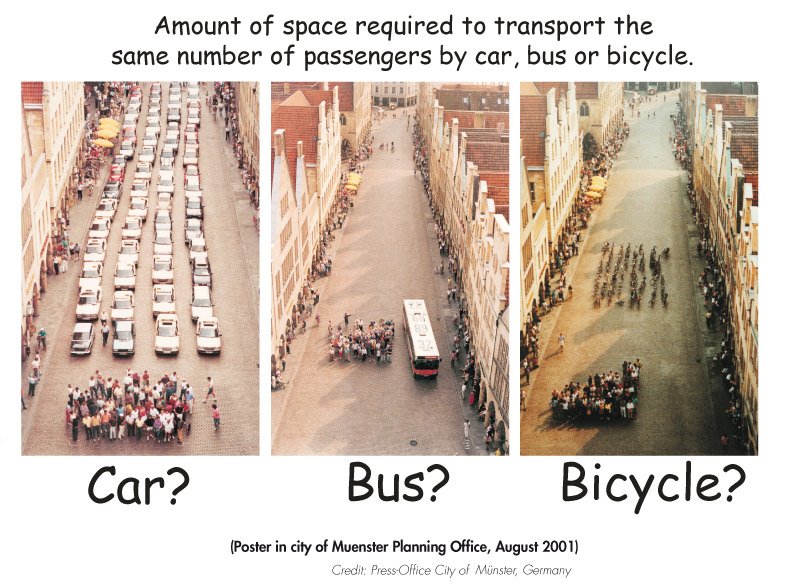
When the car began spreading in earnest in the 1920s, the total U.S. population was 106,021,537. In 1930 it was 122,775,046. Today it’s approximately 316,000,000. Moving to a highly car-dependent lifestyle made sense for a long time, but now a lot of urban areas are simply choked by them. This famous photo from the City of Muenster Planning Office succinctly demonstrates the problem, as does L.A. during rush hour:

Cities, buses, and bikes

Education is also part of the city puzzle, since it’s provided publicly and, usually, on a per-city basis. For much of the period from approximately 1970 – 2010, it was possible for parents to outrun well-meaning but poorly executed court degrees pertaining to school districting. It’s hard to measure the extent to which school busing and similar schemes drove many parents to the suburbs, even if they would’ve liked to stay in cities. This 2006 WSJ piece describes some of the pernicious consequences that are still reverberating in Seattle, which is a microcosm for the problems elsewhere. Schools and real estate both show the same basic principle: when principles meet self-interest, self-interest usually wins. Everyone favors low- and moderate-income housing in theory but don’t want it in their neighborhood, and everyone favors racial integration in theory unless their kid gets moved to the worse school.

Still, that’s tangential to Jacobs’s main points and how they affect contemporary decisions in cities. That I’m still citing Jacobs’ work more than 50 years later demonstrates its importance. To the extent any normal person has heard of anyone having anything to do with urban planning, they’ve heard of Jacobs and Moses. Pretty much anyone with any formal education in the subject has not only heard of them but read at least excerpts of their writing. It’s like being in English lit and wondering who this Shakespeare guy is.