Links: Sci-fi and the future, the future of clothing, the scientific paper, the disappearing doctor, and more!

* How science fiction feeds the fuel solutions of the future.

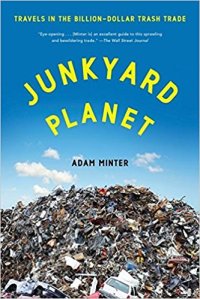
* The Future of Clothing Isn’t in Tatters. See also the book Junkyard Planet, which is amazingly good.

* “Belief in College Has Become Religious,” though not by me, unless exposure has made me the equivalent of an atheist.

* How the humble bicycle can save our cities. Oddly, it never mentions ebikes. Also, Electric bike purchases pulling people from private cars, finds NITC study. This should be obvious to anyone who’s ever ridden an electric bike. Propella makes a $1,000 ebike that looks pretty good.

* “The scientific paper is obsolete,” a much more thorough and interesting treatment than is implied by the title.

* Politics vs aesthetics: on James Wood. Wood is awesome and not everything has to be political everywhere, all the time. Aesthetics endure much better than politics.

* The Disappearing Doctor: How Mega-Mergers Are Changing the Business of Medical Care

* A New Study Shows How American Polarization Is Driven by a Team Sport Mentality, Not by Disagreement on Issues. Seems pretty obvious to me; just try asking people who are superficially political how the federal budget is divided up. Their answers are likely to be revealing. And, to use a Jonathan Haidt point, why should opinions on, say, abortion, be correlated with opinions on taxes? The two issues seem totally separate.

* “Why ‘The China Hustle’ is a finance documentary all U.S. investors need to see.” I can’t attest to the veracity of this one, but it at least seems plausible.

* Why bother observing inconsistencies?

Junkyard Planet — Adam Minter

I wish I’d read Junkyard Planet: Travels in the Billion-Dollar Trash Trade when it came out: it’s both informative and, sometimes, strangely lyrical, which I wasn’t expecting in a book about the scrap metal business. You may think a book titled “Junkyard Planet” is boring, and I anticipated precisely that and was proved wrong. For Minter the scrap business is tied up with his family: he grew up in in the industry, so, like a writer from a restaurant family, he gets things most journalists don’t, or wouldn’t (“Some of my earliest and happiest memories are of wandering among the family junk inventory, often with my grandmother, finding treasures:” a sentence few of us can utter).

He’s also refreshingly direct about costs and benefits; many writers want to condemn the global recycling trade because of the obvious pollution produced in China. But Minter goes the extra step and asks: why do things exist as they do? Will exist this way in the future?

This book aims to explain why the hidden world of globalized recycling and reclamation is the most logical (and greenest) endpoint in a long chain that begins with the harvest in your home recycling bin, or down at the local junkyard. There are few moral certainties here, but there is a guarantee: if what you toss into your recycling bin can be used in some way, the international scrap recycling business will manage to deliver it to the person or company who can do so most profitably.

It turns out that “Huge, mind-bending, Silicon Valley-scale fortunes have been built by figuring out how to move the scrap newspapers in your recycling bin to the country where they’re most in demand.” Did you know that? Me neither. I learned from every page. It also turns out that for a couple decades following World War II, most dead cars were simply discarded in vast junkyards or chucked wherever they could be concealed. It took China decades in turn to go through all that American scrap (“the world’s most recycled product (by weight) isn’t a newspaper, a notebook computer, or a plastic water bottle—it’s an American automobile, most of which is metal”).

By the way, there are many important reasons to choose electric or plug-in electric cars, but one of them is the car’s valuable battery. Even in a decade or two, when the battery is likely to be too depleted for automotive use, it’s still likely to be valuable as grid storage. Seriously: “
Why Used Electric Car Batteries Could Be Crucial To A Clean Energy Future
.” Individual choices today are going to matter a decade or two from now.

For now, though, there are two major ways to get raw materials for new goods:

Digging mines was one way to obtain those raw materials; the other was to go to the United States, the place that many scrap traders call the Saudi Arabia of Scrap, the land where there’s more scrap than the people can handle on their own. It’s a funny nickname, Saudi Arabia of Scrap, but it’s not meant as a compliment. Rather, it’s an opportunity to exploit.

Think about this quote, too, every time you hear about a “shortage” of some commodity (nickel, cobalt, poorly named “rare earth” metals). A “shortage” usually means that someone doesn’t want to buy at a given price. You’ll know there’s really a shortage of something when you can sell old laptops, phones, or computers to Best Buy for a couple bucks. Right now, it’s not profitably enough to pay for out-of-date electronics. If and when it is profitable enough, you’ll be able to sell them—and profit will likely motivate more than green signaling.

By the way, what China is doing now is what the U.S. did more than a century ago; in the nineteenth century,

The U.S. was not yet scrapping its old infrastructure, [. . .] so it looked abroad to Europe [. . .] for raw materials. According to data culled by Carl Zimring, U.S. imports of scrap iron and steel grew from 38,580 tons in 1884 to 380,744 tons in 1887—a tenfold increase during, not coincidentally, a railroad building binge.

There are many more points of interest in the book. The total amount of recycling going on is much greater than I imagined, but it’s primarily happening behind the scenes and far behind the headlines.

In some ways, Junkyard Planet tells a circular story: each developing country goes from poor and a tremendous importer of “junk” (which is not actually junk), then moves up the value chain towards wealth and producing more apparent junk than it consumes. The obvious question is, “When will the world run out of poor, developing countries?” One hopes the answer is, “Soon.”

Links: GMO research, the outrage machine, common fallacies, scientists and movies, and more!

* Why one scientist is quitting GMO research, since he’s exhausted by the relentlessly negative response. Yet it appears that GMOs are a net improvement by many metrics. We are trending towards ten billion people and need to feed them.

* “Why the Outrage?: Cambridge Analytica,” one of the very few intelligent pieces I’ve seen. In response to Internet outrage, I say: Facebook will change when people stop using it. The measurable response to outrage about Facebook since its inception has been near zero: more people use Facebook and use it longer, quarter after quarter. Look for revealed preferences. See also “Facebook is America’s scapegoat du jour.”

* Speaking of scapegoats and falsehoods, “Preventive care doesn’t save money and bankruptcies aren’t widely caused by lack of insurance. Which is not what many of us, including me, intuitively expect, but there you have it. So what is really going on?

* “‘Christianity as default is gone’: the rise of a non-Christian Europe.”

* The Last Conversation You’ll Ever Need to Have About Eating Right.

* “Why do so many scientists want to be filmmakers?” Is the inverse true too?

* “Ways To Live A Full Life (And Leave Nothing On The Table) By Age 30;” I’m not convinced by numbers 5, 10, 14, 26, 28, or 29, but that’s not too surprising in any list of 40 life-knowledge things.

* “Universities balk at the tyranny of anonymous feedback: Lecturers feel pilloried by student comments that show bias and can blight careers.” Old news, new wrapper. Still, many university types seem to like anonymous feedback (also known as gossip) in other domains.

* Things Russ Roberts learned from Jordan B. Peterson.

* “Scientists say we’re on the cusp of a carbon dioxide–recycling revolution.” Great news if true.

* “Is This the Hardest Course in the Humanities?” I’m not surprised that most humanities courses are suffering for enrollments.

* “On Harold Bloom’s new book on Shakespeare’s King Lear,” a much more interesting piece than the title may make you think.

What it’s like going to a Conversation with Tyler

I forgot to post this expeditiously, but I was at this conversation between Tyler Cowen and Matt Levine. You may listen to Conversations with Tyler, as I do, and wonder what they’re like live. I suspect they’re all different from each other, because some occur on university campuses, some are one-on-one, and this happened at what I think is Bloomberg News’s headquarters.

Some last-minute work things meant that I only arrived just before the start, but I did get a chance to chat before the chat, so to speak. Of the half dozen or so people I talked to, all were there for Matt, not Tyler, so they knew finance, and I often got that sense of turning off when they found out I wasn’t in the guild: there is no good business or networking opportunity here, so it’s time to move on—this isn’t a bad thing and in some circumstances I’ve done the same thing (“this isn’t what I’m here for, so let me keep looking”). But I was in “intellectual curiosity” mode more than “job networking” mode and in that mode I’m broader minded.

Almost everyone looked the same, but in a way hard to describe. If you’ve ever been to gatherings of consultants or finance people in New York (or similar places?), you’ll know what I mean: either light pastel colors or very dark clothes, lots of tucked-in dress shirts, a sense of restraint. It’s a little different, though, than similar gatherings in L.A., where people are not just more tan but more… glossy? Wearing short-sleeved shirts? The audience was almost all guys.

Bloomberg central feels like a combination of Deathstar and sleek Silicon Valley moguldom. I don’t think I’ve ever been in a better-designed space, but enough good design starts to feel oppressive. Security guys were all over the place, though not, I think, to protect the speakers. I think they’re just… there. Very visibly there.

During the talk itself, every time the word “risk” was mentioned, I thought of Nassim Taleb. How much do we really understand about derivatives and swaps? In my case very little, but even in the case of experts and “experts” I wonder if the answer is very much. I could be totally wrong, of course.

After the talk I had to leave quickly, alas, but maybe the crowd was less interest-seeky after a couple drinks.

If you get a chance to go, you totally should. Live events are good for many reasons, one being that they act as a reminder about why educational utopians who think online education is likely to upend live education may be wrong. The real world is very high resolution. I discovered that, when I listen to podcasts, I’m almost always moving, most often but not exclusively when I’m making dinner. It’s hard for me to sit still and purely listen for an entire hour, even to very engaging conversation. This is similar to my thinking about most modern classical music venues: they’re usually too hushed, too cerebral, too little audience movement, and too little beer.

Live audience events also do complex status transfers that I don’t entirely get, but they’re easy to feel in the moment. That’s obvious on some level but I very rarely see it stated as such.

Links: Book reviews, is learning unpleasant?, the decline of religion, the “Asian squat,” and more!

* “What’s the point of book reviews? The problem with literary criticism in the digital age.” I read reviews but write fewer than I once did.

* Contra to the link in this post, maybe there is a campus free speech crisis.

* And Then There Were Nones: How Millennials’ Flight From Religion is Transforming American Politics.

* “Why Can’t Everyone Do the ‘Asian Squat’?” I’ve been engaged in a multi-year odyssey in an attempt to be able to reliably, regularly perform weightlifting squats, and the attempt has been revealing. Being able to perform standard weightlifting squats seemed like it would be easy, but in actuality it’s been one of these activities that first appears to be as simple as walking across the street yet turns out to be a trek across the country.

* “Why Earth’s History Appears So Miraculous.” Scary, but also important. See also The Three-Body Problem.

* People are using old laptop batteries to build their own versions of Tesla’s Powerwall, which is very cool but also very dangerous. “Don’t do this at home” is actually great advice here.

* “American Adults Just Keep Getting Fatter.”

* “India Is Moving Towards Minoritarian Dystopia, One Community At A Time,” which may be most interesting for its implications outside of India.

* The World of Crime and Punishment,” which makes me want to read it. When I tried reading it when I was younger, Raskolnikov seemed too ridiculous, illogical, and just nuts. Now I have a lot more context for how common those conditions are.

* Is it the case that “The Democrats have become the party of sexual morality?” And other interesting observations about political parties and political history.

* “The Bitter Truth of Learning: it’s Tough, Unpleasant, and Often Pointless.” An underrated point. See also The Case Against Education.

The Three-Body Problem – Cixin Liu

Keep reading this book: the first three-quarters seem aimless, and I gave up. What’s at stake? Who gives a damn about this video game? (I also have an anti-video-game prejudice.) But enough people I admire recommended the book that I kept going, and I’m glad I did.

And after The Three-Body Problem, I read the next two which are in some ways structured similarly: somewhat meandering first halves followed by shocking reversals and revelations, culminating in a work of deep time that does not seem to break special or general relativity but does work with them.

The real terror here is not the many monsters of fairy tales, whether ancient or modern, but knowledge itself: “If even an extremely simple arrangement like the three-body system is unpredictable chaos, how can we have any faith in discovering the laws of a complicated universe?” Wang asks about two-thirds through the novel. I will not offer the answer, but I did read Martin Rees’s essay “Is There a Limit to Scientific Understanding?” just before re-starting The Three-Body Problem. One hopes there is no limit to scientific understanding, but that is a hope, not a guarantee.

In the “game” Wang plays in The Three-Body Problem, a civilization keeps being destroyed by perturbations in the orbit of three suns around a planet (hence the title). Each time he enters the world, he needs to observe or solve a problem in order for the civilization to advance—it’s a bit like the computer game Civilization or Age of Empires. Except this game seems to have unnerving, mysterious consequences in the real world.

Not much is explained, and it’s hard to identify the “missing” information pieces in the novel; The Three-Body Problem doesn’t seem to have rules, as other novels do. In a mystery novel, the implicit rules are there, and the killer is human, with human motives and values. He (usually a he, but not always) cannot destroy humanity itself. A mystery novel is like a war using conventional weapons. Unpleasant and miserable, perhaps, but unlikely to be existentially destructive. Nuclear weapons are different: they could be existentially destructive, and war with them is different. Some novels seem to have no internal rules and no guarantee that the good guys will win, or even that any guys will survive. These novels are existentially unsettling, and they tend to be classified as SF; Three-Body is one of them (Blindsight is another).

Initially the novel starts in China’s Cultural Revolution: “During those years, everyone had a special sensitivity for their own political situation. The sense was especially acute in Ye Wenjie. She felt the world around her closing in like a sack being drawn shut, and everything press in on her.” We may think the novel is about politics, and it often is, but science is its bedrock, for reasons I don’t want to elaborate here but that will become apparent over the trilogy’s course. The novel’s world depends on science, but also on the fear of contact with a more technologically advanced society. In Three-Body, Wang finds that “This civilization seems to have developed to a very advanced state.” The implication being, of course, that it may soon be destroyed.

Some spoilers follow. In later books, the possibility of civilization extinction is explored and occurs. The third book in the series, Dearth’s End, finds that one threat had, from humanity’s perspective, “lasted close to three centuries [. . .] yet what took its place was an even crueler universe.” People—in the broadest sense possible—who don’t struggle and win, die. There is no long-term respite from competition.

We don’t often see modern fiction imply this. A nonfiction book like Zero to One may, but most who read Zero to One aren’t seeking its darker depths. Perhaps we should go there.

If you read The Three-Body Problem, don’t give up halfway through, as I did. Often, when the book (and not just the first one) seems like it’s at best dully meandering, something shocking happens. That sense of complacency and direction shattered happens again and again, perhaps as a metaphor for life. I don’t fully understand the extensive metaphoric readings the books could be given, and that’s good news: they’re rich enough for re-readings and many readings, in a way many books aren’t. There are also many sub-genres of science fiction stashed in it, ranging from first contact to deep space exploration to the many-worlds theory.

Some things remain strangely absent—we don’t get AI centuries from now?—but they can be ignored because there’s so much on the page.

Does politics have to be everywhere, all the time? On Jordan B. Peterson

The Intellectual We Deserve: Jordan Peterson’s popularity is the sign of a deeply impoverished political and intellectual landscape” has been making the rounds for good reason: it’s an intellectually engaged, non-stupid takedown of Peterson. But while you should read it, you should also read it skeptically (or at least contextually). Take this:

A more important reason why Peterson is “misinterpreted” is that he is so consistently vague and vacillating that it’s impossible to tell what he is “actually saying.” People can have such angry arguments about Peterson, seeing him as everything from a fascist apologist to an Enlightenment liberal, because his vacuous words are a kind of Rorschach test onto which countless interpretations can be projected.

I hate to engage in “whataboutism,” but if you’re going to boot intellectuals who write nonsense, at least half of humanities professors are out—and maybe more. People can have long (and literally endless) arguments about what “literary theory” is “actually saying” because most of its content is itself vacuous enough to be “a kind of Rorschach test.” Peterson is responding in part to that kind of intellectual environment. An uncharitable reading may find that he produces vacuous nonsense in part because that sells.

A more charitable reading, however, may find that in human affairs, apparent opposites may be true, depending on context. There are sometimes obvious points from everyday life: it’s good to be kind, unless kindness becomes a weakness. Or is it good to be hard, not kind, because the world is a tough place? Many aphorisms contradict other aphorisms because human life is messy and often paradoxical. So people giving “life advice,” or whatever one may call it, tend to suffer the same problems.

You may notice that religious texts are wildly popular but not internally consistent. There seems to be something in the human psyche that responds to attractive stories more than consistency and verifiability.

More:

[Peterson] is popular partly because academia and the left have failed spectacularly at helping make the world intelligible to ordinary people, and giving them a clear and compelling political vision.

Makes sense to me. When much of academia has abrogated any effort to find meaning in the larger world or impart somewhat serious ideas about what it means to be and to exist in society, apart from particular political theories, we shouldn’t be surprised when someone eventually comes along and attracts followers from those adrift.

In other words, Robinson has a compelling theory about what makes Peterson popular, but he doesn’t have a compelling theory about how the humanities in academia might rejoin planet earth (thought he notes, correctly, that “the left and academia actually bear a decent share of blame [. . .] academics have been cloistered and unhelpful, and the left has failed to offer people a coherent political alternative”).

Too many academics on the left also see their mission as advocacy first and learner or impartial judge second. That creates a lot of unhappiness and alienation in classrooms and universities. We see problems with victimology that have only recently started being addressed. Peterson tells people not to be victims; identifying as a victim is often bad even for people who are genuine victims. There much more to be said about these issues, but they’ll have to be saved for some other essay—or browse around Heterodox Academy.

More:

Sociologist C. Wright Mills, in critically examining “grand theorists” in his field who used verbosity to cover for a lack of profundity, pointed out that people respond positively to this kind of writing because they see it as “a wondrous maze, fascinating precisely because of its often splendid lack of intelligibility.” But, Mills said, such writers are “so rigidly confined to such high levels of abstraction that the ‘typologies’ they make up—and the work they do to make them up—seem more often an arid game of Concepts than an effort to define systematically—which is to say, in a clear and orderly way, the problems at hand, and to guide our efforts to solve them.”

Try reading Jung. He’s “a wondrous maze” and often unintelligible—and certainly not falsifiable. Yet people like and respond to him, and he’s inspired many artists, in part because he’s saying things that may be true—or may be true in some circumstances. Again, literary theorists do something similar. Michel Foucault is particularly guilty of nonsense (why people love his History of Sexuality, which contains little history and virtually no citations, is beyond me). In grad school a professor assigned Luce Irigaray’s book Sexes and Genealogies, a book that makes both Foucault and Peterson seem lucid and specific by comparison.

Until Robinson’s essay I’d not heard of C. Wright Mills, but I wish I’d heard of him back in grad school; in that atmosphere, where many dumb ideas feel so important because the stakes are so low, he would’ve been revelatory. He may help explain what’s wrong in many corners of what’s supposed to be the world of ideas.

Oddly, the Twitter account Real Peer Review has done much of the work aggregating the worst offenders in published humanities nonsense (a long time ago I started collecting examples of nonsense in peer review but gave up because there was so much of it and pointing out nonsense seemed to have no effect on the larger world).

the Peterson way is not just futile because it’s pointless, it’s futile because ultimately, you can’t escape politics. Our lives are conditioned by economic and political systems, like it or not [. . .]

It’s true, I suppose, in some sense, that you can’t escape politics, but must all of life be about politics, everywhere, all the time? I hope not. One hears that “the personal is the political,” which is both irritating and wrong. Sometimes the personal is just personal. Or political dimensions may be present but very small and unimportant, like relativity acting on objects moving at classical speeds. The politicizing of everyday life may be part of what drives searching people towards Peterson.

Sometimes people want to live outside the often-dreary shadow of politics, but, some aspects of social media make that harder. I’ve observed to friends that, the more I see of someone on Facebook, the less I tend to like them (maybe the same is true of others who know me via Facebook). Maybe social media also means that the things that could be easily ignored in a face-to-face context, or just not known, get highlighted in an unfortunate and extremely visible way. Social media seems to heighten our mimetic instincts in not-good ways.

We seem to want to sort ourselves into political teams more readily than we used to, and we seem more likely to cut off relationships due to slights or beliefs that wouldn’t have been visible to us previously. In some sense we can’t escape politics, but many if not most of us feel that political is not our most defining characteristic.

I’m happy to read Peterson as a symptom and a response, but the important question then becomes, “To what? Of what?” There are a lot of possible answers, some of which Robinson engages—which is great! But most of Peterson’s critics don’t seem to want to engage the question, let alone the answer.

The rest of us are back to the war of art. Which has to first of all be good, rather than agreeing with whatever today’s social pieties may be.

Links: Political correctness, Twitter trolls, Wodehouse, Updike, and more!

* “Everything we think about the political correctness debate is wrong: Support for free speech is rising, and is higher among liberals and college graduates.” Good news overall, but it does still seem like there’s some tyranny of the minority going on.

* “How the baby boomers — not millennials — screwed America.”

* Who else will like marijuana legalization? Economists.

* “For Stormy Daniels, swatting away Twitter trolls is a work of art.” From the WaPo and thus likely SFW.

* “The Decline of ‘Big Soda:’ The drop in soda consumption represents the single largest change in the American diet in the last decade.” Great news!

* P.G. Wodehouse: Frivolous, Empty, and Perfectly Delightful.

* A long explanation by an Evangelical of why Evangelicals swing for Trump, despite the obvious ways he doesn’t fit their professed narrative(s). The intellectual and psychological contortions are… impressive. See also this interview with the author.

* Why bikes are booming in DC. If you build it they will ride.

* “A defense of big business.” Size is actually underrated, at least politically and in signaling terms.

* Person on Reddit offers theory about why men go to strip clubs; it’s all text and thus likely SFW. There is a poorly written book, G-Strings and Sympathy, also on this topic (books that cite Jean Baudrillard are likely to be bad). Nonetheless, it observes that attention in an almost therapeutic way is often on the menu as much or more than what one typically imagines is on the menu. If this topic interests you that is likely to be the right book.

* John Updike, remote and noble mentor.

* “The ‘Butter-Chicken Lady’ Who Made Indian Cooks Love the Instant Pot.” Making Indian food at home is underrated.

What happened to the academic novel?

In “The Joke’s Over: How academic satire died,” Andrew Kay asks: What happened to the academic novel? He proffers some excellent theories, including: “the precipitate decline of English departments, their tumble from being the academy’s House Lannister 25 years ago — a dignified dynasty — to its House Greyjoy, a frozen island outpost. [. . .] academic satires almost invariably took place in English departments.” That seems plausible, and it’s also of obvious importance that writers tend to inhabit English departments, not biology departments; novels are likely to come from novelists and people who study novels than they are from people who study DNA.

But Kay goes on to note that tenure-track jobs disappeared, which made making fun of academics less funny because their situation became serious. I don’t think that’s it, though: tenure-track jobs declined enormously in 1975, yet academic satires kept appearing regularly after that.

But:

When English declined, though, academic satire dwindled with it. Much of the clout that English departments had once enjoyed migrated to disciplines like engineering, computer science, and (that holiest of holies!) neuroscience. (Did we actually have a March for Science last April, or was that satire?) Poetry got bartered for TED talks, Words­worth and Auden for that new high priest of cultural wisdom, the cocksure white guy in bad jeans and a headset holding forth on “innovation” and “biotech.”

And I think this makes sense: much of what English departments began producing in the 1980s and 1990s is nonsense that almost no one takes seriously—even the people who produce it, and it’s hard to satirize total nonsense:

Most satire relies on hyperbole: The satirist holds a ludicrously distorted mirror up to reality, exaggerating the flaws of individuals and systems and so (ideally) shocking them into reform. But what happens when reality outpaces satire, or at least grows so outlandish that a would-be jester has to sprint just to keep up?

What English departments are doing is mostly unimportant, so larger cultural attention focuses on TED talks or edge.org or any number of other venues and disciplines. Debating economics is more interesting than debating deconstructionism (or whatever) because the outcome of the debate matters. In grad school I heard entirely too many people announce that there is no such as reality, then go off to lunch (which seemed a lot like reality to me, but I was a bit of a grad-school misfit).

A couple years ago I wrote “What happened with Deconstruction? And why is there so much bad writing in academia?“, which attempts to explain some of the ways that academia came to be infested by nonsense. Smart people today might gaze at what’s going on in English (and many other humanities) departments, laugh, and move on to more important issues—to the extent they bother gazing over at all. If the Lilliputians want to chase each other around with rhetorical sticks, let them; the rest of us have things to do.

Decades of producing academic satire have produced few if any changes. The problems Blue Angel and Straight Men identified remain and are if anything worse. No one in English departments has anything to lose, intellectually speaking; the sense of perspective departed a long time ago. At some point, would-be reformers wander off and deal with more interesting topics. English department members, meanwhile, can’t figure out why they can’t get more undergrads to major in English or more tenure-track hires. One could start by looking in the mirror, but it’s easier and more fun to blame outsiders than it is to look within.

Back when I was writing a dissertation on academic novels, a question kept creeping up on me, like a serial killer in a horror novel: “Who cares?” I couldn’t find a good answer to that question—at least, not one that most people in the academic humanities seemed to accept. It seems that I’m not alone. Over time, people vote with their feet, or, in this case, attention. If no one wants to pay attention to English departments, maybe that should tell us something.

Nah. What am I saying? It’s them, not us.

The Case Against Education — Bryan Caplan

The Case Against Education is a brilliant book that you should read, though you’ll probably reject its conclusions without really considering them. That’s because, as Caplan argues, most of us are prone to “Social Desirability Bias:” we want to say things that are popular and make people feel good, whether or not they’re true. Some true things may be socially desirable—but many false things may be too; the phrase “Don’t shoot the messenger” exists for a reason, as does the myth of Cassandra. We like to create scapegoats, and messengers are handy scapegoats. Simultaneously, we don’t like to take responsibility for our own ideas; and we like to collectively punish iconoclasts (at first, at least: later they may become idols, but first they must be castigated).

Caplan is an iconoclast but a data-driven one, and that’s part of what makes him unusual and special. And, to be sure, I myself am prone to the biases Caplan notes. Yet, as I read The Case Against Education, I couldn’t find many holes to poke in the argument. The book blends data and observation / anecdote well, and it also fits disturbingly well with my own teaching experiences. For example, Caplan notes that students find school boring and stultifying: “Despite teachers’ best efforts, most youths find high culture boring—and few change their minds in adulthood.” While “school is boring” seems obvious to most people, it’s also worth asking why. Many of the reasons Caplan gives are fine, but I’ll also add that “interesting” is often also “controversial,” and many controversial / interesting instructors will take heat, as I argue in “Ninety-five percent of people are fine — but it’s that last five percent:”

Almost no teacher gets in trouble for being boring, but a teacher can get in trouble or can get in trouble for being many values of “interesting.” Even I’ve had that problem, and I’m not sure I’m that interesting an instructor, and I teach college students.

It’s easy for outsiders to say that teachers should stand up to the vocal, unhappy minority. But it’s less easy to do that when a teacher relies on their job for rent and health insurance. It’s also less easy when the teacher worries about what administrators and principals will do and what could happen if the media gets involved or if the teacher gets demonized.

Despite the fact that no one actively wants school to be boring, the collection of forces operating on the school experience pushes it towards boredom. Many people, for example, are very interested in sex and drugs, but those topics also excite many students and parents, such that it’s difficult to say much that’s true about them in school.

As Caplan says, however, boredom is almost a feature, not a bug. Boring classes allow students to signal traits that employers value, like conscientiousness, intelligence, and conformity. Even if reading Ethan Frome is boring, being willing to tolerate Ethan Frome is important to people who would not themselves read Ethan Frome.

Caplan argues that most education is actually about signaling, not skill development. It’s notable how little we in as a society have improved education in the last two decades, when the Internet has opened up many new learning and signaling opportunities. Caplan has a theory about why: using weird counter-signaling efforts itself signals non-conformity and general weirdness (“‘alternative’ signals of conformity signal nonconformity”). So we’re stuck in a negative equilibrium.

He might be right. That said, I wonder if we’re just seeing a lag: twenty years is a long time by some standards, but in the history of education it’s a relatively short time. The problems with contemporary education also seem to argue that many employers would be well-served to ignore the signals sent by degree and search for alternate signals instead. Google claims to be doing this, but I don’t know of any researchers who’ve audited or studied Google’s internal data (if you do, please leave a pointer in the comments).

The people who most need to read this book are probably educators and high school students. The former probably won’t read it because it punctures some of the powerful myths and beliefs that keep them motivated. The latter probably won’t read it because high school students read very few books, and the ones most likely to read The Case Against Education are probably also likely to gain the most from higher education. So it’s another of these books that’s caught in a readerly catch-22.

Here is a Claudia Goldin paper, “The Race between Education and Technology: The Evolution of U.S. Educational Wage Differentials, 1890 to 2005;” as one person said on Twitter, “I agree with @bryan_caplan that the wage premium from education mainly comes from signaling, rather than learning vocational skills. But – I also believe widespread, generalist, higher ed can be a very good thing (as explained in [“The Race Between…”]).”

I also wonder about this: “employers throughout the economy defer to teachers’ opinions when they decide whom to interview, whom to hire, and how much to pay them.” Do they? Do most employers require transcripts and then actively use those transcripts? It seems that many do look for degrees but don’t look for grades.

One question, too, is why more people don’t go into various forms of consulting; smaller firms are less likely to be interested in credentials than larger ones. I do grant writing for nonprofits, public agencies, and some research-based businesses. Zero clients have asked about educational credentials (well, a few public agencies have superficial processes that ask about them, but the decision-makers don’t seem to care). Clients are much more interested in our experience and the skills demonstrated by our website and client list than they are in credentials. And when we’ve hired various people, like website programmers or graphic designers, we’ve never asked about education either, because we don’t care—we care if they can get the job done. In restaurants, I’ve never stopped a server or hostess to ask if the chef went to cooking school. So smaller firms may offer some respite from degree madness; if there is a market opportunity for avoiding expensive college and the credentials race (for individuals), it might be there.

Yet at the same time, I feel (perhaps wrongly) that school did help me become a better writer. “Feel” is a dangerous word—it’s hard to dispute feelings but easy to dispute data—yet I don’t know how else to describe it. When I read other people’s writing, especially other people’s proposals, I often think, “This helps explain why I have the job I do.” It’s possible to get through college and learn very little about writing. Occasionally managers will learn that I teach writing and say, “Why can’t college graduates write effectively?” An excellent question and one that requires 10,000 words of answer or no answer at all. But the alternative—not taking any writing classes—often seems worse.

Caplan also conducts many fascinating thought experiments, of sorts, although perhaps “contextualizes common practices and ideas” may be more accurate:

The human capital model doesn’t just imply all cheaters are wasting their time. It also implies all educators who try to prevent cheating are wasting their time. All exams might as well be take-home. No one needs to proctor tests or call time. No one needs to punish plagiarism—or Google random sentences to detect it. Learners get job skills and financial rewards. Fakers get poetic justice.

Signaling, in contrast, explains why cheating pays—and why schools are wise to combat it. In the signaling model, employers reward workers for the skills they think those workers possess. Cheating tricks employers into thinking you’re a better worker than you really are. The trick pays because unless everyone cheats all the time, students with better records are, on average, better workers.

Makes sense to me. I sometimes tell students that, if they manage to get through college without learning how to read and write effectively, no one comes back to ask me why. No college offers partial refunds to the unemployable who nonetheless graduate. The signal is the signal.

Many of you will not like The Case Against Education too because it is thorough. Caplan goes through his arguments, then many rebuttals, then rebuttals to the rebuttals. If you want a book that only goes one or two layers deep, this is the wrong book for you and you should stick to the Internet.

Many books also fail to convincingly answer the question, “What should we do about the problem identified?” Caplan doesn’t. He argues that public spending on education (or “education:” as much of what seems like education should be called signaling) should be eliminated altogether, while simultaneously acknowledging that this is only slightly more likely than someone jumping to the moon.

Caplan fulfills many of the conditions of myth, but probably not enough people will read this book to truly hate him. Which is a pity: as I said in the first line, the book is brilliant. But socially desirable persons will reject it, if they consider it at all. And the education machine will press on, a monstrous juice press squeezing every orange that enters its maw. Once I was the orange; now I am the press.

One other answer to “What education does?” may be “to keep options open” and “provide a base from which to build later.” Without some writing and numeracy skills, it’ll be hard to enter many careers; while school may do a lousy job of building them (as Caplan demonstrates), if the alternative to school nothing (i.e. Netflix, hanging out, and partying), school may be a better option than nothing.

As for optionality, I think of my friends, many artistically inclined, who got to their mid or late 20s and around that time got tired of working marginal jobs, struggling to pay rent, working in coffee shops, crashing on friends’ couches, etc. Things that seem glamorous at age 20 often seem depressing five or ten years later. Many of them have gone back to school of various kinds to get programming or healthcare jobs. In the former case, math is important, and in the latter case, biology and some other science knowledge is important. Those who blew off math or bio in high school or college struggle more in those occupations. So maybe education is about keeping at least some options open—or more options than would be open for someone who quits school or begins vocational ed in 8th grade.

Finally, education might be an elite phenomenon. We educate everyone, or, more realistically, attempt to educate everyone, in order to get a relatively small number of elite people into position to drive the entire culture forward. The people at the pinnacle of the scientific, technical, artistic, and social elites got there in part because they had access to education that was good enough to get them into the elite spheres where it’s possible to make a real difference.

I’m not sure I’m in those elite spheres, but I may be close, and at age 15 I probably didn’t look like such a good bet. Yet education continued and here I am, engaging in the kinds of conversations that could move the culture forward. If I’d been tracked differently at age 15 that might not’ve happened. Yes, the process is horrendously wasteful, but it’s useful to give many people a shot, even if most people go nowhere.

To be sure, I buy Caplan’s argument, but I’ve not seen this angle pursued by others, and it at least seems plausible. I also don’t know how one would measure the “education as elite phenomenon” argument, which is another weakness of my own point.

Still, I’ve become more of an elitist because of my involvement in the educational system, which shows that most students are in fact bored and don’t give a damn. When I started grad school I thought I could help students become more engaged by changing the nature of the short journal assignments: instead of just writing for me, students would start blogs that they would read and comment on. Education would become more peer-driven and collaborative. The material would seem relevant. Right?

After a semester or two of reactions that ranged from indifference at best to massive hostility at worst, I stopped and went back to the usual form of short written responses, printed, and handed in. That was easier on me and on the students, and it still at least exposed students to the idea of writing regularly. A few may have continued the practice. Most probably didn’t (and don’t). I learned a lot, maybe more than students, and I also learned that I’m a weirdo for my (extreme) interests in writing and language—but my own time in the education system and my own friend set had to some extent hidden that from me. Now, however, it’s so apparent that I wonder what 24-year-old me was thinking.

Caplan helps explain what I was thinking; many people who go into various kinds of teaching are probably optimists who themselves like school. They’re selected for being, in many cases, passionate weirdos. Personally, I like passionate weirdos and misfits and the people who don’t fit well into the school system (I’ve been all three). But I seem to be unusual in that respect too, though I wasn’t so weird that I couldn’t fit into the convention-making machine. A good thing, too—as Caplan notes, it’s individually rational to pursue educational credentials, even if the mass pursuit of those credentials may not be so good for society as a whole. Correlation is not causation, as you no doubt learned from your statistics classes and still understand today.

Here is a good critical review, not wholly convincing in my view, but worth thinking about.