Links: Short books, free thought, unfree devices, male contraception, Google’s politically correct monoculture, and more!

* “In praise of short books.” No argument here. I’d rather write, “In praise of books that are the right length for their material,” which may be short (Rapture is short) or long (Cryptonomicon is long).

* Math journal editors resign to start rival journal that will be free to read.

* “Apple and other tech companies are fighting to keep devices hard to repair.” It’s not hard to understand why.

* Ninni Holmqvist’s novel The Unit imagines a dystopia for the childless.

* “Why We Can’t Have the Male Pill: A condom alternative could be worth billions. What’s taking so long?”

* “Why I left Academia: Part I.” This is an impressively brazen and horrible story and maybe the worst I’ve heard. One of the (many) reasons not to go to grad school in the humanities is that a single person can so easily halt or retard your progress. That’s rarely if ever true in the rest of the working world.

* “Trump’s Fledgling Presidency Has Already Collapsed.” Seems overly optimistic to me.

* “Modern American elites have come to favour inconspicuous consumption.” Seems like conspicuous precision is an improvement on conspicuous consumption.

* Google promotes and enforces politically correct monoculture, although the headline is different. Or maybe no one comes out looking good. It’s disappointing to read so few sentences like, “I think it’s really important to discuss this topic scientifically, keeping an open mind and using informed skepticism when evaluating claims about evidence,” even if I’m not sure the evidence is as strong as claimed at the link.

Briefly noted: “The Little Hours,” the movie

The Little Hours is charming and I laughed; the trailer is worth watching because it gives the flavor of the movie without ruining the narrative or many of the jokes. The best moment of the trailer is a quote from the Catholic League, “It was trash. Pure trash.” I was ready to walk out if it was dumb (a good strategy for all movies) but instead was happy to stay and to leave refreshed. It’s hard to define what a “taut” movie is, but I know one when I see it, and this one is taut. Too many indie movies, as well as some studio movies) have 40 minutes of material in a 120-minute movie. This one has 90 minutes of material in a 90-minute movie, and if anything I wouldn’t have minded it being longer.

Transposing modern concerns, tone, and language into a medieval setting works for me but some of you may hate that. In some ways you can think of this as Monty Python but with a more forward sex plot and more female rivalry (too rarely depicted in film). I don’t know The Decameron well enough to get callbacks to it.

All the actors are just right.

Sounds weirdly like modern politics, no?

“When we feel like victims, all our actions and beliefs are legitimized, however questionable they may be. Our opponents or simply our neighbors, stop sharing common ground with us and become our enemies. We stop being aggressors and become defenders. The envy, greed, or resentment that motivates us becomes sanctified, because we tell ourselves we’re acting in self defense. . . . The first step for believing passionately is fear. Fear of losing our identity, our life, our status, or our beliefs.”

That’s a speech given by Andreas Corelli in The Angel’s Game (a great novel, and its English translation came out in 2009).

Oh, and he’s the devil. So we probably ought to be wary of what he says.

Reading such passages is a reminder of why politics in the post-literacy era may not be going so well. It would be hard for a high-literacy person—like most of the “founding fathers” were—to have made some of the recent political choices that voters have made.


Links: The boring sense of the “party,” reading, pigs, college, and more!

* “My Party Is in Denial About Donald Trump: We created him, and now we’re rationalizing him. When will it stop?” A fantastic question.

* Want Teenage Boys to Read? Easy. Give Them Books About Sex. By Lemony Snicket. Seems pretty obvious, no? See also my long-ago post, “Reading: Wheaties, marijuana, or boring? You decide.”

* “14 Years After Decriminalizing Drugs, Portugal’s Bold Risk Paid Off.” Except I’d call it an “obvious policy” rather than a “bold risk.”

* Tesla Model 3 first drive review. Or here is another variant, from The Verge instead of Motortrend. And: “Driving Tesla’s Model 3 changes everything.”

* 34 criminal cases tossed after body cam footage shows cop planting drugs.

* Pigs are smart and sensitive, yet we continue to justify killing them for food.

* “The Heretical Things Statistics Tell Us About Fiction.”

* “Colleges say they could lower tuition — if only they could talk to each other about it.” I’m not convinced this is true, but it is intersting, and certainly the current approach has not yielded good outcomes for many people. See e.g.:

On the other hand, said Scherer, “it’s just possible that collusion in tuition-setting could be reflected on the cost side by an above-average increase” in the price. “If you relaxed the pressure even more, where would it go? To a general reduction of tuition or to higher educational spending generally on the facilities and staff side? I, frankly, am skeptical.”

* U.S. Nuclear Comeback Stalls as Two Reactors Are Abandoned. Ill news.

* Have smartphone destroyed a generation? Yes, it’s almost pure clickbait, but isn’t it delicious clickbait? Maybe you’ll read the headline and first paragraph on your phone.

* Cars and generational shift.

Rapture — Susan Minot

I like Rapture but it’s not for everybody: it’s too focused on relationships, too explicit (though I would prefer the word “realistic,” many would disagree), too much about artistic educated urban people who want some things that are incommensurate with other things, too didn’t-Anna-Karenina-already-do-this?. It dissects the moment into a million little pieces, like Ian McEwan’s On Chesil Beach; we experience a succession of moments in a rush, and in writing we can slow them, reexamine them, reexperience them, or experience them from a new vantage.
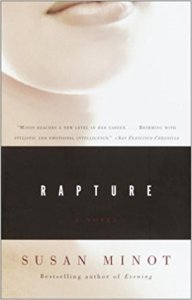
Still, to my mind it’s about three people who aren’t ready or able to leap towards the obvious relationship-structure conclusion, even if the wrapping around that core idea is Kay’s afternoon with Benjamin. The narrative perspective shifting from Kay to Benjamin and back. Their thoughts are not so dissimilar but retain dissimilar enough to retain interest. They think in similar ways, as perhaps people in similar milieus and with similar “wrong” desires might. Neither Benjamin nor Kay knows each other, like we all don’t really know anyone, and we get that from the first page:

He had no idea what had gotten her there.
He certainly wasn’t going to ask her about it. There was no way he was going wade into those dangerous waters and try to find out why she’d changed her mind…

Probably wise on his part. We also get a similar idea later on, midway through: “What did other people know about what really went on inside a person?” Some things are unknowable, and fiction likes to remind us of this.

A few pages into the novel, we switch to Kay’s perspective for the first time:

It was overwhelming, the feeling that this was pretty much the only thing that mattered, this being with him, this sweetness, this . . . communing . . . this . . . there was no good word for it.

(Ellipses in original.)

It raises questions: how much does “pretty much” elide here? And if this is “pretty much the only thing that mattered,” why do we spend so much time and energy doing other things, like building civilization? This is an analytic novel, so Kay doesn’t answer, but we might consider it as we read. I also don’t know what to do with later, similar thoughts, like “This was real, this was the most real thing.” Getting down to what is really real is tricky, and answers tend to vary based on the moment a person happens to be in. Are things that matter real? Are real things things that matter? I don’t know either.

Sometimes the vision is blank:

He shut his eyes. He saw the empty landscape. He knew he had to get out of bed and get going and soon, but he was mesmerized by this vision of emptiness. It was telling him something.

Maybe I like the novel because I’m working on one that uses somewhat similar narrative perspective on material that isn’t so different. We all fantasize about knowing what someone else is thinking, but only in fiction do we actually get to switch perspective to see. That fantasy is as potent as flying, and while we can fly via planes or rockets or other external apparatus, we never get to fly the way we do in our dreams.