Sugar in my Bowl: Real Women Write About Real Sex — Edited by Erica Jong

Sugar in my BowlI can’t really generalize about the pieces in Sugar in my Bowl other than to say that most have a quality of the forbidden about them. Michel Foucault famously argues in The History of Sexuality that we’ve always talked about sex and that the “regressive hypothesis,” which holds sex can’t be discussed, is wrong. But I think he’s wrong, or at least wrong regarding the United States: it’s still difficult for many people, especially women to speak and write of sex, which is why Erica Jong—the editor of Sugar in my Bowl—can cite what amounts to a version of the regressive hypothesis in her introduction. Maybe we’re now collectively allowed to express all kinds of sexual signs, but moving from physical expression of signs like the ones seen in movies and porn to intellectual analysis is or feels forbidden. What happens in the mind is so intimate relative to what you’ve got under your clothes. Anyone can shuck their clothes, and Victoria’s Secret has built a massive business on the promise that most of us will, but relatively few people have the ability to really express what’s happening in their minds. Susan Cheever writes that “A one-night stand is the erotic manifestation of carpe diem—only we are seizing the night instead of the day,” but one has to wonder: how many people have felt precisely that and never found the words to express it?

Without the words to express it, one can’t create the writing that will allow others to feel empathy. I don’t buy the school of thought that holds men and women can’t fundamentally understand each other, or that either sex is incapable of writing characters from the other effectively in fiction. People who want to learn what other people are thinking will find a way to do so, and, if they’re good, they’ll be able to reproduce what other people are thinking. There’s a cultural meme, for example, that women automatically “give up” sex to men who “take” it from women. While that no doubt describes many encounters, especially first encounters, it doesn’t describe all of them. Consider Anne Roiphe describing her first, or what I assume to be her first, time, after playing doctor with a boy as a child:

Years later when Jimmy and I were thirteen we were kissing in the dark at a party. We were sitting on a table in my classmates’ living room. Couples were curled up together in every corner of the floor, despite the fact that the carpet was rough and scratchy. Louis Armstrong was playing softly in the background. Abandoned in a corner was the Coke bottle that had begun it all. It was a game of spin the bottle that had brought Jimmy and I to the moment. ‘Do you remember,’ I said, ‘when we played doctor.’ ‘Yes,’ he said. ‘Do you have hair there now?’ he asked. ‘Yes,’ I said. ‘I really need to see it,’ he said. We found a closet. I showed him. He showed me his penis, larger, straight penis, full of some mysterious fluid.

This isn’t merely a my-first-time description (although it is that too), which litter memoirs and the Internet like discarded water bottles after a concert. It’s her way of delving into what’s nominally about the development of sex but really feels like the growth of an artist:

The thing about sex is that each act while different from the other even with the same person, even with the same person for forty years, is not a single act. It builds on the sex the night before, the year before, the decade before. Sex is a matter that unfolds like an accordion in the brain, the past is connected to the near past to the present and the future stands there waiting to be attached. So the feeling in the body, the feelings for someone else, the excitement of the new or the welcome of the familiar rises and falls, depends on memory, gains its depth from what happened at the beginning, a while ago, in the imagination, in reality.

You get older, you try things, you realize that, say, writing “is not a single act,” that it “builds on the [writing] the night before, the year before, the decade before.” Experience makes you good, and, although, there’s a sense that experience contrasts with innocence and is somehow bad, Roiphe doesn’t buy it. Neither do many of the writers in Sugar in my Bowl. They’re too heavily thinkers to buy the bullshit, and when thinkers break down their lives, they realize how much more valuable experience is than ignorance. It’s ignorance, and the celebration of it, that they’re really fighting, collectively, through writing, which is a powerful and impressive thing if you take the time to think about it. Maybe even more powerful than sex, which is their putative subject and the one that branches into so many other subjects; as so often happens, writers inevitably write about other things while they nominally write about one. Those “other” things can’t help being present to those who care to look. Susan Cheever writes, for example, “Sex feels like a series of shared secrets, a passage through a maze leading to the most wonderful feelings available to human beings.” But it’s so often hidden, and hidden deliberately, that one might ask why something wonderful must be “a passage through a maze,” unless seeking is part of the finding. Others want it to be religious, like Fay Weldon when she says:

I have been convinced not just of the significance and marvel of sex, but also of its sanctity, and its healing power, and the importance it plays in our lives, and how it is wrong to deny this. And if for a time thereafter, as I fled from bed to bed in search of love, I became a positive priestess of Aphrodite, it was not for long. I had a baby, as I was bound to, and steadied up. The psychoanalyst told me I suffered from low self-esteem, but my version is I was just born to like sex, and inherited the tendency from my father.

Notice the “sanctity,” the way she becomes a “priestess,” and the way she might not be in full control of her sexuality—she’s is “just born to like sex.” So if she did it, she did it, and so what?

There’s a wide and funny drift of self-knowing hypocrisy in these essays, many of which feel like the writer is talking to their younger selves, as when Ariel Levy says: “I smoked pot when I was twelve. I dropped acid when I was thirteen. Losing my virginity was the next logical step. It’s not like these things were necessarily fun. Well, the pot, actually, was great—unless you are reading this and you are twelve, in which case it was awful.” This reminds me of the first weekend I smoked pot, in high school (it wasn’t great: I don’t much care for the feeling, although I understand that many others do). The next week, a friend said she was going to the elementary school a block from my house to talk about D.A.R.E., which is a dumb and ineffective program. She invited me to go with her. Most importantly, this got me out of a couple classes. I went, spouted platitudes, felt like the world’s most terrible hypocrite. When we left, I told my friend about my experience with pot. She said, “I got wasted this weekend.”

So far as I know, we both turned out reasonably okay. So why not admit, unabashedly, “the pot, actually was great,” and leave the qualification out? I can imagine reasons, like the ones Megan McArdle pointed out:

In my experience, the big dividing line [between favoring drug legalization and not favoring it] is having kids. Read this interview with P.J. O’Rourke and discover some shocking things coming out of his mouth about how he doesn’t want his kids to do drugs. Having kids makes you realize how narrowly you escaped killing yourself–and remember all the friends who overdosed, or got arrested on a DUI, or spent their twenties working at a job that would let them smoke up three times a day, only to realize at age 35 that they had pushed themselves into a dead end. [. . ..]

in my experience, as the kids approach the teenage years, a lot of parents do suddenly realize they aren’t that interested in legal marijuana any more, and also, that totally unjust 21-year-old drinking age is probably a very good idea.

That’s not a good intellectual argument, but it is a very persuasive one that explains why we are where we are. (Does Levy have children, I wonder?) Still, Ariel’s line is funny precisely because of the discomfort she experiences at imagining a twelve year old wanting to follow in these particular footsteps.

I like Sugar in my Bowl more than it probably deserves, which may say more about my present preoccupations and less than its absolute merit. But, as I said above, while the anthology has the drawback of anthologies it also has the virtue: any piece that doesn’t resonate is only a few pages from being done and is easily skipped. And if you don’t care for reading a collection primarily about sex, you can also read it for what it says about history, relationships, politics, and writing. Jong thinks it’s also important because it equalizes an unlevel playing field some; she writes about

the fear some potential contributors had that they would not be taken seriously if they wrote for my anthology.

Anaïs Nin had made exactly the same argument in 1971 when I asked her why she allowed her diaries to be bowdlerized for publication: ‘Women who write about sex are never taken seriously as writers,’ she said.

‘But that’s why we must do it, Miss Nin,’ I countered.

And that is why we must do it. We must brave the literary double standard.

I can’t tell if she’s right, though she sounds the same note in the “Acknowledgments” section, where she writes that “Women who write about sex still get no respect—but we don’t give a damn!” Really? I don’t think I’d take someone less serious for writing about sex or not writing about it; Jong sounds certain that it’s true, however, and I wonder: who is giving the respect needed here? And, if someone is giving this respect, is it actually worth having? Isn’t an assumed position on the outside of some presumed literary establishment a necessary precondition for eventually getting in the literary establishment? The questions presume the answers, and, by creating this anthology, Jong does imply that 1) she can probably get more respect with it than without and 2) writing about sex is probably more literarily respectable now than it ever has been.

What Stephen King does and most writers should do:

Don’t be put off by the first sentence of this excerpt:

A serious engagement with a wide range of social and political issues forms the undercurrent of much of King’s work, but it is free of cant or dogma. His characters speak up, never lapsing into thumbsucking anomie. King himself, rather than picking at emotional scabs, taps directly into the underlying marrow, and, though there are notable exceptions, a consistent message resonates: ‘It really isn’t about your parents; it’s about you’re afraid.’ King’s balm is his generosity as a storyteller. ‘He’s got to be the most casually dismissed great storyteller we have,’ his friend the humorist Dave Barry believes. ‘What makes writing interesting is the story. Except for English majors and English teachers, most people like a story. And Steve just has the capacity to see a story everywhere and in everything.’

It’s from “What Are You Afraid Of? Terror is Stephen King’s medium, but it’s not the only reason he’s so popular—and so frightening” in The New Yorker, and although it’s hidden behind a paywall, if you’d like to read the whole thing, send me an e-mail and I’ll see what I can do.

I’d like to say something wise to extend the thoughts expressed above, but I don’t have any. You could take some lessons from this—avoid dogma, think about stories—but they’re ones most artists and would-be artists probably absorb over time.

Sexting and society: How do writers respond?

In a post on the relative quality of fiction and nonfiction, I mentioned that fiction should be affected by how society and social life changes. That doesn’t mean writers should read the news de jour and immediately copy plot points, but it does mean paying attention to what’s different in contemporary attitudes and expression. I got to thinking about “sexting,” an unfortunate but useful portmanteau, because it’s an example of a widespread, relatively fast cultural change enabled by technology. (Over a somewhat longer term, “From shame to game in one hundred years: An economic model of the rise in premarital sex and its de-stigmatisation” describes “a revolution in sexual behaviour,” which may explain why a lot of contemporary students find a lot of nineteenth century literature dealing with sexual mores to be tedious.)

Laws that cover sexting haven’t really caught up with what’s happening on the ground. Penelope Trunk wrote a an article called The Joys of Adult Sexting, in which she does it and thinks:

And what will his friends think of me? Probably nothing. Because they have women sending nude photos of themselves. It’s not that big a deal. You know how I know? Because the state of Vermont, (and other states as well) is trying to pass a law that decriminalizes sending nude photos of oneself if you are underage. That’s right: For years, even though kids were sending nude photos of themselves to someone they wanted to show it to, the act was illegal—an act of trafficking in child pornography.

But sending nude photos is so common today that lawmakers are forced to treat it as a mainstream courting ritual and legalize it for all ages.

Sending a naked photo of yourself is an emotionally intimate act because of the implied trust you have in the recipient. When you act in a trusting way—like trusting the recipient of the photo to handle it with care and respect—you benefit because being a generally trusting person is an emotionally sound thing to do; people who are trusting are better judges of character.

Trunk’s last paragraph explains why, despite all the PSAs and education and whatever in the world, people are going to keep doing it: because it shows trust, and we want significant others to prove their trust and we want to show significant others we trust them. You can already imagine the dialogue in a novel: “Why won’t you send me one? Don’t you trust me?” If the answer is yes, send them; if the answer is no, then why bother continuing to date? The test isn’t fair, of course, but since when are any tests in love and lust fair?

Over time, as enough kids of legislators and so forth get caught up in sexting scandals and as people who’ve lived with cell phone cameras grow up, I think we’ll see larger change. For now, the gap between laws / customs and reality make a fruitful space for novels, even those that don’t exploit present circumstances well, like Helen Shulman’s This Beautiful Life. Incorporating these kinds of social changes in literature is a challenge and will probably remain so; as I said above, that doesn’t mean novelists should automatically say, “Ah ha! Here’s today’s headlines; I’m going to write a novel based on the latest sex scandal/shark attack/celebrity bullshit,” but novelists need to be aware of what’s going on. I wrote a novel called Asking Alice that got lots of bites from agents but no representation, and the query letter started like this:

Maybe marriage would be like a tumor: something that grows on you with time. At least that’s what Steven Deutsch thinks as he fingers the ring in his pocket, trying to decide whether he should ask Alice Sherman to marry him. Steven is almost thirty, going on twenty, and the future still feels like something that happens to other people. Still, he knows Alice won’t simply agree to be his long-term girlfriend forever.

When Steven flies to Seattle for what should be a routine medical follow up, he brings Alice and hits on a plan: he’ll introduce her to his friends from home and poll them about whether, based on their immediate judgment, he should ask Alice. But the plan goes awry when old lovers resurface, along with the cancer Steven thought he’d beaten, and the simple scheme he hoped would solve his problem does everything but.

Asking Alice is asking questions about changes in dating and marriage; if you write a novel today about the agonies of deciding who to marry with the metaphysical angst such a choice engendered in the nineteenth century, most people would find that absurd and untrue: if you get married to a Casaubon, you divorce him and end up in about the same circumstance as you were six months before you started. But a lot of people still get married or want to get married, and the question is still important even if it can’t drive the plot of a novel very well. It can, however, provide a lot of humor, and that’s what Asking Alice does.

A lot of literature, like a lot of laws, is also based on the premise that women don’t like sex as much as men, don’t or won’t seek it out, and are automatically harmed by it or wanting it. This is a much more tenuous assertion than it used to be, especially as women write directly about sex. A novel liked Anita Shreve’s Testimony, discussed extensively by Caitlin Flanagan here and by me here, engages that idea and finds it somewhat wanting. So does the work of Belle de Jour (now revealed as Dr. Brooke Magnanti), who basically says, “I worked as a hooker for a long time, didn’t mind it, and made a shit ton of money because I made a rational economic decision.” A lot of academic fiction premised on professors having sex with students examines the idea that female students can want/use sex just as much as men; this is how Francine Prose’s Blue Angel works, and Prose is a canny observer of what’s going on and how it connects to the past.

Note that women wrote all these examples, which I don’t think is an accident, since they’re probably less likely to put other women on pedestals than men are. I’ve been reading a lot of sex memoirs / novels written by women (Never the Face; Nine and a Half Weeks; two of Mary Karr’s memoirs, which are good but overrated; Abby Lee (British sex blogger); Elisabeth Eaves’ Bare) in part because I want to write better female characters. After reading a lot of this stuff, I’m even less convinced than I was that there are stereotypically “male” or “female” ways of thinking or writing about the world, but knowledge itself never hurts and I don’t regret the time spent. On a similar note, Janice Radway’s Reading the Romance is totally fascinating, even when Radway tries to explain away retrograde features of romances or how women are often attracted to high-powered, high-status men.

She write in a time before sexting, but I wonder if she’s thought about doing a Young Adult version using similar methodology today. For writers and others, sexting shows that teenagers can make their own decisions as people too, even if those are arguably bad decisions. To me, this is another generational gap issue, and one that will probably close naturally over time. One older agent said on the phone that maybe I needed a younger agent, because her assistant loved Asking Alice but she didn’t want to rep it.

Damn.

I’m old enough to have lived through a couple medium-scale social changes: when I was in high school, people still mostly talked to each other on the phone. In college, people called using cell phones and often communicated via IM. After college, I kept using phones primarily for voice, especially to arrange drinks / quasi-dates, until I realized that most girls have no ability to talk on the phone anymore (as also described Philip Zimbardo and the ever-changing dynamics of sexual politics). As I result, I’d now use text messages if I were arranging drinks and so forth. Around the time I was 23, I realized that even if I did call, women would text back. That doesn’t mean one should race out and change every phone conversation in a novel that features a contemporary 19-year-old to a text conversation (which would be tedious in and of itself; in fiction I write, I tend not to quote texts very often), but it’s the kind of change that I register. Things changed between the time I was 16 and 23.

I’m in the McLuhan, “the medium changes what can be said,” which means that the text is probably changing things in ways not immediately obvious or evident. Sexting is one such way; it lowers the cost of transmission of nude pictures to the extent that you can now do so almost instantly. Laws are predicated on the idea that balding, cigar-chomping, lecherous 40-year-old men will try and coerce 16-year-old girls outside cheer practice, not ubiquitous cell phone cameras. Most parents will instinctively hate the cigar-chomping 40-year-old. They will not hate their own 14-year-old. So you get for all sorts of amusement where laws, putative morals, conventional wisdom, technology, and desire meet. Still, when pragmatics meet parents, expect parental anger / protectiveness to win for the moment but not for all time. Nineteenth and twentieth century American culture is not the only kind out there. As Melvin Konner wrote in The Evolution of Childhood:

Contrary to some claims of cultural historians, anthropologists find that liberal premarital sex mores are not new for a large proportion of the cultures of the ethnological record and that liberal sexual mores and even active sexual lives among adolescents do not necessarily produce pregnancies. In fact, a great many cultures permit or at least tolerate sex play in childhood (Frayser 1994). Children in these cultures do not play ‘doctor’ to satisfy their anatomical curiosity—they play ‘sex.’ They do play ‘house’ as Western children do, but the game often includes pretend-sex, including simulated intercourse. Most children in non-industrial cultures have opportunities to see and hear adult sex, and they mimic and often mock it.

Perhaps our modern aversion to sex among adolescents is in part because of the likelihood of pregnancy, economic factors, and others. Given the slow but real outcry from places like the Economist and elsewhere, this might eventually change. That’s pretty optimistic, however. A lot of social and legal structures merely work “good enough,” and the justice system is certainly one of those: we’ve all heard by now about cases where DNA evidence resulted in exoneration of people accused of murder or rape. So maybe we’re now heading towards a world in which laws about sexting are unfair, especially given current practice, but the laws remain anyway because the law doesn’t have to be optimal: it has to be good enough, and most people over 18 probably don’t care much about it unless it happens to be their son or daughter who gets enmeshed in a legal nightmare for behavior that doesn’t result in tangible harm.

Something like a quarter to a third of American adults have smoked pot, but we still have anti-pot laws. America can easily afford moral hypocrisy, at least for now, and maybe sexting will be something like weed: widely indulged in, a rite of passage, and something not likely to result in arrest unless you happen to be unlucky or in the wrong situation at the wrong time. The force generation the prohibition—that is, parents engaging in daughter-guarding—might be much stronger than the force of individual rights, utilitarianism, or pragmatic observations about the enforcement of laws against victimless crimes that do not result in physical harm.

There’s more of the legal challenges around this in Ars Technica’s article “14-year old child pornographers? Sexting lawsuits get serious,” which should replace “serious” with “ridiculous.” In the case, a 14-year-old girl sent a 14-year-old boy a video of herself masturbating, and then her family sued his. But how does a 14-year-old be guilty of the sexual exploitation of children,” as is claimed by the girl’s family—if a 14 year old can’t consent to consent to this kind of activity, then a 14-year old also can’t have the state of mind necessary to exploit another one. Paradoxes pile up, of the sort described in Regulating Sex: The Politics of Intimacy and Identity, where the writers show how the age of consent has been rising as the age of being tried as an adult has been falling. Somewhere inside that fact, or pair of facts, there’s a novel waiting to be written.

Questions like “What happens when people do things sexually that they’re not supposed to? How does the community respond? How do they respond?” are the stuff novelists feed on. They motivate innumerable plots, ranging from the beginnings of the English novel at Pamela and Clarissa all the way to the present. When Rose and Pinkie are first talking to each other in Brighton Rock, Rose lies about her age: ” ‘I’m seventeen,’ she said defiantly; there was a law which said a man couldn’t go with you before you were seventeen.” Brighton Rock was published in 1938. People have probably been evading age-of-consent laws for as long as there have been such laws, and they will probably continue to do so—whether those laws affect sex or depictions of the body.

Adults have probably been reinforcing prohibitions for as long as they’ve existed. Consider this quote, from the Caitlin Flanagan article about Testimony linked above:

Written by a bona fide grown-up (the author turned 63 last fall), Testimony gives us not just the lurid description of what a teen sex party looks like, but also an exploration of the ways that extremely casual sex can shape and even define an adolescent’s emotional life. One-night stands may be perfectly enjoyable exercises for two consenting adults, but teenagers aren’t adults; in many respects, they are closer to their childhoods than to the adult lives they will eventually lead. Their understanding of affection and friendship, and most of all their innocent belief, so carefully nurtured by parents and teachers, that the world rewards kindness and fairness, that there is always someone in authority to appeal to if you are being treated cruelly or not included in something—all of these forces are very much at play in their minds as they begin their sexual lives.

In Testimony, the sex party occurs at the fictional Avery Academy; Shreve imagines Siena, the girl at the center of the event, as a grifter, eager to exploit her new status as victim so that she can write a killer college essay about it, or perhaps even appear on Oprah. For the most part, the boys are callous and self-serving.

Flanagan has no evidence whatsoever that “teenagers aren’t adults” other than bald assertion. That “they are closer to their childhoods than to the adult lives they will eventually lead” has more to do with culture than with biology, as Robert Epstein argues in The Case Against Adolescence: Rediscovering the Adult in Every Teen and Alice Schlegel and Herbert Barry argue in Adolescence: An Anthropological Inquiry, and even then, it depends on when a particular person hits puberty, how they react, and how old they are; nineteen-year olds are probably closer to their adults selves than thirteen-year olds. Saying that teenagers believe, according to an ethos created by teachers, that “the world rewards kindness and fairness,” indicates that Flanagan must have had a very different school experience than I did or a lot of other people did (for more, see “Why Nerds are Unpopular.”) As I recall, school was capricious, arbitrary, and often stupid; the real world rewards fulfilling the desires of others, whether artistically, financially, sexually, or otherwise, while the school world rewards jumping through hopes and mindless conformity. If I don’t like the college I go to, I can transfer; if I don’t like my job, I can quit; if I don’t like some other milieu, I leave it. In contrast, school clumps everyone together based on an accident of geography.

In Testimony, Shreve misses or chooses not to emphasize that Sienna enjoys the attention, and she’s not actually got much beyond that. She says that “I”m going to start a new life. I can be, like, Sienna. I can whoever I want” {Shreve “Testimony”@27}. In Rob’s voice, Sienna is described this way:

I remember that Sienna started moving to the beat, a beer in her hand, as if she were in a world of her own, just slowly turning this way and that, and moving her hips to the music, and little by little the raucous laughter started to die down, and we were all just watching her. She was the music, she was the beat. Her whole little body had become this pure animal thing. She might have been dancing alone in her room. She didn’t look at any of us, even as she seemed to be looking at all of us. There was no smile on her face. If it was a performance, it was an incredible one. I don’t think anyone in the room had ever seen anything like it. She was in this light-blue halter top with these tight jeans. The heels and her little jacket were gone already. You just knew. Looking at her, you just knew.

She took off her own clothes, and “We watched as she untied her halter top at the neck. The blue cloth fell to reveal her breasts. They were beautiful and firm and rounded like her face. You knew at that moment you were in for good [. . .]” Later, he says “It was group seduction of the most powerful kind.” Given how Mike, the headmaster, describes the video in the first section, it’s hard to see Sienna as lacking agency, or someone who’s coerced into her actions. That, in the end, is what I think makes the Caitlin Flanagans of the world so unhappy: if the Siennas will perform their dances and give it up freely and happily, does that mean other girls will have to chase the market leader? Will they have to acknowledge that a reasonably large minority of girls like the action, like the hooking up, like the exploring? If so, a lot of Western narratives about femininity go away, if they haven’t already. If you’re a novelist, you have to look at the diversity of people out there and the diversity of their desires. Shreve does this quite well. So does Francine Prose in Blue Angel. If you’re writing essays / polemics, though, you can questionable claim that teenagers are closer to their childhood selves all you want.

I like Flanagan’s writing because she’s good at interrogating what’s going on out there, but I’m not the first to notice her problems with politics; William Deresiewicz is more concise than I am when he writes Two Girls, True and False, but the point is similar. Flanagan wants to imply that all people, or all girls, are the same. They aren’t. The ones unhappy with the hookup culture are certainly out there, and they might be the majority. But the Siennas are too. To deny them agency because they’re 14 is foolish. Matthew, J. Dot’s father, says that “The irony was that if a few kids had done something similar at the college, they’d be calling it an art film.” He’s right. Things don’t magically change at 18. Our culture and legal system are designed around the fiction that everything changes at 18, when it actually does much earlier. The gap between puberty and 18, however, is a fertile ground for novelists looking for cultural contradictions.

How to be a faster writer: Don't

There’s a Slate article making the rounds on “How to be a faster writer,” which has lots of good advice, including some that a lot of people don’t seem to appreciate (like: you don’t become a good writer over night; you grow into it, like any other cognitively challenging skill.) It’s also got some not-so-good advice:

The research verifies that taking notes makes writing easier­—as long as you don’t look at them while you are writing the draft! Doing so causes a writer to jump into reviewing/evaluating mode instead of getting on with the business of getting words on the screen.

If research, outline, and so forth are actually part of the writing process, I think they can be smoothly integrated with the art of writing itself (as I write this, the Slate article I’m responding to is on the right and the Textmate window on the left, letting me look back and forth).

When I was writing completely unpublishable novels, I didn’t use outlines, and I ended up with piles of words that utterly lacked narrative tension and the many good qualities that stem from narrative tension. Such piles of words didn’t have much point, which more astute readers observed. One told me to think about writing a novel in which something happens.

So I went through a three-novel phase during which I’d heavily outline, and I’d usually have the outline on one screen (or one side of the screen) and a main document on the other. This prevented me from getting “stuck” or from writing off into nowhereville without the structure of a scene. A lot of amateur writers have trouble with plot: they think their novels should resemble famous ones they’ve read in school, in which characters spend a lot of time talking about their feelings in a very deep way, or the sense of being lost, or the ennui imparted by the modern world. There’s nothing precisely wrong with this sort of writing, if done well, but most people seem to like reading (and writing) novels where something happens in a series scenes that build to a climax better. Sure, a lot of novels you’ve read in school don’t really do that for various reasons, some very good, but if you imitate them, you’ll often be doing yourself and your reader a disservice. If you’re unconsciously imitating the boring novels you’ve read in school, that’s even worse, because you don’t have enough command over your craft to know what you’re doing.

These days, I still make a bit of an outline, but I can do a lot of the outlining in my head—the last novel I finished, One Step Into the Labyrinth, really needed an outline because the plot was complex; about half a dozen literary agents have the full manuscript or a piece of it, so you may yet see it in bookstores near you. The novel I’m working on now isn’t as complex, and although I’m not using an outline, I’m still writing in scenes that build up to something. In essence, I’ve learned how to write in scenes without necessarily needing an external structure to guide those scenes and make sure they work towards a whole. I suspect this to be a sign of growth, and, I hope, not a malignant sign, like cancer.

My Dad doesn’t write proposals using outlines. He’s internalized virtually everything he needs to know about delivering human services. When I gave technical writing students a proposal writing assignment for the Department of Education’s Educational Opportunity Centers (EOC) Program, however, I knew I couldn’t expect them to write like my Dad did, because what’s appropriate for experts isn’t appropriate for amateurs. I couldn’t just give them an RFP and let ’em rip—I had to get them to think about how services should actually be delivered and real-world constraints; many had a charmingly strong vision of the power and competence of volunteers. Others wanted to hire 30 staff people on an RFP that offered a $230,000 / year grant. Virtually all had to be taught to read between the lines. My Dad—and these days, I—will do that automatically.

Slate says that, during writing

the writer’s brain is juggling three things: the actual text, what you plan to say next, and—most crucially—theories of how your imagined readership will interpret what’s being written. A highly skilled writer can simultaneously be a writer, editor, and audience.

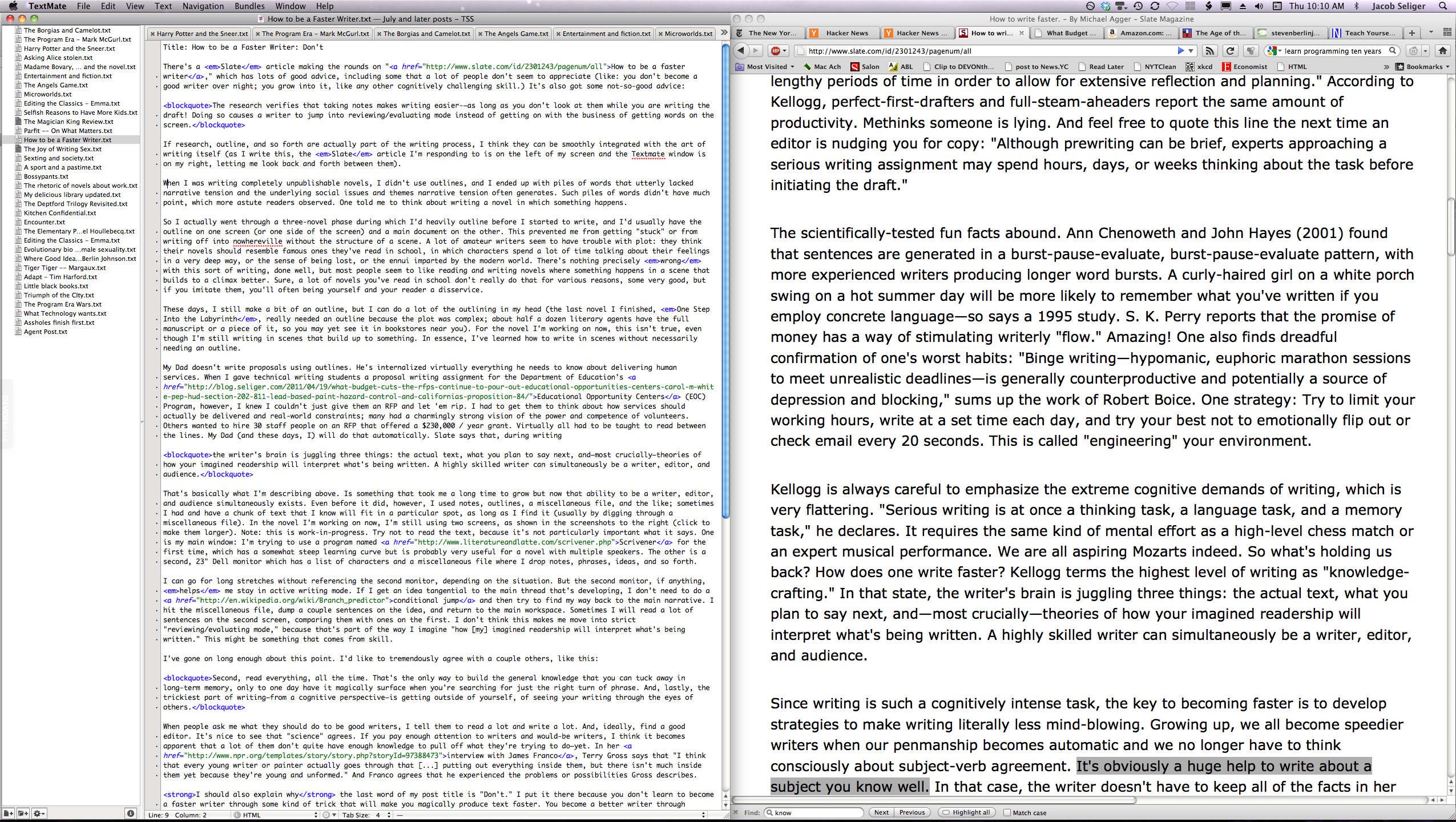
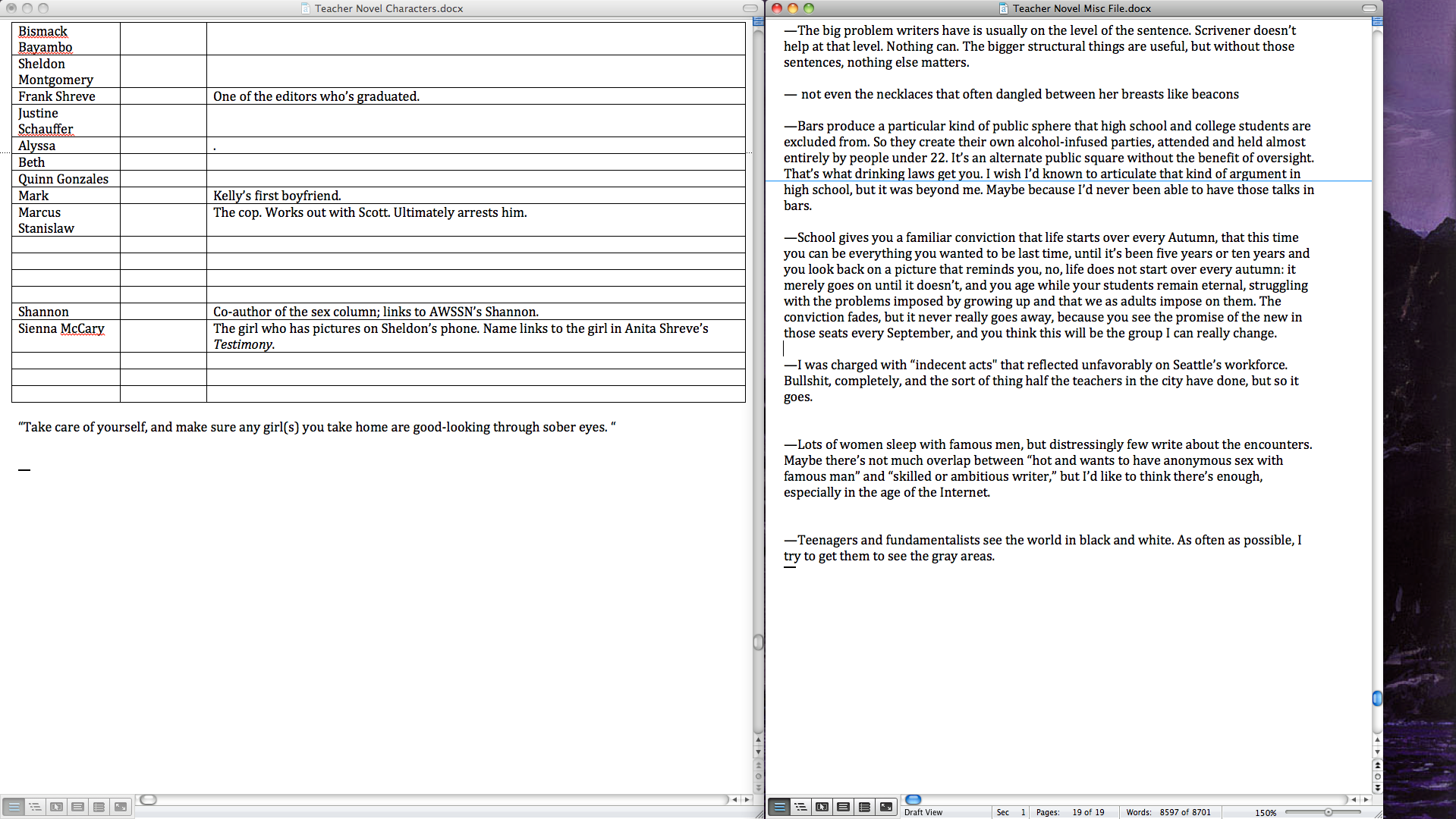
That’s basically what I’m describing above. Is something that took me a long time to grow but now that ability to be a writer, editor, and audience simultaneously exists. Even before it did, however, I used notes, outlines, a miscellaneous file, doodled; sometimes I had, and have, a chunk of text that I know will fit in a particular spot, as long as I find it, usually by digging through a miscellaneous file. In the novel I’m working on now, I’m still using two screens, as shown in the screenshots to the right (click to make them larger). Note: because this is work-in-progress, try not to read the text, because it’s not particularly important what it says and the conversation I was working on last night doesn’t make sense or have the same resonance out of context.

Anyway, as you can see, one screenshot shows my main window: I’m trying to use a program named Scrivener for the first time, which has a somewhat steep learning curve but is probably very useful for a novel with multiple speakers. The other is a second, 23″ Dell monitor which has a list of characters and a miscellaneous file where I drop notes, phrases, ideas, and so forth. I’m using Word at the moment, but I’ve used Mellel and all manner of other writing programs for this purpose. Nothing even remotely sophisticated is happening on those screens, so the word processor doesn’t matter much.

I can go for long stretches without referencing the second monitor, depending on the situation. But the second monitor, if anything, helps me stay in active writing mode. If I get an idea tangential to the main thread that’s developing, I don’t need to do a conditional jump and then try to find my way back to the main narrative. I hit the miscellaneous file, dump a couple sentences on the idea, and return to the main workspace. Sometimes I will read a lot of sentences on the second screen, comparing them with ones on the first. I don’t think this makes me move into strict “reviewing/evaluating mode,” because that’s part of the way I imagine “how [my] imagined readership will interpret what’s being written.” This might be something that comes from skill.

I’ve gone on long enough about a minor point of contention. I’d like to tremendously agree with some of the other points made in Slate, like this:

Second, read everything, all the time. That’s the only way to build the general knowledge that you can tuck away in long-term memory, only to one day have it magically surface when you’re searching for just the right turn of phrase. And, lastly, the trickiest part of writing—from a cognitive perspective—is getting outside of yourself, of seeing your writing through the eyes of others.

When people ask me what they should do to be good writers, I tell them to read a lot and write a lot. And, ideally, find a good editor. It’s nice to see that “science” agrees. If you pay enough attention to writers and would-be writers, I think it becomes apparent that a lot of them don’t quite have enough knowledge to pull off what they’re trying to do—yet. In her interview with James Franco, Terry Gross says that “I think that every young writer or painter actually goes through that […] putting out everything inside them, but there isn’t much inside them yet because they’re young and unformed.” And Franco agrees that he experienced the problems or possibilities Gross describes.

I should also explain why the last word of my post title is “Don’t.” I put it there because you don’t learn to become a faster writer through some kind of trick that will make you magically produce text faster. You become a better writer through experience and through reading. Those aren’t things you can do in a day or a week or a month. They’re things you do over years. The only way to start if you haven’t already is to start now, especially since the greatest value in writing isn’t always in writing for other people. I’ve been rereading Mihaly Csikszentmihalyi’s book Flow: The Psychology of Optimal Experience, which was even better the second time around than the first (probably because now I have the background knowledge to really grok it). He says:

[I]t is never a waste to write for intrinsic reasons. First of all, writing gives the mind a disciplined means of expression. It allows one to record events and experiences so that they can be easily recalled, and relived in the future. It is a way to analyze and understand experiences, a self-communication that brings order to them.

“A disciplined means of expression” is available to anyone, even someone with no readers. Csikszentmihalyi gets that writing isn’t just about writing: “If the only point to writing were to transmit information, then it would deserve to become obsolete. But the point of writing is to create information, not simply to pass it along. [. . .] It is the slow, organically growing process of thought involved in writing that lets the ideas emerge in the first place.” It’s about generating ideas that emerge through an attempt to express those ideas (Paul Graham says something similar in The Age of the Essay). Given that writing is about itself, we shouldn’t be as worried about how fast we’re writing; as demonstrated in Flow, when we’re really writing well we often won’t have a sense of time, because we’ll be in a moment-to-moment existence in which our task demands complete concentration and little else matters. Doesn’t that sound better than merely getting words on the page? It sure does to me.

By the way, you shouldn’t valorize writers and writing too much, because writing can have strange effects on the mind. In Michael Chabon’s Wonder Boys, Grady Tripp describes “the midnight disease” that writers suffer from,

[…] which started out as a simple feeling of disconnection from other people, an inability to ‘fit in’ by no means unique to writers, a sense of envy and of unbridgeable distance like that felt by someone tossing a restless pillow in a world full of sleepers. Very quickly, though, what happened with the midnight disease was that you began actually to crave this feeling of apartness, to cultivate and even flourish within it. You pushed yourself farther and farther and farther apart until one black day you woke to discover that you yourself had become the chief object of your hostile gaze.

And I don’t think this unique to writer: programmers, hackers, engineers, scientists, and others probably feel too: all the people who, like Gollum in The Lord of the Rings, still desire to walk free under the sun even as they are compelled to return to darkness and solitude. The solitude is what it takes to do the work: but for writers, they’re writing about people, which is odd that one needs to get away from people to describe people, but it’s nonetheless true for many of us.

By the way, most of those delicious quotes come from DevonThink Pro, but they’re still evidence that I’ve done a certain amount of reading and thinking about writing that enabled me to write this post over an hour or so (back to Slate: “It’s obviously a huge help to write about a subject you know well”). If I was 19 and writing this post, I simply wouldn’t have been able to write it. Not like this, anyway. If you look at the blog archives—I discourage you, but if you must, you must—and compare early posts to the posts I write these days, there simply is no comparison. That’s because I’ve learned how to write blog posts effectively, or somewhat effectively, anyway. I’m capable of doing things now that I simply couldn’t do then. Want to really write faster? You can teach yourself how in ten years.

"You can do other things between the fun bits, you know"

A friend and I have an arrangement to exchange whatever substantial work we’ve written each Friday. It’s like an MFA program, without the pretension. She missed a week, saying:

Nice weather and boys, extension required.

Having some knowledge of such situations (as long as you replace “boys” with “girls”), I replied:

In my experience, you can only spend so much time in the sun before you burn and so much time in bed before, well, you need to do something else in the interim. If that latter bit weren’t true, we probably wouldn’t have iPhones, civilization, and all the other things that make the modern world wonderful or horrible or both.

Yeah, Freud got there first, but so what?

“You can do other things between the fun bits, you know”

A friend and I have an arrangement to exchange whatever substantial work we’ve written each Friday. It’s like an MFA program, without the pretension. She missed a week, saying:

Nice weather and boys, extension required.

Having some knowledge of such situations (as long as you replace “boys” with “girls”), I replied:

In my experience, you can only spend so much time in the sun before you burn and so much time in bed before, well, you need to do something else in the interim. If that latter bit weren’t true, we probably wouldn’t have iPhones, civilization, and all the other things that make the modern world wonderful or horrible or both.

Yeah, Freud got there first, but so what?

Thoughts on Anita Shreve's Testimony and Tom Perrotta's Election

I recently read Tom Perrotta’s Election and Anita Shreve’s Testimony very closely because they’re similar to a novel I’m working on and relevant to an academic paper, which is a two-for-one deal. I like both novels, but reading Testimony a third time gave me some insight into how it functions; don’t keep reading if you fear spoilers:

1) Testimony is much looser than Election; I think Election is a better book for that reason. We get a better sense of character from it, and the motivations of each characters. I love the scene where Tammy is crying in front of the school counselor and says, “I’m in love,” but she loves her best friend, or former best friend, Lisa. The counselor says, “When you’re ready, you can tell me all about him.” Tammy thinks, “That’s when I realized how impossible it was, my whole life.” She’s right. That also gives motivation for everything else in the story, which looks inexplicable to everyone else. In Testimony, Silas and Rob in particular remain ciphers throughout the novel. That might be intentional.

2) There are more characters in Testimony; their voices are more different than the voices in Election, but too many of them are weak. Silas is or sounds like an idiot, although there’s an explanation in the sense that “he” wrote his sections in the cold, while he’s nuts with grief at his own behavior, and when he might be committing suicide because he can’t stand facing his family and Noelle. Noelle is little better as a character because she’s a little smarter. Sienna is like my dumber freshmen. Ellen, Rob’s mom, may be the most irritating: she speaks in the second person, and aside from her caring for Rob, she doesn’t have much of a function. I get the impression that she’s there to give conventional middle-class women someone to root for than because she moves the story along. Tammy and Paul’s mother does something similar in Election, but she has many fewer scenes.

3) Testimony has a much weaker sense of scene in general; the scenes it does have are much looser and less focused, as noted above. The abstract observations in Election are grounded in the immediate actions of the characters. The ones in Testimony sometimes aren’t. The Ellen character in particular has this problem. Still, some the lyrical sections in Testimony are quite nice.

4) Both novels have choppier timelines than I realized when I first read through them. Readers can probably follow more dodges and weaves than I fully realized previously, and they can handle moving backward and forward in time without explicit direction.

5) The teenage characters mentioned in point two show the danger of letting teenagers speak as teenagers; I’m fond of quoting Salon‘s review of “90210” and “Gossip Girl” on the subject: “Where Blair and Serena’s lines snap, crackle and pop with wit and cleverness, the soggy stars of “90210” stumble over one cliché after another. “Awkward!” Annie blurts at Ethan after they encounter Ethan’s ex Naomi, then Annie does her best impression of the cynical teenage eye roll, as Ethan mutters, “Good times!” Oof. [. . .] But every scene is filled with such teen-bot tripe.” That’s not true of Testimony, but the novel flirts with this problem. Mike anchors the story sufficiently that we don’t get lost among the inarticulate. Noelle is also more knowledgable than the others, and we’ve all met Siennas. The reason for Silas’s meanderings get explained at the end.

6) I’m impressed that Shreve kept the knowledge that only Mike, Anna, Owen, and Silas have from leaking into the other characters. Silas’s actions remain mysterious to us until we learn his mother is having an affair with Mike. The idea that this would cause him to get drunk and bang a hot 14-year-old girl stretches plausibility but doesn’t tear it.

7) The “professional” characters are very flat, and factual, like the reporter, Colm, and the lawyer; these are supposed to provide a counterpoint to the highly emotionally charged scenes from the teenagers, who aren’t articulate and don’t know what’s happening to them. Except for Noelle, who is looking back, and J. Dot, who is aloof, an asshole, and perhaps right.

8) There are only really two major events in the novel: the making of the tape and the Mike / Anna romance. Virtually everything else is lead up, reaction to, or speculation regarding those two things. Contrast that with Election’s romances: there’s Tracy-Jack. Paul-Lisa. Tammy-Lisa, and Tammy’s crush on Dana. There are other events: Mr. M encourages Paul to run. The Warren family constellation, with its tensions. Tracy’s desire to be president, or be something, with President being a reasonable proxy. The election itself ensures that the novel is about more than just who’s with who. There’s a lot more narrative and less “This is how I feel.” It’s also shorter novel. The longer book doesn’t have quite enough narrative to sustain it. There are a number of places where I say things like, “This chapter is fairly useless.” That’s for a reason.

9) The entries / chapters for Testimony are much longer than the ones for Election because each chapter is much, much longer. I don’t think a greater or smaller number of chapters is inherently better, but in this case I think the game goes to Perrotta; Election has 100 “chapters” or unique voices who speak, while Testimony has 53.

10) Looking over this, I’m too harsh on Testimony. It’s still a very finely written book. I read very few books twice, let alone more than twice, let alone think about them consciously as models for a novel or worth writing an academic article about.

Thoughts on Anita Shreve’s Testimony and Tom Perrotta’s Election

I recently read Tom Perrotta’s Election and Anita Shreve’s Testimony very closely because they’re similar to a novel I’m working on and relevant to an academic paper, which is a two-for-one deal. I like both novels, but reading Testimony a third time gave me some insight into how it functions; don’t keep reading if you fear spoilers:

1) Testimony is much looser than Election; I think Election is a better book for that reason. We get a better sense of character from it, and the motivations of each characters. I love the scene where Tammy is crying in front of the school counselor and says, “I’m in love,” but she loves her best friend, or former best friend, Lisa. The counselor says, “When you’re ready, you can tell me all about him.” Tammy thinks, “That’s when I realized how impossible it was, my whole life.” She’s right. That also gives motivation for everything else in the story, which looks inexplicable to everyone else. In Testimony, Silas and Rob in particular remain ciphers throughout the novel. That might be intentional.

2) There are more characters in Testimony; their voices are more different than the voices in Election, but too many of them are weak. Silas is or sounds like an idiot, although there’s an explanation in the sense that “he” wrote his sections in the cold, while he’s nuts with grief at his own behavior, and when he might be committing suicide because he can’t stand facing his family and Noelle. Noelle is little better as a character because she’s a little smarter. Sienna is like my dumber freshmen. Ellen, Rob’s mom, may be the most irritating: she speaks in the second person, and aside from her caring for Rob, she doesn’t have much of a function. I get the impression that she’s there to give conventional middle-class women someone to root for than because she moves the story along. Tammy and Paul’s mother does something similar in Election, but she has many fewer scenes.

3) Testimony has a much weaker sense of scene in general; the scenes it does have are much looser and less focused, as noted above. The abstract observations in Election are grounded in the immediate actions of the characters. The ones in Testimony sometimes aren’t. The Ellen character in particular has this problem. Still, some the lyrical sections in Testimony are quite nice.

4) Both novels have choppier timelines than I realized when I first read through them. Readers can probably follow more dodges and weaves than I fully realized previously, and they can handle moving backward and forward in time without explicit direction.

5) The teenage characters mentioned in point two show the danger of letting teenagers speak as teenagers; I’m fond of quoting Salon‘s review of “90210” and “Gossip Girl” on the subject: “Where Blair and Serena’s lines snap, crackle and pop with wit and cleverness, the soggy stars of “90210” stumble over one cliché after another. “Awkward!” Annie blurts at Ethan after they encounter Ethan’s ex Naomi, then Annie does her best impression of the cynical teenage eye roll, as Ethan mutters, “Good times!” Oof. [. . .] But every scene is filled with such teen-bot tripe.” That’s not true of Testimony, but the novel flirts with this problem. Mike anchors the story sufficiently that we don’t get lost among the inarticulate. Noelle is also more knowledgable than the others, and we’ve all met Siennas. The reason for Silas’s meanderings get explained at the end.

6) I’m impressed that Shreve kept the knowledge that only Mike, Anna, Owen, and Silas have from leaking into the other characters. Silas’s actions remain mysterious to us until we learn his mother is having an affair with Mike. The idea that this would cause him to get drunk and bang a hot 14-year-old girl stretches plausibility but doesn’t tear it.

7) The “professional” characters are very flat, and factual, like the reporter, Colm, and the lawyer; these are supposed to provide a counterpoint to the highly emotionally charged scenes from the teenagers, who aren’t articulate and don’t know what’s happening to them. Except for Noelle, who is looking back, and J. Dot, who is aloof, an asshole, and perhaps right.

8) There are only really two major events in the novel: the making of the tape and the Mike / Anna romance. Virtually everything else is lead up, reaction to, or speculation regarding those two things. Contrast that with Election’s romances: there’s Tracy-Jack. Paul-Lisa. Tammy-Lisa, and Tammy’s crush on Dana. There are other events: Mr. M encourages Paul to run. The Warren family constellation, with its tensions. Tracy’s desire to be president, or be something, with President being a reasonable proxy. The election itself ensures that the novel is about more than just who’s with who. There’s a lot more narrative and less “This is how I feel.” It’s also shorter novel. The longer book doesn’t have quite enough narrative to sustain it. There are a number of places where I say things like, “This chapter is fairly useless.” That’s for a reason.

9) The entries / chapters for Testimony are much longer than the ones for Election because each chapter is much, much longer. I don’t think a greater or smaller number of chapters is inherently better, but in this case I think the game goes to Perrotta; Election has 100 “chapters” or unique voices who speak, while Testimony has 53.

10) Looking over this, I’m too harsh on Testimony. It’s still a very finely written book. I read very few books twice, let alone more than twice, let alone think about them consciously as models for a novel or worth writing an academic article about.

Why don't novels with love stories describe how characters come to like each other?

I was talking to a friend about Anita Shreve’s Testimony, which has a bunch of characters who fall in love or lust with one another, including the four whose taped orgy unleashes emergent destructive forces on everyone around them. Or, rather, the reaction to the video unleashes those forces; the video itself is harmless save for how others treat it. The important thing for this post, however, is how those moments of love or lust are depicted. The short version is that they aren’t. In one sentence, characters are going about their business; in another, they are noticing one another in a potentially erotic way; many sentences later, they’re in bed with each other. But the moments when real interest develops are never really portrayed, save maybe through action or sudden thought. It’s like trying to describe the moment when an idea hits: we can resort to metaphor, but we can’t truly describe what it’s like to be in a state of flow.

My best guess to the question posed by the title is that in real life very few people decide they like or love each other. It just. . . happens, like an idea. You might see manifestations of it; in Testimony, the relationship between Mike and Anna really starts with the touch of a hand. The one between Silas and Noelle begins with them spending more time together. The attractive is partly physical and partly something else. The “something else” interests me.

I wouldn’t be surprised if, in evolutionary terms, we’re not even supposed to understand or analyze our feelings; they’re just supposed to guide us to survival and reproduction. Based on the large number of studies cited in The Evolutionary Biology of Human Female Sexuality and elsewhere that show how much we understand subconsciously, this probably shouldn’t surprise us. But it does, especially in the context of stories, since so many of them have or should have reasons behind the characters’ action in them. When we push those reasons, however, we begin to see that they’re not so firm as we might once have imagined. I’d like to know about the limits of stories and how they reflect the way people act because sussing the limits helps us figure out how, if at all, we can or should transcend them.

Why don’t novels with love stories describe how characters come to like each other?

I was talking to a friend about Anita Shreve’s Testimony, which has a bunch of characters who fall in love or lust with one another, including the four whose taped orgy unleashes emergent destructive forces on everyone around them. Or, rather, the reaction to the video unleashes those forces; the video itself is harmless save for how others treat it. The important thing for this post, however, is how those moments of love or lust are depicted. The short version is that they aren’t. In one sentence, characters are going about their business; in another, they are noticing one another in a potentially erotic way; many sentences later, they’re in bed with each other. But the moments when real interest develops are never really portrayed, save maybe through action or sudden thought. It’s like trying to describe the moment when an idea hits: we can resort to metaphor, but we can’t truly describe what it’s like to be in a state of flow.

My best guess to the question posed by the title is that in real life very few people decide they like or love each other. It just. . . happens, like an idea. You might see manifestations of it; in Testimony, the relationship between Mike and Anna really starts with the touch of a hand. The one between Silas and Noelle begins with them spending more time together. The attractive is partly physical and partly something else. The “something else” interests me.

I wouldn’t be surprised if, in evolutionary terms, we’re not even supposed to understand or analyze our feelings; they’re just supposed to guide us to survival and reproduction. Based on the large number of studies cited in The Evolutionary Biology of Human Female Sexuality and elsewhere that show how much we understand subconsciously, this probably shouldn’t surprise us. But it does, especially in the context of stories, since so many of them have or should have reasons behind the characters’ action in them. When we push those reasons, however, we begin to see that they’re not so firm as we might once have imagined. I’d like to know about the limits of stories and how they reflect the way people act because sussing the limits helps us figure out how, if at all, we can or should transcend them.