The past is no fun and self-publishing is the worst: Ted Heller and solipsism

Those of you who are thinking about publishing your own books or already have—and I know you’re out there—should read Ted Heller’s “The future is no fun: Self-publishing is the worst” for a couple reasons, the most important being that it highlights the way self-publishing is probably not a path to fame and fortune for most of us. But Heller should also highlight that, for most of us, conventional publishing wasn’t a path to fame and fortune either.

He writes that he conventionally published three books between 2001 and 2011, then found that he couldn’t get a publisher for his fourth, West of Babylon. If he’d begun publishing in 1991 and had the same experience in 2001, that would’ve been it: self-publishing didn’t exist in a practical form, and now it does, which means his book at least has a chance.

It’s also clear that Heller is doing it wrong. He writes about sending review copies to newspapers and magazines (“I do everything I possibly can in about four or five paragraphs to inspire interest in whomever the email is sent to”), but that’s like me wanting to become a gigolo for female clients: the world just doesn’t work that way. Me wanting the world to work that way isn’t going to make the world work that way either. Newspapers and magazines barely review conventionally published books any more, and self-published books are explicitly forbidden by most of them; to the extent newspapers and magazines write about such books, it’s after they’ve become best-sellers (like 50 Shades of Grey).

Heller appears to have few personal connections with anyone at newspapers or magazines (“When I finally found contact information for someone at the show I’d been on, they did email me back [. . .] to politely tell me that they would not be having me back onto their show”), which means he’s wasting his time by sending out random P.R. e-mails. I know this. Why doesn’t he?

Heller doesn’t have a blog, as far as I can tell. He doesn’t say that he scraped the e-mails of everyone he’s ever corresponded with and sent a quick e-mail blast about his book. He apparently hasn’t been collecting the e-mail addresses of his readers. The price for West of Babylon —$8—is too high. It should be $3 – $5. The book sounds at best mildly appealing. Though the topic–has-been, 60-year-old rockers—makes me want to look elsewhere, it could be pulled off. Still, based on the description, I wonder: what’s at stake? Do I care about whether these guys can “pull the tour off?”

The Salon piece also makes Heller sounds like. . . I’m look for a euphemism but none come to mind. . . an asshole:

If there is one positive thing about this self-publishing business it is this: You separate the wheat from the chaff among your friends and acquaintances. Who is willing to lend a hand and who cannot wait to abandon you? Who will nudge someone they know and get your book to them and who just won’t even acknowledge your desperation or is laughing at you behind your back? Some people have been remarkable, others’ names are now forever etched onto my Eternal Personal Shit List.

Look, if your friend doesn’t like your book, it doesn’t mean shit, other than that your friend doesn’t like your book. I’m neutral towards 60% of the books I read, actively dislike 30%, and find 10% magical. Playing the straight odds, when a friend publishes a book, there’s a 90% shot that I’ll be neutral towards or dislike their book. The probability of me liking their book is probably lower, because the vast majority of books I read are books I choose.

When I start self-publishing, I doubt all my friends will like what I write. Which is okay. Having cancer and seeing who supports you and who doesn’t separates “the wheat from the chaff among your friends and acquaintances.” Publishing a book that you friends don’t love is hardly a reason to be “forever etched onto my Eternal Personal Shit List.”

Let’s examine the upside for a moment. Heller has a real chance to get his book in front of readers, which he wouldn’t have had ten years ago. He’s playing a game with low odds of success. Thousands of other writers, and maybe hundreds of thousands, are in the same game. But he’s living in a time when it’s possible to get in the game, and that itself is still something to celebrate.

EDIT: I should add that, based on what I’ve read, most writers at most major publishing houses get very little real marketing / PR help. The ones who do are the lucky exceptions. Throwing a stone into the ocean of literature and having it sink to the bottom is normal. Throwing a stone into the ocean of literature and having it turn into a cruise ship is not.

Links: Critics and novelists, ethernet, dissertations, fashion, writing, porn data, and more

* “There comes a moment in the life of every literary critic when they need to give up and admit they’re never going to be a novelist. [ . . .] I don’t, in short, have a novelist’s soul.” Though I disagree with this: “Novelists appear to dwell most deeply in their childhoods.”

* “Ethernet at 40: [Bob Metcalfe, Ethernet’s inventor] reveals its turbulent youth.” Ethernet is still, even when wireless is a viable alternative. In some circumstances running a cheap ethernet cable from a router to a desk, couch, or other work station can still be a real win, especially given how even very long ethernet cables from Monoprice.com only cost a couple of dollars. Ethernet cables last forever, aren’t subject to the level of interference wireless is, and, in many conditions, have faster data transfer speeds than wireless.

* Essays in Biography.

* “The Dissertation Can No Longer Be Defended,” which makes points that should be obvious to damn near everybody involved in the humanities section of academia.

* Three views of consumption and the slow economy.

* Riding Around Paris With Olivier Zahm, Fashion’s Most Libidinal Editor.

* “A warning to college profs from a high school teacher,” which is actually about the stakes of student testing.

* New York Times “journalist” John Broder lies in Tesla motors review, gets called out for it.

* “Deep Inside: A Study of 10,000 Porn Stars;” highly data-driven and should be safe for work.

* New York real estate: a study in price escalation.

* Megan McArdle: “How to Make the Most of Your Higher Education.” The bit about not majoring in English, and not getting a PhD in it, resonates, especially as someone who did the one and is doing the other.

If you have a “passion for writing” and never do it, you don’t have a passion for writing

I signed up for writing-related Meetup.com notifications, and one said this:

Do you have a passion for writing but find it hard to carve out time to engage in the practice of it? It can be hard to find a local writing group convenient for your schedule. If you love to write and would like to be surrounded by others who motivate you, this is the place for you

If “you have a passion for writing,” you don’t need other people around you, any more than if you have a passion for masturbation you need a group wank. You just do it, and masturbation might arguably be the world’s most common leisure activity (among the young at the very least).

IMG_1269For 99% of people, if you “find it hard to carve out time to engage in the practice of [writing],” the solution is simple: redirect time spent on TV and Facebook to writing. If I recall correctly, William Gibson said that he doesn’t write all the time; he’s merely reallocated the time most people spend watching TV to writing. I’m not arguing that would-be writers should never watch TV, but I am arguing that needing extrinsic motivation is, in most circumstances, inferior to having intrinsic motivation.

People also may underestimate how much can be done in small blocks of time. This post, for example, has only taken me a couple of minutes. I haven’t been posting much because I’ve been self-editing a novel and writing proposals. Blogging gets crowded out by those activities. Yet it’s still possible for me to write a short post that says something substantive in about 15 minutes. Cory Doctorow has said in various places that he writes 250 words of fiction every day. A “typical” novel is about 80,000 – 90,000 words. At 250 words per day, you can write a novel in 320 days.

If you have a “passion” for writing, you can express it every day, just like many of you love yourselves every day. You don’t need a group to do it. The need for a group is identical to the need for excuses.

I’m not opposed to writers’ groups in all shapes and forms, and the right group at the right time could in principle provide valuable feedback for the right person (and the right person could give valuable feedback to others). But the raw work should be done alone, and the door opened to others when that work is done.

Links: Sex at Yale, bikes, writing, TV, margins, urban life, editing, and more

* Where are the Bicycles in Post-Apocalyptic Fiction?

* Sex in the Meritocracy: Performance anxiety, not hedonism, motivates Yale’s sexual culture.

_MG_8659* In Writing, First Do No Harm.

* A model of TV viewership:

For TV I do not think upfront bingeing can become the norm. The model of “I don’t really care about this, but I have nothing much to talk to you about, so let’s sit together and drop commentary on some semi-randomly chosen TV show” seems to work less well when the natural unit of the show is thirteen episodes and you are expected to show dedication.

I hadn’t conceptualized TV this way, but the description is accurate and may explain the confusion, verging on horror, that people express when they register the absence of a TV in our apartment. I hesitate to include the previous sentence because I don’t want to become this guy and do use an iMac to watch TV sometimes. Nonetheless it is striking that so many people have so little to talk about.

* Joseph Gordon-Levitt turns the camera on paparazzi; they don’t like it.

* “Margins:”

If you have bigger lungs than your competitor, all things being equal, force them to compete in a contest where oxygen is the crucial limiter. If your opponent can’t swim, you make them compete in water. If they dislike the cold, set the contest in the winter, on a tundra. You can romanticize all of this by quoting Sun Tzu, but it’s just common sense.

* Cool news watch: the bulb discussed here: Switch LED bulb: The long-awaited light bulb is finally here. Is it worth $50? is now available.

* “The emergence of “YIMBY” [Yes In My Backyard] organizations in American cities would be a welcome counterpoint to the prevailing tides of NIMBYism that often dominate local government. But it is worth saying that broader institutional reforms are what’s really needed.”

* “Editing, Silvers advises me, is an instinct. You must choose writers carefully, having read all of their work, rather than being swayed by ‘reputations that are, shall we say, overpromoted’, and then anticipate their needs, sending them books and news articles.” Editing is also an act of sympathy: an editor needs to be sympathetic to the writer’s work. I would be a terrible editor of genre romance novels, and some of my friends have not cared much for my own writing out of taste.

* For writers, along with the above: “The Business Rusch: Hiring Editors,” which is a problem I’ve been thinking about and don’t know how to solve. She confirms, however, that it’s probably impossible for self-published writers to hire effective content editors. Line editors and copyeditors, yes, but not content editors. I can see writers’ groups becoming more important in an era of self-publishing.

Behind the Beautiful Forevers — Katherine Boo

Behind the Beautiful Forevers is a lesson in perspective. I’ve never felt as rich as I did reading it, which is a compliment to its writer. Forgetting the sheer material wealth virtually all Americans have, even the poorest, is so easy. We become acclimated. If we don’t have the latest iPhone, many of us stupidly think ourselves failures. The acquisitive impulse masters us. Boo forces us out of that acclimation and acquisitiveness and forces us to see the status and survival fights among India’s poorest, who don’t have a (mostly) functioning judicial system.

Behind_the_beautiful_foreversThat’s hard to confront, and the difficulty of doing something is also hard to confront. If massive charities like World Vision can’t conquer India’scorruption, what can a random individual do? Some things, at the margins, but cultures and institutions don’t happen overnight. Much of the West has been building its (functioning) cultures and institutions for centuries. India hasn’t.

But I’m addressing Behind the Beautiful Forevers from the wrong perspective, and making a mistake the book studiously doesn’t make. Boo almost always writes about individuals. To follow one thread about corruption, consider this sequence, the first about Manju, an idealistic teenage girl being schooled in her mother’s effective ways of survival and status:

When Manju first asked about the rumor [that Corporator Subhash Sawant had been accused in court of electoral fraud], Asha had shrugged it off. Her patron had previously made two murder charges disappear. ‘Court cases can be managed in Mumbai,’ as the Corporator put it.

The euphemism—”managed”—is so apt, and so cruel to those who don’t have the power to manage cases. Asha, Manju’s mother, is on the brink of acquiring that power. Later, we find this characterization: “The Indian criminal justice system was a market like garbage, Abdul now understood. Innocence and guilt could be bought and sold like a kilo of polyurethane bags.” It’s a lesson that everyone in Annawadi learns at some point in this book, whether they are corrupt themselves or deal with the corrupt.

Later still, Manju anticipates receiving a B.A. and then a B.Ed., which will qualify her to be a teacher. But “She had no hope of securing a permanent job at a government school, since such jobs typically required paying enormous bribes to education officials.” That’s the sort of story any American papers, even the husks that remain, would love to carry, and that would generate outrage and indictments. In Manju’s world, it’s the world. We see that “When a new school opened in the pink temple by the sewage lake, many of them [the children Manju taught] gravitated to it, but it closed as soon as the leader of the nonprofit had taken enough photos of children studying to secure the government funds.”

But the inhabitants of Annawadi are there because a Mumbai slum is an improvement on the other major option, which is living in a rural farming village. Two teen girls see as much: “To both Meena and Manju, marrying into a village family was like time-traveling backward” (one of them will survive to the end). Living in a place where “Sewage and sickness looked like life” is an improvement. At the beginning of the book, Annawadians are sharing in the global boom. But the book covers the end of that boom, too; as the economic crisis takes hold,

2009 arrived in the slum under a blanket of poverty, the global recession overlaid by a crisis of fear. More Annawadians had to relearn how to digest rats. Sonu deputized Sunil to catch frogs at Naupada slum, since Naupada frogs tasted better then sewage-lake ones.

Rats are an improvement on starvation, but eating rats and frogs means a status demotion, much as finding an exit from the garbage trade (this will make sense in the context) and then re-entering it means that social status goes up, then goes more painfully down. Status, like wages, is stick.

Starvation is omnipresent in part because charitable donations and government efforts that start at the top of Indian society rarely make their way fully to the bottom, where the Annawadians live, and where Meena and Manju want to time travel forward. Their views are the product of place: “In Meena’s opinion, any mother who financed her daughter’s college education, rarely slapped her, and hadn’t arranged her marriage at age fifteen could be forgiven for other failings.”

Boo mostly reports. She is too canny a writer to lard her book with these observations, however; they would make the book preachy and dull. I had assumed it would be, based on its publicity; I only read a copy because it was forced on me by a friend, and now I understand why. Boo has subject and content. She uses novelistic techniques, most obviously a close third-person narrator, to create, unfairly but compellingly, the minds of her characters / subjects. None of her characters are economists; all are struggling in various capacities.

Yet they are making choices to try and improve their lives: “In an area with little unclaimed space, a sodden, snake-filled bit of brushland across the street from the international terminal seemed like the least-bad place to live.” Boo is so good with language: she knows that “least-bad” conveys more than “best,” because there are no good options. She calibrates the sentence to the mental state of the people making the decision about where to live. It’s a small example of the skill Boo shows on practically every page. The immediate desire upon finishing Behind the Beautiful Forever is to reread for the virtuosity of Boo’s language skills while not wanting to because of the terrible struggles she describes. Death is everywhere, like the obstacles imposed by the police and political bureaucracy.

The police seek bribes and know they can, because “To be poor in Annawadi, or in any Mumbai slum, was to be guilty of one thing or another.” Constant guilt means that it is harder to seek official redress for wrongs. For instance:

Abdul’s family knew many of the officers at the local station, just enough to fear them all. When they learned that a family in the slum was making money, they visited every other day to extort some. The worst of the lot had been Constable Pawar, who had brutalized little Deepa, a homeless girl who sold flowers by the Hyatt. But most of them would gladly blow their noses in your last piece of bread.

The image of the police blowing “their noses in your last piece of bread” conveys the vast gap in power: for people who eat rats, bread is valuable and scarce. To gratuitously ruin shows a lack of empathy seldom seen outside psychopaths. The image, like so many in Behind the Beautiful Forevers, lingers.

There is a temptation in books like this to deplore the conditions in which people live, cultural indifference, and widespread corruption. Boo doesn’t. She lets the events speak, as she does in the example of Abdul collecting garbage. Her book is an example to writers, and so is her assessments of status subtleties.

The end of chapter ten is devastating in its understatement; I don’t want to reveal why here because doing so will destroy part of the story, but death appears, as it often does, with the suddenness of its presence in life.

I haven’t seen anyone criticize the quality of Boo’s writing, which is superb throughout. She doesn’t waste words. On her themes and content, the best criticism I’ve seen is here, in Paul Beckett’s piece for the Wall Street Journal’s Indian Edition, where he points out that Boo doesn’t indicate how life looks from the perspective of the cops, the judges, the doctors, or Sister Paulette, or she doesn’t indicate that they turned her away. Boo also did an interview with Bill Gates.

Behind the Beautiful Forevers is a testament to skilled reporting, a pleasure, and an inspiration for writers who should always want to do better.

Life: Comedy edition

“The comic impulse, then, is about a willingness to dwell in the awkward, shameful places we’d prefer not to dwell. It’s what allows us to face the truth of ourselves on behalf of others.”

—Steve Almond, “Funny is the New Deep,” from The Writer’s Notebook II: Craft Essays from Tin House

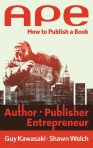
APE: Author, Publisher, Entrepreneur — Guy Kawasaki and Shawn Welch

ape_cover_KawasakiFor decades, books got published something like this: you, the writer, wrote and polished your book; you submitted a query letter and perhaps sample chapters to literary agents; an agent read the full manuscript; an agent took you on; the agent pitched your book to large publishing houses in New York; the editor, or ideally more than one editor, made an offer; the agent negotiated; and you got a book deal. This system worked kind of okay, and there wasn’t a better way to do it, but a lot of writers, including me, got hung up in the “an agent took you on” step.

Now, self-publishing has a realistic chance of success—defined as getting your work to readers and getting some amount of money from those readers—which offers opportunities and headaches. Big publishers know change is coming. The opportunities are obvious, and the headaches stem from having to learn a lot of stuff that publishers used to do, like cover design, knowing what a “widow” is, and figuring out how to hire a copy editor. APE: Author, Publisher, Entrepreneur wants to explain the new world, and it’s a book for a very specific group: people who are, for whatever reason, deeply interested in the publishing industry, and people who want to write a book, have written a book, or want to publish the book they’ve written. If you’re sure you don’t fall into those categories and aren’t likely to, stop reading. You’re probably wasting your time. If you want to know, keep going.

A few months ago I noted this, from Tim Parks’s “Does Money Make Us Write Better?“, in a links post:

When they are starting out writers rarely make anything at all for what they do. I wrote seven novels over a period of six years before one was accepted for publication. Rejected by some twenty publishers that seventh eventually earned me an advance of £1,000 for world rights. Evidently, I wasn’t working for money. What then? Pleasure? I don’t think so; I remember I was on the point of giving up when that book was accepted. I’d had enough. However much I enjoyed trying to get the world into words, the rejections were disheartening; and the writing habit was keeping me from a “proper” career elsewhere.

These kinds of stories infect writer interviews, as do tales of heroic perseverance. John Barth and William Goldman almost quit writing too. But more interesting still are the dark matter writers, the ones we don’t hear about because they gave up and aren’t being interviewed or writing introductions to reprints of their older books. I don’t want to be one of them. And I bet I can make more than £1,000, though I don’t know how long ago Parks began writing: adjusted for inflation, £1,000 might be a lot of money.

Kawasaki and Welch explain how to avoid being a dark matter writer. They say, “Will your book add value to people’s lives? This is a severe test, but if your answer is affirmative, there’s no doubt that you should write a book.” Still, people write books for all sorts of reasons, though I suspect the major reasons are related and twofold: the book they’d like to read doesn’t already exist, and they have something to say. Answers like “to add value to people’s lives” are good reasons to write a book, and good reasons to do many things. There is still some doubt. Writing a book can consume all your mental energy. It might add value to, say, two people’s lives, which might not justify the costs. Not everyone has the impetus towards book writing; to get through the difficulties of writing a book, I think that writing itself has to be fun, or fun at times (more on that later).

But the number of people who could write books and aren’t, in part because of the daunting publishing process, is much larger than the number who do write books. And that pool is getting larger. One challenge is that writers are going to have to think more like publishers, and publishers are going to have to think more like entrepreneurs. APE is about these transformations, and it takes its place near J.A. Konrath and Jack Kilborn’s The Newbie’s Guide to Publishing (Everything A Writer Needs To Know) and Kristine Kathryn Rusch’s Surviving the Transition: How Writers Can Thrive in the New World of Publishing (one thing writers evidently do, once they spend the painful time learning to self-publish, is write guides so that others can learn the same).

How useful APE will be to you depends on how much other reading you’ve done in the how-to-be-a-writer genre. I have trouble resisting it, and so sections of APE are less useful; some, like chapters 6, were fun but already well-known to me. The later ones, on the finer point of Kindle, Nook, and iBooks publishing, were exceedingly useful. I follow digital publishing closely, because I’m going to do it, but I still learned things: for example, I didn’t realize that Google Play exists. Google Play might not matter for me, or for you, but uploading to it requires little time beyond the effort necessary for iBooks and Barnes and Noble’s Nook.

Kawasaki and Welch also have overly strong views on tools (which may make sense given Kawasaki’s background: “For four years I evangelized Macintosh to software and hardware developers and led the charge against world-wide domination by IBM;” the word “evangelized” is key here, implying religious fervor that’s been transferred from God to Mac). I’ve learned some about photography in the last two years, perhaps a reaction against the extreme amount of reading and writing I’ve done, and in cameras, there’s a continual debate between the people who want the newest, coolest gear and who argue that the latest gear enables them to get shots they couldn’t have gotten before. Their intellectual adversaries argue that the most important tool is between the photographer’s ears and that composition, subject matter, and skill with what you have matters more than the newest cameras and the best lenses.

I’ve read impassioned pleas from both sides, and agreed fully with one side, then read the opposite, and agreed fully with them. There isn’t a right answer. One cliche in the photography community holds that every image you’ve admired was captured with worse gear than what you’ve got. Yet there’s also no reason to ignore the tools you’re using and the potential that new tools may unlock.

Kawasaki and Welch write, “In our book (again, pun intended), you should use a Macintosh. No computer makes you more creative and productive, because a Macintosh becomes part of you whereas you need to overcome other operating systems.” I don’t think it matters that much, which is somewhat funny because I’m writing this on an iMac. But pretty much any computer made in the last ten years will due, because, the most important parts of the writing process are a) a word processor and b) there is no b.

There are some nifty tools I use extensively, like Devonthink Pro, and some nifty tools that I’ve used less extensively but still helpfully at times, like Scrivener. Nonetheless, 95% of the real “work” of writing still happens on the level of the sentence and paragraph (though Kawasaki and Welch say of Scrivener, “I pride myself in having an organized mind, but my mind isn’t this organized”)*. A Mac is not going to give you great sentences. Neither is Windows or Linux or the tea you drink or the cafe you write at or the hot literary groupie offering you head or the pen you use. Great sentences, like change, come from within.

They also say, “We have never met anyone who regretted buying a Macintosh.” I have—like those who need perfect Exchange synchronization, or people who are seduced by the Mac’s cool factor, only to realize that the paying-the-rent factor is even more important. These are quibbles. Still, in one chapter the writers quote Zoe Winters, and I would repurpose her advice to apply to technology: “There is no shortcut to awesome.” Writing well is always a longcut, not a shortcut, and self-publishing arguably makes the road longer. There’s no real alternative, through software, hardware, or anything else.

The road may be long, but one can find comfort and encouragement along the way. Kawasaki and Welch write, “If You Want to Write by Brenda Ueland [. . .] changed my life by empowering me to write even though I didn’t consider myself a writer.” This is a common feeling, but it’s also one that’s long puzzled me: I spend very little, if any, time considering whether or not I’m “a writer.” I just do it. I didn’t need permission to be a writer, and neither do you. Alternately, if you do need permission, let me bestow it on you: a random stranger on the Internet has now dubbed thee a writer. Feel better?

You should. You should also realize that writing may be lonely in the moment, but it’s a way of bringing people together over time. This tension is implied in moments like these:: “Authors who write to impress people have difficulty remaining true to themselves. A better path is to write what pleases you and pray that there are others like you.” I would also add that few people are likely to be impressed anyway, and those who might be impressed will be more impressed if your book is written, at least some of the time, because you’re having fun and seeing where things go. Think about your favorite sexual experiences: few of them probably arose because you were putting a lot of pressure on yourself or your partners to have a Great Sexual Experience. Most of them probably arose because you and your partner(s) were relaxed and ready to have a good time by seeing where things go. So too with writing, and many other activities.

Sometimes writing will be painful, as Kawasaki and Welch note. I won’t deny it. But parts should be fun, and the fun will show in the final product.

In a few places, I’d like to see better writing in a book about writing. One chapter begins, “This section explains how to take a manuscript and turn it into a book. We assume that you have a rock-solid draft of your book.” “Rock-solid” turns up 74 million hits on Google. It’s a cliche. A book about writing should itself be impeccably written. This one is close—very close. Perhaps the next update will fix that.

Elsewhere, the writers say, “For example, The Schmoe Way by Joe Schmoe from Schmoe Press doesn’t cut it.” And “Pure text posts don’t cut it in the highly visual world of social media.” And “While printed books may never die (an ebook of Annie Leibovitz’s photographs won’t cut it) [. . . .]” What does “cut it,” and what is being cut? All of these could be improved: for example, “an ebook of Annie Leibovitz’s photographs is as useful as sheet music for someone who wants to hear Beethoven’s Fifth.” Maybe that’s a little clunky too, but it’s still an improvement because the metaphor is fresh. One could say, “Pure text posts in the highly visual world of social media make more sense than a pure text movie, but both are improved by images.”

Some words are wasted. The last sentence in this paragraph:

Undaunted, [Amanda] Hocking decided to self-publish her novels with Kindle Direct Publishing to pay for the $300 trip. She started with My Blood Approves, and by October 2010, she made over $20,000. Over the next twenty months, she made $2.5 million. The rest, as the saying goes, is history.

could be removed. I can only think of two similar nonfiction books that had no wasted words: Rework (the 37signals book, and one of the few books I’ve read that should be expanded) and Derek Sivers’ Anything You Want (where Sivers even talks about brevity and clarity in “You should feel pain when unclear“—”Writing that email to all customers would take me all day, carefully eliminating every unnecessary word, and reshaping every sentence to make sure it could not be misunderstood”). The best writing advice I’ve ever received is “omit unnecessary words.” Almost everyone is guilty of this crime at times, including me, in this post, in this blog, and in my other writing.

Their advice on serial commas is askew; Kawasaki and Welch favor serial commas (“A serial comma (or Oxford comma, as they say across the pond) prevents confusion when you are listing several items”), but serial commas can also create ambiguity.

These are minor issues, but I bring them up because nonfiction should aspire to be art. Kawasaki and Welch agree—they say, “Metaphors and similes beat the crap out of adjectives and adverbs, so use them when you can. For example, rather than saying, ‘Hockey is very violent,’ you could say, ‘Hockey is war on ice.'” Perhaps I’m overly fastidious about the War Against Cliche. Others who are highly attuned to language will notice too.

Some sections of APE linger in the mind long after they’re read, like this:

There are two kinds of people: eaters and bakers. Eaters think the world is a zero-sum game: what someone else eats, they cannot eat. Bakers do not believe that the world is a zero-sum game because they can bake more and bigger pies. Everyone can eat more. People trust bakers and not eaters.

It expresses a sentiment I’ve discussed in many contexts, but in a way I hadn’t conceived. My closest approximation came in “How to think about science and becoming a scientist:”

while society needs a certain number of lawyers to function well, too many lawyers leads to diminishing returns as lawyers waste time ginning up work by suing each other over trivialities or chasing ambulances.

By contrast, an excess of scientists and engineers means more people who will build the stuff that lawyers then litigate over. Scientists and engineers expand the size of the economic pie; lawyers mostly work to divide it up differently. Whenever possible, work to be a person who creates things, instead of a person who tries to take stuff created by someone else.

Kawasaki and Welch are bakers. They’re creators. They want to help you be one too. Still, according to them, you have to be the kind of writer who wants to “take control of their fate and embrace the ideas here in order to maximize their success.” A fair number of writers don’t appear to care about being able to “maximize their success” as measured by sales and finances, and in some literary circles cachet comes from not marketing one’s book, or appearing not to market it; sometimes not marketing becomes marketing, as examples like J. D. Salinger and Cormac McCarthy show.

This underlying model of success can seem claustrophobic, and, just I gave you permission to be be a writer above, I give you permission to be selective with social networks here: plans for Facebook, Twitter, LinkedIn, e-mail, Google+, and more would leave me with less writing time. I want to do things that really interest me, and that’s mostly long-form writing. Facebook and Twitter aren’t interesting, and I want the mental space they would otherwise occupy to be occupied by better things. I’m also reluctant to trust Facebook and Google+ because that gives those companies so much control over what I do and who I talk to. There was a recent kerfuffle when Facebook “turned down the volume” of businesses that had Facebook pages. That’s good for Facebook’s users but terrible for anyone who spent time and money encouraging people to interact on Facebook.

Facebook is, of course, where the people are. Using it is good advice, but it might also be useful to ask what you can say no to. In Anything You Want, Derek Sivers has a chapter called “No more yes. It’s either HELL YEAH! or no,” where he says that your reaction to most propositions should be one of those two extremes. To me, Facebook, Google+, and Twitter are in the lukewarm middle. Kawasaki and Welch “recommend using Google+ as a blogging platform.” Does it allow one to export nicely-formatted XML that will allow you to easily switch, if necessary? That’s a prerequisite, at least to me.

Kawasaki and Welch might be overly enamored of social media, and me underly enamored, but unless you want a Salinger-like existence you probably need to do something. There are few alternative to social media, e-mail, and other promotional efforts, and those efforts are a boon to outsiders. The authors say, “I’ve never come across an author who was happy with the marketing efforts of his publisher.” That might be because publishers have one thing that can’t be replicated by outsiders: distribution. Publishers are set up for a world where they control distribution. That advantage is eroding over time.

The chapters about social networking show you how to make sure you have access to new advantages.

The downside is that learning the business consumes time like space shuttles consume jet fuel. At the moment, however, APE is a relatively easy, comprehensible way of learning about all the steps that one should take to move from “guy with a story” or “guy with a long document” to “writes books that other people value and read.”


* I’ve only used Scrivener for one novel, called THE HOOK, that has different, named narrators at different times, like Tom Perrotta’s Election, Anita Shreve’s Testimony, or William Faulkner’s As I Lay Dying. Scrivener was an ideal tool for this task because it made rearranging sections easy, and it made reading each speaker’s full narrative, in order, easy. I can also see it being very useful for non-narrative nonfiction and or dissertations / academic books (James Fallows is a convert). For most fiction, I think the bigger problem is making the story cohere, not rearranging it.

Warning: Don’t buy James Scott Bell’s Plot & Structure: (Techniques And Exercises For Crafting A Plot That Grips Readers From Start To Finish)

I bought Plot & Structure because the issue of how a novel’s narrative moves seems to be understudied by academics, who tend to produce jargon-laden, overly analytical nonsense, and by novelists themselves. I’d really like an equivalent of How Fiction Works, but for an important matter that James Wood disdains (“the novel soon showed itself willing to surrender the essential juvenility of plot”). My ideal book would, as Wood says, ask “a critic’s questions and [offer] a writer’s answers.”

Unfortunately, Bell asks few questions and offers fewer answers. This is frustrating to me because, when I started writing, plot was a major weakness. The first two novels I actually wrote to completion had no real plots and thus weren’t very good novels (my Dad pointed out the former and let me infer the latter). Since then I’ve spent a lot of time thinking about plot, and being dissatisfied that I’ve never seen it addressed well elsewhere. Self-consciously literary writers and critics tend to discount it (as Wood does), sometimes to the detriment of their own work.

Genre writers tend to understand plot but either aren’t known to me, critically speaking, or write so poorly on a sentence-by-sentence level that their work isn’t interesting. To me, the best novels combine plot/story and language in a single, cohesive package. That, however, is difficult to do, and the difficulty may explain why we see so many arid academic-feeling novels about, oh, I don’t know, language and pure consciousness and What It Means To Be Alive Today, while so many genre novels with ticking bombs and handsome heroes and buxom heroines who put out surprisingly easily and simple words laid out in simple ways that won’t confuse anyone.

Not only is this dearth annoying because of my own flaws, but because I can’t point aspiring writers to a particular book and say, “Read this.” I can talk about some of my own techniques—I’ve written plot outlines for a number of books I admire, like an artist tracing his favorite paintings in order to imbibe their spirit and technique. With scenes, I’ve learned to ask what each character wants, what stands in his or her way, and why he or she is doing to overcome that barrier. I don’t always have answers—the characters often don’t have them, either—but at least asking the questions provides some structure to what might otherwise be a misaligned mess.

One can’t, of course, separate plot from character, setting, narrating, and other technical features in a novel. It would be stupid to try. But plot is a great blindspot in Wood’s criticism, and it’s a blind spot I aspire to see, or to see someone else seeing.

Bell, however, is blind.

Elmore Leonard on what it means to write

“I’m glad I’ve always had a commercial bent. I want to make money doing this. I had no dream of going to the Iowa Writing School, or whatever it’s called, and learning to write that way. When The New Yorker guy asked me to send him a story, I said, ‘I don’t write New Yorker stories. The stories I write I can always understand.’ And I can. My stories always have a definite ending, a payoff. I think he was a little insulted.”

—Elmore Leonard, in an interview with Keith Taylor for Witness

The place of literary criticism

A second Zadie Smith quote, also from Changing My Mind: “Here’s the funny thing about literary criticism: it hates its own times, only realizing their worth twenty years later.” This is remarkably close to what I wrote to a friend not long ago, concerning why I like blogging despite the fact that I’m also enmeshed in an academic context that only values peer-reviewed articles and books: “English profs always show up to a fire long after the house has been burned down and the fire already long extinguished.”

Blogging, if the blogger is any good, offers the possibility of getting to the fire when it’s still going, or even building a fire of your own. Maybe in twenty years this will be more widely recognized.

%d bloggers like this: