Links and Books Briefly Noted: Norman Rush's Mortals and Stephanie Kuehnert's I Wanna Be Your Joey Ramone

* Books Briefly Noted: Norman Rush’s Mortals is fun, but not as good as Mating. Read that first.

Mortals has lots of thought on the subject of identity, and internationalism, and love, and other Big Ideas, but they don’t quite coalesce into a whole. Still, to say a book is good but not up to the standards of Mating isn’t too terrible a comment, given the high standard of excellence. Ideas recurse through Mortals, growing bigger and smaller in relation to each other; in one early scene, Ray, a spy built closer to the ineptness of Austin Powers than the skill of James Bond but nonetheless an intellectual, thinks, “Like the development process itself writ small, the paving of the mall was a process of improvement that never seemed to get finished.” It’s not the only process of improvement that’s never finished. Yet those ideas and the events reflecting them are not so cohesive or moving as they are in Mating.

* The New York Times inquires: If you’re online, are you really reading? My response: isn’t it obvious? Steven Berlin Johnson already answered preempted the piece with his response, Dawn of the Digital Natives.

* The uses of book blogs over search engines, argued by Tyler Cowen at Marginal Revolution.

* Books Briefly Noted: Stephanie Kuehnert’s I Wanna Be Your Joey Ramone shows promise that fizzles into too many stilted conversations, clichés (Carlisle, Wisconsin, is “a small, tight-knit community” and Emily’s face is “a mask of irritation” in a sentence that’s awkward as a whole), and banal statements. For example, from the air, “Emily lifted her eyes from the brown squares of land carved up by rivers and roads […]” Compare this to Bellow, as originally posted here:

“And at a height of three miles, sitting above the clouds, I felt like an airborne seed. From the cracks in the earth the rivers pinched back at the sun. They shone out like smelters’ puddles, and then they took a crust and were covered over. As for the vegetable kingdom, it hardly existed from the air; it looked to me no more than an inch in height. And I dreamed down at the clouds, and thought that when I was a kid I had dreamed up at them, and having dreamed at the clouds from both sides as no other generation of men has done, one should be able to accept his death very easily.”

—Saul Bellow, Henderson the Rain King

(Notice James Wood’s remark in How Fiction Works: “Bellow had a habit of writing repeatedly about flying partly, I guess, because it was the great obvious advantage he had over his dead competitors, those writers who had never seen the world from above the clouds: Melville, Tolstoy, Proust.”)

Granted, it’s not entirely fair to compare first-time novelists to a master, but any novelist needs to realize that they should be comparing themselves to the best, because if they aren’t, they’re wasting their time and everyone else’s. Nonetheless, I will reiterate that Kuehnert might improve over time, and even Bellow’s first was clearly not his best. In one passage, Kuehnert writes, “Where I saw, grass struggled to grow in gnarly turfs, nourished by spilt beer and cigarette butts. Just a few feet away […] it was lush, green, and tall, which made the area surrounding the warehouse look like the patchy head of a balding man.” Notice the smooth alliteration and consonance of the first sentence, with the sibilant “s” of “saw” merging into the end of “grass,” then the repeated “g’s” and finally the harmonious end of “beer” and “butts,” in a sentence expressing anything but harmony. The comparison to a bald head works, and the contrast between where Emily is and what’s within easy reach functions as a metaphor regarding her larger experience. Alas: passages like this are far rarer than the one about flying. In addition, she keeps using bad near-synonyms for “said,” and, even worse, likes attached adverbs to those synonyms. Stop!

* The LA Times’ blog, Jacket Copy, asks about writing and running.

Of course, maybe I’m not one to talk: neither of the unpublished novels in my proverbial drawer discuss running or feature athletes, and this note bemoans the lack of writing rather than solving the problem.

(Ugh: look at five and a half minutes in the first transition zone. I was disoriented from the swim and couldn’t get my shoes on and then forgot my helmet.)

* Ars Technica tells us that Yahoo’s music store is closing for good—and anyone who bought music from them won’t be able to play it in the future. This fear is the major problem with the Amazon Kindle, as discussed here, here, and here.
The Best Software Writing — Joel Spolsky

Well-written, insightful books on subjects I know nothing about often impart some lasting and surprising ideas. The biggest problem is finding them, since you don’t know they’re well-written or insightful till it’s too late. Pleasant surprises have abounded recently, one being The Devil’s Candy: The Bonfire of the Vanities Goes to Hollywood. Another comes from Joel Spolsky, who writes a popular blog on software called Joel on Software and edited The Best Software Writing I. In an industry where books age date so fast as to be almost pointless, like the hardware that runs software, one astonishing aspect is how The Best Software Writing, published in 2005 and composed of many essays written earlier, is still relevant and fascinating—and will probably be so for a long time yet.

Take Danah Boyd’s “Autistic Social Software,” which, like most of The Best Software Writing, explains how computers and people interact. It was published around 2004, which represented a societal turning point not widely recognized at the time, as virtually everyone my age hopped on what we now call “social networking sites.”* She observes that those sites weren’t very good because they’re not focused on users, even drawing a not entirely apt analogy similar to the one I made Science Fiction, literature, and the haters:

While many science fiction writers try to convey the nuances of human behavior, their emphasis is on the storyline, and they often convey the social issues around a technology as it affects that story. Building universal assumptions based on the limited scenarios set forth by sci-fi is problematic; doing so fails to capture the rich diversity of human behavior.

Her comments about science fiction are accurate regarding much, but not all of it, just like her comments about the focus of programmers on computers and their limitations, forcing us to adapt to them rather than vice-versa. The market has a knack for giving people what they want, however, and that focus is changing over time as iterative generations of software improve and people move to sites that work better. Boyd says, “[…] there is a value in understanding social life and figuring out how to interact with people on shared terms.” Right: and those who figure out what that means will be rewarded. I’m reminded of a programmer friend whose e-mail signature says “Computers aren’t the future; people are,” and I suspect he would approve of the lessons in this essay and larger book.

That’s a single example of how you take offline phenomenon—how people congregate—and apply it to an online context. Other essays reverse that dynamic. Clay Shirky’s “A Group Is Its Own Worst Enemy” explains how online groups form and break apart in much the same fashion as offline groups. You could look at this in terms of clubs, families, countries or jobs, all of which have similar cohesive and destructive forces assailing them over different time periods. One thing the military has going for it is hundreds of years of experience in taking people and forcing them to work together toward a common goal. Many sports accomplish the same thing. But in both cases, the tasks—destroying things and killing people, moving a ball down a field—are narrow and well-defined compared to the wide-open field of artistic creation. Granted, both the military and sports have their wider, macro possibilities—what do we destroy and who do we kill and why? (this question is more often known as politics), or what rules should the game have and why?—but they’re not intrinsically undefined like software, or other forms of intellectual endeavor (Paul Graham wrote about this in Great Hackers.) The incentives are easier to get right. In software, like life, they’re not. Compensation becomes harder to get right when goals are less easily defined, which is a major subject in one essay and subsidiary in others. I wrote about it as applied to grant writing, using Spolsky as a launching pad, and if more people realized what he’s already discovered, we might not waste so much effort trying to reinvent the wheel or invent futile algorithms for what is inherently a tricky subject.

The Best Software Writing is, yes, about software, but it’s about more, including the future. Those interested in seeing it, and the inside of the most transformative industry of recent times, would do well to read it. It contains more thought than Literacy Debate: Online, R U Really Reading?, a New York Times article published yesterday (read it, or the rest of the paragraph won’t make much sense). Why hasn’t the reporter figured done enough background research? I wish I could say. It contrasts with Shirky’s other article, “User as Group,” which demonstrates much of what’s right about the new mediums without questioning the medium’s utility—something that the New York Times article utterly misses. Furthermore, on the individual level, the individual is going to suffer the pain of insufficient literacy or numeracy in the form of inferior jobs and a less intense life. Many seem happy to make such trade-offs, and we go on telling them to eat their Wheaties. If they don’t, they won’t be able to write at the level of skill and detail in The Best Software Writing, which would make the world a poorer place, but those involved don’t seem to care as a group. Oh well. What harm not reading Spolsky or Fred Brooks will harm the individual, but it will also cause splash damage to others who have to work with them. To the extent reading online ameliorates those problems, as Shirky implies, we’ve made improvements. He, Spolsky, and Brooks who write about programming only to the extent you’re unwilling to see programming as a metaphor.

The major fear articles like “Literacy Debate: Online, R U Really Reading?” express, I suspect, is that many people are getting along without books and stories. On a societal basis, this probably isn’t a good thing, since democracies depend on educated citizens with historical knowledge—but on a personal level, if you’re a mid-level account manager at some large company, how much does your familiarity with Tolstoy and Norman Rush really help or hurt you? On the other hand, if you want to be at the top of virtually any field, you need to read and understand the world. In software, that means books like The Best Software Writing, which, though it consists almost entirely of pieces that originally appeared online, is a physical, dead-tree book that I liked reading on paper far more than I would’ve on the screen, where I already spend entirely too much of my face time. I want what I find convenient, as do most people, and many of the essays point toward defining what that means. It’s got more about how fulfill human desires than most books, fiction or nonfiction. Volume II of The Best Software Writing might never appear. Given the strength of the first, I wish it would.


* I hope future readers find this strange phrase an anachronism showing how primitive we are, because it’s ugly and imprecise. If a phrase must be one, it at least shouldn’t be the other.

Barney’s Version — Mordecai Richler

Barney’s Version isn’t always clear or pretty, whether he’s portraying himself, his friends, his quasi-loves—whether Barney genuinely loved anyone aside from himself is uncertain, with claims otherwise of dubious merit—and his enemies. These categories blend into one another with alarming and realistic regularity. The novel is also seriously fun rather than funnily serious, in the tradition of excessive, bombastic, narcissistic personalities too eccentric for politics but otherwise cut out for that field, like the narrators of Martin Amis’ Money and many of Saul Bellow’s novels, but most notable Seize the Day and Herzog.

Social impropriety binds those characters together and is abundant in Barney’s Version. In a rare moment, Barney Charnofsky is “Bingeing on respectability, I was not determined to prove to Clara’s ghost that I could play the nice middle-class Jewish boy better than she had ever dreamed.” He fails, and trying to prove anything to a ghost is ridiculous, but I love the inversion of the typical mode of bingeing as negative, recalling Richard Feynman’s comment, “So I have developed a very powerful sense of social irresponsibility […] It’s made me a very happy man ever since.”

One character says to Barney, “Now will you please be quiet and stop making an exhibition of yourself.” He doesn’t, of course, since he’s spent his entire life making an exhibition of himself, perhaps explaining the irritation verging on envy that he feels toward a successful acquittance. Barney says of him, “But, after all these years as a flunk, my old friend and latter-day nemesis has acquired a small but vociferous following, CanLit apparatchiks to the fore.” I wonder what he would think of me becoming such an apparatchik by way of coming to Barney’s Version through the 2nd Canadian Book Challenge, Eh?. Nonetheless, publicity, however minor, on my part gives Barney more of a chance to make an exhibit of himself.

He doesn’t do so in a simple manner, either. Chapter four begins by saying, “What follows appears to be yet another digression.” The whole novel is a digression—this post mimics its structure—which makes a certain amount of sense because most people’s entire lives are one long digression, or a series of them, and the narrative cohesion usually given to them by biography and the like is more an effort to impose order on chaos, like selecting a line to fit to a series of data points regardless of whether the line has any meaning.* For such a novel to work, it must nonetheless tell a story with some kind of beginning, middle, and end, even if those elements aren’t in their usual order, and Barney’s Version succeeds as a novel despite and because of its narrator’s protestations.

We’re also not sure when to trust Barney, especially because a would-be editor keeps inserting footnotes. Elsewhere, Miriam, the perhaps love of Barney’s life, says “I believe you,” when Barney denies killing his somewhat friend who might’ve slept with his second wife and might’ve been set-up to do so by Barney himself as a way of getting Barney a divorce (got all that?). He says, ” ‘I’ll be out of here in a week,’ […] hoping that saying it aloud would render it true.” Many of his hopes are improbably rendered true, and his belief in his own belief is somewhat perplexing. As for Miriam, believing a liar might also not be a great idea, but then Miriam might not know Barney’s a liar, or she merely expressing optimism to a man she doubts. It’s not clear what. A lot of Barney’s Version is humorously unclear. In other words, you get a lot of narrative play and epistemological complexity among your laughs. If there’s a better way to get said fiber, I’m not sure of it, and I like mine with sugar much more than vinegar. Life, after all, is pretty funny, and seeing that reflected in books is a relief. Mild offense sometimes blends into hilarious social commentary, as when lawyers are “[…] perhaps mollified because parents of the accused had promised to endow a chair of visible-minority social studies at the college.” That could be a line from Francine Prose’s Blue Angel. Later, we find in Barney’s Version:

I don’t hold with shamans, witch doctors, or psychiatrists. Shakespeare, Tolstoy, or even Dickens understood more about the human condition than ever occurred to any of you.

Usually the third in that opening series isn’t placed with the other two, but the structure is an effective way to express Barney’s low opinion of someone trying to help him. Fortunately, the psychiatrist doesn’t take much offense, as Barney has low opinions of many people, places, and professions, as well as, at times, himself. He also demonstrates obvious allusions in a novel filled with them, some subtle and some not, and his ability to go from hockey to Shakespeare and back impresses. Speaking of hockey, at one point a long-winded girlfriend causes him to start reading about sport in lieu of her, a feeling I remember well, as when I found myself in such a similar low-signal-to-noise-ratio circumstance, the New Yorker was my outlet of preference, causing a roommate to remark once, “I could tell you were on the phone with her because normally I hear you talking.”

I’m tempted to go on about Barney’s Version—there’s a murder plot, an unreliably unreliable narrator, jokes from fading memory, an intrusive editor, family squabbles, drinking problems/solutions, none of which have been fully discussed in this sketch of a sketch—and the more I consider it, the more I realize its easily missed depth and the more I’m inclined to recommend it, given its paradoxical ability to be both light and heavy at the same time, like a character who’s finally reconciled The Unbearable Lightness of Being. Barney’s Version has the magic of a novel that wiggles out of description with such finesse that I barely realize what’s happened, and I’m not reading about the world, but Barney’s version of it.


* Alain de Botton’s fabulous Kiss & Tell is the most successful mockery of biography I’ve read. It also comes with the sanction of the American lit apparatchiks, who put it on my senior year AP English test.

The Cider House Rules — John Irving

I go back and forth about John Irving, sometimes marveling at him, as I did through much of The World According to Garp and, now, The Cider House Rules, and sometimes rolling my eyes, as I did at A Prayer For Owen Meany. He gets at the multifaceted aspects of life and somehow contains a strong, uncertain moral bent without (usually) sermonizing. He has a tendency to delve into character background and explanation at the expense of action, giving overly elaborate details about characters who remain flat anyway. Yet his gift for keeping forward moment despite any obstacles from his own verbosity is amazing, as is his almost Henry James-esque ability to nail an idea, as he does when he writes, “Society is so complex that even Heart’s Haven had a wrong part to it.”

The Cider House Rules moves seamlessly between the narrative action and overarching generalizations with more skill than a 19th Century novel and so much dexterity that they don’t seem unnatural or forced, as such abstractions or general life lessons often can—in, for example, The Spies of Warsaw. Rarely does the novel devolve into Steinbeck-land moralism and sentimentality, as when Wilbur Larch argues that Homer has a duty to help those who cannot help themselves—in this case by performing abortions. Granted, the argument has some logical fallacies for careful readers to see, but it’s nonetheless jarring in a book that’s otherwise carefully evenhanded. Problems exist, such as the aforementioned biographies of minor characters, and Irving is more a fan of the sledge hammer than chisel. Perhaps this rambunctiousness is the subject of some attacks against him: Irving doesn’t have the cool and cutting quality that seems in vogue among many critics today, the aesthetic preference for a single sentence summary of a person rather than paragraphs of background designed to bring a character to the foreground. But whatever faults John Irving has, failing to live is seldom one: his best characters usually have the differentiated roundness that brings them alive. James Wood thinks not: in a recent post, he said:

The review I just wrote about Joseph O’Neill’s superb novel,”Netherland,” in “The New Yorker,” praises the novel both for its deep and wise interest in life and lives, and for its high degree of artifice and style. That doubleness is entirely in keeping with my attacks on people like Tom Wolfe, John Irving, the more formulaic elements of John Updike, and so on.

(Link added by me).

The Cider House Rules might not have the lifeness Wood prefers, but it has the engaging quality I love and too infrequently find. It had long been sitting on my bookshelf, waiting to be read, and so I decided to try it. As this introduction shows, I liked it more than not, even if some parts revealed too heavy a hand and showed, I think, what Wood meant. Still, the whole—with Wilbur and Homer Larch at the center of a novel about the discovery of what it means to assume the terrible weight of responsibility while still laughing at the lunacy of the world—carries any weaknesses along with it in a flood, as Irving’s best novels do. They forge their own eccentric morality and philosophy, but though I think of them often I can’t immediately define those traits that I can feel. One day, maybe, but one mark of a good novelist is, I think, the inability to corral all their themes and ideas without a great deal of study, and by that standard, too, Irving succeeds.

Life: Henry James edition

“He said to her one day that she had too many ideas and that she must get rid of them.”

—Henry James, The Portrait of a Lady

I often feel the same way about ideas discard mine in the Internet.

Blue Angel — Francine Prose

Francine Prose’s Blue Angel (2000) bears more than a little resemblance to Richard Russo’s Straight Man (1997), which isn’t bad—both are smart, funny novels that use English departments as a launching rather than end point to explore politics, society, and life. Bad novels become mired in their time and place; good novels transcend them by making a particular time and place a metaphor or microcosm for something bigger. Sure, it’s easy to mock academic (or business, or families, or any number of other social configurations) life, as structure can easily ossify and become stultifying, but using these structures as a base instead of destination helps transcend them, as both Blue Angel and Straight Man do. From similar beginnings, however, Blue Angel and Straight Man diverge based on their protagonists’ decisions, and in Blue Angel the choice eventually leads to a hilarious and astonishing Kafka-esque tribunal scene.

Blue Angel is based around two theoretical premises: the fundamental imbalance of knowledge between novelists teaching creative writing and know-it-all, under-literate students taking said classes. I feel confident making the second generalization because I was one of those students—now I’m not in the classes but am otherwise similar. The second premise involves sexual politics and power, or lack thereof—while it’s wrong, wrong, wrong for professors to sleep with students, Blue Angel implies that it’s not always the professor who has the power. In addition, a plot point involving the latent sexual tension in many relationships is irresistible as a device in novels where very little else is otherwise at stake. And what kind of tension is going on in Blue Angel? Is it gender, power, class, or something else? They intersect and morph, much like in The Bonfire of the Vanities, and Prose leaves the battle lines deliciously ambiguous. I can’t remember who said it, but I read that one way of propelling a novel is to get two people who shouldn’t sleep together to do so and then see what happens.

This used to be easier, when sex outside of marriage was completely taboo and divorce led to societal suicide and extreme social censure. Now you have to go a bit further. Marriage plots don’t work nearly as effectively when most people aren’t virgins when they marry and quickie, no-fault divorces mean that a bed decision can leave you back in the same fundamental position you once were six months after accidental nuptials. Ian McEwan exploits the cusp of this revolution in On Chesil Beach, but writers who set stories in contemporary times have to deal with contemporary mores. Prose does effectively through the hothouse atmosphere of an English Department, where Ted Swenson finds that he’s teaching “[…] every Tuesday afternoon, [when] Swenson’s job requires him to discuss someone’s tale of familial incest, fumbling teenage sex, some girl’s or boy’s first blow job, with the college’s most hypersensitive and unbalanced students, some of whom simply despise him for reasons he can only guess: he’s the teacher, and they’re not, or he looks like somebody’s father.”

Is Swenson trapped? If so, by what, or whom, except himself? It’s not obvious, and Swenson is aware of the dilemma: “But like convicts who love their shackles, nearly all [professors] chose not to escape” Blue Angel and Straight Man imply one can leave this vast, masturbatory game if you have sufficient ironic distance to survive, perhaps tempered with the unpleasant realization that you might be too weak, timid, or self-satisfied. The game is more serious and less serious than it appears, depending on the narrator’s mind at any time, and this is made more difficult when writing teachers aren’t performing the first part of their jobs and have reasons—in Swenson’s case, “[…] once more he’s [Swenson] siphoned all his creative juices into a brain-numbing chat with a student. He’s ruined the day for writing, and his punishment is to face yet another of the problems with not writing, which is: how to kill all that time.” The reality is that Swenson isn’t a writer: if he were, he wouldn’t complain about writing, he would simply be doing it. In an interview Robertson Davies discussed how he produced innumerable novels while working as a publisher and, later, while teaching. Swenson is, like many of his students, simply making excuses.

He’s also not so different from Ruby, his daughter, than he’d like to think, though she is underdeveloped and a mere figure. This might be intentional, as recriminations over her place haunt the conversations between Swenson and Sherrie; perhaps this strained distance is the norm for parents and their children rather than the exception. There are some other problems than the portrait of Ruby—for example, as so often happens in novels, the scenes involving computers are poorly done. Ruby also says, “The Women’s Studies Department had to threaten a class-action lawsuit before they’d even investigate.” This makes no sense, because there is class or group of people to file suit—only a single organization or entity. Granted, it could be the character’s mistake, but Blue Angel doesn’t show this to be the case. Elsewhere, however, Prose nails details, as when Angela Argo, the improbable temptress, takes a class in “Text Studies in Gender Warfare.” Blue Angel could recursively be an assigned text in such a class, given its minute reading of the bizarre sexual politics overlaid on the wider culture in tun overlaid on whatever biological human instinct hides under the veneer of modern discourse. References to churches, religion, and Jonathan Edwards peter out towards the end of Blue Angel, which is a shame because they offered a rich vein of allusions for a novel with more than a little secular sin and, it implies, mindless persecution instead of the high-minded search for justice and truth that the university is supposed to cultivate. Blue Angel is far deeper than its premise suggests, and its self-aware humor gives it enough heft to bite into a situation that could easily degenerate into silly farce.

Life: thoughts on computers and tools

“Walking into Nathan and Kristi’s empty house was a reminder of why stuff doesn’t really matter: We make the inanimate objects come to life, and not vice versa. Similarly, it reminded me that the fond feelings I have for this place are all wrapped up in the people. There was certainly no charm to those bare walls, studded with hooks where pictures once hung.”

—Alan Paul, “The Annual Expat Exodus Never Gets Any Easier

This is an appropriate quote given a friend’s recent e-mail asking if I’d become overly enamored of computers, given what she called an “almost pornographic” shot of my desk. It’s not dissimilar from Faramir’s comment in The Lord of the Rings, when he separates tools from their uses this way in The Two Towers: “[…] I do not love the bright sword for its sharpness, nor the arrow for its swiftness, nor the warrior for his glory. I love only that which they defend […]”

So too I feel about tools, be they computers or pens, or books themselves, which I see not as objects of reverence, but as bulbs that only shed light when read and shared. This could in part be a decadent opinion born of economic opportunity: five hundred years ago, or even fifty years ago, I might not have been so blithe, as books were far more expensive than they are today and have been declining in relative price for almost all of the 20th Century. Regardless of that, I’m lucky enough to live in a time when books are relatively inexpensive; though a book might have symbolic meaning, it is the thing or potential within, not the thing itself, that appeals, and it’s only to the extent that the exterior thing has the potential to manifest what’s within that I’m interested.

Mid-June links: The Library of America and the book as an object

* John Lanchester writes that he finds it hard to read those gorgeous Library of American volumes.

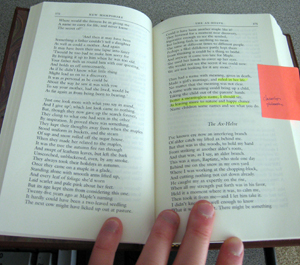
No such compulsion here! While I understand his feeling, I highlight when the need arises:

That’s one way of ensuring that the books exist to be read, not fetishized. Lanchester says, “A paperback is a paperback; the collected writings of a writer, any writer, have the air of belonging to Culture in the abstract. That’s off-putting.” I agree: responding to the author in the book itself is one way of ameliorating that problem.

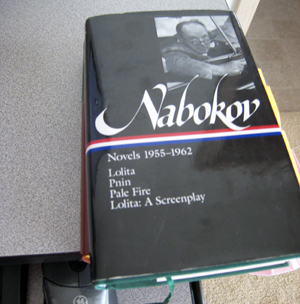
Sometimes I write a fair amount, as in Lolita:

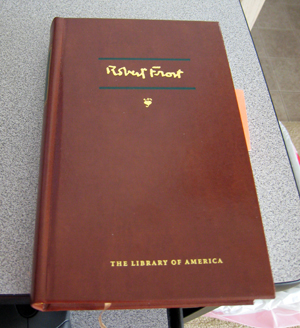
Screw resale value. Then again, Amazon knocks about a third off the price, and the Library of America had a fire sale (haha) of Frost, perhaps explaining part of my cavalier attitude.

EDIT 6/18/08: Gabriel Zaid’s So Many Books explains more about books as monuments than I do here.

* Kingsley Amis’ fairly extensive writing about alcohol has now been published in a single volume called Everyday Drinking, as the New York Times reports.

“Serving good drinks,” he wrote, “like producing anything worth while, from a poem to a motor-car, is troublesome and expensive.”

And, as with good food or good writing, good drinks are best prepared for those who will appreciate them.

Although I’m tempted to buy Everyday Drinking, I’m afraid I’ve already laden myself with enough contrarian books, ranging from The Joy of Drinking to The Book of Vice. In addition, despite my apparent dedication to such topics, I feel that drinking is better experienced in person than through the medium of literature, even if reflection deepens the experience once sufficient experience has been had.

Transpose those thoughts to other endeavors at your own peril.

* Nigel Beale writes about “How to re-establish evaluative criticism as central to the academic study of literature.” Since I’m about to start graduate school in English, it’s a topic near to my mind. What he doesn’t mention, however, is that evaluative criticism does exist to a greater extent than he gives it credit for, and it even has its own place in English departments—just under the heading “creative writing,” and “MFA,” rather than in the usual classes.

* Nigel Beale part deux—he says a good book needs:

1) to find and revel in funny, beautiful, thought-provoking phrases, 2) dwell on profound paragraphs that contain useful truths about life and human nature, 3) lose myself in the lives of exceptional characters.

They correspond roughly to professionalism and aesthetic delight, searching for meaning in life, and pleasure at being able to occupy someone else’s mind. Defining what those mean will quickly bloat any discussion of them to the size that Beale is trying to avoid with brevity.

* Jason Fisher on Rereading Madeleine L’Engle’s A Wrinkle in Time. It’s on my to be read list, along with 100 other books.

* Since science fiction has been in the air, Marc Andreessen’s top books of the 00s (“oughts?”) can land here.

* Read this concerning genre and that great bender Michael Chabon.

* Lester Hunt speculates on the decline of the Western:

[…] a major source of the charm of westerns is that they are set in a situation in which the presence of the state is minimal or non-existent. In the wild West, you often have to enforce your own rights. If you wait for civil society to do it, you’ll be dead. In a word, westerns are about anarchy. They are fiction’s only constitutionally anarchist genre. As such, they represent a wild sort of freedom. Maybe, like the romance of property, that’s not such a popular idea any more, either.

Notice that one of the most popular genres nowadays is the police procedural, in which the protagonist is a government employee. Yecch! Is there any way you could get further away from the ethos of the western? (Try to imagine Ethan Edwards even saying the word, “procedural.”)

This might explain why I don’t much care for police procedurals. Still, I’d note that many of them portray the police as corrupt and incompetent, while the heroes often act outside the traditional police structure.

* By way of Anecdotal Evidence, William Maxwell on reading and aging.

* That the TSA is denying the ability to fly to people without papers is infuriating. Have they not read the innumerable books about dystopias (1984, Brave New World, We…) and history/society (Foucault) on the subject of state surveillance? Evidently not. Slashdot commenters are unusually articulate about the issue. See my thoughts on its relation to reading here.

Reading: Wheaties, marijuana, or boring? You decide.

Eventually one must tire of reading the debates about reading and prefer to just read, or, if you’re the sort of person who doesn’t, watch T.V., or whatever—though if you don’t like reading, I’m rather puzzled that you’re at this site. Regardless, you should read this long, worthwhile, and non-polemical look at the decline of reading from Heather Harris (hat tip Books, Inq.):

One of the great pastimes of the literati, aside from complaining about the Bush administration and attending live tapings of A Prairie Home Companion, is collective hand-wringing about the sad fact that Americans no longer read. Apparently, most of us would sooner watch Rock of Love–Bret and Ambre are so not going to make it–than pick up a novel. Enter Mikita Brottman: Maryland Institute College of Art professor, Oxford scholar, author, and patron saint of the tome-averse masses in her new book The Solitary Vice: Against Reading. Brottman is the latest in a long line of philosophers and writers to question reading’s value, and in this day of reading campaigns and self-important book clubs, the question of whether reading per se is a virtuous activity is timely.

I’ve been collecting examples of quotes and articles concerning the decline of reading, as the debate about whether reading is good or bad for you seems to have been rolling around since the origins of the English novel. Other required reading on reading is Steven Johnson’s Dawn of the Digital Natives, whose perspective is closer to Brottman’s than the unnamed literati of the article.

I fall into more of the rah-rah reading crowd, both for personal and societal reasons. The argument about writing and reading changing our culture resonates with me, as even people who never read have been affected by the innumerable writers and reformers of various kinds whose work extends perpetually backwards in time. In addition, as Foucault argues, power and knowledge are inherently bound, and the most efficient way to transmit knowledge seems to be reading.

Why have we dismantled most forms of racial discrimination or many of the barriers to women in the workforce or other kinds of discrimination based on things other than ability? Why do we let atheists maintain their beliefs openly? It’s largely because some people were willing to challenge the larger culture, chiefly through writing, and enough people were interested in reading to have absorbed those principles or ideas, which now come at us through a thousand outlets. I just read in Alain Badiou’s ‘Ethics: An Essay on the Understanding of Evil (Wo Es War): “When Nietzsche proposes to ‘break the history of the world in two’ by exploding Christian nihilism and generalizing the great Dionysian ‘yes’ to Life […]” I thought, really? Although I don’t necessarily buy the “exploding Christian nihilism” bit (what nihilism?), count me as a late convert to the Dionysian principle. Without books, it’s doubtful that I would’ve made it there, and it’s in part my own trajectory that leads me to believe, perhaps irrationally, in the transformative value of thinking about the world through reading.

To delve into personal territory, books helped me leave the social carapace that hardened when I was 10 or 11, not create it, as Brottman says happened to her. Books were a recovery from an unhappy move and from video games and helped me articulate more of a worldview and change my behavior, and while I don’t think of books as therapy, they do have some therapeutic aspects to them. To bring the level of seriousness back to an appropriate level, consider what Richard Feynman said in Surely You’re Joking, Mr. Feynman!: “And Von Neumann gave me an interesting idea: that you don’t have to be responsible for the world that you’re in. So I have developed a very powerful sense of social irresponsibility as a result of Von Neumann’s advice. It’s made me a very happy man ever since. But it was Von Neumann who put the seed in that grew into my active irresponsibility!”

Without reading, I might lack this powerful sense of social irresponsibility and instead just have accepted accepted received wisdom instead of revising received wisdom. Let this be a lesson, by the way, to the natterers, including myself, on getting young people to read—instead of pushing reading ceaselessly like whole wheat bread, maybe it’s time to forbid it, and stock copies of Henry Miller and Bret Easton Ellis in the liquor store, thereby necessitating that teenagers get their older siblings or boyfriends or whatever to buy it for them. They might pass copies of Lost Girls around like furtive bongs at parties. I call this the “gateway drug” approach to reading, as opposed to the “whole wheat” approach.

Still, on a marginally more serious note, if no one reads, then who will write the challenges to cultural, legal, social, and technical problems? And who will read them? That, implicitly, is what many of hand-wringers worry about. Steven Johnson might argue, perhaps correctly, that those challenges will come from visual media, and that’s possible—but I doubt most visual media can match the depth of depth of text. I’m convinced that reading causes you to think—as Caleb Crain’s Twilight of the Books argues—differently and gives you the tools to argue against bad public policy, bureaucracies, and the like. To me, reading is linked to freedom itself, and I don’t think it’s mere correlation that the initial moves toward democracy coincided with the rise of what evidence we have for written languages, or that repressive governments fear and try to control books and knowledge. Thus, I see reading as important in the personal sphere for individual growth and in the societal sphere for correcting the excesses of organizations with power. And they’re fun—Feynman often criticized such organizations through his social irresponsibility, and has helped transmit that sense to others. Reading doesn’t have to be antisocial, and I usually find being social around people who read is more fun than being around people who don’t, simply because the readers get more and get it faster. Once again, the correlation/causation issue arises, but from my perspective, it doesn’t matter—I’ll take the reader over the non-reader, and many people not in positions of, say, government authority would probably do the same. Without falling prey to Godwin’s Law, I’ll note that many authoritarian regimes try to control knowledge and specific manifestations of knowledge, like books and professors. As a result, I see reading as both a public and private good, although one that, paradoxically, might be best inculcated in young people by trying to show it as dangerous, rather than good for you like Wheaties.

This argument might not matter, since surveys keep appearing that claim people read less and less, but like any believer, I’m still convinced of the faith’s importance. I’m not as much a proselytizer as someone who thinks others should come to it on their volition—I’m less of a Christian missionary and more of a Buddhist monk. Or maybe I’ve just got an economic interest in reading, since I spend an enormous amount of time writing. I think it’s deeper than that, although I won’t be so ridiculously grandiose as to say things like, “The future depends on it!” like a character from a bad superhero movie, I will say that reading still matters as a component of free thought and free life, and it doesn’t have to come at the expense of sociability. It can be good for you but shouldn’t necessarily be pitched that way. The culture, however, will move in whatever way it does, and I suspect those in the debate will be increasingly on the margins of the culture as a whole.


EDIT: Added last paragraph on 6/11/08.

Henderson the Rain King

Henderson the Rain King is not my favorite Bellow novel: Henderson’s sojourn in Africa is unconvincing and borders on Orientalism, the novel’s symbolism is heavy, and some disjointed sections feel superfluous, as when Henderson writes letters to his wife, Lily, in Chapter 19, or when he discusses the lion hunts with King Dahfu. Still, even Bellow batting below average scores more hits than most writers at their best, and in rereading Henderson I remember why I like Bellow so much—he’s so alive, and his characters ceaselessly try to expand their own lives and learn to encompass this big thing we call life. Granted, they’re always unsuccessful at the latter, but this isn’t necessarily a bad thing; it’s an impossible quest just to understand life—especially humanity in all its varieties—let alone encompassing it, is probably impossible.

This might feed into what Bellow, like some other great novelists, so disliked about academic research and writing, as academics by definition try to define and elucidate, while so much of Bellow’s writing shows why some major factors of life simply can’t be elucidated. Therefore, academics and critics like me are ourselves going on a futile quest in our attempts to comprehend Bellow, who wrote novels like Henderson that show why the explaining isn’t possible; as Sam Tanenhaus wrote regarding the Library of America edition of Bellow, “It may be heretical, or just foolish, for a book review editor to admit it, but there are times when criticism is beside the point.” Indeed, and it makes me wary in writing this. No wonder Bellow liked Blake’s poetry, as I see some of the same defiance of full explanation in Blake, especially his later work. Henderson is a particularly strong example of this tendency, with the protagonist’s constant drive toward something he can’t seem to articulate beyond “I want, I want,” forming a base for the unnameable: what does Henderson want? Life? Experience? Knowledge? Something else?

Much of Henderson is, I think, intended as comic, given its outlandish events. Still, those events, like the lion hunt or the moving of the statue, are too symbolically endowed for my taste. They seem more like a statement of Henderson’s character than necessary events to the novel. Such scenes also parallel to too great a degree Joseph Campbell’s The Hero With A Thousand Faces. That book came out in 1949 and Henderson in 1959, and during the period between them Bellow might have read or at least heard about Hero. Many of its elements show in farcical ways: the call to adventure is through narcissistic desire that leads to departure from the United States for Africa; failure in the blown-up water cistern; initiation in the form of moving a statute; and eventual success, after a fashion. Henderson is more concerned with himself than anyone or thing else, however, and rather than reconciling himself with his society he thinks that, “this is the payoff of a lifetime of action without thought” when he’s forced to imitate a jungle beast. As he says elsewhere, noting the ridiculousness of his own situation, “If I had to shoot at that cat, if I had to blow up frogs, if I had to pick up Mummah without realizing what I was getting myself into, it was not out of line to crouch on all fours and roar and act the lion.”

Yet in Henderson those comic aspects are also a critique of the quest narrative, as Henderson can’t find wholeness or completion. He searches for an abstraction layer not available through travel, even when elements of home—the United States—follow him: “It was just my luck to think I had found the conditions of life simplified so I could deal with them—finally!—and then to end up in a ramshackle palace reading these advanced medical texts.” The issues keep coming: “And though I’m no expert I guess he’s [King Dahfu] thinking of mankind as a whole, which is tired of itself and needs a short in the arm from animal nature.” If that weren’t enough, he continues: “Anyway, I begin to ask (or perhaps it was more a plea than a question), why is it always near me—why! Why can’t I get away from it awhile? Why, why!” Why indeed: it’s a question religion doesn’t answer, or at least not satisfactorily anymore, and that philosophy seems to have failed at answering despite its numerous and increasingly verbose attempts, and that novels pose and don’t seem to answer. In the mythology Campbell discusses, you come back from your quest whole and ready to take your place in the adult community or you die and uphold the standards of that community or you transcend life; in Henderson and later, ironic texts, your quest is forever incomplete, because like Henderson, you can’t answer that pivotal question that becomes an exclamation: “Why, why!”

Why, why! indeed, and Bellow keeps setting up the questions through exploration without giving answers. The closest he comes, I think, is in Ravelstein, where Chick marvels at the “creature” that is Ravelstein while also being resigned to accept his fate. Whether this is an improvement on the manic energy of earlier Bellow novels or a depressing acceptance of the end is a matter of perspective on which I have no opinion. But, like the master, I will try to frame the issue, even if the issue has a habit of being larger than that frame. And so the critic struggles with Bellow like Itelo wrestling with Henderson, and even champion critics don’t seem able to win. But this preoccupation with trying to explain Bellow stays with me, and this is not, I suspect, my last word on the subject, even if my attempts are as futile as Henderson’s.