Process, outcomes, and random discoveries

I was listening to a Fresh Air interview with Brad Pitt, the guy who plays Billy Beane in the Moneyball movie, and Pitt said something very interesting: Billy Beane realized that baseball is mostly about “process” and maximizing your odds. A single pitch or a single at-bat is basically random; a terrible player could homer, a great one strike out. But if you have faith in the process and fidelity to it, you’ll maximize your chance of success over time. Notice those words: “maximize your chance of success.” You won’t automatically succeed in whatever the endeavor might be, but we live in a chaotic, random world where no one is guaranteed anything.

So I heard this interview about a week ago. Since then, I’ve seen a bunch of similar stuff, which keeps reappearing like, if I were a person who wasn’t convinced things are random, the world is trying to tell me something. Here’s a description of Steve Jobs: “What was important to Jobs was not making money per se, but the process of creation.” That word, “process,” appears again: if it’s right, the money will follow if you get the process right. When a Playboy interviewer asks Justin Timberlake “Why [. . .] some celebrities crack and fade and others, like you, just keep on keeping on? Have you figured that out?,” Timberlake says he doesn’t know but will speculate, and he goes on to say:

I think it’s about process. If you care about the process of what you’re doing, you can care about the actual work. You’ll stick around. The other thing is, you always need to be learning something new. In whatever I’ve done, I’ve always looked at myself as a beginner. Hopefully I can continue to do that for the next 30 years as I grow into an older man.

He’s trying to do with music what Billy Beane is trying to do with baseball and what Steve Jobs was trying to do with consumer technology. Or what Alain de Botton describes in The Pleasures and Sorrows of Work, in which the author sees a worker in a Belgian biscuit factory whose “manner drew attention away from what he was doing in favour of how he was doing it.” If you attend to how you do something, the outcome will tend to improve more than absolute attention to the outcome. It seems like a lot of experts, a lot of people who can do good work year after year, are really focusing on process refining. This might map to “experimental” and “conceptual” artists, to use Galenson’s terminology in Old Masters and Young Geniuses: The Two Life Cycles of Artistic Creativity. As I read more about what makes artists, scientists, and others succeed, I increasingly realize that a focus on process is essential, if not the essential thing.

And it’s something I’m noticing over and over again, in a variety of contexts. When I started grad school, I began going to the University of Arizona’s Ballroom Dance Club. This is hilarious: if you asked a girl who had the misfortune of going with me to high school dances about what I’d be like a couple years later, I doubt any would’ve guessed, “Dancing.” Fewer still would’ve guessed, “At least being a competent dancer.” To aspire to “good” or “masterful” is probably unwise, but “competent” is well within my reach—and within almost anyone’s reach, really, if you have the desire. And ballroom club is all about the fundamentals too: here’s how you should move. Here’s how you isolate a single part of your body. The overall look, feel, and flow of any dance is composed of individual motions and a dancer’s control over those individual motions, which eventually come to appear to be a single, fluid motion. But it isn’t. It’s the result of the dancer breaking down each individual part and practicing it until it becomes part of him.

One time, a guy who’d been dancing for about a decade had us spend about half an hour of an hour-long classes on spins. Skilled dancers can perform nearly perfect 360-degree spins every time. I can’t. I usually end up ten to fifty degrees off. I can’t get my body, shoes, and motion harmonized sufficiently to ensure that I can perform perfect spins. But I keep working on it, in the hopes of improving this seemingly simple but actually complex activity. I’m doing in dancing what Billy Beane is doing in baseball, Justin Timberlake is doing in music, Steve Jobs was doing in technology, and you should probably be doing in your own field or fields.

And if your practice isn’t as good as it should be this time, focus on improving your process so you’ll be better next time. As you, the reader, might imagine, the same principle applies to other things. Like classes. Since I now teach and take them, I have a lot of experience with students who want to fight about grades. I don’t budge, but every semester students want to fight either during the semester or the end. I try to convey to them that grades are imperfect but they’re really about learning; concentrate on learning and the achievement, whether in grade or other form, will eventually follow.

Most of them don’t believe me. This is unfortunate, since most students also don’t know that, as Paul Graham writes, there are really Two Kinds of Judgment:

Sometimes judging you correctly is the end goal. But there’s a second much more common type of judgement where it isn’t. We tend to regard all judgements of us as the first type. We’d probably be happier if we realized which are and which aren’t.

The first type of judgement, the type where judging you is the end goal, include court cases, grades in classes, and most competitions. Such judgements can of course be mistaken, but because the goal is to judge you correctly, there’s usually some kind of appeals process. If you feel you’ve been misjudged, you can protest that you’ve been treated unfairly.

Nearly all the judgements made on children are of this type, so we get into the habit early in life of thinking that all judgements are.

But in fact there is a second much larger class of judgements where judging you is only a means to something else. These include college admissions, hiring and investment decisions, and of course the judgements made in dating. This kind of judgement is not really about you.

To be fair, I am trying to judge them correctly. But the second class of judgments bleed into grading: the grade is the means of trying to get students to be better writers. When they want to fight about grades, they haven’t fully internalized that I’m trying to get them into a process-oriented mode despite the school setting. The grades are outcomes and a necessary evil—and, besides, some students are simply more skilled than others.

But if students have fidelity to the process—to becoming, in my classes, better writers, or in other classes, better at whatever the class is attempting to impart—they’re going to maximize the probability of long-term success. And I wonder if students internalize the outcome-oriented mode of school—”My worth depends on my grades”—and then find themselves shocked when they’re plunged into the process-oriented real-world, where no one grades you, success or failure can’t be measured via GPA, and even people who do everything “right” may still fail for reasons outside their control.

This is probably doubly painful because students are used to type one judgments, not type two, and instructors don’t do much to disabuse students. Instructors don’t do enough to encourage resilience, and maybe we should, or should more than we do now.

By the way, I’m not just climbing the mountain and shouting at the unwashed masses below. I tell myself the same thing about writing fiction (or blog posts): I’ve probably gotten dozens of requests from agents for partial or full manuscripts. None have panned out; some still have pieces of the latest novel. But I tell myself that a) I’m going to write a better novel next time and b) if I maintain fidelity to the craft of writing itself, I will eventually succeed. Alternately, I might simply start self-publishing, but that’s an issue for another post. The point here is about writing—and about what I’m doing right now.

I keep writing this blog not because it brings me fame and fortune—alas, it doesn’t—but because I like to write, I think through writing, and because some of the writing on this blog is and/or will be useful to others. And I like to think this blog makes me a better writer not only of blog posts, but also a better writer in other contexts. I’m focused on the process of improvement more than the outcome of conventional publication. Which isn’t to say I don’t want that outcome—I do—but I understand that the outcome is, paradoxically, a result of attention to something other than the outcome.
Why we need the third way: “What Are You Going to Do With That” and the need for imagination

In “What Are You Going to Do With That?,” William Deresiewicz tells the freshmen class at Stanford:

In the journey toward the success that you all hope to achieve, you have completed, by getting into Stanford, only the first of many legs. Three more years of college, three or four or five years of law school or medical school or a Ph.D. program, then residencies or postdocs or years as a junior associate. In short, an ever-narrowing funnel of specialization. You go from being a political-science major to being a lawyer to being a corporate attorney to being a corporate attorney focusing on taxation issues in the consumer-products industry. You go from being a biochemistry major to being a doctor to being a cardiologist to being a cardiac surgeon who performs heart-valve replacements.

But he goes on to point out why and how these kinds of defined professional paths—the ones high school and college students students are so often told constitute “success”—might not be optimal, for either the person on the path or society in general. If you “simply go with the flow,” you can end up merely being defined by what someone else has laid out. Perhaps not surprisingly, Deresiewicz goes on to say, “There is an alternative.” He calls it “moral imagination” and defines it this way: “Moral imagination means the capacity to envision new ways to live your life.” I would call it something else: the “third way.”

Deresiewicz’s essay shows why we need more talk about the third way: there are more options out there than further advanced schooling. Stanford in particular is a good place to be reminded of this. Obviously, Deresiewicz doesn’t say you must choose grad school or the professions, but the absence of any acknowledgement about starting your own company implies that those are the two primary choices.

I’ve had similar talk. In my interview with him, Tucker Max describes the primary speech he gives at colleges:

[. . . W]hen you’re an undergrad, generally you think you can do two things. You’re gonna have to get a job after you graduate or you gotta go do more school. Because everyone who’s giving you advice or telling you how to live your life are people who’ve done one of those two things.

He describes a “third way,” with his two normal paths defined a lot like Deresiewicz’s, but in a lower register:

You don’t generally have anyone in your life who has gone out on their own and done something entrepreneurial or done something artistic or truly risky or truly taken the path less traveled, because those people [. . .] don’t work in academics. And don’t become cubicle monkeys. So what I try and explain in my speeches is that there’s a third way. Because a lot of people—I think most people—want to do something besides those two things.

A lot of people want to do something else, but that something else is, in some ways, harder to do than the normal path. Yet the people who go the third way often talk about it as being more satisfying, and the people who go the “two paths” often speak wistfully of the third—despite the difficulty one is likely to encounter. A friend wrote this to me: “I know for a fact that I’d hate [Tucker] Max’s writing, but he’s dead right about how few students are aware that they can do something artistic or creative or entrepreneurial.” Too few students are aware of this—and too few people in general are. You can consider this post a very small step in the direction of increasing awareness.

So far I’ve noted two examples. Paul Graham talks about the problem of standard paths too, in “A Student’s Guide to Startups:” “Till recently graduating seniors had two choices: get a job or go to grad school. I think there will increasingly be a third option: to start your own startup.” His answer is more defined than Deresiewicz’s or Max’s, but the very language he uses is similar. But he’s also got a way of generating the “third way” by funding startups. Instead of merely telling people to find one, he’s creating a third way for people to flow, which might be the most valuable contribution of all, at least for the technically inclined.

I think all three of these disparate writers—Deresiewicz, Max, and Graham—are pointing to a more fundamental need for the imagination necessary to exit the obvious paths that so often end up going nowhere. Of the three, Graham has done the most to institutionalize this process and make it available for others by starting Y Combinator. Max has probably done the most to be a living embodiment of an unusual third way. Deresiewicz is pointing to the possibility from within the way of a well-defined path (and the same one I’m one) from undergrad to graduate school to being a professor. Taken together, they diagnose and offer treatment for the same malady that can’t quite be identified yet comes from so many sources and has so many symptoms: Dilbert, cubicles, malaise, ennui, florescent lights, midlife crises, 20-somethings with advanced degrees working as baristas, waiters, or bartenders, essay writers.

Artistic or creative activities don’t usually come prepackaged in convenient jobs that get handed to college graduates. They get created by people who are artistic and creative, who find a way to turn what they want to do, or their inchoate ideas, into something greater than the idea itself. The “inchoate idea” is important: I suspect most people don’t entirely know what they’re doing when they find a third way. Steven Berlin Johnson has a term for this in his book Where Good Ideas Come From: The Natural History of Innovation: the slow hunch. This happens when something that you’ve been gnawing on slowly develops over time. Johnson describes it much more fully, of course, but a lot of my ideas in writing novels or academic work comes from slow hunches. Writing fiction isn’t an activity that really comes packaged in convenient job form: it is made by each practitioner individually. People who succeed as writers sometimes do so not through conventional publishing, but through alternate ways—as Max did with his website, or as J.A. Konrath apparently does with his blog, “A Newbie’s Guide to Publishing.”

Like Deresiewicz and Max, I don’t really have a solution to the problem other than to encourage you to think imaginatively. But who’s against thinking imaginatively? Partners are probably telling their third-year associates the same thing, even as the associates put in soul-killing seventy hours weeks under those menacing florescent lights. The other part of my solution is to be aware of the problem. I’ll also channel Graham in “What You’ll Wish You’d Known” and encourage you to stay upwind:

In the graduation-speech approach, you decide where you want to be in twenty years, and then ask: what should I do now to get there? I propose instead that you don’t commit to anything in the future, but just look at the options available now, and choose those that will give you the most promising range of options afterward.

It’s not so important what you work on, so long as you’re not wasting your time. Work on things that interest you and increase your options, and worry later about which you’ll take.

Suppose you’re a college freshman deciding whether to major in math or economics. Well, math will give you more options: you can go into almost any field from math. If you major in math it will be easy to get into grad school in economics, but if you major in economics it will be hard to get into grad school in math.

Flying a glider is a good metaphor here. Because a glider doesn’t have an engine, you can’t fly into the wind without losing a lot of altitude. If you let yourself get far downwind of good places to land, your options narrow uncomfortably. As a rule you want to stay upwind.

“Work on things that interest you and increase your options:” the target of Graham’s essay is nominally high school students, but it’s applicable to a much broader swath of people. Maybe you’re one. If so, however, you’ll probably read this and then go back to filling out those TPS reports. Or maybe you’ll be one of the very rare people who realize there is no speed limit and react appropriately. At least you can’t say that no one told you. At least three people have: Deresiewicz, Max, and Graham. Four if you count me, writing a meta essay.

Why we need the third way: "What Are You Going to Do With That" and the need for imagination

In “What Are You Going to Do With That?,” William Deresiewicz tells the freshmen class at Stanford:

In the journey toward the success that you all hope to achieve, you have completed, by getting into Stanford, only the first of many legs. Three more years of college, three or four or five years of law school or medical school or a Ph.D. program, then residencies or postdocs or years as a junior associate. In short, an ever-narrowing funnel of specialization. You go from being a political-science major to being a lawyer to being a corporate attorney to being a corporate attorney focusing on taxation issues in the consumer-products industry. You go from being a biochemistry major to being a doctor to being a cardiologist to being a cardiac surgeon who performs heart-valve replacements.

But he goes on to point out why and how these kinds of defined professional paths—the ones high school and college students students are so often told constitute “success”—might not be optimal, for either the person on the path or society in general. If you “simply go with the flow,” you can end up merely being defined by what someone else has laid out. Perhaps not surprisingly, Deresiewicz goes on to say, “There is an alternative.” He calls it “moral imagination” and defines it this way: “Moral imagination means the capacity to envision new ways to live your life.” I would call it something else: the “third way.”

Deresiewicz’s essay shows why we need more talk about the third way: there are more options out there than further advanced schooling. Stanford in particular is a good place to be reminded of this. Obviously, Deresiewicz doesn’t say you must choose grad school or the professions, but the absence of any acknowledgement about starting your own company implies that those are the two primary choices.

I’ve similar talk. In my interview with him, Tucker Max describes the primary speech he gives at colleges:

[. . . W]hen you’re an undergrad, generally you think you can do two things. You’re gonna have to get a job after you graduate or you gotta go do more school. Because everyone who’s giving you advice or telling you how to live your life are people who’ve done one of those two things.

He describes a “third way,” with his two normal paths defined a lot like Deresiewicz’s, but in a lower register:

You don’t generally have anyone in your life who has gone out on their own and done something entrepreneurial or done something artistic or truly risky or truly taken the path less traveled, because those people [. . .] don’t work in academics. And don’t become cubicle monkeys. So what I try and explain in my speeches is that there’s a third way. Because a lot of people—I think most people—want to do something besides those two things.

A lot of people want to do something else, but that something else is, in some ways, harder to do than the normal path. Yet the people who go the third way often talk about it as being more satisfying, and the people who go the “two paths” often speak wistfully of the third—despite the difficulty one is likely to encounter. A friend wrote this to me: “I know for a fact that I’d hate [Tucker] Max’s writing, but he’s dead right about how few students are aware that they can do something artistic or creative or entrepreneurial.” Too few students are aware of this—and too few people in general are. You can consider this post a very small step in the direction of increasing awareness.

So far I’ve noted two examples. Paul Graham talks about the problem of standard paths too, in “A Student’s Guide to Startups:” “Till recently graduating seniors had two choices: get a job or go to grad school. I think there will increasingly be a third option: to start your own startup.” His answer is more defined than Deresiewicz’s or Max’s, but the very language he uses is similar. But he’s also got a way of generating the “third way” by funding startups. Instead of merely telling people to find one, he’s creating a third way for people to flow, which might be the most valuable contribution of all, at least for the technically inclined.

I think all three of these disparate writers—Deresiewicz, Max, and Graham—are pointing to a more fundamental need for the imagination necessary to exit the obvious paths that so often end up going nowhere. Of the three, Graham has done the most to institutionalize this process and make it available for others by starting Y Combinator. Max has probably done the most to be a living embodiment of an unusual third way. Deresiewicz is pointing to the possibility from within the way of a well-defined path (and the same one I’m one) from undergrad to graduate school to being a professor. Taken together, they diagnose and offer treatment for the same malady that can’t quite be identified yet comes from so many sources and has so many symptoms: Dilbert, cubicles, malaise, ennui, florescent lights, midlife crises, 20-somethings with advanced degrees working as baristas, waiters, or bartenders, essay writers.

Artistic or creative activities don’t usually come prepackaged in convenient jobs that get handed to college graduates. They get created by people who are artistic and creative, who find a way to turn what they want to do, or their inchoate ideas, into something greater than the idea itself. The “inchoate idea” is important: I suspect most people don’t entirely know what they’re doing when they find a third way. Steven Berlin Johnson has a term for this in his book Where Good Ideas Come From: The Natural History of Innovation: the slow hunch. This happens when something that you’ve been gnawing on slowly develops over time. Johnson describes it much more fully, of course, but a lot of my ideas in writing novels or academic work comes from slow hunches. Writing fiction isn’t an activity that really comes packaged in convenient job form: it is made by each practitioner individually. People who succeed as writers sometimes do so not through conventional publishing, but through alternate ways—as Max did with his website, or as J.A. Konrath apparently does with his blog, “A Newbie’s Guide to Publishing.”

Like Deresiewicz and Max, I don’t really have a solution to the problem other than to encourage you to think imaginatively. But who’s against thinking imaginatively? Partners are probably telling their third-year associates the same thing, even as the associates put in soul-killing seventy hours weeks under those menacing florescent lights. The other part of my solution is to be aware of the problem. I’ll also channel Graham in “What You’ll Wish You’d Known” and encourage you to stay upwind:

In the graduation-speech approach, you decide where you want to be in twenty years, and then ask: what should I do now to get there? I propose instead that you don’t commit to anything in the future, but just look at the options available now, and choose those that will give you the most promising range of options afterward.

It’s not so important what you work on, so long as you’re not wasting your time. Work on things that interest you and increase your options, and worry later about which you’ll take.

Suppose you’re a college freshman deciding whether to major in math or economics. Well, math will give you more options: you can go into almost any field from math. If you major in math it will be easy to get into grad school in economics, but if you major in economics it will be hard to get into grad school in math.

Flying a glider is a good metaphor here. Because a glider doesn’t have an engine, you can’t fly into the wind without losing a lot of altitude. If you let yourself get far downwind of good places to land, your options narrow uncomfortably. As a rule you want to stay upwind.

“Work on things that interest you and increase your options:” the target of Graham’s essay is nominally high school students, but it’s applicable to a much broader swath of people. Maybe you’re one. If so, however, you’ll probably read this and then go back to filling out those TPS reports. Or maybe you’ll be one of the very rare people who realize there is no speed limit and react appropriately. At least you can’t say that no one told you. At least three people have: Deresiewicz, Max, and Graham. Four if you count me, writing a meta essay.

Don’t rent an apartment from Navid Abedian in Tucson, Arizona, or, how I learned to be wary of lawsuits

In 2008 I moved in Tucson for grad school and rented a condo that turned out to be a decent place to live, except for the landlord and a neighbor universally referred to as “Crazy Nick” (he was not crazy in a good way). When my roommate and I moved, the landlord kept about $500 of our deposit after promising that he wouldn’t and saying that he’d refund it. Stealing our security deposit violated Arizona’s Residential Landlord & Tenant Act, which regulates the usual tenant-landlord problems.

Because I’m such a smart guy and was both unhappy about his lies and interested in our money, I decided to sue him in small claims court, where I eventually won a $1,350 judgment. He paid $350 after a debtor’s hearing in January and promised to pay the rest; in June I sought another debtor’s hearing to compel him to pay at which point he threatened to come over to my apartment and kill me. For those of you keeping score, this marks the second time someone has done so in one summer, up from zero times previously in my entire life.

I filed a police report, stayed at friends’ houses for a few days, and canceled the hearing: improbable though Abedian’s threat might be, it’s not worth shooting or being shot over $1,000. He’s also a cipher to me: all I know is that he works in a carpet store, bought a condo in Tucson near the height of the ’00s real estate boom and, according to a Google search, might have his house foreclosed on. In other words, he might be desperate, and people have killed each other over far less than $1,000.

Although running away sets a bad precedent—will he just threaten to kill the next tenant who comes along? am I not doing the right thing for my fellow man—I still think capitulating wiser than continuing.

What originally seemed to mostly be entertainment (i.e. going to court and pontificating), began to suck up way too much mental energy. In the Hacker News discussion of Paul Graham’s “The Top Idea In Your Mind,” grellas wrote, “There is a lesson here about lawsuits, which will drain you of both money and peace of mind all at the same time. Sometimes you can’t turn the other cheek, much as you would like to do so, and have no choice but to fight. Having the guts to stand up for yourself (or for your company) is in itself a virtue and there are times when it is best not to walk away.”

He’s right, and a lawsuit I’d imagined as entertainment and teaching a useful lessons that might turn into dividends for the next tenants backfired. It also occupied way too much space in my mind—space that I should’ve spent writing or doing research. Instead I worried about the sanity and desperation of a guy I didn’t know and who was probably armed.

In Francine Prose’s novel Touch, the protagonist is a 14- or 15-year-old girl named Maisie, who tells her preening stepmother, Joan, a version of what happened on a bus when two or three boys touched her breasts in somewhat murky circumstances. It isn’t clear at the narrative’s start whether she consented, but the event as narrated to us is also one in which the characters act without enough culpability to call what they did anything beyond adolescent horseplay and power struggles.

Joan wants to meet a lawyer, which makes Maisie think that “I was filled with dread. Pure dread. It felt like icy water trickling down my back.” Joan says, “It would be a matter of principle.” Most people don’t lead their lives solely according to principle; pragmatics matter too. Few of us want to be martyrs for a cause, and if we do, that cause better be worth it. Most of us want to get along. Altruistic punishment is real but can be overrated. Maisie would be harming her own well-being and self-interest. I thought I was standing up for the principle of tenants’ rights and for fairness, but I chose to give up that principle when Navid threatened to kill me. Pragmatics won.

Like Maisie, I’m choosing pragmatism—which I probably should’ve learned in the first place. I’ve started Bleak House a couple of times (I’m not a Dickens fan) and understand Jardyce vs Jardyce well enough to know that lawsuits are often vehicles for mutually assured destruction more than they are about fairness or rights. When in doubt or when it’s avoidable, don’t get the law involved. And, apparently, be ready to write off your security deposit.

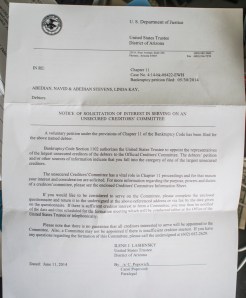
OLYMPUS DIGITAL CAMERAEDIT: It’s 2014 and I’d mostly forgotten about Navid, but I just got a letter saying that he declared bankruptcy. I’m a) somehow listed as a creditor and b) the Department of Justice somehow got my current address, in order to c) invite me on some kind of creditors’ committee. I wish I couldn’t say that I don’t feel a little schadenfreude, but, alas, I’m too small a person. Apparently his wife or ex-wife, Linda Kay Abedian Stevens—or Linda Kay Stevens? the wording is unclear—was also on the lease and on the property deed.

Since leaving Tucson I have been threatened with death zero times.

The Shallows: What the Internet is Doing to Our Brains — Nicholas Carr

One irony of this post is that you’re reading a piece on the Internet about a book that is in part about how the Internet is usurping the place of books. In The Shallows, Carr argues that the Internet encourages short attention spans, skimming, shallow knowledge, and distraction, and that this is a bad thing.

He might be right, but his argument misses one essential component: the absolute link between the Internet and distraction. He cites suggestive research but never quite crosses the causal bridge from the Internet as inherently distracting, both because of links and because of the overwhelming potential amount of material out there, and that we as a society and as a people are now endlessly distracted. Along the way, there are many soaring sentiments (“Our rich literary tradition is unthinkable without the intimate exchanges that take place between reader and writer within the crucible of a book”) and clever quotes (Nietzsche as quoted by Carr: “Our writing equipment takes part in the forming of our thoughts”), but that causal link is still weak.

I liked many of the points Carr made; that one about Nietzsche is something I’ve meditated over before, as shown here and here (I’ve now distracted you and you’re probably less likely to finish this post than you would be otherwise; if I offered you $20 for repeating the penultimate sentence in the comments section, I’d probably get no takers); I think our tools do cause us to think differently in some way, which might explain why I pay more attention to them than some bloggers do. And posts on tools and computer set ups and so forth seem to generate a lot of hits; Tools of the Trade—What a Grant Writer Should Have is among the more popular Grant Writing Confidential posts.

I use Devonthink Pro as described by Steven Berlin Johnson, which supplements my memory and acts as research tool, commonplace book, and quote database, and probably weakens my memory while allowing me to write deeper blog posts and papers. Maybe I remember less in my mind and more in my computer, but it still takes my mind to give context to the material copied into the database.

In fact, Devonthink Pro helped me figure out a potential contradiction in Carr’s writing. On page 209, he says:

Even as our technologies become extensions of ourselves, we become extensions of our technologies […] every tool imposes limitations even as it opens possibilities. The more we use it, the more we mold ourselves to its form and function.

But on page 47 he says: “Sometimes our tools do what we tell them to. Other times, we adapt ourselves to our tools’ requirements.” So if “sometimes our tools do what we tell them to,” then is it true that “The more we use it, the more we mold ourselves to its form and function?” The two statements aren’t quite mutually exclusive, but they’re close. Maybe reading Heidegger’s Being and Time and Graham Harman’s Tool-Being will clear up or deepen whatever confusion exists, since he a) went deep but b) like many philosophers, is hard to read and is closer to a machine for generating multiple interpretations than an illuminator and simplifier of problems. This could apply to philosophy in general as seen from the outside.

This post mirrors some of Carr’s tendencies, like the detour in the preceding paragraph. I’ll get back to the main point for a moment: Carr’s examples don’t necessarily add up to proving his argument, and some of them feel awfully tenuous. Some are also inaccurate; on page 74 he mentions a study that used brain scans to “examine what happens inside people’s heads as they read fiction” and cites Nicole K. Speer’s journal article “Reading Stories Activates Neural Representations of Visual and Motor Experiences,” which doesn’t mention fiction and uses a memoir from 1951 as its sample text.

Oops.

That’s a relatively minor issue, however, and one that I only discovered because I found the study interesting enough to look up.

Along the way in The Shallows we get lots of digressions, and many of them are well-trod ones: the history of the printing press; the origins of the commonplace books; the early artificial intelligence program ELIZA; Frederick Winslow Taylor and his efficiency interest; the plasticity of the brain; technologies that’ve been used for various purposes, including metaphor.

Those digressions almost add up to one of my common criticisms of nonfiction books, which is that they’d be better as long magazine articles. The Shallows started as one, and one I’ve mentioned before: “Is Google Making Us Stupid?” The answer: maybe. The answer now, two years and 200 pages later: maybe. Is the book a substantial improvement on the article? Maybe. You’ll probably get 80% of the book’s content from the article, which makes me think you’d be better off following the link to the article and printing it—the better not to be distracted by the rest of The Atlantic. This might tie into the irony that I mentioned in the first line of this post, which you’ve probably forgotten by now because you’re used to skimming works on the Internet, especially moderately long ones that make somewhat subtle arguments.

Offline, Carr says, you’re used to linear reading—from start to finish. Online, you’re used to… something else. But we’re not sure what, or how to label the reading that leads away from the ideal we’ve been living in: “Calm, focused, undistracted, the linear mind is being pushed aside by a new kind of mind that wants and needs to take in and dole out information in short, disjointed, often overlapping bursts—the faster, the better.”

Again, maybe, which is the definitive word for analyzing The Shallows: but we don’t actually have a name for this kind of mind, and it’s not apparent that the change is as major as Carr describes: haven’t we always made disparate connections among many things? Haven’t we always skimmed until we’ve found what we’re looking for, and then decided to dive in? His point is that we no longer do dive in, and he might be right—for some people; but for me, online surfing, skimming, and reading coexists with long-form book reading. Otherwise I wouldn’t have had the fortitude to get through The Shallows.

Still, I don’t like reading on my Kindle very much because I’ve discovered that I often tend to hop back and forth between pages. In addition, grad school requires citations that favor conventional books. And for all my carping about the lack of causal certainty regarding Carr’s argument, I do think he’s on to something because of my own experience. He says:

Over the last few years I’ve had an uncomfortable sense that someone, or something, has been tinkering with my brain, remapping the neural circuitry, reprogramming the memory. My mind isn’t going—so far as I can tell—but it’s changing. I’m not thinking the way I used to think. I feel it most strongly when I’m reading. I used to find it easy to immerse myself in a book or a lengthy article. My mind would get caught up in the twists of the narrative or the turns of the argument, and I’d spend hours strolling through long stretches of prose. That’s rarely the case anymore. Now my concentration starts to drift after a page or two. I get fidgety, lose the thread, begin looking for something else to do. I feel like I’m always dragging my wayward brain back to the text. The deep reading that used to come naturally has become a struggle.

I think I know what’s going on. For well over a decade now, I’ve been spending a lot of time online, searching and surfing and sometimes adding to the great databases of the Internet.

He says friends have reported similar experiences. I feel the same way as him and his friends: the best thing I’ve found for improving my productivity and making reading and writing easier is a program called Freedom, which prevents me from getting online unless I reboot my iMac. It throws enough of a barrier between me and the Internet that I can’t easily distract myself through e-mail or Hacker News (Freedom has also made writing this post slightly harder, because during the first draft, I haven’t been able to add links to various appropriate places, but I think it worth the trade-off, and I didn’t realize I was going to write this post when I turned it on). Paul Graham has enough money that he uses another computer for the same purpose, as he describes in the linked essay, which is titled, appropriately enough, “Disconnecting Distraction” (sample: “After years of carefully avoiding classic time sinks like TV, games, and Usenet, I still managed to fall prey to distraction, because I didn’t realize that it evolves.” Guess what distraction evolved into: the Internet).

Another grad student in English Lit expressed shock when I told him that I check my e-mail at most once a day and shook for every two days, primarily in an effort not to distract myself with electronic kibble or kipple. Carr himself had to do the same thing: he moves to Colorado and jettisons much of his electronic life, and he “throttled back my e-mail application […] I reset it to check only once an hour, and when that still created too much of a distraction, I began to keeping the program closed much of the day.” I work better that way. And I think I read better, or deeper, offline.

For me, reading a book is a very different experience from searching the web, in part because most of the websites I visit are exhaustible much faster than books. I have a great pile of them from the library waiting to be read, and an even greater number bought or gifted over the years. Books worth reading seem to go on forever. Websites don’t.

But if I don’t have that spark of discipline to stay off the Internet for a few hours at a time, I’m tempted to do the RSS round-robin and triple check the New York Times for hours, at which point I look up and say, “What did I do with my time?” If I read a book—like The Shallows, or Carlos Ruiz Zafon’s The Shadow of the Wind, which I’m most of the way through now—I look up in a couple of hours and know I’ve done something. This is particularly helpful for me because, as previously mentioned, I’m in grad school, which means I have to be a perpetual reader (if I didn’t want to be, I’d find another occupation).

To my mind, getting offline can become a comparative advantage because, like Carr, “I’ve had an uncomfortable sense that someone, or something, has been tinkering with my brain,” and that someone is me and that someone is the Internet. But I can’t claim this is true for all people in all places, even as I tell my students to try turning off their Internet access and cell phones when they write their papers. Most of them no doubt don’t. But the few who do learn how to turn off the electronic carnival are probably getting something very useful out of that advice. The ones who don’t probably would benefit from reading The Shallows because they’d at least become aware of the possibility that the Internet is rewiring our brains in ways that might not be beneficial to us, however tenuous the evidence (notice my hedging language: “at least,” “the possibility” “might not”).

Alas: they’re probably the ones least likely to read it.

The Possessions Exercise (According to Geoffrey Miller)

I’m re-reading Geoffrey Miller’s books The Mating Mind and Spent: Sex, Evolution, and Consumer Behavior, partially for pleasure and partially because some of his ideas might make it into my dissertation. The latter book is worth reading if for nothing other than the exercises he lists at the end, including “The Possessions Exercise:”

List the ten most expensive things (products, services, or experiences) that you have ever paid for (including houses, cars, university degrees, marriage ceremonies, divorce settlements, and taxes). Then, list the ten items that you have ever bought that gave you the most happiness. Count how many items appear on both lists.

(This exercise ought to be conjoined with the reading of Paul Graham’s essay Stuff.)

For many people, I suspect that relatively few items appear on each list, although that might be projection on my own part.

I do a lot of work on my computer, so many of the “bought” items tend to be related to that: an iMac, an Aeron, a Kinesis Advantage. The “university degree” appears on both lists, although I suspect that I often appreciated the experience of being at a university for undergrad as much if not more than the classes I was actually putatively there to take.

The big takeway from Miller’s exercise is obvious: what we really value often isn’t what we pay the most for, but few of us realize that. We overvalue stuff, to use Paul Graham’s phrase, and we undervalue each other, learning, making things, and interpersonal experience.

Tyler Cowen's political (and general) wisdom

“[…] we are accustomed to judging the truth of a claim by the moral status of the group making the claim.”

That’s Tyler Cowen speaking of “Climategate” in his post “The limits of good vs. evil thinking.” Normally I would put something like this in a links post, but “The limits of good vs. evil thinking” is so good that I’m emphasizing it with an independent post.

The major problem is that sometimes people we perceive as morally palatable can make untruthful or not optimally useful claims, while the opposite—people we perceive as morally unpalatable can make truthful or optimally useful claims—can also occur. Notice that I’m intentionally not providing examples of either phenomenon. As Paul Graham says in the notes to “What You Can’t Say:”

The most extreme of the things you can’t say would be very shocking to most readers. If you doubt that, imagine what people in 1830 would think of our default educated east coast beliefs about, say, premarital sex, homosexuality, or the literal truth of the Bible. We would seem depraved to them. So we should expect that someone who similarly violated our taboos would seem depraved to us.

If I said this kind of thing, it would be like someone doing a cannonball into a swimming pool. Immediately, the essay would be about that, and not about the more general and ultimately more important point.

The more important point is about avoiding ad hominem attacks and being able to consider claims independently of the person making the claims in some circumstances. As Cowen says, this is really hard.

Early August links: Book stalking, teaching, Playboy's Guide to Lingering, and more

* Makers’ versus Managers’ Schedules:

Most powerful people are on the manager’s schedule. It’s the schedule of command. But there’s another way of using time that’s common among people who make things, like programmers and writers. They generally prefer to use time in units of half a day at least. You can’t write or program well in units of an hour. That’s barely enough time to get started.

* Rands’ The Book Stalker: Where is it? Everyone has one could well describe me.

* From the department of unintended consequences: “The New Book Banning: Children’s books burn, courtesy of the federal government.” This is because the Consumer Product Safety Improvement Act of 2008 (CPSIA) stops the selling of used children’s good produced before 1985, when lead was banned, unless those products conform to the post-1985 standards. Although lead in children’s books hasn’t been shown to be harmful, the books don’t pass muster anyway.

I am generally not an organized political person who writes angry letters to Congresspersons and such, but this might be worth an exception.

(Hat tip to Megan McArdle.)

* A “teach naked” proponent challenges us to stop using computers while we teach:

Mr. Bowen is part of a group of college leaders who haven’t given up on that dream of shaking up college instruction. Even though he is taking computers out of classrooms, he’s not anti-technology. He just thinks they should be used differently—upending the traditional lecture model in the process.

Here’s the kicker, though: The biggest resistance to Mr. Bowen’s ideas has come from students, some of whom have groused about taking a more active role during those 50-minute class periods. The lecture model is pretty comfortable for both students and professors, after all, and so fundamental change may be even harder than it initially seems, whether or not laptops, iPods, or other cool gadgets are thrown into the mix.

This is what I generally shoot for; in classrooms without computers, I never use one, and even when they come with classrooms, I generally use them very little, and mostly as a whiteboard substitute.

* What goes into book jackets: sometimes the answer is “facile stereotypes” or “very little.”

* Edifying editing, from a journal reviewer. Contrast this with my recent post, “Careers—and careerism—in academia and criticism“. Notice this bit from “Edifying editing:”

Ellison finds that the profession has slowed down, doubling the “submission to print” time at major journals. What was unexpected for me was the finding that most of the
slowdown is the number of revisions, not the ‘within round cycle time.’ I hadn’t realized that the interminable wait for a response was common twenty-five years ago. What has changed, Ellison shows, is that we have about doubled the number of rounds. I had thought it was merely deficiencies in my own papers that caused me to revise three, four, even five times. But no, it is a profession-wide phenomenon.

Like most economists, I am personally obsessed with efficiency, and wasted resources offend me in an irrational way. The way economists operate journals is perhaps the most inefficient operation I encounter on a regular basis. It is a fabulous irony that a profession obsessed with efficiency operates its core business in such an inefficient manner. How long do you spend refereeing a paper? Many hours are devoted to reviewing papers. This would be socially efficient if the paper improved in a way commensurate with the time spent, but in fact revising papers using blind referees often makes papers worse. Referees offer specific advice that push papers away from the author’s intent. It is one thing for a referee to say “I do not find this paper compelling because of X” and another thing entirely to say that the referee would rather see a different paper on the same general topic and try to get the author to write it.

Does anyone have data about paper efficiency and the humanities? Searching through Project MUSE, JSTOR, and Google Scholar yields nothing through the criteria I tried.

* I very much like the poem “Playboy’s Guide to Lingering” by Joseph J. Capista, although I can’t decide why; normally the Slate poems leave me high and dry, like the New Yorker’s.

* A review of Thy Neighbor’s Wife from Bill Wasik at The Second Pass; compare to my comments here. I’m not sure I buy this: “Of all the mass utopian notions of the twentieth century, the sexual revolution was both the most spectacularly successful and, in the end, the most thwarted” because it would seem that the “success” part has dominated the “failure” part.

* Hilarious if silly: Vampires Suck. Actually, they don’t. And that’s the problem:

Just as America’s young men are being given deeply erroneous ideas about sex by what they watch on the Web, so, too, are America’s young women receiving troubling misinformation about the male of the species from Twilight. These women are going to be shocked when the sensitive, emotionally available, poetry-writing boys of their dreams expect a bit more from a sleepover than dew-eyed gazes and chaste hugs. The young man, having been schooled in love online, will be expecting extreme bondage and a lesbian three-way.

* State governments are behaving with even less foresight than usual; according to a Salon post quoting the San Jose Mercury News, “In 1980, 17 percent of the state budget went to higher education. By 2007, that had fallen to 10 percent — the same as prisons and parole.” And 2007 predated the current crisis, showing that the trend away from higher education funding is accelerating.

* A variety of research shows that driving while distracted leads to more accidents, and I wouldn’t be surprised if thinking while distracted leads to an inability to consider deep thoughts and inhibits creativity. This is part of the reason I’m suspicious of Tyler Cowen’s argument in Create Your Own Economy that the ceaseless flow of bite-sized information bits is a net positive.

* Fascinating: Japan and Korea’s hidden protectionist measures prevented U.S. car companies from competing in their home markets, and the English-language press largely ignored the story. Compare this to the argument in David Halberstam’s The Reckoning. Maybe the widely held story regarding Detroit’s utter incompetence needs to be substantially revised.

* Why 2024 Will Be Like Nineteen Eighty-Four from Slate’s Farhad Manjoo observes, “The worst thing about this story [of Amazon remotely deleting copies of Orwell’s 1984] isn’t Amazon’s conduct; it’s the company’s technical capabilities.” Indeed. But the main thing he forgets is that our future, like our toilets, is unlikely to be completely paperless: to the extent readers and publishers want to continue distributing books via print, they’ll still be able to. The situation probably isn’t as dire as Manjoo implies, but his warning is very much worth remembering: you don’t want the means of knowledge dissemination in a single company’s hands. It used to be that writers feared churches more than anything else; then it was governments; now it might be companies. Perhaps that’s a microcosm of the overall development of power in our world.

* Speaking of electronic books, Barnes & Noble has demonstrated its capacity to totally miss the boat with its recently announced eBook Reader. Problems: 1) It’s late to the game, with Sony and Amazon having preempted it by years; 2) No e-ink paper—who wants to read books on crappy computer and iPod screens? 3) Lousy device name. “Kindle” and “iPod” are evocative and unique; eBook Reader is not. If a Kindle-like device is coming, maybe Barnes & Noble could stage a dramatic comeback, but I’m not optimistic.

(Also see the WSJ’s article here.)

* Why Do We Rape, Kill and Sleep Around? The article argues it’s not evolution; compare this to Geoffrey Miller’s arguments.

* IKEA is not the social or environmental paragon its corporate image makes it out to be.

* Gas and the suburbs.

* The wisdom of Megan McArdle regarding bike commuting.

* Finally, for some foreign affairs: Is Burma attempting to build nuclear weapons?

The unlamented death of Portfolio Magazine

In Condé Bust: Why Portfolio [magazine] folded, Slate cites reasons like retro style and a high cost structure—which was no doubt was the largest immediate cause of death—combined with a fiercely competitive marketplace. But the article should have paid more attention to the “high cost structure issue;” as Paul Graham says in “Could VC be a Casualty of the Recession?“:

Someone running a startup is always calculating in the back of their mind how much “runway” they have—how long they have till the money in the bank runs out and they either have to be profitable, raise more money, or go out of business. Once you cross the threshold of profitability, however low, your runway becomes infinite.

I, however, would like to speculate on another Portfolio problem: it wasn’t very good. For a while, they sent me free issues, as described here, but the chief function of those free issues was to convince me not to subscribe.

I like smart magazines but have been burned too many times by unfortunate subscriptions to try more of the wannabes or the ones I just don’t have time for. The New York Review of Books can be great on literature but is often erratic, and its knee-jerk politics leave much to be desired; I’d rather read it at the library than pay for it, especially given how often it acts as a somnolent rather than stimulant. Not long ago, a string of interesting articles in New York and the low subscription price—$20 seemed reasonable—inspired yet another bad gamble for a magazine without content. I like the Economist but find it expensive and, in trying to read it every week, oppressive, and too broad: the minutia of the political situation in random country X might be fascinating, but not fascinating enough. Its business and technology features often don’t surpass those linked by Hacker News, where I also sometimes learn of unusual books I wouldn’t otherwise.

Given all that, the hurdle for a new magazine is high, and it’s especially high if it’s not going to stand out. Portfolio didn’t.

Life: and taking leave of it momentarily

“Why should a man be scorned if, finding himself in prison, he tries to get out and go home? Or if, when he cannot do so, he thinks and talks about other topics than jailers and prison-walls? The world outside has not become less real because the prisoner cannot see it. In using escape in this way the critics have chosen the wrong word, and, what is more, they are confusing, not always by sincere error, the Escape of the Prisoner with the Flight of the Deserter.”

—J.R.R. Tolkien, On Fairy-Stories

(This appends to The joys of fantasy and Romance. Note too that Paul Graham uses the prison metaphor in his essay about schools, Why Nerds are Unpopular.)