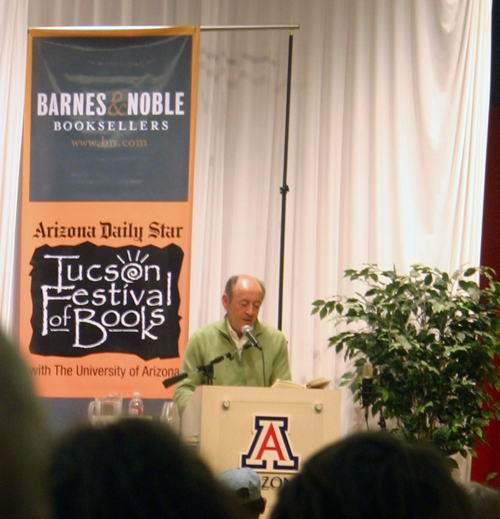
Billy Collins and Elmore Leonard at the Tucson Festival of Books

The Tucson Festival of Books began with a mystery friend—the designation is at the request of said friend—and I wandering the booths. Some monkish types tried to convince me to buy a copy of the Bhagavad Gita that I already had. We attended a nonfiction panel where one member spoke of the danger of “Not realizing the potential of the moment” and capturing “the spirit of the event” and asking “what is truth?” During the talk, I read the first 40 pages of Out of Sight.

The food tent came next, and with it most notably some excellent caramel corn:

caramel-corn2

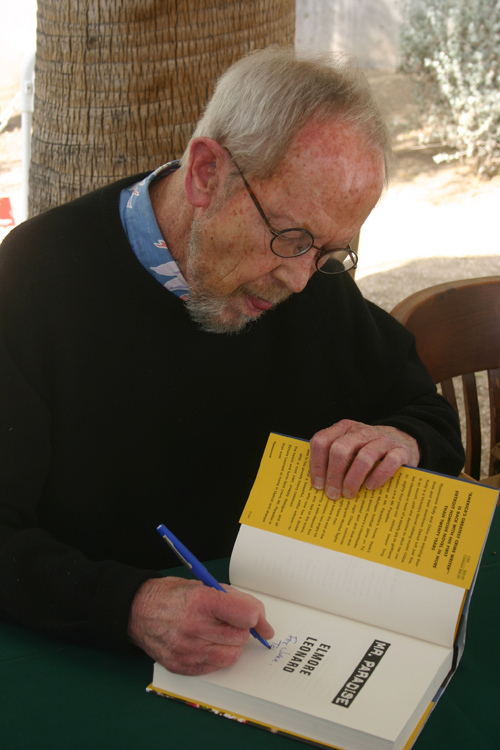
A few hundred people heard Elmore Leonard, but the guy who interviewed him wasn’t particularly skillful (with questions about Westerns—Leonard hasn’t written them in decades—and ones that boil down to, “What writers have influenced you?” His answer, which I could’ve predicted, was The Friends of Eddie Coyle; see this post) and called Leonard a “man who needs no introduction.” Then why introduce him? Anyway, Leonard did say that he shifted from writing Westerns to “Easterns” and that Arizona highways in the 50s were filled with good stories that he used in his novels and stories.elmore_leonard_signing2

The novel he’s writing now is set on the East Coast of Africa, which is a greater stretch for Leonard than some previous novels because he doesn’t know how to relate to the story as well. But his forthcoming novel, Road Dogs, will be released in May and follows the more familiar teerritory Jack Foley of Out of Sight along with a few other characters from books I haven’t read. Expect to read more about Road Dogs in this space.

Leonard’s best response came from a question about his characters’ morality or lack thereof, when Leonard said “I have a kind feeling of all my characters… I like my characters, but I think most of them are just dumb.” He’s also difficult to imitate because “you have to imitate the emotions behind them,” which too many people seem to discount. An audience member asked about redemption and Leonard answered about money; he also repeated the advice he’s given to directors of movies based on his books: When someone delivers a funny line that’s not intentionally funny, don’t cut to someone laughing. To Leonard, that’s part of what ruined the movie version of Be Cool, which is better as a book.

The last speaker on Saturday, Billy Collins was a quiet riot, knowing that the better part of jokes often consists of holding back and the better part of delivery consists of practice. His reading was like a big-deal boxing match, with a few palookas warming up the crowd before the main card that served chiefly to highlight Collins’ skill. He took Leonard’s advice by not smiling as he said, “If it’s wrong to be writing to a reader, I don’t want to be right.” Next month is apparently national poetry month, and Collins said, “If you name a day or a week or a month after something, you know it’s in decline.” There is no national TV week.

His poems were wonderful; in “Tension,” one got the impression that Collins is a rule-breaker of the best sort. He’s wry and self-aware, as in “The Trouble with Poetry:”

the trouble with poetry is
that it encourages the writing of more poetry,

[…]

And how will it ever end?
unless the day finally arrives
when we have compared everything in the world
to everything else in the world

and there is nothing left to do
but quietly close our notebooks
and sit with our hands folded on our desks

He’s contributing to the proliferation of poetry, so it’s obviously not so great a problem, and yet the poem shifts into a brief comment on life, when he mentions a book that “I carried in a side pocket of my uniform / up and down the treacherous halls of high school,” implying that perhaps poetry helped him to become a poetic thief and thus to encourage “the writing of more poetry.”billy_collins2

The tongue-in-cheek aspect continued through Collins’ poems; he read one called “On Turning Ten” that he said he wrote because he “wanted to make fun of poets who write midlife crisis death poems.” So there’s an elegy to all that’s lost upon attaining one’s tenth year. In “The Lanyard,” looking up the word “lanyard” in a dictionary functions as a “cookie nibbled by a French novelist.” The poem compares a child making a lanyard for his mother in payment for all she’s done:

She gave me life and milk from her breasts,
and I gave her a lanyard.
SHe nursed me in many a sickroom,
lifted teaspoons of medicine to my lips,
set cold face-cloths on my forehead,
and then led me out into the airy light
and taught me to walk and swim,
and I, in turn, presented her with lanyard.
Here are thousands of meals, she said,
and here is clothing and a good education.
And here is your lanyard, I replied,
which I made with a little help from a counselor.

The mock conceit reminds one of the disparity that must exist between most parents and their children, which can only be repaid by passing it on. But for Collins, the issue isn’t a heavy burden, or if it is, it should be addressed lightly, in a poem like “The Lanyard” that is aware of its own absurdity and therefore becomes more real in exchange of “thousands of meals” for a lanyard, “which I made with a little help from a counselor.”

I wish Collins’ attitude had been shared by the nonfiction panel. Alas: we can’t all be so reasonable.

If nothing else, being induced to read Collins made the Festival worthwhile. Hopefully I learned something and, to paraphrase something its participants said, this post captures the spirit of the event.

March Links: The Watchmen, Orwell, and Goldengrove

* “From Comic Book to Literary Classic:” Does The Watchmen deserve all the hype? The WSJ asks. Their answer is mostly “no,” a verdict I concur with.

* Speaking of Watchmen-related hype, Ta-Nehisi Coates summarizes my feeling toward movies:

I think I’m mostly done with comic book movies, and big budget movies in general. I don’t think (with a few exceptions) that they’re made for me. Which is fine. But the more comic book movies I see, the more I value the imaginative space created by books.

(For more on this, see Why are so many movies awful?)

* Orwell wasn’t a mensch or a lout or an ideologue in the normal sense, and trying to define him is as much a challenge today as it must have been in his time. Julian Barnes tries to make some sense of him in “Such, Such Was Eric Blair:”

All prophets risk posthumous censure, even mockery; and the Orwell we celebrate nowadays is less the predictor than the social and political analyst. Those born in the immediate postwar years grew up with the constant half-expectation that 1984 would bring all the novel described: immovable geopolitical blocs, plus brutal state surveillance and control. Today, the English may have their sluggardly couch-potato side; their liberties have been somewhat diminished, and they are recorded by CCTV cameras more often than any other nation on earth. But otherwise 1984 passed with a sigh of relief, while 1989 and the fall of the Berlin Wall brought a louder one.

Orwell believed in 1936 that “the combines can never squeeze the small independent bookseller out of existence as they have squeezed the grocer and the milkman.” That “never” was a risky call. And on a larger scale, he believed throughout World War II that peace would bring the British revolution he desired, with blood in the gutters and the “red militias…billetted in the Ritz,” as he put it in private diary and public essay. And after the revolution:

The Stock Exchange will be pulled down, the horse plough will give way to the tractor, the country houses will be turned into children’s holiday camps, the Eton and Harrow match will be forgotten….

One out of four on the vision thing; and tractors were hardly a difficult pick.

I’ve mentioned his collected Essays before and will no doubt again; even when they’re infuriating, they’re enormously clever.

* Jacket Copy reports that, 27 years after John Cheever’s death, the man is everywhere. Everywhere, that is, except for my bookshelf: I’ve never read his novels, which are on the ever-expanding “to be read” list. This week’s New Yorker also has an article about Cheever. It includes this bit:

“How lonely and unnatural man is and how deep and well-concealed are his confusions”—no wonder Cheever’s fiction is slighted in academia while Fitzgerald’s collegiate romanticism is assigned. Cheever’s characters are adult, full of adult darkness, corruption, and confusion. They are desirous, conflicted, alone, adrift. They do not achieve the crystalline stoicism, the defiant willed courage, of Hemingway’s.

Really? I’m not sure I agree with the premise that Cheever is slighted in academia, and even if I did, I don’t think I’d buy the reason stated.

* The Wall Street Journal, meanwhile, calls Cheever The Audubon of Suburbia:

“Cheever: A Life,” arriving as it does with the publication of Library of America editions of Cheever’s stories and novels, edited by Mr. Bailey, seems intended to spur a rediscovery of the author. It won’t be the first, or the last. Cheever occupies a secure place in the literature of the American dream, forming the link between Fitzgerald and Updike. The formidable achievement of his short stories alone ensures that he is destined to be the subject of periodic rediscovery, reassessment and biographical shading-in.

* Maybe I will read Francine Prose’s Goldengrove:

Prose’s book is filled with characters who comprehend their experience of the world through the lenses that art–high art, popular art, and everything in between–offers up. Even though Goldengrove tells a sad story, I found great comfort and pleasure in reading about these characters and their attachments to and imitations of art, and appreciated Myers’s identification of this kind of activity and attachment as a subject of the novel. “We learn what we were like as children from such books as The Mill on the Floss, C. S. Lewis’s Narnia stories, and Goldengrove,” he says. Our experience of art is as much a life experience as anything else.

I didn’t care for The Mill on the Floss, but the overall point is well-taken.

* The best article on Kindle economics and bookstores that I’ve seen: Digital readers will save writers and publishing, even if they destroy the book business.

* Speaking of book publishing, MobyLives reports:

Exact data on how the used book market is eroding the market for new books is hard to come by but the consensus is — it ain’t helping.

The Wall Street Journal predicted in 2005: “While the market’s size is still modest — about $600 million, or 2.8% of the $21 billion that readers spent on consumer books in 2004 — it is growing at 25% annually. Jeff Hayes, group director for InfoTrends Research Group, suggests that it could reach $2.25 billion in U.S. sales by 2010, or 9.4% of a projected $23.9 billion in consumer book sales.”

Announcement: The Tucson Festival of Books is this weekend

tucson_festival_books_tents21I’ve complained before about the dearth of literary activity in Tucson, but this weekend ought to shut me up for a while: the Tucson Festival of Books is coming to the University of Arizona campus this weekend. Preparations on the mall are underway, as shown on the right.

I’m particularly interested in Billy Collins and Elmore Leonard, who are both speaking on Saturday afternoon. Expect a report next week. If you’re in town, be sure to come!

T.C. Boyle interview for The Women: Part 1

T.C. Boyle is the author of 8 short story collections and 12 novels, including Talk Talk, The Inner Circle, Drop City, and, most recently, The Women. His new novel describes the architect Frank Lloyd Wright through the view of a fictional apprentice, Tadashi Sato, who focuses on Wright’s relationship with his three wives, his mistress, and his mother. Each influences Wright, paralleling his increasing sophistication as an artist.

Boyle spoke at Changing Hands Bookstore in Tempe on February 25. He wore red Chucks, black jeans, and a gold coat, looking a bit like the professor you imagine being even more fun at the bar after class or a faintly piratical psychologist—which, in a way, many novelists are. This interview was conducted afterwards, and the following is an edited transcript. Links have been subsequently added by me.

Jake Seliger: How’s your tour been so far?

T.C. Boyle: It’s really rewarding, huge crowds and a lot of dedicated readers. It’s wonderful, and I really love to meet the readers because I will never get over the thrill of having people liking my work and engaging with them. But I’m also exhausted. However, we are celebrating right now because this is the last gig.

JS: As I said on the phone, there’s a very interesting set of symmetries for me because I have a copy of Stories, which you signed on 2/9/99.

TCB: Wow.

JS: The very first time I went to a reading—

TCB: But it’s signed to Isaac.

JS: That’s my Dad. But I was there with him. Anyway, about your new book, which I really enjoyed, you mentioned [in his talk at Changing Hands] that there’s an obvious parallel between writing and architecture that goes on throughout The Women. There’s one scene in particular where the two come together on page 237: “He left the car running as he got out to swing open the gate, seeing the small things, the way the ditch along the drive had eroded in the previous week’s storm, the weeds crowding out the wildflowers, the iridescent blue of the damselflies threading the air…” it’s just one of these really interesting moments where you can see him looking at all these small things and see the way he might build these small ones into bigger ones.

TCB: Because he was a perfectionist and attentive to detail. Everyday he decorated the house, everyday. No matter what the season, he would send the apprentices out or he himself had tremendous energy to cut flowers or cut a branch off the tree in the winter, and always the house changing and flowing and big pots of full of things and bringing the outdoors in. And that was part of what he wanted to do.
JS: It’s interesting that you talk about a lot of the changes in the house because in some ways it seems like he went through a lot of interpersonal changes—obviously he went through a lot of changes in terms of the women he was with as well—and I think there’s a parallel there. Were you thinking consciously about that, in terms of the changing of architecture and the changing of people? It seems like a lot of that is going on in the book.

TCB: I think so.

JS: [Arizona] is very, very car centered…

TCB: Yeah, I hate that, that’s one of the reasons I left LA and moved to Santa Barbara. Where I’m living now, there’s just a village, and I can walk everywhere. I do walk everywhere. It makes your life a thousand times better because you don’t have to fight for parking spots, or worry about traffic. You just walk. You see nature. It’s just wonderful.

JS: There’s some descriptions in The Women too of Wright walking around, going on some jaunts of his own.

TCB: Yeah, he becomes my creature and my character of course, as does anybody you invent or write about. And I’m worried about the effect he has on his acolytes, what type of person he is, but irrespective of that I do believe that art has no ethical consideration. Art just stands for itself and what it is. So I admire him despite some of his personality problems. One thing I admire is that [Wright] was a nature boy.

JS: You do admire Wright, and he does have a lot of admirable qualities, and one thing I was thinking about when I was reading the book is that you see the admiration there, but he’s also not the sort of person one would want as a relative.

TCB: He would be impossible. If he were here, we wouldn’t even be able to say a word. He becomes a little bit of a satiric figure here. But I love to have it both ways in many of my stories and a book like this. Miriam, for instance. I have a lot of fun with her in a satiric way, although she’s sort of opéra bouffe, which is what his whole life seems to be—Frank Lloyd Wright with Miriam. But I also want you to feel something too… there’s a kind of dread hanging over the book, because you know that Mamah’s going to be burned because you read about it in the footnote. But you keep going backward in time, so you know you’re going to get there.

JS: It’s a reverse chronology. It’s interesting that you mention Miriam as an example of having it both ways because she’s in some ways the character who most fascinates me.

TCB: Me too. She took right over and I love her.

JS: … You’re introduced to Miriam as a harpy—

TCB: It’s going [chronologically] backwards [in time]. It gives you a chance to reflect on what loves relationships are like, when you meet someone and they’re great and you love them and then they turn sour. So when you first see Miriam and she’s this incredible harpy, this maniac, and poor Olgivanna. But then you backtrack and you see Miriam ten years earlier. I thought that was a really intriguing way to tell the story. And also it allows me to end with the tragedy of Mamah.

JS: Perhaps I was accidentally thinking of Miriam coming first because she seems to really cast a very long shadow across the first part of the book, and I’m thinking in particular of this passage: “For years now—longer than he could remember—he’d been rolling a stone up a hill, a boulder that picked up weight on each revolution like a ball of snow, and Miriam’s face was imprinted on the side of it…” you get this Sisyphean aspects of it, and I can imagine him looking at that face. To me, there’s this fascinating aspect of it, that she’s so present in his life.

TCB: Yeah, and in the actual history he seemed to be the sort of artist who needed lots of tumult in his life in order to create—to have someone to butt up against. I don’t think ever bargained for something as extreme as Miriam, because of her mental problems and her drug addiction and her grandiosity and desire to be as great as the great man that she’s allied with. Still, unlike me—

JS: I like how you add “unlike me.”

TCB: —who needs tranquility to work. I’m a little fascinated by the kind of artist who needs this tumult in order to work. The obvious metaphor, of course, is that to build a book is like building a house.
JS: You build one brick at a time or one sentence at a time.

TCB: Also, we see something. We have a vision first, and then we translate it to accomplish something concrete. He always began by just drawing a picture of a house in colored pencils.

JS: With soft lead.

TCB: With soft lead. There’s a lot of that going on to intrigue me. The other key figures I’ve written about who are the egomaniacs, Kellogg and Kinsey, were both men of science, and here I’m writing about an artist and trying to re-imagine it a bit… of course we have to stay inside writing our books and think inside our own minds. He got to do that sort of work in his drawing… but then he also got to go outside, and be physical, and work among the workers. And also, I don’t know how you work, but I’m improvisatory. You know, it just happens, it just continues to happen, step by step by slow accretion. So is he. He didn’t adhere strictly to plans over time.

JS: It’s interesting how you talk about the inside and outside, because I was listening on the way over here to an interview you did with Michael Silverblatt of Bookworm [a book radio show hosted on KCRW and available at http://www.kcrw.com/etc/programs/bw] about your last book, Talk Talk, and that you as a writer can’t live inside your head for 365 days a year, and you need that teaching aspect or going out into the world to try to stay sane.

TCB: Absolutely.

JS: So would say that he has that built into his work?

TCB: Sure. He wasn’t simply a draftsman working for somebody—he was a creator. By the way, I did Michael’s show yesterday, and it was the best one we ever did. He was such a deep reader… it’s a pleasure to meet deep readers who are really engaged with it, way beyond “I like this, I don’t like this.” It’s a much deeper experience. He was very taken with the intricate structure of The Women and how it works and what it says about levels of meaning…
We don’t know any history of an event. Any biography of somebody has its biases, even in terms of what happened on a given day, or what the events were. So you’ve got an unsteady sort of revelation of truth anyway. Then when you take it from the point of view of Tadashi, who is learning about himself. He gives it another level altogether. And then, in my view—and this is part of the fun I had with it and the humor—Tadashi apparently has delivered a manuscript or reminiscences to his grandson-in-law, O’Flaherty-San, for translation and elaboration. So he’s now reading this text and writing footnotes, and sometimes he’s very surprised by what the footnotes say. And in the course of commenting on the text, as we get into the more tragic aspects, he then begins to reflect on his own self in the footnotes. So there’s a lot going on and yet it seemed to be the proper structure for this. It just began to reveal itself to me. And I had a great deal of fun with it as a result.

JS: Have you ever read Mordecai Richler’s book Barney’s Version?

TCB: No.

JS: I ask because it’s got at least a somewhat similar structure… it’s written [from the perspective of an] old man who is partially losing his memory, and his son is going back through his memoir reading, and it’s got all these little foonotes…

TCB: So they’re having a dialog in footnotes?

JS: Yeah, in a way they are. And it’s a very funny novel… in one of your other interviews, you said you like John Barth’s The Sot-Weed Factor

TCB: It’s utterly huge in my life.

JS: How so?

TCB: It’s picaresque, and it’s wild humor. And its subversion of history is something that really appealed to me.

JS: It seems like in The Sot-Weed Factor, Ebenezer Cooke is going on this journey, if not from innocence to cynicism, then from innocence to something else. It seems like in The Women, Tadashi-san is still very much revering the master. In a way he is, but in a way he’s also subverting the master.

TCB: Yes. That’s where I got my title, when he gives this speech at the end of the introduction, and he’s trying to sum up and he gets a little out of control. He says that Wrieto-san [Tadashi’s name for Frank Lloyd Wright] is this great master we revered and we paraded through the streets, who was a philanderer and abuser, especially of the women. So that gave me a dramatic context to let him try to discover something of himself.

JS: Is there an answer about what [Tadashi] discovers [over the course of the book]? I’m taken with a footnote on page 384, when Tadashi says that he thinks Daisy Hartnett [a white woman Tadashi thinks he loves but whom Wright sends away after discovering their affair] was certainly a force of nature. It’s a fascinating footnote because Tadashi reacts to being separated from Daisy in a way that you can’t imagine Wright reacting in being separated from what he wants. Tadashi accepts it. It feels like there’s this shadow plot flowing underneath with him and Daisy, and it just pops up here and there.

TCB: Yeah. I think so. And again, this is about relationships, and reflecting on relationships. How is this different from the kind of relationship that Frank Lloyd Wright had with his women? This seems to be much deeper.

JS: It’s so short with Daisy—[Tadashi says] “I can say that Daisy Hartnett was certainly a natural force, and I too much constrained by expectation.” It seems like he’s still constrained by expectation.

TCB: It’s a cultural thing too.

JS: You’ve got your combination of three big figures—Kellogg, Kinsey, and now Wright.

TCB: Yes. And don’t forget we also have Mungo Park of Water Music and Stanley McCormick [of Riven Rock] into the mix also. But they don’t fit quite so neatly into this little box set of the egomaniacs of the 20th century.

JS: The egomaniacs and the admired ones. Both in this book, you have Tadashi, who is a superficially passive figure. I say “superficially passive” in part because of those footnotes that are constantly interposing themselves. In The Inner Circle, you’ve got [John] Milk [the first-person narrator], who’s another person who seems very passive compared to the great man. In some ways, they seem to me like Carraway figures who are separated from the big man.

TCB: It’s a good observation. A number of people have been making that connection. It’s a time-honored way of getting at the personality of some larger-than-life figure. I’m not so much interested in investing Frank Lloyd Wright and writing about him from his point of view, although we get a little bit of it because the story needed it at certain points. I think it much more fascinating to veer—like [how] The Great Gatsby works. That is, to have a character who changes and observes the great man, but you learn about the character more than about the great man. And so you learn what the effect of a guru is on some people—to give yourself up to somebody. What is the cost to you? Because obviously I would never do that. I’m a fan of a thousand artists who I love dearly. But I’m not going to give my life up for them, or I’m not going to serve them. I want to be their equal. But many people are simply followers of not only artists, but political figures—

JS: I’m thinking back to Drop City.

TCB: Yes, exactly.

JS: I think in that book you have a very clear—well, perhaps not very clear—delineation between the followers and not.

TCB: So, what happens is—as you’ll discover in your own career—when you write many books, you can look back and see what your themes and obsessions are and why you choose the particular subject or character to write about. It’s great. I could write papers on my own work. I could sit and articulate about it.

JS: I think people have written papers on your work.

TCB: They may have. Of course, I don’t do that in the abstract beforehand. I am simply an artist. I don’t want to be a man of letters. I don’t want to write anything except fiction. It’s magic. It’s magic that I love. I don’t have time for anything else.

JS: So you don’t have those Fridays like John Barth did? Have you read his collections The Friday Book and Further Fridays?

TCB: No.

JS: He also wrote essays which I think are very good… He says four days a week he writes fiction and on the Friday he—

TCB: I would love to read them. I should. Updike was one of my heroes too, and he was our foremost man of letters. And he was quite consciously doing that. I am different though. I realized this a long while ago. Even though I got my Ph.D. in 18th century British Lit and I love scholarship, to me scholarship is only a tool for me to create a story. I am much more intuitive and much more an artist than I am analytical. I discovered this and I’m running with it.

And so far I don’t see any limits or any end to that. I don’t have Fridays to write essays because I’m working on Fridays on fiction. It’s all I want to do. And I think because anything can be a story for me and any mode and anything I want to discover, I can only think about deeply if I create a fiction. There seems to be no… burn out factor. There’s no end to the material. I feel very lucky in that way.

JS: I can see that, especially where you’ve talked elsewhere about wanting to be unique each time. I think you’ve done a remarkable job—I’ve pointed out parallels [among Boyle’s works], but that’s because at an abstract enough level you can see parallels in anything.

TCB: I still want to have a new way in to each story.

JS: That seems to be what Tadashi provides you.

TCB: Because it would be very easy to write another book like The Inner Circle, where a single “I” narrator revisits his integration with the master. But I’d just done that, and I was interested in something else altogether. Of course intervening were Tooth and Claw and Talk Talk.

JS: Talk Talk has Dana, who is a very figure in that. She’s a kind of driving person, and Bridger is an enabler—

TCB: As his name suggests.

JS: Right. I suspect there’s an obvious, freshman-year analysis of the book—

TCB: No, that’s great. Don’t forget, I was there too, and I made all these connections in the book, and I was thankful for them. So I’m greatly honored that other people see these connections, and that I have a body of work in which people can compare this story or that one or this novel and that one and see threads. It’s wonderful. I’m very happy.

JS: I think I do see that, with Dana… as a powerful figure. In that book, I think she’s more powerful than Bridger, and she’s the force of it, bringing others along—well, bringing Bridger along in her wake. In [The Women], I think Miriam in a way wants to do that, but if she found someone she could do it with, I don’t think she would be happy. Or I think she would then start moving on—

TCB: Right. These are really people, who were really attracted to one another for the psychological reasons that you’re suggesting. She needed the greatest challenge possible. And so did he. And again, I have to withdraw here, and I’m not anything like this. I couldn’t imagine the writers who marry other writers. It’s your enemy sleeping in bed with you. How could you keep from choking her to death every night?

JS: I’ll ask Michael Chabon that next time I see him, because he’s married to, um—

TCB: Ayelet [Waldman]. I know them both, yeah—

JS: I’m telling Noah about the flood, then.

TCB: —that’s really strange. For me [to imagine being with someone much like him]. I mean, everybody’s different. My wife is my complete antithesis. She doesn’t want to be on stage. She’s mathematical and scientific, which I am not. Her trick is that she’s imperfect, which allows me to be perfect.

JS: That’s good. If she were here and I said, “By the way, Tom says that your imperfections allow him to be perfect,” how do you thinks she’d respond? In a Miriam way, or in a Kitty way?

TCB: Don’t forget, the wife and mother-in-law of a comedian always take a beating. It’s just the way it is. She knows, she understands. I’ll tell you, this is true though, about Frau Boyle and myself, sometimes she goes on tour with me, and I do my little shtick, like tonight—I develop a shtick. You want to hear me being very original about the book—it’s in the first couple days. So, I just speak spontaneously to the crowd and then I do the reading and then I take questions. But there is a shtick involved—it might be a little different each night, but I’m going to come to the same basic points and make the same basic jokes. It’s like the tenth night, and she’s heard it ten times, and I see the whole crowd, and they’re roaring with laughter. Then I see her, and she’s roaring with laughter as well! And that’s true love.

JS: I can’t see Miriam laughing at herself if someone is making jokes at her expense.

TCB: No. She took herself very seriously.

JS: In some ways, given how Kitty is portrayed, it’s hard to see her laughing at herself too.

TCB: No, of course not. She did fly a bit outside the parameters of what I was interested in in this book. She was probably the most difficult to deal with. First of all, she wasn’t going to be one of the principal players—I knew that. But it’s a little difficult too because what is she but a victim? You’d have to do an entire book about that relationship to really do justice to that sort of personality. And also a personality where a couple had married… young, for sex, joy and love. And he moved on. He went for progressively more sophisticated women. Mamah was a feminist, she was college educated as Kitty was not—and as he was not—and Miriam had her European connections and spoke fluent German. This was something exotic. It was something to aspire to. So I think he would have moved on in any case.

EDIT: You can read part two of the interview here.

T.C. Boyle interview for The Women: Part 1

T.C. Boyle is the author of 8 short story collections and 12 novels, including Talk Talk, The Inner Circle, Drop City, and, most recently, The Women. His new novel describes the architect Frank Lloyd Wright through the view of a fictional apprentice, Tadashi Sato, who focuses on Wright’s relationship with his three wives, his mistress, and his mother. Each influences Wright, paralleling his increasing sophistication as an artist.

Boyle spoke at Changing Hands Bookstore in Tempe on February 25. He wore red Chucks, black jeans, and a gold coat, looking a bit like the professor you imagine being even more fun at the bar after class or a faintly piratical psychologist—which, in a way, many novelists are. This interview was conducted afterwards, and the following is an edited transcript. Links have been subsequently added by me.

Jake Seliger: How’s your tour been so far?

T.C. Boyle: It’s really rewarding, huge crowds and a lot of dedicated readers. It’s wonderful, and I really love to meet the readers because I will never get over the thrill of having people liking my work and engaging with them. But I’m also exhausted. However, we are celebrating right now because this is the last gig.

JS: As I said on the phone, there’s a very interesting set of symmetries for me because I have a copy of Stories, which you signed on 2/9/99.

TCB: Wow.

JS: The very first time I went to a reading—

TCB: But it’s signed to Isaac.

JS: That’s my Dad. But I was there with him. Anyway, about your new book, which I really enjoyed, you mentioned [in his talk at Changing Hands] that there’s an obvious parallel between writing and architecture that goes on throughout The Women. There’s one scene in particular where the two come together on page 237: “He left the car running as he got out to swing open the gate, seeing the small things, the way the ditch along the drive had eroded in the previous week’s storm, the weeds crowding out the wildflowers, the iridescent blue of the damselflies threading the air…” it’s just one of these really interesting moments where you can see him looking at all these small things and see the way he might build these small ones into bigger ones.

TCB: Because he was a perfectionist and attentive to detail. Everyday he decorated the house, everyday. No matter what the season, he would send the apprentices out or he himself had tremendous energy to cut flowers or cut a branch off the tree in the winter, and always the house changing and flowing and big pots of full of things and bringing the outdoors in. And that was part of what he wanted to do.
JS: It’s interesting that you talk about a lot of the changes in the house because in some ways it seems like he went through a lot of interpersonal changes—obviously he went through a lot of changes in terms of the women he was with as well—and I think there’s a parallel there. Were you thinking consciously about that, in terms of the changing of architecture and the changing of people? It seems like a lot of that is going on in the book.

TCB: I think so.

JS: [Arizona] is very, very car centered…

TCB: Yeah, I hate that, that’s one of the reasons I left LA and moved to Santa Barbara. Where I’m living now, there’s just a village, and I can walk everywhere. I do walk everywhere. It makes your life a thousand times better because you don’t have to fight for parking spots, or worry about traffic. You just walk. You see nature. It’s just wonderful.

JS: There’s some descriptions in The Women too of Wright walking around, going on some jaunts of his own.

TCB: Yeah, he becomes my creature and my character of course, as does anybody you invent or write about. And I’m worried about the effect he has on his acolytes, what type of person he is, but irrespective of that I do believe that art has no ethical consideration. Art just stands for itself and what it is. So I admire him despite some of his personality problems. One thing I admire is that [Wright] was a nature boy.

JS: You do admire Wright, and he does have a lot of admirable qualities, and one thing I was thinking about when I was reading the book is that you see the admiration there, but he’s also not the sort of person one would want as a relative.

TCB: He would be impossible. If he were here, we wouldn’t even be able to say a word. He becomes a little bit of a satiric figure here. But I love to have it both ways in many of my stories and a book like this. Miriam, for instance. I have a lot of fun with her in a satiric way, although she’s sort of opéra bouffe, which is what his whole life seems to be—Frank Lloyd Wright with Miriam. But I also want you to feel something too… there’s a kind of dread hanging over the book, because you know that Mamah’s going to be burned because you read about it in the footnote. But you keep going backward in time, so you know you’re going to get there.

JS: It’s a reverse chronology. It’s interesting that you mention Miriam as an example of having it both ways because she’s in some ways the character who most fascinates me.

TCB: Me too. She took right over and I love her.

JS: … You’re introduced to Miriam as a harpy—

TCB: It’s going [chronologically] backwards [in time]. It gives you a chance to reflect on what loves relationships are like, when you meet someone and they’re great and you love them and then they turn sour. So when you first see Miriam and she’s this incredible harpy, this maniac, and poor Olgivanna. But then you backtrack and you see Miriam ten years earlier. I thought that was a really intriguing way to tell the story. And also it allows me to end with the tragedy of Mamah.

JS: Perhaps I was accidentally thinking of Miriam coming first because she seems to really cast a very long shadow across the first part of the book, and I’m thinking in particular of this passage: “For years now—longer than he could remember—he’d been rolling a stone up a hill, a boulder that picked up weight on each revolution like a ball of snow, and Miriam’s face was imprinted on the side of it…” you get this Sisyphean aspects of it, and I can imagine him looking at that face. To me, there’s this fascinating aspect of it, that she’s so present in his life.

TCB: Yeah, and in the actual history he seemed to be the sort of artist who needed lots of tumult in his life in order to create—to have someone to butt up against. I don’t think ever bargained for something as extreme as Miriam, because of her mental problems and her drug addiction and her grandiosity and desire to be as great as the great man that she’s allied with. Still, unlike me—

JS: I like how you add “unlike me.”

TCB: —who needs tranquility to work. I’m a little fascinated by the kind of artist who needs this tumult in order to work. The obvious metaphor, of course, is that to build a book is like building a house.
JS: You build one brick at a time or one sentence at a time.

TCB: Also, we see something. We have a vision first, and then we translate it to accomplish something concrete. He always began by just drawing a picture of a house in colored pencils.

JS: With soft lead.

TCB: With soft lead. There’s a lot of that going on to intrigue me. The other key figures I’ve written about who are the egomaniacs, Kellogg and Kinsey, were both men of science, and here I’m writing about an artist and trying to re-imagine it a bit… of course we have to stay inside writing our books and think inside our own minds. He got to do that sort of work in his drawing… but then he also got to go outside, and be physical, and work among the workers. And also, I don’t know how you work, but I’m improvisatory. You know, it just happens, it just continues to happen, step by step by slow accretion. So is he. He didn’t adhere strictly to plans over time.

JS: It’s interesting how you talk about the inside and outside, because I was listening on the way over here to an interview you did with Michael Silverblatt of Bookworm [a book radio show hosted on KCRW and available at http://www.kcrw.com/etc/programs/bw] about your last book, Talk Talk, and that you as a writer can’t live inside your head for 365 days a year, and you need that teaching aspect or going out into the world to try to stay sane.

TCB: Absolutely.

JS: So would say that he has that built into his work?

TCB: Sure. He wasn’t simply a draftsman working for somebody—he was a creator. By the way, I did Michael’s show yesterday, and it was the best one we ever did. He was such a deep reader… it’s a pleasure to meet deep readers who are really engaged with it, way beyond “I like this, I don’t like this.” It’s a much deeper experience. He was very taken with the intricate structure of The Women and how it works and what it says about levels of meaning…
We don’t know any history of an event. Any biography of somebody has its biases, even in terms of what happened on a given day, or what the events were. So you’ve got an unsteady sort of revelation of truth anyway. Then when you take it from the point of view of Tadashi, who is learning about himself. He gives it another level altogether. And then, in my view—and this is part of the fun I had with it and the humor—Tadashi apparently has delivered a manuscript or reminiscences to his grandson-in-law, O’Flaherty-San, for translation and elaboration. So he’s now reading this text and writing footnotes, and sometimes he’s very surprised by what the footnotes say. And in the course of commenting on the text, as we get into the more tragic aspects, he then begins to reflect on his own self in the footnotes. So there’s a lot going on and yet it seemed to be the proper structure for this. It just began to reveal itself to me. And I had a great deal of fun with it as a result.

JS: Have you ever read Mordecai Richler’s book Barney’s Version?

TCB: No.

JS: I ask because it’s got at least a somewhat similar structure… it’s written [from the perspective of an] old man who is partially losing his memory, and his son is going back through his memoir reading, and it’s got all these little foonotes…

TCB: So they’re having a dialog in footnotes?

JS: Yeah, in a way they are. And it’s a very funny novel… in one of your other interviews, you said you like John Barth’s The Sot-Weed Factor

TCB: It’s utterly huge in my life.

JS: How so?

TCB: It’s picaresque, and it’s wild humor. And its subversion of history is something that really appealed to me.

JS: It seems like in The Sot-Weed Factor, Ebenezer Cooke is going on this journey, if not from innocence to cynicism, then from innocence to something else. It seems like in The Women, Tadashi-san is still very much revering the master. In a way he is, but in a way he’s also subverting the master.

TCB: Yes. That’s where I got my title, when he gives this speech at the end of the introduction, and he’s trying to sum up and he gets a little out of control. He says that Wrieto-san [Tadashi’s name for Frank Lloyd Wright] is this great master we revered and we paraded through the streets, who was a philanderer and abuser, especially of the women. So that gave me a dramatic context to let him try to discover something of himself.

JS: Is there an answer about what [Tadashi] discovers [over the course of the book]? I’m taken with a footnote on page 384, when Tadashi says that he thinks Daisy Hartnett [a white woman Tadashi thinks he loves but whom Wright sends away after discovering their affair] was certainly a force of nature. It’s a fascinating footnote because Tadashi reacts to being separated from Daisy in a way that you can’t imagine Wright reacting in being separated from what he wants. Tadashi accepts it. It feels like there’s this shadow plot flowing underneath with him and Daisy, and it just pops up here and there.

TCB: Yeah. I think so. And again, this is about relationships, and reflecting on relationships. How is this different from the kind of relationship that Frank Lloyd Wright had with his women? This seems to be much deeper.

JS: It’s so short with Daisy—[Tadashi says] “I can say that Daisy Hartnett was certainly a natural force, and I too much constrained by expectation.” It seems like he’s still constrained by expectation.

TCB: It’s a cultural thing too.

JS: You’ve got your combination of three big figures—Kellogg, Kinsey, and now Wright.

TCB: Yes. And don’t forget we also have Mungo Park of Water Music and Stanley McCormick [of Riven Rock] into the mix also. But they don’t fit quite so neatly into this little box set of the egomaniacs of the 20th century.

JS: The egomaniacs and the admired ones. Both in this book, you have Tadashi, who is a superficially passive figure. I say “superficially passive” in part because of those footnotes that are constantly interposing themselves. In The Inner Circle, you’ve got [John] Milk [the first-person narrator], who’s another person who seems very passive compared to the great man. In some ways, they seem to me like Carraway figures who are separated from the big man.

TCB: It’s a good observation. A number of people have been making that connection. It’s a time-honored way of getting at the personality of some larger-than-life figure. I’m not so much interested in investing Frank Lloyd Wright and writing about him from his point of view, although we get a little bit of it because the story needed it at certain points. I think it much more fascinating to veer—like [how] The Great Gatsby works. That is, to have a character who changes and observes the great man, but you learn about the character more than about the great man. And so you learn what the effect of a guru is on some people—to give yourself up to somebody. What is the cost to you? Because obviously I would never do that. I’m a fan of a thousand artists who I love dearly. But I’m not going to give my life up for them, or I’m not going to serve them. I want to be their equal. But many people are simply followers of not only artists, but political figures—

JS: I’m thinking back to Drop City.

TCB: Yes, exactly.

JS: I think in that book you have a very clear—well, perhaps not very clear—delineation between the followers and not.

TCB: So, what happens is—as you’ll discover in your own career—when you write many books, you can look back and see what your themes and obsessions are and why you choose the particular subject or character to write about. It’s great. I could write papers on my own work. I could sit and articulate about it.

JS: I think people have written papers on your work.

TCB: They may have. Of course, I don’t do that in the abstract beforehand. I am simply an artist. I don’t want to be a man of letters. I don’t want to write anything except fiction. It’s magic. It’s magic that I love. I don’t have time for anything else.

JS: So you don’t have those Fridays like John Barth did? Have you read his collections The Friday Book and Further Fridays?

TCB: No.

JS: He also wrote essays which I think are very good… He says four days a week he writes fiction and on the Friday he—

TCB: I would love to read them. I should. Updike was one of my heroes too, and he was our foremost man of letters. And he was quite consciously doing that. I am different though. I realized this a long while ago. Even though I got my Ph.D. in 18th century British Lit and I love scholarship, to me scholarship is only a tool for me to create a story. I am much more intuitive and much more an artist than I am analytical. I discovered this and I’m running with it.

And so far I don’t see any limits or any end to that. I don’t have Fridays to write essays because I’m working on Fridays on fiction. It’s all I want to do. And I think because anything can be a story for me and any mode and anything I want to discover, I can only think about deeply if I create a fiction. There seems to be no… burn out factor. There’s no end to the material. I feel very lucky in that way.

JS: I can see that, especially where you’ve talked elsewhere about wanting to be unique each time. I think you’ve done a remarkable job—I’ve pointed out parallels [among Boyle’s works], but that’s because at an abstract enough level you can see parallels in anything.

TCB: I still want to have a new way in to each story.

JS: That seems to be what Tadashi provides you.

TCB: Because it would be very easy to write another book like The Inner Circle, where a single “I” narrator revisits his integration with the master. But I’d just done that, and I was interested in something else altogether. Of course intervening were Tooth and Claw and Talk Talk.

JS: Talk Talk has Dana, who is a very figure in that. She’s a kind of driving person, and Bridger is an enabler—

TCB: As his name suggests.

JS: Right. I suspect there’s an obvious, freshman-year analysis of the book—

TCB: No, that’s great. Don’t forget, I was there too, and I made all these connections in the book, and I was thankful for them. So I’m greatly honored that other people see these connections, and that I have a body of work in which people can compare this story or that one or this novel and that one and see threads. It’s wonderful. I’m very happy.

JS: I think I do see that, with Dana… as a powerful figure. In that book, I think she’s more powerful than Bridger, and she’s the force of it, bringing others along—well, bringing Bridger along in her wake. In [The Women], I think Miriam in a way wants to do that, but if she found someone she could do it with, I don’t think she would be happy. Or I think she would then start moving on—

TCB: Right. These are really people, who were really attracted to one another for the psychological reasons that you’re suggesting. She needed the greatest challenge possible. And so did he. And again, I have to withdraw here, and I’m not anything like this. I couldn’t imagine the writers who marry other writers. It’s your enemy sleeping in bed with you. How could you keep from choking her to death every night?

JS: I’ll ask Michael Chabon that next time I see him, because he’s married to, um—

TCB: Ayelet [Waldman]. I know them both, yeah—

JS: I’m telling Noah about the flood, then.

TCB: —that’s really strange. For me [to imagine being with someone much like him]. I mean, everybody’s different. My wife is my complete antithesis. She doesn’t want to be on stage. She’s mathematical and scientific, which I am not. Her trick is that she’s imperfect, which allows me to be perfect.

JS: That’s good. If she were here and I said, “By the way, Tom says that your imperfections allow him to be perfect,” how do you thinks she’d respond? In a Miriam way, or in a Kitty way?

TCB: Don’t forget, the wife and mother-in-law of a comedian always take a beating. It’s just the way it is. She knows, she understands. I’ll tell you, this is true though, about Frau Boyle and myself, sometimes she goes on tour with me, and I do my little shtick, like tonight—I develop a shtick. You want to hear me being very original about the book—it’s in the first couple days. So, I just speak spontaneously to the crowd and then I do the reading and then I take questions. But there is a shtick involved—it might be a little different each night, but I’m going to come to the same basic points and make the same basic jokes. It’s like the tenth night, and she’s heard it ten times, and I see the whole crowd, and they’re roaring with laughter. Then I see her, and she’s roaring with laughter as well! And that’s true love.

JS: I can’t see Miriam laughing at herself if someone is making jokes at her expense.

TCB: No. She took herself very seriously.

JS: In some ways, given how Kitty is portrayed, it’s hard to see her laughing at herself too.

TCB: No, of course not. She did fly a bit outside the parameters of what I was interested in in this book. She was probably the most difficult to deal with. First of all, she wasn’t going to be one of the principal players—I knew that. But it’s a little difficult too because what is she but a victim? You’d have to do an entire book about that relationship to really do justice to that sort of personality. And also a personality where a couple had married… young, for sex, joy and love. And he moved on. He went for progressively more sophisticated women. Mamah was a feminist, she was college educated as Kitty was not—and as he was not—and Miriam had her European connections and spoke fluent German. This was something exotic. It was something to aspire to. So I think he would have moved on in any case.

EDIT: You can read part two of the interview here.
Life: Horror stories

“We love horror stories because they’re not happening to us yet.”

—T.C. Boyle in a soon-to-be-published interview

February 2009 Links: Book Reviews, Literary Blogs, Amazon, and more

* The Washington Post’s Book World supplement won’t be available in print any longer. Terry Teachout expresses my sentiments in Omega/alpha:

I’ve said it before, but it’s worth repeating: it is the destiny of serious arts journalism to migrate to the Web. This includes newspaper arts journalism. Most younger readers–as well as a considerable number of older ones, myself among them–have already made that leap. Why tear your hair because the Washington Post has decided to bow to the inevitable? The point is that the Post is still covering books, and the paper’s decision to continue to publish an online version of Book World strikes me as enlightened, so long as the online “magazine” is edited and designed in such a way as to retain a visual and stylistic identity of its own.

* Cynthia Crossen answers a reader’s question about books that change lives in much the way I would: by saying that no book can be the universal answer, since the right book has to find the right person at the right time.

(But, for the record, I’ll give my personal answers: Robert Penn Warren’s All the King’s Men and Tolkien’s Lord of the Rings.)

EDIT: * Cynthia Crossen part duex:”How People Reveal Their True Colors” asks for literary expression of how masters treat slaves in a Hegelian sense. My answer to the headline, however, would tend to be that no one behavior or situation tends to reveal “true” colors, whatever those are.

* Patrick Kurp on blogs:

Maintaining a literary blog is like keeping a big band on the road during the waning days of swing music. The audience is aging and no longer guaranteed. They look elsewhere for diversion – television, bop or R&B. As the boss, you make sure the arrangements are in order, payroll is met, dates booked, players rehearsed and reasonably sober. You’re not Basie or Goodman but you’re a professional and people count on you. You’re never certain who’s listening, if anyone, but you still love the music and probably aren’t suited for doing anything else. Tomorrow’s another gig and you’ll be there.

* Strained metaphors and questionable analogies probably capsize the argument of “Technology is Heroin,” but I’d also never considered the entertainment evolution ideas contained within.

* Nigel Beale lists ten wicked quotes on writing.

* Sad:

Why is the newspaper business losing readers at an accelerated rate while television viewership is stronger than ever? Here’s a speculative idea: A tipping point has been passed in the competition between print and screen that has been under way since the beginnings of broadcast TV and now continues with video and other media.

Consumers are increasingly avoiding newspapers — and books, too — because the text mode is now used so infrequently that it can feel like a burden. People are showing a clear preference for a fully formed video experience that comes ready to play on a screen, requiring nothing but our passive attention.

* Tim Berners-Lee, who in effect invented the Internet as we know it, on Net Neutrality, which might turn out to be one of the essential rights of our age.

* I wrote about Amazon.com and prices earlier, and a New Yorker review piqued my interest in Robert Crawford’s The Bard: Robert Burns, A Biography. The book’s retail price is $35; Amazon.com is selling it for $23 as of Feb. 7. I called the Barnes and Nobel and Borders in Tucson, both of which are selling it for… $35.

This is why Amazon.com is doing so well. On a side not, Farhad Manjoo argues that “Amazon’s amazing e-book reader is bad news for the publishing industry” on Slate. He’s probably right, but, like Microsoft’s operating system hegemony with Windows, it’s unlikely that much will change the larger trends he’s examining.

* CNet’s “Tech coalition launches sweatshop probe” offers yet another reason to like the excellent Unicomp Keyboards (as discussed previously in Product Review: Unicomp Customizer keyboard, or, the IBM Model M reborn):

A tech industry watchdog plans to investigate conditions at a Chinese hardware factory that supplies IBM, Microsoft, Dell, Lenovo and Hewlett-Packard, following a damning report on conditions there by a human-rights organization.

The National Labor Committee report, “High Tech Misery in China,” said these tech giants use Meitai Plastic and Electronics, a keyboard supplier that operates a factory that “dehumanizes young workers.”

In response, the Electronic Industry Citizenship Coalition (EICC), a self-regulating body set up by tech companies, will carry out a third-party audit into the working conditions at the factory, IBM told ZDNet UK on Friday.

* Although it has almost nothing to do with books, Mark Bowden’s “The Last Ace” is a compelling piece of contrarian reporting that demonstrates the trade-off issues frequently left out of other articles, like Fred Kaplan’s “The Air Force doesn’t need any more F-22s.” The F-22 is among the most maligned expenses in the federal budget, and yet Bowden implies that buying more of them might paradoxically mean they’re less likely to be used.

American air superiority has been so complete for so long that we take it for granted. For more than half a century, we’ve made only rare use of the aerial-combat skills of a man like Cesar Rodriguez, who retired two years ago with more air-to-air kills than any other active-duty fighter pilot. But our technological edge is eroding—Russia, China, India, North Korea, and Pakistan all now fly fighter jets with capabilities equal or superior to those of the F-15, the backbone of American air power since the Carter era. Now we have a choice. We can stock the Air Force with the expensive, cutting-edge F‑22—maintaining our technological superiority at great expense to our Treasury. Or we can go back to a time when the cost of air supremacy was paid in the blood of men like Rodriguez.

See this post for more about the issue, including Bowden’s clarifying point that he’s not arguing for the F-22, but rather trying to understand the consequences from not building more of them. In other words, he’s evaluating trade-offs. Nonetheless, it’s hard not to read between the lines of his article and come away with the impression that building more F-22s would be a smart idea, even if it might not actually be the optimal use of resources.

(Why “almost nothing” to do with books? Because although this isn’t between hard covers—yet—Bowden wrote a number of fascinating foreign policy and nonfiction books, including Guests of the Ayatollah: The Iran Hostage Crisis: The First Battle in America’s War with Militant Islam and, perhaps most famously, Black Hawk Down.)

John Updike’s “Lifeguard”

John Updike’s “Lifeguard” is too deep a story to be so clever and too clever to be so deep. In it, an unnamed lifeguard and theology student beautifully conflates his two worlds, living in one nine months of the year and the other for that last quarter around the sun, to paraphrase the narrator. In sitting on the chair, he surveys the beach as one might imagine God surveying the Earth, with the power to save lives. The distance of the guard from his patrons and the slightly patronizing air he must assume to protect them from themselves is in part the image of God in the lifeguard, raised up and looking down, just as the narrator’s perspective takes on the heady quality of one above the fray. Maybe he just hasn’t joined it: “Someday my alertness will bear fruit; from near the horizon there will arise, delicious, translucent, like a green bell above the water, the call for help, the call, a call, it saddens me to confess, that I have yet to hear.”

Is there any point in summarizing the short story? It’s five pages, and in explicating its beauty I destroy it, like stepping on the flower I mean to pick. “Lifeguard” might answer that “Swimming offers a parable. We struggle and thrash, and drown; we succumb, even in despair, and float, and are saved.” We thrash to describe what we experience, too, and like the student, we’re lost in metaphoric clouds, and yet aware:

You are offended that a divinity student lusts? What prigs the unchurched are! Are not our assaults on the supernatural lascivious, a kind of indecency? If only you knew what de Sadian degradations, what frightful psychological spelunking, our gentle transcendentalist professors set us to, as preparation for our work, which is to shine in darkness.

I feel that my lust makes me glow; I grow cold in my chair, like a torch of ice, as I study beauty. I have studied much of it, wearing all styles of bathing suit and facial expression, and have come to this conclusion:

But to read the conclusion, you’ll have to read the story. It’s not a conclusion that, I suspect, many are likely to agree with, but it’s oddly appropriate, like a recipe mixing cocoa and chili that nonetheless works. And notice the little binaries and paradoxes Updike sets: the lust in the student of God, the “torch of ice,” the shining in darkness not thanks to goodness, but thanks to that lust. Updike would probably chastise me for confusing divinity and theology students, if there is some difference between the two I’m unaware of it. But I am aware of how astonishing this story is, even to me, the person who usually doesn’t like short stories because they end just as I’m finally getting into them.

In another, the eponymous lifeguard thinks that “I wake at odd hours and in the shuddering darkness and silence and feel my death rushing toward me like an express train” It shows a bit of the Northeastern character of the story, since California, Arizona, or Florida, the first two being places I’ve lived, wouldn’t have express trains—they’d have cars, and you’d be crushed by an SUV rather than an express train. “Lifeguard,” published in 1961, came to me by way of the New Yorker’s “Picked-Up Pieces: Moments from a half century of Updike.” In 2006, “My Father’s Tears” was published, and it included this paragraph:

We did not foresee, that moment on the platform as the signal bells a half mile down the tracks warned of my train’s approach, that within a decade passenger service to Philadelphia would stop, and that eventually the station, like stations all across the East, would be padlocked and boarded up. It stood on its empty acre of asphalt parking space like an oversized mausoleum. All the life it had once contained was sealed into silence, and for most of the rest of the century it ignominiously waited, in this city where progress was slow, to be razed.

Perhaps Updike was aware of the anachronistic train metaphor when he used it. Or perhaps he wanted us to place “Lifeguard” in an earlier era, one where religion was more likely to be taken seriously by serious people instead of being usurped by the unbelievers like me or the foolish Sarah Palins of the world. Or Updike recalled his own youth in “Lifeguard,” standing with his father on the soon-to-be-closed platform. Regardless of its temporal meaning, that sentence—“I wake at odd hours and in the shuddering darkness and silence and feel my death rushing toward me like an express train”—could so easily be a cliche, and yet in the context it’s not. “Lifeguard” is a short story that makes me suddenly appreciate the short story and perceive the potential of the form, and it makes me want to read more short stories and more Updike in the search for other works as profound and clever. I’ve not read much Updike—friends keep recommending the Rabbit novels and The Witches of Eastwick, which I keep delaying for no articulated reason beyond the lengthening of my “to read” pile, which grows faster than the time in which those books are to be read. Updike, however, might now have taken a shortcut to the top.

John Updike's "Lifeguard"

John Updike’s “Lifeguard” is too deep a story to be so clever and too clever to be so deep. In it, an unnamed lifeguard and theology student beautifully conflates his two worlds, living in one nine months of the year and the other for that last quarter around the sun, to paraphrase the narrator. In sitting on the chair, he surveys the beach as one might imagine God surveying the Earth, with the power to save lives. The distance of the guard from his patrons and the slightly patronizing air he must assume to protect them from themselves is in part the image of God in the lifeguard, raised up and looking down, just as the narrator’s perspective takes on the heady quality of one above the fray. Maybe he just hasn’t joined it: “Someday my alertness will bear fruit; from near the horizon there will arise, delicious, translucent, like a green bell above the water, the call for help, the call, a call, it saddens me to confess, that I have yet to hear.”

Is there any point in summarizing the short story? It’s five pages, and in explicating its beauty I destroy it, like stepping on the flower I mean to pick. “Lifeguard” might answer that “Swimming offers a parable. We struggle and thrash, and drown; we succumb, even in despair, and float, and are saved.” We thrash to describe what we experience, too, and like the student, we’re lost in metaphoric clouds, and yet aware:

You are offended that a divinity student lusts? What prigs the unchurched are! Are not our assaults on the supernatural lascivious, a kind of indecency? If only you knew what de Sadian degradations, what frightful psychological spelunking, our gentle transcendentalist professors set us to, as preparation for our work, which is to shine in darkness.

I feel that my lust makes me glow; I grow cold in my chair, like a torch of ice, as I study beauty. I have studied much of it, wearing all styles of bathing suit and facial expression, and have come to this conclusion:

But to read the conclusion, you’ll have to read the story. It’s not a conclusion that, I suspect, many are likely to agree with, but it’s oddly appropriate, like a recipe mixing cocoa and chili that nonetheless works. And notice the little binaries and paradoxes Updike sets: the lust in the student of God, the “torch of ice,” the shining in darkness not thanks to goodness, but thanks to that lust. Updike would probably chastise me for confusing divinity and theology students, if there is some difference between the two I’m unaware of it. But I am aware of how astonishing this story is, even to me, the person who usually doesn’t like short stories because they end just as I’m finally getting into them.

In another, the eponymous lifeguard thinks that “I wake at odd hours and in the shuddering darkness and silence and feel my death rushing toward me like an express train” It shows a bit of the Northeastern character of the story, since California, Arizona, or Florida, the first two being places I’ve lived, wouldn’t have express trains—they’d have cars, and you’d be crushed by an SUV rather than an express train. “Lifeguard,” published in 1961, came to me by way of the New Yorker’s “Picked-Up Pieces: Moments from a half century of Updike.” In 2006, “My Father’s Tears” was published, and it included this paragraph:

We did not foresee, that moment on the platform as the signal bells a half mile down the tracks warned of my train’s approach, that within a decade passenger service to Philadelphia would stop, and that eventually the station, like stations all across the East, would be padlocked and boarded up. It stood on its empty acre of asphalt parking space like an oversized mausoleum. All the life it had once contained was sealed into silence, and for most of the rest of the century it ignominiously waited, in this city where progress was slow, to be razed.

Perhaps Updike was aware of the anachronistic train metaphor when he used it. Or perhaps he wanted us to place “Lifeguard” in an earlier era, one where religion was more likely to be taken seriously by serious people instead of being usurped by the unbelievers like me or the foolish Sarah Palins of the world. Or Updike recalled his own youth in “Lifeguard,” standing with his father on the soon-to-be-closed platform. Regardless of its temporal meaning, that sentence—“I wake at odd hours and in the shuddering darkness and silence and feel my death rushing toward me like an express train”—could so easily be a cliche, and yet in the context it’s not. “Lifeguard” is a short story that makes me suddenly appreciate the short story and perceive the potential of the form, and it makes me want to read more short stories and more Updike in the search for other works as profound and clever. I’ve not read much Updike—friends keep recommending the Rabbit novels and The Witches of Eastwick, which I keep delaying for no articulated reason beyond the lengthening of my “to read” pile, which grows faster than the time in which those books are to be read. Updike, however, might now have taken a shortcut to the top.

New Kindle, same problems

As seemingly every media outlet has mentioned, Amazon released the Kindle 2.0, and the press fawning is more notable than the gadget itself. To be sure, its stats are impressive, and maybe this one will be better made than 1.0. Its big problem, however, still looms: DRM and software. You don’t own a “book” bought with the Kindle—you have a temporary license for it. If Amazon discontinues the Kindle, or declares bankruptcy, or has any of the myriad of other problems companies are susceptible to, your investment is as solid as the wireless transmission of the book itself.

To quote an earlier post:

Gizmodo tells us that we might or might not be able to resell “books” that have been “purchased” with the Kindle or Sony eBook reader. The scare quotes are intentional because whether the physical embodiment of words or the words themselves constitute a “book” hasn’t been decided, and whether one has actual control over a Kindle or eBook hasn’t been decided either. From my initial comments:

Furthermore, I know that I’ll be able to read my copy of A Farewell to Alms in ten years. Will Amazon still produce the Kindle or Kindle store in ten years? Maybe, maybe not. I have books printed a hundred years ago that have journeyed places I doubt their original owners could’ve fathomed. Most Kindles will end up in consumer electronic junk heaps in five years, just like most iPods.

To be sure, in a few circumstances the Kindle is superior, and Megan McArdle enumerates some here: “I don’t think it’s for everyone, but for a subset of people like me–people who buy a lot of new books every year, so that the half-price books make it cost effective, people who spend a lot of time in transit, and people who travel a lot for work–it’s a godsend.” If you’re moving every six months, or likely to be deployed on a Navy ship or sub, or tend to read any given book only once but read many books per year, the Kindle might be worthwhile. For the rest of us, its End User Licensing Agreement (EULA) makes it terribly unappealing.