The Magician King — Lev Grossman

I love The Magicians. I like The Magician King.

The Magician King has many of the qualities that made The Magicians special: twists on standard fantasy tropes; impressive language in many sentences, although not quite as impressive its predecessor; and a consistent willingness to instill a sense of wonder about the world and about what the characters might be able to accomplish. Happy endings aren’t foreordained, which is to be admired.

But The Magician King lacks the surprising urgency of The Magicians and feels like another lap after the race is over. Consider a passage from page six, after Quentin, Julia, Janet, and Eliot have returned to Fillory as benevolent if distracted monarchs. They’re hunting a magic hare who can see the future, which sounds like a bum gig; life’s excitement comes from not knowing what happens next:

The point wasn’t really to catch the hare. The point was—what was the point? What were they looking for? Back at the castle their lives were overflowing with pleasure. There was a whole staff whose job it was to make sure that every day of their lives was absolutely perfect. It was like being the only guests at a twenty-star hotel that you never had to leave.

Does this sound familiar? If you read The Magicians, it should, since The Magicians is endlessly concerned with the questing for meaning that can’t be imposed from without. I’m going to spend the next couple paragraphs looking at similar rhetoric from The Magicians; if this sort of thing bores you, skip to the paragraph that starts with a series of bolded words. Rhetorical comparisons aren’t everyone’s forte, but they’re essential for understanding how The Magician King is too often a rehash of the same problems presented in The Magicians but without a new angle on those problems.

In The Magicians, Quentin thinks:

You just had to get some idea of what mattered and what doesn’t, and how much, and try not to be scared of the stuff that doesn’t. Put it in perspective. Or something like that. Otherwise what was the point?

“What was the point” is a decent question for someone with an adolescent temperament. Quentin spends the rest of the novel ineffectively trying to answer the question. He doesn’t answer it, not perfectly, but somewhat understands that you make the “point” for yourself. You make meaning for yourself, because meaning can’t be imposed by external social forces, and death itself gives meaning to life. One would think the sheer realism of The Magicians’s end would show Quentin as much. When the party reaches Ember’s Tomb at the end of The Magicians, two large, evidently hostile animals charge, and we find our hero panicking: “Oh my God, Quentin thought, this is really happening. This is really happening.” You don’t make something merely by saying it, although the prospect of death wakes him from the upper-middle class reverie where he’s been living. Death, especially violent death, is not beautiful or noble—it is terrifying and shocking. It reminds you of why so many people move to the quiet suburbs and get jobs in middle management. Beats the hell out of getting the hell beaten out of you.

The repetition of “This is really happening” is like a refrain designed to keep Quentin awake. He watches the death of the Ferret and thinks, “He wasn’t ready for this. This wasn’t what he’d come here for.” He wasn’t ready then and he never will be—unlike Alice, whose maturity contrasts with his throughout The Magicians. She says, “[…] don’t talk to me about death. You don’t know anything about it.” She’s right. The disappointing thing is that he still doesn’t in The Magician King. He hasn’t internalized the central fact that death is connected to finding meaning because death and its predecessor aging can’t be avoided. I am not opposed to characters who don’t realize this; I am opposed to characters who don’t realize this, have a series of events that should cause an epiphany, appear to realize it, and then forget that they’ve realized it in the next novel.

Early in The Magicians, Quentin is still in a mostly mundane reality and thinks that

He’d spent too long being disappointed by the world—he’d spent so many years pining for something like this, some proof that the real world wasn’t the only world, and coping with the overwhelming evidence that it in fact was. He wasn’t going to be suckered in just like that. It was like finding a clue that somebody you’d buried and mourned wasn’t really dead after all.

And now, in the time of The Magician King, he’s a king in Fillory and still dissatisfied. You can’t get no satisfaction, Quentin, but the problem eventually shifts from the world’s fault to your own. He is still “looking for something else. He didn’t know what it was.” You were looking for something else in Brooklyn and now you’re looking for something else in Fillory. No one, not even a Seeing Hare, can tell Quentin. Whenever “Life was good” for Quentin, it was time to fuck it up for no particular reason. Seeing someone fuck up a perfectly good life through understandable hubris and dumb social dynamics is thrilling and sickening once, as it is in Donna Tartt’s The Secret History. Seeing someone do so twice is just daft.

In The Magician King, Quentin is still in awe of where he is: “You really knew you were in a magical fantasy otherworld when a beautiful woman wearing a skimpy dress made of leaves suddenly jumped out of a tree.” But he’s been seeing magic constantly for, presumably, years. Are talking animals not enough? Still, the novel’s fidelity to the bureaucratic grit of life is impressive—Janet says of Dryads, “I spend enough time listening to them bitch about land allocation.” Ruling Fillory becomes associated with petty zoning squabbles of the sort you can find at City Hall if you’re so inclined. That Grossman includes such ideas is part of what makes The Magicians and its sequel special. But it also raises expectations, and when he includes something that’s wrong, it’s disquieting, as with this:

Fillory wasn’t England. For one thing the population was tiny—there couldn’t have been more than ten thousand humans in the whole country, plus that many talking animals and dwarves and spirits and giants and such.

A population that small wouldn’t be sufficient to get Fillory into medieval-level specialization; at best, 20,000 people could support a slightly elevated hunter-gatherer lifestyle. Plus, why is the land so infertile that it can only feed 10,000 people? Prior to the Industrial Revolution, the Malthusian paradox ensured that populations grew to approximately the size of the agricultural capacity of the land itself. With only 10,000 people and 10,000 magical non-people, there couldn’t have been much arable land, and certainly not enough to sustain any kind of specialization network (for more on similar topics, see, for example, Mokyr’s The Enlightened Economy and Clark’s A Farewell to Alms, along with the vast corpus of economic and historical literature about historical development patterns and the Industrial Revolution). Fillory is big enough to have a navy. Countries of 20,000 don’t even have an army, and the knowledge necessary to grow a ship-building industry must span thousands if not hundreds of thousands of people. Suddenly, I’m jolted out of a fictional universe and into the various economics textbooks I’ve read by a seemingly trivial detail.

And this isn’t the only scene of questionable economics. Quentin goes on a quest to collect taxes from an outer island with a single-digit population, and while there an uncanny resident says:

Tomorrow I’ll take you out to see the gold beetles. They’re amazing: they eat dirt and poop out gold ore. Their nests are made of gold!

If a source of apparently infinite gold is available via a short ship ride from the mainland, the logical thing to do is to begin farming and set up a trading route. Why hasn’t anyone done so? The Spanish imported so much silver from the Americas in the age of colonization that some economists believe it caused inflation in the European economy. People are very good at acting on incentives and exploiting commodities. Why aren’t the Fillorians? It could be because the novel states that there’s an abundance of everything, again for reasons that aren’t obvious, but that’s not a terribly satisfying explanation.

You could get over these errors and others by waving your hand and saying, “It’s magical”—Quentin says “Magic was part of the ecosystem”—but it still rankles in a book devoted to showing the “real” side of magical living. These are minor details, but they stand out in a book devoted to realism.

Quentin has a small-l liberal, educated, and modern knowledge of how group formation works (a hilarious sample of his liberalism: “If I were a Fillorian I would depose me as an aristocratic parasite”), as shown by his unwillingness to identify with the putative patriotism embodied in a tapestry

that depicted a marvelously appointed griffin frozen in the act of putting a company of foot soldiers to flight. It was supposed to symbolize the triumph of some group of long-dead people over some other group of long-dead people whom nobody had liked, but for some reason the griffin had cocked its head to one side in the midst of its rampage and was gazing directly out of its woven universe at the viewer as if to say, yes, granted, I’m good at this. But is it really the best use of my time?

“The triumph of some group of long-dead people over some other group of long-dead people:” your own fears, prejudices, and beliefs will one day probably appear the same way to many others. Are your beliefs so strong and important that the issues they represent will still be important 100 years from now? Five hundred? A thousand? Or will you be another long-dead person of limited importance, with ridiculous but firmly held allegiances to minor causes that turn out to be historical blips?

Many parts of The Magician King are funny: “Quentin had some idea that Australians were fun-loving and easy-going, and if that was true he could see why Poppy had gotten the hell out of Australia.” Quentin draws his sword, but he has trouble: “Nothing made you look like more of a dick than standing there trying to find the end of your scabbard with the tip of your sword.” Although The Magician King is, alas, less sexed than its predecessor, one doesn’t need Freud to realize Quentin is talking about more than a sword, especially when he thinks: “Let somebody else be the hero. He’d had his happy ending” (if that isn’t enough, Eliot also makes a sword-related double entendre on page 29). I guess it takes a while to recharge after a happy ending, even for a king.

The humor both conceals and reveals vital truths. Quentin has never really been the hero, so thinking he should let somebody else be the hero is presumptuous. This is played for comedy, and successfully. The comedy naturally and appropriately falls away as the novel progresses into darker days, much as it does in The Magicians, but the jokes make the novel fun. So do the moments of self-recognition, like this one:

Quentin couldn’t think who Benedict reminded him of until he realized that this was what he had probably looked like to other people when he was sixteen. Fear of everybody and everything, hidden behind a mask of contempt, with the greatest contempt of all reserved for himself

Quentin’s diagnosis the problems of others more easily than his own: “Maps of places, rather than actual places, were obviously where young master Benedict preferred to live.” Replace “Maps of places” with “The Internet” and “actual places” with “the real world,” and you’ve got a decent description of a lot of contemporary adolescents. The novel is very good at these mappings onto the real world.

The “good,” however, is not consistent; even the novel’s first line has an “almost, but not quite” feel: “Quentin rode a gray horse with white socks named Dauntless.” Is Dauntless the name of the white socks or the gray horse? The context makes it obvious, but I had to double check. There are also reflections of contemporary society—the quartet, who are listlessly hunting a magic rabbit, “moved in silence, slowly, together but lost in their separate thoughts.” Rather like people and their cell phones: if you look around, you’ll often find couples or groups all of whom are looking into their phones, as if searching crystal balls for answers. Do they find them? I sometimes want to ask. But I don’t. Usually.

There aren’t as many of those spectacular sentences as there were in The Magicians; there are some, like this: “Casually, like she was calling over a waiter, Julia summoned a tiny songbird to her wrist and raised it up to her ear.” Nice: the metaphor makes magic seem normal, a part of her life, which contrasts with Quentin’s continued shock at magic. The magic blends with the technological; a paragraph later, Quentin notices how Julia “was always giving and getting little secret messages from the talking animals. It was like she was on a different wireless network from the rest of them.” Talking animals and wireless networks correspond to fantasy/fairy tale and to science fiction / literary fiction, but these two sentences join them. If you’ve ever accidentally tried connecting an 802.11b device to an 802.11n network, you’ll understand the frustration of knowing that everyone around you can use, theoretically, up to 130 Mbs / second while you’re stuck at 11 Mbs / second (Grossman makes the technological metaphorical; I extend the metaphor). A few days ago, my class was talking about James Baldwin’s short story “Sonny’s Blues,” and I wrote on the board that music functions like TCP/IP. Did anyone notice? I’m not sure.

The wireless network comparison reminds me of this description from The Magicians, of Eliot: “That guy was a mystery wrapped in an enigma and crudely stapled to a ticking fucking time bomb. He was either going to hit somebody or start a blog.” The equivalence between hitting someone and starting a blog, which one senses many do because they wish they had the courage to hit someone, is so biting, so surprising. More surprising than the wireless network, however appropriate the wireless network comparison is.

Grossman hides a lot in a small space. The Magician King opens in Fillory while The Magicians closes in New York. That gap is filled in swiftly: “But then he and the others had pulled themselves together again and gone back to Fillory. They faced their fears and their losses and took their places on the four thrones of Castle Whitespire and were made kings and queens.” There’s a whole novel in those lines. The passage is also strange because pulling themselves together has never been a strong suite for the collected magicians; they seem much better at tearing each other pointlessly apart.

You could argue that much of this review consists of quibbles, small points, and things easily ignored. You’d be partially right. Taken on their own, many of the things I’ve written about are unimportant. Taken together, they begin to form a pattern. I don’t expend this kind of energy on every good but somewhat disappointing book that comes my way; most I don’t write about at all, let alone at this length. I’m writing about this one because of how good The Magicians was. You don’t hold a college athlete, even an accomplished one, to the same standards as an Olympian, and The Magician King should be competing at the Olympic level but instead settles for keeping one eye on the NCAA rankings, hoping to make it to Nationals. That’s not quite ambitious enough, however impressive competing at the college level might be.

In The Magicians, Julia was an object of Quentin’s misdirected adolescent lust at the start and reappeared at the end, riding a broomstick and rescuing Quentin from himself. Quentin does need to be rescued from himself routinely; this pattern holds in The Magician King. Hell, Julia even says, “Sometimes you just have to do things, Quentin [. . .] You spend too much of your time waiting.” Yes. We know.

Her story takes up a large narrative chunk of The Magicians, which is really two threads in two separate time registers: Quentin’s, moving forward on his self-conscious quest, and Julia’s regarding her progression as a magician outside the Brakebills track. But her story lacks urgency. In an interview, Grossman said: “It was almost an engineering project to retrofit that particular timeline. Because in Magician King, we go over the same period of time that happened in The Magicians, and we fit Julia’s story in there.” The engineering shows where it should be hidden, and, more than that, it feels. Since you—the reader—already know Julia becomes a magician, there’s not much narrative tension until the scene where she loses some of her humanity (which I won’t describe further here, though it’s shocking and powerful). Otherwise, she’s going through a bizarro-world version of what Quentin has already done. Since we know she learns magic, the means of getting there aren’t all that important. Neither are the various somewhat arbitrary hoops she goes through, which resemble the spiraling downward of despair one sees in drug addiction narratives. The culmination of the narrative is strong, but the getting there is too long and feels too much like padding. Or engineering, if you prefer.

More on that in the next section.

Don’t read the rest of this post if spoilers irritate you. A friend wrote to say this, and only this, in an e-mail with the subject line “Just finished the Magician King:”

Magical fox-rape cum… really???!!!

The worst.

I’m actually not opposed to the scene my friend is referencing: it is hard to read and vile, but then so is rape, and rape is part of the world, and the world should be the novelist’s subject. I think my friend is fixated on a scene she would’ve respected or accepted in a different context—a context that was a main story, not a subsidiary one. The scene is the culmination of Julia’s powers and makes us understand what she’s given up, so to speak, to get where she is. It’s a powerful point. But the temporal shifting of the scene, from Julia’s distant past to her present, isn’t as important as it should be because it’s grafted onto Quentin’s saving Fillory quest. The Julia story should’ve been told in its own book, with its own details and tensions, and the larger Magician King story should’ve been a third, standalone novel. Conflating them makes an awkward chimera of a novel.

So we get a somewhat ungainly hybrid, with the false crescendo of the fox-God rape being a prelude to the true ending. It doesn’t work as well as it should. Which isn’t to say the scene doesn’t work at all: it does. It’s only disappointing because of the sense that the scene and its story could’ve been so much better—like The Magician King itself. The novel is good. As I said in the first line of this review, I like it. But The Magician King doesn’t have that essential feeling, that power, that grip that made me say to friends who like fantasy or want book recommendations, “Heard of Lev Grossman’s The Magicians? No? Get a copy.” Now those friends have heard of Lev Grossman, and they want to know how the new ones is. I tell them it’s okay—and it is—but I also ask: have you already read Philip Pullman? Ursula K. le Guin? Tolkien? Elmore Leonard? If not, start there. I wish Quentin had new problems. The world is full of unmet needs and desires. Why can’t he realize that? Read The Magician King if you have the time and inclination. But literature is very big, life is short, and sometimes incredible writers don’t produce the book you most hope for.

Reading How Fiction Works

I finished re-reading How Fiction Works a couple days ago—it is always a good time to re-read How Fiction Works—and realized that, every time I read it, I recognize a few more of the author-characters it mentions. This time, Effi Briest caught my eye: what was once another blank reference, noted and moved past, had now become freighted with meanings and impressions. The experience reminded me of how I used to feel going into bookstores or libraries. The real question for the younger me was, “How can anyone possibly make decisions among ten of thousands of choices?” There were so many books with authors I’d never heard of. How do you find the one you want to read among all of them? By reading thousands of dust jackets?

Now, I scan the shelves of bookstores and see more than names and cover art: this writer I’ve already read and didn’t like; this one I’ve already read and liked, but I’ve read all her work; this one I heard about through a blog post; this other one appeared on Bookworm and made his book sound boring. The challenge has changed from merely knowing something about what’s on the shelves to finding something I could actually want to read among many books I know I don’t want to read.

When I first read How Fiction Works in 2008, I didn’t stop at every reference to an author I didn’t know because I never would’ve gotten through the damn thing. Plus, as much as I love Wood’s criticism, I’ve also realized how different our tastes are; Wood quotes from Adam Smith writing in the eighteenth century regarding how writers use suspense to keep interest and says, “But the novel soon showed itself willing to surrender the essential juvenility of plot […]” I find that deeply wrong: a novel without plot is veering close to badly done philosophy. So many, though by no means all, of the novels he loves aren’t likely to have much in the way of plot. When I read amateur writing, I often notice the lack of any plot and often suggest the writer think about things like what the main character is reacting to, what the main character wants and why he can’t get it, what subsidiary characters want, and so on. A writer doesn’t, of course, need to be able to answer every one of those questions, but I get the impression a lot of beginning writers don’t ask them.

Wood actually comes very close to suggesting something similar when he writes

The unpractised novelist cleaves to the static, because it is much easier to describe than the mobile: it is getting these people out of the aspic of arrest and mobilised in a scene that is hard. When I encounter a prolonged ekphrasis like the parody above, I worry, suspecting that the novelist is clinging to a handrail and is afraid to push out.

But Wood’s definition of “push out” is probably different from mine, even if the ailment he diagnoses is the same. And it’s amazing to realize just how many of the things I inchoately knew before I read How Fiction Works are discussed, described, dissected, elaborated in the book. And now, as I said, when I come back to it, I find my gaps in knowledge filled in. Here’s another example of that, this time dealing with a critic:

Gabriel Josipovici discusses Beckett in [. . .] On Trust (2000). He points out that Foucault liked to quote from The Unnameable, as evidence of the death of the author: ‘No matter who is speaking, someone says, no matter who is speaking,’ wrote Beckett. Josipovici comments that Foucault forgets that ‘it is not Beckett saying this but one of his characters, and that the point about that character is that he is desperately seeking to discover who speaks, to recover himself as more than a string of words, to wrest an “I” from “someone says”.’

Gabriel Josipovici: he wrote Whatever Happened to Modernism?, a book I half-liked and wrote about at the link. Maybe one day I’ll read the book, recognize every reference, and wonder whatever happened to that person who first read it in a relative fog.

Bullshit politics in literary criticism: an example from Deceit, Desire, and the Novel

I’m reading Rene Girard’s great book Deceit, Desire, and the Novel (1961) and came to this:

Dostoyevsky [was] convinced [. . .] that Russian forms of experience were in advance of those in the West. Russia has passed, without any transitional period, from traditional and feudal structures to the most modern society. She has not known any bourgeois interregnum. Stendhal and Proust are the novelists of this interregnum. They occupy the upper regions of internal mediation, while Dostoyevsky occupies its lowest {Girard “Deceit”@44}.

By 1961, it was pretty damn obvious that Stalin had murdered millions of his own citizens in the 1920s and 1930s. It was pretty damn obvious that Russia was a totalitarian country, which I don’t really buy as a form of “the most modern society.” The political reality is simpler: Russian hasn’t really passed “from traditional and feudal structures.” It’s still a dictatorship, only this time it’s softer: Vladimir Putin doesn’t rule with an iron fist and direct gulags, but by co-opting putatively democratic institutions and controlling TV stations. Except for a period in the 1990s and perhaps the early 2000s, before Putin had completely solidified control, Russia was something other an autocracy or something close to it.

So a sentence like “Russia has passed, without any transitional period, from traditional and feudal structures to the most modern society” is about as wrong as one can get outside of the hard sciences, if a phrase like “most modern society” is to have any meaning at all. Given the choice between Russia and countries with “bourgeois interregnums” that manage not to murder their citizens, I’ll choose the latter any time. Most of the analysis in Deceit, Desire, and the Novel is so good that I pass over the occasional gaffe like the one above, but it’s symptomatic of where literary criticism goes wrong, which most often happens when it touches politics or economics in a naive or uninformed way.

If you’re interested in this sort of criticism, read Alan Sokal and Jean Bricmont’s Fashionable Nonsense: Postmodern Intellectuals’ Abuse of Science.

Edit: On the subject of Russia’s slide into autocracy, see also Russia’s Economy: Putin and the KGB State.

Sexting and society: How do writers respond?

In a post on the relative quality of fiction and nonfiction, I mentioned that fiction should be affected by how society and social life changes. That doesn’t mean writers should read the news de jour and immediately copy plot points, but it does mean paying attention to what’s different in contemporary attitudes and expression. I got to thinking about “sexting,” an unfortunate but useful portmanteau, because it’s an example of a widespread, relatively fast cultural change enabled by technology. (Over a somewhat longer term, “From shame to game in one hundred years: An economic model of the rise in premarital sex and its de-stigmatisation” describes “a revolution in sexual behaviour,” which may explain why a lot of contemporary students find a lot of nineteenth century literature dealing with sexual mores to be tedious.)

Laws that cover sexting haven’t really caught up with what’s happening on the ground. Penelope Trunk wrote a an article called The Joys of Adult Sexting, in which she does it and thinks:

And what will his friends think of me? Probably nothing. Because they have women sending nude photos of themselves. It’s not that big a deal. You know how I know? Because the state of Vermont, (and other states as well) is trying to pass a law that decriminalizes sending nude photos of oneself if you are underage. That’s right: For years, even though kids were sending nude photos of themselves to someone they wanted to show it to, the act was illegal—an act of trafficking in child pornography.

But sending nude photos is so common today that lawmakers are forced to treat it as a mainstream courting ritual and legalize it for all ages.

Sending a naked photo of yourself is an emotionally intimate act because of the implied trust you have in the recipient. When you act in a trusting way—like trusting the recipient of the photo to handle it with care and respect—you benefit because being a generally trusting person is an emotionally sound thing to do; people who are trusting are better judges of character.

Trunk’s last paragraph explains why, despite all the PSAs and education and whatever in the world, people are going to keep doing it: because it shows trust, and we want significant others to prove their trust and we want to show significant others we trust them. You can already imagine the dialogue in a novel: “Why won’t you send me one? Don’t you trust me?” If the answer is yes, send them; if the answer is no, then why bother continuing to date? The test isn’t fair, of course, but since when are any tests in love and lust fair?

Over time, as enough kids of legislators and so forth get caught up in sexting scandals and as people who’ve lived with cell phone cameras grow up, I think we’ll see larger change. For now, the gap between laws / customs and reality make a fruitful space for novels, even those that don’t exploit present circumstances well, like Helen Shulman’s This Beautiful Life. Incorporating these kinds of social changes in literature is a challenge and will probably remain so; as I said above, that doesn’t mean novelists should automatically say, “Ah ha! Here’s today’s headlines; I’m going to write a novel based on the latest sex scandal/shark attack/celebrity bullshit,” but novelists need to be aware of what’s going on. I wrote a novel called Asking Alice that got lots of bites from agents but no representation, and the query letter started like this:

Maybe marriage would be like a tumor: something that grows on you with time. At least that’s what Steven Deutsch thinks as he fingers the ring in his pocket, trying to decide whether he should ask Alice Sherman to marry him. Steven is almost thirty, going on twenty, and the future still feels like something that happens to other people. Still, he knows Alice won’t simply agree to be his long-term girlfriend forever.

When Steven flies to Seattle for what should be a routine medical follow up, he brings Alice and hits on a plan: he’ll introduce her to his friends from home and poll them about whether, based on their immediate judgment, he should ask Alice. But the plan goes awry when old lovers resurface, along with the cancer Steven thought he’d beaten, and the simple scheme he hoped would solve his problem does everything but.

Asking Alice is asking questions about changes in dating and marriage; if you write a novel today about the agonies of deciding who to marry with the metaphysical angst such a choice engendered in the nineteenth century, most people would find that absurd and untrue: if you get married to a Casaubon, you divorce him and end up in about the same circumstance as you were six months before you started. But a lot of people still get married or want to get married, and the question is still important even if it can’t drive the plot of a novel very well. It can, however, provide a lot of humor, and that’s what Asking Alice does.

A lot of literature, like a lot of laws, is also based on the premise that women don’t like sex as much as men, don’t or won’t seek it out, and are automatically harmed by it or wanting it. This is a much more tenuous assertion than it used to be, especially as women write directly about sex. A novel liked Anita Shreve’s Testimony, discussed extensively by Caitlin Flanagan here and by me here, engages that idea and finds it somewhat wanting. So does the work of Belle de Jour (now revealed as Dr. Brooke Magnanti), who basically says, “I worked as a hooker for a long time, didn’t mind it, and made a shit ton of money because I made a rational economic decision.” A lot of academic fiction premised on professors having sex with students examines the idea that female students can want/use sex just as much as men; this is how Francine Prose’s Blue Angel works, and Prose is a canny observer of what’s going on and how it connects to the past.

Note that women wrote all these examples, which I don’t think is an accident, since they’re probably less likely to put other women on pedestals than men are. I’ve been reading a lot of sex memoirs / novels written by women (Never the Face; Nine and a Half Weeks; two of Mary Karr’s memoirs, which are good but overrated; Abby Lee (British sex blogger); Elisabeth Eaves’ Bare) in part because I want to write better female characters. After reading a lot of this stuff, I’m even less convinced than I was that there are stereotypically “male” or “female” ways of thinking or writing about the world, but knowledge itself never hurts and I don’t regret the time spent. On a similar note, Janice Radway’s Reading the Romance is totally fascinating, even when Radway tries to explain away retrograde features of romances or how women are often attracted to high-powered, high-status men.

She write in a time before sexting, but I wonder if she’s thought about doing a Young Adult version using similar methodology today. For writers and others, sexting shows that teenagers can make their own decisions as people too, even if those are arguably bad decisions. To me, this is another generational gap issue, and one that will probably close naturally over time. One older agent said on the phone that maybe I needed a younger agent, because her assistant loved Asking Alice but she didn’t want to rep it.

Damn.

I’m old enough to have lived through a couple medium-scale social changes: when I was in high school, people still mostly talked to each other on the phone. In college, people called using cell phones and often communicated via IM. After college, I kept using phones primarily for voice, especially to arrange drinks / quasi-dates, until I realized that most girls have no ability to talk on the phone anymore (as also described Philip Zimbardo and the ever-changing dynamics of sexual politics). As I result, I’d now use text messages if I were arranging drinks and so forth. Around the time I was 23, I realized that even if I did call, women would text back. That doesn’t mean one should race out and change every phone conversation in a novel that features a contemporary 19-year-old to a text conversation (which would be tedious in and of itself; in fiction I write, I tend not to quote texts very often), but it’s the kind of change that I register. Things changed between the time I was 16 and 23.

I’m in the McLuhan, “the medium changes what can be said,” which means that the text is probably changing things in ways not immediately obvious or evident. Sexting is one such way; it lowers the cost of transmission of nude pictures to the extent that you can now do so almost instantly. Laws are predicated on the idea that balding, cigar-chomping, lecherous 40-year-old men will try and coerce 16-year-old girls outside cheer practice, not ubiquitous cell phone cameras. Most parents will instinctively hate the cigar-chomping 40-year-old. They will not hate their own 14-year-old. So you get for all sorts of amusement where laws, putative morals, conventional wisdom, technology, and desire meet. Still, when pragmatics meet parents, expect parental anger / protectiveness to win for the moment but not for all time. Nineteenth and twentieth century American culture is not the only kind out there. As Melvin Konner wrote in The Evolution of Childhood:

Contrary to some claims of cultural historians, anthropologists find that liberal premarital sex mores are not new for a large proportion of the cultures of the ethnological record and that liberal sexual mores and even active sexual lives among adolescents do not necessarily produce pregnancies. In fact, a great many cultures permit or at least tolerate sex play in childhood (Frayser 1994). Children in these cultures do not play ‘doctor’ to satisfy their anatomical curiosity—they play ‘sex.’ They do play ‘house’ as Western children do, but the game often includes pretend-sex, including simulated intercourse. Most children in non-industrial cultures have opportunities to see and hear adult sex, and they mimic and often mock it.

Perhaps our modern aversion to sex among adolescents is in part because of the likelihood of pregnancy, economic factors, and others. Given the slow but real outcry from places like the Economist and elsewhere, this might eventually change. That’s pretty optimistic, however. A lot of social and legal structures merely work “good enough,” and the justice system is certainly one of those: we’ve all heard by now about cases where DNA evidence resulted in exoneration of people accused of murder or rape. So maybe we’re now heading towards a world in which laws about sexting are unfair, especially given current practice, but the laws remain anyway because the law doesn’t have to be optimal: it has to be good enough, and most people over 18 probably don’t care much about it unless it happens to be their son or daughter who gets enmeshed in a legal nightmare for behavior that doesn’t result in tangible harm.

Something like a quarter to a third of American adults have smoked pot, but we still have anti-pot laws. America can easily afford moral hypocrisy, at least for now, and maybe sexting will be something like weed: widely indulged in, a rite of passage, and something not likely to result in arrest unless you happen to be unlucky or in the wrong situation at the wrong time. The force generation the prohibition—that is, parents engaging in daughter-guarding—might be much stronger than the force of individual rights, utilitarianism, or pragmatic observations about the enforcement of laws against victimless crimes that do not result in physical harm.

There’s more of the legal challenges around this in Ars Technica’s article “14-year old child pornographers? Sexting lawsuits get serious,” which should replace “serious” with “ridiculous.” In the case, a 14-year-old girl sent a 14-year-old boy a video of herself masturbating, and then her family sued his. But how does a 14-year-old be guilty of the sexual exploitation of children,” as is claimed by the girl’s family—if a 14 year old can’t consent to consent to this kind of activity, then a 14-year old also can’t have the state of mind necessary to exploit another one. Paradoxes pile up, of the sort described in Regulating Sex: The Politics of Intimacy and Identity, where the writers show how the age of consent has been rising as the age of being tried as an adult has been falling. Somewhere inside that fact, or pair of facts, there’s a novel waiting to be written.

Questions like “What happens when people do things sexually that they’re not supposed to? How does the community respond? How do they respond?” are the stuff novelists feed on. They motivate innumerable plots, ranging from the beginnings of the English novel at Pamela and Clarissa all the way to the present. When Rose and Pinkie are first talking to each other in Brighton Rock, Rose lies about her age: ” ‘I’m seventeen,’ she said defiantly; there was a law which said a man couldn’t go with you before you were seventeen.” Brighton Rock was published in 1938. People have probably been evading age-of-consent laws for as long as there have been such laws, and they will probably continue to do so—whether those laws affect sex or depictions of the body.

Adults have probably been reinforcing prohibitions for as long as they’ve existed. Consider this quote, from the Caitlin Flanagan article about Testimony linked above:

Written by a bona fide grown-up (the author turned 63 last fall), Testimony gives us not just the lurid description of what a teen sex party looks like, but also an exploration of the ways that extremely casual sex can shape and even define an adolescent’s emotional life. One-night stands may be perfectly enjoyable exercises for two consenting adults, but teenagers aren’t adults; in many respects, they are closer to their childhoods than to the adult lives they will eventually lead. Their understanding of affection and friendship, and most of all their innocent belief, so carefully nurtured by parents and teachers, that the world rewards kindness and fairness, that there is always someone in authority to appeal to if you are being treated cruelly or not included in something—all of these forces are very much at play in their minds as they begin their sexual lives.

In Testimony, the sex party occurs at the fictional Avery Academy; Shreve imagines Siena, the girl at the center of the event, as a grifter, eager to exploit her new status as victim so that she can write a killer college essay about it, or perhaps even appear on Oprah. For the most part, the boys are callous and self-serving.

Flanagan has no evidence whatsoever that “teenagers aren’t adults” other than bald assertion. That “they are closer to their childhoods than to the adult lives they will eventually lead” has more to do with culture than with biology, as Robert Epstein argues in The Case Against Adolescence: Rediscovering the Adult in Every Teen and Alice Schlegel and Herbert Barry argue in Adolescence: An Anthropological Inquiry, and even then, it depends on when a particular person hits puberty, how they react, and how old they are; nineteen-year olds are probably closer to their adults selves than thirteen-year olds. Saying that teenagers believe, according to an ethos created by teachers, that “the world rewards kindness and fairness,” indicates that Flanagan must have had a very different school experience than I did or a lot of other people did (for more, see “Why Nerds are Unpopular.”) As I recall, school was capricious, arbitrary, and often stupid; the real world rewards fulfilling the desires of others, whether artistically, financially, sexually, or otherwise, while the school world rewards jumping through hopes and mindless conformity. If I don’t like the college I go to, I can transfer; if I don’t like my job, I can quit; if I don’t like some other milieu, I leave it. In contrast, school clumps everyone together based on an accident of geography.

In Testimony, Shreve misses or chooses not to emphasize that Sienna enjoys the attention, and she’s not actually got much beyond that. She says that “I”m going to start a new life. I can be, like, Sienna. I can whoever I want” {Shreve “Testimony”@27}. In Rob’s voice, Sienna is described this way:

I remember that Sienna started moving to the beat, a beer in her hand, as if she were in a world of her own, just slowly turning this way and that, and moving her hips to the music, and little by little the raucous laughter started to die down, and we were all just watching her. She was the music, she was the beat. Her whole little body had become this pure animal thing. She might have been dancing alone in her room. She didn’t look at any of us, even as she seemed to be looking at all of us. There was no smile on her face. If it was a performance, it was an incredible one. I don’t think anyone in the room had ever seen anything like it. She was in this light-blue halter top with these tight jeans. The heels and her little jacket were gone already. You just knew. Looking at her, you just knew.

She took off her own clothes, and “We watched as she untied her halter top at the neck. The blue cloth fell to reveal her breasts. They were beautiful and firm and rounded like her face. You knew at that moment you were in for good [. . .]” Later, he says “It was group seduction of the most powerful kind.” Given how Mike, the headmaster, describes the video in the first section, it’s hard to see Sienna as lacking agency, or someone who’s coerced into her actions. That, in the end, is what I think makes the Caitlin Flanagans of the world so unhappy: if the Siennas will perform their dances and give it up freely and happily, does that mean other girls will have to chase the market leader? Will they have to acknowledge that a reasonably large minority of girls like the action, like the hooking up, like the exploring? If so, a lot of Western narratives about femininity go away, if they haven’t already. If you’re a novelist, you have to look at the diversity of people out there and the diversity of their desires. Shreve does this quite well. So does Francine Prose in Blue Angel. If you’re writing essays / polemics, though, you can questionable claim that teenagers are closer to their childhood selves all you want.

I like Flanagan’s writing because she’s good at interrogating what’s going on out there, but I’m not the first to notice her problems with politics; William Deresiewicz is more concise than I am when he writes Two Girls, True and False, but the point is similar. Flanagan wants to imply that all people, or all girls, are the same. They aren’t. The ones unhappy with the hookup culture are certainly out there, and they might be the majority. But the Siennas are too. To deny them agency because they’re 14 is foolish. Matthew, J. Dot’s father, says that “The irony was that if a few kids had done something similar at the college, they’d be calling it an art film.” He’s right. Things don’t magically change at 18. Our culture and legal system are designed around the fiction that everything changes at 18, when it actually does much earlier. The gap between puberty and 18, however, is a fertile ground for novelists looking for cultural contradictions.

This Beautiful Life — Helen Schulman

I heard about This Beautiful Life in a New York Times review and immediately worried: the novel sounded similar to the novel I’m working on that doesn’t have a title (I’m referring to it as “The Teacher Novel”). But reading This Beautiful Life makes me happy because the Teacher Novel is definitely not worse and almost certainly better. This Beautiful Life is too frequently boring; it’s disconnected from itself (the very short first and last chapters are effective and engaging, however). Anita Shreve’s Testimony and Tom Perrotta’s Election cover similar territory far, far better.

Other comparisons work too. Reading the first long section of This Beautiful Life, which belongs to Liz, the mother, made me reread the first three chapters of The Great Gatsby, because Gatsby isn’t just better, it’s on a whole different plane, even though it’s also covering the banal problems of rich New Yorkers. Gatsby retains its ability to amaze, especially at how deftly Fitzgerald transitions from scene to scene. He’s so damn technically good that 1) I wonder / doubt if I’ll ever do anything as good and 2) Schulman looks unfortunate in comparison (funnily enough, Jake, the 15-year-old boy, reads Gatsby towards the end; I wonder if he learns anything).

Schulman avoids transitions by not writing much in scenes. There are some good sentences (one example: Liz, Jake’s mother, notes his height and says that “It was as if, suddenly, three extra vertebrae had been added to the staircase of his spine”) and amusing bits, but most of the novel isn’t composed of scenes, and the writing isn’t quite enough to make up for that. I feel like I’m reading weekend New York Times articles on overly yoga-ified Upper East Siders. The novel lacks the fiery pop at the end of Election‘s chapters, as it does tension. The father, Richard, has the strongest section, mostly because he actually does something, instead of sitting around being acted on.

Like Testimony, This Beautiful Life has the problem of having a single, main event, without any other plot points or subsidiary issues, but Testimony has more voice. It has more knowledge of itself. This Beautiful Life also got a moral problem: a 13-year-old girl named Daisy sends a 15-year-old guy named Jake a sex tape, and he forwards it to one person. Who cares? She did it willingly, and although she’s young it’s apparent she has sufficient knowledge and agency of what she’s doing to make the question of her agency unimportant. The novel is set in 2003, which is essential: if it were set closer to the present, the idea of a sex tape becoming a social conflagration beyond the confines of high school would be wildly improbable.

I feel like the New York Times reviewer, Maria Russo, read an entirely different book than I did, or hasn’t read This Beautiful Life’s predecessors. Schulman teaches in New York, and I wonder if getting the cover of the book review was a sweetheart deal with Russo, her agent, and/or the book review editor (if so, I’d love such a deal). Not everything that makes the NYT Book Review cover is aesthetically or intellectually interesting (here I’m thinking of Angelology, an utterly forgettable book). Russo assume that social and cultural mores are permanent (“What can the future hold for unformed, vulnerable kids who bumble their way into the lowliest realm of the permanent record that is the Internet? (Or, in Daisy’s case, reach it by simulating sex with a toy baseball bat.) Should their parents be held responsible, or are they equally victimized by the seductions and traps of digital life?”) instead of fluid. Russo gets to the idea that cultural mores, but not until the last paragraph. I would’ve liked a stronger historical sense. These criticisms may be due to the brevity of the venue: the NYT only allows so many words, and I think her review is in the neighborhood of 1,200.

I suspect that, if it hasn’t happened already, sexting will be pretty normal and not enough to drive plots in the near future. For guidance on changing mores, look to the past. In 1900 – ~1965, you could drive plots using the question of whether teenagers have sex, given how much of society was set up against that. Today, if you did the same, you’d have to use religious prohibition or something similar to drive the plot, which isn’t very satisfying because the solution (“stop being a religious wacko; your parents are unreasonable”) is obvious. Caitlin Flanagan get some, but not all of this—I’ve seen her work in The Atlantic. We’re seeing the phenomenon of “shocking” behavior becoming normal much faster than we used to, which makes me worried about the Teacher Novel, because it might not age well if behavior considered daring or inappropriate today becomes obvious tomorrow. Fortunately, I think the central questions avoid sex tape plots, but still: looking at changes throughout history make me wonder what’ll happen next.

For example, one grad seminar assigned Dreiser’s famous novel Sister Carrie, which was apparently shocking for its day (IIRC, it was published in 1900, though it might be a little later—1910?). Reading it now is banal. Who cares if a woman divorces one guy and marries another? I wonder if these narratives about teenage sex tapes will have the same effect in the nearish future, once people who’ve grown up with sending naked pictures of yourself as a standard practice; Penelope Trunk gets this, but she’s uncommonly opened minded, and I sense a generation gap (am I on the wrong side, I wonder?).

The first and last pages of This Beautiful Life are very good and describe Daisy. The sex acts that begin this novel (and Testimony) are effective attention-getters because most people don’t believe or want to believe that 12- and 14-year-old girls can be sexual (raising the question: have most people forgotten what it’s like to be 12 – 14?). The second paragraph is a single sentence: “Still think I’m too young?” It’s a provocation, but the description isn’t sexy: she has “a hunky ponytail” and “A little roll of ivory fat nestled above the waistband” of her skirt. The suggestion is powerful anyway, and the pages to follow are largely the lead-up and comedown from the two that begin the novel. This has the unfortunate side effect of draining narrative tension; Election avoids this problem through a shadow story about how the party happens, which isn’t revealed until the very end of the novel. This, along with the sheer diversity of voices, makes it a better novel.

Still, This Beautiful Life is a reminder that the novel as a genre is still going places movies and TV can’t or won’t. If a director portrayed a video of a girl who in this scene: “The breasts inside were small, and at first she covered them with her palms, fingers splayed like scallop shells. Then she unhooked the bra in front and they popped out as if on springs”, she’d be arrested for depicting someone under 18 in a sexualized circumstance with nudity. The director could hint and imply but couldn’t show what the novel describes.

I have to read the first paragraph of the second section ironically: “As with so many things of consequence, it all began with a party.” It seems highly unlikely that many “things of consequence” started with a party; an idea, a conversation, a scribble in a notepad, maybe, but a party? Seems improbable. Pages 10 and 11 of the hardcover have a lot of superfluous stuff. I took a picture of a page with my edits, where I remove sentences the book doesn’t need. In rereading of Gatsby, part of what’s so amazing is how essential most of it feels. So mysterious. We don’t even meet Gatsby until chapter three, and then by accident. One of the novel’s letdowns is in Chapter 6, where Nick suddenly regurgitates a bunch of stuff about Gatsby’s supposed background (this is similar to what Mark Sarvas mentioned in 2007: that it’s important not to become overawed by the great). Too much of the novel should be tightened like the face of the mothers Liz lives among. On page 100, “Richard felt the skin on his face tighten.” You could remove that sentence and lose nothing. There’s also a strange mistake: Schulman writes URLs as “feigenbaum/blogspot.com,” when Blogspot URLS are always in the form feigenbaum.blogspot.com. It’s minor, but it galls.

So do aspects of the characters. Take this early scene from Liz:

It’s your butt or your face—you can’t have both, Liz thought. Some movie star had said this; she’d read it or heard something like it somewhere, and had stored a smudged replica of the quote in the hash of celebrity trivia her brain had accumulated without effort, along with all the other stuff and nonsense that passed for knowledge these days from print magazines and whatever: TV, the Net, idle chitchat, the air . . . But it was true, about your butt or your face.

The “hash of celebrity trivia” is what’s so odd to me about Liz: she used to be an art historian. She got a PhD in art history. Yet little to no knowledge of art, art theory, aesthetics, or related subjects trickles into her thought. By now I’ve met lots and lots of academics, and the ones who stick it out to the PhD don’t do so for the money, which is practically nonexistent; they do do so for the love of their subject. It’s bizarre that Liz imparts so little of this in her thinking; she says that “her dissertation had distinguished itself because she’d focused on the synthesis of art, design, and dance in a new and radical way” {Schulman “Beautiful”@38}. But what way is that? How does it differ? Liz “couldn’t remember the subtitle” of that dissertation, which is understandable: titles are easy to forget. But much of the content appears to have gone the way of that subtitle. If art plays a real role in her present life, it’s well-hidden.

People’s professions cast shadows over their conversation, but Liz’s appears to be a veneer that lies no deeper than the letters after her name. What happened to all the knowledge she must have acquired? Why doesn’t she ever think in ideas? Characters content to surf on the world of everyday minutia are boring; one thing that sets science fiction apart from other kinds, at least in the view of Neal Stephenson, is its focus on ideas. He elaborates in this Salon interview, where he defines science fiction’s big tent as

Fiction that’s not considered good unless it has interesting ideas in it. You can write a minimalist short story that’s set in a trailer park or a Connecticut suburb that might be considered a literary masterpiece or well-regarded by literary types, but science fiction people wouldn’t find it very interesting unless it had somewhere in it a cool idea that would make them say, “That’s interesting. I never thought of that before.” If it’s got that, then science fiction people will embrace it and bring it into the big-tent view of science fiction. That’s really the role that science fiction has come to play in literature right now. In arty lit, it’s become uncool to try to come to grips with ideas per se.

Knowing something of celebrity gossip doesn’t automatically preclude one from having ideas, thinking about ideas, or thinking about what might go beyond the tiny halo of an individual life. Thinking about ideas also isn’t incompatible with worry about the body, sexual attractiveness, how others respond to the body, and so forth. But this moment is emblematic of why Liz, as a character, tends to be boring: she doesn’t have access to those ideas. The writing isn’t as crisp and mysterious as Fitzgerald’s (but then again, whose is?). The structure isn’t as sharp as Shreve’s or Perrotta’s.

If Liz had really been the house intellectual, the person who understands the deeper cultural structures underlying what her family is going through, she could’ve been a fascinating character. Instead she seems to have hung up her mind when she became a former. I suspect not all women do. The noun she uses in the passage above—”trivia”—is the problem: her life appears to have become trivia. This isn’t a fact that dooms her altogether, but if you can’t rise beyond trivia, then why bother? And I’m not asking that she cite Foucault or tedious theoretical windbags; I’m just asking for more awareness of her own situation. Give me some cool ideas about what things are about. Literature that endures has ideas; Jane Austen, whatever her faults, is constantly questioning how families and social relationships should work. Her characters are attuned to the minutest questions of status. I’d like to see the same here.

Liz has some faint idea of her problem, since she notes the “nonsense that passed for knowledge.” But it doesn’t pass for knowledge “from print magazine and whatever:” it passes for knowledge because she consumes it. Anytime she wants, she can skip US Weekly and pick up The Atlantic. But she doesn’t.

This passage isn’t bad on its own; if it were embedded in a story with more power, I’d take from it what I think Schulman was shooting for: Liz’s struggle with the wealthy but stultifying environment she’s in and can’t easily leave without harming her family and her husband’s work. It’s a worthy struggle, but a frustrating one because Liz should have the intellectual and financial tools to understand it. But she chooses not to use them, and a character who seems pointlessly helpless is a tedious character too. And Liz does have some real thoughts. In this scene of self-criticism, she’s looking at her ex-flings writing and says:

He was smart, funny, but still immature. He hadn’t seemed to have developed distance from his own dilemmas or learned how to structure a narrative. At what point did potential, budding and nascent, turn into stagnancy? At what point did stagnancy equal tragedy? Is that what made midlife unendurable for so many? Is that what made each and every day feel so damaging?

All this is plausible, and notice how she moves from the guy’s writing to her own life: she stats off talking with him, and by the second sentence you still think she’s talking about him. By the third—”At what point did stagnancy equal tragedy?”—you get the idea that she’s not talking about someone else. She’s talking about herself, as critics so often are when they write criticism. So she gets some self-analysis by the end of the story.

So does her son. Jake is uncommonly knowledgeable, like so many adolescents in fiction; he notes how teenagers mostly “walked around, calling out to one another, ‘S’up. S’up.’ It was rhetorical, not ever a question. Nothing was up, usually, unless something was. They were kids; they were terminally looking for something to do.” They don’t find it. At the very least, this passage feels dangerous, knowing what we know about the novel from the dust jacket and the first two pages. There’s a sense of a transgression. But you’ve read these scenes before, especially if you’re a regular young adult reader, but Jake’s crush on a girl of Chinese descent is endearing; he notices what she wears and “thought Audrey’s haircut made her look French, although he had no idea really what that meant.” Who does, really? Maybe someone who’s read La Seduction. That he wants Audrey drives him forward and toward Daisy, who wants him and sets about luring him via video. Lesson: people do strange things for love. Perhaps it’s a lesson we already know, but so it goes.

He understands Daisy slightly better than his mother does: Liz says of Daisy, “That poor, wretched, stupid girl. Marjorie says the mother’s always away somewhere, that even when she was little she was always picked up by a nanny.” As if someone who wasn’t picked up by a nanny would automatically never make a sex tape. Plus, Daisy presumably wouldn’t have made the tape if she didn’t think it was a good idea; perhaps she has a high discount rate, and adults, with lower discount rates, are thus unhappy because they’re judging someone they don’t understand. Her husband does the same thing, but intentionally, to a reporter. He says that of the video “It looked like a junior league Debbie Does Dallas. I don’t know where the girl learned this stuff.” The answer is obvious: the Internet. Of course, lots of people “learn” stuff of this nature from the Internet and turn out to be perfectly okay, as Daisy does.

But Richard understands something that he doesn’t want to define; he watches the video (all the adults do, and one gets a prurient swirl of surveillance). When he does, he uses standard moralistic language, but he also notes, basically, that it’s also hot, a way similar to some of the comments in Testimony, when either Mike or Rob is describing the tape of Sienna. If someone is being intellectually honest, they have to acknowledge that erotic power isn’t flipped on like a switch when one turns 16 or 18. In some people it develops early. When Richard sees the video, he also says:

And for all the video’s dismal raunch, its tawdriness, for all its sexual immaturity and unknowingness, there is something about the way this girl has revealed herself, the way that she has offered herself, truly stripped herself bare, that is brave and powerful and potent and ridiculous and self-immolating and completely nuts.

He’s right; the nuttiness, the sense of going beyond the bounds, gives the video its power (does this language sound familiar? It’s similar to how I described Ariel Sands’ Never the Face). In the end, there can be something about such a video. Richard doesn’t understand everything; he says that “It looked like a junior league Debbie Does Dallas. I don’t know where the girl learned this stuff.” The answer is obvious: the Internet. Of course, lots of people “learn” stuff of this nature from the Internet and turn out to be perfectly okay, as Daisy does. The novel needs to be set in 2003, because if it were set in 2011, a viral sex tape wouldn’t be so shocking, and I’m somewhat confident that high school students have developed antibodies for the event (from what students tell me, that’s true).

What’s normal today may not be normal tomorrow, and, thus, the worries about the tape might eventually be as strange to us as Seventeenth Century European schisms and wars. Manufactured drama around sex can make the amorality of Gossip Girl attractive by comparison. What would Blair say to Jake and Daisy?

Virtually everyone in this novel is reacting to things. Jake reacts to Daisy. Liz reacts to circumstances. Richard reacts to Jake. The only person who really acts on their own volition in the novel is Daisy; if anyone’s the hero, she is. That the hero gets to say so little is unfortunate. Notice how The Great Gatsby is driven by several great wants: Gatsby’s for Daisy; Daisy for excitement or some way out of her stultifying life with Tom (he who cites The Rise of the Coloured Empires), Nick’s for figuring out who Gatsby really is. Without all that want, like the voice of “I want, I want” in Henderson the Rain King, you wouldn’t have a story in The Great Gatsby. You’d have a series of still lifes. This Beautiful Life is more animated than a still life but less than The Great Gatsby. It shows so much promise, and The Great Gatsby keeps creeping up in it.


She’s gotten a lot of good press. The NYT review is above; the Paris Review blog interviewed her. The Washington Post has a banal review not worth linking to. Reading such reviews reminds me of why I like James Wood so much, even when I disagree with his assessments.

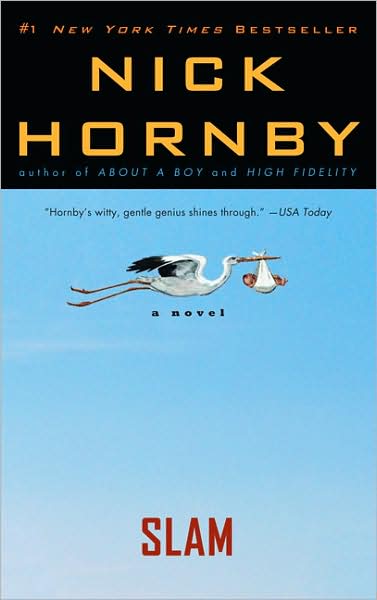
Slam — Nick Hornby

Slam starts with great promise: a list of bullets that show a lot of Sam’s life in a short space and show why it’s going well (“For example: Mum got rid of Steve, her rubbish boyfriend.”) It’s got a fun, fantastical conceit in that Tony Hawk talks to the narrator and comes to represent a kind of externalized consciousness, giving Sam a dialogic way of bouncing ideas off another person. But the novel itself meanders. I look for the great sentences and don’t find them. To be fair, there are strong sections.; for example, in analyzing (as best he can) his family, Sam says:

The story of my family, as far as I can tell, is always the same story, over and over again. Someone—my mum, my dad, my grandad—starts off thinking that they’re going to do well in school, and then go to college, maybe, and then make pots of money. But instead, they do something stupid, and they spend the rest of their lives trying to make up for the mistake they made. Sometimes it can seem as though kids always do better than their parents. You know—someone’s dad was a coal miner, or whatever, but his son goes on to play for a Premiership team, or wins Pop Idol, or invents the Internet. Those stories make you feel as though the whole world is on its way up. But in our family, people always slip up on the first step. In fact, most of the time they don’t even find the stairs.

Notice the metaphor at the end: most of the world “is on its way up,” without noting the transportation method (flight? an elevator?), but his family doesn’t “even find the stairs.” It’s a bittersweet passage, with him not exactly castigating his family but still fundamentally aware of social class. Yet why not start the metaphor at the beginning of the paragraph? His family’s story is always the same, with them looking up as other people go by, or being on the ground floor of a building whose top they can’t even conceptualize, or something to that effect? You could do much better than the ideas I’ve come up with in 30 seconds, but the point is that there’s no reason not to extend the metaphor—maybe throughout not just the paragraph but the book. We appreciate that Sam’s awareness is a step on the road to change, but he could be slightly more aware without harming the fundamental structure of the story.

Perhaps not surprising, some of the story’s tension involves whether Sam will continue the family tradition or break it. He meets a higher class, very attractive girl named Alicia. They talk music. He works to avoid being subservient to her, but later thinks that “I knew that I didn’t want to be [Alicia’s] friend, if you know what I mean, and I was worried that her being friendly to me meant that I didn’t stand a chance with anything else. I know that’s wrong. Mum is always telling me that friendship has to come first, before anything else.” Sam knows the score even when his mother doesn’t, or doesn’t want him to know. She is, in essence, pitching him the idealized version of romance, which he has internalized to the extent that he says he knows that not wanting to be Alicia’s conventional friend is “wrong,” imputing a sense of morality on an act that’s more about strategy than morality. In a different world, friendship would come first. If you search Google for “Friend Zone, you’ll find a wide array of articles with advice on how to avoid becoming “just a friend.” Sam’s Mum is trying to give him advice that isn’t highly applicable to the real world.

If you’re already aware of these dynamics, however, the novel will feel like old news. It’s not bad, exactly, but it’s not exciting, either. A lot of the book is fun. It just feels average, unlike Francine Prose’s Touch. I’m looking for ways that make it more than average and not finding them. Hornby’s best book, by far, is still High Fidelity. Maybe it always will be. I often think about it when writing contemporary novels that feature love stories; he fundamentally understands that such love stories tend towards comedy, that indecision is the great modern problem, and that love stories need more than just a should-I-or-shouldn’t-I plot. Whenever I read High Fidelity, I’m impressed again at how surprisingly well constructed it is. I keep trying his other books (A Long Way Down, How to be Good, Slam) in search of the same kind of mastery. I keep not finding it.

“You can do other things between the fun bits, you know”

A friend and I have an arrangement to exchange whatever substantial work we’ve written each Friday. It’s like an MFA program, without the pretension. She missed a week, saying:

Nice weather and boys, extension required.

Having some knowledge of such situations (as long as you replace “boys” with “girls”), I replied:

In my experience, you can only spend so much time in the sun before you burn and so much time in bed before, well, you need to do something else in the interim. If that latter bit weren’t true, we probably wouldn’t have iPhones, civilization, and all the other things that make the modern world wonderful or horrible or both.

Yeah, Freud got there first, but so what?

"You can do other things between the fun bits, you know"

A friend and I have an arrangement to exchange whatever substantial work we’ve written each Friday. It’s like an MFA program, without the pretension. She missed a week, saying:

Nice weather and boys, extension required.

Having some knowledge of such situations (as long as you replace “boys” with “girls”), I replied:

In my experience, you can only spend so much time in the sun before you burn and so much time in bed before, well, you need to do something else in the interim. If that latter bit weren’t true, we probably wouldn’t have iPhones, civilization, and all the other things that make the modern world wonderful or horrible or both.

Yeah, Freud got there first, but so what?

Thoughts on Anita Shreve’s Testimony and Tom Perrotta’s Election

I recently read Tom Perrotta’s Election and Anita Shreve’s Testimony very closely because they’re similar to a novel I’m working on and relevant to an academic paper, which is a two-for-one deal. I like both novels, but reading Testimony a third time gave me some insight into how it functions; don’t keep reading if you fear spoilers:

1) Testimony is much looser than Election; I think Election is a better book for that reason. We get a better sense of character from it, and the motivations of each characters. I love the scene where Tammy is crying in front of the school counselor and says, “I’m in love,” but she loves her best friend, or former best friend, Lisa. The counselor says, “When you’re ready, you can tell me all about him.” Tammy thinks, “That’s when I realized how impossible it was, my whole life.” She’s right. That also gives motivation for everything else in the story, which looks inexplicable to everyone else. In Testimony, Silas and Rob in particular remain ciphers throughout the novel. That might be intentional.

2) There are more characters in Testimony; their voices are more different than the voices in Election, but too many of them are weak. Silas is or sounds like an idiot, although there’s an explanation in the sense that “he” wrote his sections in the cold, while he’s nuts with grief at his own behavior, and when he might be committing suicide because he can’t stand facing his family and Noelle. Noelle is little better as a character because she’s a little smarter. Sienna is like my dumber freshmen. Ellen, Rob’s mom, may be the most irritating: she speaks in the second person, and aside from her caring for Rob, she doesn’t have much of a function. I get the impression that she’s there to give conventional middle-class women someone to root for than because she moves the story along. Tammy and Paul’s mother does something similar in Election, but she has many fewer scenes.

3) Testimony has a much weaker sense of scene in general; the scenes it does have are much looser and less focused, as noted above. The abstract observations in Election are grounded in the immediate actions of the characters. The ones in Testimony sometimes aren’t. The Ellen character in particular has this problem. Still, some the lyrical sections in Testimony are quite nice.

4) Both novels have choppier timelines than I realized when I first read through them. Readers can probably follow more dodges and weaves than I fully realized previously, and they can handle moving backward and forward in time without explicit direction.

5) The teenage characters mentioned in point two show the danger of letting teenagers speak as teenagers; I’m fond of quoting Salon‘s review of “90210” and “Gossip Girl” on the subject: “Where Blair and Serena’s lines snap, crackle and pop with wit and cleverness, the soggy stars of “90210” stumble over one cliché after another. “Awkward!” Annie blurts at Ethan after they encounter Ethan’s ex Naomi, then Annie does her best impression of the cynical teenage eye roll, as Ethan mutters, “Good times!” Oof. [. . .] But every scene is filled with such teen-bot tripe.” That’s not true of Testimony, but the novel flirts with this problem. Mike anchors the story sufficiently that we don’t get lost among the inarticulate. Noelle is also more knowledgable than the others, and we’ve all met Siennas. The reason for Silas’s meanderings get explained at the end.

6) I’m impressed that Shreve kept the knowledge that only Mike, Anna, Owen, and Silas have from leaking into the other characters. Silas’s actions remain mysterious to us until we learn his mother is having an affair with Mike. The idea that this would cause him to get drunk and bang a hot 14-year-old girl stretches plausibility but doesn’t tear it.

7) The “professional” characters are very flat, and factual, like the reporter, Colm, and the lawyer; these are supposed to provide a counterpoint to the highly emotionally charged scenes from the teenagers, who aren’t articulate and don’t know what’s happening to them. Except for Noelle, who is looking back, and J. Dot, who is aloof, an asshole, and perhaps right.

8) There are only really two major events in the novel: the making of the tape and the Mike / Anna romance. Virtually everything else is lead up, reaction to, or speculation regarding those two things. Contrast that with Election’s romances: there’s Tracy-Jack. Paul-Lisa. Tammy-Lisa, and Tammy’s crush on Dana. There are other events: Mr. M encourages Paul to run. The Warren family constellation, with its tensions. Tracy’s desire to be president, or be something, with President being a reasonable proxy. The election itself ensures that the novel is about more than just who’s with who. There’s a lot more narrative and less “This is how I feel.” It’s also shorter novel. The longer book doesn’t have quite enough narrative to sustain it. There are a number of places where I say things like, “This chapter is fairly useless.” That’s for a reason.

9) The entries / chapters for Testimony are much longer than the ones for Election because each chapter is much, much longer. I don’t think a greater or smaller number of chapters is inherently better, but in this case I think the game goes to Perrotta; Election has 100 “chapters” or unique voices who speak, while Testimony has 53.

10) Looking over this, I’m too harsh on Testimony. It’s still a very finely written book. I read very few books twice, let alone more than twice, let alone think about them consciously as models for a novel or worth writing an academic article about.

Thoughts on Anita Shreve's Testimony and Tom Perrotta's Election

I recently read Tom Perrotta’s Election and Anita Shreve’s Testimony very closely because they’re similar to a novel I’m working on and relevant to an academic paper, which is a two-for-one deal. I like both novels, but reading Testimony a third time gave me some insight into how it functions; don’t keep reading if you fear spoilers:

1) Testimony is much looser than Election; I think Election is a better book for that reason. We get a better sense of character from it, and the motivations of each characters. I love the scene where Tammy is crying in front of the school counselor and says, “I’m in love,” but she loves her best friend, or former best friend, Lisa. The counselor says, “When you’re ready, you can tell me all about him.” Tammy thinks, “That’s when I realized how impossible it was, my whole life.” She’s right. That also gives motivation for everything else in the story, which looks inexplicable to everyone else. In Testimony, Silas and Rob in particular remain ciphers throughout the novel. That might be intentional.

2) There are more characters in Testimony; their voices are more different than the voices in Election, but too many of them are weak. Silas is or sounds like an idiot, although there’s an explanation in the sense that “he” wrote his sections in the cold, while he’s nuts with grief at his own behavior, and when he might be committing suicide because he can’t stand facing his family and Noelle. Noelle is little better as a character because she’s a little smarter. Sienna is like my dumber freshmen. Ellen, Rob’s mom, may be the most irritating: she speaks in the second person, and aside from her caring for Rob, she doesn’t have much of a function. I get the impression that she’s there to give conventional middle-class women someone to root for than because she moves the story along. Tammy and Paul’s mother does something similar in Election, but she has many fewer scenes.

3) Testimony has a much weaker sense of scene in general; the scenes it does have are much looser and less focused, as noted above. The abstract observations in Election are grounded in the immediate actions of the characters. The ones in Testimony sometimes aren’t. The Ellen character in particular has this problem. Still, some the lyrical sections in Testimony are quite nice.

4) Both novels have choppier timelines than I realized when I first read through them. Readers can probably follow more dodges and weaves than I fully realized previously, and they can handle moving backward and forward in time without explicit direction.

5) The teenage characters mentioned in point two show the danger of letting teenagers speak as teenagers; I’m fond of quoting Salon‘s review of “90210” and “Gossip Girl” on the subject: “Where Blair and Serena’s lines snap, crackle and pop with wit and cleverness, the soggy stars of “90210” stumble over one cliché after another. “Awkward!” Annie blurts at Ethan after they encounter Ethan’s ex Naomi, then Annie does her best impression of the cynical teenage eye roll, as Ethan mutters, “Good times!” Oof. [. . .] But every scene is filled with such teen-bot tripe.” That’s not true of Testimony, but the novel flirts with this problem. Mike anchors the story sufficiently that we don’t get lost among the inarticulate. Noelle is also more knowledgable than the others, and we’ve all met Siennas. The reason for Silas’s meanderings get explained at the end.

6) I’m impressed that Shreve kept the knowledge that only Mike, Anna, Owen, and Silas have from leaking into the other characters. Silas’s actions remain mysterious to us until we learn his mother is having an affair with Mike. The idea that this would cause him to get drunk and bang a hot 14-year-old girl stretches plausibility but doesn’t tear it.

7) The “professional” characters are very flat, and factual, like the reporter, Colm, and the lawyer; these are supposed to provide a counterpoint to the highly emotionally charged scenes from the teenagers, who aren’t articulate and don’t know what’s happening to them. Except for Noelle, who is looking back, and J. Dot, who is aloof, an asshole, and perhaps right.

8) There are only really two major events in the novel: the making of the tape and the Mike / Anna romance. Virtually everything else is lead up, reaction to, or speculation regarding those two things. Contrast that with Election’s romances: there’s Tracy-Jack. Paul-Lisa. Tammy-Lisa, and Tammy’s crush on Dana. There are other events: Mr. M encourages Paul to run. The Warren family constellation, with its tensions. Tracy’s desire to be president, or be something, with President being a reasonable proxy. The election itself ensures that the novel is about more than just who’s with who. There’s a lot more narrative and less “This is how I feel.” It’s also shorter novel. The longer book doesn’t have quite enough narrative to sustain it. There are a number of places where I say things like, “This chapter is fairly useless.” That’s for a reason.

9) The entries / chapters for Testimony are much longer than the ones for Election because each chapter is much, much longer. I don’t think a greater or smaller number of chapters is inherently better, but in this case I think the game goes to Perrotta; Election has 100 “chapters” or unique voices who speak, while Testimony has 53.

10) Looking over this, I’m too harsh on Testimony. It’s still a very finely written book. I read very few books twice, let alone more than twice, let alone think about them consciously as models for a novel or worth writing an academic article about.