From the Department of “No Shit:” technology and computers are not silver bullets for education

File this New York Times article under “no shit:”

But to many education experts, something is not adding up — here and across the country. In a nutshell: schools are spending billions on technology, even as they cut budgets and lay off teachers, with little proof that this approach is improving basic learning.

This conundrum calls into question one of the most significant contemporary educational movements.

There is no silver bullet and no New Jesus for education. There never will be, but the search goes on, because it’s easier to search for the magic methodology that will solve seemingly intractable problems than it is to admit the thing Google, Facebook, and Microsoft have realized about software engineers: talent, motivation, and tenacity vary greatly among individuals and that you can’t merely take someone who lacks all three, put them through some kind of system or give them some kind of tool, and expect everyone to be equally good on the other side. That kind of thing works passable well if you’re building widgets on an assembly line, but it works terribly for any kind of creative or intellectual work.

Nonetheless, it’s much easier to search for that magic methodology to improve very old skills that are surprisingly resistant to methodology: reading, writing, and math. None of those fundamental skills has changed much in the last century. Yet we keep searching for that formula that doesn’t exist, because teaching and learning are inherently hard, like software engineering, math, writing, and any number of other complex but vital skills. Technologies—now we have special blackboards! They blink! They light up! They’re new!—might mask the essential difficulty of task, but they can’t remove it, much as some programming IDEs try to hide some of the essential difficulty of coding. But fields that are essential difficult can’t be mastered by sleight-of-hand or new whizzy gadgets.

They can only be mastered by people who are dedicated to the craft and to continuous self-improvement. The people who, because they believe they can, can. The ones whose tenacity is boundless and who aren’t willing to blame external circumstances.

You need a weird set of skills to teach effectively: you need to empathize with your students—to be able to see from their point of view—without becoming mired in their point of view. You need to master your field, but not in such a way that you lose the beginner’s mindset required to master the field in the first place. You need the stoic’s attitude of realizing you can’t control everything while still having the achiever’s mindset that you must strive to do the best you can, no matter what. You need to be willing to try new things and ideas while not leaving behind the old ones that work. You need to remember not everyone is interested in the things you’re interested in, and you need to do whatever it takes to make subjects more interesting than they would be otherwise. You need to find that profitable zone of challenge for most students—something hard enough to make them struggle but not so hard that it’s impossible to accomplish—it’s reasonable to expect college freshmen to be able to read a story or article on their own, but it’s not reasonable to expect them to pick up and digest every nuance on their own. Some will. Most won’t. You need to be enthusiastic, because enthusiasm is as contagious as boredom, but your job isn’t to be a cheerleader and enthusiasm can’t substitute for knowledge. You need, in other words, a bunch of paradoxical traits that balance each other.

You also need to realize that students need things broken down in steps, and need to learn by example and through discussion. Last week I taught Neal Stephenson’s 2005 New York Times opinion piece, “Turn On, Tune In, Veg Out.” Whenever I do, I let the class talk for a while at the beginning; when discussion dies, I ask students to do a simple activity: write the essay’s main point in a sentence or two. Then I come around and look at the sentences.

It should be simple, right? Read the piece, find the main point. But it’s not simple. It’s actually quite hard, and most people are bad readers (myself included). When I go around and look at sentences, lots of students get caught up on the distinction between geeking and vegging out. Others think the piece is primarily about Star Wars. Only a few—usually around five of fifty—get the essential elements of the main point.

Stephenson basically says, twice, that he’s using Star Wars as a metaphor: once in the third paragraph: “Twenty-eight years later, the vast corpus of “Star Wars” movies, novels, games and merchandise still has much to say about geeks – and also about a society that loves them, hates them and depends upon them” and once more in the last paragraph: “If the “Star Wars” movies are remembered a century from now, it’ll be because they are such exact parables for this state of affairs” (emphasis added). But most students haven’t learned how to think metaphorically, as writers do. Metaphor is one of those essential ways of thinking that people need to be effective writers. In On Writing Stephen King says:

The use of simile and other figurative language is one of the chief delights of fiction—reading it and writing it, as well. When it’s on target, a simile delights us in much the same way meeting an old friend in a crowd of strangers does. By comparing two seemingly unrelated objects—a restaurant bar and a cave, a mirror and a mirage—we are sometimes able to see an old thing in a new and vivid way. Even if the result is mere clarity instead of beauty, I think writer and reader are participating together in a kind of miracle. Maybe that’s drawing it a little strong, but yeah—it’s what I believe.

In How Fiction Works, James Wood says:

“Metaphor is analogous to fiction, because it floats a rival reality. It is the entire imaginative process in one move. If I compare the slates on a roof to an armadillo’s back, or – as I did earlier – the bald patch on the top of my head to a crop circle (or on very bad days, to the kind of flattened ring of grass that a helicopter’s blades make when it lands in a field), I am asking you to do what Conrad said fiction should make you do – see. I am asking you to imagine another dimension, to picture likeness. Every metaphor or simile is a little explosion of fiction within the lager fiction of the novel or story.

Again: that’s hard. And technology isn’t going to make it any easier to start thinking about metaphors, which is probably a precursor to writing in a way that uses metaphor deftly. Before you can do that, you’re probably going to need to recognize when other writers are doing it, and yet, while Stephenson says that he is twice, most students don’t pick up on it. This isn’t to blame them, by the way—a lot of my graduate seminars are still about what the writer actually says. Some of you are probably getting caught up on this discussion of metaphor and think that I’m really writing about how it’s important for students to learn, when this is only a subsidiary point supporting my main point about the place of technology in classrooms. Here’s Wood again on the subject of learning to read:

You only have to teach literature to realise that most young readers are poor noticiers. I know from my own old books, wantonly annotated twenty years ago when I was a student, that I routinely underlined for approval details and images and metaphors that strike me now as commonplace, while serenely missing things which now seem wonderful. We grow, as readers, and twenty-year-olds are relative virgins.

If he wasn’t a good noticer at 20, what hope is there for the rest of us? And how is having a laptop going to help someone become a better noticer? Consider too one other thing to notice: in “Turn On, Tune In, Veg Out,” Stephenson isn’t using any complex or convoluted vocabulary. His sentence structure isn’t very complex; there aren’t lots of nasty nested clauses you have to mentally sort out to figure out what’s being talked about, as there are often are in abstruse literary theory and philosophy. His piece isn’t hard to read. But it’s still evidently hard for many freshmen to understand. So I spend a lot of time working towards understanding, towards reading for detail, towards asking, “Where do you see that?” Technology isn’t going to help that process very much. It may even hurt it by offering a proliferating number of distractions: if you interrupt your reading of “Turn On, Tune In, Veg Out” four times for text messages and once for an e-mail, are you going to remember how Stephenson said “Twenty-eight years later, the vast corpus of “Star Wars” movies, novels, games and merchandise still has much to say about geeks – and also about a society that loves them, hates them and depends upon them” by the end?

I’m teaching honors students, which is easier than teaching standard classes, which is in turn easier than teaching in tough inner-city schools. So I don’t face the same challenges as some of the teachers mentioned in the NYT article. But sometimes I think about Daniel Singal’s Atlantic article, “The Other Crisis in American Education: A college professor looks at the forgotten victims of our mediocre educational system–the potentially high achievers whose SAT scores have fallen, and who read less, understand less of what they read, and know less than the top students of a generation ago.” As the subtitle implies, he argues that the best students aren’t as challenged as they once were. I can’t tell if he’s right or if he’s hearkening back to a mythical golden age, but I do think about his work sometimes when I see what’s going on around me: other grad students and professors want to watch movies in class, or they aren’t even focused on imparting and enhancing basic reading and writing skills—the same ones pretty much everyone needs. Are the strongest students really getting something out of their classes? Is the technology really helping? If not, could it be part of what’s actually causing “our mediocre educational system?” I’m not saying it does, but I am saying it’s worth pondering.

Still, I think the strongest thinkers and learners—the ones who are now running Google and Facebook, the ones who are now partners in law firms and building their own businesses—are doing fine. Better than ever, maybe. Generation X was supposed to be the slacker generation, but its members built large blocks of the Internet—the same set of technologies you’re almost certainly using to read this. But I wonder if there’s not a growing bifurcation between the people who are doing really well and the ones who aren’t. In income terms, that’s certainly true, but I wonder if it’s happening in intellectual terms too. Stephenson thinks so: “Nothing is more seductive than to think that we, like the Jedi, could be masters of the most advanced technologies while living simple lives: to have a geek standard of living and spend our copious leisure time vegging out.” But the people who spend all that time vegging out aren’t going to create whatever the next iPod and Facebook will be. And they won’t reap those rewards, either. They’re the ones who might be “learning less,” as Singal has it. The people who make the next iPod and Facebook will be the one who are focused on “geeking out” regarding important topics. The ones who will, I hope, have teachers—whether in honors or not—who are focused on the essential questions that imparting knowledge involves.

By the way, I’m not trying to beat up college freshmen—if I were, I wouldn’t have the empathy necessary to be good. A lot of college seniors are little better than my freshmen, which I found out by working for Steven Klein at the Steven Klein LSAT Company. The LSAT is mostly a test of reading. If you can read effectively, you’ll do pretty well. But a lot of 22 – 24-year-old college graduates had a lot of trouble on reading comprehension because they couldn’t or hadn’t been trained to look at every word, evaluate it in relation to other words and in relation to the context of the passage, and understand what it means. I think back to those experiences when I read books like Richard Arum and Josipa Roksa’s Academically Adrift: Limited Learning on College Campuses or articles like the one about cool whizzy tech stuff in classrooms. The whizzy tech stuff isn’t going to help readers when they’re facing the LSAT.

A second “by the way” is in order: I’m neither trying to denigrate technology nor be a luddite—I say so as the guy typing on a fancy keyboard, ergonomic chair, and 27″ iMac, with a bunch of Textmate windows open. Computers make the mechanical process of writing easier, so that the hard stuff—the stuff that goes on in the mind—can dominate. Technology is great—in its place. The University of Arizona has computers and projectors and other neat stuff in many classrooms, and if that neat stuff is available, I use it.

But technology complements other skills; it doesn’t substitute for them. You can only use computers effectively to the extent you can read, write, and do simple math effectively—try programming without algebra. Or try to extract information from man pages without strong reading comprehension skills; hell, I like to imagine myself as being at least moderately literate, and I find some of them tough. So this is not one of those tedious essays in which Old Man Withers shakes his cane and complains about the kids with those damn beeping gizmos and sending those darned pictures of each others’ privates around and get off my damn lawn. Plus, I’m too young to shake my cane; I ran a modest but real number of miles yesterday. Even when I do have a cane someday, I hope that it 1) has a hidden sword, because that kind of thing is cool and 2) that I haven’t ossified to the point where I’m not willing to learn new things.

But this is an essay that points out how basic skills and the means of imparting those basic skills haven’t changed so much, as Amanda Ripley’s Atlantic article, “What Makes a Great Teacher?” makes clear in its discussion of what great teachers do:

First, great teachers tended to set big goals for their students. They were also perpetually looking for ways to improve their effectiveness. [. . .] Superstar teachers had four other tendencies in common: they avidly recruited students and their families into the process; they maintained focus, ensuring that everything they did contributed to student learning; they planned exhaustively and purposefully—for the next day or the year ahead—by working backward from the desired outcome; and they worked relentlessly, refusing to surrender to the combined menaces of poverty, bureaucracy, and budgetary shortfalls.

Notice the thing absent from this list: use computers, iPads, and so forth. Sure, those great teachers could use technology, but they don’t need to. And the technology is not going to automatically make an indifferent teacher set big goals or recruit families or maintain focus or plan. Used poorly, it’s just going to provide some flash and pizazz and some distractions. Check out this Marginal Revolution discussion of a study looking at how introducing computers in poor households actually decreased student grades because students spent more time playing games on them than doing homework:

Not surprisingly, with all that game playing going on, the authors find that the voucher program actually resulted in a decline in grades although there was also some evidence for an increase in computer proficiency and perhaps some improvement in a cognitive test.

See also “Computers at Home: Educational Hope vs. Teenage Reality:” “Students posted significantly lower math test scores after the first broadband service provider showed up in their neighborhood, and significantly lower reading scores as well when the number of broadband providers passed four.” These reports should give technology cheerleaders pause: you aren’t going to get better results simply by lashing a computer on a teacher’s back and telling him to use it.*

To be a good teacher, you still need that weird skill- and mindset mentioned above. If you don’t have it or aren’t willing to develop it, I doubt anything else imposed on an individual teacher from the outside, like mandates to use technology, are going to do much for that teacher or for his or her students. If you want to really improve teaching, you’ll need to take an approach similar to the one Facebook and Google take to hiring hackers, which means a relentless focus not on degrees that offer dubious value in predicting achievement but on finding the best people and making sure they stay. Finding the best teachers is different from finding programmers—you probably can’t tell who’s going to be a good teacher before they hit the classroom—but you can at least acknowledge that you’re not going to get people who are good merely by saying, “use iPads in the classroom.” Steve Jobs and Bill Gates didn’t have iPads in their classrooms growing up, and maybe that’s part of what made Jobs able to have the vision necessary to Turn On, Geek Out, and make the iPad.


* I had a computer in middle and early high school that I used to master Starcraft and various other computer games, until I somehow realized I was wasting my life and smashed my Starcraft disks in the driveway. I sometimes use this analogy when I explain the situation to friends: some people can handle snorting the occasional line of coke without getting addicted; it’s just a fun way of spending a Saturday night. Some people can handle computer games in the same way. I discovered, at the time, that I’m not one of them, and, worse, I’ll never get those three or so wasted years back. Now I tend to find video games boring on average and can’t play for longer than half an hour to an hour at a stretch, while I’ve trained myself up to being able to write effectively for three to six hours at a time. The first draft of this essay, for example, took me about two hours.

From the Department of "No Shit:" technology and computers are not silver bullets for education

File this New York Times article under “no shit:”

But to many education experts, something is not adding up — here and across the country. In a nutshell: schools are spending billions on technology, even as they cut budgets and lay off teachers, with little proof that this approach is improving basic learning.

This conundrum calls into question one of the most significant contemporary educational movements.

There is no silver bullet and no New Jesus for education. There never will be, but the search goes on, because it’s easier to search for the magic methodology that will solve seemingly intractable problems than it is to admit the thing Google, Facebook, and Microsoft have realized about software engineers: talent, motivation, and tenacity vary greatly among individuals and that you can’t merely take someone who lacks all three, put them through some kind of system or give them some kind of tool, and expect everyone to be equally good on the other side. That kind of thing works passable well if you’re building widgets on an assembly line, but it works terribly for any kind of creative or intellectual work.

Nonetheless, it’s much easier to search for that magic methodology to improve very old skills that are surprisingly resistant to methodology: reading, writing, and math. None of those fundamental skills has changed much in the last century. Yet we keep searching for that formula that doesn’t exist, because teaching and learning are inherently hard, like software engineering, math, writing, and any number of other complex but vital skills. Technologies—now we have special blackboards! They blink! They light up! They’re new!—might mask the essential difficulty of task, but they can’t remove it, much as some programming IDEs try to hide some of the essential difficulty of coding. But fields that are essential difficult can’t be mastered by sleight-of-hand or new whizzy gadgets.

They can only be mastered by people who are dedicated to the craft and to continuous self-improvement. The people who, because they believe they can, can. The ones whose tenacity is boundless and who aren’t willing to blame external circumstances.

You need a weird set of skills to teach effectively: you need to empathize with your students—to be able to see from their point of view—without becoming mired in their point of view. You need to master your field, but not in such a way that you lose the beginner’s mindset required to master the field in the first place. You need the stoic’s attitude of realizing you can’t control everything while still having the achiever’s mindset that you must strive to do the best you can, no matter what. You need to be willing to try new things and ideas while not leaving behind the old ones that work. You need to remember not everyone is interested in the things you’re interested in, and you need to do whatever it takes to make subjects more interesting than they would be otherwise. You need to find that profitable zone of challenge for most students—something hard enough to make them struggle but not so hard that it’s impossible to accomplish—it’s reasonable to expect college freshmen to be able to read a story or article on their own, but it’s not reasonable to expect them to pick up and digest every nuance on their own. Some will. Most won’t. You need to be enthusiastic, because enthusiasm is as contagious as boredom, but your job isn’t to be a cheerleader and enthusiasm can’t substitute for knowledge. You need, in other words, a bunch of paradoxical traits that balance each other.

You also need to realize that students need things broken down in steps, and need to learn by example and through discussion. Last week I taught Neal Stephenson’s 2005 New York Times opinion piece, “Turn On, Tune In, Veg Out.” Whenever I do, I let the class talk for a while at the beginning; when discussion dies, I ask students to do a simple activity: write the essay’s main point in a sentence or two. Then I come around and look at the sentences.

It should be simple, right? Read the piece, find the main point. But it’s not simple. It’s actually quite hard, and most people are bad readers (myself included). When I go around and look at sentences, lots of students get caught up on the distinction between geeking and vegging out. Others think the piece is primarily about Star Wars. Only a few—usually around five of fifty—get the essential elements of the main point.

Stephenson basically says, twice, that he’s using Star Wars as a metaphor: once in the third paragraph: “Twenty-eight years later, the vast corpus of “Star Wars” movies, novels, games and merchandise still has much to say about geeks – and also about a society that loves them, hates them and depends upon them” and once more in the last paragraph: “If the “Star Wars” movies are remembered a century from now, it’ll be because they are such exact parables for this state of affairs” (emphasis added). But most students haven’t learned how to think metaphorically, as writers do. Metaphor is one of those essential ways of thinking that people need to be effective writers. In On Writing Stephen King says:

The use of simile and other figurative language is one of the chief delights of fiction—reading it and writing it, as well. When it’s on target, a simile delights us in much the same way meeting an old friend in a crowd of strangers does. By comparing two seemingly unrelated objects—a restaurant bar and a cave, a mirror and a mirage—we are sometimes able to see an old thing in a new and vivid way. Even if the result is mere clarity instead of beauty, I think writer and reader are participating together in a kind of miracle. Maybe that’s drawing it a little strong, but yeah—it’s what I believe.

In How Fiction Works, James Wood says:

“Metaphor is analogous to fiction, because it floats a rival reality. It is the entire imaginative process in one move. If I compare the slates on a roof to an armadillo’s back, or – as I did earlier – the bald patch on the top of my head to a crop circle (or on very bad days, to the kind of flattened ring of grass that a helicopter’s blades make when it lands in a field), I am asking you to do what Conrad said fiction should make you do – see. I am asking you to imagine another dimension, to picture likeness. Every metaphor or simile is a little explosion of fiction within the lager fiction of the novel or story.

Again: that’s hard. And technology isn’t going to make it any easier to start thinking about metaphors, which is probably a precursor to writing in a way that uses metaphor deftly. Before you can do that, you’re probably going to need to recognize when other writers are doing it, and yet, while Stephenson says that he is twice, most students don’t pick up on it. This isn’t to blame them, by the way—a lot of my graduate seminars are still about what the writer actually says. Some of you are probably getting caught up on this discussion of metaphor and think that I’m really writing about how it’s important for students to learn, when this is only a subsidiary point supporting my main point about the place of technology in classrooms. Here’s Wood again on the subject of learning to read:

You only have to teach literature to realise that most young readers are poor noticiers. I know from my own old books, wantonly annotated twenty years ago when I was a student, that I routinely underlined for approval details and images and metaphors that strike me now as commonplace, while serenely missing things which now seem wonderful. We grow, as readers, and twenty-year-olds are relative virgins.

If he wasn’t a good noticer at 20, what hope is there for the rest of us? And how is having a laptop going to help someone become a better noticer? Consider too one other thing to notice: in “Turn On, Tune In, Veg Out,” Stephenson isn’t using any complex or convoluted vocabulary. His sentence structure isn’t very complex; there aren’t lots of nasty nested clauses you have to mentally sort out to figure out what’s being talked about, as there are often are in abstruse literary theory and philosophy. His piece isn’t hard to read. But it’s still evidently hard for many freshmen to understand. So I spend a lot of time working towards understanding, towards reading for detail, towards asking, “Where do you see that?” Technology isn’t going to help that process very much. It may even hurt it by offering a proliferating number of distractions: if you interrupt your reading of “Turn On, Tune In, Veg Out” four times for text messages and once for an e-mail, are you going to remember how Stephenson said “Twenty-eight years later, the vast corpus of “Star Wars” movies, novels, games and merchandise still has much to say about geeks – and also about a society that loves them, hates them and depends upon them” by the end?

I’m teaching honors students, which is easier than teaching standard classes, which is in turn easier than teaching in tough inner-city schools. So I don’t face the same challenges as some of the teachers mentioned in the NYT article. But sometimes I think about Daniel Singal’s Atlantic article, “The Other Crisis in American Education: A college professor looks at the forgotten victims of our mediocre educational system–the potentially high achievers whose SAT scores have fallen, and who read less, understand less of what they read, and know less than the top students of a generation ago.” As the subtitle implies, he argues that the best students aren’t as challenged as they once were. I can’t tell if he’s right or if he’s hearkening back to a mythical golden age, but I do think about his work sometimes when I see what’s going on around me: other grad students and professors want to watch movies in class, or they aren’t even focused on imparting and enhancing basic reading and writing skills—the same ones pretty much everyone needs. Are the strongest students really getting something out of their classes? Is the technology really helping? If not, could it be part of what’s actually causing “our mediocre educational system?” I’m not saying it does, but I am saying it’s worth pondering.

Still, I think the strongest thinkers and learners—the ones who are now running Google and Facebook, the ones who are now partners in law firms and building their own businesses—are doing fine. Better than ever, maybe. Generation X was supposed to be the slacker generation, but its members built large blocks of the Internet—the same set of technologies you’re almost certainly using to read this. But I wonder if there’s not a growing bifurcation between the people who are doing really well and the ones who aren’t. In income terms, that’s certainly true, but I wonder if it’s happening in intellectual terms too. Stephenson thinks so: “Nothing is more seductive than to think that we, like the Jedi, could be masters of the most advanced technologies while living simple lives: to have a geek standard of living and spend our copious leisure time vegging out.” But the people who spend all that time vegging out aren’t going to create whatever the next iPod and Facebook will be. And they won’t reap those rewards, either. They’re the ones who might be “learning less,” as Singal has it. The people who make the next iPod and Facebook will be the one who are focused on “geeking out” regarding important topics. The ones who will, I hope, have teachers—whether in honors or not—who are focused on the essential questions that imparting knowledge involves.

By the way, I’m not trying to beat up college freshmen—if I were, I wouldn’t have the empathy necessary to be good. A lot of college seniors are little better than my freshmen, which I found out by working for Steven Klein at the Steven Klein LSAT Company. The LSAT is mostly a test of reading. If you can read effectively, you’ll do pretty well. But a lot of 22 – 24-year-old college graduates had a lot of trouble on reading comprehension because they couldn’t or hadn’t been trained to look at every word, evaluate it in relation to other words and in relation to the context of the passage, and understand what it means. I think back to those experiences when I read books like Richard Arum and Josipa Roksa’s Academically Adrift: Limited Learning on College Campuses or articles like the one about cool whizzy tech stuff in classrooms. The whizzy tech stuff isn’t going to help readers when they’re facing the LSAT.

A second “by the way” is in order: I’m neither trying to denigrate technology nor be a luddite—I say so as the guy typing on a fancy keyboard, ergonomic chair, and 27″ iMac, with a bunch of Textmate windows open. Computers make the mechanical process of writing easier, so that the hard stuff—the stuff that goes on in the mind—can dominate. Technology is great—in its place. The University of Arizona has computers and projectors and other neat stuff in many classrooms, and if that neat stuff is available, I use it.

But technology complements other skills; it doesn’t substitute for them. You can only use computers effectively to the extent you can read, write, and do simple math effectively—try programming without algebra. Or try to extract information from man pages without strong reading comprehension skills; hell, I like to imagine myself as being at least moderately literate, and I find some of them tough. So this is not one of those tedious essays in which Old Man Withers shakes his cane and complains about the kids with those damn beeping gizmos and sending those darned pictures of each others’ privates around and get off my damn lawn. Plus, I’m too young to shake my cane; I ran a modest but real number of miles yesterday. Even when I do have a cane someday, I hope that it 1) has a hidden sword, because that kind of thing is cool and 2) that I haven’t ossified to the point where I’m not willing to learn new things.

But this is an essay that points out how basic skills and the means of imparting those basic skills haven’t changed so much, as Amanda Ripley’s Atlantic article, “What Makes a Great Teacher?” makes clear in its discussion of what great teachers do:

First, great teachers tended to set big goals for their students. They were also perpetually looking for ways to improve their effectiveness. [. . .] Superstar teachers had four other tendencies in common: they avidly recruited students and their families into the process; they maintained focus, ensuring that everything they did contributed to student learning; they planned exhaustively and purposefully—for the next day or the year ahead—by working backward from the desired outcome; and they worked relentlessly, refusing to surrender to the combined menaces of poverty, bureaucracy, and budgetary shortfalls.

Notice the thing absent from this list: use computers, iPads, and so forth. Sure, those great teachers could use technology, but they don’t need to. And the technology is not going to automatically make an indifferent teacher set big goals or recruit families or maintain focus or plan. Used poorly, it’s just going to provide some flash and pizazz and some distractions. Check out this Marginal Revolution discussion of a study looking at how introducing computers in poor households actually decreased student grades because students spent more time playing games on them than doing homework:

Not surprisingly, with all that game playing going on, the authors find that the voucher program actually resulted in a decline in grades although there was also some evidence for an increase in computer proficiency and perhaps some improvement in a cognitive test.

See also “Computers at Home: Educational Hope vs. Teenage Reality:” “Students posted significantly lower math test scores after the first broadband service provider showed up in their neighborhood, and significantly lower reading scores as well when the number of broadband providers passed four.” These reports should give technology cheerleaders pause: you aren’t going to get better results simply by lashing a computer on a teacher’s back and telling him to use it.*

To be a good teacher, you still need that weird skill- and mindset mentioned above. If you don’t have it or aren’t willing to develop it, I doubt anything else imposed on an individual teacher from the outside, like mandates to use technology, are going to do much for that teacher or for his or her students. If you want to really improve teaching, you’ll need to take an approach similar to the one Facebook and Google take to hiring hackers, which means a relentless focus not on degrees that offer dubious value in predicting achievement but on finding the best people and making sure they stay. Finding the best teachers is different from finding programmers—you probably can’t tell who’s going to be a good teacher before they hit the classroom—but you can at least acknowledge that you’re not going to get people who are good merely by saying, “use iPads in the classroom.” Steve Jobs and Bill Gates didn’t have iPads in their classrooms growing up, and maybe that’s part of what made Jobs able to have the vision necessary to Turn On, Geek Out, and make the iPad.


* I had a computer in middle and early high school that I used to master Starcraft and various other computer games, until I somehow realized I was wasting my life and smashed my Starcraft disks in the driveway. I sometimes use this analogy when I explain the situation to friends: some people can handle snorting the occasional line of coke without getting addicted; it’s just a fun way of spending a Saturday night. Some people can handle computer games in the same way. I discovered, at the time, that I’m not one of them, and, worse, I’ll never get those three or so wasted years back. Now I tend to find video games boring on average and can’t play for longer than half an hour to an hour at a stretch, while I’ve trained myself up to being able to write effectively for three to six hours at a time. The first draft of this essay, for example, took me about two hours.

Links: Books, Text Slang for Adults, public goods and bads, Qwests’s weak Internet access offerings, Picplum, unlikely secrets, and more

* Literary agent Jane Dystel: “All of this makes me think that my colleagues on the publishing side have lost sight of the fact that in these new wild, wild west days in publishing, this is the time for them to take more, not fewer, risks. Taking risks has always been what the business of publishing is all about. There are no sure winners, guys, and the more fearful and cautious you get, the more authors will want to publish on their own—and won’t need you anymore.”

* Reminder: in the age of the death of the book, “Publishers sold 2.57 billion books in all formats in 2010, a 4.1 percent increase since 2008. (See also: Umberto Eco and Jean Claude Carriere, This is Not the End of the Book, which is actually about a wide array of topics ancillary to the death, life, or zombiehood of books.)

* Text Slang for Adults. Sample: “NSR = Need some roughage”; “T4W = Time for whiskey.”

* Lev Grossman on writing The Magician King: “when you’re in a certain phase of novel-making, you’re like a magpie: when something gleams at you funny, you swoop down and grab it and take it back to your nest, because you know, you just know, you’re going to need it later.”

* This may be the most impressive blog comment I’ve ever read (it’s from Cory Doctorow):

Education is a public good. It is best supplied and paid for by the group as a whole, because no individual or small collective can produce the overall social benefit that the nation can provision collectively.

Education doesn’t respond well to market forces because many of the social goods that arise from education — socialization, a grounding in civics, historical context, rational and systematic reasoning — are not goods or services demanded by a market, but rather they are the underlying substrate that allows people to intelligently conduct transactions in a marketplace as well as establishing and maintaining good governance.

There is a long and wide body of evidence that people with wide, solid educational foundations that transcend mere vocational skills produce societies that are more prosperous, more transparent, healthier, more democratic — that attain, in short, all the things we hope markets will attain for us.

* If you can get FiOS, you should. Tucson’s Internet access choices are so bad that I effectively have a choice between Comcast, which offers ~12mb / sec down and ~2mb / sec up, and nothing. I saw “nothing” because Qwest offers “DSL” at 1.5mb / sec down, which would’ve been great in, say, 1999, but is terrible now. I actually sent an e-mail to Qwest Arizona president Jim Campbell asking if Qwest was actually going to roll out real competition in my area. To Qwest’s credit, his administrative assistant, Deborah Statt, replied and said there wouldn’t be any improvement in 2010. Also to Qwest’s credit, she’s followed-up consistently. Alas, however, responsiveness doesn’t mean improvement, and I’m still stuck with Comcast.

* Michael Chabon’s The Yiddish Policemen’s Union comes to life, at least in terms of villains.

* PicPlum calls itself “the easiest way to send photos.” I ordered some; we’ll see how it goes.

* We’ll Show You Ours if You Show Us Yours; “we thought it would be fun to round up the favorite dirty books of some of our most illustrious literary critics at The Times. Below, their spicy replies.”

* Someone found Grant Writing Confidential by searching for “secrets to writing like dan brown.” I would start by being incoherent on the level of the sentence.

Links: Books, Text Slang for Adults, public goods and bads, Qwests's weak Internet access offerings, Picplum, unlikely secrets, and more

* Literary agent Jane Dystel: “All of this makes me think that my colleagues on the publishing side have lost sight of the fact that in these new wild, wild west days in publishing, this is the time for them to take more, not fewer, risks. Taking risks has always been what the business of publishing is all about. There are no sure winners, guys, and the more fearful and cautious you get, the more authors will want to publish on their own—and won’t need you anymore.”

* Reminder: in the age of the death of the book, “Publishers sold 2.57 billion books in all formats in 2010, a 4.1 percent increase since 2008. (See also: Umberto Eco and Jean Claude Carriere, This is Not the End of the Book, which is actually about a wide array of topics ancillary to the death, life, or zombiehood of books.)

* Text Slang for Adults. Sample: “NSR = Need some roughage”; “T4W = Time for whiskey.”

* Lev Grossman on writing The Magician King: “when you’re in a certain phase of novel-making, you’re like a magpie: when something gleams at you funny, you swoop down and grab it and take it back to your nest, because you know, you just know, you’re going to need it later.”

* This may be the most impressive blog comment I’ve ever read (it’s from Cory Doctorow):

Education is a public good. It is best supplied and paid for by the group as a whole, because no individual or small collective can produce the overall social benefit that the nation can provision collectively.

Education doesn’t respond well to market forces because many of the social goods that arise from education — socialization, a grounding in civics, historical context, rational and systematic reasoning — are not goods or services demanded by a market, but rather they are the underlying substrate that allows people to intelligently conduct transactions in a marketplace as well as establishing and maintaining good governance.

There is a long and wide body of evidence that people with wide, solid educational foundations that transcend mere vocational skills produce societies that are more prosperous, more transparent, healthier, more democratic — that attain, in short, all the things we hope markets will attain for us.

* If you can get FiOS, you should. Tucson’s Internet access choices are so bad that I effectively have a choice between Comcast, which offers ~12mb / sec down and ~2mb / sec up, and nothing. I saw “nothing” because Qwest offers “DSL” at 1.5mb / sec down, which would’ve been great in, say, 1999, but is terrible now. I actually sent an e-mail to Qwest Arizona president Jim Campbell asking if Qwest was actually going to roll out real competition in my area. To Qwest’s credit, his administrative assistant, Deborah Statt, replied and said there wouldn’t be any improvement in 2010. Also to Qwest’s credit, she’s followed-up consistently. Alas, however, responsiveness doesn’t mean improvement, and I’m still stuck with Comcast.

* Michael Chabon’s The Yiddish Policemen’s Union comes to life, at least in terms of villains.

* PicPlum calls itself “the easiest way to send photos.” I ordered some; we’ll see how it goes.

* We’ll Show You Ours if You Show Us Yours; “we thought it would be fun to round up the favorite dirty books of some of our most illustrious literary critics at The Times. Below, their spicy replies.”

* Someone found Grant Writing Confidential by searching for “secrets to writing like dan brown.” I would start by being incoherent on the level of the sentence.

Routing around network failure: public schools and community colleges

Dean Dad has an interesting post named “Three Flavors of Dual Enrollment,” which deals with high school students taking community college classes. Read the whole thing, but note this comment:

In the “everyone” version, the idea is to replace the last year or two of high school — widely acknowledged to be an academic wasteland — with the first year or two of college. Those who tout this version point out the time and cost savings to the student; some colleges have seemingly bought in, seduced by the promise of a mighty river of tuition.

I agree with the point about the dubiousness of many dual enrollment versions. That being said, the problem as a whole is a superficial one that really points to a larger problem in the way our society itself is structured: people aren’t children at the age of 16. As Paul Graham says in “What You’ll Wish You’d Known,” by the age, “Childhood was getting old.” Virtually everyone is biologically an adult at that age, and, perhaps not surprisingly, a lot of them are pretty annoyed at being treated like they’re still 10—which is what schools effectively do. And the problems of public schools mean they’re not really imparting much knowledge by that point—hence the “academic wasteland” comment earlier in his post.

Sixteen year olds are people, but schools don’t treat them as such. This is part of the point of The Case Against Adolescence and, to a lesser extent, of Adolescence: An Anthropological Inquiry. People can figure out that school is bogus. The smart ones want something better, and they often read essays like “Why Nerds Are Unpopular,” which explain exactly why high school is bogus. Community college is one outlet for these problems. Not an ideal one, as Dean Dad says, but it’s at least a possible one.

The best solution, of course, is the one Dean Dad posits: “If the high schools need fixing, then the high schools need fixing.” But you can’t really change the form of high school save through some form of charter school, voucher system, or moving to suburbs. There are lots of barriers to improving high schools, and you can read about them in this compilation post. Since high schools change with torturously slow speed, smart people try to route around the problem.

I agree with this: “the obvious remedy is to improve the junior and senior years of high school.” There’s no effective way to do this within the current constraints of school systems (local monopolies, nearly impossible to get rid of very bad kids or teachers). So the community college idea is probably a second- or third-best option. The high schools do need fixing, but I wouldn’t be surprised if this alternative becomes more popular when high schools can’t be effectively fixed.

I would’ve been a good candidate for dual-enrollment—in Washington State, it’s called Running Start—if I hadn’t been such an idiot and sacrificed eighth – tenth grades on the alter of Starcraft. School seemed very small, and to most moderately smart people it probably still does. Although she’s writing in a different context, I think Megan McArdle points out the problem:

A significant number of teens didn’t know who Osama Bin Laden was until we killed him. I can’t believe it–and yet I do believe it. I didn’t know what Iran Contra was when I was in high school, and I was a sophomore when it happened. Teenagers live in their own little world, only tangentially connected to the one the rest of us occupy.

Teenagers do “live in their own little world”—the world adults put them in. It’s such a commonplace that McArdle can say it, and nobody comments the statement. Why should we expect students to behave otherwise? I wonder if the popularity of world-is-a-lie fiction (1984, Brave New World, Lord of the Flies) among high school students is in part because the smarter among them are dimly aware of how their own world is constructed. Teachers don’t really tell them, most of the time. I suspect most people don’t figure it out until college or later—by which point they don’t care much anymore.

The Tiger Mother post (with thoughts from The Great Stagnation)

Everyone online has an opinion about Amy Chua’s Tiger Mother article, otherwise known as the tongue-in-cheek “Why Chinese Mothers Are Superior.” The essay says all work and no play makes Jack (and Jill!) a good student. A grad-student friend said she applauds the Tiger Mother and thinks her students are lazy and would be much improved if they’d been raised by Tiger Mothers.

I wonder, though, especially since reading “Mary Gates and Karen Zuckerberg Weren’t Tiger Moms: Is the Amy Chua approach bad for the American economy?” in Slate. The article describes one of the potential “anti-Tiger” positions: Americans might be better at leaving more space for spectacular failure and spectacular success, then reaping the successes. I would add one other point: I went to a Seattle-area high school that was about 25% – 33% Asian and saw a lot of the Tiger Mother causalities, including the ones who are probably now in therapy, the ones who learned to hate learning, and so on. If my parents had been tigers, I don’t think I would’ve turned out so well because I have too wide a rebellious streak and was utterly indifferent to school work of any sort until I was about 16. Now in many ways I’ve superseded the tiger cubs who burned out, at least as measured by conventional measures of status and respect.

I suspect there is no “right” way, and how people turn out is more random than not. Some of the research I’ve seen indicates that parents don’t have as much control over their children’s future as many parents think, although I can’t find any direct links at the moment. See some discussion here and here from Marginal Revolution.

Finally, I think some of the Tiger narrative’s resonance with the larger cultural is linked to the decades-old idea that the U.S. is somehow losing its educational prowess or falling from some educational golden age. But it looks like American Kids Aren’t Getting Dumber; They Were Just Never That Smart. For much of the United States’ history, the smartest thing smart people around the world could do is move to the United States. So lots of smart people came to the U.S. by default. We got lots of dividends from immigration throughout history because the United States’ political institutions worked pretty well when most places were languishing under autocracies; we managed to avoid destroying ourselves, as Europe did during World Wars I and II and Japan did during World War II; we got a lot of smart minorities who fled Germany before World War II; big oceans and good relations with Canada and Mexico protected and continue to protect the U.S. from immediate threats, which means we can spend ludicrous amounts of money on military technology. There are probably others I’m not considering. But, as Cowen points out in The Great Stagnation, the rest of the world has a relatively easy playbook to catching up to the major Western democracies. Now they’re doing so, which means our “smart and ambitious immigrants” advantage might be drying up and making the rest of the world more attractive—and the world is likely to get more competitive, by some definitions of competitive.

So we get fertile soil for Amy Chuas (notice the plural), whose writing can feed the sometimes justified anxiety a lot of people who simply read the news or live in the economy are already feeling. Others are probably just saying, “Do we really need this much materialism?” (see, for example, Stumbling on Happiness), but the answer on the political level appears to be yes. Chua bridges the individual and political whether she realizes it or not, and the potent combination of two make her so attractive both to people of the anti- or pro-Tiger Mother crowd, as well as to the meta commentators like me.

Susan Engel doesn't get the problems with schools, but she'll tell us to "Teach Your Teachers Well" anyway

Susan Engel’s Teach Your Teachers Well completely misses the point. She says:

And if we want smart, passionate people to become these great educators, we have to attract them with excellent programs and train them properly in the substance and practice of teaching.

But the problems with teacher training probably have less to do with teacher training and more to do with institutional structures and incentives within teaching itself.

She says, “Our best universities have, paradoxically, typically looked down their noses at education, as if it were intellectually inferior.” The reason they probably look down upon education is that most educators, in the sense of public school teachers, have little incentive to excel at teaching once they earn tenure; consequently, most don’t. There’s been a lot of material published on this subject:

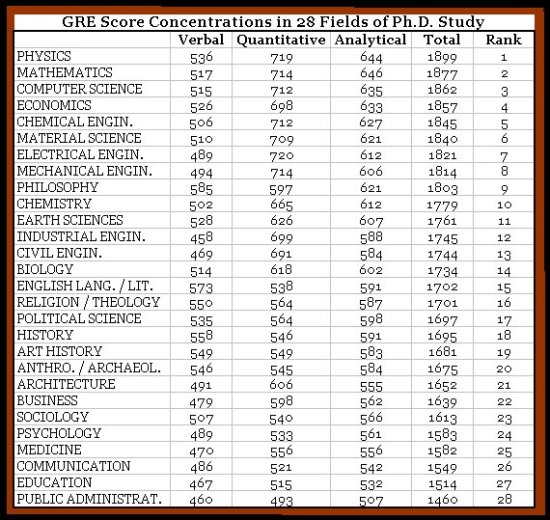
Taken together, these pieces paint the proverbial damning indictment of how teaches are hired, promoted, and (not) fired. Once you’ve read them, it’s hard to accept the dissembling evident from teachers’ unions. Given the research cited regarding the importance of good teachers and how few incentives there are to become a good teacher, maybe it shouldn’t be a surprise that education majors and graduate students typically have incredibly low standardized test scores and GPAs, as shown in the following chart (2002; source):

gre_scores_by_department

Notice that education is at the bottom. Should it be much of a surprise that the best universities, which are almost by definition hyper-competitive, look down on the profession? Susan Engel thinks so.

If you change the incentives around teaching, the programs that teach teachers will change, and so will the skill of the teachers more generally. Over the last thirty years, the larger economy has undergone a vast shift toward greater competition and freer markets—a vast boon to consumers. The market for primary and secondary education has seen virtually none of this competition, or, to the extent it has seen such competition, has seen it on a district-by-district level, which requires geographical moves to take advantage of it.

This topic is one I attend to more than others because I think I’d like teaching high school and that I might even be good at it. But the pay is low, even relative to academia (which isn’t most remunerative field in existence), and, worse, there’s virtually no extrinsic reward for excellence. Almost anyone with a slightly competitive spirit is actively driven out; even those who have it begin with probably lose it when they realize they’ll make the same money for less work than those with it. And you’ll basically have to spend an extra year or two and lots of money to get an M.A. in education, which sounds like a worthless degree.

If you teach computer science in most districts, you make as much as someone who teaches P.E. You might notice that, according to Payscale.com‘s average salary by major table, education majors usually start at about $36,200 and make a mid-career average of $54,100. That’s probably low because it doesn’t take into account the extra time off teachers get during the summer. Still, notice the numbers for Math: $47,000 / $93,600, Computer Science: $56,400 / $97,400 or even my own major, English: $37,800 / $66,900.

But I doubt money will solve the problem without institutional reform, which is very slowly picking up. Susan Engel’s comments, however, only muddy the water with platitudes instead of real solutions.

EDIT: And if you want further hilarity as far as teaching incentives go, check out Edward Mason’s story, “Union blocks teacher bonuses.” As Radley Belko says, “The Boston teacher’s union is blocking an incentive bonus for exceptional teachers sponsored by the Bill and Melinda Gates and Exxon Mobil foundations unless the bonuses are distributed equally among all teachers, good, bad, and average.”

Outliers and Blink — Malcolm Gladwell

The Gladwell coda and its problems can be seen in this passage from the introduction to Blink: The Power of Thinking Without Thinking: “The task of Blink is to convince you of a simple fact: decisions made very quickly can be every bit as good as decisions made cautiously and deliberately.” I add the emphasis because Gladwell is not actually making a very strong claim: he’s essentially arguing for maybe. In that respect he certainly succeeds, though if you’re not reading closely you might miss the caveat.

In finding rules for determining how, of all the situations in the world, which respond to a “blink” decision and which will fail with that approach, Gladwell can’t do much more than find some examples, leaving a vast space unmapped. I don’t necessarily mean this as negative criticism: it is, rather, a description of the Gladwell technique that can very easily morph into a weakness if one is not aware of it going into his books. I treat his output as a single unit because there is far more unifying them in terms of style and content than not: they all collect anecdotes and research studies and combine them to form ideas that seem intuitive once you hear them and yet skew towards the quirky. His recent articles for the New Yorker use the same technique. He then divides these subjects into loosely linked chapters.

Gladwell gives examples of where what we claim to want or think want doesn’t match what we actually do, or what we actually seek out. As he says in Blink, “We have, as human beings, a storytelling problem. We’re a bit too quick to come up with explanations for things we don’t really have an explanation for.” He’s right, and he’s probably a bit too quick to accept explanations that have been published in peer-reviewed journals, rather than examining them with the skepticism appropriate to any effort to prove cause and effect. To me, however, the storytelling claim borders on obvious, but I like the succinct formulation he gives as well as the examples, which seem to back up his idea, though one could just as easily, say, cite the Bible, or any number of mythological and religious explanations for the cosmos that developed before science got started in earnest a few centuries back. In Northrop Frye and the Phenomenology of Myth, Glen Robert Gill writes that

Frye’s encounter … with the work of Oswald Spengler, a philosopher who observed mythic patterns in history, was ‘the first of several epiphanic experiences which turned vague personal ambitions into one great vision…

One might say something similar of Gladwell, who observes patterns that are not quite mythic but take on an almost mythic scope of destiny in parts of his book, which balances on the idea that we’re shaped or even determined by culture and experience and yet still have to work incredibly hard to achieve mastery. He is never overcome by that tension, but it’s a persistent background hum: if it takes 10,000 hours of practice to achieve mastery, then what can we say of Bill Gates, Bill Joy, and Flom, all of whom had opportunity to work incredibly hard? And what do we say of people who expand the scope of their opportunity to make it greater than it was? To that Gladwell has few answers, and it seems one of the overlooked sections in his drive to create narrative coherence—which might be another word for “mythic pattern”—out of what appears to be chaos.

Gladwell also has a clever shtick: if you discount his specific examples, the general principle might still hold, and if you discount his general principle, the specific examples might still be of interest. For example, a section in Outliers: The Story of Success about why Asian countries tend have students who score better on the math portions of international exams explains that seemingly innate ability as a cultural gift because Asian countries have traditionally built and maintained rice paddies, where you have to work at them virtually every day to get rice, while Western countries tended to farm, where you worked like a dog during planting and harvesting season but otherwise lounged. The point you’re supposed to take is that Asians aren’t innately good at math, which I buy, but that they tend to work harder at it in many cases, which I also buy. The problem is that I’m not so convinced that rice paddy work is necessarily the catalyst for this: what if some other cultural or political marker is the actual truth? Gladwell doesn’t sufficiently rule out alternate causes.

Even if one accepts the rice paddies explanation, Gladwell doesn’t go on to the other obvious inferences. Shouldn’t students in Asian countries excel not just at math, but at virtually every topic in school? They do, or they seem to. But then one should ask why, historically, most Asian countries with the exception of Japan haven’t industrialized at the rate of Western countries; if they’ve been exposed to Western technologies for centuries and are so industrious, why has the world taken the larger shape it has? Those questions lead one in the direction of Jared Diamond’s famous Gun, Germs, and Steel (answer: colonialism; oppression; luck) and Gregory Clark’s A Farewell to Alms (answer: evolutionary cultural (and perhaps biological) success), but Gladwell doesn’t go there: he stays in the “Asians are good at math” rice paddies idea rather than exploring the limits and consequences of what he says.

In other words, the situation is more complex than it’s presented. Gladwell’s specific examples might not hold to explain the general principle. But that principle might still stand. And it’s got a great tagline in this case: “No one who can rise before dawn three hundred and sixty days a year fails to make his family rich.” That might be true, or mostly true, or true enough that believing it is much more likely to make your family rich than not believing it.

In Outliers, Gladwell puts a different spin on the bigger pictures, writing that:

The people who stand before kings may look like they did it all by themselves. But in fact they are in variably the beneficiaries of hidden advantages and extraordinary opportunities and cultural legacies that allow them to learn and work hard and make sense of the world in ways that others cannot.

Let’s unpack that idea for a moment. If you stretch Gladwell’s comment in one direction, he’s completely right: people who are successful by conventional materialistic or intellectual measures benefit from being born into the industrialized world. If I’d been born into the dwindling stock of indigenous peoples, I’d be highly unlikely to be writing this at the moment. Furthermore, if I’d been born five hundred years ago, I’d almost certainly not be writing this because I’d probably be a peasant hoeing tubers or something to that effect. At the same time that Gladwell writes about how cultural advantages allows people to succeed, however, he doesn’t emphasize the people who don’t succeed despite all the cultural advantages in the world: the people who are born rich and privileged and end up drug addicts or moochers or whatever. Why do some people show great resilience in terrible circumstances while others fail to thrive in opulence? If I had definitive answers to that question, I’d have solved many of the worlds questions, but I think this paragraph nonetheless demonstrates that “hidden advantages and extraordinary opportunities and cultural legacies” are not the whole story. Gladwell doesn’t say they are: but he implies it strongly enough that it’d be easy to come away with that impression. It matters where we grow up, as he argues, but what could matter more is how far we go with what we’re dealt.

Gladwell can also contradict himself. On page 42 of Outliers, he says “You can’t be poor [and have time for the 10,000 hours it takes to master complex skills], because if you have to hold down a part-time job on the side to help make ends meet, there won’t be time left in the day to practice enough.” On page 117, he tells the story of Joe Flom, a poor boy who grows up to be a name partner at one of the world’s most prestigious and wealthy firms. He says of Flom’s background that “After school, he pushed a hand truck in the garment district. He did two years of night school at City College in upper Manhattan—working during the days to make ends meet—signed up for the army, served his time, and applied to Harvard Law School.” So which is it: if you’re poor, you don’t have time to practice and you’re likely to remain poor, or it’s possible to work your way up? Neither and both, of course, because the world isn’t as definitive as either version would have you believe.

These problems do not make Gladwell worthless, and if you’re aware of them you can still learn to think better while not succumbing to potentially fatuous stories. I’ve cited his story about the conception and execution of the Herman Miller Aeron chair several times. But I suspect most of Gladwell’s millions of readers aren’t reading with the critical eye they need; they’re being taken in, repeating whatever he says, and thinking they’ve got gold. Not everyone is so taken—Megan McArdle notes some problems with Gladwell stories too, as she writes here—but I suspect many are.

I would put Gladwell in the same category as Geoffrey Miller and his books The Mating Mind and Spent, or as Freakonomics: read them, but with care, and without being ready to accept everything they claim. Of course, that basically describes what educator-types call “critical reading” anyway, but some books demand it more than others because of the extravagance of their claims against the paucity of their evidence.

One other thing I wonder about is the story of Gladwell’s success: his books have been bestsellers for years, which indicates that 1) bestsellers have random properties or are simply random, which I suspect to be the reason behind Harry Potter’s success, or 2) he taps into some non-obvious social need or desire. In his case, if the answer is number two, maybe people like his books because he’s good at connecting abstract data to stories; popular television shows are, well, popular, while math journals tend to find a niche audience. People like stories, and when you combine ideas with stories, the ideas are often more memorable. I don’t think Gladwell’s books will endure, however, and he might be an example of the tendency I posited in Literary fiction and the current marketplace: nonfiction has a shorter shelf life than fiction because it’s easier for the state of the art to advance.

In the end, however, I’m a hypocrite too: the paragraph above indulges in the same Gladwell-like speculation that I’m criticizing. But I also take more care to make the uncertainties in the stories I tell clear, rather than covering them up. When you read Gladwell—and it appears that you or someone you know will—don’t necessarily believe it all and look for the potential holes in the arguments. Still, you’ll find many rich anecdotes and strange new ways of looking at the world. With those rewards, the risk of Gladwell is relatively low, especially because reading him is so easy. For all his problems, Gladwell is very good at extending the range, if not the precision, of your intellectual vision.

Highly recommended: the perils of pop philosophy

Julian Sanchez has a brilliant post regarding some Perils of pop philosophy, which he uses as a synecdoche for blogging, journalism, and other forms of expression/knowledge that can easily be reduced to facile dilettantism rather than genuine knowledge acquisition and, ultimately, extension.

If the first paragraph confuses you, skip to the second, although by doing so you’ll probably be committing one of the sins Sanchez discusses, some of which are implied in this paragraph, which I would consider his money shot for this post:

This brings us around to some of my longstanding ambivalence about blogging and journalism more generally. On the one hand, while it’s probably not enormously important whether most people have a handle on the mind-body problem, a democracy can’t make ethics and political philosophy the exclusive province of cloistered academics. On the other hand, I look at the online public sphere and too often tend to find myself thinking: “Discourse at this level can’t possibly accomplish anything beyond giving people some simulation of justification for what they wanted to believe in the first place.” This is, needless to say, not a problem limited to philosophy. And I think it may contribute to the fragmentation and political polarization we see online, which are generally explained in sociological terms as an “echo chamber” effect or “groupthink.”

Those are real enough, but there’s also the problem that the general glut of information and opinion makes it disconcertingly easy to kid yourself about how well you understand a particular topic.

As should be obvious, the whole post is highly recommended. If you haven’t read it by now, do so.