The year's best in reading, not in publishing

Like D.G. Myers, I don’t find much interest in “year’s best” lists and the like. Most of them are, as he says, boring; maybe that has something to do with the nature of the list and the arbitrary divisions that we use to mark milestones in our lives.

That being said, I read a lot, and I’d prefer to write about what’s new to me, rather than what happens to be published in a particular 12 month period. Last year I wrote about “pointless listmaking,” and I’m reminded of a comment from Rob, the narrator of Nick Hornby’s High Fidelity, when he’s at a party given by an ex-girlfriend:

The difference between these people and me is that they finished college and I didn’t… as a consequence, they have smart jobs and I have a scruffy job, they are rich and I am poor, they are self-confident and I am incontinent, they do not smoke and I do, they have opinions and I have lists.

(Emphasis added. The novel’s first sentence involves a list: “My desert-island, all-time, top five most memorable split-ups, in chronological order: 1. Alison Ashworth…”)

Umberto Eco likes lists, or at least studies them. As previously mentioned, he said that “The list is the origin of culture.” Being the origin, however, is very different from being the destination, or the evolution, of culture, and so in that light the list might be a primitive device that is still nonetheless useful to consider. As such, after a great deal of meta commentary regarding the nature of the activity in which I’m about to engage, I’m going to give a non-numbered, non-ordered list of books I happened to read in the previous 12-month period that are books I now recommend to others, found moving, or otherwise think deserve special attention.

* Carlos Ruiz Zafón, The Angel’s Game, which I keep meaning to write about and then not doing. If one were writing an ad for the novel, it could say, accurately, “Did you love The Shadow of the Wind? Then you’ll love The Angel’s Game!” The two novels are written in the same half-mocking Gothic style, are both set in Barcelona, and both deal with murder, love, and literature.

* Max Jamison, Wilifred Sheed’s improbably hilarious novel about an unhappy theater critic.

* The Magicians, Lev Grossman’s take on what magic school might seem like to those who are already aware of magic school and fantasy conventions. As with real school, nobility takes front seat to sex and power, which occupy the back. I also read (and haven’t written about) Donna Tart’s The Secret History, which features school and murder in a surprisingly pleasant literary package.

* Daniel Gilbert’s Stumbling on Happiness ought to be required reading for those who are alive.

* John Barth’s The Sot-Weed Factor.

One nice part about reading is that books are effectively inexhaustible: given constraints on time, no one can read everything worthwhile (although Harold Bloom is apparently trying). Therefore we need developed opinions, yes, but we also need pointers to books that are worth having developed opinions about, and to my mind the handful of books above meet that criterion. Apologies to those of you who have read this far and just wanted a couple books to read, and to those of you who think the whole idea of lists so noxious and boring that, even with the aforementioned meta commentary, you don’t know how you managed to get this far into the post.
Nuts: The Barnes and Noble Nook isn't very good

The Barnes and Noble Nook isn’t ready for prime time, according to David Pogue of the New York Times. Walter Mossberg of the WSJ agrees. Too bad: I was thinking about buying one, mostly for the .pdf capabilities, but I think I’ll wait—maybe for Kindle 3. I don’t think the Kindle’s current and potential dominance of the eBook market is good for books or consumers, and part of the reason that the Nook attracted me is precisely because it represents a real competitor to the Kindle. But these reviews indicate that the Nook was either rushed to market or poorly tested.

The .pdf issue is important to me because I’m a grad student in English and have to read a steadily larger number of articles and book chapters. Most get printed, but I no longer have the physical capacity to store, organize, and carry all of them, which makes something like the Kindle or Nook appealing, despite my reservations concerning the Digital Restrictions Management (DRM). By the way, you might want to check out the comments section on my post “New Kindle, same problems,” as Jason Fisher and Maggie Brookes have been talking books, ebooks, and culture in that space.

Late November Links: Academia, artistic dangers, reading, and more

The Ph.D. Problem: On the professionalization of faculty life, doctoral training, and the academy’s self-renewal.

* A Little-Known Occupational Hazard Affecting Writers: writing (or wanting to write) outside your field.

* When Great Artists Dry Up.

* Cellphones, Texts, and Lovers, on how technology is or is not reshaping romance in the digital age. I don’t really buy the argument, but I find it suggestive nonetheless.

* James Fallows has a typically nuanced, brilliant series on Obama’s trip to Asia, and especially its Chinese implications.

* Das Keyboard is sponsoring the Ultimate Typing Championship. Do you have the “fiercest typing skills around?” Me neither. But those who do can win $2,000 at the SXSW festival in Austin. The e-mail I got says, “Oh, and don’t forget to sign-up yourself to compete! At a minimum, it’s an opportunity for bragging rights among your friends and co-workers. :)”

Alas: I’m a relatively slow typist at 50-ish WPM. Usually the problem isn’t typing speed—it’s thinking speed, and I haven’t found a hardware solution for that yet.

* Local Bookstores, Social Hubs, and Mutualization. Like me, Clay Shirky finds it more than a little difficult to believe that cheap hardcover books are bad for readers, even if they might be bad for publishers as they currently exist.

* What the iPod tells us about Britain’s economic future.

* Secret copyright treaty leaks, and it’s bad. Very bad.

* Sunday afternoon at the Shenzhen Public Library. As James Fallows says at the link, “No wonder Shenzhen is on the rise.”

* Gossip Girl might be worth watching again.

* Are too many students going to college?

* Learn your damn homophones.

* No one wants America to be the sole global superpower, but no one wants to share the load.

* I love it: the bookstore Lorem Ipsum is having an “anti-sale.” As they say: “Everyone like’s a sale, right? But does anyone like an anti-sale? We hope so!

What’s an anti-sale, you ask? It’s when nothing in the store is on sale. We’re proud to announce that none of our items are on sale, instead they are for purchase for regular price. We think it’s ground-breaking.”

* Inculcating a Love for Reading: Children’s books that might help repel the armies of electronic distraction.

* From Oxford to Wall Street: what the rising number of Rhodes Scholars in business and finance means. Or, according to actual Rhodes scholar, maybe not.

* Are U.S. Wages Too High?

* Why are some cities more entrepreneurial than others?

* The Writing Habits of Great Authors.

* Hilarious search query of the day that brought someone to The Story’s Story: “bookworms sex.”

Life: Writers' edition

“Never underestimate a writer’s vanity, especially that of a mediocre writer.”

—Carlos Ruiz Zafón, The Angel’s Game

Max Jamison — Wilfrid Sheed

Really good and really bad books often announce themselves early: in the case of the former, you find that moment of shock and astonishment that propels you forward. In Max Jamison, that moments hits on page 7, when Flashman is described not as “a theater critic at all, but a maid-of-all-work gossip columnist and second-string reviewer who scooped up free tickets like a mechanical crane and prowled the lobbies for carrion.” Status and aesthetic contempt intermingle: Flashman doesn’t appreciate art because he’s “like a mechanical crane,” and yet at the same time he feeds on the dead—dead plays, dead reviewers, dead everything.

Max, on the other hand, sees himself as an antidote of sorts to that: he’s a theater critic with, if not heart, then at least acerbic taste, which is better than no taste at all. But he’s not terribly happy and is too aware of his own faults to let something like sentimental happiness buoy him; in another early scene, he thinks that “The actors he talked to were dull as ballplayers and degradingly anxious to please.” Or, more likely, the actors are worried about angering critics on whose fancy rides their career. But if that critic is sufficiently cantankerous, their actions simply won’t matter, and Max is holding the line against—what? Not the cavalry charge, certainly, but against something, even if he’s not sure what.

In the two paragraphs above, I’ve utterly failed to convey how funny Max Jamison is, perhaps because explaining the joke also kills it. Max is funny to himself but to few others; his estranged wife says, “I wish you wouldn’t attend so much. I wish I could split an infinitive with you sometime, or have a really silly discussion.” If Max worries about split infinitives, he truly is a nasty pedant, since split infinitives are a problem in Latin, not in English. Pedants who half understand their problems and are trying to remedy them are sometimes the most amusing of all, since they’re in the joke enough to be aware of their situation but not so much that they can remedy it.

Saul Bellow frequently exploits this metaphysical, intellectual, and sometimes sexual state; so does Mordecai Richler in Barney’s Version. It also might lend heft to a novel that could otherwise flutter—what’s most fascinating about Max is his sense of infinity within a confined space, which avoids the flutter problem. He’s a theater critic, unlikely to change professions, and stuck (if one can ever use the word “stuck” with this city) in New York by virtue of that profession. He’s confined, like so many of us, by those proverbial silk chains, given that he makes enough money, gets to sleep with admirers if he wants to, doesn’t have to worry about food, and only carps about status—which is difficult, since he’s at the top of his pyramid. But the pyramid is too short for him, and there’s probably none tall enough for him, and seeing him try to climb is hilarious without being mean.

(Note: I read Max Jamison thanks to D.G. Myers’ post on The Hack, which says that Sheed wrote “… perhaps the best novel ever written about a critic. Max Jamison (1970) is about a Broadway theater critic who no longer believes in what he does for a living.” It used to be that we thrashed when we no longer believed in God. Now we thrash when we no longer believe in ourselves. What will we thrash about next?)

Pages For You — Sylvia Brownrigg

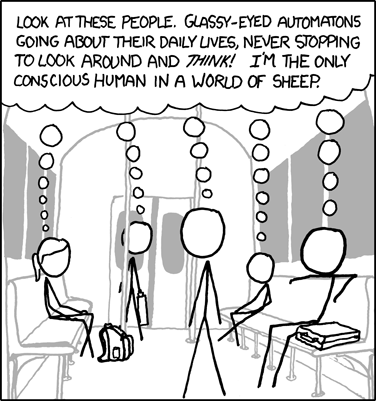
Like many teenager narcissists, Flannery Jansen thinks that she’s a special and unique sunflower “alongside such sour-souled people” as those she has to attend class and live with at college. By her own theory, “They were all planning to laugh at her, clearly, every single day, until she finally gave in and went back to the land of computers and eucalyptus, where everyone wanted you—sincerely—to have a nice day.” It’s a bit like the problem expressed so succinctly and beautifully in XKCD:

Alas, she’s probably not right, and we find out why in Pages For You, a novel that I want to be better than it is. The story follows Flannery as she chases and acquires Anne, a 28-year-old grad student in English whose idea of a good time is having or encouraging Flannery to write short quasi-diary entries about their relationship, and these pages form for the pages of the novel—the “you” in the title being Anne. The novel is written almost pornographically, in spurts that are supposed to represent Flannery’s daily writing assignments or letters to Anne.

As often happens to teenage narcissists—are we sensing a pattern here?—”Flannery had nothing to do but watch that mouth smoking, and though she couldn’t have said why it was so beautiful or described the thrill of its shape—she was too young to have anything like a vocabulary for such things—she could not stop herself from watching it, shaded a darkish persimmon that left its trace on the cigarette.” I like a nice mouth too, and having the vocabulary to describe it, but by the time I acquired the vocabulary to describe such a mouth I no longer needed said vocabulary. And smoking isn’t attractive. Even so, I like the phrase “shaded a darkish persimmon” enough that it saves the sentence from being turgid. Much of Pages For You feels like it’s about to become tedious, and then a moment later it recovers.

Take this description: Flannery stands “over a rickety kitchen table that had been flash-flooded with alcohol,” which so perfectly captures what those equally unruly college parties are like, with their sticky counters that were at least somewhat clean a few hours prior and probably won’t be clean again till much later. Long sections are oddly flat and affectless (“Flannery bundled up her items and took them away to the bookstore/cafe where she intended to enjoy them slowly, with a cup of decent coffee…”), but at least Pages For You is unusual in that it deals with a female/female romance, rather than the usual boy-meets-girl or vice-versa, then loses said boy/girl. It’s also refreshingly free of the professor-sex-plot machinations that drive many campus novels, like Francine Prose’s Blue Angel (which, to be fair, transcends its sex plot), or Bernard Malamud’s A New Life.

I like or want to like Flannery, who, even though she’s writing this at some point in the future, still doesn’t get who she was. But “Flannery did not know New York except as a movie and a myth,” much like me before I visited. And now I’d like to live there, if only it weren’t so damn expensive.

Chapters end before they really get going: that’s the major drawback for a novel structured like Pages for You, and the unusual form doesn’t have enough to do with the content to justify it. In another blow for equality, I’ve discovered something that I’ve always suspected: lesbian romances can be just as boring as their heterosexual counterparts for those not immediately involved in them. That being said, I like a coming-of-age story as much as the next fellow, and I rolled with this one to the last page, waiting for those phrases—”flash-flooded with alcohol”—that made me look again. And I kept waiting for Flannery to want something more than action and meaning, but the flash-floods of those epiphanies, alas, weren’t readily forthcoming.

Why Women Have Sex: Understanding Sexual Motivations from Adventure to Revenge (and Everything in Between) — Cindy M. Meston David M. Buss

Terry Teachout says that “Scientists are forever proving what everybody knows, especially when it comes to music.” Cross out music and replace it with sex, and you’ve also got a substantially true statement. One big advantage to Tim Harford’s The Logic of Life and Dan Ariely’s Predictably Irrational: neither is exclusively about sex or relationships, but both have some unusual experiments. The former discusses how marriage and dating are like markets and how gender imbalances work, while the latter discusses the differences in cognition and choices when in aroused versus unaroused states.

In contrast, Why Women Have Sex gives us a lot of the obvious: women have sex for a variety of reasons, not surprisingly, but the authors don’t go into why a particular reason might predominate at a particular time. The reasons are mostly descriptive instead of explanatory and predictive. Reading the table of contents is almost as good as reading the book: women do it because they’re attracted to the person, for pleasure, for love, for conquest/status, for duty, for adventure, for barter and trade. One could probably figure that out from a few months of reading Cosmo.

We learn that women like men who are tall, have a sense of humor, wealthy, skilled, upbeat, symmetrical, and attractive, the last adjective comprising the earlier ones. On page 22 we learn that “A person’s mood at the time of an initial encounter is an important factor in determining attraction—positive feelings lead to positive evaluations of others and negative feelings lead to negative evaluations.” Really? I had no idea. Notice also the hedging words: mood is an “important factor,” but far from the only one. Later on the same page, we learn that “Having a good sense of humor usually signals an easygoing, fun-loving, adaptable personality.” To my mind, the word “adaptable” is the most interesting word—how does humor signal adaptability?—but the authors don’t pick up on that thread.

The idea behind Why Women Have Sex is to give a large portrait of some of the research findings out there. This is a useful service, and if I were preparing for an academic career in sexuality or sexuality studies, or if I were a journalist who wrote about such issues frequently, I’d buy this book for its bibliography. Even so, however, the book has more scientific trappings than actual science. The introduction states their study was conducted between June 2006 and April 2009 and:

Web links and online classified advertisements requested women’s participation in a study designed to understand sexual motivations. The survey itself was hosted by a database using 128-bit encryption technology to protect the information from hackers and ensure the utmost anonymity to the study’s participants.

The tech terms are poorly used: 128-bit encryption is meaningless without noting the algorithms used, although the authors are probably talking about generic TLS/SSL layers for authentication between client and server. But the larger problem is likely to come from people posing as women who aren’t women and ballot stuffers. Even if they took care of that, they still don’t have a random sample, which would be necessary to draw conclusions about the general population. This means the conclusions that they do draw from their sample aren’t useful. For more on why this is important, take a look at almost any introduction to statistics textbook; the upshot is that their data is suspect, which undermines the book’s conclusions.

I read the first third of Why Women Have Sex closely anyway, and some claims aren’t cited in their bibliography. For example, page 14 says that “DNA fingerprinting studies reveal that roughly 12 percent of women get pregnant by women other than their long-term mates, suggesting that some, but certainly not all, women pursue this dual mating strategy.” That seems improbable, which made me curious about the study backing it up. Page 14 has two research citations; neither relates to this claim.

To me, the biggest reminder Why Women Have Sex offers is why literature retains its power over time while pop sexuality books fade like flowers against the onset of winter. Literature can withstand the onset of cold time because it tells us something that can’t easily be captured by survey; to me, Madame Bovary, The Unbearable Lightness of Being, and Alain de Botton’s On Love have vastly more explanatory power and aesthetic interest than Why Women Have Sex. I’m reminded of this passage from Robertson Davies’ The Lyre of Orpheus:

But Darcourt was not disposed to Freudian interpretations. At best, they were glum half-truths, and they explained and healed extraordinarily little. They explored what Yeats called “the foul rag-and-bone shop of the heart”, but they brought none of the Apollonian light that Yeats and many other poets cast upon the heart’s dunghill.

I quote Davies quoting Yeats: there’s a very fine movement of thought there, which Why Women Have Sex lacks. Even a book like Neil Strauss’ The Game: Penetrating the Secret Society of Pickup Artists offers more explanation, and it doesn’t even have the backstop of the many but still incomplete peer-reviewed studies offered by Why Women Have Sex. In short, there are more useful ways of looking at the questions this book asks. Try reading this interview with the authors or looking at some of the other books mentioned and you’ll begin to find those more useful ways of knowing.

Breaking The News: How the Media Undermine American Democracy — James Fallows

The weird thing about Breaking The News: How the Media Undermine American Democracy is how timely it still seems—I think Thoreau called books “the news that stays news.”* Even after some of the particulars Fallows wrote about have receded—like, say, the healthcare debate—the main point that news celebrities and TV-style have cheapened, perhaps dangerously, American knowledge and democracy remains. More importantly, the habit of political score-keeping rather than dealing with substantive issues remains too; Fallows quotes a Clinton administration staffer who said after the 1994 Republic landslide:

They [meaning voters] had ‘made the monkey jump’—they were able to discipline an institution they didn’t like. They could register the fact that they were unhappy. There doesn’t seem to be any way to do that with the press, except to stop watching and reading, which more and more people have done.

The process seems to have accelerated: i part that’s because of the Internet—people have more choices for news—but I wonder if it’s also in part because of the product being produced. Fallows gives an excellent sample of what TV news is like: mostly chasing sensation and catastrophe that doesn’t really mean anything, or have any nuance: there’s no real ambiguity concerning whether a killer should be caught and punished, or that a tornado is a tragedy. As Fallows says, “Then there is political news, almost always in the context of horse race politics—the mayor is criticizing his opponents, the city council is arguing with the mayor.” But over what? And why? The scorecard aspect ignores these important issues.

I’m not giving specific examples from Breaking the News because they’re too involved for a (relatively) short blog post, and the most specific parts of the specific examples have changed. But Fallows gives numerous anecdotes and stories to back his points, and it’s almost impossible to have seen TV news over the last ten years and not nod in agreement. The only place he fails in his proscriptions for working past the problems; most revolve around the idea of public journalism, which involves greater citizen participation in news topics, commitment to real information, and so forth. The major problem appears to be that most of the public doesn’t seem interested in such subjects, or at least in paying for them. Those who are interested subscribe to The Atlantic (Fallows’ current home), or, today, find what they need on specialized Internet forums. Most people appear interested in celebrity gossip and hating whatever “the other side” is doing.

For me, Hacker News does a better job of finding what’s worthy than all but a handful of publications (The Atlantic, The Wall Street Journal, The New Yorker, and The New York Times being the most obvious). But Hacker News is only an aggregator, not an originator. Despite strides being made by blogging, it hasn’t come close to replace media organizations—in part because of lawsuit threats that can stymie the proverbial little guy.

As Jack Shafer says on Slate, “Among the many glorious things about American journalism is that no credentialing organization or regulatory body stands between an individual who wants to break a story and his public reporting of it.” This is true: but it’s also true that the “big media,” much as hate using that phrase, has disproportionate power—especially television. And the media business (another unfortunate phrase) doesn’t seem able to reform itself, so the Internet is doing part of the job for it. Still, media companies are in the business of giving people what they want, or at least what they seem to want, and what people seem to want is to have their prejudices massaged, whether by Fox News or MSNBC. And the status conveyed by TV (which Fallows deals with in a chapter titled “The Gravy Train;” one consultant says of pundits, “Every time they vanish from the tube for a period of time, the requests for their speaking and lectures drop off dramatically.” In other words, appearing on TV is insanely lucrative) means that far more people want to get on than can get on. The result: you can get people to do or say almost everything. As Shafer says, no professional body will stop you. But if people become more accustomed to unfiltered material on the net, maybe they’ll grow more tired of the news blowhards.

Against these problems, the individual doesn’t have a tremendous amount he or she can immediately do. “Don’t watch TV, or at least most TV news” is an obvious one that’s akin to telling people to eat their broccoli, even as McDonald’s continues to expand like waistlines. But, as any community organizer knows, making people aware of a problem is often an important step in solving it. Fallows made people aware of this problem in 1996. Alas: too little has changed. Maybe this post is another step, however tiny, in the direction of change for the better.


* This quote is probably slightly wrong, or wrongly attributed. Maybe he was the one who said, “Read not the times. Read the eternities.”

Late September links: Little to do with books, much to do with life

* The best I’ve read concerning “overrated” novels, courtesy of the Little Professor.

* The humanities are in the same state financial markets were in before they crashed. Assessing the growing mountain of toxic intellectual debt, Philip Gerrans considers going short on some overvalued research.

Except that I’m not sure his analogy works, since “intellectual debt” doesn’t have to be “repaid,” doesn’t hurt anyone, and might point the way forward regarding ideas in ways that aren’t necessarily obvious at the time such “debt” is being produced/acquired.

* What kinds of inequalities bother people, and what kind do not?

* In Conniptions from me on urban economics, Tyler Cowen lists his opinions on urban issues, which I essentially agree with save for number 3, which I know nothing about:

1. I would not have brought the U.S. down the path of water subsidies, many of which are pro-suburban. (Admitted they are not always easy to repeal.)

2. I think pollution externalities should be priced in Pigouvian fashion; this would penalize many suburban developments.

3. I oppose the widening of Route 7 at Tysons Corner and I expect a disaster from the current plans.

4. I favor school choice and charter schools, which would make many U.S. cities livable again for couples with children.

5. I would price many roads for congestion, although as Bryan points out this could either help or hurt cars as a mode of transport.

6. I would allow U.S. cities to become much taller, thereby accommodating more residents. I would weaken many urban building codes in the interests of a greener America.

7. I much preferred the time when I lived near a gas station and a 7-11.

* Laws have become too vague and the concept of intent has disappeared. Notice in particular this problematic line: “Prosecutors identify defendants to go after instead of finding a law that was broken and figuring out who did it.” If the theory is that everyone is a criminal if you look hard enough, something very serious has gone amiss in our notions of justice.

* A chat with blogger Penelope Trunk:

Ben: You blog about sex a lot. Why?

Penelope: I think about it all the time. So it comes into my head a lot when I’m writing blog posts. I sort of wonder why it doesn’t come into more peoples’ heads when they are writing blog posts.

Ben: People censor themselves.

Penelope: Yeah. Well. I censor myself too. I guess it’s just we each have different types of self-censoring….

Ben: Alain de Botton has an interesting point on this. He says the professionalization of writing — novelists who write fiction full time — has made it so much fiction is disconnected from life as it’s experienced by most people.

Penelope: Totally agree. And the French have this problem more than any other culture.

* I wasn’t going to write about Dan Brown till I found this hilarious discussion of his expert style. One day I hope to be as great a writer.

* Dvorak keyboard devotees and their battle with smartphones.

* Population growth drives innovation?

* Andrew Sullivan of The Atlantic makes the pitch for print. I subscribe to The Atlantic and recommend that others do as well.

* America can’t be the world’s tech leader without immigration reforms.

* The Man Who Saved a Billion Lives has died.

* Megan McArdle and Matt Yglesias on education, in a post I almost completely agree with.

* Wow: from I was an Ambassador and Taken Hostage by Militants:

I learned a lot from my time as ambassador and Marine. Paperwork means stuff to people: really important stuff. Thinking you have to solve every problem on your own is an additional problem to your other problems: one that makes all the others worse. No matter how much you love something, it’s not going to make a square peg fit into a round hole. What people experience in the service has to do with the type of work they do and the unit they are in. Hidden assumptions hurt. A lot….

This “bad experience” changed a passive, wait-for-life-to-happen person into and active, go-make-it-happen person.

(Emphasis added.)

I wish I’d realized the power of paperwork earlier, or how important documentation is in a modern, complex, and bureaucratic society.

* Two kinds of libertarians.

What I like in this essay is also an acknowledgement of its limitations (the “cartoon” version of libertarian), but also the acknowledgment that those limitations are useful in describing broader phenomenon.

* The value of a college education.

A friendly reminder to those who think they know the answer to everything

“Humans are suckers for finding patterns where none really exist, like seeing the shapes of lions and giraffes in the clouds.”

William Easterly’s review of Leonard Mlodinow’s The Drunkard’s Walk: How Randomness Rules Our Lives and Ha-Joon Chang’s Bad Samaritans: The Myth of Free Trade and the Secret History of Capitalism is very much worth reading for its own sake, as well as being a timely reminder for the limits of our ability to understand cause/effect, whether in developmental economics or other fields.