Scrivener or Devonthink Pro, with a side of James Joyce's Ulysses

James Fallows’ post about the writing program Scrivener “suggests broader truths about the ways computers help and hinder the way we think.” He’s right, although I’ve used Scrivener and didn’t love it enough to switch: for anything beyond blog posts I mostly use a combination of Microsoft Word and Mellel, a word processor that is very fast and stable but can’t track changes. This, for me, is not merely bad: I can’t use Mellel beyond first drafts.

The other problem with Mellel isn’t related to the program itself, but to the release cycle. It’s discouraging when a forum post from the developer says, “Yes, we have been slacking off. The pace of development of Mellel – that is, the number of new releases – have dropped significantly over the last three years.” That’s another way of saying, “We’re not really working on it.”

Word, in turn, gets used for any documents I have to share with others (since they already have Word).

Fallows describes how Scrivener offers “a ‘project’ organization system that makes it easy to amass many notes, files, quotes, research documents, etc related to the essay or article or book you’re writing.” I primarily use Devonthink Pro (DTP) for this kind of purpose, and it connects whatever ideas I have to other quotes, ideas, and the like. The “artificial intelligence” engine is surprisingly useful at making connections that I didn’t realize I had. Obviously I could use DTP with Scrivener, but the use of DTP makes the marginal value of Scrivener somewhat lower.

Scrivener 2.0, however, is intriguing; these videos demonstrate its power. More on that later, as I’d like to follow-up on the idea that computers can “help and hinder the way we work.” Scrivener enables one to rearrange large chunks of materials easily, which is how a lot of writers work in the off-line world. For example, I’ve been reading Critical Essays on James Joyce’s Ulysses for a seminar paper and came across this description of Joyce’s process in A. Walton Litz’s “The Design of Ulysses:”

[Joyce] did not write Ulysses straight through, following the final order the episodes. First it was necessary to determine the design of the novel, to visualize its characters and the course of the action, and this entailed putting scattered portions on paper in order to clarify them. Then, like the mosaic worker, Joyce collected and sorted material to fit the design. Finally, the fragments were placed in their proper positions through a process of rough drafts and revisions.

The “design” and the ability to “visualize its characters and the course of the action” corresponds roughly to Scrivener’s idea pane. The “scattered portions on paper” come next so they can be rearranged, “collected” and “sorted.” There’s nothing wrong with using pieces of paper, of course—it worked for Joyce!—but I wonder what the great novelist would think of working digitally.

Joyce used notecards, and Litz liked the mosaic-worker analogy so much that he uses it again a few pages later:

It was the function of the note-sheets to assure that patterns and relationships already visualized by Joyce reached their fore-ordained positions in the text. Like the mosaic worker, he was continuously sorting and re-grouping his raw materials, assigned each fragment to its proper place in the general design. The mechanical nature of this process emphasizes the mechanical nature of those ordering principles which give Ulysses its superficial unity [. . . ]

I used to write more like this and now I write less like this: it is often my goal to ensure that each chapter follows inexorably from the preceding chapter. The narrative threads and the desires of each character should force the novel in a particular direction. If I can rearrange the chapters relatively easily, then I feel like I’ve done something wrong. I still want “patterns and relationships” to reach conclusions, but I don’t want those conclusions “fore-ordained:” I want them to arise organically, and for them to be inevitable yet surprising. This is a difficult trick to pull off, but it means that the serial nature of the writing I do is probably less likely to be helped by the structure of Scrivener than the writing some others might do.

In the essay after Litz’s, Anthony Cronin’s “The Advent of Bloom” begins with the structure of Ulysses: “[. . .] if Ulysses can be said to have a plot, its plot is formless and does not give form to the book – it is not shaped to produce a series of dramatic sensations for purposes aesthetic or otherwise; it has no conclusion in event, only a termination in time [. . .]” If a plot “does not give form to the book,” then something must; for some writers, Scrivener might organize it and help find a way to present formlessness. The program helps one create a mosaic, but I’m not trying to create a mosaic in my work, at least right now: I’m trying to create a linear plot. So I don’t think the program will help me as much as it could.

Nonfiction books, on the other hand, might be much better with Scrivener: in my papers, I move material around much more frequently than I do in fiction. Since I haven’t written any nonfiction books, however, I can’t comment as much on those.

I suspect that large, high-resolution monitors enable programs like Scrivener: at 24″ or larger, one can have a broad enough swatch of material open to really make a (computer) desktop feel like a (physical) desktop. You can layout and rearrange items much more easily. The new 27″ iMacs in particular are appealing for this purpose, and one can now find 27″ external monitors from Dell, Apple, and others. As desktops become more like desktops, being able to visualize large amounts of information at once makes tools like Scrivener more useful.

At the moment, I’m about 80K words into a novel that I think will end up in the neighborhood of 100K – 110K words, which is a bit long for a first published work but not impossibly long. Using a 24″ iMac, I can easily have two pages of text open at a time, which is very convenient. That’s what I use for my “notes” section (miscellaneous stuff I want to remember but can’t immediately add to the main narrative) and my main window, which has the novel progressing from Chapter 1 to “### END ###.” On my second monitor, a 20″ cheapie Dell, I have an outline and character list open.

Some of those functions could be taken over by Scrivener, based on what I’ve seen in the videos. For my next novel—if there is another in the immediate future; I need to devote more time to academic writing—I’d be willing to try Scrivener long enough to know if version 2.0 is a good fit. For this one, however, the thought of changing tools in the middle of the process would be too disruptive. There’s no reason, after all, that I can’t use both Scrivener and Devonthink Pro.
Scrivener or Devonthink Pro, with a side of James Joyce’s Ulysses

James Fallows’ post about the writing program Scrivener “suggests broader truths about the ways computers help and hinder the way we think.” He’s right, although I’ve used Scrivener and didn’t love it enough to switch: for anything beyond blog posts I mostly use a combination of Microsoft Word and Mellel, a word processor that is very fast and stable but can’t track changes. This, for me, is not merely bad: I can’t use Mellel beyond first drafts.

The other problem with Mellel isn’t related to the program itself, but to the release cycle. It’s discouraging when a forum post from the developer says, “Yes, we have been slacking off. The pace of development of Mellel – that is, the number of new releases – have dropped significantly over the last three years.” That’s another way of saying, “We’re not really working on it.”

Word, in turn, gets used for any documents I have to share with others (since they already have Word).

Fallows describes how Scrivener offers “a ‘project’ organization system that makes it easy to amass many notes, files, quotes, research documents, etc related to the essay or article or book you’re writing.” I primarily use Devonthink Pro (DTP) for this kind of purpose, and it connects whatever ideas I have to other quotes, ideas, and the like. The “artificial intelligence” engine is surprisingly useful at making connections that I didn’t realize I had. Obviously I could use DTP with Scrivener, but the use of DTP makes the marginal value of Scrivener somewhat lower.

Scrivener 2.0, however, is intriguing; these videos demonstrate its power. More on that later, as I’d like to follow-up on the idea that computers can “help and hinder the way we work.” Scrivener enables one to rearrange large chunks of materials easily, which is how a lot of writers work in the off-line world. For example, I’ve been reading Critical Essays on James Joyce’s Ulysses for a seminar paper and came across this description of Joyce’s process in A. Walton Litz’s “The Design of Ulysses:”

[Joyce] did not write Ulysses straight through, following the final order the episodes. First it was necessary to determine the design of the novel, to visualize its characters and the course of the action, and this entailed putting scattered portions on paper in order to clarify them. Then, like the mosaic worker, Joyce collected and sorted material to fit the design. Finally, the fragments were placed in their proper positions through a process of rough drafts and revisions.

The “design” and the ability to “visualize its characters and the course of the action” corresponds roughly to Scrivener’s idea pane. The “scattered portions on paper” come next so they can be rearranged, “collected” and “sorted.” There’s nothing wrong with using pieces of paper, of course—it worked for Joyce!—but I wonder what the great novelist would think of working digitally.

Joyce used notecards, and Litz liked the mosaic-worker analogy so much that he uses it again a few pages later:

It was the function of the note-sheets to assure that patterns and relationships already visualized by Joyce reached their fore-ordained positions in the text. Like the mosaic worker, he was continuously sorting and re-grouping his raw materials, assigned each fragment to its proper place in the general design. The mechanical nature of this process emphasizes the mechanical nature of those ordering principles which give Ulysses its superficial unity [. . . ]

I used to write more like this and now I write less like this: it is often my goal to ensure that each chapter follows inexorably from the preceding chapter. The narrative threads and the desires of each character should force the novel in a particular direction. If I can rearrange the chapters relatively easily, then I feel like I’ve done something wrong. I still want “patterns and relationships” to reach conclusions, but I don’t want those conclusions “fore-ordained:” I want them to arise organically, and for them to be inevitable yet surprising. This is a difficult trick to pull off, but it means that the serial nature of the writing I do is probably less likely to be helped by the structure of Scrivener than the writing some others might do.

In the essay after Litz’s, Anthony Cronin’s “The Advent of Bloom” begins with the structure of Ulysses: “[. . .] if Ulysses can be said to have a plot, its plot is formless and does not give form to the book – it is not shaped to produce a series of dramatic sensations for purposes aesthetic or otherwise; it has no conclusion in event, only a termination in time [. . .]” If a plot “does not give form to the book,” then something must; for some writers, Scrivener might organize it and help find a way to present formlessness. The program helps one create a mosaic, but I’m not trying to create a mosaic in my work, at least right now: I’m trying to create a linear plot. So I don’t think the program will help me as much as it could.

Nonfiction books, on the other hand, might be much better with Scrivener: in my papers, I move material around much more frequently than I do in fiction. Since I haven’t written any nonfiction books, however, I can’t comment as much on those.

I suspect that large, high-resolution monitors enable programs like Scrivener: at 24″ or larger, one can have a broad enough swatch of material open to really make a (computer) desktop feel like a (physical) desktop. You can layout and rearrange items much more easily. The new 27″ iMacs in particular are appealing for this purpose, and one can now find 27″ external monitors from Dell, Apple, and others. As desktops become more like desktops, being able to visualize large amounts of information at once makes tools like Scrivener more useful.

At the moment, I’m about 80K words into a novel that I think will end up in the neighborhood of 100K – 110K words, which is a bit long for a first published work but not impossibly long. Using a 24″ iMac, I can easily have two pages of text open at a time, which is very convenient. That’s what I use for my “notes” section (miscellaneous stuff I want to remember but can’t immediately add to the main narrative) and my main window, which has the novel progressing from Chapter 1 to “### END ###.” On my second monitor, a 20″ cheapie Dell, I have an outline and character list open.

Some of those functions could be taken over by Scrivener, based on what I’ve seen in the videos. For my next novel—if there is another in the immediate future; I need to devote more time to academic writing—I’d be willing to try Scrivener long enough to know if version 2.0 is a good fit. For this one, however, the thought of changing tools in the middle of the process would be too disruptive. There’s no reason, after all, that I can’t use both Scrivener and Devonthink Pro.
Highly recommended — the Best Book Stand “Jasmine”

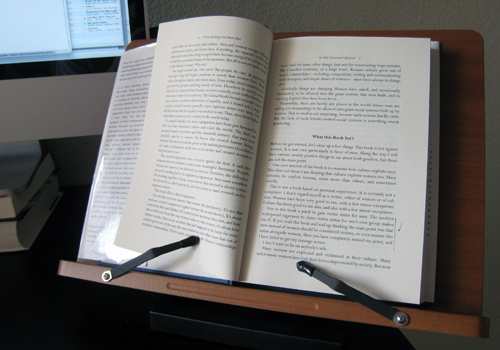
A few months ago I realized that I needed a better way to hold books as I copy passages for both reviews on this blog and for my academic work. A bit of Googling found some really janky looking products that led me to sigh and rig a solution that consisted of a bunch of heavy anthologies (those of you who were English majors might remember the infamous Nortons; they’ve finally become useful again, albeit in a way slightly different from their intent) to lean a book against, while the heaviest of them all sat slightly in front to hold the relevant book up.

Then Kevin Kelly’s blog Cool Tools came to the rescue through a review of the Freesia Book Stand:

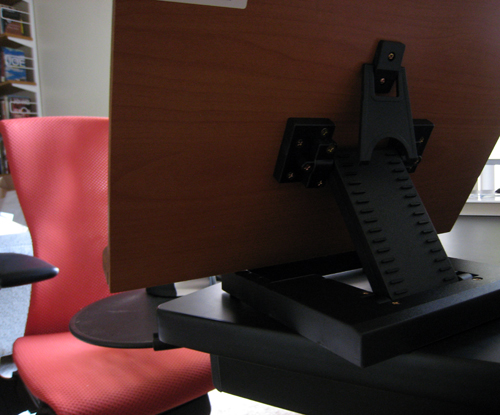
This is a simple but well-designed book stand that does exactly what it sets out to do. It is sturdy enough to hold big, heavy textbooks, but [it] looks nice. It is impressively adjustable, allowing for nearly any reading angle . Amazingly, despite the ability to hold heavy books, the stand itself is relatively light (around 3 lbs). The stand has an anti-skid coating on the bottoms so that it stays where I put it.

Exactly what I wanted. Thank you, Stephanie Misono, for suggesting this. She says, “I now wish I had gotten it years ago.” Me too; I chose the Best Book Stand Jasmine, and it would’ve been insanely useful as an undergrad, when I spent many hours looking at computer science textbooks in particular, going back and forth from page to screen.

The Freesia version is too big, so I ordered the smaller version. I have something similar for standalone printed papers, but even that isn’t nearly as satisfying; I was making edits to a novel earlier, and I flipped from one page to another with greater ease by using the Jasmine. So it’s not only good for copying passages from books, but for holding edited pages.

Does this sound minor? Maybe it is, but managing to find the perfect tool to fulfill a major need is incredibly satisfying, and this is perhaps the best solution I’ve found to a major problem in my life since reading “Tool for Thought” by Steven Berlin Johnson, which concerns DevonThink Pro. Although these tools are useful on a micro level, they probably also change the nature of what I do; as Nicholas Carr says in The Shallows:

Even as our technologies become extensions of ourselves, we become extensions of our technologies […] every tool imposes limitations even as it opens possibilities. The more we use it, the more we mold ourselves to its form and function. […] Whenever we use a tool to exert greater control over the outside world, we change our relationship with that world.

I’m probably more likely to copy marginal passages from books now that it’s become marginally easier both to do so and to organize the output once I have done so. The Jasmine hasn’t yet faded to the point of it reaching what Heidegger called “readiness-to-hand” or “Zuhandenheit,” which, to use Graham Harman’s formulation, “refers to objects insofar as they withdraw from human view into a dark subterranean reality that never becomes present to practical action any more than it does to theoretical awareness.” I’m entirely aware of the Jasmine, which is part of its pleasure, but when it fades “into a dark subterranean reality,” it will be really incorporated into my work (I suspect that writing the dissertation might force this state on me, as one book after another checks in and check out).

The Jasmine cost about $30, with about $10 in shipping. I probably would’ve paid $100 for it. Maybe more. It’s difficult to overstate its usefulness, given the kind of work I do. Students, academics, and bloggers are an obvious audience, but I’m sure other groups would find it useful too.

Highly recommended — the Best Book Stand "Jasmine"

A few months ago I realized that I needed a better way to hold books as I copy passages for both reviews on this blog and for my academic work. A bit of Googling found some really janky looking products that led me to sigh and rig a solution that consisted of a bunch of heavy anthologies (those of you who were English majors might remember the infamous Nortons; they’ve finally become useful again, albeit in a way slightly different from their intent) to lean a book against, while the heaviest of them all sat slightly in front to hold the relevant book up.

Then Kevin Kelly’s blog Cool Tools came to the rescue through a review of the Freesia Book Stand:

This is a simple but well-designed book stand that does exactly what it sets out to do. It is sturdy enough to hold big, heavy textbooks, but [it] looks nice. It is impressively adjustable, allowing for nearly any reading angle . Amazingly, despite the ability to hold heavy books, the stand itself is relatively light (around 3 lbs). The stand has an anti-skid coating on the bottoms so that it stays where I put it.

Exactly what I wanted. Thank you, Stephanie Misono, for suggesting this. She says, “I now wish I had gotten it years ago.” Me too; I chose the Best Book Stand Jasmine, and it would’ve been insanely useful as an undergrad, when I spent many hours looking at computer science textbooks in particular, going back and forth from page to screen.

The Freesia version is too big, so I ordered the smaller version. I have something similar for standalone printed papers, but even that isn’t nearly as satisfying; I was making edits to a novel earlier, and I flipped from one page to another with greater ease by using the Jasmine. So it’s not only good for copying passages from books, but for holding edited pages.

Does this sound minor? Maybe it is, but managing to find the perfect tool to fulfill a major need is incredibly satisfying, and this is perhaps the best solution I’ve found to a major problem in my life since reading “Tool for Thought” by Steven Berlin Johnson, which concerns DevonThink Pro. Although these tools are useful on a micro level, they probably also change the nature of what I do; as Nicholas Carr says in The Shallows:

Even as our technologies become extensions of ourselves, we become extensions of our technologies […] every tool imposes limitations even as it opens possibilities. The more we use it, the more we mold ourselves to its form and function. […] Whenever we use a tool to exert greater control over the outside world, we change our relationship with that world.

I’m probably more likely to copy marginal passages from books now that it’s become marginally easier both to do so and to organize the output once I have done so. The Jasmine hasn’t yet faded to the point of it reaching what Heidegger called “readiness-to-hand” or “Zuhandenheit,” which, to use Graham Harman’s formulation, “refers to objects insofar as they withdraw from human view into a dark subterranean reality that never becomes present to practical action any more than it does to theoretical awareness.” I’m entirely aware of the Jasmine, which is part of its pleasure, but when it fades “into a dark subterranean reality,” it will be really incorporated into my work (I suspect that writing the dissertation might force this state on me, as one book after another checks in and check out).

The Jasmine cost about $30, with about $10 in shipping. I probably would’ve paid $100 for it. Maybe more. It’s difficult to overstate its usefulness, given the kind of work I do. Students, academics, and bloggers are an obvious audience, but I’m sure other groups would find it useful too.

Even nuns work towards status: an example from Danielle Trussoni’s Angelology

In recent years Evangeline had been assigned to work in the St. Rose library as assistant to her prayer partner, Sister Philomena. It was an unglamorous position to be sure, not at all as high-profile as working in the Mission Office or assisting in Recruitment, and it had none of the rewards of charity work. As if to emphasize the lowly nature of the position, Evangeline’s office was located in the most decrepit part of the convent, a drafty section of the first floor down the hall from the library itself, with leaky pipes and Civil War-era windows, a combination that led to dampness, mold, and an abundance of head colds each winter.

That’s from page nine of Angelology (which isn’t very good overall). Even nuns have hierarchies, which might not involve money, but they nonetheless involve what the organization is designed to optimize—in this case, conspicuous charitability. But Evangeline doesn’t have that option: she has an “unglamorous position” that she appears to know is unglamorous, and the position doesn’t even have “the rewards of charity work,” which presumably include the recognition on the part of those being helped that you are helping them, or, if those being helped feel resentful or ashamed, the sense that one is able to rise above the circumstances. But books aren’t people and can’t provide the recognition that people can.

And the office itself is “located in the most decrepit part of the convent,” yet Evangeline doesn’t gain recognition from other nuns for the hardship that entails—including “dampness” and “mold,” although the “abundance of head colds” is a mistake on the part of either Evangeline, through free indirect speech, or Trussoni, since colds come from viruses, not from temperature drops. Still, the overall effect of privation without the recognition that would make up for the privation is apparent, as is the fact that money isn’t the primary mover of status in the nuns’ economy or society: it’s something else, something more vital to the organization’s purpose.

Even nuns work towards status: an example from Danielle Trussoni's Angelology

In recent years Evangeline had been assigned to work in the St. Rose library as assistant to her prayer partner, Sister Philomena. It was an unglamorous position to be sure, not at all as high-profile as working in the Mission Office or assisting in Recruitment, and it had none of the rewards of charity work. As if to emphasize the lowly nature of the position, Evangeline’s office was located in the most decrepit part of the convent, a drafty section of the first floor down the hall from the library itself, with leaky pipes and Civil War-era windows, a combination that led to dampness, mold, and an abundance of head colds each winter.

That’s from page nine of Angelology (which isn’t very good overall). Even nuns have hierarchies, which might not involve money, but they nonetheless involve what the organization is designed to optimize—in this case, conspicuous charitability. But Evangeline doesn’t have that option: she has an “unglamorous position” that she appears to know is unglamorous, and the position doesn’t even have “the rewards of charity work,” which presumably include the recognition on the part of those being helped that you are helping them, or, if those being helped feel resentful or ashamed, the sense that one is able to rise above the circumstances. But books aren’t people and can’t provide the recognition that people can.

And the office itself is “located in the most decrepit part of the convent,” yet Evangeline doesn’t gain recognition from other nuns for the hardship that entails—including “dampness” and “mold,” although the “abundance of head colds” is a mistake on the part of either Evangeline, through free indirect speech, or Trussoni, since colds come from viruses, not from temperature drops. Still, the overall effect of privation without the recognition that would make up for the privation is apparent, as is the fact that money isn’t the primary mover of status in the nuns’ economy or society: it’s something else, something more vital to the organization’s purpose.

The Possessed: Adventures with Russian Books and the People Who Read Them — Elif Batuman

I’ve been trying and failing to satisfactorily describe The Possessed: Adventures with Russian Books and the People Who Read Them to friends and failing to get across the book’s humor, which is unusually rich and deep. Whoever wrote the back cover blurb, with its weird melange of subject matters like a demented person’s shopping list, outdoes me:

If you’re going to read just one book about conference planning, Isaac Babel, Leo Tolstoy, boys’ leg contests, giant apes, Uzbek poetry, the life of the mind, and the resignation of the soul—seek no farther: this is the book for you!!!

It’s funnier still in Roz Chast’s handwriting. The humor, taken out of context, falls flat without the build up from earlier material, as Batuman describes situations that become jokes absurd academic setups involving the relatives of Isaac Babel or the relationship traumas experienced by our plucky, self-aware narrator. Actually, plucky isn’t a fair word: Batuman is deep, and not just because she reads a lot and lives a lot and finds ways to combine living and not living, as when she sees Don Quixote:

Don Quixote, I realized, had broken the binary of life and literature. He had lived life and read books; he lived life through books, generating an even better book. Foucault, meanwhile, broke my idea of literary theory: instead of reducing complexity and beauty, he had produced it. My interest in truth came only later, but beauty had already begun to draw me into the study of literature.

Except that Don Quixote pays for his broken binary with social opprobrium that he, wisely or not, doesn’t realize (or chooses not to realize), and his end on a deathbed leads to his famous renunciation of books of chivalry.

The life lived through books is, to some extent, the only kind of life we can have—or, alternately, we learn to lead our own lives through the narrative examples that others set for us, whether through their being or their stories. And we understand the stories of a single other person better by understanding the stories told by cultures better.

That last sentence is somewhat vague. Let me cite a comic example of someone utterly failing to do so:

While it’s true that, as Tolstoy observed, every unhappy family is unhappy in its own way, and everyone on planet Earth, vale of tears that it is, is certainly entitled to the specificity of his or her suffering, one nonetheless likes to think that literature has the power to render comprehensible different kinds of unhappiness. If it can’t do that, what’s it good for? On those grounds I once became impatient with a colleague at a conference, who was trying to convince me that the Red Cavalry cycle would never be totally accessible to me because of Lyutov’s ‘specifically Jewish alienation.’
‘Right,’ I finally said. ‘As a six-foot-tall first-generation Turkish woman growing up in New Jersey, I cannot possibly know as much about alienation as you, a short American Jew.’
He nodded: ‘So you see the problem.’

We moved from the high brow, about the power of literature and the reference to the “vale of tears,” to the very low brow, which entails virtually anything having to do with New Jersey, to the middle brow of self absorption. This is good stuff.

And if literature can’t render comprehensible different kinds of unhappiness, maybe it’s still good for passing the time until death, or at least idle cocktail party chatter, or at least impressing potential sexual partners with literary repartee, assuming you find the right sort of partner. For Batuman, grad school is that sort of place, although she also dates a banker (it doesn’t work out), and one or two others I’ve forgotten.

There are other grad school jokes, which I have a special appreciate for because I’m in it, and those sometimes combine jokes about Russia (which are also common): “The title of this book is borrowed from Dostoevsky’s weirdest novel, The Demons, formerly translated as The Possessed, which narrates the descent into madness of a circle of intellectuals in a remote Russian province: a situation analogous, in certain ways to my own experiences in graduate school.”

Batuman actually ends up in a remote, former Russian province, in the form of Uzbekistan, where a series of bureaucratic and financial snafus combined with questionable decision making lead her. During a tedious bit of orientation in preparation for going to Uzbekistan, Batuman leaves to find a hat. Despite the risk of death, maybe Batuman is better off in the Caucuses, thinking:

Somehow I ended up in an Urban Outfitters. All around me, girls were buying absolutely unwearable-looking clothes: sheer dresses with V-necks down to the navel; jeans measuring literally two inches from waist to crotch; rhinestone encrusted G-strings with no elasticity whatsoever. I found a hideous white ill-fitting sun hat, bought it, and fled to Barnes & Noble.

She’s not one of them; she’s one of us, which I can say merely because she agrees with me about airports and airplanes (“Air travel is like death: everything is taken from you.”) Compare that to one of my recent ruminations:

As I write this, I sit in a Tucson airpot bar. Airports have everything wrong with them: they are transitional, one-off spaces filled with strangers, the “restaurants” they offer consist of pre-made food with character slightly above a TV dinner, and for some reason we as a society have decided that Constitution rights and privacy don’t apply here. People I don’t know can stop me at will, and merely flying requires that I submit to security theater that is simultaneously ineffective and invasive. Everything is exorbitantly expensive but not of particularly high quality. Menus don’t have beer prices on them.

The airport, in short, is designed to extract money from a captive audience; this might be in part why I don’t care much for sports stadiums, Disneyland, and other areas where I feel vaguely captive.

But I’m less funny than Batuman, which is a good reason to read her, despite the improbability of her subject matter. Batuman’s language is wonderful too: she says that she’s going to Tashkent with “Dan… who was indescribably average in both appearance and demeanor, like some kind of composite sketch.” The comparison is fresh, describes Dan without describing him, and, more importantly, shows exactly how Batuman thinks of him, even if he has some kind of vibrant inner life not apparent on the surface. If so, alas, we get little indication of that inner life, which might be part of his problem, and the problem of many of those who don’t have adventures in Russian books—or any kind at all.

(Here’s a comment on The Possessed from the Literary Saloon.)

How to find books

Apropos of this post on influential books, a reader e-mailed me to ask how to find interesting books. My answer: look for books that are important to people who are smart, and ideally smarter than you. That’s one reason I like the “top ten influential books” meme that’s been going around: it introduced a lot of books I probably wouldn’t have found otherwise.

Other (obvious to me) places: The New Yorker; professors or highly literate friends; the better book/arts blogs, like About Last Night; and author interviews, in which novelists or other writers mention important/influential books. The last one is probably among the most useful because writers, in order to work effectively, have to read a lot. As a result, the top few books of the many thousands they’ve read are probably better than the top few of the dozens or hundreds random friends have read.

The problem with books is that you can’t really say whether they’re right for you until you read them, and what’s right for you depends on how much you already know about the subject, taste, what else you’ve read, development, background, and more. So book recommendations are by their nature hard, especially for someone like you, who I (probably) don’t know. I have a few go-to recommendations that many people seem to like—Carlos Ruiz Zafon’s The Shadow of the Wind; Alain de Botton’s On Love; Umberto Eco’s The Name of the Rose; Rebecca Goldstein’s The Mind-Body Problem; and Robertson Davies’ The Deptford Trilogy are high on that list.

This discussion reminds me of So Many Books: Reading and Publishing in an Age of Abundance, which discusses how hard the sifting process becomes as more books pile up while time to read remains constant. One can view this as depressing, because you’ll never get to read everything worth reading (unless, apparently, you’re Harold Bloom), or freeing, because you can simply read whatever comes to hand and abandon it at will.

Interviewing Brady Udall today

I’m heading up to Phoenix to interview Brady Udall this afternoon. His new novel, The Lonely Polygamist, concerns the economic and social travails of Golden Richards’ unusually large family, which are complicated by the family’s patriarch taking a job to build a brothel, rivalry and sexual awakening among the teenage children, and jockeying for position among the wives.

Paging Captain Obvious regarding Why Women Have Sex

Paging Captain Obvious:

Women also have specialized emotional defenses that protect them from being deceived. Research from the Buss Lab shows that women become extremely angry and upset when they discover that men have deceived them about the depth of their feelings in order to have sex. These emotions cause women to etch those deceptive episodes in memory, attend more closely in the future to possible instances of deception, and ultimately avoid future occurrences of deception.

In other words, women get mad when men lie to them. I wonder if men feel the same. Without a research study, I wouldn’t want to guess. (And what are these “specialized emotional defenses,” and how can they be biologically imparted?)

The quote is from David Buss and Cindy Meston’s Why Women Have Sex, an occasionally useful and often frustrating book that I describe in further detail at the link.

EDIT May 6 2010: Still, as Dawkins and Krebs observe in Behavioural Ecology on “Animal Signals: Information or Manipulation?”, “Whenever there is any form of assessment, for example in combat, courtship or between parents and offspring, bluff, exaggeration and deceit might be profitable strategies.” But in humans, this is obviously not a purely male or female strategy.