T.C. Boyle — The Women

(Note: I posted along interview with Boyle about his new novel here.)

T.C. Boyle’s The Women begins towards the end, chronologically speaking, and yet it ends with a different kind of end in the form of a fire, which reminds one of the transience of all artistic endeavors. The novel’s structure is appropriate for such a wittily recursive work, in which diva-esque architect Frank Lloyd Wright is examined chiefly through the perspectives of the various women who attracted him (and vice-versa). Those women represent an evolution of his own being, but they never just function symbolically; even the throwaway characters have fabulously apt descriptions attached to them, as when the vindictive Miriam’s attorney is described as having “a low, considered voice, deeply intimate, as if he’d been born to collusion.”

The Women is “written” by the imaginary Wright apprentice Tadashi Sato, and the sophisticated but clear narrative structure could have long academic papers written about it. Tadashi’s his grandson, however, is Irish and has “translated” the book, meaning that Tadashi’s frequent footnotes sometimes deal with the translated aspects of the story, giving at least four levels of frame: from Wright to his wives and lovers to Tadashi to O’Flaherty-San. One need not notice these narrative games to enjoy the novel and its presentation of numerous reactions to the great and greatly narcissistic man at its core. Even calling him a narcissist might be unfair: he’s more a man obsessed by his art, and in that respect virtually everything else comes second or lower. Consequently, what seems like narcissism might simply be drive.

We see Tadashi’s influence in moments like this:

Of course, all this happened a very long time ago and I’m aware that it is peripheral to the task at hand, which is to give as full a portrait of Wrieto-san as I can, and I don’t wish to dwell on the negative, not at all. Suffice to say that I stayed on at Taliesin, grudgingly at first (and perhaps I should have defied Wrieto-San and Daisy’s father and all the rest of the world…).

That, anyway, is the line of reasoning that excuses his sometimes ill behaviors. A less forgiving reader might see him as taking “from the rich and [giving] to himself and he didn’t give a damn about anybody so long as he got what he wanted,” as Miriam thinks in one of her bitter stages. The same could apply to her, since she’s constantly belittling those she considers inferior—which is virtually everything. Miriam thinks of herself as “high, higher than any of them,” with little reason that’s apparent to us. Still, her charges are not utterly baseless despite her grandiose posturing, and the alternate view of Wright sees him using his abilities as a cloak against charges of making and breaking promises with impunity and discarding people like excess building material.

Building metaphors occur throughout The Women and make for an obvious commentary on the artistic process more generally, but Boyle is too canny a writer to make Wright’s “process,” if he has one, explicit. The New Yorker chastised him for this, saying “Unfortunately, the novel avoids any sustained consideration of Wright’s relationship to his art—a passion arguably more important in forming his genius than any of the women in his life were.” But I think that’s part of the novel’s point: an artist’s relationship to his art can’t really be explained or depicted. We can only see its effects, like a black hole whose presence we discern by the debris around it. The metaphor isn’t perfect, since artists throw off light while black holes absorb it, but in Wright’s case he might absorb the personalities of the women and disciples around him. The novel’s fundamental tension revolves around how Wright “really” is versus how he’s perceived, and the novel’s strength comes from leaving that tension unresolved: we’re left with a debate more than a resolution, as we so often are in life. That’s mimesis to the world and faithful to the view of the great artist as inexplicable.

Tadashi sometimes strikes an aggressive posture for a seemingly passive character, but all of his passion shows through passive aggressiveness—perhaps the act of “writing” a history of Frank Lloyd Wright that often doesn’t show him in a flattering light is his ultimate revenge, and one we are meant to see through as we proceed through the novel, and especially in its last pages. Tadashi also undermines some of the novel’s claims; Miriam, Wright and others ceaselessly vilify and try to use the press. At one point, Miriam thinks that, “The papers were full of the story, headlines trumpeting disaster, the least detail pried from the wreckage by the ghouls of the press…” This description might be one of the more charitable considerations of the press. One wonders if Wright would have thought of Boyle what he does of the press, but Boyle has the advantage of writing long after the fact, when a reinterpretation of a figure who slides perilously towards myth can, in turn, re-appropriate that figure for the present. Boyle succeeds in doing so with panache that fortunately defies my analytic descriptions.

April Links: EBooks, Zombies, Writing, and more

* Terry Teachout’s prescience regarding e-books deserves to be noted and commended, despite my reservations.

* Speaking of ebooks, Randall Monroe describes how to read a Kindle while in bed. Personally, I prefer to just hold my forearms up with a book in front of me.

* It’s hard for me not to like this description, from Amazon’s review page, of Pride and Prejudice and Zombies:

“It is a truth universally acknowledged that a zombie in possession of brains must be in want of more brains.” So begins Pride and Prejudice and Zombies, an expanded edition of the beloved Jane Austen novel featuring all-new scenes of bone-crunching zombie mayhem.

* Although I disagree with the conclusions in Life On Venus: Europe’s Last Man, I find it fascinating:

Precisely because novels are not, and should not be, political documents, they offer a less guarded, more intuitive report on the inner life of a society. And when novelists from different European countries, writing in different languages and very different styles, all seem to corroborate one another’s intuitions, it is at least fair to wonder whether a real cultural shift is under way.

Kirsch cites three major novelists—Ian McEwan, who is one of my favorites, W.G. Sebold, and Michel Houellebecq—as major examples of modern European-ness, and then looks at a book by each:

Three more different writers could hardly be invented. Which makes it all the more suggestive, I think, that their portraits of the spiritual state of contemporary Europe are so powerfully complementary. They show us a Europe that is cosmopolitan, affluent, and tolerant, enjoying all the material blessings that human beings have always struggled for, and that the Europeans of seventy years ago would have thought unattainable. Yet these three books are also haunted by intimations of belatedness and decline, by the fear that Europe has too much history behind it to thrive. They suggest currents of rage and despair coursing beneath the calm surface of society, occasionally erupting into violence. And they worry about what will happen when a Europe, gorged on historical good fortune, must defend itself against an envious and resentful world.

This, however, could also describe a great deal of science fiction since the 1970s, or any number of major American writers, who often take it upon themselves to demystify the American dream—and here I’m thinking of Philip Roth’s later novels, much of much of Melville, and so on.

(Once again, I found this somewhere on the web and forgot to write down the original linker. Sorry!)

* William Zinsser on On Writing Well, a book I often recommend to those interested in, well, writing well:

I would write from my own convictions—take ’em or leave ’em—and I would illustrate my points with passages by writers I admired. I would treat the English language spaciously, as a gift waiting for anyone to unwrap, not as a narrow universe of grammar and syntax. Above all, I would try to enjoy the trip and to convey that enjoyment to my readers.

(Hap tip to somewhere, but I forgot where. Sorry!)

On Writing Well is, along with James Wood’s How Fiction Works and Francine Prose’s How to Read Like a Writer, an important discovery in my own writing life. T.C. Boyle said you can’t teach writing, and maybe he’s right, but you can learn the principles that’ll make it easier to learn through experience and teaching yourself.

* Men, women, and reading:

A study of reading habits showed almost half of women are ‘page turners’ who finish a book soon after starting it compared to only 26 per cent of men.

The survey 2,000 adults also found those who take a long time to read books and only managed one or two a year were twice as likely to be male than female.

(For a really fun time, now debate whether this is cultural or biological.)

(Hat tip Marginal Revolution.)

* Although I’ve praised Amazon’s prices elsewhere, those prices come at, um, a price:

Is Amazon.co.uk targeting Britain’s indie publishers with an offer they have little choice but to accept? That’s what the trade group the Independent Publisher’s Guild is saying after a Friday meeting with Amazon in which the American internet retail giant refused to negotiate a new demand for greater discounts from the indies.

* Rouss Douthat on The Tough-On-Crime Trap.

* Regarding Literacy and Suicide, from Alan Jacobs:

Dr Andrej Maruai, a Slovene psychiatrist involved in organizing the conference, presented a paper called “Suicide in Europe: Genetics, Literacy and Poverty” which convincingly shows the links between the social factors of literacy and poverty, and suicidal behavior. . . .

According to Maruai’s theory, the higher any given country’s literacy rate and the lower that country’s GNP, the more likely the country is to have a high suicide rate. The theory can be convincingly applied to the countries with the highest suicide rates in Europe, namely the three Baltic states, Hungary and Slovenia, where literacy is at almost 100 percent and where the GNP and standard of living have been adversely affected by the transition process.

* I love this quote, provided courtesy of Daring Fireball: “My muse for the session was this quote from Walt Disney: “We don’t make movies to make money, we make money to make more movies.” To me, that’s it. That’s the thing.”

* Alexander McCall Smith writes “Lost in Fiction” for the WSJ, saying that

This, and many other similar experiences, has made me think about the whole issue of the novelist’s freedom — and responsibility. The conclusion that I am increasingly drawn to is that the world of fiction and the world of real flesh-and-blood people are not quite as separate as one might imagine. Writing is a moral act: What you write has a real effect on others, often to a rather surprising extent.

I don’t buy the moral act comment, or at least not in all cases (see additional comments here). As for Smith, he wrote “The No. 1 Ladies’ Detective Agency” books, of which I read, or, rather, tried to read the first two, and I quit because they were tremendously boring and kitschy. I wonder if his political views on fiction are part of the reason; later in the same article, Smith writes, “It is one of the jobs of fiction to report on the sorrows and tragedies of this world. This must be done, though, from a morally acceptable standpoint.” That line could require an entire essay to refute, but I would say rather than part of what a novel does is a) explore what is and b) explore what “morally acceptable” means, rather than reinforcing what is already considered by most of society as morally acceptable. And a novel doesn’t have to accomplish a) and b) at once, and it could accomplish neither and still be an excellent novel. I would argue that Lolita is such a novel.

* Megan McArdle asks, Whither GM? Notice this:

As GM moves through its forecast period, its cash needs associated with legacy liabilities grow, reaching approximately $6 billion per year in 2013 and 2014. To meet this cash outflow, GM needs to sell 900,000 additional cars per year, creating a difficult burden that leaves it fighting to maximize volume rather than return on investment.

This seems, if not impossible, then at least very close to it. Someone is going to write The Reckoning for this time period.

* Check this out: “The School Edition:”

One way to see the difference between schoolbooks and real books like Moby Dick is to examine different procedures which separate librarians, the custodians of real books, from schoolteachers, the custodians of schoolbooks. To begin with, libraries are usually comfortable, clean, and quiet. They are orderly places where you can actually read instead of just pretending to read.

[…]

Real books conform to the private curriculum of each author, not to the invisible curriculum of a corporate bureaucracy. Real books transport us to an inner realm of solitude and unmonitored mental reflection in a way schoolbooks and computer programs can’t. If they were not devoid of such capacity, they would jeopardize school routines devised to control behavior. Real books conform to the private curriculum of particular authors, not to the demands of bureaucracy.

* On The Radical Honesty Movement:

Once again, I felt the thrill of inappropriate candor. And I felt something else, too. The paradoxical joy of being free from choice. I had no choice but to tell the truth. I didn’t have to rack my brain figuring out how to hedge it, spin it, massage it.

“Just being honest,” I shrug. Nice touch, I decide; helps take the edge off. She’s got a thick skin. She’ll be okay. And I’ll tell you this: I’ll never get a damn gift certificate from her again.

* Alain de Botton: Brilliant or poseur? I tend towards “brilliant” with a dash of “neither.” But I think he speaks to modernity better than many other writers, and you can expect a post on his novel On Love shortly.

(Hat tip Mark Sarvas.)

* Although I haven’t actually read any of the novels mentioned in this paragraph, I’ve read about all of them prior to reading further about them in Slate’s thoughtful “Readin’ Dirty: Wetlands is the ‘2 Girls 1 Cup’ of novels.

Looking in the most obscure corner of the Grove/Atlantic library, you might notice that the publishing house has imported such hits as 100 Strokes of the Brush Before Bed, an “erotic coming-of-age novel” crafted by a Sicilian authoress of jailbait age; The Sexual Life of Catherine M., a French art critic’s Foucauldian analysis of having many trains pulled upon her; and Baise-Moi, a revenge thriller that is somewhat an odd duck in this subgenre as it boasts an actual plot. While studies have shown that every boat on the sea will be floated by something, even Helen’s grill tools, these books don’t rate as erotica; seldom does anything like an Anaïs Nin fever shiver through them, except perhaps Catherine M., which is kind of hot. On the whole, these books do not intend to arouse but to titillate, and, in this respect, Wetlands is the epitome of the form.

* The battle against barbarism continues, per “Video of girl’s flogging as Taliban hand out justice: Mobile phone movie shows that militant influence is spreading deeper into Pakistan” from The Guardian. The horrific video attached is difficult to watch.

* That battle isn’t just far away, either, since the Phoenix police raid[ed the] home of [a] blogger whose writing is highly critical of them. Apparently no one can find out any specifics regarding the alleged reason the police raided Miller’s house, as this Arizona Republic article shows.

Get Shorty and Out of Sight redux — Elmore Leonard

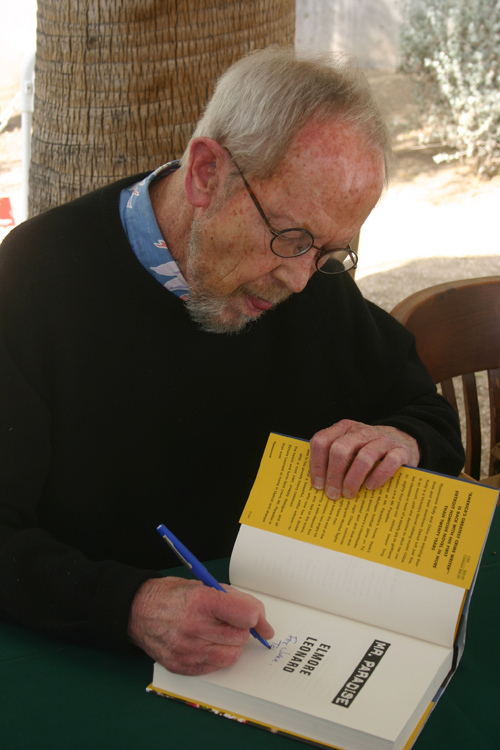
Two years and change ago I wrote a short post about Elmore Leonard, introducing him by asking “Why is Elmore Leonard so damn good when he’s at his best?” (the linked post has a long passage that’s still among my favorites for its verisimilitude in terms ofs form and content). I still have no answer, but seeing him at the Tucson Festival of Books inspired me to reread Out of Sight, Get Shorty, and Mr. Paradise. At boring panels when I couldn’t gracefully leave, the mass-market paperback edition of Out of Sight helped pass the time, but it’s not the sort of novel one can quit after 60 pages.

Leonard writes women with teeth, which numerous reviewers have noted; as Peter Wolf wrote in 1990, “Since Stick (1983), [Leonard’s] female characters have taken on a dimension rivaling that of his men; as a result, they generate more plot movement and spring more surprises than their earlier counterparts.” Describing just how Leonard does it might demand an entire academic paper; one of my favorite examples popped up in Out of Sight when Karen Sisco, the Marshall, says that, “Once you’re into it and you’re pumped up and you know who the guy is and you know you can’t give him one fucking inch . . . he has the choice, you don’t.” That might be as accurate a comment on human affairs as anyphilosophy book ever written. Or it might be empty pop commentary; another such moment happens when Sisco compares her bank robbing lover, Jack Foley, to Harry Dean Stanton in affect but not looks, saying that they were “both real guys who seemed tired of who they were, but couldn’t do anything about it.” One pleasure of the pulps is the blurred and indistinct line between the profound and silly, and one gets the impression that Leonard doesn’t care about the difference, if there is one.

The same kind of realism pervades Get Shorty. In describing Harry Zimm, Leonard says, “Forty-nine movies and [Harry] looked more like a guy drove a delivery truck or came to fix your air-conditioning when it quit, a guy with a tool kit.” Dropping the “who” and other connectors is a classic Leonard move; it looks ostentatious in a single sentence, as if the novel was poorly edited, but in the context one quickly adapts to the rhythms of speech. Martin Amis’ Money is the only other novel I can think of with so distinctive and vigorous a voice that also succeeds. And notice that description of Harry the movie guy: it’s so good because it’s accurate and tells us that many producer and production people are essentially technicians, and the skills they employ aren’t fundamentally different in deployment than the guy who fixes your car or Xerox. Leonard compresses into a sentence what Julie Salamon conveys without stating in all of The Devil’s Candy: The Bonfire of the Vanities Goes to Hollywood.

Harry is desperate and foolish; when he makes a mistake he’ll rationalize, as he does here after disobeying Chili Palmer’s advice regarding discretion:

“I had to,” Harry said, sounding pretty definite about it. “I’ve got a chance to put together a deal that’ll change my life, make me an overnight success after thirty years in the business. . . . But I need a half a million to get it started.”

In Chris Matthew’s wonderful nonfiction account/short story collection/political primer (the book has elements of all three) Hardball, he has an entire chapter called “Don’t talk unless it improves the silence.” Chili knows that. Harry doesn’t. And yet that quote conveys all of Harry’s greed, desperation and vanity all in one spot, and the link between Hollywood hustlers and drug/mob hustlers is so pervasive and intertwined with this novel that merely pointing it out is almost gratuitous. And yet the section is compelling because one always thinks of that big chance to change your life—what would you do to accomplish it? It’s an enduring question and reminds me of Scott Smith’s A Simple Plan, where the answer seems to stretch a little bit more with each passing act until the answer effectively becomes, “anything.”

Earlier I mentioned that Leonard probably wouldn’t care for elaborate discussion about the difference, if any, between genre and literary fiction. You almost hear his derision through one of his characters when Karen Flores, the woman consistently underestimated as the bimbo, says

I got the feeling the studio forced the script on her and she has to go with it. She said… [the story is] involving, reflective, has resonance, a certain texture—those are all story department words.

All of them are weak, empty synonyms for “I like it.” Why not just say that? Leonard would. Maybe that’s why he can write a novel that so effectively mocks Hollywood, feels some bizarre compulsion to dress its rationalizations—there’s that word again—in jargon to try and prevent people from seeing beneath them. Leonard doesn’t, and I think that’s part of the reason his female characters are so effective when they’re so often props in wiseguy novels: he writes them in with their own desires and hopes and goals, beyond mooning after the hero. They’re competent. So are many of his heroes: competent but flawed describes them well. His writing, on the other hand, is so competent that it transcends competence and becomes nearly flawless. I have a short list of writers whose new books I will buy almost automatically, and Leonard is on it for good reason.

Life: Frankenstein edition

“The world was to me a secret, which I desired to discover; to her it was a vacancy, which she sought to people with imagination of her own.”

—Mary Shelley, Frankenstein

The Reckoning — David Halberstam

David Halberstam’s The Reckoning is too long by at least a third and maybe a half: my copy is a fat mass-market paperback that should probably go on a diet, like the American companies it describes. Learning about the machinations of 1950s Japanese auto unions is both tedious after a time and yet simultaneously lacks the depth it should have. Nonetheless, the book is fascinating mostly because you could take the problems it describes, change some names and dates, republish it today, and find that its issues remain essentially the same. American car companies overproduce giant, gas-guzzling cars and then face problems when competition and market conditions turn against their profit centers. Unions and dealerships make it difficult for such companies to compete. If the major American car companies survive this round of major problems, you can expect the same set of stories in another ten to twenty years.

The book’s many portraits of the intertwining of society and business fascinate. A section on residents of Grosse Pointe, Detroit’s once ritzy suburb, says:

The people who lived in Grosse Pointe were not bored with it, for they knew of nothing else and wanted nothing else. They could not conceive of life being different or better. Billy Chapin—grandson of Roy, the first sales manager of the pioneer Old Motor Company, and son of Roy, president of American Motors—said that the trouble with the awful creamed spinach at the Grosse Pointe’s club was that just about the moment you became influential enough to have it taken off the menu, you found that you liked it.

This piece of writing is brilliant and effective: a generalization rings true in the surrounding context and the anecdote about Chapin shows the community’s wealth and insularity through the microcosm of spinach. Meritocracy hasn’t arrived in Grosse Pointe, or if it once lived there, it has since died and moved out West to Silicon Valley or back East to Boston, where startups congregate Maybe it moved offshore with factories. Wherever it went, it certainly doesn’t live somewhere whose nepotism is as smothered as its spinach.

Others anecdotes and descriptions are less successful. Forty pages later, we learn entirely too much about a manager named Don Lennox, who “[…] simply liked manufacturing, enjoyed making something more than dealing with numbers and paper.” That’s nice in small doses, but the cumulative weight of such observations makes the paperback edition stack up to more than 750 pages including the bibliography. Much of it isn’t directly sourced, but rather narrated like something from a Leon Uris novel.

The sense of heroes and villains could also come from a Uris novel, with the Japanese usually heroes and the bumbling Americans usually not. One American, W. Edwards Deming, is presented in the heroic mode, but the American companies ignore him because they’re too pleased with themselves to listen to his production improvements (contrast that with, say, Wal-Mart, which is so hard to beat because it tries ceaselessly to to lower prices regardless of what its competition is doing). According to The Reckoning, many American companies believed managers to be interchangeable, and

On that subject [Deming] was an angry man. He acknowledged that many important American business educators thought men like him were old fashioned, but he was sure he was right and equally sure there would eventually be a severe punishment for companies that failed to stress quality.

He was right, of course, but that’s much easier to say after the fact when he’s been proven right. How many would-be Cassandras sing their song and turn out just to be naysayers?

The Reckoning could just as easily be called Success is Never Final, since its major theme is that, since World War II, American car companies believed that only broad, flat, and straight highways awaited them. Their attitude and union agreements struck while the good times rolled haunted them and continue to haunt them. The only way to operate at virtually any level, whether as an individual, family, region, or society, is to ceaselessly work toward being the best. But as one achieves that success, the culture underlying it erodes, decadence grows, and soon one’s fatally stricken platform totters.

The bizarre thing about the three American-headquartered companies is that their current problems, as I write this at the dawn of 2009, have been ongoing for 30 years. And they still either haven’t ameliorated their majors problems or are restricted from doing so by their dealer networks and unions. Whichever of those two to three hypotheses is correct, it’s still incredible to consider that such a ridiculous saga continues.

Evidently I’m not the only one who finds The Reckoning depressingly fresh: searching for it and “Halberstam” on Google brings a load of hits relating it to modern problems, like Why David Halberstam’s “The Reckoning” Should Be Mandatory Business School Reading and Halberstam’s “The Reckoning” Still a Must-Read. See a pattern? More generally, Slate’s The Big Money just ran an article called RIP, MBA: The economic crisis has exposed the myth of business-school expertise, the MBA being a symbol of problems with car companies and others, while The Atlantic ran The Management Myth in 2005. The titles of those posts overstate the book’s importance and understate its length—how many must-reads about formerly contemporary issues should really be 750 pages?—but it’s certainly a useful book to skim.

“Halberstam’s ‘The Reckoning’ Still a Must-Read” says that “[Halberstam is widely] recognized for his groundbreaking work, The Reckoning…” Maybe the book broke new ground in 1986, but that it’s still relevant indicates in many ways how far we haven’t come.

Billy Collins and Elmore Leonard at the Tucson Festival of Books

The Tucson Festival of Books began with a mystery friend—the designation is at the request of said friend—and I wandering the booths. Some monkish types tried to convince me to buy a copy of the Bhagavad Gita that I already had. We attended a nonfiction panel where one member spoke of the danger of “Not realizing the potential of the moment” and capturing “the spirit of the event” and asking “what is truth?” During the talk, I read the first 40 pages of Out of Sight.

The food tent came next, and with it most notably some excellent caramel corn:

caramel-corn2

A few hundred people heard Elmore Leonard, but the guy who interviewed him wasn’t particularly skillful (with questions about Westerns—Leonard hasn’t written them in decades—and ones that boil down to, “What writers have influenced you?” His answer, which I could’ve predicted, was The Friends of Eddie Coyle; see this post) and called Leonard a “man who needs no introduction.” Then why introduce him? Anyway, Leonard did say that he shifted from writing Westerns to “Easterns” and that Arizona highways in the 50s were filled with good stories that he used in his novels and stories.elmore_leonard_signing2

The novel he’s writing now is set on the East Coast of Africa, which is a greater stretch for Leonard than some previous novels because he doesn’t know how to relate to the story as well. But his forthcoming novel, Road Dogs, will be released in May and follows the more familiar teerritory Jack Foley of Out of Sight along with a few other characters from books I haven’t read. Expect to read more about Road Dogs in this space.

Leonard’s best response came from a question about his characters’ morality or lack thereof, when Leonard said “I have a kind feeling of all my characters… I like my characters, but I think most of them are just dumb.” He’s also difficult to imitate because “you have to imitate the emotions behind them,” which too many people seem to discount. An audience member asked about redemption and Leonard answered about money; he also repeated the advice he’s given to directors of movies based on his books: When someone delivers a funny line that’s not intentionally funny, don’t cut to someone laughing. To Leonard, that’s part of what ruined the movie version of Be Cool, which is better as a book.

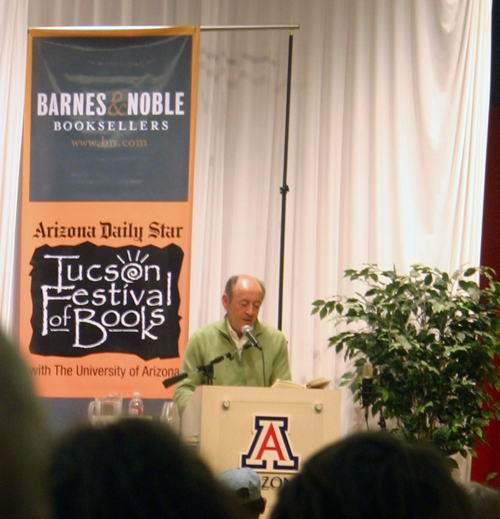
The last speaker on Saturday, Billy Collins was a quiet riot, knowing that the better part of jokes often consists of holding back and the better part of delivery consists of practice. His reading was like a big-deal boxing match, with a few palookas warming up the crowd before the main card that served chiefly to highlight Collins’ skill. He took Leonard’s advice by not smiling as he said, “If it’s wrong to be writing to a reader, I don’t want to be right.” Next month is apparently national poetry month, and Collins said, “If you name a day or a week or a month after something, you know it’s in decline.” There is no national TV week.

His poems were wonderful; in “Tension,” one got the impression that Collins is a rule-breaker of the best sort. He’s wry and self-aware, as in “The Trouble with Poetry:”

the trouble with poetry is
that it encourages the writing of more poetry,

[…]

And how will it ever end?
unless the day finally arrives
when we have compared everything in the world
to everything else in the world

and there is nothing left to do
but quietly close our notebooks
and sit with our hands folded on our desks

He’s contributing to the proliferation of poetry, so it’s obviously not so great a problem, and yet the poem shifts into a brief comment on life, when he mentions a book that “I carried in a side pocket of my uniform / up and down the treacherous halls of high school,” implying that perhaps poetry helped him to become a poetic thief and thus to encourage “the writing of more poetry.”billy_collins2

The tongue-in-cheek aspect continued through Collins’ poems; he read one called “On Turning Ten” that he said he wrote because he “wanted to make fun of poets who write midlife crisis death poems.” So there’s an elegy to all that’s lost upon attaining one’s tenth year. In “The Lanyard,” looking up the word “lanyard” in a dictionary functions as a “cookie nibbled by a French novelist.” The poem compares a child making a lanyard for his mother in payment for all she’s done:

She gave me life and milk from her breasts,
and I gave her a lanyard.
SHe nursed me in many a sickroom,
lifted teaspoons of medicine to my lips,
set cold face-cloths on my forehead,
and then led me out into the airy light
and taught me to walk and swim,
and I, in turn, presented her with lanyard.
Here are thousands of meals, she said,
and here is clothing and a good education.
And here is your lanyard, I replied,
which I made with a little help from a counselor.

The mock conceit reminds one of the disparity that must exist between most parents and their children, which can only be repaid by passing it on. But for Collins, the issue isn’t a heavy burden, or if it is, it should be addressed lightly, in a poem like “The Lanyard” that is aware of its own absurdity and therefore becomes more real in exchange of “thousands of meals” for a lanyard, “which I made with a little help from a counselor.”

I wish Collins’ attitude had been shared by the nonfiction panel. Alas: we can’t all be so reasonable.

If nothing else, being induced to read Collins made the Festival worthwhile. Hopefully I learned something and, to paraphrase something its participants said, this post captures the spirit of the event.

March Links: The Watchmen, Orwell, and Goldengrove

* “From Comic Book to Literary Classic:” Does The Watchmen deserve all the hype? The WSJ asks. Their answer is mostly “no,” a verdict I concur with.

* Speaking of Watchmen-related hype, Ta-Nehisi Coates summarizes my feeling toward movies:

I think I’m mostly done with comic book movies, and big budget movies in general. I don’t think (with a few exceptions) that they’re made for me. Which is fine. But the more comic book movies I see, the more I value the imaginative space created by books.

(For more on this, see Why are so many movies awful?)

* Orwell wasn’t a mensch or a lout or an ideologue in the normal sense, and trying to define him is as much a challenge today as it must have been in his time. Julian Barnes tries to make some sense of him in “Such, Such Was Eric Blair:”

All prophets risk posthumous censure, even mockery; and the Orwell we celebrate nowadays is less the predictor than the social and political analyst. Those born in the immediate postwar years grew up with the constant half-expectation that 1984 would bring all the novel described: immovable geopolitical blocs, plus brutal state surveillance and control. Today, the English may have their sluggardly couch-potato side; their liberties have been somewhat diminished, and they are recorded by CCTV cameras more often than any other nation on earth. But otherwise 1984 passed with a sigh of relief, while 1989 and the fall of the Berlin Wall brought a louder one.

Orwell believed in 1936 that “the combines can never squeeze the small independent bookseller out of existence as they have squeezed the grocer and the milkman.” That “never” was a risky call. And on a larger scale, he believed throughout World War II that peace would bring the British revolution he desired, with blood in the gutters and the “red militias…billetted in the Ritz,” as he put it in private diary and public essay. And after the revolution:

The Stock Exchange will be pulled down, the horse plough will give way to the tractor, the country houses will be turned into children’s holiday camps, the Eton and Harrow match will be forgotten….

One out of four on the vision thing; and tractors were hardly a difficult pick.

I’ve mentioned his collected Essays before and will no doubt again; even when they’re infuriating, they’re enormously clever.

* Jacket Copy reports that, 27 years after John Cheever’s death, the man is everywhere. Everywhere, that is, except for my bookshelf: I’ve never read his novels, which are on the ever-expanding “to be read” list. This week’s New Yorker also has an article about Cheever. It includes this bit:

“How lonely and unnatural man is and how deep and well-concealed are his confusions”—no wonder Cheever’s fiction is slighted in academia while Fitzgerald’s collegiate romanticism is assigned. Cheever’s characters are adult, full of adult darkness, corruption, and confusion. They are desirous, conflicted, alone, adrift. They do not achieve the crystalline stoicism, the defiant willed courage, of Hemingway’s.

Really? I’m not sure I agree with the premise that Cheever is slighted in academia, and even if I did, I don’t think I’d buy the reason stated.

* The Wall Street Journal, meanwhile, calls Cheever The Audubon of Suburbia:

“Cheever: A Life,” arriving as it does with the publication of Library of America editions of Cheever’s stories and novels, edited by Mr. Bailey, seems intended to spur a rediscovery of the author. It won’t be the first, or the last. Cheever occupies a secure place in the literature of the American dream, forming the link between Fitzgerald and Updike. The formidable achievement of his short stories alone ensures that he is destined to be the subject of periodic rediscovery, reassessment and biographical shading-in.

* Maybe I will read Francine Prose’s Goldengrove:

Prose’s book is filled with characters who comprehend their experience of the world through the lenses that art–high art, popular art, and everything in between–offers up. Even though Goldengrove tells a sad story, I found great comfort and pleasure in reading about these characters and their attachments to and imitations of art, and appreciated Myers’s identification of this kind of activity and attachment as a subject of the novel. “We learn what we were like as children from such books as The Mill on the Floss, C. S. Lewis’s Narnia stories, and Goldengrove,” he says. Our experience of art is as much a life experience as anything else.

I didn’t care for The Mill on the Floss, but the overall point is well-taken.

* The best article on Kindle economics and bookstores that I’ve seen: Digital readers will save writers and publishing, even if they destroy the book business.

* Speaking of book publishing, MobyLives reports:

Exact data on how the used book market is eroding the market for new books is hard to come by but the consensus is — it ain’t helping.

The Wall Street Journal predicted in 2005: “While the market’s size is still modest — about $600 million, or 2.8% of the $21 billion that readers spent on consumer books in 2004 — it is growing at 25% annually. Jeff Hayes, group director for InfoTrends Research Group, suggests that it could reach $2.25 billion in U.S. sales by 2010, or 9.4% of a projected $23.9 billion in consumer book sales.”

Announcement: The Tucson Festival of Books is this weekend

tucson_festival_books_tents21I’ve complained before about the dearth of literary activity in Tucson, but this weekend ought to shut me up for a while: the Tucson Festival of Books is coming to the University of Arizona campus this weekend. Preparations on the mall are underway, as shown on the right.

I’m particularly interested in Billy Collins and Elmore Leonard, who are both speaking on Saturday afternoon. Expect a report next week. If you’re in town, be sure to come!

T.C. Boyle interview for The Women: Part 1

T.C. Boyle is the author of 8 short story collections and 12 novels, including Talk Talk, The Inner Circle, Drop City, and, most recently, The Women. His new novel describes the architect Frank Lloyd Wright through the view of a fictional apprentice, Tadashi Sato, who focuses on Wright’s relationship with his three wives, his mistress, and his mother. Each influences Wright, paralleling his increasing sophistication as an artist.

Boyle spoke at Changing Hands Bookstore in Tempe on February 25. He wore red Chucks, black jeans, and a gold coat, looking a bit like the professor you imagine being even more fun at the bar after class or a faintly piratical psychologist—which, in a way, many novelists are. This interview was conducted afterwards, and the following is an edited transcript. Links have been subsequently added by me.

Jake Seliger: How’s your tour been so far?

T.C. Boyle: It’s really rewarding, huge crowds and a lot of dedicated readers. It’s wonderful, and I really love to meet the readers because I will never get over the thrill of having people liking my work and engaging with them. But I’m also exhausted. However, we are celebrating right now because this is the last gig.

JS: As I said on the phone, there’s a very interesting set of symmetries for me because I have a copy of Stories, which you signed on 2/9/99.

TCB: Wow.

JS: The very first time I went to a reading—

TCB: But it’s signed to Isaac.

JS: That’s my Dad. But I was there with him. Anyway, about your new book, which I really enjoyed, you mentioned [in his talk at Changing Hands] that there’s an obvious parallel between writing and architecture that goes on throughout The Women. There’s one scene in particular where the two come together on page 237: “He left the car running as he got out to swing open the gate, seeing the small things, the way the ditch along the drive had eroded in the previous week’s storm, the weeds crowding out the wildflowers, the iridescent blue of the damselflies threading the air…” it’s just one of these really interesting moments where you can see him looking at all these small things and see the way he might build these small ones into bigger ones.

TCB: Because he was a perfectionist and attentive to detail. Everyday he decorated the house, everyday. No matter what the season, he would send the apprentices out or he himself had tremendous energy to cut flowers or cut a branch off the tree in the winter, and always the house changing and flowing and big pots of full of things and bringing the outdoors in. And that was part of what he wanted to do.
JS: It’s interesting that you talk about a lot of the changes in the house because in some ways it seems like he went through a lot of interpersonal changes—obviously he went through a lot of changes in terms of the women he was with as well—and I think there’s a parallel there. Were you thinking consciously about that, in terms of the changing of architecture and the changing of people? It seems like a lot of that is going on in the book.

TCB: I think so.

JS: [Arizona] is very, very car centered…

TCB: Yeah, I hate that, that’s one of the reasons I left LA and moved to Santa Barbara. Where I’m living now, there’s just a village, and I can walk everywhere. I do walk everywhere. It makes your life a thousand times better because you don’t have to fight for parking spots, or worry about traffic. You just walk. You see nature. It’s just wonderful.

JS: There’s some descriptions in The Women too of Wright walking around, going on some jaunts of his own.

TCB: Yeah, he becomes my creature and my character of course, as does anybody you invent or write about. And I’m worried about the effect he has on his acolytes, what type of person he is, but irrespective of that I do believe that art has no ethical consideration. Art just stands for itself and what it is. So I admire him despite some of his personality problems. One thing I admire is that [Wright] was a nature boy.

JS: You do admire Wright, and he does have a lot of admirable qualities, and one thing I was thinking about when I was reading the book is that you see the admiration there, but he’s also not the sort of person one would want as a relative.

TCB: He would be impossible. If he were here, we wouldn’t even be able to say a word. He becomes a little bit of a satiric figure here. But I love to have it both ways in many of my stories and a book like this. Miriam, for instance. I have a lot of fun with her in a satiric way, although she’s sort of opéra bouffe, which is what his whole life seems to be—Frank Lloyd Wright with Miriam. But I also want you to feel something too… there’s a kind of dread hanging over the book, because you know that Mamah’s going to be burned because you read about it in the footnote. But you keep going backward in time, so you know you’re going to get there.

JS: It’s a reverse chronology. It’s interesting that you mention Miriam as an example of having it both ways because she’s in some ways the character who most fascinates me.

TCB: Me too. She took right over and I love her.

JS: … You’re introduced to Miriam as a harpy—

TCB: It’s going [chronologically] backwards [in time]. It gives you a chance to reflect on what loves relationships are like, when you meet someone and they’re great and you love them and then they turn sour. So when you first see Miriam and she’s this incredible harpy, this maniac, and poor Olgivanna. But then you backtrack and you see Miriam ten years earlier. I thought that was a really intriguing way to tell the story. And also it allows me to end with the tragedy of Mamah.

JS: Perhaps I was accidentally thinking of Miriam coming first because she seems to really cast a very long shadow across the first part of the book, and I’m thinking in particular of this passage: “For years now—longer than he could remember—he’d been rolling a stone up a hill, a boulder that picked up weight on each revolution like a ball of snow, and Miriam’s face was imprinted on the side of it…” you get this Sisyphean aspects of it, and I can imagine him looking at that face. To me, there’s this fascinating aspect of it, that she’s so present in his life.

TCB: Yeah, and in the actual history he seemed to be the sort of artist who needed lots of tumult in his life in order to create—to have someone to butt up against. I don’t think ever bargained for something as extreme as Miriam, because of her mental problems and her drug addiction and her grandiosity and desire to be as great as the great man that she’s allied with. Still, unlike me—

JS: I like how you add “unlike me.”

TCB: —who needs tranquility to work. I’m a little fascinated by the kind of artist who needs this tumult in order to work. The obvious metaphor, of course, is that to build a book is like building a house.
JS: You build one brick at a time or one sentence at a time.

TCB: Also, we see something. We have a vision first, and then we translate it to accomplish something concrete. He always began by just drawing a picture of a house in colored pencils.

JS: With soft lead.

TCB: With soft lead. There’s a lot of that going on to intrigue me. The other key figures I’ve written about who are the egomaniacs, Kellogg and Kinsey, were both men of science, and here I’m writing about an artist and trying to re-imagine it a bit… of course we have to stay inside writing our books and think inside our own minds. He got to do that sort of work in his drawing… but then he also got to go outside, and be physical, and work among the workers. And also, I don’t know how you work, but I’m improvisatory. You know, it just happens, it just continues to happen, step by step by slow accretion. So is he. He didn’t adhere strictly to plans over time.

JS: It’s interesting how you talk about the inside and outside, because I was listening on the way over here to an interview you did with Michael Silverblatt of Bookworm [a book radio show hosted on KCRW and available at http://www.kcrw.com/etc/programs/bw] about your last book, Talk Talk, and that you as a writer can’t live inside your head for 365 days a year, and you need that teaching aspect or going out into the world to try to stay sane.

TCB: Absolutely.

JS: So would say that he has that built into his work?

TCB: Sure. He wasn’t simply a draftsman working for somebody—he was a creator. By the way, I did Michael’s show yesterday, and it was the best one we ever did. He was such a deep reader… it’s a pleasure to meet deep readers who are really engaged with it, way beyond “I like this, I don’t like this.” It’s a much deeper experience. He was very taken with the intricate structure of The Women and how it works and what it says about levels of meaning…
We don’t know any history of an event. Any biography of somebody has its biases, even in terms of what happened on a given day, or what the events were. So you’ve got an unsteady sort of revelation of truth anyway. Then when you take it from the point of view of Tadashi, who is learning about himself. He gives it another level altogether. And then, in my view—and this is part of the fun I had with it and the humor—Tadashi apparently has delivered a manuscript or reminiscences to his grandson-in-law, O’Flaherty-San, for translation and elaboration. So he’s now reading this text and writing footnotes, and sometimes he’s very surprised by what the footnotes say. And in the course of commenting on the text, as we get into the more tragic aspects, he then begins to reflect on his own self in the footnotes. So there’s a lot going on and yet it seemed to be the proper structure for this. It just began to reveal itself to me. And I had a great deal of fun with it as a result.

JS: Have you ever read Mordecai Richler’s book Barney’s Version?

TCB: No.

JS: I ask because it’s got at least a somewhat similar structure… it’s written [from the perspective of an] old man who is partially losing his memory, and his son is going back through his memoir reading, and it’s got all these little foonotes…

TCB: So they’re having a dialog in footnotes?

JS: Yeah, in a way they are. And it’s a very funny novel… in one of your other interviews, you said you like John Barth’s The Sot-Weed Factor

TCB: It’s utterly huge in my life.

JS: How so?

TCB: It’s picaresque, and it’s wild humor. And its subversion of history is something that really appealed to me.

JS: It seems like in The Sot-Weed Factor, Ebenezer Cooke is going on this journey, if not from innocence to cynicism, then from innocence to something else. It seems like in The Women, Tadashi-san is still very much revering the master. In a way he is, but in a way he’s also subverting the master.

TCB: Yes. That’s where I got my title, when he gives this speech at the end of the introduction, and he’s trying to sum up and he gets a little out of control. He says that Wrieto-san [Tadashi’s name for Frank Lloyd Wright] is this great master we revered and we paraded through the streets, who was a philanderer and abuser, especially of the women. So that gave me a dramatic context to let him try to discover something of himself.

JS: Is there an answer about what [Tadashi] discovers [over the course of the book]? I’m taken with a footnote on page 384, when Tadashi says that he thinks Daisy Hartnett [a white woman Tadashi thinks he loves but whom Wright sends away after discovering their affair] was certainly a force of nature. It’s a fascinating footnote because Tadashi reacts to being separated from Daisy in a way that you can’t imagine Wright reacting in being separated from what he wants. Tadashi accepts it. It feels like there’s this shadow plot flowing underneath with him and Daisy, and it just pops up here and there.

TCB: Yeah. I think so. And again, this is about relationships, and reflecting on relationships. How is this different from the kind of relationship that Frank Lloyd Wright had with his women? This seems to be much deeper.

JS: It’s so short with Daisy—[Tadashi says] “I can say that Daisy Hartnett was certainly a natural force, and I too much constrained by expectation.” It seems like he’s still constrained by expectation.

TCB: It’s a cultural thing too.

JS: You’ve got your combination of three big figures—Kellogg, Kinsey, and now Wright.

TCB: Yes. And don’t forget we also have Mungo Park of Water Music and Stanley McCormick [of Riven Rock] into the mix also. But they don’t fit quite so neatly into this little box set of the egomaniacs of the 20th century.

JS: The egomaniacs and the admired ones. Both in this book, you have Tadashi, who is a superficially passive figure. I say “superficially passive” in part because of those footnotes that are constantly interposing themselves. In The Inner Circle, you’ve got [John] Milk [the first-person narrator], who’s another person who seems very passive compared to the great man. In some ways, they seem to me like Carraway figures who are separated from the big man.

TCB: It’s a good observation. A number of people have been making that connection. It’s a time-honored way of getting at the personality of some larger-than-life figure. I’m not so much interested in investing Frank Lloyd Wright and writing about him from his point of view, although we get a little bit of it because the story needed it at certain points. I think it much more fascinating to veer—like [how] The Great Gatsby works. That is, to have a character who changes and observes the great man, but you learn about the character more than about the great man. And so you learn what the effect of a guru is on some people—to give yourself up to somebody. What is the cost to you? Because obviously I would never do that. I’m a fan of a thousand artists who I love dearly. But I’m not going to give my life up for them, or I’m not going to serve them. I want to be their equal. But many people are simply followers of not only artists, but political figures—

JS: I’m thinking back to Drop City.

TCB: Yes, exactly.

JS: I think in that book you have a very clear—well, perhaps not very clear—delineation between the followers and not.

TCB: So, what happens is—as you’ll discover in your own career—when you write many books, you can look back and see what your themes and obsessions are and why you choose the particular subject or character to write about. It’s great. I could write papers on my own work. I could sit and articulate about it.

JS: I think people have written papers on your work.

TCB: They may have. Of course, I don’t do that in the abstract beforehand. I am simply an artist. I don’t want to be a man of letters. I don’t want to write anything except fiction. It’s magic. It’s magic that I love. I don’t have time for anything else.

JS: So you don’t have those Fridays like John Barth did? Have you read his collections The Friday Book and Further Fridays?

TCB: No.

JS: He also wrote essays which I think are very good… He says four days a week he writes fiction and on the Friday he—

TCB: I would love to read them. I should. Updike was one of my heroes too, and he was our foremost man of letters. And he was quite consciously doing that. I am different though. I realized this a long while ago. Even though I got my Ph.D. in 18th century British Lit and I love scholarship, to me scholarship is only a tool for me to create a story. I am much more intuitive and much more an artist than I am analytical. I discovered this and I’m running with it.

And so far I don’t see any limits or any end to that. I don’t have Fridays to write essays because I’m working on Fridays on fiction. It’s all I want to do. And I think because anything can be a story for me and any mode and anything I want to discover, I can only think about deeply if I create a fiction. There seems to be no… burn out factor. There’s no end to the material. I feel very lucky in that way.

JS: I can see that, especially where you’ve talked elsewhere about wanting to be unique each time. I think you’ve done a remarkable job—I’ve pointed out parallels [among Boyle’s works], but that’s because at an abstract enough level you can see parallels in anything.

TCB: I still want to have a new way in to each story.

JS: That seems to be what Tadashi provides you.

TCB: Because it would be very easy to write another book like The Inner Circle, where a single “I” narrator revisits his integration with the master. But I’d just done that, and I was interested in something else altogether. Of course intervening were Tooth and Claw and Talk Talk.

JS: Talk Talk has Dana, who is a very figure in that. She’s a kind of driving person, and Bridger is an enabler—

TCB: As his name suggests.

JS: Right. I suspect there’s an obvious, freshman-year analysis of the book—

TCB: No, that’s great. Don’t forget, I was there too, and I made all these connections in the book, and I was thankful for them. So I’m greatly honored that other people see these connections, and that I have a body of work in which people can compare this story or that one or this novel and that one and see threads. It’s wonderful. I’m very happy.

JS: I think I do see that, with Dana… as a powerful figure. In that book, I think she’s more powerful than Bridger, and she’s the force of it, bringing others along—well, bringing Bridger along in her wake. In [The Women], I think Miriam in a way wants to do that, but if she found someone she could do it with, I don’t think she would be happy. Or I think she would then start moving on—

TCB: Right. These are really people, who were really attracted to one another for the psychological reasons that you’re suggesting. She needed the greatest challenge possible. And so did he. And again, I have to withdraw here, and I’m not anything like this. I couldn’t imagine the writers who marry other writers. It’s your enemy sleeping in bed with you. How could you keep from choking her to death every night?

JS: I’ll ask Michael Chabon that next time I see him, because he’s married to, um—

TCB: Ayelet [Waldman]. I know them both, yeah—

JS: I’m telling Noah about the flood, then.

TCB: —that’s really strange. For me [to imagine being with someone much like him]. I mean, everybody’s different. My wife is my complete antithesis. She doesn’t want to be on stage. She’s mathematical and scientific, which I am not. Her trick is that she’s imperfect, which allows me to be perfect.

JS: That’s good. If she were here and I said, “By the way, Tom says that your imperfections allow him to be perfect,” how do you thinks she’d respond? In a Miriam way, or in a Kitty way?

TCB: Don’t forget, the wife and mother-in-law of a comedian always take a beating. It’s just the way it is. She knows, she understands. I’ll tell you, this is true though, about Frau Boyle and myself, sometimes she goes on tour with me, and I do my little shtick, like tonight—I develop a shtick. You want to hear me being very original about the book—it’s in the first couple days. So, I just speak spontaneously to the crowd and then I do the reading and then I take questions. But there is a shtick involved—it might be a little different each night, but I’m going to come to the same basic points and make the same basic jokes. It’s like the tenth night, and she’s heard it ten times, and I see the whole crowd, and they’re roaring with laughter. Then I see her, and she’s roaring with laughter as well! And that’s true love.

JS: I can’t see Miriam laughing at herself if someone is making jokes at her expense.

TCB: No. She took herself very seriously.

JS: In some ways, given how Kitty is portrayed, it’s hard to see her laughing at herself too.

TCB: No, of course not. She did fly a bit outside the parameters of what I was interested in in this book. She was probably the most difficult to deal with. First of all, she wasn’t going to be one of the principal players—I knew that. But it’s a little difficult too because what is she but a victim? You’d have to do an entire book about that relationship to really do justice to that sort of personality. And also a personality where a couple had married… young, for sex, joy and love. And he moved on. He went for progressively more sophisticated women. Mamah was a feminist, she was college educated as Kitty was not—and as he was not—and Miriam had her European connections and spoke fluent German. This was something exotic. It was something to aspire to. So I think he would have moved on in any case.

EDIT: You can read part two of the interview here.

T.C. Boyle interview for The Women: Part 1

T.C. Boyle is the author of 8 short story collections and 12 novels, including Talk Talk, The Inner Circle, Drop City, and, most recently, The Women. His new novel describes the architect Frank Lloyd Wright through the view of a fictional apprentice, Tadashi Sato, who focuses on Wright’s relationship with his three wives, his mistress, and his mother. Each influences Wright, paralleling his increasing sophistication as an artist.

Boyle spoke at Changing Hands Bookstore in Tempe on February 25. He wore red Chucks, black jeans, and a gold coat, looking a bit like the professor you imagine being even more fun at the bar after class or a faintly piratical psychologist—which, in a way, many novelists are. This interview was conducted afterwards, and the following is an edited transcript. Links have been subsequently added by me.

Jake Seliger: How’s your tour been so far?

T.C. Boyle: It’s really rewarding, huge crowds and a lot of dedicated readers. It’s wonderful, and I really love to meet the readers because I will never get over the thrill of having people liking my work and engaging with them. But I’m also exhausted. However, we are celebrating right now because this is the last gig.

JS: As I said on the phone, there’s a very interesting set of symmetries for me because I have a copy of Stories, which you signed on 2/9/99.

TCB: Wow.

JS: The very first time I went to a reading—

TCB: But it’s signed to Isaac.

JS: That’s my Dad. But I was there with him. Anyway, about your new book, which I really enjoyed, you mentioned [in his talk at Changing Hands] that there’s an obvious parallel between writing and architecture that goes on throughout The Women. There’s one scene in particular where the two come together on page 237: “He left the car running as he got out to swing open the gate, seeing the small things, the way the ditch along the drive had eroded in the previous week’s storm, the weeds crowding out the wildflowers, the iridescent blue of the damselflies threading the air…” it’s just one of these really interesting moments where you can see him looking at all these small things and see the way he might build these small ones into bigger ones.

TCB: Because he was a perfectionist and attentive to detail. Everyday he decorated the house, everyday. No matter what the season, he would send the apprentices out or he himself had tremendous energy to cut flowers or cut a branch off the tree in the winter, and always the house changing and flowing and big pots of full of things and bringing the outdoors in. And that was part of what he wanted to do.
JS: It’s interesting that you talk about a lot of the changes in the house because in some ways it seems like he went through a lot of interpersonal changes—obviously he went through a lot of changes in terms of the women he was with as well—and I think there’s a parallel there. Were you thinking consciously about that, in terms of the changing of architecture and the changing of people? It seems like a lot of that is going on in the book.

TCB: I think so.

JS: [Arizona] is very, very car centered…

TCB: Yeah, I hate that, that’s one of the reasons I left LA and moved to Santa Barbara. Where I’m living now, there’s just a village, and I can walk everywhere. I do walk everywhere. It makes your life a thousand times better because you don’t have to fight for parking spots, or worry about traffic. You just walk. You see nature. It’s just wonderful.

JS: There’s some descriptions in The Women too of Wright walking around, going on some jaunts of his own.

TCB: Yeah, he becomes my creature and my character of course, as does anybody you invent or write about. And I’m worried about the effect he has on his acolytes, what type of person he is, but irrespective of that I do believe that art has no ethical consideration. Art just stands for itself and what it is. So I admire him despite some of his personality problems. One thing I admire is that [Wright] was a nature boy.

JS: You do admire Wright, and he does have a lot of admirable qualities, and one thing I was thinking about when I was reading the book is that you see the admiration there, but he’s also not the sort of person one would want as a relative.

TCB: He would be impossible. If he were here, we wouldn’t even be able to say a word. He becomes a little bit of a satiric figure here. But I love to have it both ways in many of my stories and a book like this. Miriam, for instance. I have a lot of fun with her in a satiric way, although she’s sort of opéra bouffe, which is what his whole life seems to be—Frank Lloyd Wright with Miriam. But I also want you to feel something too… there’s a kind of dread hanging over the book, because you know that Mamah’s going to be burned because you read about it in the footnote. But you keep going backward in time, so you know you’re going to get there.

JS: It’s a reverse chronology. It’s interesting that you mention Miriam as an example of having it both ways because she’s in some ways the character who most fascinates me.

TCB: Me too. She took right over and I love her.

JS: … You’re introduced to Miriam as a harpy—

TCB: It’s going [chronologically] backwards [in time]. It gives you a chance to reflect on what loves relationships are like, when you meet someone and they’re great and you love them and then they turn sour. So when you first see Miriam and she’s this incredible harpy, this maniac, and poor Olgivanna. But then you backtrack and you see Miriam ten years earlier. I thought that was a really intriguing way to tell the story. And also it allows me to end with the tragedy of Mamah.

JS: Perhaps I was accidentally thinking of Miriam coming first because she seems to really cast a very long shadow across the first part of the book, and I’m thinking in particular of this passage: “For years now—longer than he could remember—he’d been rolling a stone up a hill, a boulder that picked up weight on each revolution like a ball of snow, and Miriam’s face was imprinted on the side of it…” you get this Sisyphean aspects of it, and I can imagine him looking at that face. To me, there’s this fascinating aspect of it, that she’s so present in his life.

TCB: Yeah, and in the actual history he seemed to be the sort of artist who needed lots of tumult in his life in order to create—to have someone to butt up against. I don’t think ever bargained for something as extreme as Miriam, because of her mental problems and her drug addiction and her grandiosity and desire to be as great as the great man that she’s allied with. Still, unlike me—

JS: I like how you add “unlike me.”

TCB: —who needs tranquility to work. I’m a little fascinated by the kind of artist who needs this tumult in order to work. The obvious metaphor, of course, is that to build a book is like building a house.
JS: You build one brick at a time or one sentence at a time.

TCB: Also, we see something. We have a vision first, and then we translate it to accomplish something concrete. He always began by just drawing a picture of a house in colored pencils.

JS: With soft lead.

TCB: With soft lead. There’s a lot of that going on to intrigue me. The other key figures I’ve written about who are the egomaniacs, Kellogg and Kinsey, were both men of science, and here I’m writing about an artist and trying to re-imagine it a bit… of course we have to stay inside writing our books and think inside our own minds. He got to do that sort of work in his drawing… but then he also got to go outside, and be physical, and work among the workers. And also, I don’t know how you work, but I’m improvisatory. You know, it just happens, it just continues to happen, step by step by slow accretion. So is he. He didn’t adhere strictly to plans over time.

JS: It’s interesting how you talk about the inside and outside, because I was listening on the way over here to an interview you did with Michael Silverblatt of Bookworm [a book radio show hosted on KCRW and available at http://www.kcrw.com/etc/programs/bw] about your last book, Talk Talk, and that you as a writer can’t live inside your head for 365 days a year, and you need that teaching aspect or going out into the world to try to stay sane.

TCB: Absolutely.

JS: So would say that he has that built into his work?

TCB: Sure. He wasn’t simply a draftsman working for somebody—he was a creator. By the way, I did Michael’s show yesterday, and it was the best one we ever did. He was such a deep reader… it’s a pleasure to meet deep readers who are really engaged with it, way beyond “I like this, I don’t like this.” It’s a much deeper experience. He was very taken with the intricate structure of The Women and how it works and what it says about levels of meaning…
We don’t know any history of an event. Any biography of somebody has its biases, even in terms of what happened on a given day, or what the events were. So you’ve got an unsteady sort of revelation of truth anyway. Then when you take it from the point of view of Tadashi, who is learning about himself. He gives it another level altogether. And then, in my view—and this is part of the fun I had with it and the humor—Tadashi apparently has delivered a manuscript or reminiscences to his grandson-in-law, O’Flaherty-San, for translation and elaboration. So he’s now reading this text and writing footnotes, and sometimes he’s very surprised by what the footnotes say. And in the course of commenting on the text, as we get into the more tragic aspects, he then begins to reflect on his own self in the footnotes. So there’s a lot going on and yet it seemed to be the proper structure for this. It just began to reveal itself to me. And I had a great deal of fun with it as a result.

JS: Have you ever read Mordecai Richler’s book Barney’s Version?

TCB: No.

JS: I ask because it’s got at least a somewhat similar structure… it’s written [from the perspective of an] old man who is partially losing his memory, and his son is going back through his memoir reading, and it’s got all these little foonotes…

TCB: So they’re having a dialog in footnotes?

JS: Yeah, in a way they are. And it’s a very funny novel… in one of your other interviews, you said you like John Barth’s The Sot-Weed Factor

TCB: It’s utterly huge in my life.

JS: How so?

TCB: It’s picaresque, and it’s wild humor. And its subversion of history is something that really appealed to me.

JS: It seems like in The Sot-Weed Factor, Ebenezer Cooke is going on this journey, if not from innocence to cynicism, then from innocence to something else. It seems like in The Women, Tadashi-san is still very much revering the master. In a way he is, but in a way he’s also subverting the master.

TCB: Yes. That’s where I got my title, when he gives this speech at the end of the introduction, and he’s trying to sum up and he gets a little out of control. He says that Wrieto-san [Tadashi’s name for Frank Lloyd Wright] is this great master we revered and we paraded through the streets, who was a philanderer and abuser, especially of the women. So that gave me a dramatic context to let him try to discover something of himself.

JS: Is there an answer about what [Tadashi] discovers [over the course of the book]? I’m taken with a footnote on page 384, when Tadashi says that he thinks Daisy Hartnett [a white woman Tadashi thinks he loves but whom Wright sends away after discovering their affair] was certainly a force of nature. It’s a fascinating footnote because Tadashi reacts to being separated from Daisy in a way that you can’t imagine Wright reacting in being separated from what he wants. Tadashi accepts it. It feels like there’s this shadow plot flowing underneath with him and Daisy, and it just pops up here and there.

TCB: Yeah. I think so. And again, this is about relationships, and reflecting on relationships. How is this different from the kind of relationship that Frank Lloyd Wright had with his women? This seems to be much deeper.

JS: It’s so short with Daisy—[Tadashi says] “I can say that Daisy Hartnett was certainly a natural force, and I too much constrained by expectation.” It seems like he’s still constrained by expectation.

TCB: It’s a cultural thing too.

JS: You’ve got your combination of three big figures—Kellogg, Kinsey, and now Wright.

TCB: Yes. And don’t forget we also have Mungo Park of Water Music and Stanley McCormick [of Riven Rock] into the mix also. But they don’t fit quite so neatly into this little box set of the egomaniacs of the 20th century.

JS: The egomaniacs and the admired ones. Both in this book, you have Tadashi, who is a superficially passive figure. I say “superficially passive” in part because of those footnotes that are constantly interposing themselves. In The Inner Circle, you’ve got [John] Milk [the first-person narrator], who’s another person who seems very passive compared to the great man. In some ways, they seem to me like Carraway figures who are separated from the big man.

TCB: It’s a good observation. A number of people have been making that connection. It’s a time-honored way of getting at the personality of some larger-than-life figure. I’m not so much interested in investing Frank Lloyd Wright and writing about him from his point of view, although we get a little bit of it because the story needed it at certain points. I think it much more fascinating to veer—like [how] The Great Gatsby works. That is, to have a character who changes and observes the great man, but you learn about the character more than about the great man. And so you learn what the effect of a guru is on some people—to give yourself up to somebody. What is the cost to you? Because obviously I would never do that. I’m a fan of a thousand artists who I love dearly. But I’m not going to give my life up for them, or I’m not going to serve them. I want to be their equal. But many people are simply followers of not only artists, but political figures—

JS: I’m thinking back to Drop City.

TCB: Yes, exactly.

JS: I think in that book you have a very clear—well, perhaps not very clear—delineation between the followers and not.

TCB: So, what happens is—as you’ll discover in your own career—when you write many books, you can look back and see what your themes and obsessions are and why you choose the particular subject or character to write about. It’s great. I could write papers on my own work. I could sit and articulate about it.

JS: I think people have written papers on your work.

TCB: They may have. Of course, I don’t do that in the abstract beforehand. I am simply an artist. I don’t want to be a man of letters. I don’t want to write anything except fiction. It’s magic. It’s magic that I love. I don’t have time for anything else.

JS: So you don’t have those Fridays like John Barth did? Have you read his collections The Friday Book and Further Fridays?

TCB: No.

JS: He also wrote essays which I think are very good… He says four days a week he writes fiction and on the Friday he—

TCB: I would love to read them. I should. Updike was one of my heroes too, and he was our foremost man of letters. And he was quite consciously doing that. I am different though. I realized this a long while ago. Even though I got my Ph.D. in 18th century British Lit and I love scholarship, to me scholarship is only a tool for me to create a story. I am much more intuitive and much more an artist than I am analytical. I discovered this and I’m running with it.

And so far I don’t see any limits or any end to that. I don’t have Fridays to write essays because I’m working on Fridays on fiction. It’s all I want to do. And I think because anything can be a story for me and any mode and anything I want to discover, I can only think about deeply if I create a fiction. There seems to be no… burn out factor. There’s no end to the material. I feel very lucky in that way.

JS: I can see that, especially where you’ve talked elsewhere about wanting to be unique each time. I think you’ve done a remarkable job—I’ve pointed out parallels [among Boyle’s works], but that’s because at an abstract enough level you can see parallels in anything.

TCB: I still want to have a new way in to each story.

JS: That seems to be what Tadashi provides you.

TCB: Because it would be very easy to write another book like The Inner Circle, where a single “I” narrator revisits his integration with the master. But I’d just done that, and I was interested in something else altogether. Of course intervening were Tooth and Claw and Talk Talk.

JS: Talk Talk has Dana, who is a very figure in that. She’s a kind of driving person, and Bridger is an enabler—

TCB: As his name suggests.

JS: Right. I suspect there’s an obvious, freshman-year analysis of the book—

TCB: No, that’s great. Don’t forget, I was there too, and I made all these connections in the book, and I was thankful for them. So I’m greatly honored that other people see these connections, and that I have a body of work in which people can compare this story or that one or this novel and that one and see threads. It’s wonderful. I’m very happy.

JS: I think I do see that, with Dana… as a powerful figure. In that book, I think she’s more powerful than Bridger, and she’s the force of it, bringing others along—well, bringing Bridger along in her wake. In [The Women], I think Miriam in a way wants to do that, but if she found someone she could do it with, I don’t think she would be happy. Or I think she would then start moving on—

TCB: Right. These are really people, who were really attracted to one another for the psychological reasons that you’re suggesting. She needed the greatest challenge possible. And so did he. And again, I have to withdraw here, and I’m not anything like this. I couldn’t imagine the writers who marry other writers. It’s your enemy sleeping in bed with you. How could you keep from choking her to death every night?

JS: I’ll ask Michael Chabon that next time I see him, because he’s married to, um—

TCB: Ayelet [Waldman]. I know them both, yeah—

JS: I’m telling Noah about the flood, then.

TCB: —that’s really strange. For me [to imagine being with someone much like him]. I mean, everybody’s different. My wife is my complete antithesis. She doesn’t want to be on stage. She’s mathematical and scientific, which I am not. Her trick is that she’s imperfect, which allows me to be perfect.

JS: That’s good. If she were here and I said, “By the way, Tom says that your imperfections allow him to be perfect,” how do you thinks she’d respond? In a Miriam way, or in a Kitty way?

TCB: Don’t forget, the wife and mother-in-law of a comedian always take a beating. It’s just the way it is. She knows, she understands. I’ll tell you, this is true though, about Frau Boyle and myself, sometimes she goes on tour with me, and I do my little shtick, like tonight—I develop a shtick. You want to hear me being very original about the book—it’s in the first couple days. So, I just speak spontaneously to the crowd and then I do the reading and then I take questions. But there is a shtick involved—it might be a little different each night, but I’m going to come to the same basic points and make the same basic jokes. It’s like the tenth night, and she’s heard it ten times, and I see the whole crowd, and they’re roaring with laughter. Then I see her, and she’s roaring with laughter as well! And that’s true love.

JS: I can’t see Miriam laughing at herself if someone is making jokes at her expense.

TCB: No. She took herself very seriously.

JS: In some ways, given how Kitty is portrayed, it’s hard to see her laughing at herself too.

TCB: No, of course not. She did fly a bit outside the parameters of what I was interested in in this book. She was probably the most difficult to deal with. First of all, she wasn’t going to be one of the principal players—I knew that. But it’s a little difficult too because what is she but a victim? You’d have to do an entire book about that relationship to really do justice to that sort of personality. And also a personality where a couple had married… young, for sex, joy and love. And he moved on. He went for progressively more sophisticated women. Mamah was a feminist, she was college educated as Kitty was not—and as he was not—and Miriam had her European connections and spoke fluent German. This was something exotic. It was something to aspire to. So I think he would have moved on in any case.

EDIT: You can read part two of the interview here.