“The right really was coming after college next”

Excuse the awkward headline and focus on the content in “The right really was coming after college next.” Relatively few people point out that college has been coming after the right for a very long time; sometimes college correctly comes after the right (e.g. Iraq War II), but the coming after is usually indiscriminate. I’ve spent my entire adult life hearing professors say that Republicans are stupid or people who vote for Romney or whoever are stupid. Perhaps we ought not to be surprised when the right eventually hits back?

A few have noticed that “Elite colleges are making it easy for conservatives to dislike them.” A few have also noticed that we ought to be working towards greater civility and respect, especially regarding ideological disagreement; that’s one purpose of Jonathan Haidt’s Heterodox Academy. Still, on the ground and on a day-to-day level, the academic vituperation towards the right in the humanities and most social sciences (excluding economics) has been so obvious and so clear that I’m surprised it’s taken this long for a backlash.

Because I’m already imagining the assumptions in the comments and on Twitter, let me note that I’m not arguing this from the right—I find that I’m on the side of neither the right nor the left, in part because neither the right nor the left is on my side—but I am arguing this as someone who cares about freedom of speech and freedom of thought, which have never been free and have often been unpopular. It’s important to work towards understanding before judgment or condemnation, even though that principle too has likely never been popular or widely adopted.

It seems to me that homogeneous, lockstep thought is dangerous wherever it occurs, and increasingly it appears to be occurring in large parts of colleges. One hopes that the colleges notice this and try to self-correct. Self-correction will likely be more pleasant than whatever political solution might be devised in statehouses.


Ninety-five percent of people are fine — but it’s that last five percent

How Airline Workers Learn to Deal with Passengers” reminds me of something I’ve noticed about teaching and consulting: 95% of people are fine, but that last 5% can occupy disproportionate time and mental energy.* There’s a temptation to become somewhat armored against that last 5%, which negatively impacts interactions with the vast majority of normal, reasonable people.

A lot of public-facing professions seem to have this problem, including emergency medicine doctors, cops, retail workers, and public school teachers. Because the bottom 5% can be noisy and time-consuming, a kind of misanthropy can set in, as one begins to think the few represent the whole—even if, intellectually, one knows it does not. Mental, psychological, and emotional armoring can reduce one’s overall effectiveness; this is particularly obvious in teaching, in which person-to-person connection plays a stronger role than it does in consulting.

Something about the human mind seems to make one negative interaction stand out more than 10 positive or normal interactions. I didn’t realize this at first, so a small number of negative experiences affected me much more than they should have. There’s a kind of crowding-out effect going on. Now, when I have to deal with someone who is unreasonable or at least not representative of the whole, I try to actively, consciously remind myself that they don’t represent the whole. Behind every irrationally unhappy person there are probably 49 to 99 normal people who aren’t giving me unwarranted grief.

Colleges in particular have been in the news lately, and a lot of people have read stories about crazy social justice warriors or censorious students—like the Middlebury College thing or the Halloween costumes at Yale brouhaha. Sure, these stories are in fact outrageous, but, again, they’re also salient because they’re unusual. Because they’re unusual, they make the news (and these kinds of events do represent a problem, though the problem tends to be overstated).

Friends and acquaintances sometimes ask me about the activists students suppressing speech. Yeah, I do, a little, but not very much. The vast, overwhelming majority of college students, seem to want what college students have always wanted: to learn something; to get by; to get a job when they’re done; to get laid; to learn something about themselves and the societies they live in; to make friends; to individuate from their families. You could add other items. Many students feel a vague sense of worry about being excellent sheep, and that worry is itself a sign of intellectual health. Most students, if they’ve thought about free-speech issues at all, vaguely support it. But a minority of well-organized and angry activists can make a lot more noise and news than the silent majority! As Nassim Taleb says, “The Most Intolerant Wins: The Dictatorship of the Small Minority.” A motivated minority, especially given the college-complaint apparatus, can create a lot of bureaucratic hassle.

Professors and other students often feel a kind of chilling effect, and one related to my essay, “How do you know when you’re being insensitive? How do you know when you’re funny?” Similar issues play out in many fields beyond teaching and consulting. One angry, unreasonable, or irrational customer or client drowns out a lot of generically happy or satisfied ones. Or consider “I was a landlord: This is what it taught me about people.” Landlords have to be prepared for worst-case scenarios, and that preparation bleeds into their everyday scenarios and interactions.

Teaching, especially at the K – 12 level, suffers from defensive posture problem. A teacher who tries to be honest and interesting risks the ire of his or her angriest, unhinged, or most ideological students (and, even worse, their parents). Almost no teacher gets in trouble for being boring, but a teacher can get in trouble or can get in trouble for being many values of “interesting.” Even I’ve had that problem, and I’m not sure I’m that interesting an instructor, and I teach college students. Students who complain about school being boring get told that school is supposed to be boring. Students who complain about school being interesting (or “offensive,” or whatever) get much more attention.

It’s easy for outsiders to say teachers should stand up to the vocal, unhappy minority. But it’s less easy to do that when a teacher relies on their job for rent and health insurance. It’s also less easy when the teacher worries about what administrators and principals will do and what could happen if the media gets involved or if the teacher gets demonized. It would be helpful for more administrations to make public statements like the University of Chicago’s, confirming a commitment to free speech and open inquiry.

Social media probably amplifies many of the problem traits described above by allowing the least-reasonable people to organize, scream, and (not infrequently) lie. I don’t know what, if any, solution exists to these problems, apart from most individuals to attempt to be as reasonable as possible and not succumb to the noisy but unhinged minority. Not much of a rallying cry, is it? No one, or almost no one, rallies for free speech and free inquiry.


* You can change the ratios some; I doubt the number of problem students reaches 10% in most scenarios, and I also doubt that the number declines below 2% (among professions that face the general public).

Why hasn’t someone tried to build or fund a very low-cost, very high-quality college?

As the title asks, why hasn’t someone tried to build or fund a very low-cost, very high-quality college? Or, if they have, what school is out there and has tried this?

It seems like a ripe strategy because virtually every (even slightly) selective school is pursing the same prestige strategy—high sticker prices, nominal discounts via “scholarships,” tenure-based faculty selection system, extensive administrative bloat, and so on. Yet even as schools relentlessly copy each other, news about outrageous student loan burdens is everywhere and probably affecting the choices made by students, and student openness to alternatives. At the same time, college tuition has been outpacing inflation for decades, and everyone knows it. Education is a component of the “cost disease” that is afflicting other sectors too. The number of college administrators has grown enormously (though that may not be the prime factor behind public-school cost increases). Students used to be possible to work summer jobs and graduate with little or no debt; schools in the 1960s or 1970s don’t appear to have been dramatically worse at education than schools today, and in some ways they may have been better, yet today colleges are many times more expensive. Schools trumpet their commitment to nominal education quality, the same way airlines trumpeted their commitment to passenger comfort, before deregulation forced airlines to compete on price and other metrics too, and anyone who’s been to a modern college knows that real commitment is “quality” is more rhetorical than real.

College costs and debts have soared, and at the same time the number of PhDs granted far outstrips the number of tenure-track or teaching jobs, so the workforce is available. Most universities and even many colleges care far more about research, much of which is bogus anyway, than teaching. Many universities don’t care about teaching at all, as long as the professor shows up to lecture, isn’t drunk, and doesn’t trade sex for grades. I hear many, many grad students and early professors lament the way their schools don’t care about teaching. There’s a surplus of cheap PhDs out there who’d desperately like to be professors. While professors who only teach two or three classes per semester complain relentlessly about all the “work” they supposedly have and how “busy” they allegedly are, it could be very easy to get professors to teach far more than they currently do at most schools, further reducing costs.

In short, the supply of faculty is there, and the supply of students ought to be there. With the setup above, let me repeat: why hasn’t anyone attempted to start a teaching-focused college with low tuition and extremely high-quality academics? I’m thinking of a school with a mandate to minimize the number of administrators, sports teams, and other boondoggles. One could even eliminate tenure, and thus ensure that PhDs hired today won’t still be on the payroll in 40 years. The school could highlight “proof of knowledge” over seat time as a metric; to my knowledge, there’s nothing intrinsic about four or five years of seat time. Students who study hard could and should spend less time in the seat.

Some of the situation I’m describing sounds like a community college, but I’m imagining a school that still draws from a national applicant pool and still maintains or attempts to maintain an elite or comprehensive academic character. Think of a liberal arts school but scaled up and with fewer administrators. If I were a billionaire I might try to do this; stupendously rich people loved endowing schools in the 19th Century, but that seems to have fallen out of fashion. Still, it worked then, so perhaps it could work now.

It may be that schools are really selling prestige and status, and consequently a low-cost, high-quality teaching school would be too low prestige and low status to attract students.

Still, and again as noted previously, pretty much every school, public or private, is pursuing the exact same prestige, admissions, and marketing strategy. With one or two exceptions (CalTech, University of Chicago—okay, there are a few others, but not many), they don’t even try (really or seriously) to distinguish themselves, and almost every school competes for the same BS college rankings. Such a uniform market seems ripe for alternate approaches, yet none are being tried or have taken off, though there are some small scale efforts, like Minerva.

What am I missing?

* Maybe it was easier to start colleges in the 19th Century, when regulation was nonexistent and complex subsidies of various kinds weren’t available. In the 19th Century, many colleges were also founded with the explicit intent of saving students’ souls, so perhaps the lack of religiosity in today’s billionaires and/or most of today’s students is a factor. God is an underappreciated component of many older endeavors.

* Current schools might just be too damn good at marketing for others to break in. Plus, college is a huge investment, which engenders a certain amount of conservatism in choices. Given costs, though, I think there’s room for experimentation here.

* Maybe there are efforts afoot and they’ve either failed or are too small for me to have noticed.

* Current schools are pursuing a complex price discrimination strategy, in which the sticker price is paid by a relatively small number of students, and much of the study body receives “scholarships” that are really tuition discounts. Maybe this system is more appealing to students and possibly schools than a transparent, everyone-pays-$5,000-per-year strategy.

* Students by and large pay with their parents’ money or pay with loans, so many an unbundled version of a school really is less attractive than one with lots of administrators, feel-good projects, fancy gyms, etc. Despite schools’ rhetoric to the contrary, they’re obsessed with attracting and retaining rich kids, so that market may be where all the juice is.

* Billionaires who might fund this are busy doing other things.

* The number of “good” or at least weird and different students who would try such a school is not great enough (given the current cost of college and the number of students out there, I find this one hard to believe, but it isn’t impossible).

I’m guessing number four is most likely, but maybe there are other features I’m missing.
Why do so many people continue to pursue doctorates?

In “The Ever-Tightening Job Market for Ph.D.s: Why do so many people continue to pursue doctorates?”, Laura McKenna reviews the data on how terrible grad programs and the academic job market are, then goes on to ask: “Why hasn’t all this information helped winnow down the ranks of aspiring professors—why hasn’t it proved to be an effective Ph.D. prophylactic?” Having observed and participated in the mass delusion, I have some possible answers:

1. It’s a way to (pointlessly) delay adulthood.

2. Fear of the job market.

3. Don’t know what else to do.

4. Magical thinking (despite the numerous articles out there, like mine) that attempt to dissuade it). I think this is the biggest issue. In addition, there seems to be a Lake Woebegone effect: Everyone thinks they’re going to be above average.

5. Contrary to what grad students often say, in many disciplines and programs grad school is pretty easy and fun! You get to hang out on campus, think about ideas, take a minimal number of classes, do a bit of teaching, and have copious free time. Also, let me be euphemistic and say that many straight guys spend a lot of time with female undergrads. The problem is that, as time advances and your priorities start changing (want a real life / job, date people who don’t date people whose lives aren’t together, etc.), reality starts to intrude. Many grad students have an unacknowledged Peter Pan complex.

6. For most, academic success has been rewarded every step of the way (thanks to Hacker News reader mathattack for this point). The individuals who’ve gotten the most mileage listening to their teachers are also the ones who most need to stop listening to them. Professors are very keen on producing more professors and reproducing themselves, even though doing so is often not in the best interests of a particular individual.

7. People mistakenly focus on the outliers who accomplish major, important breakthroughs and think that they’ll be like the outliers, not the medians. This is another variant of the Lake Woebegone effect.

Note that a few fields (econ, computer science) appear to have relatively robust job outcomes for PhDs, so some of the above likely doesn’t apply to them.

Links: The lure of hatred, particle physics, bookstores, academic failures, and satisfaction

* “The Nazi-Era Papers My ‘Mexican’ Mother Kept: She preserved her German ID card, with its ‘J’ stamp, as a warning about the danger in societies driven by nativism and anger.” The most essential link in this list.

* “Is Particle Physics About to Crack Wide Open?

* Can On-Demand Printing Bolster Bookstores?

* “NYC Planners Propose Long Overdue Subway Line Just for the Boroughs.”

* “Is Libertarian Gary Johnson a factor in Clinton-Trump matchup?“, an underrated story.

* “Job-Seeking Ph.D. Holders Look to Life Outside School: New doctorate holders are grappling with dwindling employment prospects within the academy.” This should not surprise readers of this blog. This is me: “Ph.D.s still earn a significant premium over others in the labor market and their overall rate of unemployment remains low, though a growing number are taking jobs that don’t use their education.”

* “University lets rape accuser bring experienced lawyer, won’t let accused bring one,” in what is not likely to be the last of these sorts of bizarre cases.

* An Expensive Law Degree, and No Place to Use It, which should also be well-known to readers here. Yet when I tell students not to go law school, many of them look at me funny.

* “Sex, Income and Happiness.” This is congruent with my 2009 post on Stumbling on Happiness and my 2014 post on “The inequality that matters.”

Life: There is no authority left edition

All modern thought is falsified by a mystique of transgression, which it falls back into even when it is trying to escape. For Lacan, desire is still a by-product of the law. Even the most daring thinkers nowadays do not dare to recognize that prohibition has a protective function with regard to the conflicts inevitably provoked by desire. They would be afraid that people might see them as ‘reactionary’. In the currents of thought that have dominated us for a century, there is one tendency we must never forget: the fear of being regarded as naive or submissive, the desire to play at being the freest thinker—the most ‘radical’, etc. As long as you pander to this desire, you can make the modern intellectual say almost anything you like. This is the new way in which we are still ‘keeping up with the Jonses’.

— Rene Girard, Things Hidden Since the Foundation of the World.

The book itself is a hodgepodge of brilliance and incoherence / irrelevance, but the former outweighs the latter. The notion of defining the difference between “man” and “animal” seems to fascinate older philosophers in a way that I find bizarre or unimportant.

To my mind, the strongest part about American culture American culture’s meta ability to rapidly re-write itself in response to changing conditions and outside influences, including conditions related to Girard’s conception of desire.

Universities treat adjuncts like they do because they can

There Is No Excuse for How Universities Treat Adjuncts: Students are paying higher tuition than ever. Why can’t more of that revenue go to the people teaching them?” is well-summarized by its headline, but there is a very good “excuse” why universities treat adjuncts how they do: because they can. When people stop signing up for grad school and/or to be adjuncts, universities will have to offer better pay and/or conditions. Until that happens, universities won’t.

Markets are clearing.

“There Is No Excuse” keeps popping up in my inbox or in discussion sites, and commenters typically decry administrators (which is fine with me, although I’m not sure they’re the fundamental driver of cost) and promote unions. On unions in universities I don’t have strong opinions; there may be some benefits to the people who get into the union on the ground floor, but raising the pay of some adjuncts will result in shortages of any work for others.

If the market-clearing price is $3,000 per class, and universities have to pay $5,000, there’ll be a large pool of people who can’t get those higher wages because there aren’t a sufficient number of jobs out there for them. So one can trade plentiful but somewhat poorly remunerative jobs for a smaller number of somewhat more remunerative jobs for those who grab them. Supply of adjuncts also seems to change rapidly depending on economic conditions, with the supply contracting when the economy is strong and rapidly expanding when the economy is weak; I’d be curious about empirical work on the elasticities.

If unions become pervasive, universities will also be somewhat less reluctant to hire anyone, because those people who are hired won’t leave—which is already a problem with the tenure system. In the late ’80s and early ’90s, a series of court cases eliminated mandatory retirement policies. Those rulings, combined with lengthening life expectancy, mean that tenured faculty could stay on indefinitely—blocking the path forward for younger academics. Which leads to the explosion of adjuncts presently being decried in the media. Unions (usually) prevent their members from being fired, and, if lay-offs do happen, they happen on a “first-in, first-out” basis. So the youngest and freshest workers will be axed first.

Still, I find the rhetoric of faculty who argue that the job of grad students is to be students hilarious; at the University of Arizona, grad students in English taught the same number of classes for the same number of hours as full-time faculty. Grad students, like medical residents, are workers, regardless of what else they’re called.

It’s also worth contemplating alternatives to academia, which has lots of barriers to entry, formal credentials, and unspoken rules. Marginal product of labor for academics is hard to measure. by contrast, technology employment works well in part because there are close to zero barriers to entry. Someone who wants to learn to code can type “Learn to code” in Google and start. Unions will make the existing barriers to academia higher, and will leave it less like the healthier parts of the economy.

Academics are not exempt from the law of supply and demand, and it turns out that tenured academics are savvy marketers, singing a song of the life of the mind to the unwary who throw themselves onto the shore of a barren island. Supposedly smart people seem to be doing a lot of not-so-smart things.

I personally like teaching as an adjunct because the jobs are plentiful, the hours are flexible, and the work is quite different from what I usually do. On a dollars-per-hour basis the pay is much worse than grant writing, but the work itself is sometimes gratifying, and one gets the usual and much-discussed pleasures of teaching (the joy of young minds, etc.). The online conversation around adjuncts is dominated by people who teach at five different schools and have neither time nor money. Like any job it is not perfect. I do it for the same reason everyone, everywhere, works any job: it beats the alternatives.

The race to the bottom of victimhood and “social justice” culture

In “A Different Kind of Diversity Fear” Matthew Reed writes of a junior professor who

mentioned that many faculty of his age group get really quiet when diversity comes up because they’re afraid that in saying something inadvertently off-key, they’ll get tagged as anti-diversity. Rather than take the chance, they simply wait for the subject to change.

I’ve witnessed similar things in schools where I’ve taught, and this is happening because the diversity coalition is, weirdly, eating its own supporters. At Seliger + Associates we see related challenges in grant writing and wrote about a particular instance in “Cultural Sensitivity, Cultural Insensitivity, and the ‘Big Bootie’ Problem in Grant Writing.” The story at the link is hilarious and demonstrates the dangers of saying almost anything about diversity or related matters, since the line between cultural sensitivity and cultural insensitivity barely exists and moves constantly, without warning.

It’s virtually impossible for people, even well-meaning people sympathetic to the social justice worldview, to know whether they’re saying the right thing or the wrong thing about diversity, inclusion, or related matters. Inadvertently saying the wrong thing means being accused of insensitivity—or worse (Scott Alexander touches similar themes in “Radicalizing the Romanceless“). People who are actively trying to be sensitive can’t predict whether they’ll be accused of being insensitive.

Jonathan Haidt has also written about the dangers of victim culture, in “Where microaggressions really come from: A sociological account” and “The Yale Problem Begins in High School:”

Their high schools have thoroughly socialized them into what sociologists call victimhood culture, which weakens students by turning them into “moral dependents” who cannot deal with problems on their own. They must get adult authorities to validate their victim status.

Victimhood culture has also taken root in universities. It isn’t a purely left-wing phenomenon anymore, either: right-wing students can also take on the mantle of oppression, especially in a university context when right-wing students are the minority. In the United States, can a religious Christian be a victim? What about Saudi Arabia or Pakistan? That line of thinking, and the competition to be the bigger victim, can lead to a race to the bottom over who is a victim and who isn’t.

From a professor’s point of view, it takes only one well-meaning but inadvertent comment to end up pilloried. As noted previously, the likely reception of the comment is unknowable, while the accusation can be almost as damning as conviction. In that environment, the optimal solution for someone who values their job is the one Reed’s prof came up with: silence.

Silence around important issues is probably bad, but one doesn’t need elaborate game theory to see why it happens. There is no defense against insensitivity or “triggering.” In “The Coddling of the American Mind,” Greg Lukianoff and Haidt write:

Because there is a broad ban in academic circles on “blaming the victim,” it is generally considered unacceptable to question the reasonableness (let alone the sincerity) of someone’s emotional state, particularly if those emotions are linked to one’s group identity. The thin argument “I’m offended” becomes an unbeatable trump card. This leads to what Jonathan Rauch, a contributing editor at this magazine, calls the “offendedness sweepstakes,” in which opposing parties use claims of offense as cudgels. In the process, the bar for what we consider unacceptable speech is lowered further and further.

I’ve seen the offendedness sweepstakes play out in classrooms. It’s ugly. It’s also impossible to adjudicate different people’s different levels of offendedness because there’s no real standard to compare one person’s level of offense to another’s. I can tell whether a paper is poorly written or well written or whether an argument is well-researched or poorly researched, but I can’t tell whether student x has a better “claim” to victimhood than student y.

The obvious counter to perpetual offendedness is that living in the world requires some level of fortitude and resilience. The flipside to that, however, is that people (including professors) can use “fortitude and resilience” as excuses for being jerks or being deliberately provocative in a non-productive manner.

Still, the current academic climate seems to have swung too far towards the offendedness sweepstakes and too far from fortitude and resilience. But we’re unlikely to see a fortitude coalition form, and even attempting to do such a thing risks the “insensitive” label. So we get more and more offense and less thought.

Outside of academia and some media circles none of this matters.

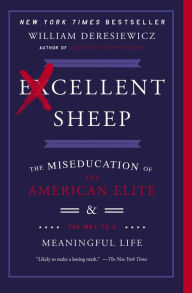
Briefly noted: Excellent Sheep: The Miseducation of the American Elite and the Way to a Meaningful Life — William Deresiewicz

Excellent Sheep is great though polemical—snide remarks about tech companies are neither true nor useful—and one gets a sense of its contents from “Solitude and Leadership: If you want others to follow, learn to be alone with your thoughts,” which went viral for the best of reasons (as opposed to the worst, which is more common). “Eros in the Classroom” is also good, though curiously erotically attenuated, and could be read profitably in tandem with Laura Kipnis’s “Sexual Paranoia Strikes Academe.” The two point to the need for satirization of contemporary academic mores, but that satirization is already so thorough that its failure to make much of a dent inside academia is obvious.

excellent_SheepBut Excellent Sheep is comprehensive, despite its overreach. But major orators know that if they have the audience the audience will forgive much, as such is the case here. The book is situated as one that fills a need and one that speaks to the author’s earlier self:

This book, in many ways, is a letter to my twenty-year-old self. It talks about the kinds of things I wish someone had encouraged me to think about when I was going to college—such as what the point of college might be in the first place.

I was like so many kids today (and so many kids back then.) I went off to college like a sleepwalker, like a zombie. College was a blank. College was the ‘next thing.’ [. . .] Up ahead were vaguely understood objectives: status, wealth, getting to the top—in a word, ‘success.’

I was perhaps slightly less blank but barely so. That being said, I often try to talk to current college students about what college is about and usually get resistance. So it may be that Deresiewicz’s twenty-year-old self wouldn’t listen to older Deresiewicz anyway. And, like almost any book of this sort, Excellent Sheep probably won’t be read by many of the students who could most benefit from reading it. Many who might be handed it might resist it. Slightly analogously, I’m struck by Emily Nussbaum’s description of Mary Gaitskill’s Bad Behavior: “In 1988, when her short-story collection Bad Behavior came out, it became a dorm-room bible for women I knew: Finally, here was a fiction writer unafraid to walk straight through the feminist battlefields of that very strange period.” I’ve assigned it before and it’s not been treated as a Bible; some students cottoned to it but some strongly resisted, though I also don’t think of it as dealing with “the feminist battlefields” of anything: I think of the stories as being about individuals, not dreary ideologies or ideological think-pieces.

Deresiewicz has a keen grasp of what’s happening in contemporary academia and, often, life itself. He writes of a “system,” or “a set of tightly interlocking parts,” including “private and affluent public high schools; the ever-growing industry of tutors and consultants, test-prep courses and enrichment programs; the admissions process itself; [. . .] the brand-name graduate schools and employment opportunities that come after the BA [. . .]” and of course much more. But this paragraph is the most interesting:

What that system does to kds and how they can escape from it, what it does to our society and how we can dismantle it—those are the subjects of this book. I was teaching a class at Yale on the literature of friendship. One day we got around to talking about the importance of being alone. The ability to engage in introspection, I suggested, is the essential precondition for living the life of the mind, and the essential precondition for introspection is solitude. My students took this in for a second—introspection, solitude, the life of the mind, things they probably had not been asked to think about before—then one of them said, with a dawning sense of self-awareness, “So are you just saying that we’re all just, like really excellent sheep?”

He goes on: “The system manufactures students who are smart and talented and driven, yes, but also anxious, timid, and lost, with little intellectual curiosity and a stunted sense of purpose.” I’ve noticed those things. They are of course not pervasive. But I also find them impossible to miss.

Excellent Sheep is a truer work of philosophy than 99% of the stuff published under the banner of “philosophy.”

Already I’ve chewed through a thousand words and two long blockquotes and have gotten to page three of Excellent Sheep. That should speak to the book’s quality. To attend to its every argument would be to almost write another book. As I said before, don’t trust everything. But do read it. It is also interesting to me that this article about Peter Thiel describes his mistrust of the education system, which partially evolved from his unhappiness with a track-based life and system. Yet this system persists for reasons, some of which Megan McArdle articulates in “What Really Scares Helicopter Parents.” The system has been in construction for decades. Startups are one route around them. Self-publishing is another. One can no doubt imagine more.

Many people are bad at being and bad at purpose. Including, possibly, me. Excellent Sheep challenges them, which is to say, us.


Links: Electric cars, the booming erotic toy industry, academic freedom’s worst enemies, iMacs get love, and more

* In California, Electric Cars Outpace Plugs, and Sparks Fly.

* “The Race to Build the Perfect Couples’ Sex Toy,” conceivably NSFW but there are no photos or drawings of humans. I found it interesting throughout.

* “Cinemas must ‘drastically improve’ or lose audiences, says Christopher Nolan.” He’s wrong about the “real film” issue: he should be more worried at the shocking level of dilapidation at movie theaters, and the worse level of food available.

* “Professors teach students how to stifle academic freedom, U.K. scholar argues in new book,” and students are oddly eager to do whatever authority figures tell them to do.

* “Inside the lab: Why Apple still sweats the details on iMac,” a fascinating story; Apple also updated iMacs on October 13. I use a 5K iMac, and it’s an amazing machine. If you order one, make sure you get the Fusion drive upgrade. The 21.5″ models are now reasonably affordable.

* What a city designed only for bikes would look like.

* How Harvard fights unions; it is entertaining to me how university people, who are probably the most theoretically pro-union group in the U.S., can’t or won’t allow unions in their institutions, or actively fight against them.

* “The Porn Business Isn’t Anything Like You Think It Is,” which is safe-for-work.

* “Why ‘game’ and ‘pickup’ are popular in the Anglo-sphere” (otherwise titled “The Male Hunger For Endless Shallow Relationships Is A Symptom Of A Fundamentally Broken Society”); speculative. See also “The appeal of ‘pickup’ or ‘game’ or ‘The Redpill’ is a failure of education and socialization.”