Everyone gets their own sandbox? On Syria:

From “What is going on in Syria? (model this):”

I think first in terms of Yugoslavia in the 1990s, which also saw the collapse of an untenable-once-placed-under-pressure nation-state, followed by atrocities.

My own pet theory as a very much non-expert who wastes some attention on the news is that Iraq and Syria need to be broken into smaller pieces based on ethnicity: Kurdistan, Sunni-stan, and Shia-stan, and perhaps others. From what I understand Kurdistan is already more or less operating, just without an official declaration of statehood; there still isn’t an Iraqi “state” per se. “Iraqis” don’t really fight for Iraq: they fight for their ethnic groups.

Breaking countries into single-ethnicity pieces may be the major lesson of Yugoslavia and perhaps World War II, which had the unfortunate effect of making many European countries close to monoethnic.

There are problems with this solution in the Middle East (e.g. Turkey and Kurds) but there also seem to be many problems with the status quo, to the extent there is a status quo.

Perhaps the only thing average individuals can do is attempt to use less oil at the margin (shift from a hybrid car to a plug-in hybrid when necessary, from a standard car to a hybrid, and there are others), since oil is indirectly funding so much of the violence. When I read about large-scale, seemingly intractable problems, I often want more writers to ask, “What is an average person supposed to do?” and then attempt to answer the question.

Note, however, that Iraq and Syria also have cousin marriage problems that may destabilize the state and empower smaller groups.

Still, take this analysis skeptically, given my views on Iraq War II when it happened, and given too that foreign policy seems like William Goldman’s description of Hollywood: nobody knows anything. The CIA famously missed the fall of the Soviet Union. Pretty much no one expected World War I. The U.S. thought Vietnam, Afghanistan, and Iraq War II were going to go well. And so on.

The U.S. has been fighting little wars (apart from the obvious big ones) for its entire existence, and while the tools have changed the rhetoric only sometimes has. In addition, overall I see the world as getting better. One account of this can be seen in Steven Pinker’s The Better Angels of Our Nature. Most of Latin America is doing well. Even Africa is doing better than is sometimes assumed. The thing the U.S. and the West in general most have on our side is time and immigration patterns. Pretty much no one is fighting to emigrate from their current country to, say, Russia. Even current scare-story China sees more Chinese leaving than others trying to enter. Most parts of the world that aren’t tremendously fucked up are attempting to emulate the U.S. and Europe in many, though not all, dimensions. The long-term trends are positive for most people in most places even if Syria is a disaster.

To my mind giving everyone their own sandbox is a move in the right direction, despite opposition.
Links: Outlier pants, your microbiome, academia, words direct from Aleppo, MRSA, and more!

* “Burgers and fries have nearly killed our ancestral microbiome:” or how real food promotes good things in our guts, and vice-versa. Perhaps the most actionable piece you’ll read today. Plus: “Forget paleo, go mid-Victorian: it’s the healthiest diet you’ve never heard of.”

* “The Revenge of the Coddled: An Interview with Jonathan Haidt.”

* Are English departments better than what I, and possibly you, think? I hope so but I’m skeptical. Freddie also doesn’t have a TT job right now; we’ll see if he gets one and how his views might evolve over time. This is a good time to reiterate “What you should know BEFORE you start grad school / PhD programs in English Literature: The economic, financial, and opportunity costs.” Short version: Don’t do it.

* Aleppo-based VLC contributor speaks to the Paris attacks.

* “Saudi Arabia, an ISIS that has made it.” In political discussions I often point out that Saudi Arabia’s tone, values, and policies are diametrically opposed to the ones espoused by the American and European governments that often support Saudi Arabia.

* California’s DOT Admits [the obvious:] More Roads Mean More Traffic.

* A MRSA vaccine is in the works.

* Case Study: Outlier on Creating the 21st Century Jean. Has anyone worn these? I’m thinking about getting a pair.

* On Mary Gaitskill’s The Mare. Books about children rarely interest me (exception: Philip Pullman’s His Dark Materials), but Gaitskill’s Bad Behavior is for the right person amazing.

Life: The trap edition

The pursuit of easier life resulted in much hardship, and not for the last time. It happens to us today. How many young college graduates have taken demanding jobs in high-powered firms, vowing that they will work hard to earn money that will enable them to retire and pursue their real interests when they are thirty-five? But by the time they reach that age, they have large mortgages, children to school, houses in the suburbs that necessitate at least two cars per family, and a sense that life is not worth living without really good wine and expensive holidays abroad. What are they supposed to do, go back to digging up roots? No, they double their efforts and keep slaving away.

—Yuval Noah Harari in Sapiens: A Brief History of Humankind, which is quite good, though the above is out of context.

I wonder how much of the financial arms race is driven by a) parochial housing policies and b) the number of people who genuinely enjoy the work at high-powered firms. Some small number of people do really enjoy being lawyers. Not many, but they exist.

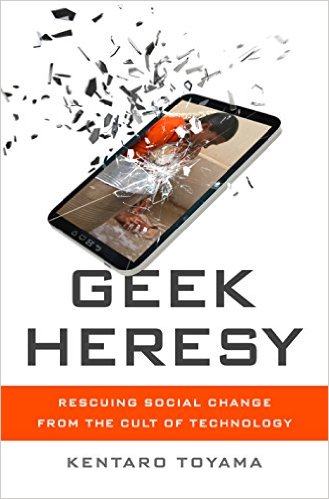
Geek Heresy: Rescuing Social Change From the Cult of Technology — Kentaro Toyama

My review on Grant Writing Confidential is actually germane to readers of The Story’s Story, too, so I’ll start by directing you there. The book’s central and brilliant point is simple: for at least a century various people have imagined that better technology and the spread of technology will solve all sorts of social ills and improve all sorts of institutions, with education being perhaps the most obvious.

Geek_heresy2There are many other fascinating points—too many to describe all of them here. To take one, it’s often hard to balance short- and long-term wants. Many people want to write a novel but don’t want to write right now. Over time, that means the novel never gets written, because novels get written one sentence and one day at a time. Technology does not resolve this challenge. If anything, Internet access may make it worse. Many of us have faced an important long-term project only to diddle around on websites:

Short-term pleasure often leads to long-term dissatisfaction. That intuition underlies the psychologist’s distinction between hedonia and eudaimonia. Pleasure-seeking hedonism is questionable, but maybe long-term eudaimonic life satisfaction is good.

One sees these issues all over. Porn remains ridiculously popular (though some consumers of it are no doubt fine). Many people drink soda despite how incredibly detrimental soda is to health, and in my view how bad soda tastes compared to, say, ice cream. TV watching time is still insanely high, though it may be slightly down from its previous highs. There are various ways one can try to remove agency from the people watching porn while drinking soda and keeping one eye on a TV in the background, but the simpler solution is to look at people’s actions and see revealed preferences at work.

Most people don’t have the souls of artists and innovators trapped in average everyday lives. Most people want their sodas and breads and sugars and TV and SUVs and all the other things that elite media critics decry (often reasonable, in my view). Most people don’t connect what they’re doing right now to their long-term outcomes. Most people don’t want to be fat but the soda is right here. A lot of people want a better love life but in the meantime let’s check out Pornhub. Most people want amazing Silicon Valley tech jobs, but Netflix is here right now and Coursera seems far away.

And, to repeat myself, technology doesn’t fix any of that. As Toyama says of one project that gives computer access to children, “technology amplifies the children’s propensities. To be sure, children have a natural desire to learn and play and grow. But they also have a natural desire to distract themselves in less productive ways. Digital technology amplifies both of these appetites.” I had access to computers as a teenager. I wasted more time than I want to contemplate playing games on them, rather than building the precursors to Facebook. Large markets and social issues emerge from individual choices, and a lot of elite media types want to blame environment instead of individual. But each individual chooses computer games—or something real.

It turns out that “Low-cost technology is just not an effective way to fight inequality, because the digital divide is much more a symptom than a cause of other divides. Under the Law of Amplification, technology – even when it’s equally distributed – isn’t a bridge, but a jack. It widens existing disparities.” But those disparities emerge from individual behaviors. People who want to be writers need to write, now. People who want better partners or sex lives need to quit the sugar, now. One could pair any number of behaviors and outcomes in this style, and one could note that most people don’t do those things. The why seems obvious to me but maybe not to others. The people who become elite developers often say coding is fun for them in a way it apparently isn’t to others (including me). Writing is fun to me in a way it apparently isn’t to others. So I do a lot of it, less because it’s good for me than because it’s fun, for whatever temperamental reason. Root causes interest me, as they do many people with academic temperaments. Root causes don’t interest most people.

Let me speak to my own life. I’ve said variations on this before, but when I was an undergrad I remember how astounded some of my professors were when they’d recommend a book and I’d read it and then show up in office hours. I didn’t understand why they were astounded until I started teaching, and then I realized what most students are like and how different the elite thinkers and doers are from the average. And this is at pretty decent colleges and universities! I’m not even dealing with the people who never started.

Most of the techno-optimists, though—I used to be one—don’t realize the history of the promise of technology to solve problems:

As a computer scientist, my education included a lot of math and technology but little of the history or philosophy of my own field. This is a great flaw of most science and engineering curricula. We’re obsessed with what works today, and what might be tomorrow, but we learn little about what came before.

Yet technology doesn’t provide motivation. It’s easy to forget this. Still, I wonder if giving 100 computers to 100 kids might be useful because one of them will turn out to be very important. The idea that a small number of people drive almost all human progress is underrated. In The Enlightened Economy Joel Mokyr observes that the Industrial Revolution may actually have been driven primarily by ten to thirty thousand people. That’s a small number and a small enough number that the addition to or subtraction of a single individual from the network may have serious consequences.

This isn’t an idea that I necessarily buy but it is one I find intriguing and possibly applicable to a large number of domains. Toyama’s work may reinforce it.

The Charlie Hebdo response:

Is here:

Charlie_Hebdo on the paris massacre

Still, it is not obvious to me that religion, especially in its modern Western forms, is intrinsically opposed to the other items on that list, all of which I support and ideally enact.

The Tyler Cowen response is “So many questions…” That was posted almost two days ago and more questions still remain than answers.

Links: Philip Pullman, PC, cars, women and dating, safe spaces, student loans, false rape accusations, SpaceX, and more!

* Twenty years since The Golden Compass: an interview with Philip Pullman. Read it and if you haven’t read His Dark Materials go do that instead.

* “Our generation did not invent political correctness, but we can fight it“—if we choose to.

* Evanston, The Suburb That Tried To Kill the Car; evidently the urban planners there read and understood The High Cost of Free Parking.

* “Why women lose the dating game,” another piece with somewhat bogus framing but one that at least considers what things look like for men. The quoting of Dalrock is a good sign.

* “At Group Sex Parties, Strict Rules Make for Safe Spaces: Gatherings emphasize consent and respect for boundaries as much as exploration.” Probably SFW and most interesting for the mainstream venue in which the article appears.

* “What [If Anything] We’re Buying With $1 Trillion in Student Loans.” I propose that all further articles about higher education, cost, and access must use the phrase or at least concept “Diminishing marginal utility” or “Diminishing marginal returns.” As noted here and elsewhere, treating “college” as if it’s one big, identical thing is crazy.

* “‘Guilty until proven innocent’: life after a false rape accusation: A growing group of men are calling for changes in the law around sexual assault to protect those who are the victims of false accusations.”

* Why nuclear energy is our best option at the moment: shout it from the rooftops. Most international political problems are really energy problems.

* A penny for your books, making a point I’ve long reiterated.

* “Police violence in Alabama:” note: “there’s no law that allows cops to beat or shock you because they don’t like your attitude.” Why do cops not realize this, or enact it if they do? Cops beat people for the sake of it. They behave like animals.

* Fresh Climate Data Confirms 2015 Is Hotter Than Any Other Year in Human History.

* SpaceX and Boeing compete to get astronauts to space; everyone is the winner. See also my review of Elon Musk: Tesla, SpaceX, and the Quest for a Fantastic Future.

* “Is great philosophy, by its nature, difficult and obscure?” Or might philosophers write obscurely in order to seem profound, or merely make it difficult or impossible to evaluation what they’re saying?

* A history of men’s boots and shoes, and why modern ones are so good; the piece is fascinating but in a way hard to describe.

* “Many Say High Deductibles Make Their Health Law Insurance All but Useless;” alternately, one could read this as “At the margin, revealed preferences show that people don’t want as much healthcare as many eggheads imagined.” The reporter of course chooses not to explore this possibility.

Life: Lord of the Rings / The Myth of Sisyphus edition

“There are some things it is better to begin than to refuse, even though the end may be dark.”

—Tolkien, The Two Towers.

Links: Energy (fusion, cars), AI research, flu shots, Texas, “trigger warnings,” and more!

* Stellar work: Research into fusion has gone down a blind alley, but a means of escape may now be at hand. File this under “Good news that should be more widely reported.” Most of the world’s “political” problems are really energy problems in another form, which is why I often link to discussions of energy, energy production, and energy politics.

* “Why Texas Is Our Future,” and why so many people are moving there, from “Texas Forever: How I Found the American Dream in the Lone Star State.” The latter piece inspired me to check just how much I lose to New York City and State taxes. The answer is distressing. Many superficially liberal cities are actually inhumane to normal residents, and many superficially conservative cities are actually far more humane.

* Charles observes, probably correctly: “I think if people knew what passes for “AI research”, they’d be a lot less worried about a dystopian outcome. Or, to quote Andrew Ng, “I don’t work on preventing AI from turning evil for the same reason that I don’t work on combating overpopulation on the planet Mars.”

* “For God’s Sake, Go Get a Flu Shot.” This may be the most immediately actionable piece you read today.

* “Why San Francisco’s way of doing business beat Los Angeles’.”

* “Bernie Sanders’ campaign is such a counterexample. It fits poorly with the ‘low nonwhite representation is caused by insufficiently strong social justice orientation’ theory, but very well with the counter-theory I propose in that post: nonwhites are just generally less eager to join weird intellectual signaling-laden countercultural movements.”

* The invisible device that powers everything you do, on lithium-ion batteries and John Goodenough, who is responsible for more of the modern world than is commonly realized.

* Car dealers are awful. It’s time to kill the dumb laws that keep them in business.

* A professor sympathetic to “trigger warnings” tires of them. And, in addition: “My trigger-warning disaster: ‘9 1/2 Weeks,’ ‘The Wire’ and how coddled young radicals got discomfort all wrong.”

* Is wheat only so bad for you because of industrial farming and breeding? See also Gary Taubes’s Why We Get Fat: And What to Do About It, which changed my eating habits, though I think Taubes overstates the case against fruit. It may be that “flour” is not as bad for you as is commonly assumed, but rather that the peculiar way flour is produced and disseminated is horrible for you.

* Why high-speed rail doesn’t work in the U.S., from someone who actually works on rail projects.

* First test drives of the 2016 Volt are emerging and make the car sound promising.

Briefly noted: Mozart in the Jungle — Blair Tindall

Mozart in the Jungle is surprisingly good and an ode to all the sex musicians have, the drugs musicians do (“I watched Janet bent over the desk to snort cocaine through a straw” occurs on page 2), and most notably a cautionary tale about the economics that underlie their industry. In Mozart in the Jungle Tindall succeeds as few do yet still barely succeeds enough to feed herself. The later sections, as she contemplates her own approaching infertility, she turns melancholy, because she knows that while others in her age group have families she has an oboe. Many adventures at age 22 are slogs at 40, and this is something many 22-year-olds know in passing but don’t feel till they’re much older.

Mozart_in_the_jungleTindall’s relative success still feels like failure to her, financially and, often, artistically. Megan McArdle’s recent post on journalism strikes many notes similar to Tindall’s; the two are both writing about glamour industries battered by changing economics and excess supply (facilitated by digital transmission) relative to demand. In Tindall’s case, the number of financially secure oboe players is probably in the single and low double digits. She makes that threshold, but only in an artistically tedious way. For her, the smart thing to do is get out. When she makes decisions as a 20-year-old, she fails to realize that as a 35- or 40-year-old she will want and feel different things.

In school she finds that “my classmates toiled harder over their textbooks than I did over my oboe, yet they didn’t receive the same special attention.” Attention, though, is a dangerous stimulant, and so too are other stimulants, here recalled and made comic by an older mind reviewing a younger event:

Jose took off the same black turtleneck and dashiki he wore every day, the odor of his unwashed body mixing with cheap musk. We kissed, embracing as the climate of Brahams’s G-minor quintet washed over us. Jose peeled away my top gently, caressing my shoulders, nuzzling my neck and pulling back the covers. I could see another woman’s menstrual blood smeared on the bottom sheet, but I let him push me back on the bedding.

It goes… okay. The gap between fantasy and reality recurs through the memoir, to the very end:

A young person who dreamily “wants to go to Juilliard” or “be a concert pianist” should research the reality of those statements. [. . .] I’m one of those part-time musicians now. When I do play music, it is a joy. The reality of performing full-time wasn’t the fantasy I’d imagined as a little girl. What offers me a meaningful life today are the infinite possibilities in our modern world, of which music is only one. Thousands of people have been influenced by the Sierra magazine articles I’ve written about environmental conservation.

Incidentally, that quote also sums my feeling about grad school in the humanities.

Tindall also wistfully sees her Upper West Side neighbors go from libidinously ravenous, providing her a voyeuristic thrill as they have continual passionate sex, to parents, while Tindall plays the oboe and can’t or won’t maintain long-term relationships as her child-bearing years slip away like leaves off a tree in Boston in autumn. The memoir also came out before Tindall stalked her ex-boyfriend, Bill Nye, so there may be more to her story and character than Mozart in the Jungle.

Links: Your house, cars, dubious campus policies, nuclear power, NIMBYs, and more

* “The most disruptive technology of the last century is in your house,” an underappreciated and lovely point: “The number of hours that people spent per week preparing meals, doing laundry and cleaning fell from 58 in 1900 to only 18 hours in 1970, and it has declined further since then.”

* Europe’s love affair with diesel cars has been a disaster.

* The Little Disturbances of Man.

The Limits Of The Digital Revolution: Why Our Washing Machines Won’t Go To The Moon:” On the future of work and why innovation may be slowing.

* For Students Accused Of Campus Rape, Legal Victories Win Back Rights, which makes too much sense; see also “‘Have We Learned Anything From the Columbia Rape Case?’ Not at the New York Times.”

* “You’ll Be Able to Buy Any Volvo as an Electric by 2019,” though I wonder if this is true.

* “Nuclear power is cheap, reliable, emissions-free–and struggling to keep up.” Nuclear power should be at the top of the agenda, especially when combined with electric cars. By the way, the next edition of the Chevy Volt is getting great reviews, and the development process behind the car is detailed in The Powerhouse: Inside the Invention of a Battery to Save the World. The Powerhouse is not a Tom-Wolfe-quality book but is interesting throughout and will make you respect the Volt.

* FYI for the grad students among you:

The decline of school-age children has important implications for colleges. College enrollment fell over the past few years just as the college-age population peaked. According to Census projections, the college-age population won’t return to the 2012 peak for more than 20 years.

* Students don’t seem to be learning anything in school, globally, which ought to depress those of us who do classroom work.

* Depressing, but: “This speech convinced me Israel’s wave of violence is so much worse than it looks.”

* How NIMBYs make your paycheck smaller.

* “Free” college tuition for everyone is not a good idea:

A more pressing issue is that community college is already close to de facto free for lower-income individuals, if they piece grants and aid together. Yet the completion rate at these colleges is at best approaching thirty-eight percent. The real problems come before college, and encouraging more people to attend four-year colleges is unlikely to do much good. In any case, here is further evidence that higher subsidies to community college attendance very often do not lead to more actual education. The same or worse is likely to hold for state universities.