Product Review: Das Keyboard Model "S" Professional

The main question regarding the Das Keyboard Professional Model “S” should not be whether it’s a very nice keyboard: it is. The keys are precise and smooth, and the amount of force necessary to generate a letter is far more appropriate than the standard keyboards shipped with most computers. Rather, the main question should be: is the Das Keyboard substantively better than the Unicomp Customizer and Space Saver, both of which use the time-tested IBM Model M design and manufacturing equipment? The answer is probably “no,” especially when one considers their relative cost: as of this writing, the Unicomp keyboards are $69 and made in the United States, while Das Keyboards are $129 and made in Taiwan.*

First impressions

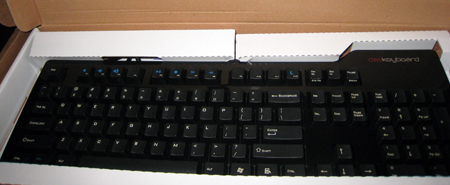
The slim keyboard and its housing:
das_keyboard_model_s_1

As shown, the Das Keyboard is black and unadorned by anything save a “daskeyboard” logo in the upper right. The keys themselves are matte black with white letters etched in by laser, while the borders are glossy and probably prone to fingerprints and smudging over time. The attractive minimalist design makes the keyboard look like part of a set when placed next an iMac and Aeron, as though it were designed to complement them.

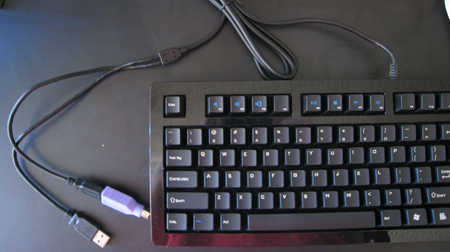
The chief drawback aesthetically and practically is the split USB cord:
das_keyboard_split

das_keyboard_3

Not surprisingly, a picture like this doesn’t appear on the Das Keyboard website. It’s reminiscent of the Matias Tactile Pro 2, and not in a good way.

But the Das Keyboard does have two USB ports on the side, which is a useful feature the Customizer lacks. To me it doesn’t make much of a difference: I taped a four-port, powered USB hub to the bottom of my desk, and that’s where I plug in peripherals, my printer, and an iPhone cord. The hub cost $10, like the one at the link, although I bought mine elsewhere.

The keys

Each stroke brings a satisfying but muted clack, and I like typing on the Das Keyboard. Its keys don’t travel quite as far as the Customizer or Space Saver’s; it’s also easier to bottom out because one doesn’t have the curious resistance that a buckling spring provides, as described here:

The most widely produced buckling-spring keyswitch keyboard is the IBM model M keyboard. When pressing an individual key, the operator is physically applying increasing force (approximately 60-70 grams of force) against a coiled spring. The spring provides slight resistance, so that you can rest your fingers on the keyboard and not cause an accidental or inadvertent key press. Once the key travels a particular distance (approx. 2.5 – 3.5mm), the spring reaches the “catastrophic buckling” point and produces an audible click at the same exact instance that the computer records the keystroke.

With the Das Keyboard, you can still rest your fingers on the keys, but when typing you won’t have the catastrophic buckling that prevents bottoming out. Consequently, the Das Keyboard has a slightly harsher feel than the Customizer or Space Saver. It seems to take approximately the same amount of force to generate a keystroke, but that’s based solely on feel rather than on testing. There might be an objective difference between the two, but if so, it’s not great.

The key switches themselves appear to Cherry MX Blues, which are explained in greater detail at the link and in this Hot Hardware essay. You can see them in the Das Keyboard here:

das_keyboard_cherry_mx_blue

These switches are louder, though not enormously so, than the Cherry MX “Brown” switches found in the Kinesis Advantage Ergonomic Keyboard, which I reviewed at the link, or the Majestouch Tenkeyless Keyboard. You could use the Kinesis Advantage or Majestouch Tenkeyless keyboard in a dorm or office without offending those in the same room, but the Das Keyboard is probably too loud for those environments. I assume the “silent” version uses Cherry MX “Brown” switches that are quieter and also appropriate for group settings. To get a sense of how loud each keyboard is, check out this video, which compares the Advantage, Customizer, and Das Keyboard:

What do all these models mean?

If you’ve visited the Das Keyboard website, you’re probably aware that you can buy four models: the “Original Das Keyboard Professional, “Das Keyboard Model “S” Professional,” which I am reviewing, the “Das Keyboard Model “S” Professional Silent,” and the “Das Keyboard Model “S” Ultimate.”

Here’s how the somewhat confusing nomenclature and model numbers work: A Das Keyboard “Professional” means there are letters on the keyboard, like mine; not having any letters doesn’t seem to confer any benefit aside from sheer geek street cred, about which I care less than practicality. A Das Keyboard “Ultimate” is identical to the “Professional” except that it’s blank. The Das Keyboard “Silent” is quieter, presumably due to using Cherry MX “Brown” switches like those mentioned above.

The Original Das Keyboard Professional lacks media function keys, has only a single USB connector, isn’t compatible with KVM switches, and doesn’t have “Full n-key rollover,” which means that if you mash, say, six keys at once, the keyboard might not register all of them. The last feature is apparently useful for gaming. The short version is that the differences between the “Original” and “Model S” are marginal and not very important. Given the choice, I’d probably take the original.

Mac support

The Das Keyboard supports OS X and Linux as well as Windows. You can buy a set of Mac- and Linux-friendly keycaps for $14.95, which is comparable to Unicomp’s cost for OS-specific keys. You’ll have to swap the Option and Command key in OS X’s system preferences, as described here.

A strange problem

Edit Nov. 12 2009: Thomas Aitchison of Das Keyboard sent me an e-mail saying that the problem I described below is a known bug and that the company is recalling the keyboards in the affected serial number range, so this probably no longer applies.

Every couple hours, a key would stop working. The first time it was the “e:” I typed “swt” instead of “sweet” in TextMate. The same thing happened in Word and Mellel. But when I plugged the keyboard into my MacBook, the “e” was back, and switching back to my iMac also solved the problem. The same thing happened a few hours later with the “control” key. Unplugging the keyboard and plugging it back in did the trick. It happened again with the “p” key, and presumably with others that I hadn’t noticed because I didn’t use them.

In addition, the remapped “option” key doesn’t function properly. In OS X, option-shift-hyphen generates an em dash, like this: —. But I had to remap the caps lock key to option to generate that dash. I have no idea why. This hasn’t happened with any of the other keyboards I’ve used with this computer: the Matias Tactile Pro, the Customizer, the Advantage, or the Apple Aluminum Keyboards. I assume this is a problem unique to this particular Das Keyboard or to this Das Keyboard with my iMac; if this happened with a purchased computer, the company promises “For repair and exchange: no waiting, no hassle. We will ship you a replacement as soon as we receive your shipment.”

A second opinion

My girlfriend used the Das Keyboard for a day and didn’t like it as much as I did: she said she heard a high-pitched squeak from it. Of the keyboards I’ve tried recently, she likes the Kinesis Advantage best. In comparison to the Unicomp Customizer, she wrote, “WAY better than the daskeyboard. […] It takes a little more effort, and maybe I’ll find at the end of the day my muscles aren’t a fan of it, but for now, it’s definitely better. Feels more solid.”

Conclusion

Even Das Keyboard’s website says that “Das Keyboard compares to the legendary IBM model M. Its best-in-class mechanical gold-plated key switches provide a tactile and audio click that makes typing a pure joy.” They’re right: it does compare to the Model M. Either keyboard is an good choice. If I had to make it, I’d take the Model M. Its durability is proven, the key travel is slightly better, and it sounds slightly more like a typewriter and slightly less “plasticky” to my ears. In addition, it’s about $50 cheaper after shipping. The only drawback is the lack of USB ports, which seems minor in comparison to how the keyboard feels.

EDIT: I wrote a long post on what I think of the the Kinesis Advantage, Unicomp Space Saver, and Das Keyboard two years later.


* I don’t highlight where the keyboards are made out of a misplaced and ignorant jingoistic nativism, but rather because, all else being equal, I’d generally choose the item made in a western country (Canada, the United States, most of Europe) over one not made there under the assumption that the workers are probably treated better and make living wages. Taiwan is an industrialized country, so this probably doesn’t apply, but I notice the difference anyway. In addition, products made elsewhere usually cost less; I find it suggestive that, in this case, the opposite is true.

* Note: The review unit was provided by Das Keyboard and returned to the manufacturer after this review was written.

Product Review: Das Keyboard Model “S” Professional

The main question about the Das Keyboard Professional Model “S” is not whether it’s a very nice keyboard: let me get that out of the way by saying it is. The keys are precise and smooth, and the amount of force necessary to generate a letter is far more appropriate than the standard keyboards shipped with most computers.

Instead, the main question is whether the Das Keyboard is substantively better than the Unicomp Customizer and Space Saver, both of which use the time-tested IBM Model M design and manufacturing equipment. The answer is probably “no,” especially when one considers their relative cost: as of this writing, the Unicomp keyboards are $69 and made in the United States, while Das Keyboards are $129 and made in Taiwan.*

First impressions

The slim keyboard and its housing:

das_keyboard_model_s_1

As shown, the Das Keyboard is black and unadorned by anything save a “daskeyboard” logo in the upper right. The keys are matte black with white letters etched in by laser—a nice touch—while the borders are glossy and probably prone to fingerprints and smudging over time. The attractive minimalist design makes the keyboard look like part of a set when placed next an iMac and Aeron, as though it were designed to complement them.

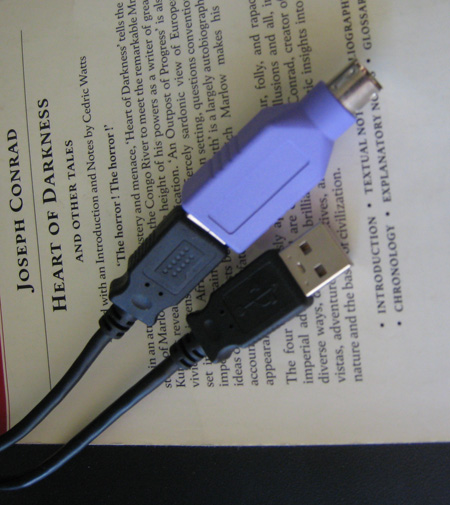
The chief drawback aesthetically and practically is the split USB cord:
das_keyboard_split

das_keyboard_3

Not surprisingly, a picture like this one doesn’t appear on the Das Keyboard website. It’s reminiscent of the Matias Tactile Pro 2, and not in a positive way.

But the Das Keyboard does have two USB ports on the side, which is a useful feature the Customizer lacks. To me extra USB ports don’t make much difference: I taped a four-port, powered USB hub to the bottom of my desk, and that’s where I plug in peripherals, my printer, and an iPhone cord. The hub cost $10.

The keys

Each stroke brings a satisfying but muted clack. I like typing on the Das Keyboard. Its keys don’t travel quite as far as the Customizer or Space Saver’s, and it’s also easier to bottom out because one doesn’t have the curious resistance that a buckling spring provides, as described here:

The most widely produced buckling-spring keyswitch keyboard is the IBM model M keyboard. When pressing an individual key, the operator is physically applying increasing force (approximately 60-70 grams of force) against a coiled spring. The spring provides slight resistance, so that you can rest your fingers on the keyboard and not cause an accidental or inadvertent key press. Once the key travels a particular distance (approx. 2.5 – 3.5mm), the spring reaches the “catastrophic buckling” point and produces an audible click at the same exact instance that the computer records the keystroke.

With the Das Keyboard, you can still rest your fingers on the keys, but when typing you won’t have the catastrophic buckling that prevents bottoming out. Consequently, the Das Keyboard has a slightly harsher feel than the Customizer or Space Saver. It seems to take approximately the same amount of force to generate a keystroke, but that’s based solely on feel rather than on testing. There might be an objective difference between the two, but if so, it’s not great.

The key switches themselves appear to Cherry MX Blues, which are explained in greater detail at the link and in this Hot Hardware essay.

das_keyboard_cherry_mx_blue

These switches are louder, though not enormously so, than the Cherry MX “Brown” switches in the Kinesis Advantage Ergonomic Keyboard or the Majestouch Tenkeyless Keyboard. You could use the Kinesis Advantage or Majestouch Tenkeyless keyboard in a dorm or office without offending those in the same room, but the Das Keyboard is probably too loud for those environments. I assume the “silent” version uses Cherry MX “Brown” switches that are quieter and also appropriate for group settings. To get a sense of how loud each keyboard is, check out this video, which compares the Advantage, Customizer, and Das Keyboard:

What do all these models mean?

If you’ve visited the Das Keyboard website, you’re probably aware that you can buy four models: the “Original Das Keyboard Professional, “Das Keyboard Model “S” Professional,” which I am reviewing, the “Das Keyboard Model “S” Professional Silent,” and the “Das Keyboard Model “S” Ultimate.”

Here’s how the somewhat confusing nomenclature and model numbers work: A Das Keyboard “Professional” means there are letters on the keyboard, like mine; not having any letters doesn’t seem to confer any benefit aside from sheer geek street cred, about which I care less than practicality. A Das Keyboard “Ultimate” is identical to the “Professional” except that it’s blank. The Das Keyboard “Silent” is quieter, presumably due to using Cherry MX “Brown” switches like those mentioned above.

The Original Das Keyboard Professional lacks media function keys, has only a single USB connector, isn’t compatible with KVM switches, and doesn’t have “Full n-key rollover,” which means that if you mash, say, six keys at once, the keyboard might not register all of them. The last feature is apparently useful for gaming.

The differences between the “Original” and “Model S” are marginal and not very important. I’d probably take the original.

Mac support

The Das Keyboard supports OS X and Linux as well as Windows. A set of Mac- and Linux-friendly keycaps goes for $14.95, which is comparable to Unicomp’s cost for OS-specific keys. You’ll have to swap the Option and Command key in OS X’s system preferences, as described here.

A strange problem

Edit Nov. 12 2009: Thomas Aitchison of Das Keyboard sent me an e-mail saying that the problem I described below is a known bug and that the company is recalling the keyboards in the affected serial number range, so this probably no longer applies.

Every couple hours, a key would stop working. The first time it was the “e:” I typed “swt” instead of “sweet” in TextMate. The same thing happened in Word and Mellel. But when I plugged the keyboard into my MacBook, the “e” was back, and switching back to my iMac also solved the problem. The same thing happened a few hours later with the “control” key. Unplugging the keyboard and plugging it back in did the trick. It happened again with the “p” key.

In addition, the remapped “option” key doesn’t function properly. In OS X, option-shift-hyphen generates an em dash, like this: —. But I had to remap the caps lock key to option to generate that dash. I have no idea why. This hasn’t happened with any of the other keyboards I’ve used with this computer: the Matias Tactile Pro, the Customizer, the Advantage, or the Apple Aluminum Keyboards. I assume this is a problem unique to this particular Das Keyboard or to this Das Keyboard with my iMac. Fortunately, the company promises: “For repair and exchange: no waiting, no hassle. We will ship you a replacement as soon as we receive your shipment.”

A second opinion

My girlfriend used the Das Keyboard for a day and didn’t like it as much as I did: she said she heard a high-pitched squeak. Of the keyboards I’ve tried recently, she likes the Kinesis Advantage best. In comparison to the Unicomp Customizer, she wrote, “WAY better than the daskeyboard. […] It takes a little more effort, and maybe I’ll find at the end of the day my muscles aren’t a fan of it, but for now, it’s definitely better. Feels more solid.”

Conclusion

Even Das Keyboard’s website says that “Das Keyboard compares to the legendary IBM model M. Its best-in-class mechanical gold-plated key switches provide a tactile and audio click that makes typing a pure joy.” They’re right: it does compare to the Model M. Either keyboard is an good choice.

But I’d take the Model M. Its durability is proven, the key travel is slightly better, and it sounds more like a typewriter and slightly less “plasticky” to my ears. It’s about $50 cheaper after shipping. The only drawback is the lack of USB ports, which is minor.

EDIT: I wrote a long post on what I think of the the Kinesis Advantage, Unicomp Space Saver, and Das Keyboard two years later.


* I don’t highlight where the keyboards are made out of a misplaced and ignorant jingoistic nativism, but rather because, all else being equal, I’d generally choose the item made in a western country (Canada, the United States, most of Europe) over one not made there under the assumption that the workers are probably treated better and make living wages. Taiwan is an industrialized country, so this probably doesn’t apply, but I notice the difference anyway. In addition, products made elsewhere usually cost less; I find it suggestive that, in this case, the opposite is true.

* Note: The review unit was provided by Das Keyboard and returned to the manufacturer after this review was written.

Life: Children and The Children's Book

“The young desire to be free of the adults, and at the same time were prepared to resent any hint that the adults might desire to be free of them.”

—A.S. Byatt, The Children’s Book (which is excellent and highly recommended so far).

Life: Children and The Children’s Book

“The young desire to be free of the adults, and at the same time were prepared to resent any hint that the adults might desire to be free of them.”

—A.S. Byatt, The Children’s Book (which is excellent and highly recommended so far).

Malcolm Gladwell on Harper Lee's To Kill A Mockingbird

I have two fundamental problems with Malcolm Gladwell’s piece in the New Yorker concerning To Kill a Mockingbird: one is philosophical/moral, and the other aesthetic. The philosophical/moral problem is that incrementalism is not necessarily an invalid approach to major social injustice. Gladwell says:

Old-style Southern liberalism—gradual and paternalistic—crumbled in the face of liberalism in the form of an urgent demand for formal equality. Activism proved incompatible with Folsomism.

That’s true: but it doesn’t mean that the James Folsom approach—who was progressive by southern standards in the first of the twentieth century—wasn’t an improvement over what came later as part of the unjustified backlash. Gradual change can set the stage for radical change, as it did with the Civil Rights movement, and pragmatism is sometimes more effective than attempting to radically alter social, economic or political life.

The Stanford Encylopedia of Philosophy describes the philosopher Richard Rorty this way: “Rorty is a self-proclaimed romantic bourgeois liberal, a believer in piecemeal reforms advancing economic justice and increasing the freedoms that citizens are able to enjoy.” Rorty gives a convincing defense of those piecemeal reforms in his various books, and I’m not wholly convinced of Gladwell’s interpretation that To Kill a Mockingbird is problematic for that reason.

And this idea applies to more than politics. Megan McArdle just posted a piece on Federal Reserve Chairman Ben Bernacke that ended, “As it says in To Kill a Mockingbird, Bernanke did the best he could with what he had. It was not perfect. But looking around at the mostly employed people on the streets, I’m glad he was there.” From what I understand of the recent financial crisis, I basically agree with her assessment: Bernacke and the other players in Washington did the best they could given the information they had at the time, which is based on pieces like The Final Days of Merrill Lynch in The Atlantic and Inside The Crisis: Larry Summers and the White House economic team in the New Yorker.

The second problem is aesthetic: like Nabokov, I don’t think novels need to play the role of social arbiter or champion. A novel that is sufficiently abhorrent—like one that actively praises segregation in the fashion that Soviet novels would advance inaptly named social realism, or one that shills for retrograde religious ideals—would probably be bad by virtue of their social commentary, but I think To Kill a Mockingbird is subtler than that, and to me the novel’s most interesting component is the development of Scout as a person. That’s inherently tied up with morality and politics, of course, but how and whether the novel succeeds in that respect ought to be the major consideration in evaluating a novel.

In other words, once the novel passes the relatively low bar of not being actively abhorrent, it should be judged on other principles than whether it conforms to what appear to be a person or age’s moral norms.

Commencement — J. Courtney Sullivan

J. Courtney Sullivan’s Commencement is a less accomplished version of Claire Messud’s The Emperor’s Children, and it has all the narrative tension of an overcooked noodle. It shoots for modern-day Jane Austen and hits something closer to the chick-lit bulls-eye. I noted this to my girlfriend, who said that she could’ve told me it was chick-lit based on its teal dust jacket. I try not to judge a book by its cover, but in this case apparently my principles apparently wouldn’t have mattered.

The writing in Commencement isn’t bad, but it also isn’t good; I’m searching through pages, looking for a representative quote, or something that’s at least stylistically unusual enough to merit consideration and am finding… nothing. The prose conveys information effectively but without any pizzaz; it is what James Wood might call an efficient literary/commercial novel, having absorbed a few conventions of modernism while retaining a passionate eye and penchant for understatement. Wood says that “There is a familiar American simplicity, for instance, which is Puritan and colloquial in origin, ‘a sort of ecstatic fire that takes things down to the essentials,’ as Marilynne Robinson has it in her novel Gilead.” Sullivan doesn’t have that. She works for the New York Times, which might explain why Commencement reads like a long piece for the Sunday Styles or one of the other less rigorous sections.

I read Commencement based on a mostly positive review in the same paper. It says, for example, that “Sullivan’s characters are often motivated by urges that are taboo to admit in certain quarters: getting love and nurture from men, or staying protected in a cocoon of female friendship rather than confronting the larger world.” Outside of the Mormon church and some university Women’s Studies departments, I can’t imagine what those “certain quarters” might be. In an age of Sex and the City and Katy Perry’s “I Kissed a Girl (And I Liked It),” taboos aren’t very strong. One notable thing about the review is that while it comments extensively on the novel’s social content, it says virtually nothing about its style or prose. Perhaps that’s because the reviewer drew a blank, just as I did, and therefore fell back on sociology when aesthetics failed to rouse any feeling whatsoever.

The death of literature part 11,274, from Saul Bellow

“From the first, too, I had been warned that the novel was at the point of death, that like the walled city or the crossbow, it was a thing of the past. And no one likes to be at odds with history. Oswald Spengler, one of the most widely read authors of the early ’30s, taught that our old tired civilization was very nearly finished. His advice to the young was to avoid literature and the arts and to embrace mechanization and become engineers.”

That’s from Saul Bellow’s “Hidden Within Technology’s Empire, a Republic of Letters” for the New York Times’ Writers on Writing collection. Fortunately he didn’t listen to the various Spenglers of his day. I often find it amusing to read the various predictions of literature’s demise, which have so frequently been trumpeted in the 20th Century and now the 21st; Orwell does a good job with the same theme in his collected essays.

Although being wrong in the past doesn’t necessarily equate to being wrong in the present, the poor track records of both religious apocalypse and the demise of reading tend to make me skeptical of new claims about either.

(Legitimately) free music: The Orange Mountain Music Philip Glass Sampler Vol.I

Amazon is currently giving away The Orange Mountain Music Philip Glass Sampler Vol.I, which caught my attention because I’ve liked Glass since really hearing him for the first time last year during a University of Arizona dance showcase when some of the students used “Metamorphosis.”

I’m listening to the “sampler” now, which has more variation in style than a complete album for obvious reasons. While some transitions between songs verge on jarring, but the album still seems worth downloading.

(Hat tip Crooked Timber.)

Why Women Have Sex: Understanding Sexual Motivations from Adventure to Revenge (and Everything in Between) — Cindy M. Meston David M. Buss

Terry Teachout says that “Scientists are forever proving what everybody knows, especially when it comes to music.” Cross out music and replace it with sex, and you’ve also got a substantially true statement. One big advantage to Tim Harford’s The Logic of Life and Dan Ariely’s Predictably Irrational: neither is exclusively about sex or relationships, but both have some unusual experiments. The former discusses how marriage and dating are like markets and how gender imbalances work, while the latter discusses the differences in cognition and choices when in aroused versus unaroused states.

In contrast, Why Women Have Sex gives us a lot of the obvious: women have sex for a variety of reasons, not surprisingly, but the authors don’t go into why a particular reason might predominate at a particular time. The reasons are mostly descriptive instead of explanatory and predictive. Reading the table of contents is almost as good as reading the book: women do it because they’re attracted to the person, for pleasure, for love, for conquest/status, for duty, for adventure, for barter and trade. One could probably figure that out from a few months of reading Cosmo.

We learn that women like men who are tall, have a sense of humor, wealthy, skilled, upbeat, symmetrical, and attractive, the last adjective comprising the earlier ones. On page 22 we learn that “A person’s mood at the time of an initial encounter is an important factor in determining attraction—positive feelings lead to positive evaluations of others and negative feelings lead to negative evaluations.” Really? I had no idea. Notice also the hedging words: mood is an “important factor,” but far from the only one. Later on the same page, we learn that “Having a good sense of humor usually signals an easygoing, fun-loving, adaptable personality.” To my mind, the word “adaptable” is the most interesting word—how does humor signal adaptability?—but the authors don’t pick up on that thread.

The idea behind Why Women Have Sex is to give a large portrait of some of the research findings out there. This is a useful service, and if I were preparing for an academic career in sexuality or sexuality studies, or if I were a journalist who wrote about such issues frequently, I’d buy this book for its bibliography. Even so, however, the book has more scientific trappings than actual science. The introduction states their study was conducted between June 2006 and April 2009 and:

Web links and online classified advertisements requested women’s participation in a study designed to understand sexual motivations. The survey itself was hosted by a database using 128-bit encryption technology to protect the information from hackers and ensure the utmost anonymity to the study’s participants.

The tech terms are poorly used: 128-bit encryption is meaningless without noting the algorithms used, although the authors are probably talking about generic TLS/SSL layers for authentication between client and server. But the larger problem is likely to come from people posing as women who aren’t women and ballot stuffers. Even if they took care of that, they still don’t have a random sample, which would be necessary to draw conclusions about the general population. This means the conclusions that they do draw from their sample aren’t useful. For more on why this is important, take a look at almost any introduction to statistics textbook; the upshot is that their data is suspect, which undermines the book’s conclusions.

I read the first third of Why Women Have Sex closely anyway, and some claims aren’t cited in their bibliography. For example, page 14 says that “DNA fingerprinting studies reveal that roughly 12 percent of women get pregnant by women other than their long-term mates, suggesting that some, but certainly not all, women pursue this dual mating strategy.” That seems improbable, which made me curious about the study backing it up. Page 14 has two research citations; neither relates to this claim.

To me, the biggest reminder Why Women Have Sex offers is why literature retains its power over time while pop sexuality books fade like flowers against the onset of winter. Literature can withstand the onset of cold time because it tells us something that can’t easily be captured by survey; to me, Madame Bovary, The Unbearable Lightness of Being, and Alain de Botton’s On Love have vastly more explanatory power and aesthetic interest than Why Women Have Sex. I’m reminded of this passage from Robertson Davies’ The Lyre of Orpheus:

But Darcourt was not disposed to Freudian interpretations. At best, they were glum half-truths, and they explained and healed extraordinarily little. They explored what Yeats called “the foul rag-and-bone shop of the heart”, but they brought none of the Apollonian light that Yeats and many other poets cast upon the heart’s dunghill.

I quote Davies quoting Yeats: there’s a very fine movement of thought there, which Why Women Have Sex lacks. Even a book like Neil Strauss’ The Game: Penetrating the Secret Society of Pickup Artists offers more explanation, and it doesn’t even have the backstop of the many but still incomplete peer-reviewed studies offered by Why Women Have Sex. In short, there are more useful ways of looking at the questions this book asks. Try reading this interview with the authors or looking at some of the other books mentioned and you’ll begin to find those more useful ways of knowing.

Starbucks and instant coffee: Signs of ill times?

The Wall Street Journal is reporting that Starbucks will now sell instant coffee. This is more than a little bit strange, since the company has spent 25 years implicitly and explicitly arguing that hot brown water, sometimes combined with milk, should be a necessary luxury for modern life, and ideally costing $2 – $3 because of the fine ingredients and the whole process around making it. But if you don’t need the fine ingredients and long process, why pay $2?

The WSJ article says, “It’s worth noting that the last time instant coffee made any sort of splash was when Nescafé came to market in 1938—as though we really needed yet another indication that the economy is languishing in dreary pseudo-depression.” Good point: and we know what happened in the years after 1938.