September links: How to do literary criticism, yet another piece on changing literary standards, and ch-ch-changes with publishing and reading

* The Literary Critic as Humanist: Frank Kermode, 1919-2010, exemplified an ideal that is dying.

* Essential reading: The New Social Novel.

* John Grisham: “Boxers, Briefs and Books,” which is about how hard and rewarding writing is, even when it doesn’t necessarily look it.

* Of Two Minds About Books, from the New York Times.

* The great book glut of 2010. This is a great time to be a reader, especially if you’re buying used from Abe Books, Amazon, or an equivalent, for reasons described here:

Lastly there are those riding the glut by listing 100s of thousands of cheap books and making money even on books listed at one penny (it’s the postage–they like light books). These are mainly ISBN ( I Sell By Numbers) sellers who catalogue with a barcode reader and buy books by the pallet at breathtakingly low prices. These are held in vast warehouses ( the ‘fulfillment’ sheds are near Luton.) A long way from the rambling old second hand bookshop.

* A brilliant idea for New Yorkers (and, hopefully, the rest of us): RentEnforcer. You say where you live, how much you pay, and your apartment size, then find out if what you’re paying is similar to or different from what others are paying.

* How Censoring Craigslist Helps Pimps, Child Traffickers and Other Abusive Scumbags.

* The Washington Post exploits “owning a substantial share of the public debate” by pushing its own financial interests. I hadn’t actually realized this is true.

* How did I end up living in a state as crazy as Arizona?

* This post on the changes in reading because of the physical experience that reading on a Kindle entails basically describes me.

* Don’t Quit!: “Very, very few novelists get to stay home writing all day.”

* There’s another of these posts about how the publishing industry is doomed or at least changing—but, this one, by Paul Carr, is not mindlessly “rah-rah ebooks.”

A quote from Seth Godin: “The timeframe for the launch of books has gone from silly to unrealistic. Today, even though all other media has accelerated rapidly, books still take a year or more [to be published].” But the amount of time from acceptance to bookstores isn’t really about the technology: it’s about marketing, finding space on bookstore shelves, etc.

At some point between now and 25 years from now I don’t doubt that publishers will have changed, perhaps to the point of redundancy. But this just isn’t happening that fast.

This one from the Carr: “And so yes, Seth, you’re right: you definitely should consider what the shelf-life of your idea is. And if you find it’s so short that it’ll be redundant in a few weeks, let alone a few months, then you shouldn’t – mustn’t – wait!” Yeah—and if your idea is so insubstantial that a few weeks might obviate its necessity or importance, perhaps that idea is so trivial as to be unimportant. That’s my basic problem with Twitter.

The article continues:

For all of the reasons above, there are really only two types of person for whom it makes a jot of sense to tear up their book deal and abandon the professionalism, billion-dollar print market, and immeasurable cachet of traditional publishing. The first is highly skilled self-promoter likes Godin who have successfully identified their entire (niche) audience and who know they will only ever sell a certain number of copies of their books to that same audience. […]

The second type of person is more tragic: authors who, for whatever reason, fear they’re about to be dumped by their publisher (or at best paid a tiny advance for their next book) and who want to save face by using innovation as an excuse.

And here’s both the problem and the solution at the moment, at least from the perspective of a novelist: “The catch-all argument is that, thanks to today’s technology, publishers are redundant: anyone can write, publish and market an ebook.” Anyone can write, publish, and market an ebook, but no one is doing any kind of quality control on those books. I’ve been sent a variety of self-published books, and one thing stands out: they were universally awful. Most of them weren’t even laid out well, visually. That’s why, as Carr points out, publishers aren’t going anywhere for the time being.

* Should you self-publish? See above. Short answer: only if you already have an obvious readership.

What an unappealing book description looks like: Jean-Christophe Valtat's 03

In an essay about Jean-Christophe Valtat’s novella 03, James Wood writes that the work is an “eight-one-page monologue, written in one unbroken paragraph, about a teenage boy’s unrequited love for a mentally handicapped girl he sees every day at the bus stop […]”

Although I can’t give a complete theory of what makes a novel unappealing, I do know that Wood’s description of 03 has many elements I might include: very little probably happens in terms of narrative, if the story occurs chiefly a bus stop. A whole book composed of a “monologue” sounds unappealing: the dialogic aspects, to use Bakhtin’s conception, of novels makes them fun and gives their stories urgency as people’s desires collide. I want plot. And “one unbroken paragraph” reads to me suspiciously like a gimmick, and, beyond seeming like a gimmick, this would make the book hard to read. The title, 03, also has the whiff of a gimmick or of existentialism.

The short description Wood offers tells me one major thing: I don’t want to read this book. I would much rather read Wood writing about this book than the book itself; he offers insights that are probably more important, in this case, than the work he’s writing about, which is never a good sign for a novel.

Various writers have raised the rally cry against writers who engage in confusing postmodern game playing for its own sake: this, more or less, describes B.R. Myers’ A Reader’s Manifesto, Tom Wolfe’s “Stalking the Billion-Footed Beast“, Lev Grossman’s “Good Books Don’t Have to Be Hard,” and, most recently, Justin Peacock’s “The New Social Novel,” which actually isn’t new, but I’m willing to spot him the adjective in this case. Although I wouldn’t endorse everything every writer says in each of these essays, I do think they point towards a general idea: give us novels of substance, although we don’t always know what we mean by novels of substance and can’t necessarily define them.

I’m guessing 03 isn’t one, however.

What an unappealing book description looks like: Jean-Christophe Valtat’s 03

In an essay about Jean-Christophe Valtat’s novella 03, James Wood writes that the work is an “eight-one-page monologue, written in one unbroken paragraph, about a teenage boy’s unrequited love for a mentally handicapped girl he sees every day at the bus stop […]”

Although I can’t give a complete theory of what makes a novel unappealing, I do know that Wood’s description of 03 has many elements I might include: very little probably happens in terms of narrative, if the story occurs chiefly a bus stop. A whole book composed of a “monologue” sounds unappealing: the dialogic aspects, to use Bakhtin’s conception, of novels makes them fun and gives their stories urgency as people’s desires collide. I want plot. And “one unbroken paragraph” reads to me suspiciously like a gimmick, and, beyond seeming like a gimmick, this would make the book hard to read. The title, 03, also has the whiff of a gimmick or of existentialism.

The short description Wood offers tells me one major thing: I don’t want to read this book. I would much rather read Wood writing about this book than the book itself; he offers insights that are probably more important, in this case, than the work he’s writing about, which is never a good sign for a novel.

Various writers have raised the rally cry against writers who engage in confusing postmodern game playing for its own sake: this, more or less, describes B.R. Myers’ A Reader’s Manifesto, Tom Wolfe’s “Stalking the Billion-Footed Beast“, Lev Grossman’s “Good Books Don’t Have to Be Hard,” and, most recently, Justin Peacock’s “The New Social Novel,” which actually isn’t new, but I’m willing to spot him the adjective in this case. Although I wouldn’t endorse everything every writer says in each of these essays, I do think they point towards a general idea: give us novels of substance, although we don’t always know what we mean by novels of substance and can’t necessarily define them.

I’m guessing 03 isn’t one, however.

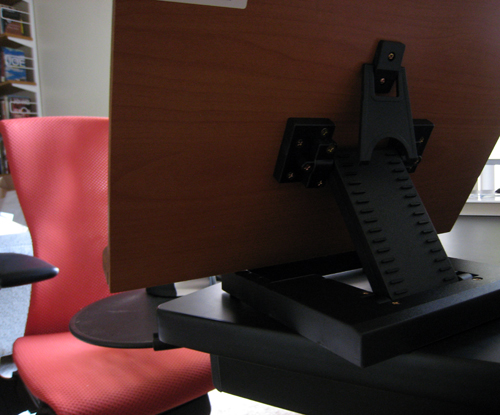
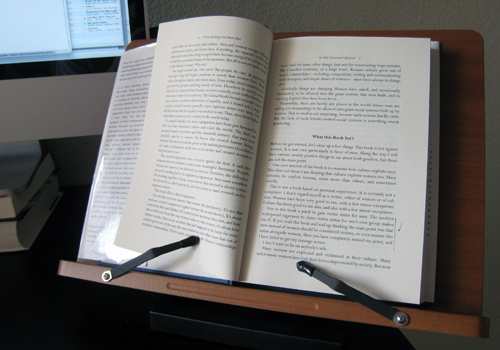
Highly recommended — the Best Book Stand "Jasmine"

A few months ago I realized that I needed a better way to hold books as I copy passages for both reviews on this blog and for my academic work. A bit of Googling found some really janky looking products that led me to sigh and rig a solution that consisted of a bunch of heavy anthologies (those of you who were English majors might remember the infamous Nortons; they’ve finally become useful again, albeit in a way slightly different from their intent) to lean a book against, while the heaviest of them all sat slightly in front to hold the relevant book up.

Then Kevin Kelly’s blog Cool Tools came to the rescue through a review of the Freesia Book Stand:

This is a simple but well-designed book stand that does exactly what it sets out to do. It is sturdy enough to hold big, heavy textbooks, but [it] looks nice. It is impressively adjustable, allowing for nearly any reading angle . Amazingly, despite the ability to hold heavy books, the stand itself is relatively light (around 3 lbs). The stand has an anti-skid coating on the bottoms so that it stays where I put it.

Exactly what I wanted. Thank you, Stephanie Misono, for suggesting this. She says, “I now wish I had gotten it years ago.” Me too; I chose the Best Book Stand Jasmine, and it would’ve been insanely useful as an undergrad, when I spent many hours looking at computer science textbooks in particular, going back and forth from page to screen.

The Freesia version is too big, so I ordered the smaller version. I have something similar for standalone printed papers, but even that isn’t nearly as satisfying; I was making edits to a novel earlier, and I flipped from one page to another with greater ease by using the Jasmine. So it’s not only good for copying passages from books, but for holding edited pages.

Does this sound minor? Maybe it is, but managing to find the perfect tool to fulfill a major need is incredibly satisfying, and this is perhaps the best solution I’ve found to a major problem in my life since reading “Tool for Thought” by Steven Berlin Johnson, which concerns DevonThink Pro. Although these tools are useful on a micro level, they probably also change the nature of what I do; as Nicholas Carr says in The Shallows:

Even as our technologies become extensions of ourselves, we become extensions of our technologies […] every tool imposes limitations even as it opens possibilities. The more we use it, the more we mold ourselves to its form and function. […] Whenever we use a tool to exert greater control over the outside world, we change our relationship with that world.

I’m probably more likely to copy marginal passages from books now that it’s become marginally easier both to do so and to organize the output once I have done so. The Jasmine hasn’t yet faded to the point of it reaching what Heidegger called “readiness-to-hand” or “Zuhandenheit,” which, to use Graham Harman’s formulation, “refers to objects insofar as they withdraw from human view into a dark subterranean reality that never becomes present to practical action any more than it does to theoretical awareness.” I’m entirely aware of the Jasmine, which is part of its pleasure, but when it fades “into a dark subterranean reality,” it will be really incorporated into my work (I suspect that writing the dissertation might force this state on me, as one book after another checks in and check out).

The Jasmine cost about $30, with about $10 in shipping. I probably would’ve paid $100 for it. Maybe more. It’s difficult to overstate its usefulness, given the kind of work I do. Students, academics, and bloggers are an obvious audience, but I’m sure other groups would find it useful too.

Highly recommended — the Best Book Stand “Jasmine”

A few months ago I realized that I needed a better way to hold books as I copy passages for both reviews on this blog and for my academic work. A bit of Googling found some really janky looking products that led me to sigh and rig a solution that consisted of a bunch of heavy anthologies (those of you who were English majors might remember the infamous Nortons; they’ve finally become useful again, albeit in a way slightly different from their intent) to lean a book against, while the heaviest of them all sat slightly in front to hold the relevant book up.

Then Kevin Kelly’s blog Cool Tools came to the rescue through a review of the Freesia Book Stand:

This is a simple but well-designed book stand that does exactly what it sets out to do. It is sturdy enough to hold big, heavy textbooks, but [it] looks nice. It is impressively adjustable, allowing for nearly any reading angle . Amazingly, despite the ability to hold heavy books, the stand itself is relatively light (around 3 lbs). The stand has an anti-skid coating on the bottoms so that it stays where I put it.

Exactly what I wanted. Thank you, Stephanie Misono, for suggesting this. She says, “I now wish I had gotten it years ago.” Me too; I chose the Best Book Stand Jasmine, and it would’ve been insanely useful as an undergrad, when I spent many hours looking at computer science textbooks in particular, going back and forth from page to screen.

The Freesia version is too big, so I ordered the smaller version. I have something similar for standalone printed papers, but even that isn’t nearly as satisfying; I was making edits to a novel earlier, and I flipped from one page to another with greater ease by using the Jasmine. So it’s not only good for copying passages from books, but for holding edited pages.

Does this sound minor? Maybe it is, but managing to find the perfect tool to fulfill a major need is incredibly satisfying, and this is perhaps the best solution I’ve found to a major problem in my life since reading “Tool for Thought” by Steven Berlin Johnson, which concerns DevonThink Pro. Although these tools are useful on a micro level, they probably also change the nature of what I do; as Nicholas Carr says in The Shallows:

Even as our technologies become extensions of ourselves, we become extensions of our technologies […] every tool imposes limitations even as it opens possibilities. The more we use it, the more we mold ourselves to its form and function. […] Whenever we use a tool to exert greater control over the outside world, we change our relationship with that world.

I’m probably more likely to copy marginal passages from books now that it’s become marginally easier both to do so and to organize the output once I have done so. The Jasmine hasn’t yet faded to the point of it reaching what Heidegger called “readiness-to-hand” or “Zuhandenheit,” which, to use Graham Harman’s formulation, “refers to objects insofar as they withdraw from human view into a dark subterranean reality that never becomes present to practical action any more than it does to theoretical awareness.” I’m entirely aware of the Jasmine, which is part of its pleasure, but when it fades “into a dark subterranean reality,” it will be really incorporated into my work (I suspect that writing the dissertation might force this state on me, as one book after another checks in and check out).

The Jasmine cost about $30, with about $10 in shipping. I probably would’ve paid $100 for it. Maybe more. It’s difficult to overstate its usefulness, given the kind of work I do. Students, academics, and bloggers are an obvious audience, but I’m sure other groups would find it useful too.

Being wrong, and a partial list of ways I’ve been wrong

A variety of somewhat big-deal econ bloggers have written about things they now believe they were wrong about. Looking back on changed opinions (which is a slightly more polite of saying “I was wrong”) is a useful exercise in intellectual honesty—a trait most people lack. I might be among them but like to think that I’m more intellectually honest than I actually am.

Still, here are some (unsorted) opinions on topics about which I’ve been wrong or at least not as right as I could be:

1) I basically believed that the stock market’s average rate of return would remain 10% per year over reasonable time periods. That it will still average somewhere close to 10% per year still seems probable, but the “reasonable time periods” (like two decades or so) no longer does, and in the long run, as a famous economist whose name escapes me observed, we’re all dead.

2) Like McArdle, the “Great Moderation” seemed real up until the last six months or so.

3) There are some things I was wrong about that turned out well: I didn’t think we’d see a black president in my lifetime. In 2004, if you’d told me that a black man would be president in 2008, I probably would’ve laughed at you.

4) I didn’t get why people liked Jane Austen until I read James Wood’s How Fiction Works, with its description of free indirect speech, and his examples from Austen. Now I do.

5) The iPhone? Nice, but a fad. I didn’t think it would be as important as it has been, or that other phone manufacturers would be so slow to respond.

6) I didn’t think Facebook would become and stay as popular as it is; I signed as an undergrad chiefly as a quick way of figuring out which girls already had boyfriends. Now I seldom log on, but evidently I’m in the minority.

7) I used to believe that it was possible to have rational discussions about religion and/or politics with most people. Now I don’t. Both subjects is are seldom subjected to empirical tests, so no feedback mechanism can demonstrate when or if a belief is wrong. Politics are (slightly) more subject to such tests, via election, studies, and the like, but the broadest political beliefs aren’t really. See Paul Graham’s “Keep Your Identity Small” for more on this subject, along with “What You Can’t Say.” At best one can have meta-conversations about religion and politics (“Why do people need religion?”)

8) During the ramp-up to the Iraq war, I was in college, and many of my professors were virulently against the war and thought that the government was perfectly capable of dissembling and distorting the debate about weapons of mass destruction; some had lived through Vietnam, with its phony Gulf of Tonkin incident, and the later Iran-Contra hearings. I hadn’t and thought it wildly implausible that so many people and institutions would be hoodwinked by faulty information, so I was more or less in favor of the war, like a lot of my equally gullible compatriots.

Oops.

9) On first reading Carlos Ruiz Zafón’s The Shadow of the Wind, I didn’t appreciate many of its most impressive qualities, especially regarding the narrative, the dialogue, and the extent to which the novel combines post-modern games with immense readability. Now I do.

10) I used to think that the sexual double standard was primarily due to misinformation, the cruel application of religious principles to individual lives, ignorance, and malice. Now I think the sexual double standard is primarily due to daughter-guarding by parents and parents’ influence on culture, female efforts to guard men through slandering their potential competitors’ reputations, general female competitiveness, the fact that the choosier sex is always the one that invests more in offspring, and differing economic and pleasure incentives acting on children than their parents.

These forces help explain a great deal of our culture’s confusion about sexuality and its mixed messages—especially among the young. I used to think this confusion would eventually devolve into a more laissez-faire, I’m-okay-you’re-okay attitude, which it still might, but now that day seems very far off.

(See my essay “The Weekly Standard on the New-Old Dating Game, Hooking Up, Daughter-Guarding, and much, much more” for details.)

11) A student question from two years ago prompted me to realized that, although I used to believe something close to the classical economic model of man in which behavior automatically reveals preferences and if someone does something, it must be because they rationally believe it will benefit them, now I’ve realized that context, framing effects, peer pressure, time preferences, and the like have a far greater effect than I once gave them credit for. Reading Dan Ariely’s Predictably Irrational, Philip Zimbardo’s The Lucifer Effect and The Time Paradox, Neil Strauss’ The Game, and Tim Harford’s The Logic of Life contributed to my change in views.

It might not hurt for you to try this test for yourself: if you can’t think of anything you’ve been wrong about, does that mean that you’re consistently right about everything, or does that mean something quite different? If you need help, there’s an entire book on the subject by Kathryn Schulz named Being Wrong: Adventures on the Margins of Error, although I haven’t actually read said book yet.

Being wrong and a partial list of ways I’ve been wrong

A variety of somewhat big deal bloggers in economics have written about things they now believe they were wrong about. Looking back on changed opinions (which is a slightly more polite of saying “I was wrong”) is an exercise in intellectual honesty—a trait widely lacked.

Some (unsorted) things I’ve been wrong about:

1) I basically believed that the stock market’s average rate of return would remain 10% per year over reasonable time periods. That it will still average somewhere close to 10% per year still seems probable, but the “reasonable time periods” (like two decades or so) no longer does, and in the long run, as a famous economist whose name escapes me observed, we’re all dead.

2) Like McArdle, the “Great Moderation” seemed real up until the last six months or so.

3) There are some things I was wrong about that turned out well: I didn’t think we’d see a black president in my lifetime. In 2004, if you’d told me that a black man would be president in 2008, I probably would’ve laughed.

4) I didn’t get why people liked Jane Austen until I read James Wood’s How Fiction Works, with its description of free indirect speech, and his examples from Austen. Now I do.

5) The iPhone? Nice, but a fad. I didn’t think it would be as big a deal as it has been, or that other phone manufacturers would be so slow to respond.

6) I didn’t think Facebook would become and stay as popular as it is; I signed as an undergrad chiefly as a quick way of figuring out which girls already had boyfriends. Now I seldom log on, but evidently I’m in the minority. Pictures of dogs, food, babies… I don’t care but the evidence shows many, many people do.

7) I used to believe that it was possible to have rational discussions about religion and/or politics with most people. Both subjects are seldom subjected to empirical tests, so no feedback mechanism can demonstrate when or if a belief is wrong. Politics are (slightly) more subject to such tests, via election, studies, and the like, but the broadest political beliefs aren’t really. See Paul Graham’s “Keep Your Identity Small” for more on this subject, along with “What You Can’t Say.”

8) During the ramp-up to the Iraq war, I was in college, and many of my professors were virulently against the war and thought that the government was perfectly capable of dissembling and distorting the debate about weapons of mass destruction; some had lived through Vietnam, with its phony Gulf of Tonkin incident, and the later Iran-Contra hearings. I hadn’t and thought it wildly implausible that so many people and institutions would be hoodwinked by faulty information, so I was more or less in favor of the war, like a lot of my equally gullible compatriots.

9) On first reading Carlos Ruiz Zafón’s The Shadow of the Wind, I didn’t appreciate many of its most impressive qualities, especially regarding the narrative, the dialogue, and the extent to which the novel combines post-modern games with immense readability. Now I do.

10) I used to think that the sexual double standard was primarily due to misinformation, the cruel application of religious principles to individual lives, ignorance, and malice. Now I think the sexual double standard is primarily due to daughter guarding by parents and parents’ influence on culture, female efforts to guard men through slandering their potential competitors’ reputations, general female competitiveness, and the fact that the choosier sex is always the one that invests more in offspring.

These forces help explain cultural incoherence about sexuality, especially among the young. A laissez-faire, I’m-okay-you’re-okay attitude seems very far off.

(See “The Weekly Standard on the New-Old Dating Game, Hooking Up, Daughter-Guarding, and much, much more.”)

11) A student question from two years ago prompted me to realized that, although I used to believe something close to the classical economic model of man in which behavior automatically reveals preferences and if someone does something, it must be because they rationally believe it will benefit them, now I’ve realized that context, framing effects, peer pressure, time preferences, and the like have a far greater effect than I once gave them credit for. Reading Dan Ariely’s Predictably Irrational, Philip Zimbardo’s The Lucifer Effect and The Time Paradox, Neil Strauss’ The Game, and Tim Harford’s The Logic of Life contributed to my change in views.

Try the “What I’ve been wrong about” test for yourself. If you can’t think of anything you’ve been wrong about, does that mean that you’re consistently right about everything, or does that mean something quite different? If you need help, see Kathryn Schulz’s Being Wrong: Adventures on the Margins of Error, although I haven’t actually read said book yet.

Don’t rent an apartment from Navid Abedian in Tucson, Arizona, or, how I learned to be wary of lawsuits

In 2008 I moved in Tucson for grad school and rented a condo that turned out to be a decent place to live, except for the landlord and a neighbor universally referred to as “Crazy Nick” (he was not crazy in a good way). When my roommate and I moved, the landlord kept about $500 of our deposit after promising that he wouldn’t and saying that he’d refund it. Stealing our security deposit violated Arizona’s Residential Landlord & Tenant Act, which regulates the usual tenant-landlord problems.

Because I’m such a smart guy and was both unhappy about his lies and interested in our money, I decided to sue him in small claims court, where I eventually won a $1,350 judgment. He paid $350 after a debtor’s hearing in January and promised to pay the rest; in June I sought another debtor’s hearing to compel him to pay at which point he threatened to come over to my apartment and kill me. For those of you keeping score, this marks the second time someone has done so in one summer, up from zero times previously in my entire life.

I filed a police report, stayed at friends’ houses for a few days, and canceled the hearing: improbable though Abedian’s threat might be, it’s not worth shooting or being shot over $1,000. He’s also a cipher to me: all I know is that he works in a carpet store, bought a condo in Tucson near the height of the ’00s real estate boom and, according to a Google search, might have his house foreclosed on. In other words, he might be desperate, and people have killed each other over far less than $1,000.

Although running away sets a bad precedent—will he just threaten to kill the next tenant who comes along? am I not doing the right thing for my fellow man—I still think capitulating wiser than continuing.

What originally seemed to mostly be entertainment (i.e. going to court and pontificating), began to suck up way too much mental energy. In the Hacker News discussion of Paul Graham’s “The Top Idea In Your Mind,” grellas wrote, “There is a lesson here about lawsuits, which will drain you of both money and peace of mind all at the same time. Sometimes you can’t turn the other cheek, much as you would like to do so, and have no choice but to fight. Having the guts to stand up for yourself (or for your company) is in itself a virtue and there are times when it is best not to walk away.”

He’s right, and a lawsuit I’d imagined as entertainment and teaching a useful lessons that might turn into dividends for the next tenants backfired. It also occupied way too much space in my mind—space that I should’ve spent writing or doing research. Instead I worried about the sanity and desperation of a guy I didn’t know and who was probably armed.

In Francine Prose’s novel Touch, the protagonist is a 14- or 15-year-old girl named Maisie, who tells her preening stepmother, Joan, a version of what happened on a bus when two or three boys touched her breasts in somewhat murky circumstances. It isn’t clear at the narrative’s start whether she consented, but the event as narrated to us is also one in which the characters act without enough culpability to call what they did anything beyond adolescent horseplay and power struggles.

Joan wants to meet a lawyer, which makes Maisie think that “I was filled with dread. Pure dread. It felt like icy water trickling down my back.” Joan says, “It would be a matter of principle.” Most people don’t lead their lives solely according to principle; pragmatics matter too. Few of us want to be martyrs for a cause, and if we do, that cause better be worth it. Most of us want to get along. Altruistic punishment is real but can be overrated. Maisie would be harming her own well-being and self-interest. I thought I was standing up for the principle of tenants’ rights and for fairness, but I chose to give up that principle when Navid threatened to kill me. Pragmatics won.

Like Maisie, I’m choosing pragmatism—which I probably should’ve learned in the first place. I’ve started Bleak House a couple of times (I’m not a Dickens fan) and understand Jardyce vs Jardyce well enough to know that lawsuits are often vehicles for mutually assured destruction more than they are about fairness or rights. When in doubt or when it’s avoidable, don’t get the law involved. And, apparently, be ready to write off your security deposit.

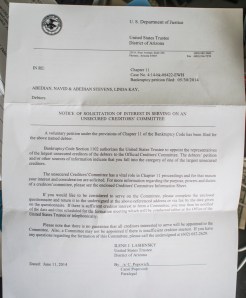
OLYMPUS DIGITAL CAMERAEDIT: It’s 2014 and I’d mostly forgotten about Navid, but I just got a letter saying that he declared bankruptcy. I’m a) somehow listed as a creditor and b) the Department of Justice somehow got my current address, in order to c) invite me on some kind of creditors’ committee. I wish I couldn’t say that I don’t feel a little schadenfreude, but, alas, I’m too small a person. Apparently his wife or ex-wife, Linda Kay Abedian Stevens—or Linda Kay Stevens? the wording is unclear—was also on the lease and on the property deed.

Since leaving Tucson I have been threatened with death zero times.

Has science fiction "run out of steam?"

This post began life as a Slashdot comment in response to Has Sci-Fi Run Out of Steam?:

I doubt it, any more than science or technology has run out of steam due to a lack of imagination. Rather, I wonder if the science fiction publishing business has either run out of steam or become an active roadblock between writers and readers. It seems that most publishers are trying a play-it-safe approach that demands repetition over originality. This is based partially on what I see featured in bookstores and partially on my own experience, which I discuss extensively in Science fiction, literature, and the haters. It begins:

Why does so little science fiction rise to the standards of literary fiction?

This question arose from two overlapping events. The first came from reading Day of the Triffids (link goes to my post); although I don’t remember how I came to the book, someone must’ve recommended it on a blog or newspaper in compelling enough terms for me to buy it. Its weaknesses, as discussed in the post, brought up science fiction and its relation to the larger book world.

The second event arose from a science fiction novel I wrote called Pearle Transit that I’ve been submitting to agents. It’s based on Conrad’s Heart of Darkness—think, on a superficial level, “Heart of Darkness in space.” Two replies stand out: one came from an agent who said he found the idea intriguing but that science fiction novels must be at least 100,000 words long and have sequels already started. “Wow,” I thought. How many great literary novels have enough narrative force and character drive for sequels? The answer that came immediately to mind was “zero,” and after reflection and consultation with friends I still can’t find any. Most novels expend all their ideas at once, and to keep going would be like wearing a shirt that fades from too many washes. Even in science fiction, very few if any series maintain their momentum over time; think of how awful the Dune books rapidly became, or Arthur C. Clarke’s Rama series. A few novels can make it as multiple-part works, but most of those were conceived of and executed as a single work, like Dan Simmons’ Hyperion or Tolkien’s The Lord of the Rings (more on those later).

The minimum word count bothers me too. It’s not possible for Pearle Transit to be stretched beyond its present size without destroying what makes it coherent and, I hope, good. By its nature it is supposed to be taunt, and much as a 120-pound person cannot be safely made into a 240-pound person, Pearle Transit can’t be engorged without making it like the bloated star that sets its opening scene. If the market reality is that such books can’t or won’t sell, I begin to tie the quality of the science fiction I’ve read together with the system that produces it.

If the publishing system itself is broken and nothing yet has grown up to take its place (I have no interest in trolling through thousands of terrible novels uploaded to websites in search of a single potential gem, for those of you Internet utopians out there), maybe the source of the genre’s troubles isn’t where PC Pro places it.

In addition, although science fiction publishing might appear sclerotic at times, science fiction in movies and TV shows continues unabated—many of which draw material from books. One commenter realized this: “The huge change in SF since I first started reading it in the 70’s is that these days, movie/TV SF is a gigantic, popular commercial enterprise, utterly dwarfing written SF.”

Still, I’ve found fun and fascinating SF writers thanks to the Internet: Jack Vance started as a recommendation and an article in the NYT magazine; Charlie Stross writes a blog; and others have sent good advice on where to look. But I think a lot of SF has turned towards the cerebral, towards alternate / fake worlds, and towards dealing with massive institutions on earth. These are all broad claims—too broad for a blog post—that I might follow-up in a future essay, but they’ve been churning in my mind enough for me to look for them in fiction—where they seem to be almost everywhere.

One other funny item: PC Pro uses the antiquated cliche “run out of steam,” which refers to steam engines that probably haven’t been widely used since the 19th century, to refer to a genre concerned with how the present represents the future. Maybe this indicates language itself can run far behind whatever the perceived times are.

August 2010 Links: Bookshelves, query letters, and more

* Good advice from Jaron Lanier: how to be on the Internet.

* Exactly the sort of thing that appeals to me: bookshelf porn (note: this link is entirely safe for work, unless you have an office that bans employees from looking at books).

* I want to read this book too, based solely on the query letter.

* The Golden State’s War on Itself: How politicians turned the California Dream into a nightmare.

* Awesome: In German Suburb, Life Goes On Without Cars.

* The inevitable envy among writers.

* Salinger’s toilet up for auction — seriously?. Note that the appendage “seriously?” is from Carolyn Kellogg, although she expresses my sentiments as well.

* I love Slate’s “Bogus Trend Stories of the Week” feature, in which they discuss stories based on questionable or phony numbers, anecdote, moral panic, hysteria, fear mongering, and the like. The best part: cited numbers or statistics often contradict the overall thrust of the stories themselves. Sex often plays a role, as it does in this week’s topic: Child pornography, sextortion, and Chinese hymenoplasties. Samples:

Presented with convincing data, I’m prepared to believe that child porn is growing. But if a Department of Justice report states that the number of offenders is unknown and the quantity of images and videos of child pornography being traded is also unknown, how can anybody say that the distribution of child porn is on the rise?

* Measuring colleges for what they do instead of who they enroll: finally.

* The bizarre place that is Russia:

For the disastrous Russian heat wave has exposed a key failing of Russian society: The flow of information has stopped. There is not a single newspaper that even strives to be national in its coverage. The television is not only controlled by the Kremlin; it is made by the Kremlin for the Kremlin, and it is entirely unsuited to gathering or conveying actual information. Even the Russian blogosphere is bizarrely fragmented: Researchers who “mapped” it discovered that, unlike any other blogosphere in the world, it consists of many non-overlapping circles. People in different walks of life, different professions, and different parts of the country simply do not talk to one another. The same is true of political institutions: Since the Russian government effectively abolished representative democracy, canceling direct elections, there is no reason—and no real mechanism—for Moscow politicians to know what is going on in the vast country. Nor do governors need concern themselves with the lives and the disasters in their regions—they, too, are no longer elected but are appointed by the Kremlin.

Some Americans suffer from information overload; Russians suffer from the opposite.