Links: Signals, literary fiction, a theory of children, PhD stupidity, expensive woman seeks retarded millionaire, sex tape theory, and more

* “Why aren’t men responding to economic signals?” (Note: the content is not what you expect from the title.)

* “Most contemporary literary fiction is terrible.” I would ask: according to what standard, as measured by who? Remember too that the terrible literary fiction of the past has probably been forgotten.

* “A Childless Bystander’s Baffled Hymn;” sample: “Why all the choices — ‘What would you like to wear?’— and all the negotiating and the painstakingly calibrated diplomacy? They’re toddlers, not Pakistan.”

* Doing a PhD is often a waste of time, which is depressingly obvious to me.

* A Reddit discussion aptly analogizing economics to computer science.

* Hugh Howey: Self-publishing is the future and great for writers.

* Austin gets Google Fiber, becomes a more attractive place to live.

* “Expensive woman seeks retarded millionaire.”

* Flaunt it while you got it? Farrah Abrahams and a theory of sex tapes. Maybe.

Connecting the dots between beliefs: an example from density and housing policy

In “New York City, NIMBY Paradise: New Yorkers genuinely believe that their housing restrictions are normal” Megan McArdle points out that “a combination of zoning ordinances, building permits, and local NIMBY opposition had made New York distinctly unfriendly to new development, and that it would be rational to build far more units than the city currently allows” but that “I am constantly surprised by the extent to which New Yorkers regard all this not only laudatory, but normal–even as they bemoan the high cost of housing.”

I too am surprised. It’s at least intellectual coherent to complain that prices are high or to argue that development should be limited, but the two together is bizarre. I’m living in Manhattan and occasionally lament to friends or people in bars or whatever that we don’t get more housing built,* which would reduce rents (or at least rent increases), and they inevitably look at me like I’m from Mars. Then they say, “But there’s construction all over the city!” Which is (sort of) true, in the sense that walking around the East Village and LES reveals a fair number of projects—but almost all of them are short. When I mention supply and demand, I get funnier looks, like I’ve just revealed I’m a community, Christian, libertarian, or some other suspicious outsider.

I just don’t think most people connect difficulty in building, or how supply affects demand.

IMG_2181The other day I was wasting time on Reddit and spent time responding to people in this thread about housing in Seattle, which is another place where it’s hard to build and rents are rising, and a lot of people on the thread manifest the kind of difficulty in connecting supply and demand you’re talking about in your post and that I’ve noticed out and about. If I were being mean / direct, I would posit that most people like to complain and don’t understand, or choose not to understand, simple economics.

If I’m being less mean, I’d argue that most people just lunge at a random opinion, hold it, and don’t really think anything more about it; that’s one of Jonathan Hadit’s important points in The Righteous Mind. Still, I never hear, “Extensive housing regulation leads to high prices and that’s a desirable trade-off,” or “We should accept high prices as a reasonable consequence of limiting construction.” Those are normative statements and closer to morality or philosophy, and they’re at least reasonable.

Most people, however, have only a vague sense of the link between public policy and their living arrangements. My Dad, when I told him about this, mentioned that he used to work for cities and had to listen to people express their opinions, most of which were incoherent. Apparently little has changed, except that the incoherent can organize through the Internet.

Anyway, Matt Yglesias has pointed out in many contexts that “Gentrification can’t be stopped by halting construction—to have a chance you need even more construction.” People with money will simply outbid people with less for scarce real estate resources, and various legislative efforts to prevent this basic dynamic have failed and always will fail because people are cleverer than legislatures and markets want to clear. It’s also common for people in hot urban areas like New York and Seattle to lament gentrification, high rents, and developer avariciousness.

If this were limited only to random idiots in bars and coffeeshops, that would be okay, but many reporters are economically illiterate too. One recent random but representative example is Lynn Thompson’s Seattle Times story “Would new rules leave loopholes for big houses on small lots?,” which spends 900 words discussing housing issues but doesn’t include supply or demand.

I sent a letter to the editor of the Seattle Times and to Thompson pointing this out, and I got a nice note back from Thompson saying that “I did another story about a month ago that found that we have enough growth through 2040 under current zoning [. . . .]” But what does “enough” mean? It too is a basically incoherent concept, at least in economic terms, because particular individuals don’t know what “enough” means. That’s why we have markets. Moreover, she didn’t mention price, or the pricing issues

Her colleague Sanjay Bhatt, however, reported that Single-family home prices rose by 20% from 2012 – 2013, and rents in Seattle and environs have been rising faster than inflation for a decade or more.

Why don’t reporters working in this field understand econ 101? And why do editors let them get away with it? The omission is glaring, and it works to undermine the confidence of anyone with any reasonable amount of knowledge in the Seattle Times (and other papers, which routinely make the same kinds of errors). I don’t mean to pick on Thompson or the Seattle Times in particular, since they just happen to be salient examples and the general problems I’m describing here are widespread.


* Are or sex chat are more fun and was the norm is college, but not everyone is ready for the latter five minutes after meeting. A shame, really, but I learned many things from Martha McPhee’s wonderful novel Dear Money, and one is that people above the age of 30 often regard real estate and wealth as a sort of sexual sport.

Thoughts on the movie Spring Breakers

* “Spring break forever” is a refrain in the movie, but spring break forever is actually hell. You need “normal” life to contextualize the party and make it special. Not every day can be a festival if a “festival” is to have any meaning. Tucker Max says in Hilarity Ensures that he “worked in Cancun, Mexico for six full weeks during my second year at Duke Law School” and by the end he says “Cancun beat me, like it eventually beats everyone.”

* A lot of the people in the theater were laughing, and so was I, because the absurdity of the movie. Is this a New York cynicism thing? Would the theater have been laughing in Oklahoma or Kansas? It was hard to tell if most of the movie was supposed to be funny.

* I don’t grok in fullness the spring break ideal, because to the extent I want to drink, take drugs, and hook up with random girls, I can do so at home, and it’s triply easy in college. That being said, I understand intellectually that for many people the distance and otherness of spring break lets them decide that “normal” rules don’t apply. . . but if they don’t apply there, why not just decide they don’t apply at home, either? Is this a lack of imagination?

* Young, attractive women very rarely commit armed robberies, as they do at the beginning of Spring Breakers to fund the trip, because armed robberies are not worth doing: from what I’ve read, the going rate for reasonably young, attractive hookers is about $200 – $250 per hour. The characters could have made more money with way less risk with a couple hours and Craigslist. But the armed robbery functions as a symbolic stepping outside of normal boundaries for them. Still, selling sex makes more sense than robbing banks.

* The movie conveys altered states effectively: the jump cuts, the voiceovers, the visual and audio not matching: for the first 50 or so minutes it’s mesmerizing, like some drugs.

* It’s axiomatic that people who do stupid, dangerous things often die. It’s possible to do things that are stupid but not dangerous, like most reality TV, or things that are dangerous but not stupid, like be an astronaut or test pilot, but the convergence of those two is uniquely irritating.

* Spring Breakers is less fun than Magic Mike but shares many points; both movies are set in Florida, and what does that say about the state?

* Related to point #3, spring break as a concept, like Vegas, fascinates me, especially from a woman’s perspective. If you’re a woman, and especially a reasonably attractive one, it isn’t hard to go out and get laid. So why bother pretending that spring break (or Vegas) is fundamentally different than any other part of your life? Some psychological / anthropological mechanism is at work here.

* The reviews that make it sound interesting are exaggerating the movie’s content; if you want porn, go watch porn, and if you want a story, watch a better movie (it’s not impossible to reconcile nudity and story—HBO does it constantly, and well, but too often movies sunder the two, which is strange given how much our early lives are devoted to stories about nudity or seeking it). Also, Tyler Cowen’s characterization is interesting, and I agree about the vitality, at least in the movie’s first half.

* Leaping from the last point, movies in general are in an interesting spot: in an age of Internet porn, there’s no particular reason other than history and path dependence for them to avoid explicit sexuality, but, on the other hand, in an age of Internet porn, showing T&A isn’t sufficient to make a movie interesting.

* I was ready to leave with about twenty minutes left, and offered to go, but she said, “Don’t you want to know what happens?” and I said, “No. Some of them are going to die, but who cares?” In the context of the movie, “Who cares?” is an important, unasked question.

James Fallows and The Iraq Invasion, ten years later

James Fallows has been running a series on the tenth anniversary of the Iraq invasion, and his essential questions are about accountability and the future—as he says, “Anyone now age 30 or above should probably reflect on what he or she got right and wrong ten years ago.” I’m not quite there, but in 2003 I basically favored the war because I was an idiot who listened to government propaganda.

I didn’t really realize or hadn’t yet internalized that government—especially the political parts—lie all the time, and one important part of living in a democracy is paying attention to when parts of government lie. My professors, however, did. Many had lived through Vietnam and knew the capacity for political mendacity. I wonder if, 30 years from now, I’ll be addressing a group of gullible students and watching their skepticism at my own claims, and the sureness of their faith in the powers that be.

At the time the war started, I also happened to be taking a seminar called “State Building in the Middle East and the Balkans” with a guy named Petros Vamvakas (who is still teaching!); being 18 or 19, however, I knew everything that a person who’d lived through the Greek Junta and studied the Middle East for decades didn’t. Vamvakas also knew how to teach, and he knew some of the tricks that I’ve since learned: you can’t usefully confront student ignorance head-on. You have to attack it obliquely, through questions, readings, and your own example.

That’s exactly what he did.

In the seminar, anti-war students outnumbered pro-war students, which led to predictable debates. In retrospect, however, the interesting thing was what Vamvakas knew about deep ethnic divisions, tribal identity, and oil wealth. He also laid out what was going to happen and even how it was probably going to happen: he foresaw that the U.S. military would crush the Iraqi military, and that the U.S. would then botch the peace (which it did), because that peace would be almost impossible in a made-up country like Iraq—at least, impossible without a dictator. To Vamvakas’s mind, one major Iraq question was how long the Kurds would remain part of the country. Whether the northern, Kurdish part of Iraq is still really part of Iraq is up for debate (and they like the war, for reasons not all that dissimilar to the reasons Americans like the role of the French in the American Revolution).

Vamvakas also predicted the guerilla war, or insurgency, or whatever one calls it. He understood that inflicting democracy is a difficult if not impossible thing to do.

History vindicated his views. It has also shown me that a single professor in a small liberal arts college can know and understand far more than people in positions of enormous, life-and-death power. It’s cliché to say that hubris and ignorance fueled the war, but it’s still true; no one in the White House thought to ask Vamvakas what was likely to happen after the invasion. Few dissenters within the political and military establishment, like Eric Shinseki, were ignored, marginalized, or punished.

I watched the war on TV and believed what I read in the press. The war taught me, the hard way, not to be chary of what I read, and to look more carefully and who is speaking and what they know. The most knowledgable person might not have a megaphone, and the person with a megaphone may want to lie.

Amazon.com is clever in its use of tracking and follow-up e-mails

I’ve been thinking about selling my camera and buying a smaller one, so I’ve been reading about the various choices and, naturally, looking at prices—including prices on Amazon. This morning I found, unprompted, a random e-mail from Amazon:

Screen shot 2013-03-31 at 8.58.59 AM

Not only has Amazon listed at the top some of the cameras I’ve looked at (like the X100S and RX1), but it recognized the general kind of camera I’m interested in (high-end, fixed lens camera; small mirrorless cameras) and listed a bunch of those too. Some of them are misses—Leica’s cameras look completely silly to me—but the hits are there. I haven’t done more than browse, and browsing alone caused Amazon to kick out an e-mail telling me about their financing credit card. I don’t think I’ve ever seen a retailer do so before.

The Amazon finance card doesn’t interest me and I’m not going to buy a camera today—or one from Amazon, because of they charge sales tax and most online retailers don’t. But I’m simultaneously impressed and creeped out by the company’s nudge e-mails.

This e-mail and post are also useful reminders: virtually everything you do online can be tracked, if someone wants to track you. Amazon does, for reasons that presently seem benign. Nonetheless, next time I move I might delete this account (if that’s possible) and start another one, which won’t have a purchase history going back to 2002.

Links: Unmarried moms and ignoring incentives, higher education and competence, Moleskine’s IPO, Victoria’s Secret, and more!

* “The New Unmarried Moms: We’ve reduced teen pregnancy, but now childbearing outside wedlock is exploding among 20-somethings,” which is interesting but ignores some of the really powerful social factors at work. A lot of women are willing to sleep with fun-loving bad boys over dutiful workers; consequently, we probably shouldn’t be surprised that men modify their behavior in response. In addition, as Philip Greenspun says in “Another reason to feel like a failure: Scientists say that women are easy to get into bed:”

At lower paternal income levels, a variety of forms of government assistance will provide the single mother with roughly $45,000 per year in tax-free benefits, depending on the state (see this chart). That is more than the average American worker’s take-home pay. At higher paternal income levels, court-ordered child support payments may provide the non-working single mother with a substantially higher (tax-free) income than working at an average wage.

In other words, the financial consequences of having a child often aren’t dire and in some cases may actually be a net financial improvement. Note that I’m not trying to make a normative statement about whether this is good or bad: I am trying to observe how people respond to incentives.

* Great news: we’re (slowly) moving toward a world where education looks at competency, not hours with ass-in-seat. This is flying under the radar of the national press but is hugely important.

_MG_9736-1* Moleskine’s IPO; if the company is this profitable, why aren’t more companies getting into the notebook biz? Rhodia’s Webnotebook is my favorite, despite some flaws.

* Get LED lightbulbs.

Buzz Bissinger’s extraordinary story of shopping and (a little bit of) sex. I thought it would be boring but laughed a lot.

* “The Shadowy Residents of One Hyde Park—And How the Super-Wealthy Are Hiding Their Money.” I don’t think I’d want to live in a $5M+ apartment even if I had the money for it.

* How marriage changes relationships and gender dynamics; actual title includes the phrase “the boob test.” See also the first link in this post.

* How to think like the next generation, by Penelope Trunk; as usual overstated but still useful.

* 11 solutions to the Fermi Paradox.

* “Victoria’s Secret Sells to High School Girls. So What?” Sample: “Apparently, you can fill out applications to major universities or have boys see you in your underpants, but you can’t do both.”

* A Man’s “C-Card:” Commitment.

TheAtlantic.com is increasingly copying others instead of writing their own work

Something is rotten at The Atlantic: Jordan Weissman “wrote” a piece called “Disability Insurance: America’s $124 Billion Secret Welfare Program,” which is just a restatement of an NPR Planet Money report and some of David Autor’s work (which I’m familiar with through his Econtalk interview and reading some of his subsequent papers; he’s also mentioned by NPR.) This comes not long after Nate Thayer called out The Atlantic for trying to get writers to work for free. It seems like TheAtlantic.com is increasingly doing things like this: using thinly-veiled re-writes to drive traffic to it. Weissman’s piece adds little if anything to the NPR piece, and The Atlantic could have just linked to that piece.

The magazine is still very good, and original, but The Atlantic’s web content has been getting worse in a very noticeable way, with thinly-veiled re-writes of other people’s work. If you want to write about other people’s work, just link to it directly.

I’ve been noticing this phenomenon more and more, but this is the first time I’ve posted about it. I hope it doesn’t become a series.

(And I’m letting the Scientology ad thing slide, because I think it was an honest mistake.)

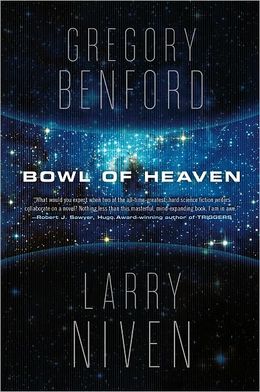
Bowl of Heaven — Larry Niven and Gregory Benford

Bowl_of_heavenIt’s almost always a mistake to represent alien consciousness in science fiction. Aliens, if we ever encounter them, are likely to be so alien that we can’t or won’t understand them—not at first, and conceivably not ever. The bigger problem with representing alien consciousness in science fiction comes from the language that is doing the representing.

Language, as pretty much everyone who has ever learned a foreign one knows, shapes what and how you think, as does the culture that carried by that language. Languages, though translatable, have different flavors. And the aliens in Bowl of Heaven sound like the humans, who sound like each other, and all of whom sound like Americans. They can’t do much better than call the human-built spacecraft “boldly simple.” These are aliens who, even more than most aliens in fiction, feel like humans dressed in exotic garb and wielding exotic technology.

Arthur C. Clarke wisely avoided this problem in Rendezvous with Rama, which is one reason the first one is so good and the latter ones less so.

It’s very hard to create fully differentiated human characters, each with a style all their own. Few accomplish this, which is why most writers choose a single first-person narrator, or a limited third-person narrator. One accomplishment in a novel like Anita Shreve’s Testimony is that the characters don’t sound alike, as they do in, say, Tom Perrotta’s Election, or many of Elmore Leonard’s novels. Hell, the style of, say, Remains of the Day, Jonathan Strange & Mr Norrell, and Atonement are as different as they are because each of their authors is trying to achieve (and achieving) a very specific effect and way of thinking. Niven and Benford aren’t.

I got into Bowl of Heaven because Peter Watts blurbed it and wrote about it in Circling the Bowl. I should’ve paid more heed to the way he described it: “Bowl of Heaven resonates with me, not so much as a work of fiction but as an artefact of the publishing industry.” I can see why it wouldn’t resonate with him “much as a work of fiction,” because by that standard it doesn’t succeed well. I should’ve read his post more carefully and noticed that sentence, though he also notes that “Bowl of Heaven seems to have done just fine with the advance reviewers.”

_MG_9690-1Watts looked at Amazon reviews for the book and noticed that “27% of the reviews complain about sloppy editing and continuity errors.” I’m going to complain about sloppy editing too: a lot of my pages looked like the one on the right, in which extraneous words and sentences are crossed out. This is the sort of thing nearly all authors do on their own (many pages of my own work are filled with cross-outs), and that line and copy editors do too. Generally I ignore extraneous sentences in novels, because everyone commits a couple. But when page after page looks like the one depicted to the right, I get annoyed.

Anyway, Watts’s recommendation kept me reading despite editing problems, but I quit reading when the English-speaking aliens appeared, with all of their Capitalized Proper Nouns (“For Memor was not amid the fevered straits of the Change;” there are also mentions of “the Dancing,” “the Watchers,” and capital-A “Astronomers”). There’s better work out there: before Bowl of Heaven, make sure you’ve read Blindsight and Starfish first: those are Watts novels, and I don’t remember where I first learned about them, and both are hard to read at their beginnings but dazzling by their ends as pieces click into place.

To return to the language issue, novels like Bowl of Heaven tend to give SF a bad rep among lit-fic types, who are obsessively attentive to language and how people use language in very particular way. As I noted above, these authors aren’t attentive to those issues, and they also seem to have a confused point of view—and not one that’s intentionally confused for artistic effect, like Virginia Woolf. The effect feels like a mess: it seems like the novel is following Cliff from a first-person limited view, but then it slips into a paragraph or two with only things that Redwing, or other characters, could know. It’s the sort of thing that undergrads learn about in creative writing classes.

Maybe there’s an artistic purpose here, but if so I’m not seeing it. If not, it’s just a mistake, and seeing novels with many simple mistakes praised by many eminent science fiction writers will tend to subtly and unfairly devalue the genre as a whole.

J.M. Coetzee’s realism

“[T]he generability of the particular is the of realism, is it not? I have in mind realism as a way of seeing the world and recording it in such a way that particulars, though captured in all their uniqueness, seem yet to have meaning, to belong to a coherent system.”

—J.M. Coetzee, Here and Now: Letters 2008 – 2011