Routing around network failure: public schools and community colleges

Dean Dad has an interesting post named “Three Flavors of Dual Enrollment,” which deals with high school students taking community college classes. Read the whole thing, but note this comment:

In the “everyone” version, the idea is to replace the last year or two of high school — widely acknowledged to be an academic wasteland — with the first year or two of college. Those who tout this version point out the time and cost savings to the student; some colleges have seemingly bought in, seduced by the promise of a mighty river of tuition.

I agree with the point about the dubiousness of many dual enrollment versions. That being said, the problem as a whole is a superficial one that really points to a larger problem in the way our society itself is structured: people aren’t children at the age of 16. As Paul Graham says in “What You’ll Wish You’d Known,” by the age, “Childhood was getting old.” Virtually everyone is biologically an adult at that age, and, perhaps not surprisingly, a lot of them are pretty annoyed at being treated like they’re still 10—which is what schools effectively do. And the problems of public schools mean they’re not really imparting much knowledge by that point—hence the “academic wasteland” comment earlier in his post.

Sixteen year olds are people, but schools don’t treat them as such. This is part of the point of The Case Against Adolescence and, to a lesser extent, of Adolescence: An Anthropological Inquiry. People can figure out that school is bogus. The smart ones want something better, and they often read essays like “Why Nerds Are Unpopular,” which explain exactly why high school is bogus. Community college is one outlet for these problems. Not an ideal one, as Dean Dad says, but it’s at least a possible one.

The best solution, of course, is the one Dean Dad posits: “If the high schools need fixing, then the high schools need fixing.” But you can’t really change the form of high school save through some form of charter school, voucher system, or moving to suburbs. There are lots of barriers to improving high schools, and you can read about them in this compilation post. Since high schools change with torturously slow speed, smart people try to route around the problem.

I agree with this: “the obvious remedy is to improve the junior and senior years of high school.” There’s no effective way to do this within the current constraints of school systems (local monopolies, nearly impossible to get rid of very bad kids or teachers). So the community college idea is probably a second- or third-best option. The high schools do need fixing, but I wouldn’t be surprised if this alternative becomes more popular when high schools can’t be effectively fixed.

I would’ve been a good candidate for dual-enrollment—in Washington State, it’s called Running Start—if I hadn’t been such an idiot and sacrificed eighth – tenth grades on the alter of Starcraft. School seemed very small, and to most moderately smart people it probably still does. Although she’s writing in a different context, I think Megan McArdle points out the problem:

A significant number of teens didn’t know who Osama Bin Laden was until we killed him. I can’t believe it–and yet I do believe it. I didn’t know what Iran Contra was when I was in high school, and I was a sophomore when it happened. Teenagers live in their own little world, only tangentially connected to the one the rest of us occupy.

Teenagers do “live in their own little world”—the world adults put them in. It’s such a commonplace that McArdle can say it, and nobody comments the statement. Why should we expect students to behave otherwise? I wonder if the popularity of world-is-a-lie fiction (1984, Brave New World, Lord of the Flies) among high school students is in part because the smarter among them are dimly aware of how their own world is constructed. Teachers don’t really tell them, most of the time. I suspect most people don’t figure it out until college or later—by which point they don’t care much anymore.

Grade Inflation? What Grade Inflation?

A friend sent me “Should I feel guilty for failing my students? As an adjunct English professor, I know I shouldn’t inflate grades — but I feel like I’m ruining people’s lives,” an excerpt from “In the Basement of the Ivory Tower,” which began life as a frighteningly accurate Atlantic article.

I agree with a lot of the “Should I feel guilty for failing my students” excerpt, but I don’t think this is correct: “First of all, twenty-first-century American culture makes it more difficult to fail people.” The biggest reason it’s hard for professors to fail students, as economists like to remind us, involves incentives.

I’m a grad student in English lit, and when I go to the job market in the near future, I’m highly unlikely to be judged at all on my grade distribution; as far as I know, the University of Arizona doesn’t even send that information out. I may or may not be seriously judged on my teaching evaluations, depending on the kind of university I try to go to. I probably won’t, or won’t very much, but the easiest way to improve evals is to give higher grades (see “Judgment Day” for one popular explanation). Perhaps not surprisingly, students give better evals to profs who get higher grades. So professors, in the absence of any institutional or professional incentives not to give higher grades, do—at least on average, even if any single prof denies doing so (I have yet to hear anyone in a public forum announce, “I inflate grades.” I do not inflate grades).

To recap: we might be looked at poorly for having bad teaching evals, which are linked to student grades, and there’s no pressure on student grades. The big thing I will be judged on is academic publishing. The more I do that, the better off I am professionally. When you give students bad grades, not only are they likely to take it out on evals, but they’re more likely to complain to your teaching advisor, show up in office hours to fight about grades, be unhappy in class, and generally take more of time, which you can’t spend writing the academic articles that will get you a job and tenure.

Combined, these two forces encourage you to give higher grades and maximize academic publishing. This force is probably strongest in softer subjects, like the humanities, business, comm, and the like (students want to argue papers all day long) and weakest in math and the sciences (if you didn’t get the right answer, your instructor will demonstrate why you’re objectively wrong). Fields like nursing probably don’t see a huge amount of grade inflation because students who don’t understand the material will kill someone if they don’t, which is a big problem for lots of people. Same in engineering—if your bridge collapses, you can’t complain that there is no such thing as a “good” bridge, or that bridge design is so “subjective.”

All this stuff might contribute to how little students are actually learning, as discussed extensively in Academically Adrift: Limited Learning on College Campuses. The book shows that most college students, through most measures, don’t acquire much real knowledge over the course of their four or more years in school. Part of Academically Adrift details the evidence used to reach this conclusion, the other big part describes how this might have happened and be happening, and the last (weakest) part discusses solutions.

How could one solve this incentive problem? Probably by plotting eval scores against grades. If you’re giving an average GPA of 3.0 and getting a 4.0 on your eval, and Suzie down the hall is giving an average GPA of 2.9 and getting a 4.3 on her evals, then Suzie is probably doing better. I don’t know why colleges aren’t moving toward systems like this, aside from inertia and the complete lack of incentive to do so. Which, I guess, means that I do know why. This wouldn’t be a perfect solution, but it would at least be a step in the right direction. A few schools are apparently doing something about the issue.

Professors don’t want to champion better evals, however, because it distracts them from the research for which they’re rewarded. Administrators don’t want to because they want tuition and grant money, not rocking the boat. High school seniors have not shown a great swell of interest in attending schools with rigorous professor evaluations; they have shown a great swell of interest in beer and circus, however, so that’s what they mostly get. Grad students want to claw their way up the academic ladder and/or finish their damn dissertations. Parents want their offspring to pass. Employers are too diffuse and don’t get much of a say. So where does the coalition for improvement come from? Some individuals, but we’ll see if they get very far.

Policies have consequences: Teacher edition

There’s a nifty thread on Hacker News regarding this post from a teacher dismayed at his district’s inability or unwillingness to enforce any sort of discipline on students (if I were him, I’d try to get the New York Times interested in the story). This comment from Maxharris caught my attention, in which the writer says, “My solution? Make attendance voluntary by abolishing truancy laws.”

I agree in theory, but in practice removing truancy laws probably won’t work out so well. Look, for example, at the chapter in Dan Ariely’s book Predictably Irrational about prebinding commitments and universities. In one experiment, he (and his co-authors) took a group of similar classes and divided them in three: one was told that it could turn in papers whenever each member wanted; another group was told it could pick due dates at the beginning but had to stick with them; and the third group was given conventional due dates spaced over the course of the semester. The last group did the best, grade-wise; the second did reasonably well too, since most students picked conventional due dates; and the first did the worst.

The lesson: people are often bad at committing to things. Most of us know this intuitively and can remember times we’ve put things off to our own unhappiness.

I’ve observed similar prebinding effects when teaching freshman composition at the University of Arizona. I used to conduct many more experiments by ranging the number of mandatory drafts: sometimes I’d require as few as one and tell students they should go through at least three to four drafts, and sometimes I assign as many as five. The more drafts, the better papers tended to be, the higher the grades I hand out, and the fewer students I find bellyaching to me in office hours or via e-mail. Without those mandatory drafts, students (mostly, though not universally) got bad grades and then resented me for it. Solution: require more drafts.

If I were the teacher with the discipline problems, I probably would’ve tried to get the local newspaper to publish my post as an article, then shown up at a school board meeting, ideally with a reporter, and a detailed list of abuses. That might get me fired. But it also might actually get something to change. The solution to the specific problem mentioned isn’t with attendance policies; it’s with district administration. And sunshine is sometimes a very effective disinfectant, as teachers’ unions are discovering the hard way.

It’s also relatively easy to advocate no truancy laws on Hacker News (and don’t such laws only apply up to 16?); if you were actually a school principal or district superintendent who did, you would probably be fired or voted out of office if such a policy were implemented and you or your community had to face the consequences of it. You’d get (even more) dumb 15-year-olds deciding to drop out of school on their own volition because school is hard and video games are fun, or whatever, and they’d probably be more likely to have crime problems (since 15-year-olds don’t have job skills), and you’d get parents unhappy that they don’t have stronger laws at their disposal to try to force recalcitrant students into school. These kinds of unintended consequences can be the most pernicious kind.

I’ve noticed that, on a lot of tech-oriented Internet outlets (think Slashdot, Hacker News, and the like), a libertarian, let-students-choose ethos prevails—see, for example, this post on student laptops in class. I’m very sympathetic to this kind of ethos and try to incorporate it in my own assignments to the extent possible. The problem that I perceive is that relatively few of the posters like Maxharris fully understand the issue they’re dealing with, the law of unintended consequences, and how bad most people are at managing their time. To some extent, this is just how it goes: some people are going to fail at things, and that’s okay. But in things like school, it’s probably not a bad idea to make this harder than it could be otherwise.

This goes beyond classes and truancy; in my time teaching, I’m pretty sure I’ve had dozens of students who were convinced they were good enough writers not to need freshmen composition. Most of them did it; maybe one to six didn’t, and probably only one. That’s why such classes exist as they do: because most people aren’t great at judging their own skill level.

Why Don't Students Like School? – Daniel T. Willingham

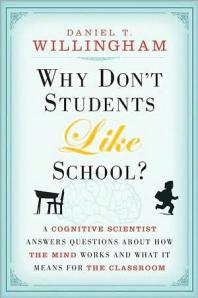
Daniel T. Willingham’s Why Don’t Students Like School: A Cognitive Scientist Answers Questions About How the Mind Works and What It Means for the Classroom is too long a title for a book that is surprisingly good, especially given how short it is. Although the title mentions the “classroom,” the book is useful not only for teachers and students, but for anyone who needs to be aware of the cognitive processes involving in learning—which should be anyone involved in the knowledge economy, since that economy is based almost entirely on being smarter and more efficient than the next guy. The only way to accomplish that is through education—and not only the kind that goes on in schools.

Although Willingham’s book focuses on the “school” part of the equation, his advice can be translated elsewhere, to anyone who has information that must be imparted to others. He says students don’t like school in part because they’re being taught poorly. This probably isn’t news to anyone who has ever attended school. The problem is what “poorly” means and how it might be improved, both on the level of an individual teacher and on the institutional level at which K-12 education and universities operate. The two aren’t often treated as a single unit for teaching purposes, in part because K-12 teachers are just supposed to teach, while university instructors are also supposed to be doing research. Nonetheless, both obviously struggle with student (and sometimes teacher) boredom.

The problem goes beyond the classroom and into life: “[. . .] unless the cognitive conditions are right, we will avoid thinking.” In essence, we avoid thinking more than we embrace it, on average, which makes a certain amount of sense: the more we have to think about a particular thing, the less we can think about anything else. I’ve been dimly aware of this for a reasonably long time, in part because of Paul Graham’s essay Good and Bad Procrastination, where he says:

There are three variants of procrastination, depending on what you do instead of working on something: you could work on (a) nothing, (b) something less important, or (c) something more important. That last type, I’d argue, is good procrastination.

Most of us probably spend most of our time on (a). In normal cognitive conditions, we’re probably at (b). Willingham (and teachers) want us to be at (c). He says, “Most of the problems we face are ones we’ve solved before, so we just do what we’ve done in the past.” But this does little for learning, and we have to find a space between what we already know and where we’d like to be. Too little, and we’re not really learning. Too much, and we’re likely to shut down because we don’t understand. You can’t really vector calculus to someone who doesn’t know geometry. You probably can’t teach regular calculus to someone who doesn’t.

People need opportunities to solve problems, not just be talked at. This is one reason lectures are often ineffective and/or boring: they evolved to solve the problem of paper being expensive and knowledge dissemination difficult. For their time and place in the Middle Ages, they were pretty effective. Today, however, when knowledge transmission in written form can be virtually free, lectures don’t make as much sense because in too many cases they don’t offer the chance to solve real problems. Yet teachers and professors keep using them in part out of habit.

Habit can be dangerous for both groups, unless the habit in question is the habit of breaking out of habits. Enthusiasm and boredom are both contagious. Willingham doesn’t talk about the two or how they interact, but most people like to be around those who are enthusiastic about doing something and dislike the opposite. When the person standing in front of a room doesn’t care, it’s probably not surprising that the room doesn’t care either. In my experience, better teachers have a childlike sense of wonder about the world, which makes them enthusiastic; weaker teachers don’t care. Apathy is the opposite of good teaching, and yet there are relatively few penalties against apathy in the school systems (the plural is important: there isn’t just one) operating in the United States. Willingham doesn’t discuss this, which might be a function of his method (he uses data whenever possible), an oversight, or simply beyond the scope of his argument.

He also doesn’t discuss one of the bigger problems with school: the relentless focus on GPAs and hoop jumping; Robin Hanson recently noted what might be the best advice I’ve ever read regarding studying in his post Make More Than GPA:

Students seem overly obsessed with grades and organized activities, both relative to standardized tests and to what I’d most recommend: doing something original. You don’t have to step very far outside scheduled classes and clubs to start to see how very different the world is when you have to organize it yourself.

Still, Willingham writes, “I don’t know why some great thinkers (who undoubtedly knew many facts) took delight in denigrating schools, often depicting them as factories for the useless memorization of information.” They probably did so because many schools were and are factories for the useless memorization of information. Just because one observes that, however, doesn’t mean that any memorization of facts is automatically useless. As he says on the next page, “Critical thinking is not a set of procedures that can be practiced and perfected while divorced from background knowledge.” But background knowledge is necessary, not sufficient, for critical thinking, and too many schools stop at background knowledge.

Perhaps the most useful thing teachers could to make school better is the same thing all professionals do: concentrate on ceaselessly improving their craft through incremental efforts at daily improvement. This is what we have to do for any kind of learning, and Willingham describes how we move from a state of no knowledge to shallow knowledge to deep knowledge in particular problem domains. People with no knowledge and who have some introduced tend not to retain that knowledge well; people who have shallow knowledge tend not to connect that knowledge to other knowledge; and people who have deep knowledge can fit new information into existing schemas, webs, or ideas much more effectively than those who can’t.

Books like Why Don’t Students Like School are a good place to start: I’ve changed some of my habits because of it, especially in terms of seeking feedback loops and engagement through things like polling, movement in physical space itself, and working toward asking questions that actively lead toward whatever it is I’m trying to get at—which usually involves close reading, understanding what the author is saying, or working toward analysis in papers. I focus more on the feedback loops involved in teaching, thinking, and memory. Those last two are important because “memory is the residue of thought.” This means we need to think if we’re going to remember things more effectively than we would otherwise, and this process requires dedicated practice: “If you don’t pay attention to something, you can’t learn it! You won’t remember much of the seminar if you were thinking about something else.” This might explain why I ban laptops from my classrooms: they encourage students to think about something else. But merely “thinking” isn’t enough: Willingham says “[. . .] a teacher’s goal should almost always be to get students to think about meaning.” One way to do this is simply by asking, but relatively few teachers appear to make this leap. Even that isn’t enough:

The emotional bond between students and teacher—for better or worse—accounts for whether students learn. The brilliantly well-organized teacher whom fourth graders see as mean will not be very effective. But the funny teacher, or the gentle storytelling teacher, whose lessons are poorly organized won’t be much good either. Effective teachers have both qualities. They are able to connect personally with students, and they organize the material in a way that makes it interesting and easy to understand.

We need practice to learn intellectually, just as we need practice at sports and music: “It is virtually impossible to become proficient at a mental task without extended practice.” But precisely what practice entails also remains unclear.

But the problems with Why Don’t Students Like School as a book remain. It a) has an irritating habit of using poorly formatted pictures and b) often feels under-researched. But the fact that its suggestions are real, concrete, and applicable make it useful to teachers in any capacity: many if not most of us have to teach something over the course of our lives, whether work processes to mentors, cooking to spouses, life skills to children, or technical skills to people on the Internet. And it’s sometimes vague: Willingham writes, “We are naturally curious, and we look for opportunities to engage in certain types of thought.” But what types do we try to think in? He doesn’t say. There are pointless pictures and graphs, no doubt designed to somehow make us remember things better but mostly an insult to our intelligence, as if we’re in high school instead of aspiring to teach high school and beyond.
Why Don’t Students Like School? – Daniel T. Willingham

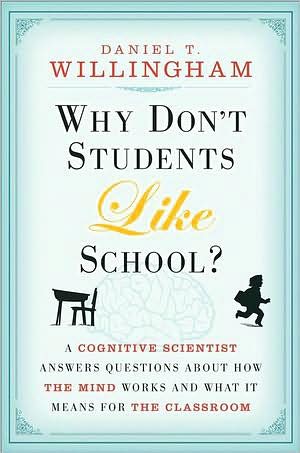
Daniel T. Willingham’s Why Don’t Students Like School: A Cognitive Scientist Answers Questions About How the Mind Works and What It Means for the Classroom is too long a title for a book that is surprisingly good, especially given how short it is. Although the title mentions the “classroom,” the book is useful not only for teachers and students, but for anyone who needs to be aware of the cognitive processes involving in learning—which should be anyone involved in the knowledge economy, since that economy is based almost entirely on being smarter and more efficient than the next guy. The only way to accomplish that is through education—and not only the kind that goes on in schools.

Although Willingham’s book focuses on the “school” part of the equation, his advice can be translated elsewhere, to anyone who has information that must be imparted to others. He says students don’t like school in part because they’re being taught poorly. This probably isn’t news to anyone who has ever attended school. The problem is what “poorly” means and how it might be improved, both on the level of an individual teacher and on the institutional level at which K-12 education and universities operate. The two aren’t often treated as a single unit for teaching purposes, in part because K-12 teachers are just supposed to teach, while university instructors are also supposed to be doing research. Nonetheless, both obviously struggle with student (and sometimes teacher) boredom.

The problem goes beyond the classroom and into life: “[. . .] unless the cognitive conditions are right, we will avoid thinking.” In essence, we avoid thinking more than we embrace it, on average, which makes a certain amount of sense: the more we have to think about a particular thing, the less we can think about anything else. I’ve been dimly aware of this for a reasonably long time, in part because of Paul Graham’s essay Good and Bad Procrastination, where he says:

There are three variants of procrastination, depending on what you do instead of working on something: you could work on (a) nothing, (b) something less important, or (c) something more important. That last type, I’d argue, is good procrastination.

Most of us probably spend most of our time on (a). In normal cognitive conditions, we’re probably at (b). Willingham (and teachers) want us to be at (c). He says, “Most of the problems we face are ones we’ve solved before, so we just do what we’ve done in the past.” But this does little for learning, and we have to find a space between what we already know and where we’d like to be. Too little, and we’re not really learning. Too much, and we’re likely to shut down because we don’t understand. You can’t really vector calculus to someone who doesn’t know geometry. You probably can’t teach regular calculus to someone who doesn’t.

People need opportunities to solve problems, not just be talked at. This is one reason lectures are often ineffective and/or boring: they evolved to solve the problem of paper being expensive and knowledge dissemination difficult. For their time and place in the Middle Ages, they were pretty effective. Today, however, when knowledge transmission in written form can be virtually free, lectures don’t make as much sense because in too many cases they don’t offer the chance to solve real problems. Yet teachers and professors keep using them in part out of habit.

Habit can be dangerous for both groups, unless the habit in question is the habit of breaking out of habits. Enthusiasm and boredom are both contagious. Willingham doesn’t talk about the two or how they interact, but most people like to be around those who are enthusiastic about doing something and dislike the opposite. When the person standing in front of a room doesn’t care, it’s probably not surprising that the room doesn’t care either. In my experience, better teachers have a childlike sense of wonder about the world, which makes them enthusiastic; weaker teachers don’t care. Apathy is the opposite of good teaching, and yet there are relatively few penalties against apathy in the school systems (the plural is important: there isn’t just one) operating in the United States. Willingham doesn’t discuss this, which might be a function of his method (he uses data whenever possible), an oversight, or simply beyond the scope of his argument.

He also doesn’t discuss one of the bigger problems with school: the relentless focus on GPAs and hoop jumping; Robin Hanson recently noted what might be the best advice I’ve ever read regarding studying in his post Make More Than GPA:

Students seem overly obsessed with grades and organized activities, both relative to standardized tests and to what I’d most recommend: doing something original. You don’t have to step very far outside scheduled classes and clubs to start to see how very different the world is when you have to organize it yourself.

Still, Willingham writes, “I don’t know why some great thinkers (who undoubtedly knew many facts) took delight in denigrating schools, often depicting them as factories for the useless memorization of information.” They probably did so because many schools were and are factories for the useless memorization of information. Just because one observes that, however, doesn’t mean that any memorization of facts is automatically useless. As he says on the next page, “Critical thinking is not a set of procedures that can be practiced and perfected while divorced from background knowledge.” But background knowledge is necessary, not sufficient, for critical thinking, and too many schools stop at background knowledge.

Perhaps the most useful thing teachers could to make school better is the same thing all professionals do: concentrate on ceaselessly improving their craft through incremental efforts at daily improvement. This is what we have to do for any kind of learning, and Willingham describes how we move from a state of no knowledge to shallow knowledge to deep knowledge in particular problem domains. People with no knowledge and who have some introduced tend not to retain that knowledge well; people who have shallow knowledge tend not to connect that knowledge to other knowledge; and people who have deep knowledge can fit new information into existing schemas, webs, or ideas much more effectively than those who can’t.

Books like Why Don’t Students Like School are a good place to start: I’ve changed some of my habits because of it, especially in terms of seeking feedback loops and engagement through things like polling, movement in physical space itself, and working toward asking questions that actively lead toward whatever it is I’m trying to get at—which usually involves close reading, understanding what the author is saying, or working toward analysis in papers. I focus more on the feedback loops involved in teaching, thinking, and memory. Those last two are important because “memory is the residue of thought.” This means we need to think if we’re going to remember things more effectively than we would otherwise, and this process requires dedicated practice: “If you don’t pay attention to something, you can’t learn it! You won’t remember much of the seminar if you were thinking about something else.” This might explain why I ban laptops from my classrooms: they encourage students to think about something else. But merely “thinking” isn’t enough: Willingham says “[. . .] a teacher’s goal should almost always be to get students to think about meaning.” One way to do this is simply by asking, but relatively few teachers appear to make this leap. Even that isn’t enough:

The emotional bond between students and teacher—for better or worse—accounts for whether students learn. The brilliantly well-organized teacher whom fourth graders see as mean will not be very effective. But the funny teacher, or the gentle storytelling teacher, whose lessons are poorly organized won’t be much good either. Effective teachers have both qualities. They are able to connect personally with students, and they organize the material in a way that makes it interesting and easy to understand.

We need practice to learn intellectually, just as we need practice at sports and music: “It is virtually impossible to become proficient at a mental task without extended practice.” But precisely what practice entails also remains unclear.

But the problems with Why Don’t Students Like School as a book remain. It a) has an irritating habit of using poorly formatted pictures and b) often feels under-researched. But the fact that its suggestions are real, concrete, and applicable make it useful to teachers in any capacity: many if not most of us have to teach something over the course of our lives, whether work processes to mentors, cooking to spouses, life skills to children, or technical skills to people on the Internet. And it’s sometimes vague: Willingham writes, “We are naturally curious, and we look for opportunities to engage in certain types of thought.” But what types do we try to think in? He doesn’t say. There are pointless pictures and graphs, no doubt designed to somehow make us remember things better but mostly an insult to our intelligence, as if we’re in high school instead of aspiring to teach high school and beyond.

What happens when people with partial knowledge start talking about college costs in Arizona and elsewhere

One painful thing about knowing a complex politicized subject fairly well is that most of the commentary on it looks pretty dumb because the commentators don’t really understand it. The latest edition of that malady comes from A Dismal Picture For Higher Education in Arizona, which someone forwarded to me because a) I’m a grad student at the University of Arizona and b) I write about academic novels. The problem with the link is that while some of it is somewhat accurate, some of it less so, and a lot of it is taken out of context. For example, it shows a table demonstrating that a surprisingly high number of people working in low-skill professions that don’t require a college degree nonetheless have one—but that probably says more about the graduates than it does about college.

The next item quotes the conservative Goldwater Institute saying that the number of administrators has grown:

Between 1993 and 2007, the number of full-time administrators per 100 students at America’s leading universities grew by 39 percent, while the number of employees engaged in teaching, research or service only grew by 18 percent. Inflation-adjusted spending on administration per student increased by 61 percent during the same period, while instructional spending per student rose 39 percent. Arizona State University, for example, increased the number of administrators per 100 students by 94 percent during this period while actually reducing the number of employees engaged in instruction, research and service by 2 percent. Nearly half of all full-time employees at Arizona State University are administrators.

(You can read more in this vein via Why So Many Administrators?, but although it asks “Why so many administrators?”, it doesn’t answer that question.)

Problem is, the Goldwater Institute study is specious for two reasons: 1) It doesn’t deal with changing definitions of “administrator” over time, and although it implies that more administrators equal more waste, it doesn’t actually talk about which administrators it wants cut. Job services offices are new and science grants often require administrators. Everyone is against bureaucracy unless it’s the bureaucracy they need. Hell, I’m against administration, bureaucracy, evil, simple carbohydrates (except for carrot cake), and the coyotes that ate my neighbor’s cat. So do we want the administrators in the beefed up jobs office cut? The ones in the disability resource centers that’ve opened widely? The ones that offer counseling to students contemplating suicides? The ones hired to manage science grants? You tell me.

Productivity among universities isn’t increasing—see College Costs: The Sequel for more on why:

College cost, and cost in the other similar industries, is rising for three broad reasons. First, over time we have found ways to reduce the number of labor hours and kilowatts of power needed to produce most manufactured goods and agricultural products. By contrast, many services remain artisan-like. The time of the service provider is the service itself, and labor-saving productivity gains are very hard to achieve. As a result, the cost of a year of college or an hour of a lawyer’s time must rise compared to the price of a ton of steel or a bushel of wheat.

This is “cost disease,” which is sometimes called Baumol’s disease, and a comment by Al zeroed in on it quite accurately. Rising productivity elsewhere in the economy generates this “disease,” while creating the growth that pays the costs for these more artisan-like services. The college-centric view of the world does not accord this argument the central place the data say it deserves.

[. . .]

A number of our critics noted that distance learning has the potential to revolutionize higher education. We wish we were as sanguine as the distance-learning optimists. The best evidence suggests that course work that blends face-to-face instruction with distance components yields the best outcome. The best courses for this are introductory classes with relatively static knowledge. Many universities already are well down the path of incorporating these approaches.

In short, we haven’t really found an effective way to increase the productivity of education because we can’t find good ways of educating mass numbers of people save through having them sit together with more experienced people who are supposed to be experts in their fields and having those “experts” (who we call “teachers” or “professors”) impart some of what they know. This doesn’t scale easily because the prof / teacher : student ratio remains approximately even. Although digital utopians want the Internet to replace teachers / profs, it appears that the vast majority of the population prefers watching porn and computer games to figuring out what the hell Hegel is talking about or how mitochondrial DNA works.

Then there are comments like this: “Arizona State University’s four-year graduation rate is a shocking 28 percent. Low standards and easy loans are a recipe for disaster.” There are two obvious ways to raise the graduation rate: raise the admissions bar so better students get in or make it easier to graduate. Grade inflation has already done the latter to some extent. ASU and UA will effectively take almost anyone, which they apparently need or want to for budgetary reasons.

An aside about grade inflation: one of the most useful efforts I’ve read about recently comes from A Quest to Explain What Grades Really Mean, which discusses UNC Chapel Hill’s effort “to add extra information — probably median grades, and perhaps more — to transcripts. In addition, they expect to post further statistics providing context online and give instructors data on how their grading compares with their colleagues’.” This would be incredibly welcomed, because at the moment there’s a strong incentive for professors to give higher grades, which lead to higher evaluations, but don’t have any immediate cost for the profs involved.

The harder way to raise the college graduation rate is to make classes smaller, track each student more carefully, increase the number of advisors, and so forth. All this will decrease “productivity” (it’s very “productive” by simple measures of productivity to have one prof lecture 1,000 students). In short, big schools would need to become more like Clark University, where I went to undergrad, only with tens of thousands of students, and this would raise costs, ceteris paribus.

The biggest problem with this article is that it acts like college administrators and professors aren’t aware of the kinds of issues raised. They are, and there’ve been endless books written about them. A recent winner: Why Does College Cost So Much?.

There may be a “A Dismal Picture For Higher Education in Arizona,” but it isn’t for the reasons stated or implied in this article.

A meta point: most big, complex social systems (think healthcare, education, government, military, companies) don’t exist as they do because they’re the theoretical best. They exist the way they do because they’ve evolved thanks to reactions from social, financial, and other pressures into the beasts they look like today. Most people don’t have the historical knowledge necessary to understand why and how they evolved they way they have.

My overall political feelings are usually captured by The Onion, mostly because so much day-to-day political discourse looks like parody. Two examples from America’s Finest News Source: “Barack Obama – Either Doing His Best In One of The Most Difficult Times In American History, Or Hitler,” since we all know politicians must be one or the other, and “Jan Brewer – Not Afraid To Do What The Federal Government Won’t And Shouldn’t,” which basically describes what Arizona politics are like:

By demanding that police check any suspicious- looking individual’s immigration status, Brewer stood up for the kind of racial profiling that other politicians wouldn’t, and under any circumstances shouldn’t, have the guts to support. Refusing to bow down to sense or reason, Brewer also made it possible for citizens to sue police officers who fail to carry out the troublingly vague terms of the new law, no matter how much it might tie up the state’s court system—a bold stance the federal government simply couldn’t be bothered with.

Efforts to solve big, institutional problems tend to suffer from unintended consequences. They tend not to respond well to ideologically driven solutions, whether those preferred by the left or right. They tend to to require a lot of strenuous effort if you’re even going to understand them, let alone propose to fix them, and the problems are much easier to identify than possible solutions to those problems, which might be worse than the problems themselves. Note one such example above: a simple way to improve the graduation rate at Arizona universities is to raise the admissions bar. But doing so means that some deserving though marginal students won’t get a shot at college at all. They’ll be more likely to steal the car of the people who write “A Dismal Picture For Higher Education in Arizona.” And so on.

This is the place where I’m supposed to propose solutions to the kinds of problems universities have, but I don’t have any that are short and easily digestible. Beware people who say they do.

Something’s wrong, but you don’t know what: the stupid person’s paradox and the Dunning-Kruger Effect

“Something’s Wrong but You’ll Never Know What It Is:” What happens when you’re too incompetent to judge that you’re incompetent? One of my friends teaches the LSAT (Law School Admission Test) and calls this the stupid person’s paradox—you’re too stupid to realize that you’re stupid. He often found evidence of the stupid person’s paradox in students with high GPAs in very easy majors who then wondered why they were terrible at the test and/or couldn’t read effectively.

I like that name better than the “the Dunning-Kruger Effect,” which finds that “our incompetence masks our ability to recognize our incompetence.” I wonder if understanding the effect makes us less likely to susceptible to it, or merely makes us implicitly smug that we’re smart enough to understand it and “they” aren’t, but in actuality we suffer just as much.

I find this bit of the article especially interesting:

DAVID DUNNING: People will often make the case, “We can’t be that stupid, or we would have been evolutionarily wiped out as a species a long time ago.” I don’t agree. I find myself saying, “Well, no. Gee, all you need to do is be far enough along to be able to get three square meals or to solve the calorie problem long enough so that you can reproduce. And then, that’s it. You don’t need a lot of smarts. You don’t have to do tensor calculus. You don’t have to do quantum physics to be able to survive to the point where you can reproduce.” One could argue that evolution suggests we’re not idiots, but I would say, “Well, no. Evolution just makes sure we’re not blithering idiots. But, we could be idiots in a lot of different ways and still make it through the day.”

Melville and the theme of boredom

I’m writing a paper on Melville’s Pierre: or, The Ambiguities, which is slowly driving me crazy (I leave it to the reader to decide whether I refer to paper or book). While searching the library last week, I came across a book whose content has no doubt been contemplated by many a student over the years:

In case you can’t read the spine, it says Melville and the Theme of Boredom. If I hadn’t seen it in a research library, I’d assume the title to be a work of parody.

The validity of grades

Marco Arment writes at Marco.org (proving that he was prescient when it comes to domain names) and created the awesome web service Instapaper, which I use solely for its Kindle export feature. One of his favorite posts is “School grades are hopelessly broken.” It’s worth reading, and Marco is probably right: school grades are too high and don’t reflect real knowledge, but like healthcare or the military, there’s no easy way to fix them.

Although Marco’s essay is mostly right, it also doesn’t propose any real solutions to the problem he describes—because there aren’t any. The incentive for parents in high school is to want their kid to get the highest grade possible; consequently, they will often fight for their kids, leading to an overall negative equilibrium, and one that I benefited from in late middle and early high school when I decided to effectively fail math as an ill-conceived protest against my parents. At the time I didn’t consciously realize this dynamic, or that protesting in ways that chiefly hurt me aren’t terribly wise, but I was also 13 – 15 at the time and didn’t know any better.

For most teachers, the easiest thing to do on an individual level is inflate grades, which reduces complaints from both parents and students. This isn’t optimal on a societal level, which generates posts like Marco’s, but it is on an individual level, and I don’t see an easy way to generate incentives to change this (more on that later). Marco says:

Grades don’t reflect your aptitude, intelligence, or understanding of the subject matter. You don’t need to actually learn much useful material to get good grades. (And many of those who learn exceptionally well don’t get good grades.)

This is probably true. But if grades don’t reflect all this, then imagine what the people with really low GPAs are like. Grades aren’t good at stratifying the high end of the curve, but they at least show some of where the low end is. And I suspect the really high end, especially in hard college majors like engineering, CS, and so forth, are still reasonably good guides to aptitude. Marco says, “You can understand why I don’t trust the validity of grades.” You shouldn’t trust grades fully—but that’s because grades aren’t supposed to be the full measure of man. Nothing is, except maybe life, and what does that really mean?

I see a lot of comments about colleges, high schools, grades, and how to improve those kinds of issues on sites like Hacker News and Slashdot. Most are good at identifying problems; Chris Smeder, for example, tells us how to improve college teaching in three major ways. He’s probably right about all of those, but he misses an important point: most universities are not set up (or, if you like buzzwords, “incentivized”) to reward teaching.

Smeder misses the main point, which isn’t identifying the problem; a gazillion people in the Chronicle of Higher Education have said virtually the same thing at various times. The real problem is solving the problem, which requires changing the incentives that drive professors. At the moment, hiring and tenure decisions at virtually all universities (and all the big ones you’ve heard of) are made mostly on research and publication. Teaching simply doesn’t count for much. Therefore, the people who succeed in getting hired and getting tenured optimize for what they’re being judged on: research and publication. Teaching is secondary. Heroic individuals and people who want to practice better teaching will help somewhat, but they aren’t enough to change the system as a whole.

Once you’ve realized this incentive problem, the question becomes, “How do you change the incentives?” I have no good answers for that, but it’s the real question you should be asking if you’re genuinely interested. And it might keep you from generalizations like this one, which is back to Marco’s essay:

Most people from my generation can’t really do anything else in the real world except bullshit jobs because nobody ever held them to very high standards.

This probably is true of all generations, and the rhetoric of most people during most generations (consider, for example, the New York Times’ Generation Me vs. You Revisited). I suspect that not all the jobs Marco assumes are bullshit are bullshit. And even if all this is true, schools aren’t going to be offering the kind of information he’d presumably like GPAs to show.

I’d get near-zero homework grades because I’d never do it, so I needed (and usually got) near-100% test grades to make up the difference. I’d barely pull through and get a C most of the time.

This works for some people, especially who start their own businesses. Most people don’t and never will. So their grades count. I’m reminded of Paul Graham’s comment from “What You’ll Wish You’d Known:”

In retrospect this was stupid. It was like someone getting fouled in a soccer game and saying, hey, you fouled me, that’s against the rules, and walking off the field in indignation. Fouls happen. The thing to do when you get fouled is not to lose your cool. Just keep playing.

By putting you in this situation, society has fouled you. Yes, as you suspect, a lot of the stuff you learn in your classes is crap. And yes, as you suspect, the college admissions process is largely a charade. But like many fouls, this one was unintentional. So just keep playing.

Rebellion is almost as stupid as obedience. In either case you let yourself be defined by what they tell you to do. The best plan, I think, is to step onto an orthogonal vector. Don’t just do what they tell you, and don’t just refuse to. Instead treat school as a day job. As day jobs go, it’s pretty sweet. You’re done at 3 o’clock, and you can even work on your own stuff while you’re there.

The right thing to do is your homework, because it’s presumably easy, and then do the rest of your work on your own time. And although GPAs are broken, they’re also the best we’ve got. As Joel Spolsky says in his advice to Computer Science majors:

Never underestimate how big a deal your GPA is. Lots and lots of recruiters and hiring managers, myself included, go straight to the GPA when they scan a resume, and we’re not going to apologize for it. Why? Because the GPA, more than any other one number, reflects the sum of what dozens of professors over a long period of time in many different situations think about your work. SAT scores? Ha! That’s one test over a few hours. The GPA reflects hundreds of papers and midterms and classroom participations over four years. Yeah, it’s got its problems. There has been grade inflation over the years. Nothing about your GPA says whether you got that GPA taking easy classes in home economics at Podunk Community College or taking graduate level Quantum Mechanics at Caltech. Eventually, after I screen out all the 2.5 GPAs from Podunk Community, I’m going to ask for transcripts and recommendations. And then I’m going to look for consistently high grades, not just high grades in computer science.

Marco can be largely right in a micro sense and still be wrong, or at least doesn’t really deal with what should happen in a macro sense. If you’re the principal of a high school, or a college president, or an individual employer, or any number of other positions, what can you do to change the presumed brokenness of grades? How can you transform the system producing said grades? Until you’ve answered that, you’ve done a lot of the work that’s already been done (see, e.g., here for an older view of school problems) without facing the hardest part of the task.