Briefly noted: Sweetbitter — Stephanie Danler

You may have read about Sweetbitter, which is a resolutely okay novel that you should not even consider unless you’ve already read and liked Kitchen Confidential and Love Me Back, both of which cover kitchen and restaurant stories (from page 9 of Sweetbitter: “When I got there they told me a lot of stories” about restaurants, Union Square, and New York). Like many New York novels, it has a masturbatory, self-important, and inward-gazing feel. Many of New York’s structural problems can be traced back to Matt Yglesias’s excellent book The Rent Is Too Damn High, but of course none of the characters in literary fiction ever read or know anything beyond what they themselves immediately experience.

sweetbitterYou will find many ridiculous lines like, “in New York City there are absolutely no rules.” The sort of lines that, spoken on a reality TV show, the literati would condescend to, justifiably, but here, in this package, it’s literature, or the sort of novel that makes literary moves. Maybe I’m unfair and the things that are profound or profound-seeming at 22 are different than the things that are profound or profound-seeming later. But there is too much, “Do you know what it means to be a server?” too much concern about “totems of who I was.”

There is also oddly little sex in a novel with too little else to recommend it. The protagonist, Tess, chases her own personal Mr. Big (although his name is appealingly Jake), and the results can either be predictable or more fairy tale than gritty realism.

I didn’t consciously realize until reading this novel and talking to a friend in the restaurant industry that the industry only really works for its employees if or when the employees get pre-tax food subsidies from other restaurants. Let me explain. Many mid- and high-end restaurant workers have an implicit or explicit deal you-scratch-my-back-I’ll-scratch-yours in which they give other “industry” people free food / booze, the value of which can probably add up to thousands of dollars a year, all of it untaxed. Since restaurant industry profits are notoriously low (some estimates are as low as 1 – 4%), some of the pay that would otherwise need to go to servers who’d get taxed on that pay instead goes to them in the form of food. And they expect that favor returned: On Monday you go to Joe’s restaurant, and on Tuesday people from Joe’s go to yours.

Still, it’s not worth reading the novel for that insight. It’s dubiously worth reading a novel with disconnected ejaculations like this all over the page:

“Appetite is not a symptom,” Simone said when I complained of being hungry. “It cannot be cured. It’s a state of being, and like most, has its attendant moral consequences.”

Okay, that’s deep, but so what?

There are good sentences, but they don’t add up to much. I neither regretted finishing nor skimming the second half. When people complain about “MFA fiction,” Sweetbitter is what they’re talking about. I’ll read the next thing Danler writes.

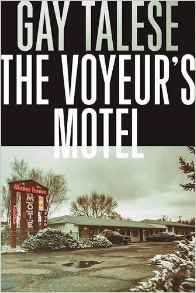
The Voyeur’s Motel — Gay Talese

The real lesson of The Voyeur’s Motel is not how depraved most people are, but rather how boring they are. In the story, Gerald Foos gets his start as a teenage voyeur by watching his aunt Katheryn “for five or six years,” and while she spent much time nude most of that time was spent “at her dressing table arranging her collection of porcelain miniature dolls from Germany, or her valuable collection of thimbles.” Who knew there even was or is such thing as a “valuable collection of thimbles?”

voyeursmotelMost of the people Foos observes over decades in his hotel are little more interesting; the epigraph to The Voyeur’s Motel could be that famous quote from Walden, “The mass of men lead lives of quiet desperation.” Except that most of the individuals and couples Foos observes seem not to know enough to even feel desperation. Instead, to the extent they have or show feelings, they seem to be consumed with petty bickering and bullshit. The number who are luminously full seem small.

Consider the preceding two paragraphs in light of complaints about smart phones and laptops and the Internet relentlessly distracting us, or Internet dating making us flightier or more demanding of partners or more likely to break up. Maybe smartphone distraction is a big improvement on what on preceded it, on arranging porcelain miniature dolls or thimbles. In 1980 Talese goes into the attic and spies on people staying in the hotel:

As I looked through the slats, I saw mostly unhappy people watching television, complaining about minor physical ailments to one another, making unhappy references to the jobs they had, and constant complaints about money and the lack of it, the usual stuff that people say every day to one another, if they’re married or otherwise in cohabitation, but is never reported upon or thought about much beyond the one-on-one relationship. To me, without the Voyeur’s charged anticipation of erotic activity, it was tedium without end, the kind acted out in a motel room by normal couples every day of the year, for eternity.

The things that people consider to be pleasures are also sometimes odd, as Foos says:

My observations indicate that the majority of vacationers spend their time in misery. They fight about money; where to visit; where to eat; where to stay; all their aggressions are somehow immeasurably increased, and this is the time they discover they are not properly matched [. . .] Vacations produce all the anxieties within mankind to come forward during this time, and to perpetuate the worst of emotions.

That’s been my experience, and I wonder if people do them anyway to say they’ve done them, or imagine the best parts of them. Maybe many of us would be better off if, as Rebecca Shuman suggests, more people took her advice in “Alone, Together: To avoid travel stress and major arguments, more couples should vacation together but fly alone.”

Is it real? Hard to say. Talese notes:

Indeed, over the decades since we met, in 1980, I had noticed various inconsistencies in his story: for instance, the first entries in his Voyeur’s Journal are dated 1966,m but the deed of sale for the Manor House, which I obtained recently from the Arapahoe County Clerk and Recorder’s Office, shows that he purchased the place in 1969. And there are other dates in his notes and journals that don’t quite scan.

“Don’t quite scan” may be an understatement. On June 30, Talese actually “disavowed” The Voyeur’s Motel:

Talese overlooked a key fact in his book: Foos sold the motel, located in Aurora, Colo., in 1980 and didn’t reacquire it until eight years later, according to local property records. His absence from the motel raises doubt about some of the things Foos told Talese he saw.

Still: Talese did see the hotel. He later walked back his disavowal. I’m a great believer in the power of fiction and the power of people to make shit up, but even by that standard making up the shit that Foos writes seems unlikely. I guess it to be more real than not real. It seems likely that no one will know.

Given the volume of material, The Voyeur’s Motel is oddly short. This long New Yorker article gives you much of the content and flavor. Still, do not listen to the negative reviews so far, which have mostly been uselessly negative and/or focused on the perceived ethics of the book; almost all of those articles about mostly about the author’s need to perform signaling and status functions, rather than the book itself.

As with Thy Neighbor’s Wife, people expecting nonstop prurience will be disappointed. In some ways the book can productively be read in conjunction with The Presentation of Self in Everyday Life, since Goffman’s book is about the social, public self and Talese’s book is about the private, supposedly unobserved and sexual self. To me and, I suspect, many readers and writers of novels the latter is more interesting and less likely to be foreseen.

The Voyeur’s Motel comes back over and over again to the need to reliever torpor. The first quotes are from the start of the book; around the midpoint we get this:

Ordinary life is boring, [Foos] concluded, not for the first time; no wonder that is always a big market for make believe: staged dramas, films, works of fiction, and also the legalized mayhem inherent in sports…

That most people do not try harder to alleviate boredom is an unsolved problem—perhaps most people don’t perceive boredom as Foos does, or they feel powerless, or both. Foos’ second wife is not immune. After retirement, she “devoted much of her free time to alphabetizing his millions of sports cards.” The sports cards are Foos’ thimbles.

The Truth: An Uncomfortable Book About Relationships — Neil Strauss

The Truth is poorly named but it’s also amazing and you should read it, preferably in the biblical, imitation-leather edition. Unfortunately, The Truth buries the lede: the weakest, most tedious section by far is the beginning, when Strauss goes to therapy for “sex addiction” (which may not exist, at least for reasonable definitions of “exist”).* Don’t give up. Get past the first third and pay special attention to the rest, where Strauss’s sharp, comedic / absurdist observations strike.

the_truthIn the first section, we learn that there is such a thing as “a CSAT,” that is, “a Certified Sex Addiction Therapist.” The therapists seem at least as mad as the patients, which seems to be a recurring theme in life (you know what they say about psych majors…). The treatment does not work, at least at first. Strauss, seeking answers, gets what appears to be an fMRI, hoping that his brain makes hedonic and novelty-seeking, only to be told that he chooses relationships or the chase. Score one for free will or something like it.

The middle section is about the chase. The chase is about women, yes, but it’s also about finding a way to be. Strauss meets people whose new-age and pseudo-religious or -mystical bullshit is vile. At one moment, meeting a woman who presents herself as a guru, “Common sense tells me to leave; curiosity drives me forward.” That’s the writer coming out. I wish I could say that I always follow common sense. I don’t, for the same reason. Strauss’s Guru attempts “mix spirituality with business” and then says, “Let me know if you have any ET experiences in Peru.”

He doesn’t. He runs.

Unfortunately he runs to a polyamory retreat that’s also infused with spirituality nonsense that should’ve died with the ’70s. That doesn’t work out either:

I look up and see a yoga stud from Kamala’s pod.

“Have you rounded up any more girls?” the orbiter asks him.

Kamala Devi and Shama Helena said polyamory was about loving relationships, not casual sex. But these guys seem more like next-level pickup artists, coming to these conferences with the intention of sucking any available women into their powerful reality.

Understanding things as they are, as opposed to how they “seem,” is rarely easy for anyone, anywhere—which may be one reason we have literature. The supposedly selfless caring for others that Strauss hears about is more like socialism, with its attendant problems: Equality for you and special privileges for me.

Later, things do not improve for Strauss: “This is truly the blackest day of my life: I’ve been kicked out of an orgy for eating popcorn.” He’s eating popcorn because he can’t fake bogosity at the level necessary for that world.

So he tries another (there are more worlds out there than most of us know). His next stop involves something like conventional swingers, if that phrase isn’t an oxymoron, at a club or party called Bliss. Towards the height of his first experience, he writes that “I would’ve paid every penny in the bank for this experience ten years ago—If I’d known it was even possible.” Many things are possible, but the mind holds us back; the same theme in a different context plays out repeatedly in Elon Musk: Tesla, SpaceX, and the Quest for a Fantastic Future. For Strauss, that moment is “the closest thing to heaven I’ve ever experienced.”

Then he passes out. He’s taken too much GHB.

So, in short, Strauss attends an orgy that should be everything he’s ever wanted, but he takes drugs he shouldn’t and doesn’t have the sex he should, or that he thinks he wants. While there, he meets a woman who seems mostly like a groupie but who also demands monogamy and yet goes to an orgy, chiefly because her “friend” is there (that people are not internally consistent or even interested in internal consistency could be a shadow theme of The Truth—or maybe it’s just been written by an “ambivalent,” as Strauss is, or is termed).

He goes to another and decides he is “determined not to wreck this orgy like all the others.” I won’t speak to what happens, but one does get the sense that Strauss is well attuned to self-criticism and understanding how others will see him.

Wanting to be a swinger or polyamorous person can make internal, logical, and consistent sense; one cannot say the same for what comes next, when Strauss, on his own, sticks three straight women in the same domicile and attempts to date all of them, simultaneously, while living with them. The preceding sentence’s length and complexity is deliberately designed to evoke the complexity of Strauss’s arrangement.

In sports there is a term called “unforced errors,” which occur when a player does something transparently wrong that is not caused by the opponent or some other outside force. What Strauss attempts is an unforced error and one that ought to be easily foreseen. But one might attribute this to that previous mentioned issue between common sense and curiosity. The three women more or less come to Strauss, in his telling. Mastering “the game” has evidently done things for him.

In The Truth Strauss ultimately assigns the genesis of his adult relationship habits to his upbringing. In his case maybe that’s true, but I’m reluctant to assume a casual relationship between upbringing and adult life: how many people who had childhoods similar to his grew up to be functional adults? Since at least the time of Freud it’s been popular to ascribe adult personality traits to childhood, but I’m not convinced those are robustly supported and that they’re more than just-so stories we tell ourselves to make sense of a deeply chaotic, multi-faceted world.

Psychiatry and psychology in particular are deeply troubled fields because we don’t have good models for the brain. In those domains it may be obvious when someone is too dysfunctional to live independently, but the supposed treatments and models are derived from poor or nonexistent premises. Imagine trying to start a car and discovering that one third of the time it starts, one third it doesn’t nothing, and another third of the time the engine dies. That’s close to the current state of real knowledge about psychiatry and psychology.

We tell ourselves stories, which is great—in some ways I am a professional storyteller—but we use science to figure out what’s reliably and consistently true, and the childhood traumas leading to adult reenactments does not appear to be reliably and consistently true. Perhaps the stories Strauss tells himself now allow him to live in a particular and better way, and in that sense they’re functional. But they may not be causal.

On page 10 of The Truth Strauss writes of his then-girlfriend and now-wife, “She is reliving her mother’s relationship with her cheating father. I am reliving my father’s secret sex life. We are repeating a pattern handed down by generations of lying, cheating assholes and the poor fools who trust them.” They specifically seem to be repeating generational trauma. The idea that we repeat our childhood experiences has been commonplace since Freud, but is it true? Do we really have any evidence of it, or, again, are we just telling ourselves stories? Pop culture loves Freudian ideas. I’m not so sure that the psychosexual narrative Strauss constructs is more real than one that accepts the null hypothesis.

By the end Strauss is married. I wonder how Strauss’s marriage will hold up over time. I wouldn’t bet on “well” without favorable odds. Many beliefs that feel firm at a given moment turn out to be provisional in the fullness of time. It’s striking that Strauss never, so far as I know, mentions his age or the age of his lover, Ingrid.

For all of his problems, I can’t imagine most guys doing what Strauss has done or accomplishing what Strauss has accomplished. For all the psychic trauma in his childhood, the outcome is impressive.

The Truth is the sort of book I can’t imagine being made, in any sort of honest way, into a movie. Oddly, perhaps, I can imagine The Game being made into a reasonably honest movie and am somewhat surprised that it hasn’t been.

The final truth about relationships is that there is no final, universal truth about relationships. We make things up as we go along and universal experiences aren’t universal. It’s not a real sexy truth. It also doesn’t require a book to say. Instead, we tell all our stories about relationships in the book of life and the stories we draw from it.**

Let us return to the beginning of The Truth again. Strauss starts by saying he is “the king of ambivalence.” He wants what he can’t have or doesn’t have at that moment. This is not good and is perhaps generalizable:

Most married people I know don’t seem to be any happier. One day Orlando Bloom, an actor I’d written a Rolling Stone article about, came over to visit. At the time he was married to one of the world’s most successful and beautiful women, Victoria’s Secret supermodel Miranda Kerr [. . .] And one of the first things out of his mouth? “I don’t know if marriage is worth it. I don’t know why anyone does it. I mean, I want romance and I want to be with someone, but I just don’t think it works.”

My other married friends haven’t fared much better.

Yet he does it anyway. To his credit, Esther Perel’s Mating in Captivity does eventually get name-checked, since Perel has done unusual work in questioning our usual arrangements. Still. On the first page Strauss considers a woman and writes a sentence that could be an alternate title: “Not my type, but I would.” The book processes his motion from “but I would” to “but I won’t,” even if she is his type (and it seems that most women are).


* Psychiatry and psychology in general aren’t in good epistemological shape. There is no good functional, reproducible model of the brain. Both fields may essentially be wielding beads and rattles rather than science and be closer to shamanism than medicine.

** This is a post I’ve meant to write for a long time, but it hasn’t been an easy write.

Briefly noted: The Course of Love — Alain de Botton

You don’t need to read The Course of Love: instead read Mating in Captivity or Neil Strauss’s book The Truth or even Gillian Flynn’s Gone Girl, which, despite its murder premise, is truer to modern relationships than The Course of Love. You may be tempted by The Course of Love because of de Botton’s charming, hilarious, earlier novels On Love and Kiss & Tell. You’ll recognize callbacks to On Love; the new novel mentions a Chloe who the narrator broke up with, and the love interest in On Love is conveniently named Chloe.

Still, those novels work because they’re funny and this one you will forget because it’s not. There is a lot of tedium in sentences like “At the center of Kisten’s love is a desire to heal the wound of Rabih’s long-buried, largely unmentioned loss.” The characters never stop saying things like, “Everything around here is deeply sensible, rational, worked out, policed—as if there were a timetable all laid out from now till the moment we die.”

Perhaps the point is that we never emerge from our adolescent philosophical stupor, when people complain about sensible, rational, worked out lives—the sorts of things that many modern Syrians would probably like.

The good news is that the last pages work. The bad news is that neurotic humor is missing, and so is a real understanding of male-female dynamics. There are some good inversions of conventional thinking, as when Kirsten seems to think, “she knows, better than most, that there is no one more likely to destroy us than the person we marry.” But most of it is closer to the banal sentences quoted previously. One hopes for Flaubert and gets this. Wasn’t it Flaubert who said that every writer should write with a hard-on? Or is that a spurious quotation? Regardless of its genesis, one senses few if any hard-ons inspired this novel, to the novel’s detriment given its subject matter.

Maybe it is not coincidence that in the first sentence of this post two of the better-than suggestions are nonfiction. If you’re militantly opposed to nonfiction, maybe The Course of Love is okay. For anyone not so militantly opposed, you can get similar subject matter that’s actually better written on a sentence by sentence level. Too much of the book feels like an amalgamation of nonfiction trend pieces and books rather than a novel. Here is one sample, chosen at random: “I Can’t Stop Bashing My Husband to Other Moms, and I’m Sorry.” Kirsten has problems bashing her husband to her friends and her husband’s response is basically to shrug. Perhaps the lesson is “Don’t get married” (or expect to grind it out if you do). That may be a valid reading of the novel. Rabih’s improbable affair may be the high point.

Unlike in, say, Michel Houellebecq, the sense of fiction never overwhelms the sense of outside reading in The Course of Love. Much of it feels ripped from time-wasting websites or New York Times trend pieces. I’ve followed de Botton for years and his books vary in quality from the sublime to the wasteful. His nonfiction, except for How to Think More About Sex, is fun and informative. One wishes for more of the good here.

There is too much good stuff for The Course of Love to matter.

Briefly noted: Leviathan Wakes — James S. A. Corey

Leviathan Wakes is defiantly, definitely okay; the biggest problem with it isn’t the novel itself but having already read Blindsight, which its some similar notes but is just a much, much better novel.

Leviathan Wakes is big on game theory, empathy, and political questions. They start early—”The temptation to have an unexplained comm failure, erase the logs, and let the great god Darwin have his way was always there” happens on page 14—and don’t really relent. Still, I dislike the implication that “the great god Darwin” thinks that individuals and small groups are inwardly selfish; evolution has also endowed us with the ability to cooperate, and humans are super-cooperators, alone among animals.

Leviathan_WakesBut the divisions among people may change shape and form, but they always remain, at least as long as we live in a world of economic scarcity. In Leviathan Wakes, Earthers, Martians, and Belters (those who grow up and/or live in the Asteroid Belt) are the primary divisions. I write this in 2016, and in the current European and American political systems there are spasms around divisions that, viewed from the proper perspective, will seem trivial. The other day I heard someone say that Trump has a point about immigrants. I agreed and amplified, suggesting that he do something about the filthy, lazy Irish and Italians, with their Papist ways and mooching dispositions. The guy I was talking to didn’t know what to do with that; the Know Nothing Party may be gone, but its ideas live on for as long as humans have a powerful psychological need to divide ourselves into tribes.

In Leviathan Wakes some descriptions are good (on a space station, “The air smelled beery with old protein yeast and mushrooms” or “The circle of life on Ceres was so small you could see the curve”), but the text can usually be described as nondescript. It’s rarely bad but rarely stellar. For example, the sentence after the one about the circle of life on Ceres is “He liked it that way,” which is representative of the novel’s language.

The sense of mystery is strong, though, and mostly excuses the sentences. You’ve read worse. You’ve read better. The plot gets sillier as the novel progresses.

What else? There is a convenient magic drive that gets people from place to place relatively rapidly. It’s hard to imagine that genetic engineering won’t have re-made the human species by the time we develop advanced space stations with room for millions of people. Did people in 1750 imagine that in 2000 we’d still be riding horses and firing muskets? Because imagining 2250 without substantial genetic engineering is hard (unless there’s an apocalypse in the meantime, which is also possible).

Leviathan Wakes is guilty of many of Charlie Stross’s space opera clichés, but I mostly forgive it. I just can’t imagine wanting to re-read it.

Straight to Hell: True Tales of Deviance, Debauchery, and Billion-Dollar Deals — John Lefevre

Masters of one medium, like Twitter, aren’t necessarily masters of another medium, like the 80,000-word memoir. They can be but don’t have to be. Lefevre mastered Twitter, but his long-form game is not as strong. That being said I did laugh when reading Straight To Hell; I feel like I couldn’t drink anywhere near the amount Lefevre does, or take anywhere near the amount of drugs. I don’t imagine I’d want to be friends with him. As he puts his life philosophy, “As we see it, if you’re dumb enough to get caught cheating, you probably don’t belong on Wall Street.”* That sounds like a sentence from a Bernie Sanders rally. It isn’t.

Straight_To_HellLeFevre writes, “From my experience, the rich and unscrupulous tend to make for entertaining company.” Speaking of political connections, he could be talking about Donald Trump, which is part of the reason he makes a popular, evil presidential candidates (and I don’t use the word “evil” lightly, but he is evil: the evil of pure id, untempered by knowledge or self-awareness). Straight to Hell has more political resonances than it should, and that may help explain its popularity, as it works on readers’ subconscious.

Still, LeFevre’s company is often entertaining, and the best one can say about his scruples is that he makes public what many would like to be private. The speaker of unpleasant truths has a kind of honor. The book is his unpleasant truths, though it is often about the unpleasant truths he dodged (“Now I know for sure, this deal is never going to work. But I still don’t want to be the one who gets blamed for killing it.”) Machiavelli has a vital role in history for a reason.

Even for people like me, who don’t see money as evil, LeFevre will make them want to see money as evil. (Consider how Sylvia Nasar puts it in Grand Pursuit: The Story of Economic Genius: “Historically, money had been seen as powerful, desirable, very likely evil, and mysterious, like natural calamities or epidemics.”) Money can be earned in ways that tend to benefit humanity or, in LeFevre’s world, in ways that tend to be about rent seeking and stealing pieces of the pie, rather than earning them, or expanding the size of the pie. Finance here looks like the latter part. That being said one doesn’t and maybe can’t know whether LeFevre’s book is representative, any more than a movie like Bad Teacher is representative of the teaching industry.

Straight To Hell is a memoir about signaling. The finance world presented in it has descended to an almost-pure signaling hell, in which there is no content, only surface. Hence the ceaseless references to luxury brands and luxury-brand schools. The two have become synonymous, however much humanities-department Marxists may want to deny it. There is a weird kinship between high school memoirs or novels and Straight To Hell. American high schools are painful because there is no content to shape form. Lefevre’s finance world is similar. In it, seniority beats skill (count the number of times the word “senior” appears). Many American high schools are so bad because there is no financially viable way to start an alternative high school that can siphon off smarter students and parents. Banks, in Straight To Hell, operate the same way. If contemporary investment banks operate anything like the way Lefevre depicts them operating, then “fin tech” (or “financial technology companies and products,” to use a phrase du jour) should be a ripe opportunity for startups, because the banks, and their personnel and culture, are so internally fucked up that smart startups ought to be able to eat them.

Unless, of course, regulatory and other barriers kill startups before the startups can really succeed. Still, anyone investing in financial companies should read Straight to Hell. It ought to give them courage, if it’s accurate. I can’t really judge whether it is. I’m too far from the industry. It seems unlikely, but unlikely things turn out to be true all the time. It seemed unlikely that the U.S. government would massively spy on virtually all of its citizens, but Snowden showed that it does. It seemed unlikely that an electric car startup could succeed, but Tesla showed that it can. I won’t discount Straight to Hell without trying to triangulate its portrayals. Still, if it is to be believed then many bankers are redistributing money to escorts and drug dealers. Not that I’m opposed, necessarily, to either group, but it is interesting given recent noise about financial inequality to see money flow from the rich to middle-skill service providers (though the book is not conceptualized or framed in that way; still, often the most interesting parts of a book are those that are unintended).

One could write an interesting piece comparing temperaments in Houellebecq and LeFevre. One could also write an interesting piece comparing Thiel in Zero to One and LeFevre. As Thiel notes, in a discussion about why startups (and other companies) must incentivize their employees with stock and other methods that align incentives:

Cash is attractive. It offers pure optionality: once you get your paycheck, you can do anything you want with it. [. . .] A cash bonus is slightly better than a cash salary—at least it’s contingent on a job well done. But even so-called incentive pay encourages short-term thinking and value grabbing. Any kind of cash is more about the present than the future.

zero to oneStraight to Hell can be seen as a document about “value grabbing” and about living in the hedonistic present. The value grabbing is not purely financial, either: It’s also sexual. The team lives or dies by the current roadshow. Slickness rules. One could also compare Straight to Hell and Zero to One in terms of humor versus earnestness. Zero to One has its moments of humor (think of the brief section comparing hipsters to the Unabomber, or the part about Richard Branson and the naked windsurfing model) but the preponderance of the book is about how to make serious, real improvements in the quality of life for all humans. Straight to Hell is about getting a bonus and getting your dick wet (concern over women’s pleasure is mostly absent, or I’d add something appropriate for women as well). There is nothing intrinsically wrong about either and indeed both have concerned me greatly at various points, but there is something distinctly sublunar about the relentlessness of those concerns, and the way one never looks up from the bonus or the girl or the meal.
Is it a satire? Is the joke on me because I don’t get it? There is much like, “There’s no justice in this world—a valuable lesson to learn at a young age, especially if you want to end up on Wall Street.” Is it bravado, trolling, or truth? After many words I still don’t know.


* If they’ll cheat someone else, they’ll cheat you when they get a chance.

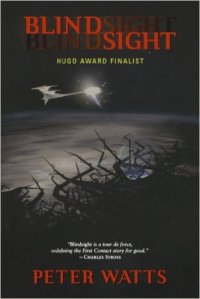
My Amazon review of Peter Watts’s Blindsight

People read Amazon reviews and Watts reads his, so I left this one.

Listen to the positive reviews: Blindsight is one of the most stunning and incredible novels I’ve read, ever, and that’s among all novels, not just SF. To describe Blindsight is not to do it justice: Like Ulysses, the plot can be summarized but the texture of it cannot really be conveyed save through the reading itself. Ulysses might be summarized as, “Neurotic man wanders through Dublin, gets stuck in his own head.” In that sense, Blindsight might be summarized as “The link between humans and post-humans encounters aliens, and nothing will ever be the same.

BlindsightBlindsight is on my mind because I just finished Leviathan Wakes by James S. A. Corey. It’s a competent, fun novel. It’s even good at times. But it covers territory similar to Blindsight’s, only less mind-blowing. It’s less developed. One can have literary blind sight and enjoyable read Leviathan Wakes, as I did, but reading them next to each other will show that something is missing from Leviathan Wakes. One needs total vision and a third eye to get Blindsight. To be sure, most people never reach enlightenment. But without reading it, you’ll never know if you can get there, or if you’ll be left at the foothills like most of us are.
The world is very different from ours in key ways but doesn’t yet have AI; before Firefall, Siri Keeton, narrator, who is supposed to have no feelings and only observation, is doing this:

I’d been liaising for a team at the Kurzweil Institute, a fractured group of cutting-edge savants convinced they were on the verge of solving the quantum-glial paradox. That particular log-jam had stalled AI for decades; once broken, the experts promised we’d be eighteen months away from the first personality upload and only two years from reliable Human-consciousness emulation in a software environment. It would spell the end of corporeal history, usher in a Singularity that had been waiting impatiently in the wings for nigh on fifty years.

But it hasn’t arrived. Not yet. Not in Blindsight’s world, which is also Siri’s world. To us it’s an odd one:

You hire people like me; the crossbred progeny of profilers and proof assistants and information theorists.

In formal settings you’d call me Synthesist. On the street you call me jargonaut or poppy. If you’re one of those savants whose hard-won truths are being bastardized and lobotomized for powerful know-nothings interested only in market share, you might call me a mole or a chaperone.

He works in “the rotational topology of information and the irrelevance of semantic comprehension.” Oddly, that may be what a lot of us do: understanding surfaces without understanding depth, if “surface” and “depth” have any meaning at all. That’s one of the (many) question Blindsight asks (Leviathan Wakes asks political economy and cooperation questions). To restate many of them would take many thousands of words. That is another way the novel is like Ulysses.

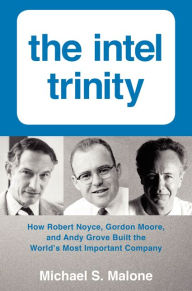
Briefly noted: The Intel Trinity: How Robert Noyce, Gordon Moore, and Andy Grove Built the World’s Most Important Company — Michael S. Malone

The Intel Trinity is another of these books that one wishes were better written but that remains interesting throughout nonetheless. For one thing, I bought the party line about Intel being essentially indomitable from its inception to the present. It wasn’t (“Frankly, the evidence argues that Intel may have been the most successful technology company ever founded by a dysfunctional start-up team—certainly by such a team that stayed together”). The book also injects ideas about history and legacy into a very contemporary culture:

Thanks to the amnesia of Silicon Valley and the digital world, [Robert Noyce] had almost been forgotten by each subsequent generation of techies as they elbowed their way to fame at a thousand dot-com companies, and then at Google, Facebook, and Twitter.

Intel_TrinityOver time, “Silicon Valley had finally and unexpectedly become history,” at least to its founders. Over a long enough time period anything becomes history, although Alan Kay famously said, “I also happen to believe in history. The lack of interest, the disdain for history is what makes computing not-quite-a-field. [. . . Computing is] complete pop culture. I’m not against pop culture. Developed music, for instance, needs a pop culture.”
It will take many more books and maybe many more years before it becomes less of a pop culture, if it ever does. The Intel Trinity is history, but the paper quality of the hardcover is oddly poor, as if the publishers themselves imagined the book to be non-essential and disposable. That contrast between the historical comments and the quality of the physical object itself is odd.

Still, it does trace the story of Intel from its beginnings and from the Fairchild exodus. Fairchild employees were apparently more dissolute and fun than modern tech company workers, or at least compared to the image of modern tech workers:

Just to repeat the anecdotes of the era is insufficient. There were endless after-work drunken gatherings at the nearby Wagon Wheel saloon, where women employees were hustled, marriages were broken, feuds were fed, and in time, employees were stolen by competitors.

Intel itself, however, was apparently less exciting, at least for most people.

The Intel Trinity also points to some of the reasons why Silicon Valley has been so hard to dislodge as a startup capitol (much as NYC is still a publishing capitol, despite outrageously high housing costs): “between 1967 and 1973, [hundreds of new companies] created not only a vast and prosperous business-technology community, but also the greatest start-up company incubator the world had ever seen” (59). At a time when most people were focused on free love and the word “start-up” to connote a new company didn’t really exist, northern California was blossoming. That’s a tremendous head start that’s hard to overcome today and will be hard to overcome tomorrow, despite San Francisco’s completely insane politics.

I haven’t yet got to the stories of Noyce, Moore and Grove. The latter has the most flabbergasting story, since he barely escaped World War II-era Hungary, when Hungary first fought on the side of the Germans, then was occupied by Germany, then was occupied by the Soviets, and eventually had its fledgling democracy crushed by the Soviets. Grove was Jewish and his survival story is amazing enough to have made me order his memoir, Swimming Across, which Malone draws from.

One has to wonder why the Intel trinity is less famous than, say, Bill Gates. I think the answer is simple: there were three of them. Larry Page and Sergey Brin are less famous than Gates, though their company is at least as important, largely because I think the press needs a single person to deify and to hate. Multiple founders makes the process of adulation and despair harder to conduct. Mark Zuckerberg is perhaps the most famous modern startup founder because he stands alone in the spotlight. This reading owes something to Zero to One, which is as much about culture and it is about startups. Culture is everywhere, even in technology, as Malone reminds us.

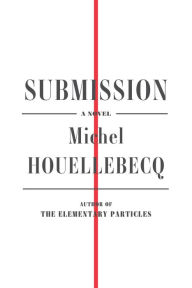
Submission — Michel Houellebecq

Like almost all Houellebecq, Submission and invites diagnoses of anhedonia (Page 1: “I realized that part of my life, probably the best part, was behind me;” Houellebecq rarely if ever writes of the “best part” of any character’s life). The weird mixture of ideas, from YouPorn (it is namechecked) to Huysmans, works and doesn’t work at the same time, and it is this paradoxical quality that I think attracts readers to Houellebecq.

Submission HouellebecqThat, and Houellebecq continues to be different in a way that almost no writers are. See also Adam Gopnik on Submission. Here is The Guardian. I mention Houellebecq in “All American fiction is young adult fiction: Discuss.” Here is Mark Lilla, in the New York Review of Books. All these pieces are excellent.
Oddly, almost no one has noticed Houellebecq’s attraction to Islam. Except for Elif Batuman, in the last part of the linked essay. In Public Enemies: Dueling Writers Take On Each Other and the World, Houellebecq writes:

It’s painful for me to admit, when I think of my atheist, politically committed friends, but I’ve never really understood the root of their commitment, it has always seemed to me to have more to do with a Christian tradition than they themselves suspected. I am speaking from pure intuition here, but in all the Christian groups I tried in vain to belong to, one of the things I completely understood was their commitment. It was very clear: they had accepted the idea that, being sons of God, all men are brothers, and behaved accordingly.

Which is quite close to what the idealized Muslims in Submission do, and, I suspect, quite far from what many real-life Muslims do (or real-life adherents of any high-commitment, high-demand creed). Commitment itself, to something, is appealing, and one characteristic of all Houellebecq’s characters is their seeming lack of commitment (even those seemingly committed to hedonism don’t seem to enjoy it that much, or as much as I would).

There are many of the weird juxtapositions one sees in classic Houellebecq: “Cro-Magnon man hunted mammoth and reindeer; the man of today can choose between an Auchan and a Leclerc, both supermarkets located in Souillac.” Or: “Even the word humanism made me want to vomit, but that might have been the canapés.” Is this no context or overwhelming context? François seems to oscillate between the two. He cares deeply about observing what’s going on and does nothing with those observations; the word “bored” appears repeatedly, almost a stand-in for “whatever.”

Plus, modern grocery stores are amazing: their convenience is incredible and price competition means that consumers win. Grocery stores means that the man of today can choose to worry about something other than where to get food from. Or, maybe, he can worry about nothing at all. Even access to pornography had to be fought for, over decades. Submission implies that maybe we’d be better off without it, but the term “revealed preferences” comes to mind (and there is a small but noisy movement for “no fap,” which is what it sounds like).

No one feels a sense of a job well done. The presence of absence is felt everywhere. François never emerges from a class feeling that he’s reached someone. Has he tried? Does he want to? The answers seem to be no. Even the attractive women he improbably sleeps with seem to move him little. We find this about Steve, his colleague: “He’d almost always invite me for a drink—usually mint tea in the Paris Mosque a few blocks from school. I didn’t like mint tea, or the Paris Mosque, and I didn’t much like Steve, but I still went.” Usually I don’t go out with people I don’t like, and I don’t think I’m exceptional in this regard, but I am capable of liking people, which François it would seem is not.

Houellebecq respects ideas as almost no contemporary novelists do, but he doesn’t do so in an academically trendy way (as, say, Alena Graedon does in The Word Exchange). If anything he does so in an academically un-trendy way.

Houellebecq does not seem to believe in Enlightenment ideas of progress. For François, private tutoring only “soon convinced me that the transmission of knowledge was generally impossible, the variance of intelligence extreme, and that nothing could undo or even mitigate this basic inequality.” The last couple centuries of relentless progress would seem to invalidate this claim, however true it may feel in the moment, at the micro level. François thinks that his “boring, predictable life continued to resemble Huysmans’s a century and a half before.” Odd. I don’t feel like my life resembles the lives of people 150 years ago. Perhaps François has this problem because education as a sector has changed very little. This contrasts with numerous other sectors.

Maybe the problem with Houellebecq narrators is that few if any discover anything or make anything—even dinner. The true hero of Submission may be the microwaved dinner. No one I’ve read more frequently mentions microwaved food. But if microwaved food signifies tedium, what signifies the opposite? Did making food from scratch, as virtually all people 60 years ago had to do for economic reasons, somehow better?

Houellebecq imagines a France in which large, politically active blocs call for Sharia Law. Yet people fleeing from many Muslim and Arab countries in the Middle East are getting fleeing from people who’d like to impose Sharia. To be sure the West imposes major culture shocks. But when you want to see whose ideas are winning, look at where people are fleeing from and where they are fleeing to. During the Cold War the number of French, English, or Americans who wanted to move to Russia was dwarfed by the number of Russians who wanted to get the fuck out.

In “The Sexual Misery of the Arab World,” Kamel Daoud writes of how

Today sex is a great paradox in many countries of the Arab world: One acts as though it doesn’t exist, and yet it determines everything that’s unspoken. Denied, it weighs on the mind by its very concealment. Although women are veiled, they are at the center of our connections, exchanges and concerns.

Daoud ends his essay by saying, “People in the West are discovering, with anxiety and fear, that sex in the Muslim world is sick, and that the disease is spreading to their own lands.” I’m not convinced the sickness is spreading: Ideas in the West about the right of individual to control his or her own body are winning. Terror in many Middle Eastern countries is a sign of weakness, not strength. Ideas cannot win on their merits; they can only be imposed via the gun. There are no real votes for Sharia, even in countries that practice it, or a modified form of it.

Other events have overtaken Submission’s world. It imagines Saudi princes lavishly funding French universities. As of this writing, in February 2016, cheap oil prices are roiling petro economies like Saudi Arabia and Iran. The Chevy Bolt will arrive in the U.S. later this year. Tesla’s Model 3 is going to be unveiled shortly. These cars may permanently cap oil prices by allowing most people to switch to electric cars as oil prices rise. France shouldn’t worry about radical Muslim takeover. Petro states should worry about what will happen when every Western economy is not wildly, wholly dependent on oil.

The previous paragraph may be bizarre in the context of a discussion about a novel, but part of Houellebecq’s world in Submission depends on the financial condition of radically Islamic countries. Those countries’ positions and stability depend on selling oil. Take away the oil and we’ll see how stable and popular many of them really are. Their leaders are able to lead lives of incredible decadence and sexual pleasure because they can afford to. That may not be true three years from now, let alone in the elections of 2022.

In another moment, François asks, rhetorically, “How could anyone argue that Europe wasn’t in decline?” Easily: First, look at where people want to go, as mentioned previously. Second, consider an article like, “Plasma physicist discusses the Wendelstein 7-X stellarator.” That stellerator, built in Germany, is an important step towards fusion power plants. It’s an incredible achievement that is primarily being accomplished by Europeans. If that’s decline then sign me up. And when was Europe in ascent? Robert Rediger notes that Huysmans “was living at at a time when the European nations were at their apogee.” Which led them straight into two insane wars, the lead-up to which can only be compared to mental illness. European temperament may be oddly negative and declinist, but the temperament and being can be further apart than Europe and Mars.

Many of you will dislike Submission. I see people on the subway and in coffeeshops reading Ferrante and Knausgaard, today’s perversely trendy writers, but none reading Houellebecq.

Houellebecq is the sort of writer who makes reading his entire oeuvre rewarding. Not all writers are like this.

It is sometimes hard to write coherently on a work that itself seems to lack coherence.

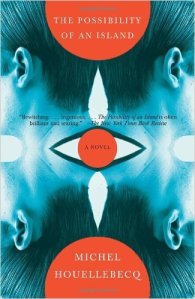
The Possibility of an Island — Michel Houellebecq

Houellebecq is not a “good” writer in the way someone like Nabokov, Ann Patchett, Elmore Leonard, Carlos Ruiz Zafón, or countless others whose sentences sing, metaphors work, and who make one stop to save the rightness of their description. But Houellebecq is a different, unusual, or unique writer: he sounds like no one else I’ve read. He’s prone to writing like a nonfiction writer (“Undoubtedly there used to be a form of demotic happiness, connected to the functioning whole, which we are no longer able to understand”), a nonfiction writer who shifts suddenly into overly pornographic registers (“Women give an impression of eternity, as though their pussy were connected to mysteries—as though it were a tunnel opening onto the essence of the world, when in fact it is just a hole for dwarves, fallen into disrepair”), or a more conventional writer (“Fortunately Harry intervened, and the conversation was raised to more transcendent subjects (the stars, infinity, etc.), which allowed me to tuck into my plate of sausages without trembling”). To “tuck into my plate of sausages” is so normal in a book—The Possibility of an Island—so weird.

If you’ve read one or two thrillers you’ve probably read most thrillers; if you’ve read one competently but boringly written commercial novel you’ve read most of them; if you’ve read 50 Shades of Grey you should be ashamed because there’s much better verbal pornography available. But Houellebecq sounds like himself, and his concerns are almost random-seeming (sexuality, contemporary consumerism, philosophy, history) yet they drive me, and I suspect others, to try to figure out what braids them. Story is one possible answer, though it is a bad one and there are others.

Being unique without exactly being good still counts. Too many “good” writers do MFA-approved stuff taken from the Francine Prose and James Wood handbooks. I don’t want to knock that style—arguably I’m doing it at times—but it is a distinctive style (almost like the New Yorker’s) and school and if you read enough lit fic or better commercial fic you’ll recognize it and start to categorize it and start to use annoying abbreviations like “fic.”

I suspect that readers who don’t reject Houellebecq outright for reasons or psychological or moral outrage may worry: what if he does describe the world? That’s why he’s morally outrageous. What if his low-affect, high-description, no-content view of the universe is right? It’s unsettling, and for that reason he may be a bad signal: say you like Houellebecq and you’re saying there may be something amiss in you. I don’t fully buy the Houellebecq worldview—too much sunny American in me, I guess, and too tight an affinity with a Zero to One worldview—but I could probably ape or paraphrase it if need be: everything comes down to material conditions; the spiritual is dead; we’re either monsters of desire or we’re standing novelistically outside it, smoking a cigarette, and commenting on it.

I wish more MFA types would read Houellebecq, and read him with care. But he’s not a writer likely to be politically palatable to university types or to contemporary mores (which is also why I suspect he has a higher chance of enduring when today’s New York Times-approved hot author is forgotten).

In an odd way parts of Houellebecq feel like Elena Ferrante, another European export who in terms of content is the opposite of Houellebecq, and yet one senses that they’re both writing about the same currents and social conditions through fiction that doesn’t feel like fiction. He fascinates instead of bores.

I don’t claim to understand Houellebecq and very few writers do. The best and most convincing reading of his work I’ve encountered is Adam Gopnik’s “The Next Thing: Michel Houellebecq’s Francophobic satire,” which views Houellebecq as nostalgic for the late ’50s and early ’60s. This seems odd to me—I view the present as better than the past and the future likely to be better than the present—but I wonder if my view is the minority one. Houellebecq’s future island is not a good one. He uses the pessimistic strands of SF in Island and The Elementary Particles. I like optimists.