Skin in the Game is congruent with Tom Ricks’ book The Generals. Almost all generals and high-ranking officers in the U.S. military are now exempt from real risk, as Ricks argues—they are exempt even the risk of being fired or reassigned for simple incompetence (or being ill-suited to a role). Almost all enlisted men and junior officers, however, are heavily exposed to real risk, like being killed. That risk asymmetry should give pause to someone contemplating joining. The risk profile for generals prior to the Korean war, while not as a great as the risk profile for regular soldiers, was more reasonable than it is today. Military contractors are arguably the greatest beneficiary of the military today. If more people knew (and acted like they knew) this, we might see changes.
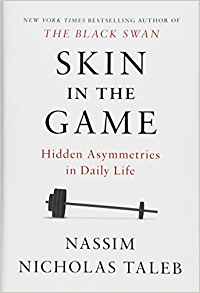 In Skin in the Game Taleb has many, many unusual examples, many of them good; he reads more like an old-fashioned philosopher (that is: one who wants to be read, heard, and understood, as opposed to one who wants tenure), and I mean that as a compliment. One of his rules is, “No person in a transaction should have certainty about the outcomes while the other one has uncertainty.” I wonder how this rule could be applied to colleges, especially under a student-loan system, in which the college is certain to be paid by the student, the student’s family, or the student’s bank (which is really to say, the bank’s student), while the student may see a variable return on investment—especially if the student is ill-equipped in the first place. Colleges may be selling credentials more than skills. But almost no one thinks about those things in advance.
Skin in the Game will, like Antifragile, frustrate you if you demand that every single sentence be true and useful. Some of Taleb’s micro-examples are bad, like his thing against GMOs:
In my war with the Monsanto machine, the advocates of genetically modified organisms (transgenics) kept countering me with benefit analyses (which were often bogus and doctored up), not tail risk analyses for repeated exposures
This view is incoherent because virtually every food eaten today has been “genetically modified,” inefficiently, through selective breeding. If you wish to learn just how hard this is, see The Wizard and the Prophet by Charles Mann. Transgenics speed the process. See this sad tale, and the links, for one researcher in the field who is giving up due to widespread opposition. He points out that, over and over again, transgenic have been shown to be safe.
Taleb is right that there are tail risks to transgenics… but that’s also theoretically true of traditional cross-breeding, and it’s also true of not engaging in transgenics. The alternative to high-efficiency transgenics is environmental degradation and, in many places, starvation. That’s pretty bad, and there’s a serious, usually unstated, environmental trade-off between signaling environmental caring and opposite transgenics (nuclear energy is the same).
Despite incorrect micro-examples, Skin in the Game is great and you should read it. It is less uneven than Antifragile. It’s also an excellent book to re-read (don’t expect to get everything the first time through) because Taleb gives so many examples and is overflowing with ideas.
Like: “If your private life conflicts with your intellectual opinion, it cancels your intellectual ideas, not your private life.” Something easily and frequently forgotten, or never considered in the first place. Look at what people do, not what they say. One of the many charming parts of Alain de Botton’s The Consolations of Philosophy is the apparently wide gap between what many philosophers wrote and how they appeared to live. Maybe the truest philosophers don’t write but do.
Or consider:
the highest form of virtue is unpopular. This does not mean that virtue is inherently unpopular, or correlates with unpopularity, only that unpopular acts signal some risk taking and genuine behavior.
A very Peter Thiel point: he asks what popular view is wrong and what unpopular views a given person holds.
Or consider:
The only definition of rationality that I’ve found that is practically, empirically, and mathematically rigorous is the following: what is rational is that which allows for survival.
This may be true, but most of us in the West now survive, unless we do something truly stupid, dangerous, or brave. So our wealth and comfort may enable us to be irrational, because we’re much less likely to pay the ultimate penalty than we once were. Darwin Awards aside, we mostly make it. We can worry more about terrorism than the much more immediate and likely specter of death in the form of the car, which kills far more people every year in the United States than terrorism.
To his credit, though, Taleb does write:
The Chernoff bound can be explained as follows. The probability that the number of people who drown in their bathtubs in the United States doubles next year [. . .] is one per several trillions lifetimes of the universe. This cannot be said about the doubling of the number of people killed by terrorism over the same period.
He’s right that the number who could be killed by terrorism is massive, especially given the risk of nuclear and biological weapons. But the disproportionate focus on terrorism takes too much attention from risks that seem mundane, like getting into cars. Everyone expects to get into car crashes. Perhaps we should be thinking more seriously about that. Too bad almost no one is.
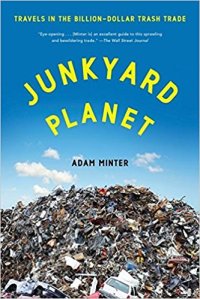 He’s also refreshingly direct about costs and benefits; many writers want to condemn the global recycling trade because of the obvious pollution produced in China. But Minter goes the extra step and asks: why do things exist as they do? Will exist this way in the future?
 Many sections resonate with very current events: “These men really do believe a ragtag army of insurgents can defeat the greatest military power the world has ever seen. The result will be a bloodbath, you know that better than me” could easily be taken from a news story about contemporary Afghanistan. Yet in the context of the novel, it defamiliarizes the tropes that appear so readily in the news.* We also know from the last 50 years of real history that ragtag armies of insurgents can defeat the greatest military power the world has ever seen, at least by some measures of “defeat.” But in Kingdom, that power isn’t the United States; it’s the Roman Empire in the period Jesus lived.
 Although neither book makes this point, I think they’re part of the continuing social reaction to the Industrial Revolution. “What,” you might be thinking, “does the Industrial Revolution have to do with contemporary books on love, marriage, and dating?” Prior to the Industrial Revolution, most societies were (relatively) stable most of the time, at least for the duration of a human life; the technological and social conditions one’s parents faced were likely the same an individual would face and the same that individual’s children would face. Cultural and technological change was of course real for much of human history, but it was also relatively slow, allowing people to acclimate to it over generations instead of years or decades.
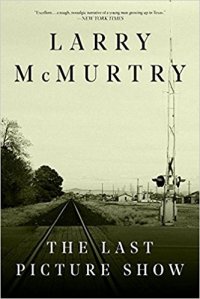 The Last Picture Show feels humane; I can’t exactly define that term in this context and I can’t point to a single sentence that encompasses it, but the feel permeates the novel. When people talk about politically correct art, they are talking about the opposite of The Last Picture Show, which is never doctrinaire yet often honest about its characters their foibles. Maybe the best is Lois, Jacy’s mom, who is scary and desiring and wants everyone around her to fuck off and wants to be gone but never quite can be.
 Implicitly, you could strike the adjective “business” and replace it with a lot of others… or perhaps strike it altogether and still achieve a similar effect. I’ve often felt exactly what Horowitz is describing but never conceptualized it that way. Over and over again, I found myself marking passages and putting checkmarks next to them. In most books, that practice falls off a third of the way through; in this one, I kept going to the very end.
 Persuader is a fairy tale about a knight who is caught between the dark forces of chaos, evil, and greed on the one side and the grinding powers of bureaucracy—FBI and military—on the other. He’s a kind of small-c conservative who is interested in the intensely personal and where it intersects with larger forces of darkness, chaos, and excessive order. Chaos is bad because of the way it destabilizes relationships; excessive order is bad in the Reacher universe because it inhibits Reacher from inflicting his own moral code on the universe, and it’s a universe where the bad guys are conveniently universally bad and the good guys are conveniently universally good.
 We should. For reasons that become apparent as the book moves forward, we may be repeating many histories of mass extinctions. Brannen traces how. Each chapter is set up like a detective story: People figure out that a mass extinction occurred, and paleontologists and geologists have to work backward from crime to culprit, examining various hypotheses along the way. The structure is effective but also difficult to excerpt.
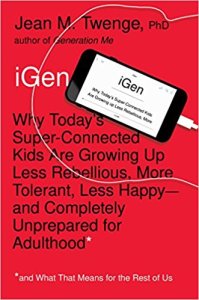 Oddly, in some ways those early criticisms were right, just too early: as a society we have largely secularized, and, although I wouldn’t lay all or even most of the reason why on the novel as a genre, it likely played a role by more freely disseminating information and letting people think for themselves, rather than having the clergy do all the thinking and information dissemination from the pulpit. When you let people think and read for themselves, many of them become less enamored of tedious religious works and the fellows who interpret those religious works to mean that giving to the church is good and sex is bad—very, very bad.
 The Story's Story