Dune — Frank Herbert

Unlike, say, Ray Bradbury and or Dan Simmons’ novels, the Dune series is probably best appreciated before one’s literary taste has better developed. It still offers some treats like a plot that moves worlds, which begins with a deadly test that, even if we know Paul Muad’dib will pass, still offers immediate tension reminiscent of the later His Dark Materials trilogy.

Granted, some of the motives regarding moves and action don’t stand up to great scrutiny—why go to Arrakis in the first place, again?—but writing that isn’t actively abhorrent. Dune does some things really, really well—most notably its descriptions of cognitive states, which have the subtlety and nuance absent from the many, many moments when the book drops into characters’ mind to telegraph what they’re feeling instead of letting us infer it. Thufir Hawat, one of the many guards and weapons masters, thinks:

He might be at that, Hawat thought. That witch-mother of his is giving him the deep training, certainly. I wonder what her precious school thinks of that? Maybe that’s why they sent the old Proctor here—to whip our dear Lady Jessica into line.

Somehow we need to be immersed in the world and given information about it, but this seems a clumsy and transparent way of doing it—and it persists through the novel, and most of the time it conveys that we’re not smart enough to understand the characters without their little soliloquies. We’re constantly hearing about how “This must not get out of hand” even when the need is already obvious. The Harry Potter series is guilty of the same problem, as revealing too much about characters while simultaneously making them flat, stealing the mystery that might otherwise make us interesting. Hamlet’s soliloquies make him less scrutable and more real; Hawat and Paul’s have the opposite effect.

Perhaps not surprisingly, much of the dialog clangs, whether it’s within or spoken. Early on, we’re treated to standard fantasy/sci-fi pablum about independence and caring:

“The old woman’s voice softened. “Jessica, girl, I wish I could stand in your place and take your sufferings. But each of us must make her own path.”
“I know.”
“You’re as dear to me as any of my own daughters, but I cannot let that interfere with duty.”

We could be in a Marine barracks, or a royal court, or a foreign planet, or a softball game, or any number of other places. This extends to the characters. The villains are irredeemably evil and cruel, taking obvious delight in those traits like a child with an over-sized ice cream. They’re more laughable than anything else, but they never laugh at themselves—how could they and maintain their dignity?—but no one else laughs at them either.

The entire absence of laughter makes Dune harder to take than it might have been in the past. The poignancy of its lack is most notable when references appear, like this one: “Paul held himself apart from the humor, his attention focused on the projection and the question that filled his mind.” But Paul never becomes part of the humor, and neither does the reader. We’re too busy being bombarded with relentless seriousness and nobility, like a 15th Century morality play. Destiny is so important that one can ignore life. Honor and codes are everything.

We’ve taken that 15th Century attitude and brought it forward thousands of years; Paul kills a woman’s husband and is asked by one of the many Noble Savages on Arrakis, “Do you accept Harah as woman or servant?” Maybe one should ask her. Maybe she should read The Feminine Mystique and ask herself if she should submit to cultural imperatives making her property to whichever buck has the biggest horns. But it’s not her place to grow—not in this narrative, or at least not in a meaningful way, and we’re not supposed to feel for her: we’re with Paul Muad’dib and his seductive powers, which give Dune its chief pleasures as he overcomes obstacle after obstacle, both physical mental, the two forming a dialectical cycle that, once begun, will of course break all the rules, as we would like to.

The issues I raise aren’t new ones, and their basic contours were known long before Dune was published. Anatomy of Criticism, Northrop Frye writes:

It is… quite possible to take the alazon [which Frye says “means imposter, someone who pretends or tries to be something more than he is”] at his own valuation: this is done for instance by the creators of the inscrutable gloomy heroes in Gothic thrillers, with their wild or piercing eyes and their dark hints of interesting sins. The result as a rule is not tragedy so much as the kind of melodrama which may be defined as comedy without humor.

Alas, that’s Dune to the experienced reader: comedy without humor because the characters are too busy posturing to perceive their ridiculousness; they can’t see their own situation and so are affected by grandiose myopia. That seems common in descriptions of modern dictators as well; Mark Bowden’s Tales of the Tyrant describes Saddam Hussein as suffering from the same ailment. In Dune the heaviness of “dark hints of interesting sins,” or at least knowledge, is pervasive, though I didn’t have language in which to put the problem properly until I read Frye, giving better form to the ideas that had plagued me without resolution.

Although it’s unfair to say so, it seems that a great deal of fantasy has the humor problem, and for all its flaws one advantage of Harry Potter is that momentous prophecy is leavened with a sense of schoolyard folly. Lord of the Rings has Sam Gamgee and other hobbits to alleviate the gloom. Dune becomes ponderous by comparison, with characters’ religious roles of honor, death, need, and codes, as if the whole of 20th Century criticism and aesthetics hadn’t happened. This is, I suspect, the quality that science fiction and fantasy detractors point to when denigrating those two forms of literature, but just because the forms the genres tend to take are weak doesn’t mean the genres themselves have to be: their best practitioners avoid the Dune problems, or outgrow them. Some phrases, like the famous mantra that fear is the mind killer, have staying power.

Dune still has flair, but not the sense of inexhaustible possibility that a novel needs to endure over a lifetime or through generations. On re-reading it, the book feels exhausted, superseded, an artifact from an earlier age rather than a living story. I wish it were otherwise.

EDIT: See also this post on Dune and its laughable honor code.
America’s War on Sex — Marty Klein

I read—or, rather, skimmed—Marty Klein’s America’s War on Sex based on a recommendation I now regret following. The book is a shrill manifesto regarding the “culture wars,” complete with an unappetizing name for the opposing side (“erotophobes”), military rhetoric (“Battleground: Adult Entertainment”), and specious reasoning that assumes you’re already a believer.

America’s War on Sex implies a vast oppositional conspiracy and portrays itself as a lone David wielding the staff of reason; one particularly ludicrous section begins, “The Sexual Disaster Industry (SDI) involves federal and local government, conservative religion, so-called morality organizations, right-wing think tanks, victim-parade daytime talk shows like Montell and Maury, and news programs looking for a bump (‘Isn’t it awful the way people go to strip clubs? Film at 11!’).” Add in the Illuminati and Knights Templar and you’ve practically got a Dan Brown novel.

If there is a “War on Sex” in America, it’s being fought with the same competence as the war on drugs, or the wars on various other nebulous, abstract concepts that are announced from time to time. This seems a useless salvo in the “culture war” that seems chiefly a product of journalists and think-tankers who need subjects to write about. One of the few positive results of the current economic climate is that “culture war” coverage has receded as an unusual, rarely noticed phenomenon known as “real problems” have begun to dominate the news.

America's War on Sex — Marty Klein

I read—or, rather, skimmed—Marty Klein’s America’s War on Sex based on a recommendation I now regret following. The book is a shrill manifesto regarding the “culture wars,” complete with an unappetizing name for the opposing side (“erotophobes”), military rhetoric (“Battleground: Adult Entertainment”), and specious reasoning that assumes you’re already a believer.

America’s War on Sex implies a vast oppositional conspiracy and portrays itself as a lone David wielding the staff of reason; one particularly ludicrous section begins, “The Sexual Disaster Industry (SDI) involves federal and local government, conservative religion, so-called morality organizations, right-wing think tanks, victim-parade daytime talk shows like Montell and Maury, and news programs looking for a bump (‘Isn’t it awful the way people go to strip clubs? Film at 11!’).” Add in the Illuminati and Knights Templar and you’ve practically got a Dan Brown novel.

If there is a “War on Sex” in America, it’s being fought with the same competence as the war on drugs, or the wars on various other nebulous, abstract concepts that are announced from time to time. This seems a useless salvo in the “culture war” that seems chiefly a product of journalists and think-tankers who need subjects to write about. One of the few positive results of the current economic climate is that “culture war” coverage has receded as an unusual, rarely noticed phenomenon known as “real problems” have begun to dominate the news.

Columbine — Dave Cullen

Dave Cullen’s Columbine debunks many of the myths that help us make sense of Columbine as a disaster but that aren’t actually correct, and his book lays what seems sure to be the definitive account of both what happened and what lessons one should take.

Lies connecting the shooters with dislike for jocks, homosexuality, trench coats, violent video games, and more fall under Cullen’s research scythe. In one instance, he cites media portrays as showing that:

[Columbine] was terrorized by a band of reckless jock lords and ruled by an aristocracy of snotty rich white kids in the latest Abercrombie & Fitch line.
Some of that was true—which is to say, it was a high school. But Columbine came to embody everything noxious about adolescence in America.

In other words, the massacre quickly came to be symbolically imbued with fears and thoughts and desires regarding a range of subjects disconnected from what actually occurred. That pernicious effect isn’t just problematic because it’s wrong—it’s problematic because it fails to teach what one should learn from Columbine, like what to look for in dangerous teenagers, how to respond to such dangers, and the like. One painful moment comes early in Columbine, when a police officer named Deputy Gardner “followed protocol and did not pursue Eric inside” the school on April 20.” It seems like a minor detail, but the protocol was wrong: he should have attacked given that active shooters were inside. Today, he probably would, and Cullen details how the change in protocol occurred and its impact.

One problem with Columbine reporting is that the media and the public at large sought and still seek scapegoats. For example, in one survey Cullen cites, the parents of Klebold and Harris “dwarfed all other causes” for the massacre, “blamed by 85 percent of the population in a Gallup poll.” No wonder they hired attorneys. But the two killers lead relatively normal lives: their parents were together and nothing they did seems to have any relation to their children’s decision to murder. The parents might have responded more harshly to earlier infractions, but problems with school administrators and the like aren’t uncommon. Nothing probably would’ve helped Harris at the time if he was a psychopath. As a result, Cullen shows that searching for a single answer regarding why they acted is wrong—the question is why each acted individually, which an FBI agent named Dwayne Fuselier realized almost immediately.

What drove Harris is clearer than what drove Klebold. Harris was a psychopath, and Cullen gives a weak description of what that means on page 187 (“Psychopaths appear charming and likable, but it’s an act. They are coldhearted manipulators who will do anything for their own gain”) but makes up for it with a much stronger, fuller definition on page 242. A New Yorker article “Suffering Souls” complements Columbine by explaining what a psychopath is in greater detail.

Klebold, however, remains more enigmatic. He was depressed and apparently weak-willed, allowing him to be dominated by Harris. Depression and social problems haunted him. He’s harder to describe for that reason, and because a relatively simple diagnosis eludes him, it’s hard to say as much about him in such a short space and still convey a sense of the book.

Columbine is filled with fascinating details. Cullen observes that “Kids nearly always leak. The bigger the plot, the wider the leakage.” Klebold and Harris leaked all over the place, but too few people took them seriously, and what’s most significant is that the few who did so were ignored. The institutions that come off looking worse in this book are the Jefferson County Sheriff and Police offices, both of which are implicated in, by order of decreasing importance, information coverups, disseminating false information, and reacting slowly to the event itself. They kept avoiding information release until forced to via lawsuit, denying the families of victims knowledge about the case, out of a combination of incompetence and fear. Stories like this make “The Agitator” an important blog.

There are other examples of lies and tawdriness. Cassie Bernall died in the attack, and her parents capitalized by publishing a book called She Said Yes claiming that Bernall was shot for answering in the affirmative when asked if she was a Christian. Even when it became clear this hadn’t happened, her youth pastor, Dave McPherson, said that churches and publishers would ignore the story. He was right.

Just below the section about information leakage, Cullen says that “Oddballs are not the problem. They do not fit the profile. There is no profile.” (emphasis in original). It’s the same conclusion Malcolm Gladwell described about profiling any sort of criminal in “Dangerous Minds” for the New Yorker. The stereotypes create false leads. The only consistent finding Cullen notes is that “All the recent school shooters shared exactly one trait: 100 percent male,” although since then he says a few female shooters have appeared.

In Columbine, we learn everything about what happened, a vast amount about the aftermath, and a great deal about “why,” but also that we’ll never get to a perfect answer about why some people commit crimes like the Columbine massacre while others in similar circumstances don’t. He tries to answer the question in When kids become mass murderers for Salon.com, but even then we’re left with incompleteness (he’s also interviewed interviewed at Salon, where many of his early pieces about Columbine were published). Despite knowing all the facts, some events retain their inner mystery—perhaps explaining our collective fascination with them.

Michael Crichton — Congo, Sphere, and Eaters of the Dead

Curiosity and recommendations inspired me to read Michael Crichton, if one can really call that activity reading, because he isn’t a very good author; as far as I can tell, his one claim to literary style or merit is Eaters of the Dead, a decent novel with a structure that compensates for Crichton’s weaknesses.

Reading Crichton came in part for reasons mentioned in “On books, taste, and distaste,” where Jason Fisher asked:

Do you do any reading purely for non-intellectual pleasure, I wonder? I, for instance, read Palahniuk novels, Crichton novels too, and pulpy fantasy and science fiction, and so on. I know this isn’t great literature, but because I know that, and don’t expect it to be, I can enjoy it for what it is.

I answered, “probably,” but noted that a book needs to reach some baseline level of linguistic and literary skill before I could enjoy it. But most of Crichton’s work doesn’t get there, and I agree with Martin Amis’ comment:

That Michael Crichton gets on any lists is a bad sign: the best review I’ve seen of his wildly popular and equally wildly uneven, and usually bad, work is in Martin Amis’ The War Against Cliché, when he praises Crichton at his best as “a blend of Stephen Jay Gould and Agatha Christie” and then discusses what’s wrong in the context of The Lost World, but it could be transposed to most of his Crichton’s novels:

The job of characterization has been delegated to two or three thrashed and downtrodden adverbs. ‘Dodgson shook his head irritably’; ‘ “Handle what?” Dodgson said irritably.’ So Dodgson is irritable. But ‘ “I tell you it’s fine,” Levine said irritably.’ ‘Levine got up irritably.’ So Levine is irritable too. ‘Malcolm stared forward gloomily.’ ‘ “We shouldn’t have the kids here,” said Malcolm gloomily.’ Malcolm seems to own ‘gloomily’; but then you irritably notice that Rossiter is behaving ‘gloomily’ too, and gloomily discover that Malcolm is behaving ‘irritably.’ Forget about ‘tensely’ and ‘grimly’ for now. And don’t get me started on ‘thoughtfully.’

I wish this criticism from Amis weren’t representative weren’t representative. In Sphere, for example, take this passage of 429 of my edition: “Norman felt dull and slow.” “Norman mumbled something, and he vaguely felt Beth grab him strongly by the arm…” “He felt numb and stupid.” “They were under the airlock, and he began to feel surging currents of water. There was something very big out there.” “… Fletcher gripped him with strong arms…”

Apparently Norman feels everything but emotion or any larger sense of himself. If this is supposed to show him being numb, it fails, because there’s insufficient variation in register throughout the novel to even notice the change. Later, this fine sentence intrudes: “There was something very big out there.” Really? Is that the best you can do? What makes it big? What does the horror of sensing that thing outside feel like? Actually, don’t tell us what it feels like if you’re going to tell us in the same way as the passage quoted above. Crichton never moves beyond this. His plots move, yes, but it takes more than plot alone to keep me interested. I’m not in the same category as James Wood, who says in How Fiction Works that “[…] the novel soon showed itself willing to surrender the essential juvenility of plot,” which I think utterly wrong and will no doubt write about in greater detail elsewhere. Still, a novel needs more than plot to live sufficiently to move me; it needs… everything in an alchemical mix without a perfect recipe.

Crichton isn’t a very good writer under most circumstances. There are writers with strong senses of plot, motion, and characterization who are very good, the most obvious example being Elmore Leonard. Carl Hiaasen’s better books fall into that category too. They’re both pop writers, but they’re good; they don’t redundantly use the same words over and over again, and they’re subtle in ways Crichton almost never is. Leonard would never write a passage as bad as the one quoted above. Ian McEwan’s novels are tightly plotted, as are many of Graham Greene’s and Philip Pullman’s. The difference between Crichton and those other authors is that they go far beyond plot. Paragraphs like this, from Congo, are just unacceptable and too common:

The large male moved menacingly toward Peter, but he never took his eyes off Amy. Amy watched him without response. It was a clear test of dominance. The male moved closer and closer, without hesitation (219).

A more skilled writer would have made us know “menacingly,” without the adverb, avoided the “Amy. Amy” repetition, and not told us about the test but let us discover the test. And if the male is moving closer and closer, implying stops or at least motion, then it seems unlikely that he’d move without hesitation. I feel like I’m repeating myself because I am; it could be argued that I’ve taken examples out of context and treated them unfairly, or that the narrator’s voice is repetitive and unimaginative because he’s being attacked by apes, or a giant squid and in cold water, or whatever other attacking monsters inhabit Crichton’s novels. I don’t think it really matters. For a novel to be merely entertaining, as opposed to something else, it must at least not be actively bad, even if its prose doesn’t remind one of T.C. Boyle or Saul Bellow or Robertson Davies.

Still, in at least one circumstance Crichton makes us forgive him. Eaters of the Dead is told from the perspective of a medieval wayfarer from 921. He’s in a foreign country and obviously wouldn’t have the highly developed style one expects of contemporary novelists, and the documentary apparatus / frame story surrounding the book, complete with scholarly detritus and explanation, helps to excuse the intentional archaisms. On the journey, we learn:

The ship was fitted with benches for oars, but never were the oars employed; rather we progressed by sailing alone. At the head of the ship was the wooden carving of a fierce sea monster, such as appears on some Northman vessels; also there was a tail at the stern. In water this ship was stable and quite pleasant for traveling, and the confidence of the warriors elevated my spirits.

Like the other two novels in the edition I have, Eaters of the Dead is flat, without any interior light, and characters lack inner being, like a cyborg version of a person. Crichton barely uses metaphor, as if comparing something to another not entirely like it might be too complex. In Eaters of the Dead, this makes sense: the Ibn Fadlan writes long before many of these stylistic conventions re-developed in the West, and he’s probably not the world’s most introspective chap anyway, given that his occupation is killing and pillaging (and probably raping on the side, but we don’t hear about that). At times this kind of writing is fun, like a sugar high, but it’s not genuinely addictive and leaves one feeling empty at the end of its consumption. And it’s not The Name of the Rose, which paradoxically combines modern writing with that of the fourteenth century, giving us a dazzling portrait of both universes at once, like a Photoshop filter turned to 50% opacity.

The final section in my edition of Eaters of the Dead contains a soul-crushing essay on whether the events described would have been historically possible. Once couldn’t imagine such a thing accompanying The Name of the Rose. My question about Crichton’s essay: who cares? It’s a novel. The better question ought to be, “is this novel any good? Why or why not?” But Crichton’s work doesn’t endeavor to undertake that more demanding task, and I suspect that I know history’s answer.

Stumbling on Happiness — Daniel Gilbert

The major takeaway from many of the recent behavioral economics and psychology books that have come out, like Predictably Irrational, The Logic of Life, The Time Paradox, and now Daniel Gilbert’s Stumbling on Happiness, is that we don’t understand ourselves nearly as well as we think we do and simultaneously misinterpret how we should act. The rational actor imagined in the Enlightenment doesn’t seem to be as real as he or she once did.

Stumbling on Happiness is an excellent contribution to this major idea, and the book is better written and better researched than virtually anything else that might be nominally placed in the “self-help” category; indeed, his might be better considered a book about psychology for laymen, and, like Philip Zimbardo, Gilbert manages the transition from research paper to popular book well. Sometimes minor factual issues get in the way of his point, which he often likes to make in a way that can seem glib but is really essential for the “zing” of transmission discussed elsewhere. For example, in the afterward Gilbert writes that “Calculating such odds [regarding future actions based on present conditions] is relatively straightforward stuff, which is why insurance companies get rich by doing little more than estimating the likelihood that your house will burn down, your car will be stolen, and your life will end early.” Except that insurance companies don’t make money primarily for that reason: they make money because they give individuals an out from losses they couldn’t afford to bear alone and because while individual variation is enormous, collective variation is less so. The casino knows nothing about one spin of the roulette wheel, but they know everything about ten million spins.

Maybe it’s unfair to focus on the negative at the front of this essay regarding a throwaway economic observation because Gilbert does so many things right. He helps us think about the way we think about ourselves thinking, consider how we might respond to experiments, and know the potholes in our own mental functioning—like the gap between how we anticipate we’ll feel upon achieving something and how we tend to actually feel. We’re always constructing images of ourselves and anticipating a future that seldom happens as we think it will:

We insist on steering our boats because we think we have a pretty good idea of where we should go, but the truth is that much of our steering is in vain—not because the boat won’t respond, and not because we can’t find our destination, but because the future is fundamentally different than it appears through the prospectiscope.

Given how much humans are good at, the question becomes why we chronically make mistake that we ought to have the cognitive power to realize. But it’s taken until the last few decades for that cognitive power to be applied in ways that do make us realize those mistakes, and it will no doubt take much, much longer for such ideas to diffuse throughout society and the media. Then again, even Gilbert might be making a bias mistake, because it’s not clear how much of his research applies to all humans, or just to humans raised in Western cultures; there might be a bias in that general direction, which he acknowledges in a few places. Still, his big ideas fascinate, as when he says that “… human beings come into the world with a passion for control, they go out of the world the same way, and research suggests that if they lose their ability to control things at any point between their entrance and their exit, they become unhappy, helpless, hopeless, and depressed.” We need control but don’t always exercise it well.

For example, maybe we need to gork how the hedonic treadmill can make us crazed, how unlikely we are to understand what we’ll enjoy (like children (and the double meaning of this is intentional)), and how important it is to stop worrying about what’s outside our ken and start focusing on things that matter to us—and how to expand that ken. Of course, the big problem is that understanding what matters to us isn’t something we’re very good at, just as understanding that we’ll not be as devastated by not getting the job, lover, or acceptance letter we want probably won’t be as important as we imagine it to be. I’m mimicking a Gilbertian habit in the preceding sentence, because he likes cataloging items. At one point, he says that “people often value things more after they own them than before, they often value things more when they are imminent than distant, they are often hurt more by small losses than by large ones, they often imagine that the pain of losing something is greater than the pleasure of getting it, and so on.” Some of those lists are more entertaining than this one because he’ll slip something unexpected in, and the technique itself is useful because he often then goes on to innumerate what exactly he means by each item, given each paragraph, section, and chapter the best of academic structure without the irritating nattering that academic writing often entails.

One such flaw stood out because I might suffer from it. Gilbert says that “committed owned attend to a car’s virtues and overlook its flaws, thus cooking to the facts to produce a banquet of satisfaction…”, making me wonder if I do the same regarding computers, since I’ve mentioned mine, along with their peripherals, several times on this blog. Naturally, I think I’ve made a sound decision and continually evaluate it based on new information, but Gilbert makes me doubt myself—which is a compliment to him—and puts the endless OS X vs Windows vs Linux flamewars in a new context of people tending to talk past one another more than engage in a Platonic or journalistic ideal of objectivity.

It’s useful to note that most of Gilbert’s recommendations are implicit, like the one above; he isn’t necessarily outright demanding anything, except knowledge, which is what most good teachers seem to do; he lets readers figure out what it means to implement advice, and the closing of Stumbling on Happiness fits its theme:

There is no simple formula for finding happiness. But if our great big brains do not allow us to go surefootedly into our futures, they at least allow us to understand what makes us stumble.

The quest to see the obstacles might itself make us stumble at times: we can make ourselves happy by believing that we should be happy, wherever we are and in whatever circumstances we’re in. The question is, why don’t we? Or, rather, why don’t we more often than we do, since dissatisfaction can be a keen motivator for working toward change. But many of us who live in the western world and are beset by existential malaise despite living with material circumstances unparalleled in human history. Now we need guides like this one because the formulas we imagine for success, like wealth, status symbols, and the like, don’t seem to work. Gilbert says that “The greatest achievement of the human brain is its ability to imagine objects and episodes that do not exist in the realm of the real, and it is this ability that allows us to think about the future.” The downside is that we have no surefooted path into the future, and Stumbling on Happiness tells us that’s okay, provided we have the tools to confront that future.

T.C. Boyle — The Women

(Note: I posted along interview with Boyle about his new novel here.)

T.C. Boyle’s The Women begins towards the end, chronologically speaking, and yet it ends with a different kind of end in the form of a fire, which reminds one of the transience of all artistic endeavors. The novel’s structure is appropriate for such a wittily recursive work, in which diva-esque architect Frank Lloyd Wright is examined chiefly through the perspectives of the various women who attracted him (and vice-versa). Those women represent an evolution of his own being, but they never just function symbolically; even the throwaway characters have fabulously apt descriptions attached to them, as when the vindictive Miriam’s attorney is described as having “a low, considered voice, deeply intimate, as if he’d been born to collusion.”

The Women is “written” by the imaginary Wright apprentice Tadashi Sato, and the sophisticated but clear narrative structure could have long academic papers written about it. Tadashi’s his grandson, however, is Irish and has “translated” the book, meaning that Tadashi’s frequent footnotes sometimes deal with the translated aspects of the story, giving at least four levels of frame: from Wright to his wives and lovers to Tadashi to O’Flaherty-San. One need not notice these narrative games to enjoy the novel and its presentation of numerous reactions to the great and greatly narcissistic man at its core. Even calling him a narcissist might be unfair: he’s more a man obsessed by his art, and in that respect virtually everything else comes second or lower. Consequently, what seems like narcissism might simply be drive.

We see Tadashi’s influence in moments like this:

Of course, all this happened a very long time ago and I’m aware that it is peripheral to the task at hand, which is to give as full a portrait of Wrieto-san as I can, and I don’t wish to dwell on the negative, not at all. Suffice to say that I stayed on at Taliesin, grudgingly at first (and perhaps I should have defied Wrieto-San and Daisy’s father and all the rest of the world…).

That, anyway, is the line of reasoning that excuses his sometimes ill behaviors. A less forgiving reader might see him as taking “from the rich and [giving] to himself and he didn’t give a damn about anybody so long as he got what he wanted,” as Miriam thinks in one of her bitter stages. The same could apply to her, since she’s constantly belittling those she considers inferior—which is virtually everything. Miriam thinks of herself as “high, higher than any of them,” with little reason that’s apparent to us. Still, her charges are not utterly baseless despite her grandiose posturing, and the alternate view of Wright sees him using his abilities as a cloak against charges of making and breaking promises with impunity and discarding people like excess building material.

Building metaphors occur throughout The Women and make for an obvious commentary on the artistic process more generally, but Boyle is too canny a writer to make Wright’s “process,” if he has one, explicit. The New Yorker chastised him for this, saying “Unfortunately, the novel avoids any sustained consideration of Wright’s relationship to his art—a passion arguably more important in forming his genius than any of the women in his life were.” But I think that’s part of the novel’s point: an artist’s relationship to his art can’t really be explained or depicted. We can only see its effects, like a black hole whose presence we discern by the debris around it. The metaphor isn’t perfect, since artists throw off light while black holes absorb it, but in Wright’s case he might absorb the personalities of the women and disciples around him. The novel’s fundamental tension revolves around how Wright “really” is versus how he’s perceived, and the novel’s strength comes from leaving that tension unresolved: we’re left with a debate more than a resolution, as we so often are in life. That’s mimesis to the world and faithful to the view of the great artist as inexplicable.

Tadashi sometimes strikes an aggressive posture for a seemingly passive character, but all of his passion shows through passive aggressiveness—perhaps the act of “writing” a history of Frank Lloyd Wright that often doesn’t show him in a flattering light is his ultimate revenge, and one we are meant to see through as we proceed through the novel, and especially in its last pages. Tadashi also undermines some of the novel’s claims; Miriam, Wright and others ceaselessly vilify and try to use the press. At one point, Miriam thinks that, “The papers were full of the story, headlines trumpeting disaster, the least detail pried from the wreckage by the ghouls of the press…” This description might be one of the more charitable considerations of the press. One wonders if Wright would have thought of Boyle what he does of the press, but Boyle has the advantage of writing long after the fact, when a reinterpretation of a figure who slides perilously towards myth can, in turn, re-appropriate that figure for the present. Boyle succeeds in doing so with panache that fortunately defies my analytic descriptions.

Product review: Pens, including the Pilot G2, Uniball Signo, Mont Blanc Extra Fine, and more

EDIT 2014: I’ll skip preliminaries and say that I now use Pigma Micron pens, usually very thin .25 or .2mm, for most purposes. They’re less fussy than the pens below and yield the best, thinnest, most consistent lines. Fountain pens have too many problems for someone like me, who writes on the go and isn’t trying to baby the pen or make it an art object. The discussion below is still valuable.

A good pen is a wonderful thing, and its connection to the right paper is one of those tiny victories that accumulate and sometimes affect us more than the major and obvious ones. I’ve sought such a victory recently: like many people, I become fond of the particular pens I use over time and bond with them, imagining that the pen is an extension of myself. That effect isn’t limited to pens, as my post on keyboards and other tools shows, and I become attached, perhaps irrationally, to the tools I use on a regular basis. Since my life is bound up with writing, such tools tend to mean pens, notebooks, computers, and computer programs.

The difficulty comes in finding the right one. So I decided to try a variety of pens, each of which seemed plausible based on its description and reputation. Part of my contest was inspired by the blog “Rands in Repose,” where a post about the “Joy Vectors” and The Gel Dilemma made me realize I had more choices. In other words, Rands underwent a similar pen crisis to mine. I’ve chiefly used fountain pens over the last few years: I like the way many of them write and didn’t mind the occasional hassles around cleaning, leakage, and upkeep. Somewhere in the last six months, however, the once-minor downsides regarding fountain pens became steadily more acute because I’ve been writing by hand much more often, and the Omas Paragon I began using with Baystate Blue ink has a habit of leaking in a most irritating way.

Moving back to a Mont Blanc Noblesse Oblige solved the problem temporarily, but the cap is loose—requiring a $45 repair to fix it. I don’t feel like paying when disposable pens are readily available and quite inexpensive. And the fountain pens I prefer have extra fine points, which require me to write slightly slower. This isn’t a big deal when you’re chiefly writing notes to yourself or marking your own work, but when I have 50 papers to grade and at least six hours of note taking per week, the difference adds up. If you’re running half a mile, the difference between a 7:10 and a 7:00 minute mile are marginal. Over a marathon, they add up.

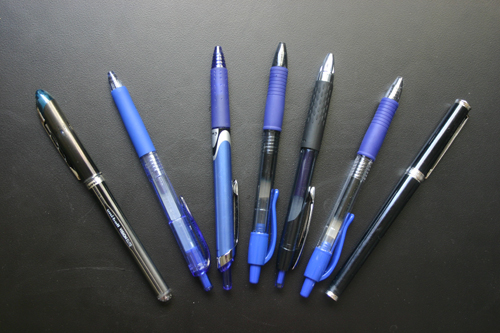
With that in mind, I found the following pens:

pens_2

The contenders include:

* A Uniball Vision Elite Micro .5mm

* A Uniball Signo Gel RT Micro .38mm

* A Pilot Precise V5 RT Extra Fine .5mm

* A Pilot G2 Extra Fine .5mm

* A Uniball 207 Micro .5mm

* A Pilot G2 Ultra Fine .38mm

* The Mont Blanc Extra Fine fountain pen for comparison purposes.

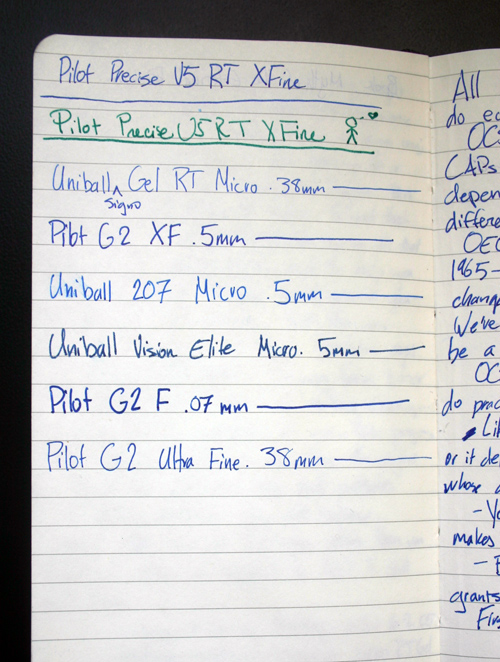
I sought a pen that wrote with a very fine line, had color that didn’t smear or bleed and looked good to me, wrote swiftly and smoothly, and fit my hand. The .38mm pens threw me at first: they seemed like they would be too fine. The following picture shows some of them writing:

notebook_gel_pens_final3

The picture doesn’t convey the thickness of the lines well, but it was obvious that the Pilot G2 Fine .7mm (not pictured among the contenders) was too thick for my purposes. The Pilot Precise wasn’t a gel pen of the sort that seems superior to the others, and the Uniball Vision Elite suffered the same problem: it spread over my moleskine notebook like blood. The Pilot G2 Extra Fine .5mm seemed a tad thick. At the end, I realized that the Signo Extra Micro .38mm, G2 Ultra Fine .38mm, and the 207 Micro .5mm were the best pens of the bunch. Japanese pens seem to be the winners: both Sanford Uniballs and all Pilot pens I tested were made in Japan and seemed to be the best regarded online.

The question: How to choose among them?

I couldn’t decide. All seemed like strong contenders. I didn’t like the 207 Micro housing as much, but it did produce a lovely sky blue color. The Pilot G2 .38mm ultimately seemed darker than I wanted. By process of elimination, I’m going with the Signo RT .38mm for now. For a while I tried swapping the 207 Micro housing with the Signo RT housing, which worked, but I’m not sure I wanted to stay with the .5mm. Thinness counts if I’m going to have any real chance at legibility, and although the .5mm and .38mm were indifferent for most note taking, writing in books with smeary pages made the .38mm shine. I could use one pen for notebooks and another for bound books, but that sounds like more hassle than it’s worth to me. I’ve now been using the Signo RT .38mm for about three weeks, and over the last month I’ve spent about a week with the Pilot G2 .38mm. The two are so close that I could be happy with either, so the .38mm wasn’t far from a coin toss. In the end, I could only pick one.

All the pens survived well. Most packages claimed that the pens would resist alteration. Although I’m not sure what a determined counterfeiter could do, but in these tests by Jet Pens simple water won’t make the ink run. I tried my own test with the finalists and found the same. In addition, Jet says that “The Uni-Ball line is known for its quick drying and waterproof characteristics, making it a favorite among artists.” I’m not an artist, at least in the visual sense, but I do appreciate quick drying and a narrow tip. The Signo RT meets those requirements, and it’s my go-to pen for the foreseeable future.

img_0053-bottom-of-post2

Get Shorty and Out of Sight redux — Elmore Leonard

Two years and change ago I wrote a short post about Elmore Leonard, introducing him by asking “Why is Elmore Leonard so damn good when he’s at his best?” (the linked post has a long passage that’s still among my favorites for its verisimilitude in terms ofs form and content). I still have no answer, but seeing him at the Tucson Festival of Books inspired me to reread Out of Sight, Get Shorty, and Mr. Paradise. At boring panels when I couldn’t gracefully leave, the mass-market paperback edition of Out of Sight helped pass the time, but it’s not the sort of novel one can quit after 60 pages.

Leonard writes women with teeth, which numerous reviewers have noted; as Peter Wolf wrote in 1990, “Since Stick (1983), [Leonard’s] female characters have taken on a dimension rivaling that of his men; as a result, they generate more plot movement and spring more surprises than their earlier counterparts.” Describing just how Leonard does it might demand an entire academic paper; one of my favorite examples popped up in Out of Sight when Karen Sisco, the Marshall, says that, “Once you’re into it and you’re pumped up and you know who the guy is and you know you can’t give him one fucking inch . . . he has the choice, you don’t.” That might be as accurate a comment on human affairs as anyphilosophy book ever written. Or it might be empty pop commentary; another such moment happens when Sisco compares her bank robbing lover, Jack Foley, to Harry Dean Stanton in affect but not looks, saying that they were “both real guys who seemed tired of who they were, but couldn’t do anything about it.” One pleasure of the pulps is the blurred and indistinct line between the profound and silly, and one gets the impression that Leonard doesn’t care about the difference, if there is one.

The same kind of realism pervades Get Shorty. In describing Harry Zimm, Leonard says, “Forty-nine movies and [Harry] looked more like a guy drove a delivery truck or came to fix your air-conditioning when it quit, a guy with a tool kit.” Dropping the “who” and other connectors is a classic Leonard move; it looks ostentatious in a single sentence, as if the novel was poorly edited, but in the context one quickly adapts to the rhythms of speech. Martin Amis’ Money is the only other novel I can think of with so distinctive and vigorous a voice that also succeeds. And notice that description of Harry the movie guy: it’s so good because it’s accurate and tells us that many producer and production people are essentially technicians, and the skills they employ aren’t fundamentally different in deployment than the guy who fixes your car or Xerox. Leonard compresses into a sentence what Julie Salamon conveys without stating in all of The Devil’s Candy: The Bonfire of the Vanities Goes to Hollywood.

Harry is desperate and foolish; when he makes a mistake he’ll rationalize, as he does here after disobeying Chili Palmer’s advice regarding discretion:

“I had to,” Harry said, sounding pretty definite about it. “I’ve got a chance to put together a deal that’ll change my life, make me an overnight success after thirty years in the business. . . . But I need a half a million to get it started.”

In Chris Matthew’s wonderful nonfiction account/short story collection/political primer (the book has elements of all three) Hardball, he has an entire chapter called “Don’t talk unless it improves the silence.” Chili knows that. Harry doesn’t. And yet that quote conveys all of Harry’s greed, desperation and vanity all in one spot, and the link between Hollywood hustlers and drug/mob hustlers is so pervasive and intertwined with this novel that merely pointing it out is almost gratuitous. And yet the section is compelling because one always thinks of that big chance to change your life—what would you do to accomplish it? It’s an enduring question and reminds me of Scott Smith’s A Simple Plan, where the answer seems to stretch a little bit more with each passing act until the answer effectively becomes, “anything.”

Earlier I mentioned that Leonard probably wouldn’t care for elaborate discussion about the difference, if any, between genre and literary fiction. You almost hear his derision through one of his characters when Karen Flores, the woman consistently underestimated as the bimbo, says

I got the feeling the studio forced the script on her and she has to go with it. She said… [the story is] involving, reflective, has resonance, a certain texture—those are all story department words.

All of them are weak, empty synonyms for “I like it.” Why not just say that? Leonard would. Maybe that’s why he can write a novel that so effectively mocks Hollywood, feels some bizarre compulsion to dress its rationalizations—there’s that word again—in jargon to try and prevent people from seeing beneath them. Leonard doesn’t, and I think that’s part of the reason his female characters are so effective when they’re so often props in wiseguy novels: he writes them in with their own desires and hopes and goals, beyond mooning after the hero. They’re competent. So are many of his heroes: competent but flawed describes them well. His writing, on the other hand, is so competent that it transcends competence and becomes nearly flawless. I have a short list of writers whose new books I will buy almost automatically, and Leonard is on it for good reason.

The Reckoning — David Halberstam

David Halberstam’s The Reckoning is too long by at least a third and maybe a half: my copy is a fat mass-market paperback that should probably go on a diet, like the American companies it describes. Learning about the machinations of 1950s Japanese auto unions is both tedious after a time and yet simultaneously lacks the depth it should have. Nonetheless, the book is fascinating mostly because you could take the problems it describes, change some names and dates, republish it today, and find that its issues remain essentially the same. American car companies overproduce giant, gas-guzzling cars and then face problems when competition and market conditions turn against their profit centers. Unions and dealerships make it difficult for such companies to compete. If the major American car companies survive this round of major problems, you can expect the same set of stories in another ten to twenty years.

The book’s many portraits of the intertwining of society and business fascinate. A section on residents of Grosse Pointe, Detroit’s once ritzy suburb, says:

The people who lived in Grosse Pointe were not bored with it, for they knew of nothing else and wanted nothing else. They could not conceive of life being different or better. Billy Chapin—grandson of Roy, the first sales manager of the pioneer Old Motor Company, and son of Roy, president of American Motors—said that the trouble with the awful creamed spinach at the Grosse Pointe’s club was that just about the moment you became influential enough to have it taken off the menu, you found that you liked it.

This piece of writing is brilliant and effective: a generalization rings true in the surrounding context and the anecdote about Chapin shows the community’s wealth and insularity through the microcosm of spinach. Meritocracy hasn’t arrived in Grosse Pointe, or if it once lived there, it has since died and moved out West to Silicon Valley or back East to Boston, where startups congregate Maybe it moved offshore with factories. Wherever it went, it certainly doesn’t live somewhere whose nepotism is as smothered as its spinach.

Others anecdotes and descriptions are less successful. Forty pages later, we learn entirely too much about a manager named Don Lennox, who “[…] simply liked manufacturing, enjoyed making something more than dealing with numbers and paper.” That’s nice in small doses, but the cumulative weight of such observations makes the paperback edition stack up to more than 750 pages including the bibliography. Much of it isn’t directly sourced, but rather narrated like something from a Leon Uris novel.

The sense of heroes and villains could also come from a Uris novel, with the Japanese usually heroes and the bumbling Americans usually not. One American, W. Edwards Deming, is presented in the heroic mode, but the American companies ignore him because they’re too pleased with themselves to listen to his production improvements (contrast that with, say, Wal-Mart, which is so hard to beat because it tries ceaselessly to to lower prices regardless of what its competition is doing). According to The Reckoning, many American companies believed managers to be interchangeable, and

On that subject [Deming] was an angry man. He acknowledged that many important American business educators thought men like him were old fashioned, but he was sure he was right and equally sure there would eventually be a severe punishment for companies that failed to stress quality.

He was right, of course, but that’s much easier to say after the fact when he’s been proven right. How many would-be Cassandras sing their song and turn out just to be naysayers?

The Reckoning could just as easily be called Success is Never Final, since its major theme is that, since World War II, American car companies believed that only broad, flat, and straight highways awaited them. Their attitude and union agreements struck while the good times rolled haunted them and continue to haunt them. The only way to operate at virtually any level, whether as an individual, family, region, or society, is to ceaselessly work toward being the best. But as one achieves that success, the culture underlying it erodes, decadence grows, and soon one’s fatally stricken platform totters.

The bizarre thing about the three American-headquartered companies is that their current problems, as I write this at the dawn of 2009, have been ongoing for 30 years. And they still either haven’t ameliorated their majors problems or are restricted from doing so by their dealer networks and unions. Whichever of those two to three hypotheses is correct, it’s still incredible to consider that such a ridiculous saga continues.

Evidently I’m not the only one who finds The Reckoning depressingly fresh: searching for it and “Halberstam” on Google brings a load of hits relating it to modern problems, like Why David Halberstam’s “The Reckoning” Should Be Mandatory Business School Reading and Halberstam’s “The Reckoning” Still a Must-Read. See a pattern? More generally, Slate’s The Big Money just ran an article called RIP, MBA: The economic crisis has exposed the myth of business-school expertise, the MBA being a symbol of problems with car companies and others, while The Atlantic ran The Management Myth in 2005. The titles of those posts overstate the book’s importance and understate its length—how many must-reads about formerly contemporary issues should really be 750 pages?—but it’s certainly a useful book to skim.

“Halberstam’s ‘The Reckoning’ Still a Must-Read” says that “[Halberstam is widely] recognized for his groundbreaking work, The Reckoning…” Maybe the book broke new ground in 1986, but that it’s still relevant indicates in many ways how far we haven’t come.