Thoughts on Steve Jobs — Walter Isaacson

I don’t think Steve Jobs, seen as a whole package, holds much of a lesson for us mortals, as Gary Stix argues here. Nonetheless, Steve Jobs the book is as fascinating as one should expect. The broad contours of his life and the book’s contents are well known, so I won’t repeat them here; I will note a few things:

1) As early as 1980, Jobs was “thrashing about for ways to produce something more radically different. At first he flirted with the idea of touchscreens, but he found himself frustrated. At one demonstration of the technology, he arrived late, fidgeted awhile, then abruptly cut off one of the engineers in the middle of their presentation [. . . .]” Notice how early he was thinking about a product that didn’t make it into shipping products until 2007. But I’m not that interested in touchscreens because, at least so far, they’re lousy for typing and other kinds of content creation. More than anything else I’m a writer, and I don’t see much use for iPads beyond checking Facebook, reading e-mails, and watching YouTube videos. Maybe they’d be useful as menus and such too. Charlie Stross gets this, and he a) actually has one and b) explains more about their uses and limitations Why I don’t use the iPad for serious writing.”

2) Not all of the book’s writing is great—phrases and ideas are too often repeated, and Isaacson shies from figurative or hyperbolic language, like a 13-year-old not quite ready to approach the opposite sex. Nonetheless, the books has enough evocative moments to balance its stylistic plodding, as in this moment: “Randy Wigginton, one of the engineers, summed it up: ‘The Apple III was kind of like a baby conceived during a group orgy, and later everybody had this bad headache, and there’s this bastard child, and everyone says, “It’s not mine.”‘”

I have yet to see an “individual orgy,” as opposed to a “group orgy,” but the metaphor nonetheless resonates.

3) Jobs didn’t think the same way most of us do about a wide array of topics. He didn’t think like the idiotic managers who think anything that can’t be measured automatically has no value. One can see non-standard thinking that works all over the book—it would be interesting to look too at people with non-standard thinking who fail—and I noticed this moment, at a Stanford class, where Jobs took business questions for while:

When the business questions tapered off, Jobs turned the tables on the well-groomed students. ‘How many of you are virgins?’ he asked. There were nervous giggles. ‘How many of you have taken LSD?’ More nervous laughter, and only one or two hands went up. Later Jobs would complain about the new generation of kids, who seemed to him more materialistic and careerist than his own. ‘When I went to school, it was right after the sixties and before this general wave of practical purposefulness had set in,’ he said. ‘Now students aren’t even thinking in idealistic terms, or at least nowhere near as much.’

Students are too shocked, and by the time they get to me they’re too often well-behaved in a dull way. I’ve mentioned weed in class, and the students are usually astonished. But I remember being a freshman, and most of the shock is undeserved. I went to school at Clark University, where mentions of pot smoking and LSD seemed fairly normal.

“Practical purposefulness” can be impractical when it blinds one to alternative possibilities that the well mannered simply cannot or will not imagine.

4) The last four paragraphs of the book are perfect.

5) Here’s Steven Berlin Johnson on the book; notice:

After devouring the first two-thirds of the book, I found myself skimming a bit more through the post-iPod years, largely because I knew so many of the stories. (Though Isaacson has extensive new material about the health issues, all of which is riveting and tragic.) At first, I thought that the more recent material was less compelling for just that reason: because it was recent, and thus more fresh in my memory. But it’s not that I once knew all the details about the battle with Sculley or the founding of NeXT and forgot them; it’s that those details were never really part of the public record, because there just weren’t that many outlets covering the technology world then.

This reminded me of a speech I gave a few years ago at SXSW, that began with the somewhat embarrassing story of me waiting outside the College Hill bookstore in 1987, hoping to catch the monthly arrival of MacWorld Magazine, which was just about the only conduit for information about Apple back then. In that talk, I went on to say:

If 19-year-old Steven could fast-forward to the present day, he would no doubt be amazed by all the Apple technology – the iPhones and MacBook Airs – but I think he would be just as amazed by the sheer volume and diversity of the information about Apple available now. In the old days, it might have taken months for details from a John Sculley keynote to make to the College Hill Bookstore; now the lag is seconds, with dozens of people liveblogging every passing phrase from a Jobs speech. There are 8,000-word dissections of each new release of OS X at Ars Technica, written with attention to detail and technical sophistication that far exceeds anything a traditional newspaper would ever attempt. Writers like John Gruber or Don Norman regularly post intricate critiques of user interface issues. (I probably read twenty mini-essays about Safari’s new tab design.) The traditional newspapers have improved their coverage as well: think of David Pogue’s reviews, or Walt Mossberg’s Personal Technology site. And that’s not even mentioning the rumor blogs.

So in a funny way, the few moments at the end of Steve Jobs where my attention flagged turned out to be a reminder of one of the great gifts that the networked personal computer has bestowed upon us: not just more raw information, but more substantive commentary and analysis, in real-time.

Except I’m a native to this environment: by the time I came to be cognizant of the world, this was already, if not a given, then at least very close. The later sections of the book had the feel of stuff I’ve already seen on the Internet, and much of the most interesting work analyzing Steve Jobs’ personality, predilections, and power had been done earlier.

To some extent, it’s always easier to chart rises than plateaus, and this is certainly true in Jobs’ case. The very end of Steve Jobs described the steps he’s taken to try ensuring the company continues in the mold of a company capable of producing great stuff—unlike most companies, which slowly come to be ruled by bean-counters and salarymen. Japanese companies like Sony are instructive here: Akio Morita‘s departure from the company coincided with its stagnation, which is most evident in its failure to see the iPod coming.

6) There are many subtle lessons that would be easy to miss in Steve Jobs and from Steve Jobs.

Is There Anything Good About Men?: How Cultures Flourish by Exploiting Men — Roy Baumeister

I would emphasize this, from Arnold Kling, about Is There Anything Good About Men?: How Cultures Flourish by Exploiting Men:

1. If you are a zero-tolerance reader (“I stopped reading on page 9, because he said X, which is obviously wrong, so I figured there was no point in going any further”), then don’t pick up this book. If you are going to finish it, you have to follow almost the complete opposite approach. “Even if a lot of this is wrong, what insights can I take away?”

And there are a lot of ideas per word and little wasted space, especially because Baumeister goes out of his way to avoid dogmatic thinking, which he says overtly:

This book is not about the “battle of the sexes.” I’m not trying to score points for men against women, or vice versa. I don’t think the “battle” approach is healthy. In fact, I think the idea that men and women are natural enemies who conspire deviously to exploit and oppress each other is one of the most misguided and harmful myths that is distorting our current views about men and women.

That being said, Is There Anything Good About Men? has an unfortunate title but many of those deep “insights” worth exploring—and perhaps an equally large amount of unsupported bullshit. It’s frustrating, for example, to see issues like one on page 54 of the hardcover edition, where Baumeister’s claims about sex drive differences between men and women have no citations to actual underlying research. Nonetheless, it’s hard to conclude that men don’t have, on average, a higher desire for sex more often and with more partners than women do; the very structure of dating markets points to this idea. He does cite work later in the book, but why not cite it when the issue is first raised?

But most of the ideas are implications are better; it’s hard to choose among his many observations to discuss in a short blog post, but here’s one I find intriguing; apologies for the length of the quote:

Mostly, men had recognized that dangerous jobs fall to them and, more important, that to be a man they have to accept them. Whether this will continue is not entirely clear. Today’s men are brought up on a rhetoric of equality, and at some point they may balk at letting women be exempted from certain unpleasant tasks.

Even more important, the psychological processes that enable men to do the dangerous jobs may be weakened. Men of past eras were famously out of touch with their feelings. Today’s men are brought up to be more like women, and that includes becoming more conversant with their own emotions. But might that undermine the ability to make themselves do what needs to be done?

To do the dirty or dangerous jobs, you have to put your feelings aside. Being a man in that sense meant that you focused on the task at hand. It meant others could count on you not to let your emotions interfere with getting the job done. One reason traditional societies put those jobs on men was that women might be too fearful or squeamish or tentative to do them. Traditional men weren’t supposed to admit to having such feelings. Yet nowadays we encourage young men to revel in their feelings. Having uncorked the emotional bottle, can we count on the men to stuff the feelings back inside and cork them away when we need them to do so?

The traditional male role has had definite privileges, but it also had duties and obligations. Our culture has come far along in doing away with those privileges. It has been slower about equalizing the duties and obligations. (to quote [Warren] Farrell once more, ‘Women have rights. Men have responsibilities.’) As we make men more like women and remove their traditional privileges, they may begin to object more strenuously to the duties and responsibilities. The obligations of fatherhood weigh far less on today’s man than on earlier generations, as indicated not least by the increasing numbers of men who abandon pregnant girlfriends or small children.

In other words, whatever the rhetoric that gender writers may espouse, when men and women face real problems and dangerous situations, men still tend to get the dirty and dangerous jobs. Equality is fine when it only means the good stuff, but when there’s a strange noise downstairs or coal mines to be stripped, guys still end up there. On the flipside, however, it may also be that society is evolving away from a space where men need not have feelings and toward one where men having feelings is more beneficial than it was in the past.

We may be seeing cultural evolution, live, even as people fight over whether it’s happening and, if it is, what it might mean. The “traditional male role” might be changing or evolving, and its supposed “privileges” or lack thereof too. See, for example, “Sex Is Cheap: Why young men have the upper hand in bed, even when they’re failing in life from Slate.com. Given the choice between coal mining and war or video games and babes in skirts, I suspect most men would rather get in touch with whatever their feelings might be and assume the latter.

You can see other examples of cultural evolution: I’ve been watching The Sopranos lately, and the tension between the “do what needs to be done” aspect and Tony’s supposed feelings and nostalgia for the maybe good-old-days, when men were men, makes The Sopranos intriguing: Tony continuously hearkens back to his father’s time, when men didn’t have (or at least show) feelings; by contrast, he’s being treated by a female therapist, who helps him explore repressed feelings that manifest themselves in dreams and panic attacks.

For whatever this passage might be worth, however, I don’t love the writing itself: vague mentions about “corking” and “uncorking” feelings among “the men” is too abstract for my taste: if this were a freshman’s paper, I’d write as much in the margins and encourage the writer to think about what, precisely, this means for individuals. Even if I know what it means, I can see reasons why it might help for men to uncork their feelings. Consider the experience of World War I, which shows the problems of men not being willing to express fear or tentativeness and willingly walking to their own deaths for no cause at all: that stupid, destructive, largely pointless war occurred in part because men were willing to let themselves be mass-brainwashed into walking into their own deaths for no reason, directed by ignoramuses who’d failed to realize that the nature of warfare had changed and that 19th Century infantry tactics will not merely fail, but fail spectacularly against 20th Century weaponry. So before we romanticize a lost era of male stoicism, let’s remember some of its costs, too, and the fact that turning off feelings and empathy may also allow men to do the many barbaric and cruel things men do.

There are other social changes, too: notice that the state is far more willing to pick up the slack for “pregnant girlfriends and small children,” which changes incentives for men and women; in addition, women appear to be much more willing to dump men who don’t suit their needs than they once might’ve. They write long articles that get turned into books like Marry Him: The Case for Settling for Mr. Good Enough that are all about female unwilligness to compromise. It’s also become much more obvious that women do not always tell the truth about fatherhood, and it’s hard to read articles like “How DNA Testing is Changing Fatherhood” and not realize what’s at stake:

Over the last decade, the number of paternity tests taken every year jumped 64 percent, to more than 400,000. That figure counts only a subset of tests — those that are admissible in court and thus require an unbiased tester and a documented chain of possession from test site to lab. Other tests are conducted by men who, like Mike, buy kits from the Internet or at the corner Rite Aid, swab the inside of their cheeks and that of their putative child’s and mail the samples to a lab. Of course, the men who take the tests already question their paternity, and for about 30 percent of them, their hunch is right.”

It’s possible in many states for a man who signs a child’s birth certificate to be responsible for paying that child’s mother for eighteen years even if that child isn’t his. That’s not an optimal way to encourage male responsibility or eagerness to support Baumeister’s pregnant girlfriends. But Baumeister doesn’t quite this far.

Nonetheless, his central insights about the sexes facing potential trade-offs that guide median preferences is fascinating and possibly true. Notice the language in the previous sentence: “trade-offs” and “median preferences,” rather than saying all people are this way or that way. From that one can extrapolate to current cultural conditions.

I would guess that Baumeister, like me, wants equal opportunities in all parts of life, but he would also point out that equal opportunities doesn’t mean people will want the same things. Men, in his viewing, are optimized towards risk taking; DNA analyses indicate that we’re descended from 40% of the men who ever lived but 80% of the women. Which means the median man died without reproducing and the median woman did. Which means the median man has an evolutionary incentive to take risks, given that his outcome if he lost the gamble was zero but so was his outcome if he didn’t take the gamble at all. Hence the hierarchies in all parts of life that men love to set up; Baumeister eventually says: “The pyramid of success is steep and cruel. Nature dooms most of the males to fail but impels each of them to try to be the one.”

I do not think most women appreciate that. Which isn’t to say most men appreciate what it’s like to experience female incentives, costs, and desires. One of the more unusual nonfiction books I’ve read attempts to do exactly that: Norah Vincent’s Self-Made Man, in which she (a lesbian in “real life,” for lack of a better term) dresses and goes about life as a man for about a year. Baumeister says:

One of the most interesting books about gender in recent years was by Norah Vincent. She was a lesbian feminist who with some expert help could pass for a man, and so she went undercover, living as a man in several different social spheres for the better part of a year. The book, Self-Made Man, is her memoir. She is quite frank that she started out thinking she was going to find out how great men have it and write a shocking feminist expose of the fine life that the enemy (men) was enjoying.

Instead, she experienced a rude awakening of how hard it is to be a man. Her readings and classes in Women’s Studies had not prepared her to realize that the ostensible advantages of the male role come at high cost. She was glad when it was over, and in fact she cut the episode short in order to go back to what she concluded was the greatly preferable life as a woman. The book she wrote was far different from the one she planned, and any woman who thinks life is better for men will find it a sobering read.

He goes on to say that men and women don’t have it “better” than each other per se; they have it different, and his book is, among other things, an attempt to explain why.

Baumeister also said something that, incidentally, reminded me of a potential weakness of the novel as a genre, and that I’ve been thinking a lot about lately: “If you consider the problems facing the world today (e.g., global warming, terrorism, pandemics), you can see that they are not likely to be handled by single persons—more likely by large and complex networks of organizations.” One problem for novels is that they focus on individuals and small groups; it’s very hard for a novel to address very large-scale issues save in the context of an individual or small group. Think of how Ian McEwan’s Solar uses Michael Beard and his foibles to discuss some of the technical challenges around global warming.

This may explain why many men prefer nonfiction to fiction: nonfiction is more easily dedicated to large, abstract ideas and organizations potentially involving thousands or millions of people. Fiction is intimate, self has more than a half dozen major characters, and often focuses on a single or small number of very intimate relationships. The fiction that men prefer on average—Elmore Leonard, murder mysteries, and so forth—often involve a single protagonist who is matching wits and brawn with a single antagonist or series of antagonists, which he must confront using an array of shallow connections to many people.

Kitchen Confidential: Adventures in the Culinary Underbelly — Anthony Bourdain

Kitchen Confidential: Adventures in the Culinary Underbelly is as good as a lot of people say it is, which is pretty uncommon. It moves quickly and cleverly: as a young man, Bourdain observes an older cook’s hands, which “looked like the claws of some monstrous science-fiction crustacean, knobby and calloused under wounds old and new.” Notice that word, “crustacean,” and how well it fits, especially since the kitchen is making seafood. The memoir is filled with evocative and expressive moments like that. I’m tempted to start listing them. But that would spoil the surprising pleasure they offer on the page.

There’s a moment when Bourdain points out one of the problems with writing about something as sensual as food, since you can never taste the food through words:

. . . the events described are somehow diminished in the telling. A perfect bowl of bouillabaisse, that first, all-important oyster, plucked from the Bassin d’Arcachon, both are made cheaper, less distinct in my memory, once I’ve written about them.

But the problem of something becoming “somehow diminishing in the telling” or “cheaper, less distinct in my memory” are perils not only of the food writer, although he might be particularly sensitive to them, but to the writer of almost any genre. Tactile sensations like food, sex, water, and the like might be especially susceptible, but even our descriptions of our thoughts are probably different once we’ve “written about them.” But writing about them is the only effective way we have of communicating them to others. And Bourdain is very, very good at that communication. I never thought I cared about what it was like to work in a kitchen, or about the tribulations of the chef. I didn’t realize just how dramatic being a chief could be. Now I understand, and am slightly closer to understanding the fascination with cooking TV shows. I say “closer,” however because I’d still rather be in the kitchen with knife and spatula at hand than watching someone else in the kitchen, much as I’d rather be on the field with a soccer ball at my feet than playing the FIFA soccer video game.

I come out of Kitchen Confidential with a sense that I’ve read a religious story, in which the wayward one day finds God. Except most of us moderns don’t really find God, but we find something abstract to serve, and that something is greater than ourselves. For Bourdain it’s food, despite the many problems that come with it. For others it might be art, science, math, business, the ideal of the family. The things you can choose to admire proliferate. But most of us only choose one or maybe two things. Or the thing chooses us.

You have to love the thing, as Bourdain does cooking, but you can’t love it only for itself. I’ve read the unfortunate prose of plenty of people who say they love “writing” but don’t love it enough to learn basic grammar, expand their vocabularies, or think about the reader more than themselves (Bourdain holds chefs who cook attractive dishes that don’t taste very good in low regard, which is approximately how I feel about people who publish essays in novel format). Love might be necessary if you’re going to go to the distance, but a lot of people have this silly, romantic idea that love is all about the moment, dying for each other, crashing emotional waves, love-at-first-sight, tussles-in-the-bedroom.

And it is about that—we learn about Bourdain’s apprenticeship—but the part is relatively small: a lot of love is about persevering during the tedious, boring parts of life, learning one’s craft, and learning how to get along with others. People who cook because they think they love to cook, without having considered that cooking professionally might mean doing it six to seven days a week for years on end, haven’t realized that no, maybe love isn’t enough. Here’s Michael Idov in “Bitter Brew: I opened a charming neighborhood coffee shop. Then it destroyed my life,” which every aspiring coffee artist should read:

Looking back, we (incredibly) should have heeded the advice of bad-boy chef Anthony Bourdain, who wrote our epitaph in Kitchen Confidential: “The most dangerous species of owner … is the one who gets into the business for love.”

Advice like this by its nature goes unheeded because most people probably can’t project themselves imaginatively into the mind of the advice giver. The advice is “diminished in the telling,” since we don’t have the sensory information and deep background that went into the person giving the advice. We’re bad at thinking about what doing something over and over for months or years at a time is like. We’ll probably never be good at it, but that’s not going to stop us from giving and taking it.

I like to cook and cook for myself and friends with what I imagine to be reasonable skill. If, for some unknown reason, Bourdain showed up at my apartment for dinner, I think I could make something he’d find passable, especially because he likes food you can eat better than food that’s designed to show off the chef’s smarts. But I probably don’t love cooking enough to do it as a pro. I don’t like it enough to put forth my best effort when I’m not in the mood. Maybe I once thought I liked cooking enough, because who hasn’t imagined themselves as a chef somewhere as they grease their pan with olive oil, knowing that an hour later perfect penne a la vodka and tender green beans with garlic will be served? We’ve all probably briefly imagined ourselves giving Nobel and Oscar acceptance speeches too.

But the gap between current skills and the social admiration can only be bridged by the long honing of skill that requires incredibly internal and psychological fortitude (or, possibly, dumb luck and not having anywhere else to go). Even if we do keep trying, the plaudits may never come. I know of Bourdain not because of his work as a chef, but because he’s so skilled a writer that I’ve seen him mentioned often enough to read his book. Which I will now recommend that you do too, because it’s fabulous. He probably could’ve amped up the sex part, though he does say that he doesn’t want the reader “to think that everything up to this point was about fornication, free booze, and ready access to drugs.” But for Bourdain it is, more than anything else, about the food. I think it would be extraordinarily difficult to fake his level of enthusiasm for food. And when you have an enthusiasm that you probably can’t fake, you’ve probably also got a shot at being the best.


I also wrote about Bourdain in “So you wanna be a writer: What Anthony Bourdain can tell you even when he’s not talking about writing.” I like that he views cooking as a craft. “Craft” sounds intellectually honest, as opposed to an art that can fall prey to pretension, and even though all arts require some level of craftsmanship. He raises cooking to an art form without overdramatizing it.

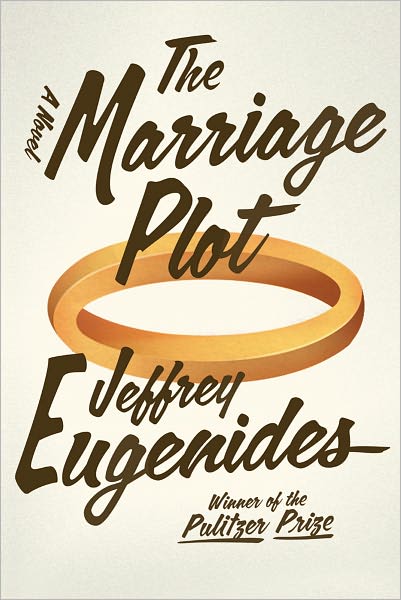
The Marriage Plot — Jeffrey Eugenides

The Marriage Plot is very competently done, and there’s nothing particularly wrong with it; some things may even be done particularly well. The problem is, as my faint praise indicates, a novel isn’t a student essay: it’s not enough for nothing to be particularly wrong. Something has to be smashing and fantastic for it to really matter. The Virgin Suicides, with its ceaseless questioning of what happened to the Lisbon sisters and its unusual narrative structure in the form of a chorus of outsider men who were once boys attempting to understand something they never quite can, had this quality. There’s a haunting, melancholy quality to the story and the way its told. Middlesex is imaginatively powerful because of Cal’s parents’ unusual relationship (does love conquer all, including biology?) and Cal’s own inter- or transexual state, which is so unusual amid novels that mostly cover straight people, occasionally cover gay people, but very seldom cover people whose bodies and minds don’t quite match like they should.

I keep copies of both Eugenides’ earlier novels, but I’m selling my copy of The Marriage Plot. I can’t imagine rereading it. In The Curtain, Milan Kundera wrote something that has long stayed with me because of how right he is:

Every novel created with real passion aspires quite naturally to a lasting aesthetic value, meaning to a value capable of surviving its author. To write without having that ambition is cynicism: a mediocre plumber may be useful to people, but a mediocre novelist who consciously produces books that are ephemeral, commonplace, conventional—thus not useful, thus burdensome, thus noxious—is contemptible.

Eugenides has that ambition. I concede The Marriage Plot might outlast its author. But I’m skeptical it will: the religious stuff Mitchell experiences doesn’t measure up, and the mostly banal problems faced by recent college graduates doesn’t quite live up to anything. Leonard is the only person with real problems, both in terms of his ailment (manic depression) and his work (as a biologist: he is confronting the natural world, and some of the most interesting sections describe both his efforts in taming yeast and his status in a science lab). Madeleine, like so many of us, is committed to love with a person who maybe isn’t worth it. In listening to her sister’s trouble, we find this: “like anyone in love, Madeleine believed that her own relationship was different from every other relationship, immune from typical problems.” She isn’t, and her relationship is more like that of other people than she’d like to imagine it to be. And The Marriage Plot is more like other novels than I want it to be.

There are long sections of background that we might not need. We find that “Leonard had grown up in an Arts & Crafts house whose previous owner had been murdered in the front hall.” Grisly, but not vital to the story. “[. . . ] Madeleine took the opportunity to make herself more presentable. She ran her hands through her hair, finger-combing it.” Nothing wrong with this: it’s just average. Maybe too Victorian. Later: “Ground personnel rolled a metal stairway up to the plane’s first door, which opened from inside, and passengers began disembarking.” Do we need this? Or can it be eliminated? On their own, these sentences are okay, and I’ve committed such sentences many times, despite Martin Amis warning me not to. I want to put this book on a diet, to convince it to render only the essential. Too much of it makes me want to cut more; I can also now say that the only thing worse than taking an essay test of your own is reading about someone else’s essay test, especially when that essay test involves religion.

There are also some strange sentences; this one makes me wonder if the last word is a typo: “Years of being popular had left her with the reflexive ability to separate the cool from the uncool, even within subgroups, like the English department, where the concept of cool didn’t appear to obtain.” What does “appear to obtain” mean? Perhaps it’s supposed to be “appear to apply.” The good ones are still good, though: “Dabney had the artistic soul of a third-string tight end.” I’ve met Dabneys. And I get what Madeleine gets: people who declaim one kind of hierarchy or status system are always setting up another, whether they recognize it or not. I also find it intriguing that Madeleine can be an intense reader and also intensely popular. The two seldom appear together in fiction. Perhaps the combination makes her an astute social reader of everyone but herself.

She also understands Mitchell, who acts as a beta orbiter for most of the novel. He provides her with extra male romantic attention mostly because he’s a fool, and she knows it on some level: “Mitchell was the kind of smart, sane, parent-pleasing boy she should fall in love with and marry. That she would never fall in love with Mitchell and marry him, precisely because of this eligibility, was yet another indication, in a morning teeming with them, of just how screwed up she was in matters of the heart.” Being “smart, sane” and “parent-pleasing” is another way of saying “boring.” He also doesn’t make a move when he’s effectively asked to. At one point, Madeleine takes Mitchell home and goes to his attic room wearing only an old shirt—then resents him for not making a move when he obviously wants to and she does too.

She has a point.

When Mitchell is too eligible, that “eligibility” gets held against him. And he buys into ideologies that encourage him to remain a fool. A priest says to Mitchell: “Listen, a girl’s not watermelon you plug a hole in to see if it’s sweet.” Tell that to most women who do the same of men. There are plenty of sexist assumptions in this statement alone to get a feminist writing an angry paper about women, innocence, desire, and sexuality. Perhaps you shouldn’t take romantic advice from someone sworn to a life of celibacy and thus ignorance in a realm that most of us take to be vitally important. To be fair, Mitchell mostly doesn’t, but that he’s seeking knowledge from a source like that tells us he doesn’t even know where to begin to look for help. And Madeleine exploits this weakness. She says, “[. . .] one night the previous December, in a state of anxiety about her romantic life, Madeleine had run into Mitchell on campus and brought him back to her apartment. She’d needed male attention and had flirted with him, without entirely admitting it to herself.”

Rather nasty. Even worse than he falls for it. The optimal solution for Mitchell: find another girl, ideally one hotter than Madeleine, and use the other girl as leverage. Moping around doesn’t get the girl. As Sean Connery says in an otherwise lousy movie called The Rock, “Losers always whine about their best. Winners go home and fuck the prom queen.” Mitchell hasn’t realized or internalized this. Contrast Mitchell’s neediness with that of his rival’s distance: “The more Leonard pulled away, the more anxious Madeleine became.” She’s desperate for Leonard, which enables him to make her like him even more. Mitchell is on the opposite side of this recusive dynamic. He should read Radway’s Reading the Romance, which describes how women like to read romance novels in which the heroine falls for major alpha males. Radway doesn’t use this term, of course, and works to explain away women’s preferences for alpha males, but the descriptions still shine through.

Still, there are funny bits to The Marriage Plot; on the same page where Madeleine assesses Mitchell as a beta, her mother says that she “saw a program about Indian recently,” as if “a program” on TV could convey much about the country—but wanting to say she’s seen it does convey a lot about her. She goes on to say, “It was terribly depressing. The poverty!” Mitchell says “That’s a plus for me [. . .] I thrive in squalor.” The unexpected reaction to Madeleine’s mother and reframing of expected values makes this funny and shows us that Mitchell isn’t the stiff he might otherwise appear to be. And the book isn’t the stiff it might otherwise be. It’s just not funny consistently enough or deep consistently enough. It’s a muddle, even when I do laugh at lines like, “Madeleine’s love troubles had begun at a time when the French theory she was reading deconstructed the very notion of love.” Love isn’t so easily eliminated, however: it only takes belief to sustain it.

And the characters are more self aware than I’ve sometimes depicted them here. Madeleine, for instance, knows that graduating from college, for a certain class of person who is expected to go to college, just isn’t that hard. On graduation day, “she wasn’t proud of herself. She was in no mood to celebrate. She’d lost faith in the significance of the day and what the day represented.” If college is mostly a test of showing up, it’s hard to blame her; and majoring in English probably isn’t very hard for most hard-core readers (it wasn’t for this one, anyway; to me reading was fun, which meant that I did so much more of it than most of my classmates that class itself wasn’t very hard). And she finds that the deconstructing education she receives isn’t much use when she’s confronted with the messy reality of interpersonal relationships, including her relationship with Leonard. Saying manic depression is a socially constructed discourse won’t get help like lithium will, even with lithium’s side effects.

Leonard’s stay at Pilgrim Lake, a biological research facility something like Cold Springs Harbor Laboratory, is among the novel’s most interesting sections. I would’ve liked it longer and Mitchell’s Indian sojourn shorter. Leonard is researching reproduction in yeast; this yields a predictable but impressive number of metaphors for human dilemmas. His work also can’t be solved by appeals to socially constructed discourse, and I suspect many of the scientists at the lab are more interesting than Madeleine at Mitchell. For example, Madeleine observes one of the very few female research scientists and observes:

Madeleine guessed that MacGregor [who just won a Nobel Prize] made people uneasy because of the purity of her renunciation and the simplicity of her scientific method. They didn’t want her to succeed, because that would invalidate the rationale for their research staffs and bloated budgets. MacGregor could also be opinionated and blunt. People didn’t like that it anyone, but they liked it less in a woman.

Tell us more about the “simplicity of her scientific method.” How does that relate to literary theory? Could we see MacGregor take more of an interest in Madeleine? Who are the people who “didn’t want her to succeed,” and how does she react to them? I wouldn’t want to turn the novel into Atlas Shrugged, but there are rich idea veins here that go unmined in favor of Mitchell’s noodlings. My suggestions are somewhat unfair, as I’m violating Updike’s first rule of book reviewing—”Try to understand what the author wished to do, and do not blame him for not achieving what he did not attempt”—but I think an exploration of gender in science more interesting than an exploration of gender and mating habits among relatively average 20-somethings. Maybe because I fit into that group I’m too close to the subject to find it remarkable, but I think the novel has a smaller-than-life quality to it, in the same way B. R. Myers describes Jonathan Franzen’s novel Freedom at the link:

One opens a new novel and is promptly introduced to some dull minor characters. Tiring of them, one skims ahead to meet the leads, only to realize: those minor characters are the leads. A common experience for even the occasional reader of contemporary fiction, it never fails to make the heart sink. The problem is not only one of craft or execution. Characters are now conceived as if the whole point of literature were to create plausible likenesses of the folks next door. They have their little worries, but so what? Do writers really believe that every unhappy family is special? If so, Tolstoy has a lot to answer for—including Freedom, Jonathan Franzen’s latest. A suburban comedy-drama about the relationship between cookie-baking Patty, who describes herself as “relatively dumber” than her siblings; red-faced husband Walter, “whose most salient quality … was his niceness”; and Walter’s womanizing college friend, Richard, who plays in an indie band called Walnut Surprise, the novel is a 576-page monument to insignificance.

The Marriage Plot is a much better novel than this, but one detects the same kinds of maladies at work: “dull minor characters,” a problem beyond “craft or execution” (which are, again, well done here), “little worries” for the most part (until an unconvincing ending), and a general feel that life is elsewhere. Around the same time, Bill Gates, Steve Jobs, Bill Joy, Richard Stallman, and many others were coalescing around Silicon Valley to change the world. I wouldn’t be communicating with you right now via this medium if it weren’t for their work. Which isn’t to say every novel set in the late 70s or early 80s should be about computers, technology, or technologists: but in the face of banality, I can’t help drifting toward thoughts of people whose work really, incredibly, resolutely matters.

Eugenides is clearly interested in the inner workings of people—the problem is that Mitchell and Madeleine do not have particularly interesting or engaging insides. Mitchell needs a copy of The Game to be time-warped to him, stat, and Madeleine needs to better realize what reading nineteenth-century novels should prime her to know: that she’s not the first person in the universe with unwise love decisions or family problems. Why doesn’t she better analyze her own situation in terms of the novels she loves so much? Why doesn’t she better realize that, yes, her life could be one of the fragments in Roland Barthes’ A Lover’s Discourse? It could be, as Eleanor Barkhorn says in “What Jeffrey Eugenides Doesn’t Understand About Women,” that Madeleine doesn’t have any real female friends, but I’m not convinced: I’ve met women who have few or no real female friends, and I don’t think that aspect of Madeleine’s life is unrealistic. The bigger problem is her lack of friends in general, so those friends can’t say the obvious to her: Why Leonard? Do you realize what you’re giving up? And if she does, and she gives up much of herself anyway, then the problem is her own blindness—a topic that I don’t find tremendously satisfying to read about, since it basically implies Madeleine is stupid. Characters can only be stupidly blinded by love for so long before one removed the “blinded” and turns “stupidly” back into a noun.

Most of my problems with the novel aren’t with its prose on a micro level, although it has those issues: it’s with the dearth of real ideas in the novel. It doesn’t quite go with the literary-theory-as-life metaphors, which drop out partway through. It doesn’t quite go with the alpha-beta-male decision that Madeleine faces. It doesn’t quite go with the manic-depression-as-serious-issue-maybe-linked-with-creativity issue that Leonard has. It’s a host of “almosts” that reminds me some of a sunnier version of Michel Houellebecq, especially in The Elementary Particles and Platform.

Houellebecq, however, is willing to engage in a kind of brutal realism—for lack of a better phrase—that Eugenides doesn’t get to. Yet that’s what the characters need: less understanding of their petty problems and more context, or a harder eye, or someone to smack Mitchell and Madeleine, then explain both their problems. I could explain their problems. I’ve met a million Mitchells and Madeleines. Hell, I used to be one in some respects. But the world has a habit of correcting your faults, if you’re paying attention to the signals the world is giving. Mitchell and Madeleine aren’t. That’s what makes them so unsatisfying. As three of the characters go, so does the very, very competent novel that doesn’t get past competence and into transcendence.


You can read my initial impressions here.

U and I: A True Story — Nicholson Baker

U and IThere’s something weirdly winsome about U and I, but it’s definitely an acquired taste; much as you wouldn’t recommend a friend who’d never eaten fish start off by trying raw eel, I wouldn’t recommend a friend read U and I unless I already knew they were a) quirky, b) at least moderately well-read and c) interested in the process of writing. U and I is like—I keep resorting to similes because, really, I don’t know what else to do—the best written, longest blog post you’ve ever read.

It’s a meditation on memory that shouldn’t be taken too seriously (sample: Nabokov “detailed his three-by-five method of fictional composition so comprehensively that Gore Vidal said in some essay that he was sick of hearing about it”). And Baker has a sense of the absurd, which I find absurd and love; he gets academia too well: “I count myself fortunate in being able to extract all the pretend-scholarly pleasure I want out of my method without urging it on anyone else.” Actual scholars appear to get real pleasure by inflicting their method on others. “Urging” is too light a word for the things I’ve seen. Baker is very polite to use “urging,” and he’s polite in general, for all his opinions.

If he’s retained that politeness, House of Holes ought to be a rather unusual book given its reputedly pornographic and hallucinatory premise (a copy is sitting on my table, waiting for me to get around to it, while I slog through The Condition of Postmodernity—which is a definitive infliction of an academic system and the kind of book that ought to be paired with Grand Pursuit: The Story of Economic Genius so that one will at least come out the other side knowing where many problems in the first book lie. Sorry for the preceding paragraph. U and I makes me more digressive than usual. If you read it, you’ll understand. It’s an acquired taste, as I said, one that sometimes needs a bit more sugar and olive oil, but one I rather liked, though I can’t recommend it except to book obsessives, writers, bibliophiles, or the people foolish enough to want to understand them. Which probably covers a fair number of readers of this blog, but still. The warning is part of being polite.

He must not be an academic at heart: academics love to apply their theories to others, with as much intellectual violence as necessary to make it stick. It turns out that Baker hadn’t read all of Updike’s books, and, with many of them, he’d only read parts, which he doesn’t remember entirely. In fact, the book isn’t really about Updike all that much at all: it’s more about artistic neuroses, learning how to write, and playing with that fickle memory beast. For example: “Once you decide on a profession, you riffle back through your past to find early random indications of a learning toward your chosen interest and you nurture them into a false prominence: so it was naturally very important to me, as a writer on the make, to have this sixth-grade vocabularistic memory in its complete form.” Baker wants us to know that we create a narrative of success and set up retrospective wayposts that make success seem foreordained, when it probably isn’t. Even the less successful among us might think so: I remember my parents being astonished that I was going to major in English. They told me they expected business or econ. Now I better understand why. But in the long run, I’m not sure it matters. There were other possibilities one could’ve guessed based on my past. But I picked one and rolled with it. This is an example of me trying not to do intellectual violence to an idea: instead of saying, “Everyone works this way!” I posit some possibilities and move on from there.

Baker mentions “early Updike, whose boy-heroes are sometimes more sensitive and queasier-stomached than one wants them to be.” But he doesn’t go on to explain. He doesn’t really explain anything. He leaves the explaining to the reader; you get what he’s doing, or you don’t. In this respect, he’s the least academic of all: instead of wanting to elaborate us to death, he wants to let us be. I know what he means about boy-heroes; sometimes you want a giant animal to attack Rabbit and see what he’s made of, or for aliens to invade in Couples, offering Piet an opportunity to do something more than carpentry and cuckoldry. Not that there’s anything wrong with those things, precisely, but, well, you hope for a bit more at times. Baker also gives good sentence, but they are often long sentences, like this one:

[. . .] many of the novels that I’ve liked lately (The Beautiful Room is Empty, The Swimming-Pool Library, A Single Man) have been so directly premised on gaiety: you feel their creators’ exultation at having so much that wasn’t sayable finally available for analysis, and you feel that the sudden unrestrained scope given to the truth-telling urge in the Eastern homosphere has lent energy and accuracy to these artists’ nonsexual observations as well [. . .]

Notice the ellipses on either end. Notice too Baker’s use of the funny word “homosphere” with the funnier adjective “Eastern.” Is there a “Western” homosphere? If so, how is it different? More tans, fewer references to ascots? And what is an ascot anyway? I’ve never known it save for the butt of a joke, and the word “butt” should be funny here in the context of the “homosphere.” Kind of, anyway. Like I was saying—Baker does go on. But that’s the pleasure in him. With him. Through him. Whatever. Still, this is enough quote for now.

No, actually, I change my mind. Writing about Updike’s book Of the Farm, Baker says that “A photographer would not so directly use his professional equipment in the metaphors he applied to his immediate surroundings—he would use it sometimes, but not in the first paragraph of the story he told. Film and f-stops are huge real presences to him, and can’t be so easily manipulated as tokens of comparison.” Not necessarily. Consider all the writers who use book and writing metaphors; I think our profession does get into our minds deeply enough that we might reach to professions for our first metaphors. Paul Graham’s writing is full of metaphors involved software and computers. That’s part of what makes it so rich.

It bugs me when I read books about doctors or lawyers or hookers or whatever and find characters who don’t think in the world in terms of their profession. I mean, a hooker probably doesn’t need to see every interaction as like something with a John, and a lawyer doesn’t need to view every interaction as adversarial or use terms like “estoppel” on every page, but once in a while, you know, it’d be nice. It’d work. I haven’t read Of the Farm, however, so I can’t comment on it. The problem with being a reader is that you’ll never have enough time to read everything you should. So you rely on memory, that uncertain beast, more than you should, and you end up be a scholarly pedant or a scatterbrained essayist. A false binary, but roll with it. On average, the latter seem funnier, and, in my own view, when in doubt, go funny.

For all U and I’s weirdness, I’m keeping the book instead of giving it away or reselling it. Maybe in a couple years it’ll say something new to me. I only worry that, instead of seeing it as weird, I’ll see it as normal.

Bare: On Women, Dancing, Sex, and Power — Elisabeth Eaves

Bare has lots of good parts but goes on too long, follows too many random tangents (the “Kim” character doesn’t illustrate anything), and repeats itself too often. But I also liked it and learned some things from it I might not have otherwise, and Eaves is usually a perceptive reader of both her own and larger social hypocrisy. She seems sensitive, or she adopts a sensitive persona in the book. I only wish she’d taken more economics classes; the big thing she’s missing is micro 111 and 201. She’s missing game theory. And evolutionary biology and psychology. Those taken together explain a lot about the double standards she justifiably complains about. Take this section, about Eaves’s dawning sexual awareness:

I had this notion until my teens that my body was my own. How to clothe it, how to gratify it, whether to impregnate it—I had believed these to be matters of personal choice. And I had a notion that the rules of society should be applied fairly to all. With the discovery of a sexual morality especially for girls, equality suddenly seemed to have been an idea meant to go the way of Santa Claus. My shock and anger would have been difficult to overstate.

She’s right. But the main disappointment of Bare is that it doesn’t go deeper into why these social forces exist, especially in the discrepancy between what parents want for their offspring and what offspring want for themselves. Girls bear the greater cost of pregnancy, and society believes that they are at greater risk of sexual predators, so parents take much greater efforts to restrict that sexuality (for more on this, see, for example, “The Daughter-Guarding Hypothesis“). If you want to deal with double standards, attack parents first, since a lot of the double standards are parentally inflicted. When parents say, “You can’t go out looking like that,” they usually mean, “you’re sending signals about sexual availability and interest that I disapprove of.” Almost no parents say the second one, however. If you could get them to, you might at least move toward greater honesty. Good luck using this vector, however.

And girls will sometimes impose double standards on themselves. Here’s another example of a spot where Eaves notes this but doesn’t go deeper:

Fraternities permitted the consumption of alcohol, whereas sororities did not. Guys could have girls over to fraternity houses any time of the day or night, but girls could have guys over only under heavy restrictions. In my sorority we could invite boys to our rooms only on Tuesday evenings from seven to ten, and most girls had three or four roommates. The upshot was that boys never made the walk of shame. The rules of the Greek system upheld an intricate web of double standards. Sororities had to have a resident ‘house mother,’ a supervising adult; the fraternities had no equivalent. When I asked other sorority girls about this rule, they told me that a house mother was required to get around an old law that classified a group of women living together as a brothel.

But sorority girls (and, perhaps, the parents who pay for their college experience) are willing to put up with “heavy restrictions”. Why doesn’t a sorority house offer a frat-style experience? If the market is there, girls will join it. That girls are willing to accept sorority rules shows that those same girls are getting something out of them, even if they complain. Think about reveled preferences here: if what people say and what they do diverge, look at what they do first.

If girls refused to enter a system that “upheld an intricate web of double standards,” the system would change. Yet they don’t. Note that I’m not advocating for double standards or saying they should exist: I believe the opposite. But Eaves should look harder for what powers and purposes these guys of social rules serve, who is enforcing them, and why, in the face of logic and the rhetoric of freedom, they persist. As I said previously, I think you can trace a lot of double-standard behavior to parents, and until you deal with that issue, you basically haven’t dealt with anything substantive. You’re making the same arguments women have been making since at least the 1960s and probably earlier. Also, I’m not convinced other sorority girls are a sound source of legal advice, or that such rules about multiple females living together would pass contemporary constitutional muster, especially if a lawsuit regarding them found its way in front of a female judge.

Plus, I can imagine what would happen to a fraternity that forbade its members from having women in their rooms: the fraternity would quickly have no members, since so much of its real purpose is ensuring sex to its members. That women don’t respond similarly en-masse to sorority rules shows that sorority girls are getting something; I could make up stories as to what (many are probably uncomfortable with having strange or partially clothed men wandering their halls), and so could you, but the important thing is starting the analysis.

This leads toward questions of how one can change larger cultures. Eaves does engage those; she starts with whether she’ll speak to others about her profession. She mostly doesn’t:

I was nowhere near as open as Zoe, a dancer with whom I became friends. She believed firmly in telling everyone. Her parents knew, as did her sister, boyfriend, and most anyone she met. I told her once that I didn’t tell certain people because I didn’t want to deal with their judgments and preconceptions. ‘That’s why you have to tell them!’ she said. ‘How are those stereotypes going to change if people like you and me don’t talk about what we do?’ She had an energy for changing minds that I lacked.

Zoe is right: maybe if people were more open about what they actually did, the many stigmas around sexuality would fade over time: but by hiding what one actually does, one allows assumptions to go unchallenged and to calcify into convention. By not speaking of then, Eaves lets the double standard get infinitesimally stronger, and by speaking of it in her writing, she at least makes it slightly weaker. You can’t complain about the double standards and simultaneously lack the “energy for changing minds” someone else has. And it makes sense that Zoe told “most anyone she met.” In high school, the essential question is, “What kind of music do you like?”, in college it’s, “What’s your major?” and once you leave the educational system it’s, “What do you do?” I don’t hide my professions. To do so would seem to hide an essential part of myself.

Still, the mere fact of being a stripper causes some change in the person. Here’s Eaves discussing some:

Stripping put me in a new world with new conventions. Having ditched the moral framework of the outside world, I was now ethically adrift where nudity and sexuality were concerned. I actually felt as if I had divorced myself from the moral norm years previously, simply by growing up and becoming sexual. But when I entered pink-and-red stripperland, my departure became official. Having given up the old norms I needed new ones, and where none were provided, I had to make my own.

Good. That comes from page 88. Two hundred pages later, from 291 – 292, we’re still there:

The sexual morality I grew up with was rife with inconsistencies. It had words to insult promiscuous women but not men, it ticketed strippers but not their customers. It imposed on women, far more than men, an intricate code of modesty that came down to a few inches of fabric, and then read a woman’s clothing or lack thereof as an indication of character. I didn’t want the morality that said I must cover my body, and that if I didn’t I was responsible for whatever came my way. I didn’t want the morality that said I should be coy and shameful about sex.

Again: there’s lots of “what” but very little “why,” which is disappointing. Why do strippers accept a sexual morality that “tickets” them (note the nice word, implying just the right amount of censure). If Eaves doesn’t want the morality—and I can’t blame her—she should be looking for more about why the morality exists. She also understands her power—”Being young, female, and attractive was one long bout of intoxication, with all the dizzy pleasure and vulnerability the word implies. In the careening, can’t-get-off, sex-saturated roller coaster from puberty to adulthood, I discovered I could hold sway over boys and men”—but not why people might use different means of finding what they want. She doesn’t like placing lonely hearts ads:

A column inch of newspaper, struck me as a sterile way to find someone compatible, whether for life or just an affair. I didn’t think of myself as romantic, but when it came to meeting men, I was attached to ideas of chemistry and coincidence. I was convinced that sex and love would follow naturally from other things I did—work, hobbies, or friends. By definition they would be unplanned and messy, but all the more exciting for it. I couldn’t understand why I would want to engineer an affair as though I were buying or selling a used bed.

Spoken truly like someone who’s attractive enough to have plenty of offers to accept or reject. The rest of us need to gin up more offers and do what it takes to do so. It’s easy to be “attached to ideas of chemistry and coincidence” when you’re young and attractive. Lots of men will offer their services, so to speak, and she gets to pick from them. For others—who are either bored with the standard offers or looking for something better—she doesn’t speak or acknowledge why they might do what they do. I know very attractive women who’ve signed up for online dating because they’re tired of the men they meet in their everyday lives. Eaves seems unusually lucky with “work, hobbies, or friends.”

Bear in mind, too, that Bare has over-readings and inconsistencies of its own, as in this description of one of Eaves’s boyfriends who has admitted to hiring a prostitute:

For men to pay for sex as a matter of course seemed to show a profound insecurity or worry about women—that women wouldn’t want to sleep with him without payment, or that when they did they wouldn’t be kind and acquiescent enough, or that a man’s and a woman’s sexual wishes simply couldn’t coincide. I also thought paying for sex indicated a subtle sense of guilt—if a man was uncomfortable facing the women he had sex with, he could pay for the promise that he wouldn’t have to.

Alternately, it’s possible that men paying for sex doesn’t mean anything, and that women who dance for sex doesn’t mean anything more or less than any other profession. She doesn’t consider that the men might just want to get laid. Not everything has to mean something. That would make for a much shorter book, of course, since books about sexuality thrive on analysis even when that analysis might not be warranted. And, sometimes, “a man’s and a woman’s sexual wishes simply [don’t] coincide”: how many women want a tall, handsome, wealthy alpha male with an impressive job who could get any woman he wants but chooses her? How many men want a perky young pneumatic blond with who is, as Ludacris once put it, “a lady in the street but a freak in the bed,” and who also thinks he’s witty and looks up to him and doesn’t make the very reasonable demands women in the real world tend to want?

Maybe Eaves isn’t really unhappy about a subtle sense of guilt: maybe she’s actually unhappy that sex-for-money subverts her own sexual power by making it easier for men to obtain a lot of what they want quickly. She has her own sexual morality that might not be much better than the one she derides. She can’t or doesn’t want to imagine why people would use dating services, and the same is true of prostitution. By writing what she wrote, Eaves has helped ensure that more men will lie about the hookers they’ve hired, since they know they’ll be judged by women like Eaves.

Consider this, on the same subject:

What angered me, specifically, was his easy acceptance of a buyer-seller relationship between men and women. In some ways I came to regard Paul as I would a customer: someone cynical, who didn’t place a high value on sexual honesty, who was easily manipulated by female facades. I could never bring myself to trust him completely. And though I wasn’t fully conscious of it, on some level I decided that he wasn’t due the respect I would have accorded a different kind of man. For me, Paul symbolized men who preferred buying women to knowing them.

Is a “hard” acceptance somehow better? Is nattering on about morality and improvement? And maybe Paul is just a dude, not someone who should be held as a symbol for all men. This preference Eaves expresses actually indicates she doesn’t like conflating market and gift norms, or that she doesn’t like it when a man she’s with does it but doesn’t mind when she herself does. Or this is another random boundary. I suspect it’s conflating gift and market economies; lots of people have addressed this, including Lewis Hyde in The Gift: Creativity and the Artist in the Modern World Geoffrey Miller in Spent: Sex, Evolution, and Consumer Behavior. But these are issues Eaves doesn’t address: her own blindspots are there for people to see. Mine probably are too, but no one has taken the trouble to observe them.

Eaves also makes the mistake some of my freshmen do in their papers: she assumes there is some unified thing called “society” “culture,” or “the media,” which gives her and others a single message. It’s not that easy. Words we use to flatten the dialectical nature of collective individual desires, like “society” or “the media” leave so much out of them. This is one lesson of Michel Foucault, however problematic some of his other comments might be. Eaves, for example, listens to this idea:

There was very little stigma attached to being a passive sex object. Images of the legs, breasts, and lips of strangers suffused my life thoroughly, from billboards to magazines to television. Far from shaming the bodies’ owners, society made them starlets, supermodels, and video queens, glorifying them with money and fame. Yet to actively pursue sex-object status—to say, ‘Okay, I agree, please look at me’—in this I felt as if there was reproach. The difference between a stripper and a woman modeling bathing suits was that the stripper acknowledged her intention to arouse, whereas the model could pretend ignorance.

Do most people make the “passive sex object” and active pursuit of “sex-object status?” Maybe they do, but it seems like an unlikely distinction to me. Plus, as I said in the paragraph above there is no “society” inflicting a sole message on you. There are only individuals who respond. It sounds like Eaves is wrestling with her own feelings and her own internalized demons and then re-projecting those on a nebulous “society” at large. The experiences of someone growing up in a small town with a highly religious family probably experiences a much different “society” than Kate Winslet’s children, since the actress “talks to her kids about same-sex feelings — reminding even liberal parents to go beyond pink and blue.”

Those two are extremes. Eaves probably grew up somewhere in the middle; she says this about when she starts having sex as a teenager:

Sex also mitigated an asphyxiating boredom. I lived on a dead-end street on a hillside, where every house sat in the middle of its own private patch of green, with views of the water and the mountains. The street was surrounded for miles by detached houses and an occasional park or school. It took about an hour on city buses to get downtown, and I had no car. [. . .] It was beautiful, peaceful, and the urban equivalent of a sensory deprivation chamber. [. . .] Boys, though, were a world to be discovered. While I waited for my life to begin, I had sex.

Suburbs are boring. That’s why parents move there: to protect their children from perceived dangers. But they don’t realize that, to a 15-year-old, the boringness of suburbia makes life itself look boring and pointless. No wonder so many yearn for college. Paul Graham gets this too:

If I could go back and give my thirteen year old self some advice, the main thing I’d tell him would be to stick his head up and look around. I didn’t really grasp it at the time, but the whole world we lived in was as fake as a Twinkie. Not just school, but the entire town. Why do people move to suburbia? To have kids! So no wonder it seemed boring and sterile. The whole place was a giant nursery, an artificial town created explicitly for the purpose of breeding children.

Where I grew up, it felt as if there was nowhere to go, and nothing to do. This was no accident. Suburbs are deliberately designed to exclude the outside world, because it contains things that could endanger children.

And as for the schools, they were just holding pens within this fake world.

Notice how Graham goes a little further than Eaves, to the “why:” “Suburbs are deliberately designed to exclude the outside world, because it contains things that could endanger children.” Eaves’s parents, whatever they did right or wrong, presumably thought they were doing the right thing. She was also doing the right thing, since sex does quite effectively mitigate (some might even say “relieve”) “asphyxiating boredom.” But she’s old enough to be able to empathize with her parents—to ask, “Why did they do what they do?” She’s smart enough to empathize with men like the hooker-hiring boyfriend. Unlike, say, Norah Vincent in Self-Made Man, however, she doesn’t. It’s too bad, because the stretch is so easily within her reach.

Bare has its problems, and it has too many weak sentences like this one: “He was tall and angular, with chiseled features, pale skin, and black hair and eyes.” It’s too much description and too little analysis. But it’s fun, and it offers access to a world not easily entered by outsiders. At the very least Eaves starts the conversation, and she does so in a way better than how many others would try to finish it.

The Magician King — Lev Grossman

I love The Magicians. I like The Magician King.

The Magician King has many of the qualities that made The Magicians special: twists on standard fantasy tropes; impressive language in many sentences, although not quite as impressive its predecessor; and a consistent willingness to instill a sense of wonder about the world and about what the characters might be able to accomplish. Happy endings aren’t foreordained, which is to be admired.

But The Magician King lacks the surprising urgency of The Magicians and feels like another lap after the race is over. Consider a passage from page six, after Quentin, Julia, Janet, and Eliot have returned to Fillory as benevolent if distracted monarchs. They’re hunting a magic hare who can see the future, which sounds like a bum gig; life’s excitement comes from not knowing what happens next:

The point wasn’t really to catch the hare. The point was—what was the point? What were they looking for? Back at the castle their lives were overflowing with pleasure. There was a whole staff whose job it was to make sure that every day of their lives was absolutely perfect. It was like being the only guests at a twenty-star hotel that you never had to leave.

Does this sound familiar? If you read The Magicians, it should, since The Magicians is endlessly concerned with the questing for meaning that can’t be imposed from without. I’m going to spend the next couple paragraphs looking at similar rhetoric from The Magicians; if this sort of thing bores you, skip to the paragraph that starts with a series of bolded words. Rhetorical comparisons aren’t everyone’s forte, but they’re essential for understanding how The Magician King is too often a rehash of the same problems presented in The Magicians but without a new angle on those problems.

In The Magicians, Quentin thinks:

You just had to get some idea of what mattered and what doesn’t, and how much, and try not to be scared of the stuff that doesn’t. Put it in perspective. Or something like that. Otherwise what was the point?

“What was the point” is a decent question for someone with an adolescent temperament. Quentin spends the rest of the novel ineffectively trying to answer the question. He doesn’t answer it, not perfectly, but somewhat understands that you make the “point” for yourself. You make meaning for yourself, because meaning can’t be imposed by external social forces, and death itself gives meaning to life. One would think the sheer realism of The Magicians’s end would show Quentin as much. When the party reaches Ember’s Tomb at the end of The Magicians, two large, evidently hostile animals charge, and we find our hero panicking: “Oh my God, Quentin thought, this is really happening. This is really happening.” You don’t make something merely by saying it, although the prospect of death wakes him from the upper-middle class reverie where he’s been living. Death, especially violent death, is not beautiful or noble—it is terrifying and shocking. It reminds you of why so many people move to the quiet suburbs and get jobs in middle management. Beats the hell out of getting the hell beaten out of you.

The repetition of “This is really happening” is like a refrain designed to keep Quentin awake. He watches the death of the Ferret and thinks, “He wasn’t ready for this. This wasn’t what he’d come here for.” He wasn’t ready then and he never will be—unlike Alice, whose maturity contrasts with his throughout The Magicians. She says, “[…] don’t talk to me about death. You don’t know anything about it.” She’s right. The disappointing thing is that he still doesn’t in The Magician King. He hasn’t internalized the central fact that death is connected to finding meaning because death and its predecessor aging can’t be avoided. I am not opposed to characters who don’t realize this; I am opposed to characters who don’t realize this, have a series of events that should cause an epiphany, appear to realize it, and then forget that they’ve realized it in the next novel.

Early in The Magicians, Quentin is still in a mostly mundane reality and thinks that

He’d spent too long being disappointed by the world—he’d spent so many years pining for something like this, some proof that the real world wasn’t the only world, and coping with the overwhelming evidence that it in fact was. He wasn’t going to be suckered in just like that. It was like finding a clue that somebody you’d buried and mourned wasn’t really dead after all.

And now, in the time of The Magician King, he’s a king in Fillory and still dissatisfied. You can’t get no satisfaction, Quentin, but the problem eventually shifts from the world’s fault to your own. He is still “looking for something else. He didn’t know what it was.” You were looking for something else in Brooklyn and now you’re looking for something else in Fillory. No one, not even a Seeing Hare, can tell Quentin. Whenever “Life was good” for Quentin, it was time to fuck it up for no particular reason. Seeing someone fuck up a perfectly good life through understandable hubris and dumb social dynamics is thrilling and sickening once, as it is in Donna Tartt’s The Secret History. Seeing someone do so twice is just daft.

In The Magician King, Quentin is still in awe of where he is: “You really knew you were in a magical fantasy otherworld when a beautiful woman wearing a skimpy dress made of leaves suddenly jumped out of a tree.” But he’s been seeing magic constantly for, presumably, years. Are talking animals not enough? Still, the novel’s fidelity to the bureaucratic grit of life is impressive—Janet says of Dryads, “I spend enough time listening to them bitch about land allocation.” Ruling Fillory becomes associated with petty zoning squabbles of the sort you can find at City Hall if you’re so inclined. That Grossman includes such ideas is part of what makes The Magicians and its sequel special. But it also raises expectations, and when he includes something that’s wrong, it’s disquieting, as with this:

Fillory wasn’t England. For one thing the population was tiny—there couldn’t have been more than ten thousand humans in the whole country, plus that many talking animals and dwarves and spirits and giants and such.

A population that small wouldn’t be sufficient to get Fillory into medieval-level specialization; at best, 20,000 people could support a slightly elevated hunter-gatherer lifestyle. Plus, why is the land so infertile that it can only feed 10,000 people? Prior to the Industrial Revolution, the Malthusian paradox ensured that populations grew to approximately the size of the agricultural capacity of the land itself. With only 10,000 people and 10,000 magical non-people, there couldn’t have been much arable land, and certainly not enough to sustain any kind of specialization network (for more on similar topics, see, for example, Mokyr’s The Enlightened Economy and Clark’s A Farewell to Alms, along with the vast corpus of economic and historical literature about historical development patterns and the Industrial Revolution). Fillory is big enough to have a navy. Countries of 20,000 don’t even have an army, and the knowledge necessary to grow a ship-building industry must span thousands if not hundreds of thousands of people. Suddenly, I’m jolted out of a fictional universe and into the various economics textbooks I’ve read by a seemingly trivial detail.

And this isn’t the only scene of questionable economics. Quentin goes on a quest to collect taxes from an outer island with a single-digit population, and while there an uncanny resident says:

Tomorrow I’ll take you out to see the gold beetles. They’re amazing: they eat dirt and poop out gold ore. Their nests are made of gold!

If a source of apparently infinite gold is available via a short ship ride from the mainland, the logical thing to do is to begin farming and set up a trading route. Why hasn’t anyone done so? The Spanish imported so much silver from the Americas in the age of colonization that some economists believe it caused inflation in the European economy. People are very good at acting on incentives and exploiting commodities. Why aren’t the Fillorians? It could be because the novel states that there’s an abundance of everything, again for reasons that aren’t obvious, but that’s not a terribly satisfying explanation.

You could get over these errors and others by waving your hand and saying, “It’s magical”—Quentin says “Magic was part of the ecosystem”—but it still rankles in a book devoted to showing the “real” side of magical living. These are minor details, but they stand out in a book devoted to realism.

Quentin has a small-l liberal, educated, and modern knowledge of how group formation works (a hilarious sample of his liberalism: “If I were a Fillorian I would depose me as an aristocratic parasite”), as shown by his unwillingness to identify with the putative patriotism embodied in a tapestry

that depicted a marvelously appointed griffin frozen in the act of putting a company of foot soldiers to flight. It was supposed to symbolize the triumph of some group of long-dead people over some other group of long-dead people whom nobody had liked, but for some reason the griffin had cocked its head to one side in the midst of its rampage and was gazing directly out of its woven universe at the viewer as if to say, yes, granted, I’m good at this. But is it really the best use of my time?

“The triumph of some group of long-dead people over some other group of long-dead people:” your own fears, prejudices, and beliefs will one day probably appear the same way to many others. Are your beliefs so strong and important that the issues they represent will still be important 100 years from now? Five hundred? A thousand? Or will you be another long-dead person of limited importance, with ridiculous but firmly held allegiances to minor causes that turn out to be historical blips?

Many parts of The Magician King are funny: “Quentin had some idea that Australians were fun-loving and easy-going, and if that was true he could see why Poppy had gotten the hell out of Australia.” Quentin draws his sword, but he has trouble: “Nothing made you look like more of a dick than standing there trying to find the end of your scabbard with the tip of your sword.” Although The Magician King is, alas, less sexed than its predecessor, one doesn’t need Freud to realize Quentin is talking about more than a sword, especially when he thinks: “Let somebody else be the hero. He’d had his happy ending” (if that isn’t enough, Eliot also makes a sword-related double entendre on page 29). I guess it takes a while to recharge after a happy ending, even for a king.

The humor both conceals and reveals vital truths. Quentin has never really been the hero, so thinking he should let somebody else be the hero is presumptuous. This is played for comedy, and successfully. The comedy naturally and appropriately falls away as the novel progresses into darker days, much as it does in The Magicians, but the jokes make the novel fun. So do the moments of self-recognition, like this one:

Quentin couldn’t think who Benedict reminded him of until he realized that this was what he had probably looked like to other people when he was sixteen. Fear of everybody and everything, hidden behind a mask of contempt, with the greatest contempt of all reserved for himself

Quentin’s diagnosis the problems of others more easily than his own: “Maps of places, rather than actual places, were obviously where young master Benedict preferred to live.” Replace “Maps of places” with “The Internet” and “actual places” with “the real world,” and you’ve got a decent description of a lot of contemporary adolescents. The novel is very good at these mappings onto the real world.

The “good,” however, is not consistent; even the novel’s first line has an “almost, but not quite” feel: “Quentin rode a gray horse with white socks named Dauntless.” Is Dauntless the name of the white socks or the gray horse? The context makes it obvious, but I had to double check. There are also reflections of contemporary society—the quartet, who are listlessly hunting a magic rabbit, “moved in silence, slowly, together but lost in their separate thoughts.” Rather like people and their cell phones: if you look around, you’ll often find couples or groups all of whom are looking into their phones, as if searching crystal balls for answers. Do they find them? I sometimes want to ask. But I don’t. Usually.

There aren’t as many of those spectacular sentences as there were in The Magicians; there are some, like this: “Casually, like she was calling over a waiter, Julia summoned a tiny songbird to her wrist and raised it up to her ear.” Nice: the metaphor makes magic seem normal, a part of her life, which contrasts with Quentin’s continued shock at magic. The magic blends with the technological; a paragraph later, Quentin notices how Julia “was always giving and getting little secret messages from the talking animals. It was like she was on a different wireless network from the rest of them.” Talking animals and wireless networks correspond to fantasy/fairy tale and to science fiction / literary fiction, but these two sentences join them. If you’ve ever accidentally tried connecting an 802.11b device to an 802.11n network, you’ll understand the frustration of knowing that everyone around you can use, theoretically, up to 130 Mbs / second while you’re stuck at 11 Mbs / second (Grossman makes the technological metaphorical; I extend the metaphor). A few days ago, my class was talking about James Baldwin’s short story “Sonny’s Blues,” and I wrote on the board that music functions like TCP/IP. Did anyone notice? I’m not sure.

The wireless network comparison reminds me of this description from The Magicians, of Eliot: “That guy was a mystery wrapped in an enigma and crudely stapled to a ticking fucking time bomb. He was either going to hit somebody or start a blog.” The equivalence between hitting someone and starting a blog, which one senses many do because they wish they had the courage to hit someone, is so biting, so surprising. More surprising than the wireless network, however appropriate the wireless network comparison is.

Grossman hides a lot in a small space. The Magician King opens in Fillory while The Magicians closes in New York. That gap is filled in swiftly: “But then he and the others had pulled themselves together again and gone back to Fillory. They faced their fears and their losses and took their places on the four thrones of Castle Whitespire and were made kings and queens.” There’s a whole novel in those lines. The passage is also strange because pulling themselves together has never been a strong suite for the collected magicians; they seem much better at tearing each other pointlessly apart.

You could argue that much of this review consists of quibbles, small points, and things easily ignored. You’d be partially right. Taken on their own, many of the things I’ve written about are unimportant. Taken together, they begin to form a pattern. I don’t expend this kind of energy on every good but somewhat disappointing book that comes my way; most I don’t write about at all, let alone at this length. I’m writing about this one because of how good The Magicians was. You don’t hold a college athlete, even an accomplished one, to the same standards as an Olympian, and The Magician King should be competing at the Olympic level but instead settles for keeping one eye on the NCAA rankings, hoping to make it to Nationals. That’s not quite ambitious enough, however impressive competing at the college level might be.

In The Magicians, Julia was an object of Quentin’s misdirected adolescent lust at the start and reappeared at the end, riding a broomstick and rescuing Quentin from himself. Quentin does need to be rescued from himself routinely; this pattern holds in The Magician King. Hell, Julia even says, “Sometimes you just have to do things, Quentin [. . .] You spend too much of your time waiting.” Yes. We know.

Her story takes up a large narrative chunk of The Magicians, which is really two threads in two separate time registers: Quentin’s, moving forward on his self-conscious quest, and Julia’s regarding her progression as a magician outside the Brakebills track. But her story lacks urgency. In an interview, Grossman said: “It was almost an engineering project to retrofit that particular timeline. Because in Magician King, we go over the same period of time that happened in The Magicians, and we fit Julia’s story in there.” The engineering shows where it should be hidden, and, more than that, it feels. Since you—the reader—already know Julia becomes a magician, there’s not much narrative tension until the scene where she loses some of her humanity (which I won’t describe further here, though it’s shocking and powerful). Otherwise, she’s going through a bizarro-world version of what Quentin has already done. Since we know she learns magic, the means of getting there aren’t all that important. Neither are the various somewhat arbitrary hoops she goes through, which resemble the spiraling downward of despair one sees in drug addiction narratives. The culmination of the narrative is strong, but the getting there is too long and feels too much like padding. Or engineering, if you prefer.

More on that in the next section.

Don’t read the rest of this post if spoilers irritate you. A friend wrote to say this, and only this, in an e-mail with the subject line “Just finished the Magician King:”

Magical fox-rape cum… really???!!!

The worst.

I’m actually not opposed to the scene my friend is referencing: it is hard to read and vile, but then so is rape, and rape is part of the world, and the world should be the novelist’s subject. I think my friend is fixated on a scene she would’ve respected or accepted in a different context—a context that was a main story, not a subsidiary one. The scene is the culmination of Julia’s powers and makes us understand what she’s given up, so to speak, to get where she is. It’s a powerful point. But the temporal shifting of the scene, from Julia’s distant past to her present, isn’t as important as it should be because it’s grafted onto Quentin’s saving Fillory quest. The Julia story should’ve been told in its own book, with its own details and tensions, and the larger Magician King story should’ve been a third, standalone novel. Conflating them makes an awkward chimera of a novel.

So we get a somewhat ungainly hybrid, with the false crescendo of the fox-God rape being a prelude to the true ending. It doesn’t work as well as it should. Which isn’t to say the scene doesn’t work at all: it does. It’s only disappointing because of the sense that the scene and its story could’ve been so much better—like The Magician King itself. The novel is good. As I said in the first line of this review, I like it. But The Magician King doesn’t have that essential feeling, that power, that grip that made me say to friends who like fantasy or want book recommendations, “Heard of Lev Grossman’s The Magicians? No? Get a copy.” Now those friends have heard of Lev Grossman, and they want to know how the new ones is. I tell them it’s okay—and it is—but I also ask: have you already read Philip Pullman? Ursula K. le Guin? Tolkien? Elmore Leonard? If not, start there. I wish Quentin had new problems. The world is full of unmet needs and desires. Why can’t he realize that? Read The Magician King if you have the time and inclination. But literature is very big, life is short, and sometimes incredible writers don’t produce the book you most hope for.

Sugar in my Bowl: Real Women Write About Real Sex — Edited by Erica Jong

Sugar in my BowlI can’t really generalize about the pieces in Sugar in my Bowl other than to say that most have a quality of the forbidden about them. Michel Foucault famously argues in The History of Sexuality that we’ve always talked about sex and that the “regressive hypothesis,” which holds sex can’t be discussed, is wrong. But I think he’s wrong, or at least wrong regarding the United States: it’s still difficult for many people, especially women to speak and write of sex, which is why Erica Jong—the editor of Sugar in my Bowl—can cite what amounts to a version of the regressive hypothesis in her introduction. Maybe we’re now collectively allowed to express all kinds of sexual signs, but moving from physical expression of signs like the ones seen in movies and porn to intellectual analysis is or feels forbidden. What happens in the mind is so intimate relative to what you’ve got under your clothes. Anyone can shuck their clothes, and Victoria’s Secret has built a massive business on the promise that most of us will, but relatively few people have the ability to really express what’s happening in their minds. Susan Cheever writes that “A one-night stand is the erotic manifestation of carpe diem—only we are seizing the night instead of the day,” but one has to wonder: how many people have felt precisely that and never found the words to express it?

Without the words to express it, one can’t create the writing that will allow others to feel empathy. I don’t buy the school of thought that holds men and women can’t fundamentally understand each other, or that either sex is incapable of writing characters from the other effectively in fiction. People who want to learn what other people are thinking will find a way to do so, and, if they’re good, they’ll be able to reproduce what other people are thinking. There’s a cultural meme, for example, that women automatically “give up” sex to men who “take” it from women. While that no doubt describes many encounters, especially first encounters, it doesn’t describe all of them. Consider Anne Roiphe describing her first, or what I assume to be her first, time, after playing doctor with a boy as a child:

Years later when Jimmy and I were thirteen we were kissing in the dark at a party. We were sitting on a table in my classmates’ living room. Couples were curled up together in every corner of the floor, despite the fact that the carpet was rough and scratchy. Louis Armstrong was playing softly in the background. Abandoned in a corner was the Coke bottle that had begun it all. It was a game of spin the bottle that had brought Jimmy and I to the moment. ‘Do you remember,’ I said, ‘when we played doctor.’ ‘Yes,’ he said. ‘Do you have hair there now?’ he asked. ‘Yes,’ I said. ‘I really need to see it,’ he said. We found a closet. I showed him. He showed me his penis, larger, straight penis, full of some mysterious fluid.

This isn’t merely a my-first-time description (although it is that too), which litter memoirs and the Internet like discarded water bottles after a concert. It’s her way of delving into what’s nominally about the development of sex but really feels like the growth of an artist:

The thing about sex is that each act while different from the other even with the same person, even with the same person for forty years, is not a single act. It builds on the sex the night before, the year before, the decade before. Sex is a matter that unfolds like an accordion in the brain, the past is connected to the near past to the present and the future stands there waiting to be attached. So the feeling in the body, the feelings for someone else, the excitement of the new or the welcome of the familiar rises and falls, depends on memory, gains its depth from what happened at the beginning, a while ago, in the imagination, in reality.

You get older, you try things, you realize that, say, writing “is not a single act,” that it “builds on the [writing] the night before, the year before, the decade before.” Experience makes you good, and, although, there’s a sense that experience contrasts with innocence and is somehow bad, Roiphe doesn’t buy it. Neither do many of the writers in Sugar in my Bowl. They’re too heavily thinkers to buy the bullshit, and when thinkers break down their lives, they realize how much more valuable experience is than ignorance. It’s ignorance, and the celebration of it, that they’re really fighting, collectively, through writing, which is a powerful and impressive thing if you take the time to think about it. Maybe even more powerful than sex, which is their putative subject and the one that branches into so many other subjects; as so often happens, writers inevitably write about other things while they nominally write about one. Those “other” things can’t help being present to those who care to look. Susan Cheever writes, for example, “Sex feels like a series of shared secrets, a passage through a maze leading to the most wonderful feelings available to human beings.” But it’s so often hidden, and hidden deliberately, that one might ask why something wonderful must be “a passage through a maze,” unless seeking is part of the finding. Others want it to be religious, like Fay Weldon when she says:

I have been convinced not just of the significance and marvel of sex, but also of its sanctity, and its healing power, and the importance it plays in our lives, and how it is wrong to deny this. And if for a time thereafter, as I fled from bed to bed in search of love, I became a positive priestess of Aphrodite, it was not for long. I had a baby, as I was bound to, and steadied up. The psychoanalyst told me I suffered from low self-esteem, but my version is I was just born to like sex, and inherited the tendency from my father.

Notice the “sanctity,” the way she becomes a “priestess,” and the way she might not be in full control of her sexuality—she’s is “just born to like sex.” So if she did it, she did it, and so what?

There’s a wide and funny drift of self-knowing hypocrisy in these essays, many of which feel like the writer is talking to their younger selves, as when Ariel Levy says: “I smoked pot when I was twelve. I dropped acid when I was thirteen. Losing my virginity was the next logical step. It’s not like these things were necessarily fun. Well, the pot, actually, was great—unless you are reading this and you are twelve, in which case it was awful.” This reminds me of the first weekend I smoked pot, in high school (it wasn’t great: I don’t much care for the feeling, although I understand that many others do). The next week, a friend said she was going to the elementary school a block from my house to talk about D.A.R.E., which is a dumb and ineffective program. She invited me to go with her. Most importantly, this got me out of a couple classes. I went, spouted platitudes, felt like the world’s most terrible hypocrite. When we left, I told my friend about my experience with pot. She said, “I got wasted this weekend.”

So far as I know, we both turned out reasonably okay. So why not admit, unabashedly, “the pot, actually was great,” and leave the qualification out? I can imagine reasons, like the ones Megan McArdle pointed out:

In my experience, the big dividing line [between favoring drug legalization and not favoring it] is having kids. Read this interview with P.J. O’Rourke and discover some shocking things coming out of his mouth about how he doesn’t want his kids to do drugs. Having kids makes you realize how narrowly you escaped killing yourself–and remember all the friends who overdosed, or got arrested on a DUI, or spent their twenties working at a job that would let them smoke up three times a day, only to realize at age 35 that they had pushed themselves into a dead end. [. . ..]

in my experience, as the kids approach the teenage years, a lot of parents do suddenly realize they aren’t that interested in legal marijuana any more, and also, that totally unjust 21-year-old drinking age is probably a very good idea.

That’s not a good intellectual argument, but it is a very persuasive one that explains why we are where we are. (Does Levy have children, I wonder?) Still, Ariel’s line is funny precisely because of the discomfort she experiences at imagining a twelve year old wanting to follow in these particular footsteps.

I like Sugar in my Bowl more than it probably deserves, which may say more about my present preoccupations and less than its absolute merit. But, as I said above, while the anthology has the drawback of anthologies it also has the virtue: any piece that doesn’t resonate is only a few pages from being done and is easily skipped. And if you don’t care for reading a collection primarily about sex, you can also read it for what it says about history, relationships, politics, and writing. Jong thinks it’s also important because it equalizes an unlevel playing field some; she writes about

the fear some potential contributors had that they would not be taken seriously if they wrote for my anthology.

Anaïs Nin had made exactly the same argument in 1971 when I asked her why she allowed her diaries to be bowdlerized for publication: ‘Women who write about sex are never taken seriously as writers,’ she said.

‘But that’s why we must do it, Miss Nin,’ I countered.

And that is why we must do it. We must brave the literary double standard.

I can’t tell if she’s right, though she sounds the same note in the “Acknowledgments” section, where she writes that “Women who write about sex still get no respect—but we don’t give a damn!” Really? I don’t think I’d take someone less serious for writing about sex or not writing about it; Jong sounds certain that it’s true, however, and I wonder: who is giving the respect needed here? And, if someone is giving this respect, is it actually worth having? Isn’t an assumed position on the outside of some presumed literary establishment a necessary precondition for eventually getting in the literary establishment? The questions presume the answers, and, by creating this anthology, Jong does imply that 1) she can probably get more respect with it than without and 2) writing about sex is probably more literarily respectable now than it ever has been.

La Seduction: How the French Play the Game of Life — Elaine Sciolino

La Seduction: How the French Play the Game of Life started life as a New York Times article that’s definitely worth reading and retains some of the humor of the book (sample: “The Customer Is Always Wrong”). And the way to read La Seduction is as a comedy. It’s not very deep, but there’s something hilarious about Sciolino’s ceaseless focus on the myriad forms of French seduction, which take a primarily erotic term and extend it as a metaphor throughout French life, or at least a certain segment of French life. There’s a sense of bemusement throughout the book, as when Sciolino indulges a fascination with French sexual practices:

Unlike Americans, who are forced to take up the mantle of purity just when assuming high office might give them an advantage in the sexual game, French politicians are allowed to enjoy their enhance opportunities. This reality flows from centuries of precedent. The kings took sexual seduction to new heights. There was a hierarchy to the women in their lives: wives, significant others (known as ‘favorites’), and women passing through through the court who provided fleeting adventures. To make sure no one forgets France’s royal history today, the kings’ escapades are routinely retold in cover stories in mainstream weekly news magazines.

Notice the Americanisms creeping in her prose: they’re “allowed to enjoy,” rather just “enjoy” or some other verb. They’ve been granted implicit permission to be naughty, and the words that point out that implication sound American. Sciolino takes the role of tut-tutting American even when she doesn’t mean to; whether this is ingrained in her upbringing or part of her schtick is hard to say. France comes off as wildly appealing in this book, which is perhaps as it should be. Sciolino makes it sound delightfully cultured a lot of the time; she doesn’t focus much on what it’s like not to have a lot of money in France, but I bet that would be pretty different. The threads of appeal and privilege come together at moments, like this one:

Growing up in france, my two daughters were allowed to drink legally as teenagers. Champagne was served at their senior prom. They developed a healthy respect for moderation. Perhaps the biggest cultural shock they faced in college in the United States was binge drinking.

The integration of wine into daily life starts early.

If you normalize drinking, it won’t be as much of a problem and can simply be a pleasure. I wonder too if part of the issue is development patterns in the United States: everyone, almost everywhere, has to drive everywhere. So drinking naturally becomes more of a problem, since it’s intertwined with driving. And because it’s forbidden whole institutions, like college fraternities, and cultures, like the high school kegger, grow up to enable drinking. Sciolino doesn’t go in this direction, but she could: she’s bent on staying observational. It’s amusing to watch an anthropologist at work, especially one who’s divided between admiration and distaste. We get this in Sciolino’s discussion of sexual politics, which frankly sound like a lot more fun in France:

The game of the sexes also extends deep into the workplace. In the United States, the mildest playfulness during business hours and in a business setting is forbidden; in France, it is encouraged. In American corporations, men are told routinely that they cross the line when they compliment a female employee on the color of her dress or the style of her hair. In France, flirtation is part of the job.

This also applies to universities: one has the presumed right to be free from unwanted advances, which also has the effect of frequently being free from wanted advances, since it’s hard to tell one from the other until the advance has been made. Much of Sciolino’s chapter deals with this French attitude, where so much is, in one woman’s words, “based on humor, irony, complicity, and what is left unsaid.” Sciolino continues by asking a small, unrepresentative survey of women “whether they are outraged by the perpetual game of seduction in their professional lives. I found that if American women engage in a perpetual battle of the sexes, French women are more likely to collaborate with the opposite sex.” The battle is a game: notice the difference in metaphors. She goes on to say that “The most exasperating thing I heard was that there are no fixed rules. You just have to intuit them, as if you are feeling your way up a vertical rock formation.” Dealing with ambiguity is hard, but, to some people, fun. Yet social rules are notoriously hard to encode; if they weren’t, there wouldn’t be innumerable advice columns advising people on social issues. When you encode a rule like “don’t comment on someone’s shirt,” you get a presumed benefit—someone who doesn’t wish to be complimented on his shirt doesn’t have to be—and a presumed drawback—someone who wishes people would notice her shirt finds that they don’t. One could say that American sexual politics are more rule-based and business less so, while the French do the opposite.

One hundred and fifty pages later, we’re still talking about the sex thing:

[Carla Bruni] didn’t seem to care what others thought of her. She reportedly told Michelle Obama that she and Sarkozy had been late to meet a foreign head of state because they were having sex, a story recounted by journalist Jonathan Alter in his book The Promise. ‘Bruni wanted to know if, like the Sarkozys, Michelle and the president had ever kept anyone waiting that way,’ Alter wrote. ‘Michelle laughed nervously and said no.’ “

It’s hard not to laugh at this paragraph, not just for the reason, but for the question that implies a shared intimacy that evidently has not quite developed, based on the adverb “nervously;” indeed, the whole book makes France sound intensely comic in a way I’d never considered before. If you want to have the stereotype that French people are busily drinking wine, having sex, and discoursing about philosophy, this is not the book for you: although Sciolino takes time to cite statistics about the fall in wine consumption (50% of earlier highs) and the prevalence of fast food (more than 1,000 McDonald’s are open for service in France), the overall feel of the anecdotes is toward whispering about sex and outrageous dalliances, even if said things are more whispered about than done.

Innovation You — Jeff DeGraff

I started Innovation You because of this Arnold Kling post. Suggestion: read his post and this one instead of the whole book. If you’re interested in how innovation and ideas work, try Steven Berlin Johnson’s Where Good Ideas Come From and Derek Sivers’ Anything You Want. They cover similar territory infinitely better. DeGraff asks a lot of questions that feel absurd and obvious at the same time, like, “How do you innovate you?” The answer is obvious: read, write, try new things. If you don’t know how to do that, there might be no hope for you. Or very little hope.

So little hope that you’d be like a student I had who I’ll call “Sarah.” She didn’t know what to write her second paper on, so she came to my office hours for help. This isn’t at all uncommon and is exactly what you, if you’re a student, should do, and if you’re one of my students who happens to be reading this, make sure you do come to office hours. Anyway, Sarah didn’t know what to write about, so I asked if she liked anything we’d read. No. Okay, did she like anything we read in the first unit? No. What classes was she taking? It was something like business, econ, a humanities class. Did she like any of them? No. What did she like? She didn’t know—shopping, hanging out with friends. What was important to her? Getting a job when she graduated, her family. How was she going to get a job if she didn’t like any of her classes? She didn’t know. I backpedalled: almost all my assignment sheets include a caveat that, if you’d like to write about a book of your own choosing, you can as long as you clear it with me first (this is to weed out the people who want to write about Twilight or self-help books or things like that). I suggested that she use that option and write on a book of her own choosing. Sarah’s response: “I have no books.” That’s a direct quote. Mind you, this is on a university campus with a giant library and equally giant bookstore. She was beyond my help; I think she’s the only student who’s come into office hours who I’ve been utterly unable to assist.

Sarah might be helped by Innovation You.

DeGraff says things like, “These days, people from all walks of life come to me for individual guidance. Who am I?” Fortunately, the question of “Who am I?” is a very contemporary one, like asking, “Should I get the iPhone with less storage space or pay for more?”, and it has no history or background whatsoever. If you’re the kind of person who smacks your head and says, ” ‘Who am I?’ is a question I’ve never thought to ask before!”, this book is for you. It has lots of very short stories that reduce people to pawns. Don’t read this book, though there are some worthwhile bits. Here’s one, where DeGraff describes a woman who kept looking for a synagogue like the one she went to as a child and not finding one that met her standards, whatever those might be, because

She was evaluating and criticizing, not creating. She reminded me of certain older, unmarried people I’ve known who decide later in life that they want a spouse after all. They are experts at going on dates and evaluating what’s wrong with every possible candidate. And they’re right—there’s something wrong with everyone. We’re human. But we’re worthwhile anyway. People don’t marry when they’ve found perfection because there is no perfection. They marry wen they’ve found someone they love whose faults they can accept, and who can accept their faults in return. {DeGraff “You”@34}

Very true. It’s a lot of what Lori Gottlieb says in Marry Him! (link goes to a Megan McArdle discussion of said book). A lot of what DeGraff says is said better in other books. Here are the other two quotes worth going in Devonthink Pro:

“Most of the distractions and wasted time in your life tend to be created by a small number of distracting, wasteful people. So today, many of us focus on trying to do more for the most important clients or customers and to avoid whoever is wasteful or doesn’t show results” {DeGraff “You”@42}.

We also avoid a small number of behaviors, like obsessively checking e-mail. And:

“At a personal level, almost anyone you know will tell you that they are overly busy and overly stressed, but who controls that? The person saying so. So we suffer our ‘do it all’ mentality and inadvertently create a melange of mediocrity. Trying to have it all, all at the same time, is at best difficult, and, at worst, destructive” {DeGraff “You”@89}.

Congrats. I’ve now saved you from spending the $6 (Amazon used) or $14 (Amazon new) that you might otherwise have spent, because you’ve got almost all the book’s contentful sections in a handful of quotes. If you’re wondering how to live your life, read the epiphany posts at Hacker News and you’ll get basically the same thing.