A Reader's Manifesto — B.R. Myers

I read and loved B.R. Myers’ A Reader’s Manifesto: An Attack on the Growing Pretentiousness in American Literary Prose, an essay decrying the literary and critical tendency toward, respectively, writing and praising mushy “self-conscious, writerly prose,” that lacks artistry, coherence, and story. The same Myers wrote an article about Elmore Leonard I derided in The Prisoner of Convention, but as much as that was misguided A Reader’s Manifesto is dead on target. Both first appeared in The Atlantic, though chopped to a smaller, shriller form. A short version of A Reader’s Manifesto is ungated, but the whole, unexpurgated book form shows more examples of what Myers perceives to be good prose, providing more balance. The printed version also rebuts many of the retorts, which often misstate Myers’ argument, to A Reader’s Manifesto. It’s easily to parodied: many critics write that Myers argues against experimentation, or demands conformity, or lacks the acuity to understand modern literature. He preemptively deals with such points, and my single sentence pop summary doesn’t contain the essay’s nuances, which are subtle and important enough to merit reading everything.

Despite my praise, you see can see precursors to A Reader’s Manifesto in Tom Wolfe’s, Stalking the Billion-footed Beast: a Literary Manifesto for the New Social Novel and in others who echo Wolfe, like Dan Simmons in this Salon interview.

None of the three directly address one of the harder problems for the average reader: deciding what to read, especially if one should not trust many critics. I doubt most readers follow the debate among mandarin book reviews and the like. As Robert Towers writes in The Flap over Tom Wolfe: How Real is the Retreat from Realism?, “The overwhelming impression one gets is that Mr. Wolfe has read very little of the fiction of the last 30 years – the period during which, he laments, realism became hopelessly old-hat, practiced chiefly by such antiquated figures as Saul Bellow, Robert Stone (born six years after Mr. Wolfe) and John Updike (one year younger than Mr. Wolfe), who ”found it hard to give up realism” (as if they ever tried!).” Wolfe and Myers infight, and are in danger of ignoring the vast corpus of modern fiction, the operative word being vast: I, for one, hesitate to make too many generalizations given the sheer number of titles published. You can find good fiction of the kind Wolfe says is no longer written, and of the kind Myers says is too-often ignored by prize committees.

To be fair, Myers never says that strong, important writing has utterly disappeared—he only laments that so many mediocre or bad writers receive so much adulation. I agree and try to defend the writers worth defending, deflate those not, and remind others of the great but forgotten, or underloved, or poorly publicized authors who deserve notice–most notably Robertson Davies. In doing so, I try to avoid the hype machines manufacture hype and reputations. A Reader’s Manifesto is a useful corrective to the hyperbolic claims of much bad modern literature, especially after trying Don DeLillo’s bizarre soporifics White Noise and Underworld. The person I love to hate most is critical sensation Jonathan Safran Foer, whose two best-known novels are so awful that it takes restraint not to write off the entire taste in books of any devotee. Skip Foer and DeLillo, and take up Myers: he is willing to say that the emperor has no clothes.


EDIT: This post also covers A Reader’s Manifesto.
Hollywood, The Golden Compass, and artistic corruption

About a month ago I picked up The Golden Compass to read the first chapter for something I was working on. It’s the first novel in Philip Pullman’s His Dark Materials trilogy, which I wrote about a year ago. Rather than stopping at chapter two, as I’d intended to, I accidentally finished the novel in the course of the day. I’m not the who loves His Dark Materials: this month’s Atlantic has an article called “How Hollywood Saved God” (warning: it’s in a walled garden, so if you’re not a subscriber you should buy the magazine) that says Pullman’s books have sold 15 million copies worldwide. Each book of the trilogy probably counts as a sale, and his other books are probably included too, but it’s safe to assume many people have read him. The number will no doubt increase with the release of the first movie.

“How Hollywood Saved God” describes the movie based on The Golden Compass. I’ll probably watch it in December, somewhat reluctantly, just as I saw The Return of the King despite knowing the high probability of disappointment. I was right about The Return of the King, a movie that provides an excellent of example of how more special effects can lead to an inferior result. With The Golden Compass, five years and a lot of wrangling have apparently succeeded in watering down the sharp content of the book. Hollywood as portrayed by this Atlantic story is the McDonald’s of art, seeking to dull strong flavors to make a more standardized product that will appeal to the widest audience, but also destroying what made the original good. Hollywood isn’t the only place with this tendency.

Some of this comes from technological fetishization, and some from the perceived effect of strong statements on financial aspects, leading to the end result:

To an industry intoxicated with sophisticated visual effects, Pullman’s creations were irresistible. In 2003, when describing what sold him on the movie, Toby Emmerich, New Line’s president of production, explained, “It was two words: Iorek Byrnison.” Iorek is an “insanely awesome character,” he added. “He can’t tell a lie,” Emmerich told me recently, “and [Lyra] is an expert liar.”

[…]

You can probably guess how things turned out. Given enough time and effort, Hollywood can tweak and polish and recast even the darkest message until it would seem at home in a Fourth of July parade. In the end, the religious meaning of the book was obscured so thoroughly as to be essentially indecipherable. The studio settled on villains that, as Emmerich put it, “feel vaguely kind of like a fascistic, totalitarian dictatorship, Russian/KGB/SS” stew. The movie’s main theme became, in one producer’s summary, “One small child can save the world.” With $180 million at stake, the studio opted to kidnap the book’s body and leave behind its soul.

Read the article to see how it happens and this for more on The Atlantic regarding movies, art, and commerce.

Nuts

I work for a few hours this morning and then read a few blogs. About Last Night has new material, and on The Elegant Variation I read about Joshua Henkin’s Matrimony. Sounds good, and despite the eight or ten books waiting to be read, I could squeeze another in. Maybe Henkin is coming to town, and I find his events page.

Nuts: Thursday November 1, 2007 at Conor Byrne’s Pub. 5140 Ballard Avenue NW, Seattle.

Ron Wodaski and Dark Matters

A friend named Ron Wodaski is writing a science fiction novel and just created a website for it. He’s the author of a number of computer and astronomy books. As far as I know this is his first novel.

Russo, Perrotta, Le Guin

Two of my favorite current authors will be visiting Seattle, Richard Russo at Elliott Bay on Tuesday for Bridge of Sighs and Tom Perrotta at the University Book Store on Oct. 29 for The Abstinence Teacher. I’ll be at both, for real this time, as I punked out of Orhan Pamuk’s lecture. If anyone has a link to a writeup, I’ll be happy to post it.

A question remains: will I finish Bridge of Sighs before Tuesday night? My sources say “unlikely,” especially because I just bought (another) copy of Straight Man and accidentally read the first chapter, which may cause me to read every subsequent chapter. It especially resonates because I initially read it a long time ago when I was a lifeguard, and I tore through much of it in the guard shack. The other guards couldn’t understand why I would laugh out loud—or, as they would type, LOL—at a book. When I told them it was funny they looked at me as though I had prophesied an alien invasion. Straight Man was so good that I probably recommended it to the person who absconded with my paperback copy. This being in pre-Delicious Library days, I was prone to letting out books I would never see again. To fill this gap, today I was in Ballard at Cupcake Royale and after wandered into my new favorite bookshop, Abraxus Books. It’s in the old Ballard Library and still feels more like a library than store, complete with luxuriant foliage in front and a secluded feel different from the shouting signs of most city businesses. The chief problem with Abraxus Books’ location is that if too few people know it exists, it might disappear. In the meantime, however, they had a hardcover copy of Straight Man for eight dollars. Score! Signed, it might be worth $10 in 20 years if I don’t cover it in highlighting—something that is improbable but possible.

Back on point to authors: Ursula K. Le Guin is appearing in Seattle as well, promoting her new book. A post describing her appearance at the Seattle Public Library was among the first I put up when I began this blog a year ago. Happy birthday to us!

Stephen King on short stories

Stephen King, the much derided and occasionally respected writer, opined on the problems in short story land for The New York Times. He’s the editor of this year’s Best American Short Stories edition and consequently had the pleasure, duty, or job of going through hundreds of them. I’m wondering if my general dislike for short stories is more a problem with the way they are currently produced:

Instead, let us consider what the bottom shelf [of the bookstore magazine rack] does to writers who still care, sometimes passionately, about the short story. What happens when he or she realizes that his or her audience is shrinking almost daily? Well, if the writer is worth his or her salt, he or she continues on nevertheless, because it’s what God or genetics (possibly they are the same) has decreed, or out of sheer stubbornness, or maybe because it’s such a kick to spin tales. Possibly a combination. And all that’s good.

What’s not so good is that writers write for whatever audience is left. In too many cases, that audience happens to consist of other writers and would-be writers who are reading the various literary magazines (and The New Yorker, of course, the holy grail of the young fiction writer) not to be entertained but to get an idea of what sells there. And this kind of reading isn’t real reading, the kind where you just can’t wait to find out what happens next (think “Youth,” by Joseph Conrad, or “Big Blonde,” by Dorothy Parker). It’s more like copping-a-feel reading. There’s something yucky about it.

Last year, I read scores of stories that felt … not quite dead on the page, I won’t go that far, but airless, somehow, and self-referring. These stories felt show-offy rather than entertaining, self-important rather than interesting, guarded and self-conscious rather than gloriously open, and worst of all, written for editors and teachers rather than for readers. The chief reason for all this, I think, is that bottom shelf. It’s tough for writers to write (and editors to edit) when faced with a shrinking audience. Once, in the days of the old Saturday Evening Post, short fiction was a stadium act; now it can barely fill a coffeehouse and often performs in the company of nothing more than an acoustic guitar and a mouth organ. If the stories felt airless, why not? When circulation falters, the air in the room gets stale.

I’m a bit late in posting the link, but the sentiments about the problems with the short story are ones I appreciate and I doubt the general trends will go away anytime soon. Still, King’s essay might not apply to me: I’ve always disliked short stories because I’m only getting into them when they end. There are some exceptions—Woody Allen, James Thurber, and T.C. Boyle come to mind—but even someone as intellectually wonderful as Flannery O’Connor doesn’t make me really want to read to read, as opposed to reading to admire her technique. As a side note, I’ll be applying to graduate schools soon, and one reason I’m trying for USC is because Boyle teaches there. My Dad took me to hear him speak in Seattle when I was 14 or 15, sparking the initial interest in author appearances that continues today through this site.

Product review: Matias Tactile Pro 2

I recently tried a product as disappointing as Children of Húrin: the Matias Tactile Pro 2 keyboard, which combined a fat price ($150) with poor build quality (loose keys, a malformed edge, and a continuing shadow key problem). Combined, they make a keyboard worse than the one they supersede—in the words of one reviewer, “[…] It’s 4 steps backwards, one step sideways, and 0 steps forward.”

I type a lot, as implied here, and so spend a greater-than-average amount of time thinking about my keyboard. When I heard about the Tactile Pro 2, I sent an e-mail to Derek Trideja, who gave me the title “Alert keyboard fetishist.” An exaggeration, but not far from the truth, and I’ve yet to find that perfect keyboard. Frequent readers will remember when I posted a picture of my writing space—since changed—and the Matias Tactile Pro Keyboard version 1 that peaks out. It’s as close as I’ve come to the perfect keyboard, and if not for the shadow keys problem it would be. Seventy nine dollars was a lot for a keyboard until I began using it regularly, and I found this one much better than the mushy keyboards that most computers come with, or the new and hideous keyboard that came with my iMac.

Programmers sometimes raved about old school IBM Model M keyboards, but the regular ones were discontinued in 1996 and don’t have an easy place for command, option, and control keys, making them poorly suited for OS X. The Tactile Pro 1 filled that gap because it had a Mac layout and the comfort I want. Shadow keys, however, develop when the writer hits a number of keys in succession—apparently the keyboard has multiple keys on the same path in some instances, which can cause characters to appear even when the user doesn’t press them. Problems occur when you type anything ending in “ion”, like “division,” which appears as “divisioqn” if you strike the keys in rapid succesion. Not fun, but still better than the mushy keyboards.

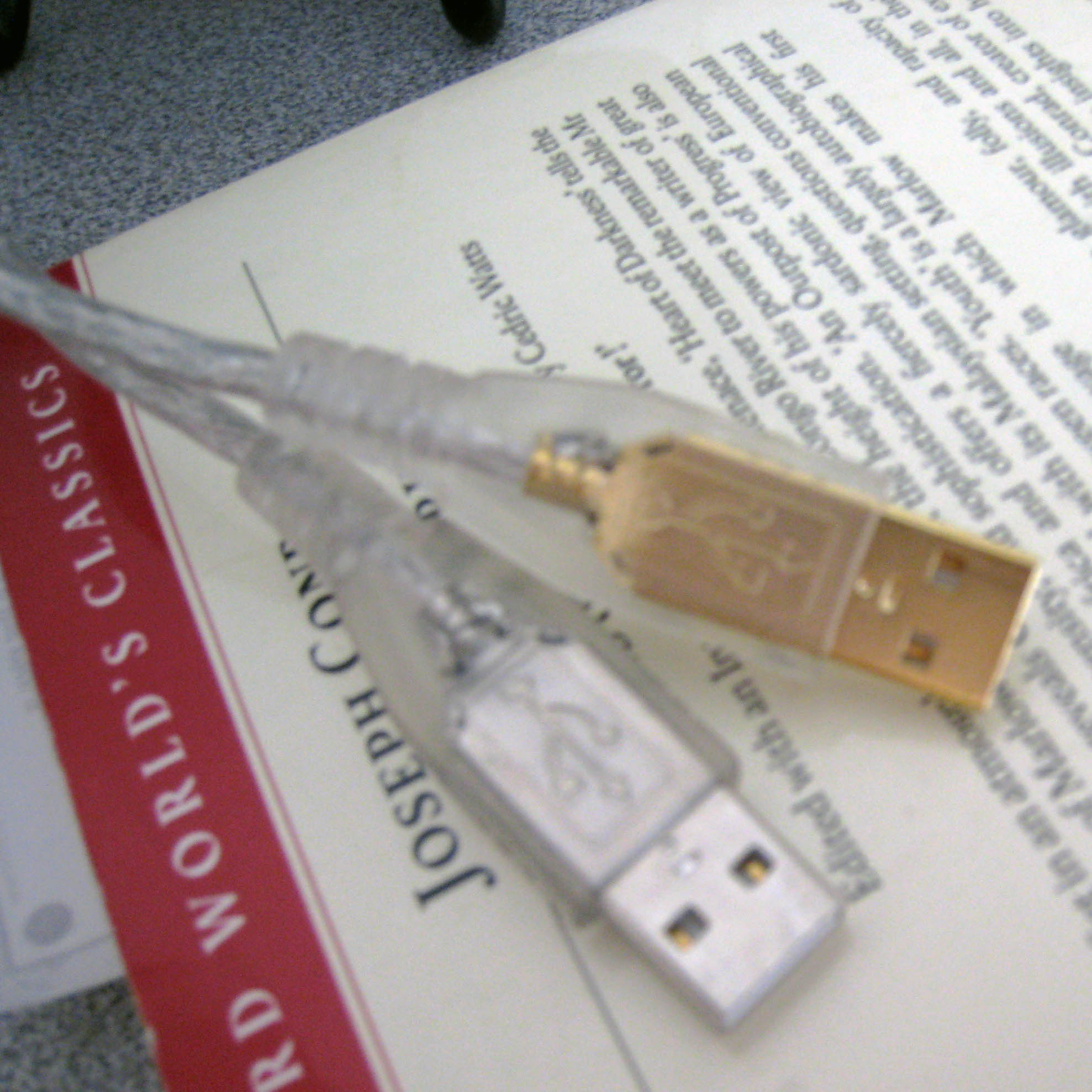
Version 2 still has those problems, although they’re not as pronounced. In an e-mail to me, someone from Matias said that the shadow key problem had been reduced in version 2. The person was right, but it hasn’t been reduced enough. In addition, the USB port situation irritated me—the old version has one cable and two USB ports, one on each side of the keyboard. The new one has a single USB port on the side of the keyboard and two ends, as depicted here:

Matias Tactile Pro USB Plugs

(Notice the background: an Oxford edition of Conrad’s Heart of Darkness and Other Tales.)

This causes me to run out of USB ports on the back of my computer and to have to continually unplug things if I want to download pictures or transfer files to a USB drive. Their marketing materials don’t mention that they’ve lost one USB port on the keyboard. In addition, the one I received has keys much looser than my previous Tactile Pro—it feels flimsier and doesn’t have the same satisfying action with each keystroke. The front edge was also malformed, as this picture shows, though not perfectly:

The deformed edge of the keyboard

I was tempted to return mine and ask for a replacement unit, but after reading this thread on Ars Technica and the previously mentioned Bronzefinger review I decided not to bother. I’d rather just have the money back, and one thing Matias does offer is a 30-day money-back guarantee. I’m sure that the writer of Bronzefinger and I are not the only ones to have made use of this policy. The keyboard feels more like something hacked together by electrical engineering students one weekend or a science fair project.

What went wrong? I have no idea. I’ve heard engineering friends say that late projects seldom bode well for the finished project, which is more likely to turn out poorly because the delay manifests underlying problems; I’ve read similar things on Slashdot, for what their opinion is worth. The Matias Tactile Pro 2 was supposed to ship in March, but the initial batch didn’t arrive until, as far as I could tell, June, and the one I bought came from the second run that shipped in September. If Matias hasn’t worked the kinks out yet, I’m not sure they will in this iteration. In the meantime, those interested in a better keyboard might want to try and snag a used Tactile Pro 1 or a reborn Model M. The Tactile Pro 2 does have a few stronger points, like an optimizer feature that allows one to change the keyboard layout, but its benefit is minor compared to the keyboard’s drawbacks.


In other technology news, Apple just announced the latest versioqn—excuse me, version—of OS X, Leopard. I’ve also started using iWork, and especially Pages, for some of my writing. Pages simply looks nicer than Word, even if Pages is still missing many features.


EDIT: I posted a review of the Customizer, which is the new version of the Model M mentioned above.

Doris Lessing and the prize

As many of you probably know by now, Doris Lessing won the Nobel Prize in literature. Unfortunately, my knowledge of her is as follows:

Still, I’m heartened by and want to read Lessing’s novels because of an op-ed in The New York Times:

It is one of the paradoxes of our time that ideas capable of transforming our societies, full of insights about how the human animal actually behaves and thinks, are often presented in unreadable language.

[…]

A very common way of thinking in literary criticism is not seen as a consequence of Communism, but it is. Every writer has the experience of being told that a novel, a story, is “about” something or other. I wrote a story, “The Fifth Child,” which was at once pigeonholed as being about the Palestinian problem, genetic research, feminism, anti-Semitism and so on.

A journalist from France walked into my living room and before she had even sat down said, “Of course ‘The Fifth Child’ is about AIDS.”

An effective conversation stopper, I assure you. But what is interesting is the habit of mind that has to analyze a literary work like this. If you say, “Had I wanted to write about AIDS or the Palestinian problem I would have written a pamphlet,” you tend to get baffled stares. That a work of the imagination has to be “really” about some problem is, again, an heir of Socialist Realism. To write a story for the sake of storytelling is frivolous, not to say reactionary.

I very much want to keep quoting, but if I continue I’ll copy the whole thing. It also marks her side on a list I’ve started keeping, with writers who believe in art for art’s sake on one side (some Romantic poets, Lessing, T.S. Eliot, Nabokov) and art being inherently political on the other side (many academic literary critics, Orwell). The debate is unending, and I fall more toward the art for art’s sake end of the spectrum.

In addition to Lessing’s piece, read Christopher Hitchens’ comments about this year’s choice in Slate. Hitchens is right about the many weak picks in the Nobel Literature prize, but he goes too far by calling many “time-servers and second-raters.” Then again, if he didn’t go too far he wouldn’t be Hitchens.

More on the Industrial Revolution: or why I post in and read English

The Pursuit of Glory: Europe 1648 – 1815 repeats a theory that partially contradicts the thesis of Gregory Clark’s A Farewell to Alms. Tim Blanning quotes another historian: “‘France was not disastrously behind [in the 1780s [economically]], and the Industrial Revolution might have taken off there with only a few years’ delay in relation to England. But the “national catastrophe” which the French Revolution and the twenty years war meant to the French economy would intensify the discrepancy and make it irremediable'” (the outer set of brackets are Blanning’s, the inner mine). The French were hobbled by wars and revolution around the period of the Industrial (R)evolution, preventing them from exploiting the inventions of the time or developing the capital stocks to fund industry. Instead, they spent all their public funds on war. Had they not been so focused on war, England might not have been the big winner in technological and other terms. Clark argues that English cultural and possibly genetic evolution were the primary causes of the Industrial Revolution’s occurrence in England, but he doesn’t give enough credence to or effectively rules out other factors like geography or politics.

A longer post on Blanning is coming.


Edit: In addition, Blanning implicitly criticizes writers like Clark: “Indeed, the idea of a revolution occurring in the economic history of the world, which then affected every other aspect of human activity […] was given a new lease of life in the middle of the twentieth century.” In other words, Big Ideas like Clark’s are a relatively recent product, and they go back a long way—each one discrediting or changing the one prior.

Good advice for writers

Mark Sarvas writes in The Elegant Variation regarding edits: “[…]I’ve learned to remove ego from the equation in these settings.”

Wise words concerning writing—I try to accomplish the same in my work. Although I’m not a novelist, I am a writer and most clients are unfamiliar with the writing process. When relationships or assignments sour, it’s often due to ego problems that are avoidable.