Media myopia and the New Yorker

A month ago, the New Yorker published an article called “Out of Print” that shows the collective problems of the newspaper and larger media industries, which has been a regular topic in the industry itself, online, and elsewhere. I’m not one of these awful “bloggers will replace the media” types, chiefly for what, as the article says, “[…] the parasitical relationship that virtually all Internet news sites and blog commentators enjoy with newspapers.” You might notice that I’m linking to a magazine.

Still, I sent this letter to the editor, which went unpublished:

That “Newspaper companies are losing advertisers, readers, market value, and . . . their sense of mission at a pace that would have been barely imaginable just four years ago” shows the industry’s collective myopia in the face of rapid technological evolution (“Out of Print,” March 31st). As a high school senior in 2001 – 2002, I was the co-editor-in-chief of my high school newspaper and seriously considered picking colleges based on their journalism programs, but even then it was obvious to me that the Internet would make journalism at best a tenuous career choice. From my perspective, the pace of change was entirely imaginable, and I shifted my academic priorities because of it.

Now I write a book blog. Although it is not professionally edited, it is one of many blogs supplementing or supplanting traditional book review sections that have been heavily cut by newspapers. My life is a microcosm of the problems being experienced by traditional print media.

Normally I like to hear about typos and amend them silently. But if there’s one in this particular blockquote—be silent! It’s too late!

On writing in art museums

I’m not the only one who has apparently noticed the poor writing in many art museums. The Wall Street Journal writes:

When the show opened last month, artist and critic Carol Diehl blogged about the “impenetrable prose from the Whitney Biennial.” As examples, she offered “random quotes” about individual artists and their work taken from the exhibition’s wall texts and catalog. Among the gems:

• “. . . invents puzzles out of nonsequiturs to seek congruence in seemingly incongruous situations, whether visual or spatial . . . inhabits those interstitial spaces between understanding and confusion.”

• “Bove’s ‘settings’ draw on the style, and substance, of certain time-specific materials to resuscitate their referential possibilities, to pull them out of historical stasis and return them to active symbolic duty, where new adjacencies might reactivate latent meanings.”

Ms. Diehl’s complaint was quickly taken up by others. Richard Lacayo, on a Time magazine blog, likened reading the show’s introductory wall text (“Many of the projects . . . explore fluid communication structures and systems of exchange”) to “being smacked in the face with a spitball.” To combat such verbiage, he recommended banning five words long popular with critics that nonetheless say nothing: “interrogates,” “problematizes,” “references” (as a verb), “transgressive” and “inverts.”

This is nothing compared to the placards at the Experience Music Project in Seattle, which, at least when I visited two years ago, were so vapid as to make me wonder if they’d been written by a high school intern. I wish I’d kept some examples.

More on Richard Price from the NYRB

Michael Chabon opines on Richard Price in the New York Review of Books. As usual regarding that publication, the essay is too long and digressive, but it’s worth reading anyway. A sample:

Lush Life is a good, worthwhile, and in many ways satisfying novel. No matter how routinely and highly praised it may be, Price’s ear for dialogue, his ability to capture and reproduce the rhythm, tone, and evanescent vocabulary of urban life, cannot be overpraised: with all due respect to Elmore Leonard, Price is our best, one of the best writers of dialogue in the history of American literature. Resorting with miraculous infrequency to the use of dialect spellings and other orthographical tricks, Price gets his characters’ words to convey subtle nuances of class, occupation, education, even geographical gradations of neighborhood, while also using them as a powerful vehicle for the transmission, in fits and starts, evasions and doublings back, of their interior lives. He is a perfect magpie for slang, and like its predecessors this novel is rich in fascinating bits of law-enforcement and street-criminal argot.

I’m on the record praising Lush Life. I still hold that Leonard is the better dialog writer, however, although Chabon’s position is entirely defensible. And I also hold that you don’t need to spell “dialog,” “dialogue.”

Harry, Revised arrives

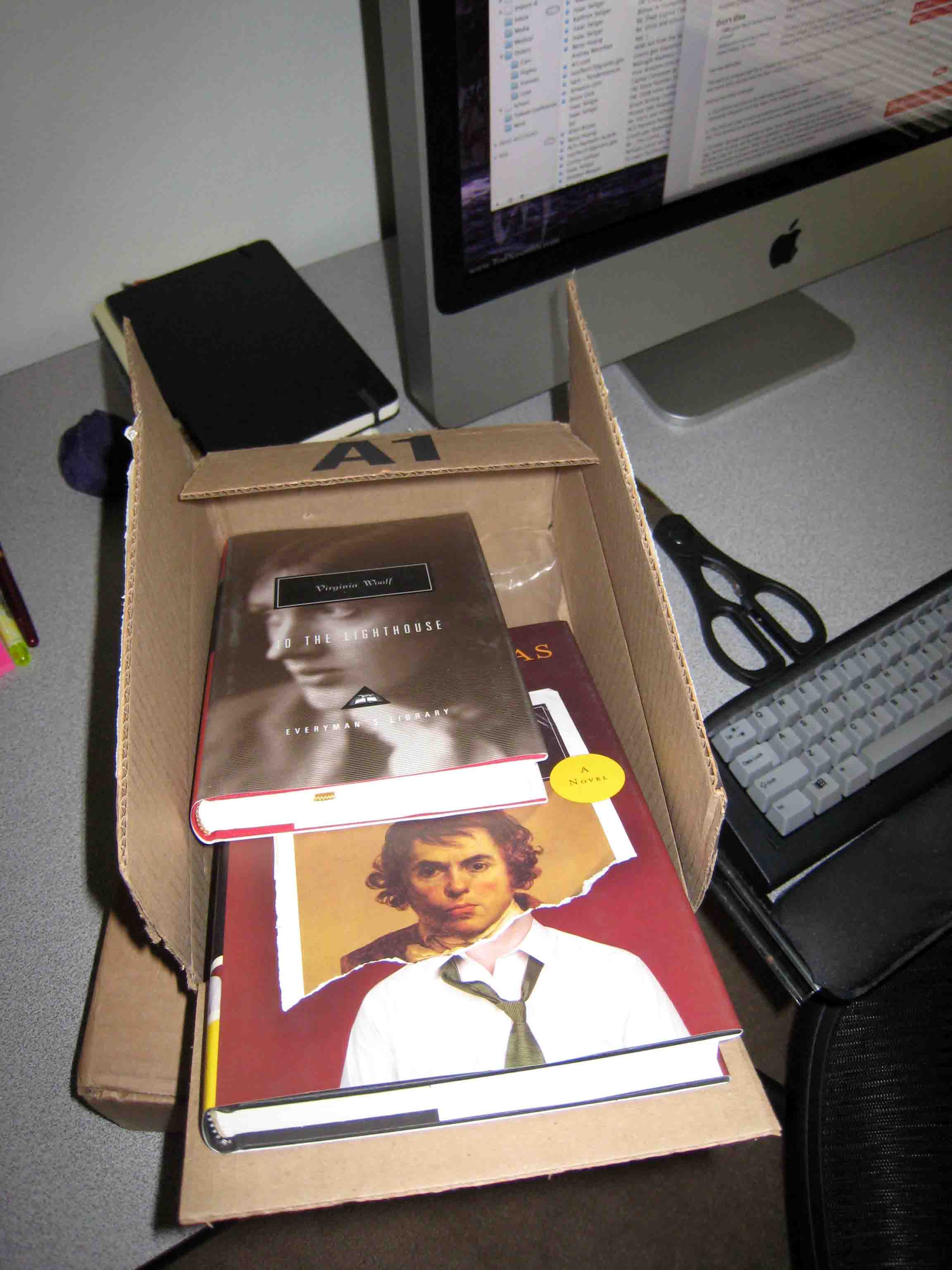
I’m finally back from Vermont and Massachusetts and in shape to work again: Alaska Airlines cancelled my Wednesday flight and left me stuck in a Boston hotel Till Thursday. The good news, however, is that I found Mark SarvasHarry, Revised:

In good company, of course.

He’ll be in Seattle on May 8 at the University Bookstore—7:00 p.m. Expect to see us there!


EDIT: I wrote a full review of Harry, Revised here.

A new feature: papers

On the menu bar, there is now a section called “papers” that contains complete copies of academic papers presented at conferences or submitted for publication. The first entry is for The Paradox of Power and Defining Good and Evil in The Lord of the Rings.

A Confederacy of Dunces

One good link deserves another: I mentioned a Cynthia Crossen column in my post on The Red Leather Diary. A few weeks ago, however, she wrote about the binary views John Kennedy Toole’s A Confederacy of Dunces inspires:

I managed to get through 100 pages before I let myself off for time served. My sides didn’t split, my belly didn’t ache, my eyes didn’t water. With its wooden dialogue, one-ply characters and a plot as twisty as a clothesline, “A Confederacy of Dunces” left me wondering who were the dunces on the Pulitzer jury in 1981.

Some readers had predicted I might not appreciate Mr. Toole’s humor. James Mosrie of West Palm Beach, Fla., wrote, “In my experience, people either love or hate this book. I can never quite gauge what reaction they will have because I’ve known people of so many varying types and tastes be so extreme with their views on the book.”

Another reader wrote, “This may be the most polarizing book of all time. I know approximately 15 people (counting you) who have read it. Without exception, the book has either (a) immediately entered the reader’s “top-five all-time” list or (b) so turned off the reader that they couldn’t finish it. For whatever reason, there is no middle ground with this book.”

I’m in category (b): I tried to read A Confederacy of Dunces, saw nothing redeeming, and couldn’t finish it. Like Crossen and Terry Teachout, however, I wish funny books got more literary respect, especially because some of my favorite novels include Richard Russo’s Straight Man, Rebecca Goldstein’s The Mind-Body Problem, Elaine Dundy’s The Dud Avocado, and Kingley Amis’ Lucky Jim. Only one of those makes it on Crossen’s list of recommended funny books, which appears at the bottom of her column.

It’s Not You, It’s Your Books

I’m sure that by now every book blogger has linked to It’s Not You, It’s Your Books in The New York Times. It’s hilarious, and I essentially agree with Beverly West except with the genders reversed:

After all, women read more, especially when it comes to fiction. “It’s really great if you find a guy that reads, period,” said Beverly West, an author of “Bibliotherapy: The Girl’s Guide to Books for Every Phase of Our Lives.”

Finding someone who likes to read is one way of avoiding the bigger problem discussed in the next paragraph:

Still, to some reading men, literary taste does matter. “I’ve broken up with girls saying, ‘She doesn’t read, we had nothing to talk about,’” said Christian Lorentzen, an editor at Harper’s. Lorentzen recalls giving one girlfriend Nabokov’s “Ada” — since it’s “funny and long and very heterosexual, even though I guess incest is at its core.” The relationship didn’t last, but now, he added, “I think it’s on her Friendster profile as her favorite book.”

Nabokov seems like a needlessly high test of literary taste, like demanding that a significant other not only be athletic, but participate in marathons. The purported link between fiction and empathy deserves a note too, since it might be used to justify otherwise almost sadistic requirement for literary knowledge and pleasure.

It's Not You, It's Your Books

I’m sure that by now every book blogger has linked to It’s Not You, It’s Your Books in The New York Times. It’s hilarious, and I essentially agree with Beverly West except with the genders reversed:

After all, women read more, especially when it comes to fiction. “It’s really great if you find a guy that reads, period,” said Beverly West, an author of “Bibliotherapy: The Girl’s Guide to Books for Every Phase of Our Lives.”

Finding someone who likes to read is one way of avoiding the bigger problem discussed in the next paragraph:

Still, to some reading men, literary taste does matter. “I’ve broken up with girls saying, ‘She doesn’t read, we had nothing to talk about,’” said Christian Lorentzen, an editor at Harper’s. Lorentzen recalls giving one girlfriend Nabokov’s “Ada” — since it’s “funny and long and very heterosexual, even though I guess incest is at its core.” The relationship didn’t last, but now, he added, “I think it’s on her Friendster profile as her favorite book.”

Nabokov seems like a needlessly high test of literary taste, like demanding that a significant other not only be athletic, but participate in marathons. The purported link between fiction and empathy deserves a note too, since it might be used to justify otherwise almost sadistic requirement for literary knowledge and pleasure.

Charles Bock in Seattle and Beautiful Children

Charles Bock was more fun to hear speak than to read; alas, I began Beautiful Children with anticipation that went unfulfilled. Problems manifested early: descriptions of video games modeled on Doom sounded vaguely off, and I’ve never seen “hard drives the size of mini-fridges.” Yet I could ignore linguistic problems when I find also find a perfect description of many would-be artists: “He had aspirations to nothing less than the creation of sensitive, artistic, emotionally honest pictures that, just maybe, would get him laid.” In another section, evocations of common ground seem strained, as when the father of lost boy Newell Ewing says that “He got […] trapped in another Politics of Marriage Conversation.” Status is everywhere in Beautiful Children, but more often stated than shown, or shown via consumption. But whenever I was about to stop reading, I’d find something like this:

Propped up against the base of the casino wall like an abandoned doll, the body was bulky in places, but still frail enough to look as if it might be carried along by a good wind. Electricity glossed over its mess of hair—kinked and matted strands of indistinct, artificial colors, clumped in all directions.

Er: it’s almost right, but “electricity” feels wrong because it’s not electricity but electric light that illuminates hair. This is a microcosm of Beautiful Children: it feels like it should be more right than it is. Clichés distract—someone “was bleeding like a stuck pig” and elsewhere a stripper named Cheri goes on “about character arcs and emotional journeys until the friggin’ cows came home.” Perhaps this is how the character would think, but the problem of how banal, uneducated characters think and speak versus the literary needs of the author is never really resolved*. If teenagers sound like teenagers they’re often boring or vapid; if they sound like adults, they don’t sound real. If there is a satisfactory solution to this problem, it is not obvious in Beautiful Children; in other novels it involves a “precocious” or abnormally literary narrator. Instead, Beautiful Children opts for long transcriptions of teenage argot that eventually had me flipping pages in a quest for substance. It was hard enough to find when a character thinks, “You cannot possibly fathom an end to your observations about the status of your physical decline, a final finality. Such things are beyond you, as they are beyond anyone; and yet the evidence permeates your days, unavoidably present, oozing from the southwestern decor of a master bedroom […]” I can’t see Robertson Davies going into such despair. Perhaps John Banville would, but much more artfully.

Banville and Davies, however, wrote many novels over the course of their careers, and, at least in Davies’ case, his early novels were not as masterful as his later ones. Beautiful Children is a first novel that Bock says took 11 years to write and, presumably, publish, and I can’t help but thinking he would’ve been better served to finish it or have otherwise built his skills elsewhere. Beautiful Children is not a bad novel and perhaps it is even good, but not 11 years good. It has an admirable range of cultural references, from Blake to The Outsiders (a “young adult” novel assigned to me in middle school) to visual media detritus. Like Richard Price’s Ladies’ Man, Beautiful Children heralds better things to come. Now that Price comes to mind, Lush Life covers ground not dissimilar from Beautiful Children and does it better. And he wrote it in four years. Bock said Beautiful Childrentook so long because it was an “ambitious book, and I just didn’t know what I was doing for a lot of it.” Many novels gestate for a long time, and he rattled some off: Catch-22 stayed with me, but there were many others. Alas, I don’t think Beautiful Children will have the lasting power of Catch-22 or Carson McCullers’ The Heart is a Lonely Hunter, another superb first novel. And in those novels, I doubt anything is “unceremoniously rejected,” as something is at the beginning of 3.3 in Beautiful Children.

Bock seems to have better novels in him; in Seattle, he said, “[Beautiful Children is] a dark book, but I believe the darkness is there to illuminate some of the wonderful parts of humanity […] also, I think there’s some pretty good jokes in there too.” There are, and he was wonderfully candid when someone asked why the dialog seemed so good and, by implication, authentic: “I have no idea.” Although he elaborated, I suspect the real truth came first. Still, I’m not sure I agree with the premise of the question: sometimes the dialog clicked and sometimes not, like much of the rest of the novel.

In another answer, Bock said he used Ponyboy because he’s an “iconic young adult character” and that he intentionally “recycles—Vegas is a place where they fake the Eiffel Tower and the great monuments of the world and turn them into casinos.” There is “no end to the uses of pop culture,” though he tries not to name drop. The recycling theme is heavy in Beautiful Children and perhaps a topic for some future graduate student. Today, someone looking for pleasure and depth could do worse than Beautiful Children—but they could do better. In “Books Briefly Noted,” the New Yorker has its own take on the novel’s problems, starting with praise and then moving to: “Yet [Beautiful Children] doesn’t quite achieve its intended emotional resonance; there is too much shaky dialogue and improbable Vegas kitsch (breast implants with candle-wax-filled nipples, for a pyrotechnic striptease), and the boy at the center of the plot is thinly drawn and so obnoxious that his disappearance is not unwelcome.” I read “Books Briefly Noted” after writing the first draft of this post, and realized that I structure my commentary the same way the New Yorker did its.


* The best description of I’ve read of this issue comes from James Wood’s How Fiction Works.